“Change is inevitable” is true, of course. But sometimes those words can be cruel and thoughtless, I’ve found, when they’re used as a rejoinder to us history types whose mission is to remember the past. It’s not that we want the past back—you can have your Bubonic Plague, for example.
What we want instead is that the past, and its people, have the chance to live on in memory, even in the second-hand memories of young people like the ones I taught.
And sometimes the past doesn’t smell good (the Thames in mid-Victorian London), doesn’t look good (a Klan Parade down Pennsylvania Avenue in 1926) or doesn’t sound good (the premier of Stravinsky’s Firebird. Sorry. I probably would’ve booed, too, but I like Beach Boys harmonies and Strauss’s Emperor’s Waltz. I am admittedly bourgeois.)
But sometimes the past is a place of comfort in a time of intense discomfort. Oh, hypothetically, like today. Even if change is inevitable, brief backward visits are harmless. They can even be sources of strength. I’ve been thinking that way the last few days about another visit to the past, in writing about the film The King’s Speech.
But since it’s Christmas, I’m not going to discuss George VI. Instead, I of course thought of the Santa at Riley’s Department Store at Marsh and Chorro in San Luis Obispo. Change there, in San Luis, is not only inevitable, it’s constant and fickle and remorseless. Now I get lost in what was once the big city of my childhood. What was a burger place ten years ago and a brew pub five years ago is now a Paraguayan Fusion restaurant today.
It’s bewildering. As much as I have always loved San Luis, I don’t go there very much anymore. (Note that I was restrained enough not to bring up the parking. Oh, damn! I just did.)
Since I was raised in the Upper Arroyo Grande Valley, San Luis was the Big City to me. Its bigness was superseded by by San Francisco’s. My Dad put us up in a high-rise hotel there when he was bidding a job for Madonna Construction, and a rare lightning storm was flitting about the skyscrapers. This is how I fell in love with the city I’ve loved ever since. But San Luis Obispo remains important to my life, and Riley’s is part of the reason why.
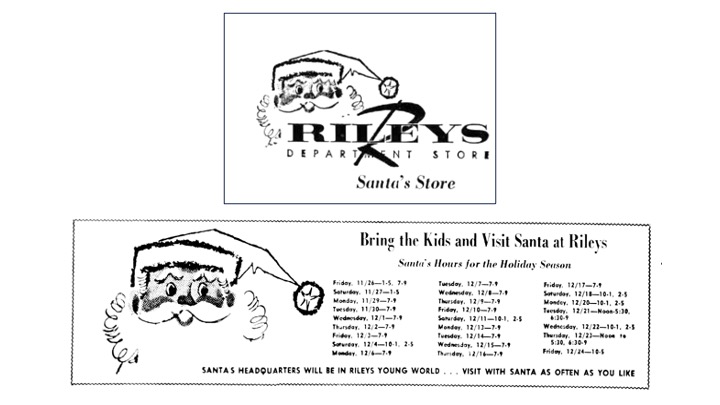
The ad above is from 1965, when I was a bit old for Santa, but I can remember visiting him once or twice in the years before, atop the mezzanine staircase inside the department store. He had a red crushed-velvet suit and his beard, fake or not, was immaculate. He was appropriately but not terrifyingly jolly. Even in 1965, when I was thirteen, I still liked seeing him up there in his chair with the line of kidlets waiting their turns.
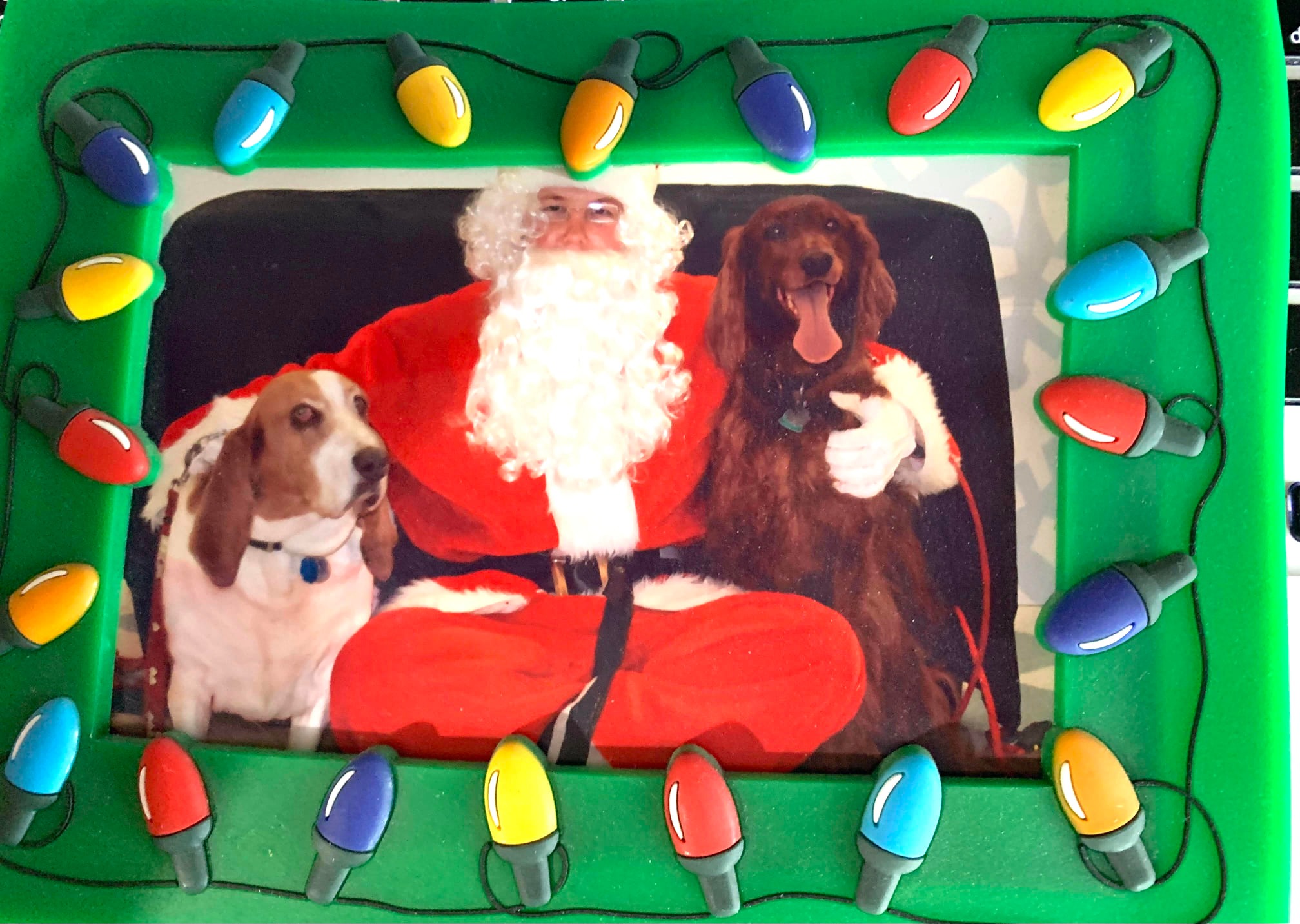
Many years later, the closest approximation of that Santa, in spirit, came at a local pet store (In Santa Maria. Sigh.) when our late and dearly beloved dogs, Wilson the Basset and Mollie the Irish Setter, got to visit this Santa. In reality, “Santa” was a former student of Elizabeth’s at St. Joseph High School, and this may be my favorite Santa photo of all time.
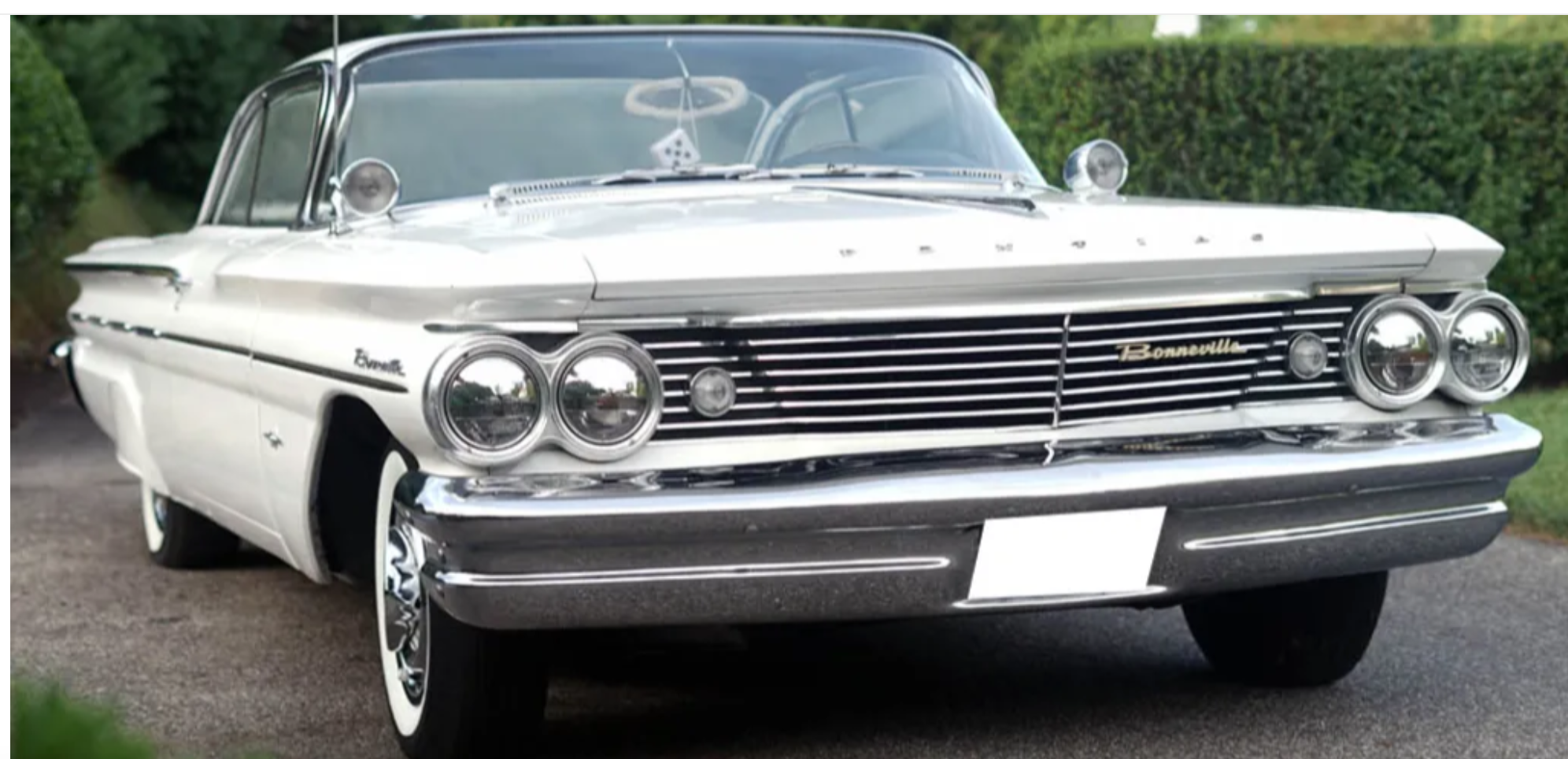
Riley’s Santa was enthroned in this building, shown off in this October 1955 full-page ad in the Telegram-Tribune, just completed by another San Luis institution, Maino Construction:
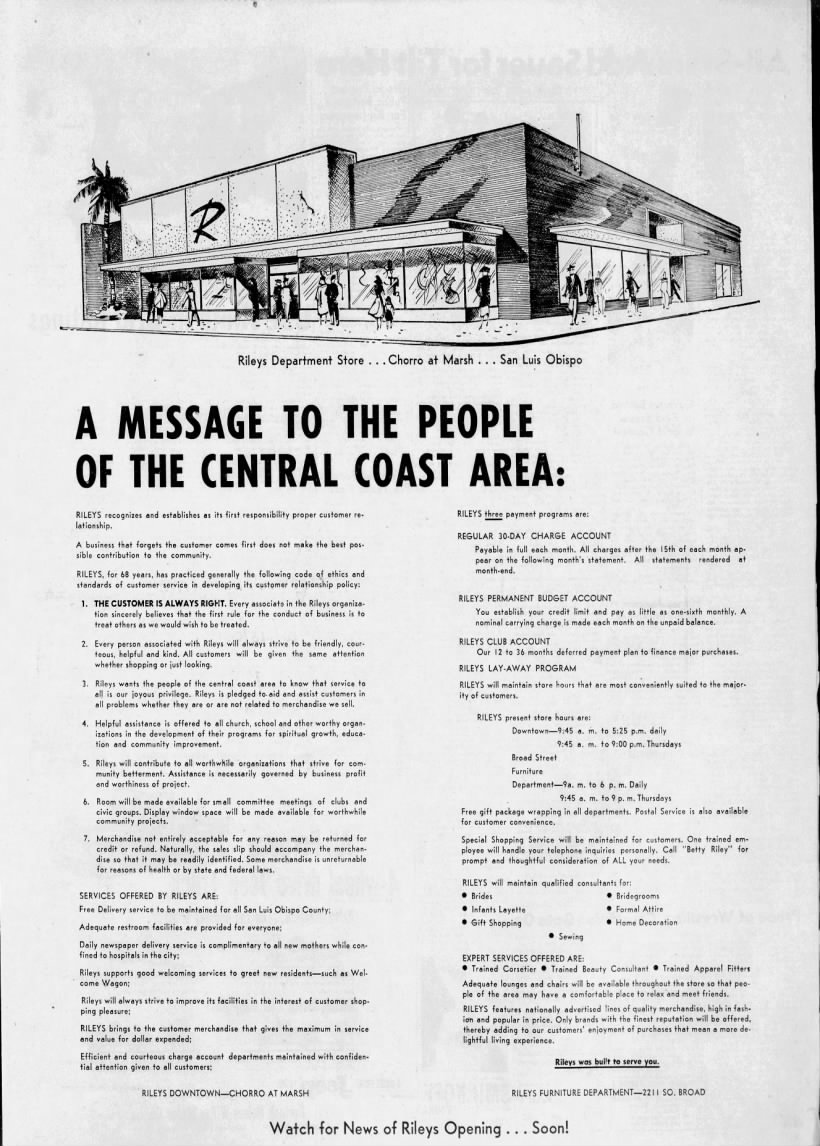
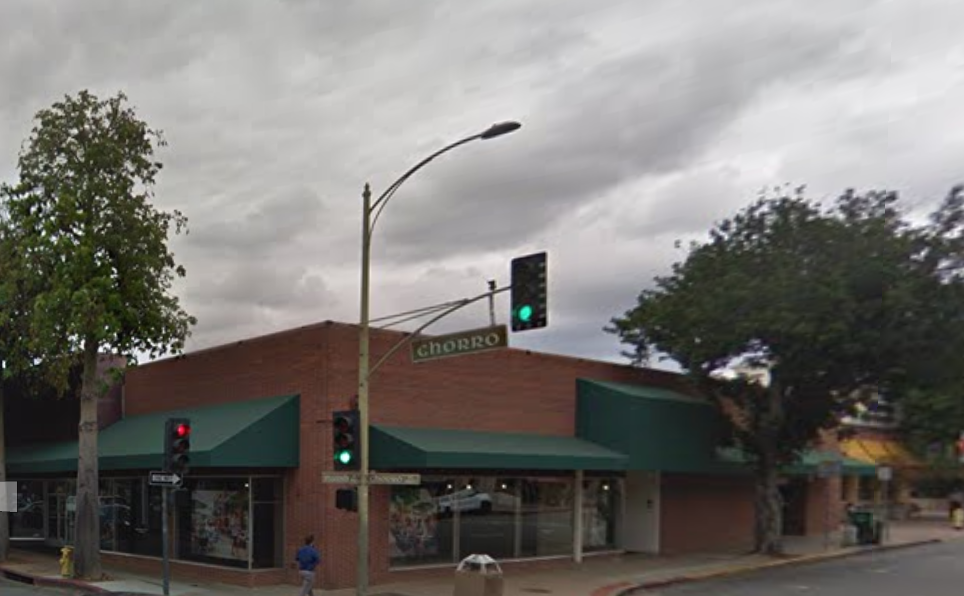
And if change is inevitable, it’s also depressing sometimes. Chorro at Marsh today is, and has been for years, empty, a discrete bit of urban blight on a street corner where, holding my Mom’s hand as a six-year-old in an earlier Christmas, my heart quickened when we crossed Marsh to go inside Riley’s.
The ad’s a little misleading. This wasn’t the grand opening of Riley’s—just this incarnation of Riley’s. That department store, under one name or another, had been a San Luis Obispo fixture since the 1880s. It got its final name in 1914:
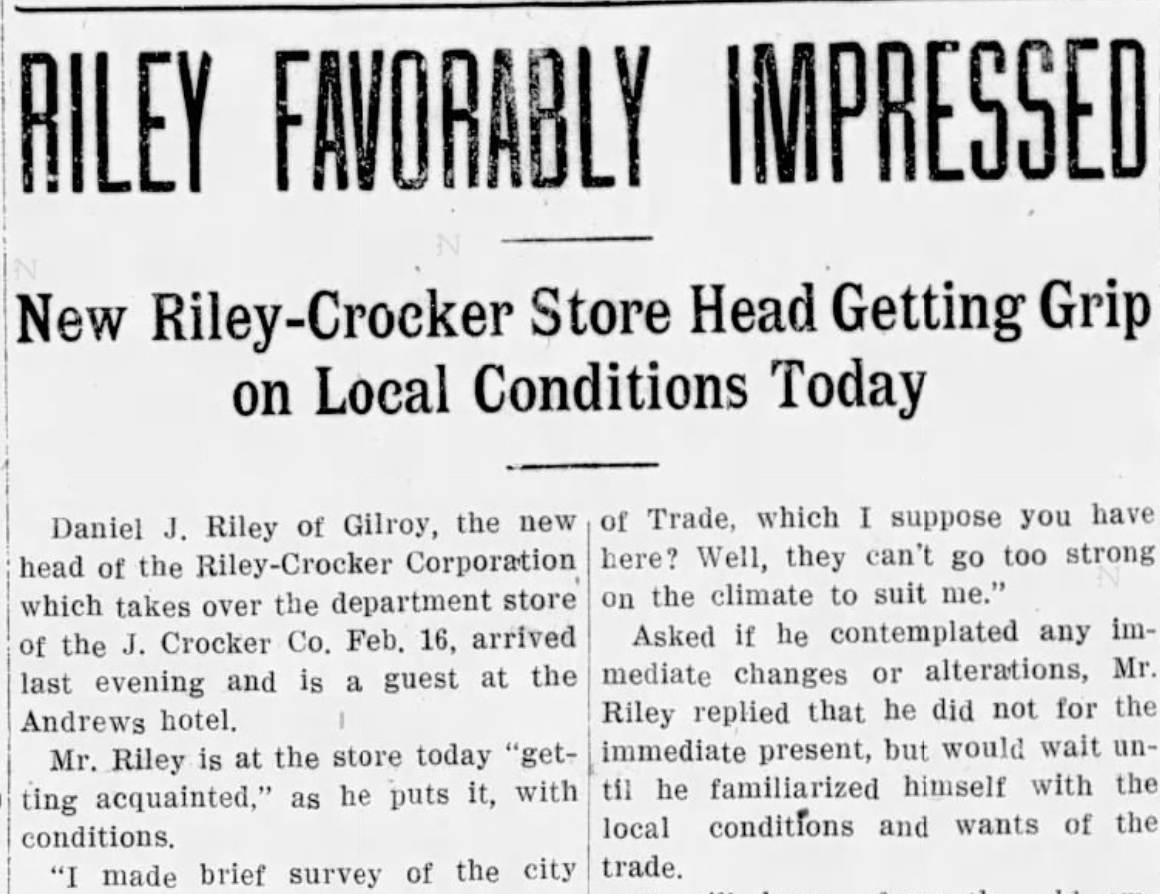
And change, in this case, a new store name, can be good. Note that Mr. Riley is staying at the newish Andrew Hotel, at the site of today’s city-county library. Nearby, in the 1890s, a bawdy house called The Palace fulfilled the carnal needs of the gandy dancers working the Southern Pacific as the track neared town. The Andrews represented the beneficial side of Progress, such a nice place that evangelist Aimee Semple McPherson once spent the night there with her lover, also her radio engineer, as the couple fled Los Angeles for what the papers called “a love nest” in Carmel.
Mercy!
I’ve written about the Perfume Ladies before, but Riley’s brought class to our area, too. Once we’d crossed Marsh and entered the store, the first sales area to the right was the perfume counter, my Mom’s favorite (Chong’s Candy was ours). The beautiful Perfume Ladies worked behind the counter there–classy, a a little reserved but also attentive to the point of devotion to my Mom. When she tried out a scent with a brief spray to her wrist, I asked for one, too. By the time she’d made her purchase from the Perfume Ladies, I must’ve smelled like the reception parlor for the girls who’d once worked The Palace.
Riley’s is also where Mom did a lot of her Christmas shopping, in those pre-Amazon days, when the only thing that “Bezos” suggested was a river in Texas with a similar name. Once she’d made her purchases, the sales clerk wrote them up, rolled the receipt into a canister that was inserted into a pneumatic tube (like the one at the Telegram-Tribune where I’d insert my story to go down to Composing) and shtoop! it would vanish. After a brief wait, shtoop! Mom’s carbon copy would return. It was pretty cool then, when i was five. Now that I am nearly seventy-two, it still is.
Riley’s closed in 1993, and this story by my friend Carol Roberts and this photo by my friend David Middlecamp are evocative of the response:

The story focuses on the employees—I’ve been lucky enough to work at places like this—who were also like a family. The grief didn’t end with them. San Luis Obispoans were heartbroken, too. There were weeks of Letters to the Editor mourning Riley’s. (More recently, I wrote in a similar way about the closing of the burger/beer/country-line dance/Minor Madness venue The Graduate, where my wedding’s best man, Rob, and my AGHS colleague and friend, Randy, were once bouncers.)
Change is inevitable. That’s why it hurts so damn much. And I guess it hurts in this case because I associate Riley’s with my mother, who remains the most influential person in my life. This photo, sadly creased for many years, shows twenty-two-year-old Mom with my big sister, Roberta, in 1942.

Mom died when I was seventeen, and I still miss her. But thinking about places like Riley’s brings her closer. San Luis Obispo when I was a little boy—the Sno-White Creamery and its milkshakes, the way pipe tobacco smelled in the smoke shop that was once the Cigar Factory, the way you raised the miniature Bear Flag at your table in Corcoran’s when you were ready to order lunch, the severe steel bun in Mrs. Avila’s hair (the lady underneath was not so severe) at the City-County library, today, the Repertory Theater–we are a bookish bunch, and visits to the library were always good for at least an hour and more often two— and, finally, the way my Mom was treated when she shopped for Dad at Rowan’s, a memory that was so powerful that the late (great) journalist Don Pieper was kind enough to quote me in his early 2000s column, which also cites another journalist, Wally Conger, my friend and colleague from the AGHS newspaper, The Altair:
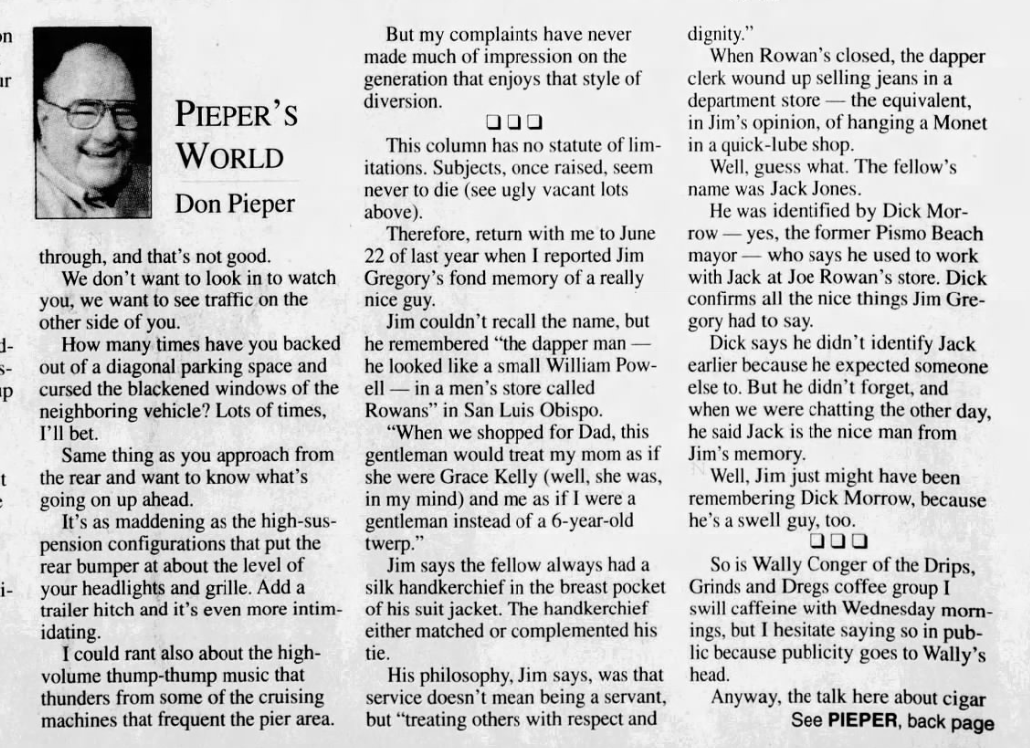
I know that I am a land line in an age of cell towers. I don’t mind that much. But I still believe that the past deserves to be remembered, even in the face of constant change, with the same attributes Dick Morrow and the Perfume Ladies conferred on my Mom—with dignity and respect.
 A Work in Progress
Loved this one, Jim. Nice to take a trip down memory lane touching base with all those places you mentioned in the article. Brings back memories so deeply ingrained in my being that in just thinking about them I can hear sounds and smell the unique aromas associated with each. Mr. Chong’s high voice welcoming in to the candy store along with the smell of his candies. Lots of times when we students at Mission Central Catholic HS we’re heading en masse over to Mass at the Mission, old Mr. Chong would squeakily chuckle as he allowed me and a couple of buddies to crouch down while the rest of the students filed by. When the coast was clear he’d give us a wave and we would race down to Staggs pool hall for 45 minutes of 9 ball. I can still remember the smells of stale beer and cigar/cigarette smoke as we walked in. The old one armed pool shark who ran the place was a guy named Emo and we had learned long ago not to let him challenge us to a game for money. The guy was the very definition of a pool shark! When it was close to the “Ite missa est” part of Mass we would damper back to Chong’s, crouch behind the counter and , on Chong’s signal, slide back into the crowd of students heading back to school for lunch.
LikeLiked by 1 person
AWESOME, Cary! What memories!
LikeLike
Cary, I was one year behind you at Mission, and your good friend. Monterey St. still went in front of the Old Mission and we would jump behind parked cars, wait for the coast to be clear and then head down to Stag’s Billiard Parlor. Emo and Benny were there controlling things for the owner, Ben. Fun times.
LikeLiked by 1 person