
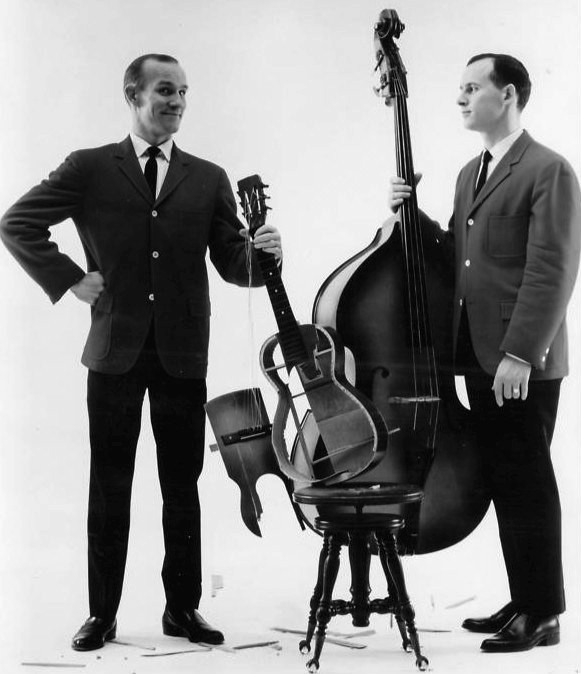
The loss of comedian/musician/yo-yo artist par excellence Tommy Smothers reminded that their act, which began at San Francisco’s Purple Onion in 1959, was part of a marvelous revival of folk music in the late 1950s into the mid-1960s.
By 1960 my big sister, Roberta, was at Cal Poly. There was a popular television show, Hootenanny (1963-1964) that showcased folk music, and Mom, Roberta and I loved it. I think several events converged to create the rediscovery of our music, including the idealism of young people (e.g. The Peace Corps) sparked by a youthful president, John Kennedy.
Some of those young people belonged to the so-called Silent Generation, kind of taken for granted, sandwiched as they were somewhere in between the World War II generation and the Boomers. Folk music, I think gave them a voice and a way to assert themselves.
The Civil Rights movement was a key factor, too, because so much music in the genre has it roots in the South and in the experience of Black Americans.
The gang that brought you films like Best in Show and This is Spinal Tap also did a wicked sendup of the times in A Mighty Wind, but I perceived, just beneath the wickedness, a hint of nostalgia. The creators of the film series and the actors therein—like Michael McKean, Christopher Guest, Harry Shearer, Catherine O’Hara and my favorite, Eugene Levy—were about the right age for Hootenanny. The film ends—a reunion concert featuring three folk groups—with its eponymous song and its tragically obscene and very funny final line:
But putting A Mighty Wind Aside, the Highwaymen’s version of this song remains lovely, I think. The man who first wrote down the lyrics heard South Carolina slaves singing it as they rowed .
Harry Belafonte was both key to the revival and its precursor. We had both of his Carnegie Hall concert albums, both double albums, and played them on the old Zenith cabinet record player so often that I swear you could almost see through them. A wonderful element in those Belafonte albums was their international flavor. The man sang songs from Jamaica, of course, but also from Venezuela, from Israel and, in this example, from Mexico. I love this—a different “Bamba” from Richie Valens’— because Belafonte, maybe the most gorgeous man Our Lord ever created, dances a little, too. (And his Spanish is flawless.)
Another border-transcending song: The lyrics for this 1961 hit by the Tokens—this later version includes The Mint Juleps, from London’s tough East End, and Ladysmith Black Mambazo, from South Africa—were from South Africa in the late 1930s, and they were in Swahili.
The New Christy Minstrels were on Hootenanny regularly and I particularly loved “Green, Green.” The lead singer with the gravelly voice, Barry McGuire, was the most popular Minstrel, but, sadly, he would go on to record “Eve of Destruction,” a review of current events as they were in 1965, and the song conclusion seemed to be that we were all going to die, and pretty darned soon. The Minstrels and the music of their contemporaries was damnably optimistic, which is what made A Mighty Wind so funny.
The absence of that optimism today—and of a healthy sense of national pride—isn’t so funny.
I think I love the images of the kids in the audience, singing along, almost as much as I love the performances. The same goes for this performance, about five years earlier, by Mahalia Jackson, at the Newport Jazz Festival. She is sublime.
Trios were popular, probably the Kingston trio most of all. “Tom Dooley,” about a man about to be hanged, has to be the most depressing song of the folk movement, so let me try M.T.A., which is funny and charming, instead:
The Limelighters (I love me some banjo, prominent in both these trios) perform a song that I’ll always associate with the CBS Baseball Game of the Week, brought to you by Falstaff Beer. When the game got slow or was approaching a blowout, announcer Dizzy Dean (his more restrained partner was Pee Wee Reese) would begin singing this song. Dean, by the way, horrified English teachers when he conjugated verbs, like this one: “HE SLUD INTO THIRD!” And Glenn Yarborough of the Limeliters, on the right, had a voice like syrup and would strike out to make a successful career on his own.
Peter, Paul and Mary were the giant trio of the folkies, and their cover of Bob Dylan’s “Blowin’ in the Wind” perhaps their most prominent hit. But I love the lyrics of this song, from 1966, near the folk revival’s end (Dylan and groups like The Byrds, Buffalo Springfield and The Seekers would keep the tradition prominent in the music they performed), The man who wrote these lyrics became popular just a little bit later, too. He was Gordon Lightfoot.
And, of course, PP and M reminded us of the debt American culture will aways owe to Woody Guthrie. The men’s voices are sweet, but Mary Travers’ voice soars, and you can see its impact in the faces of this audience, older now than they were in 1963, but in this moment young again.
The grandfather of the movement, along with Woody, was Pete Seeger, and much to my delight, Bruce Springsteen revived him, too, with a marvelous recording, “The Seeger Sessions.” This is from a performance in Dublin. Folk music, again, knows no boundaries.
The Smothers Brothers rarely got through a song without an interruption, with a befuddled Tommy getting corrected by the straight man, his brother Dickie. Their act carried over into their CBS television show, which featured guests like Buffalo Springfield and The Jefferson Airplane.
The show was too edgy and too clever for the censors and it was canceled. Vietnam, for example, came up far too often in the dialogues that interrupted their songs. The cancellation was typical of the times, with those in power trying to keep the lid shut on a pot of boiling water. But, of course, the Smothers remained popular anyway. Here they are, more than a few years later, with Tommy reviving another talent introduced during The Smothers Brothers Comedy Hour—his prowess with a yo-yo.
He and Dickie remind me of a time, I guess, when folk music evoked in us a love for our country. The Smothers Brothers loved our country so much that they weren’t afraid to call America out when they believed it to be in the wrong.


Jim and I saw Peter, Paul and Mary at the PAC in the early 2000’s. Having grown up listening to them, and other folk singers, I think I was in tears the entire time. Brought back so many memories.
LikeLiked by 1 person
Understand completely. And Happy New Year, my friends…
LikeLike