
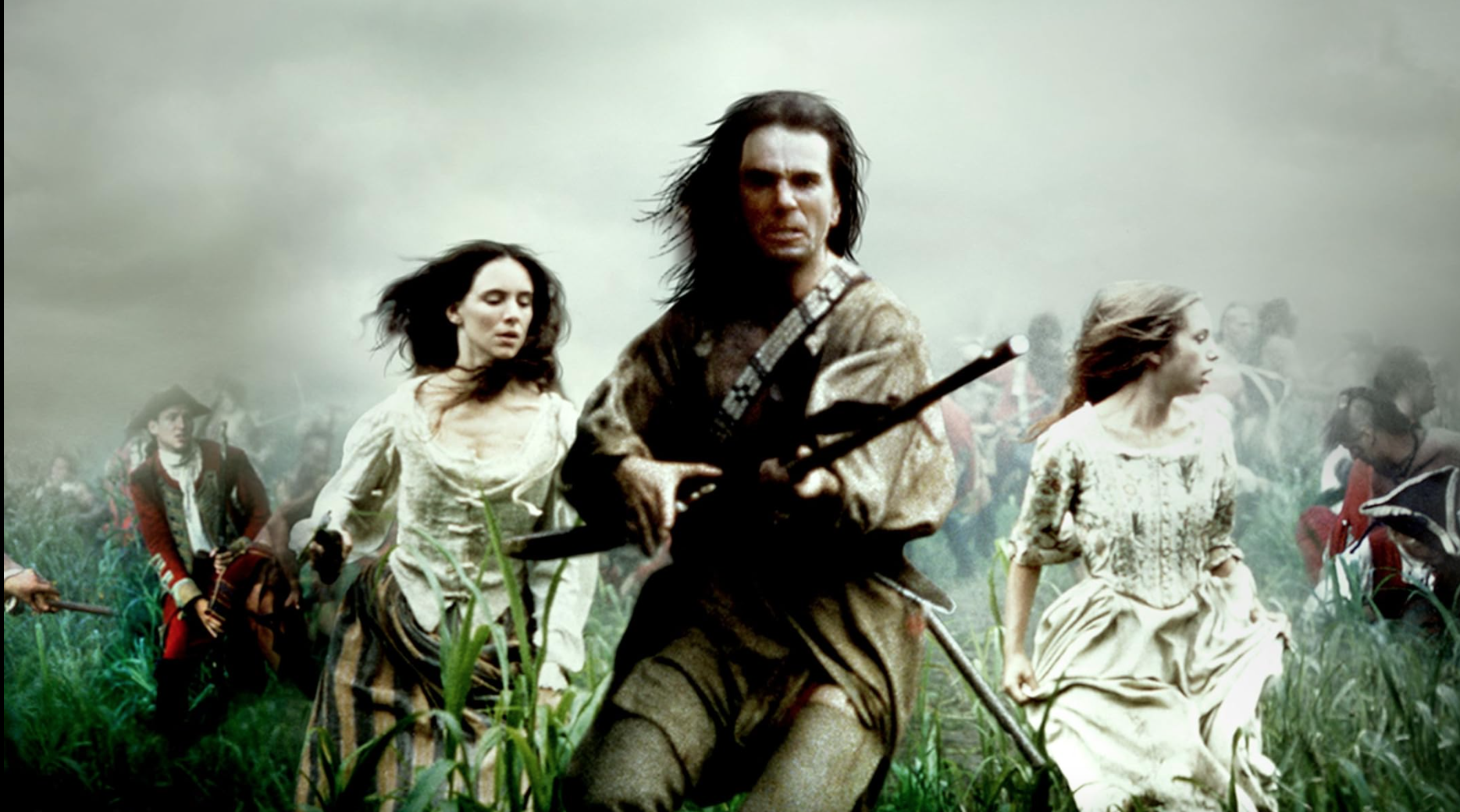
I am sorry, “Moon River” and “The Days of Wine and Roses” and “The Theme from Shaft” AND the Lawrence of Arabia theme. It’s this one, and it can’t even settle on a name. Is it “The Kiss” (it was a humdinger, in the movie) or “The Gael” or is it “Promontory” or is it simply “The Theme from Last of the Mohicans?” I don’t know and it doesn’t matter The melody comes from a Scots songwriter, Dougie McLean, and it was adopted for the 1993 Daniel Day-Lewis film, ever so much better than Fenimore Cooper’s, book by Trevor Jones and Randy Edelman. It brought out both the Irish and the Lowland Scots in me.
There have been so many treatments. Let’s start with a lone piper:
But, heck, why settle for ONE piper when a BUNCH will do? Here are the Royal Scots Dragoon Guards, and you get views of breathtakingly beautiful Scotland. You should not be overly fond of trees, you understand. Cliffs and gorse and heather and the occasional stag the size of an Indian elephant and seaside towns with doorways painted bright red and the smell of beached kelp. That’s more what Scotland’s like. And, if you feel the need to punch out Edward Longshanks, the second, shorter video features pipers at the William Wallace memorial at Bannockburn.
Here we go:
Jenny O’Connor is also called “The Hot Violinist,” which makes me sad, because she is also gifted, and the film’s theme is ideal for the violin
But, true, the same principle goes for violins as it does for bagpipes. Why not a bunch of violins?
Wait! We need more strings! Maybe a cello? The Noricum Group:
A Native American flute. Lovely:
WAIT! Where are the flippin’ DRUMS? Well, for a semi-terrifying take on the theme, here’s Clanadonia:
Whoa. I think I need to chill a little after this version. Let’s try the Prague Film Orchestra:
You may disagree with me on the theme, but the fact remains that the film is far better than the book could ever be. If you doubt that, let me quote from Mark Twain’s delightfully wicked essay, “Fenimore Cooper’s Literary Offenses:”
There are nineteen rules governing literary art in the domain of romantic fiction—some say twenty-two. In Deerslayer Cooper violated eighteen of them. These eighteen require:
1. That a tale shall accomplish something and arrive somewhere. But the Deerslayer tale accomplishes nothing and arrives in the air.
2. They require that the episodes of a tale shall be necessary parts of the tale, and shall help to develop it. But as the Deerslayer tale is not a tale, and accomplishes nothing and arrives nowhere, the episodes have no rightful place in the work, since there was nothing for them to develop.
3. They require that the personages in a tale shall be alive, except in the case of corpses, and that always the reader shall be able to tell the corpses from the others. But this detail has often been overlooked in the Deerslayer tale.
4. They require that the personages in a tale, both dead and alive, shall exhibit a sufficient excuse for being there. But this detail also has been overlooked in the Deerslayer tale.
5. They require that when the personages of a tale deal in conversation, the talk shall sound like human talk, and be talk such as human beings would be likely to talk in the given circumstances, and have a discoverable meaning, also a discoverable purpose, and a show of relevancy, and remain in the neighborhood of the subject in hand, and be interesting to the reader, and help out the tale, and stop when the people cannot think of anything more to say. But this requirement has been ignored from the beginning of the Deerslayer tale to the end of it.
6. They require that when the author describes the character of a personage in his tale, the conduct and conversation of that personage shall justify said description. But this law gets little or no attention in the Deerslayer tale, as Natty Bumppo’s case will amply prove.
7. They require that when a personage talks like an illustrated, gilt-edged, tree-calf, hand-tooled, seven-dollar Friendship’s Offering in the beginning of a paragraph, he shall not talk like a negro minstrel in the end of it. But this rule is flung down and danced upon in the Deerslayer tale.
8. They require that crass stupidities shall not be played upon the reader as “the craft of the woodsman, the delicate art of the forest,” by either the author or the people in the tale. But this rule is persistently violated in the Deerslayer tale.
9. They require that the personages of a tale shall confine themselves to possibilities and let miracles alone; or, if they venture a miracle, the author must so plausibly set it forth as to make it look possible and reasonable. But these rules are not respected in the Deerslayer tale.
10. They require that the author shall make the reader feel a deep interest in the personages of his tale and in their fate; and that he shall make the reader love the good people in the tale and hate the bad ones. But the reader of the Deerslayer tale dislikes the good people in it, is indifferent to the others, and wishes they would all get drowned together.
11. They require that the characters in a tale shall be so clearly defined that the reader can tell beforehand what each will do in a given emergency. But in the Deerslayer tale this rule is vacated.
In addition to these large rules there are some little ones. These require that the author shall:
12. Say what he is proposing to say, not merely come near it.
13. Use the right word, not its second cousin.
14. Eschew surplusage.
15. Not omit necessary details.
16. Avoid slovenliness of form.
17. Use good grammar.
18. Employ a simple and straightforward style.

Here’s the final scene from the film. The big mace is wielded by Russell Means (above), an Oglala Sioux activist who led the occupation of Alcatraz and Wounded Knee to make his people visible again.
The theme is also featured in the stunning opening scene. The animal’s death is heart-breaking, but the foot chase, and the tribute Means delivers at the hunt’s conclusion, ring true.
The “bad guy,” Magua, is played by the Cherokee actor Wes Studi, a favorite of mine. After this film came out, I saw Studi on PBS’s Reading Rainbow. He was reading a Native American version of “Cinderella,” a story that in different forms in many cultures. The children were transported by Studi’s skill and looked at him in utter and silent admiration. And affection.
Good stories live in children’s minds, and sometimes in adults’ as well, no matter how much damage the writer might do them. Good songs, I think, have that same immortality.


It is said that Fenimore Cooper never saw an Indian.
LikeLike