
Tags
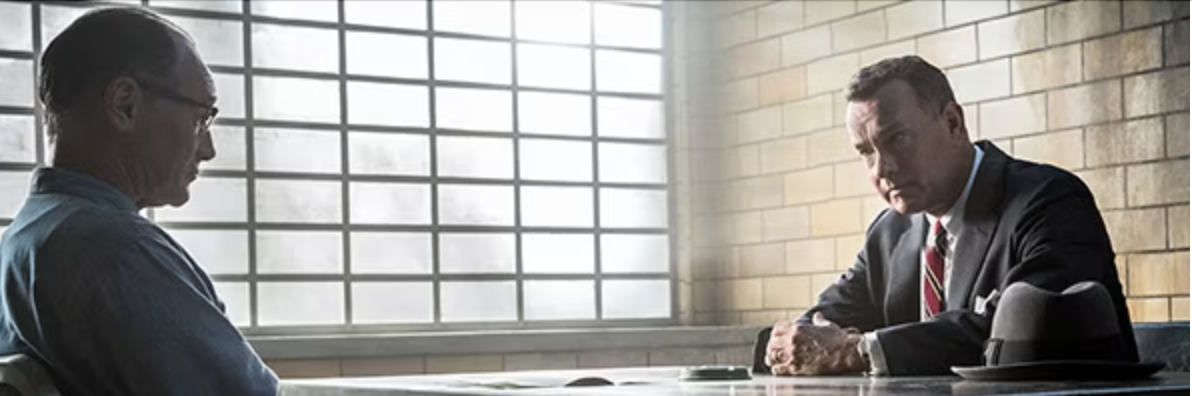
Feb 10, 1962: No wonder Bridge of Spies was on this morning. This is the date when Soviet spy Rudolf Abel was exchanged in Berlin, for CIA pilot Francis Gary Powers.
Bridge is an excellent movie on so many levels. The Spielberg-Hanks tandem is such a good fit. The script was written by the Coen Brothers (Fargo, Raising Arizona, O Brother Where Art Thou?) and the muted, faded colors, blues and grays, of Cold War East Berlin. Brooklyn is warmer, rich browns and ambers, deep red mahogany staircases,-autumnal colors and the colors subtl conveys the difference between dictatorships and democracies.
Spielberg used a Polish cinematographer, Janus Kaminski, who knew the difference.
Mark Rylance, as Abel, is a personal favorite of mine (Dunkirk, and the PBS series about Henry VIII and Cromwell, his chancellor, Wolf Hall.)
You could get the electric chair, Hanks warns Rylance at one point. Aren’t you worried?
Would it do any good? Rylance replies.
I am a sucker for movies about personal integrity (A Man For All Seasons, Julia, Dead Poets’ Society, Spotlight, Shane, To Kill a Mockingbird, Casablanca) which I guess explains why I’m so fond of this film and of Tom Hanks’s acting in it. I think he just might be my generation’s James Stewart or Gregory Peck.
And if you think my taste in films reveals me as one of those Damned Liberal history teachers, you’re right. The scene below reveals precisely the kind of Damned Liberal stuff I taught your children for thirty years. I still believe very word of Hanks’s reply to his CIA handler, and that’s because, quite simply, I have always loved my country and I always will.
Its imperfections are glaring and obvious. As Churchill noted, democracy is by far the worst of all government systems. Except for all the others. But the system that’s sliding toward plutocracy and a gerontocracy needs men and women of integrity, not destruction. The arts, including this film, reveal that truth to us.
The final scenes are moving: A woman recognizes Hanks, previously vilified as Rudolf Abel’s counsel, on the subway, and she gives him an ever-so-subtle smile for bringing Powers safely home.
Hanks’ smile, as mine would be, too, is wider. He is proud of himself.
But when he looks out the subway window and sees neighborhood kids jumping a chain-link fence–he’s just seen young men gunned down by border guards at The Wall—the smile rapidly fades. The character recedes into the ambivalence that is the lot of most of us, as human beings, every day of our lives.
It’s now hard for me to believe that so much of my life was lived during the Cold War. One day, chaff—aluminum strips designed to obscure enemy radar—came raining down on the Branch School softball field. Somewhere high above us, U.S. Air Force warplanes were practicing for World War III.
 A Work in Progress