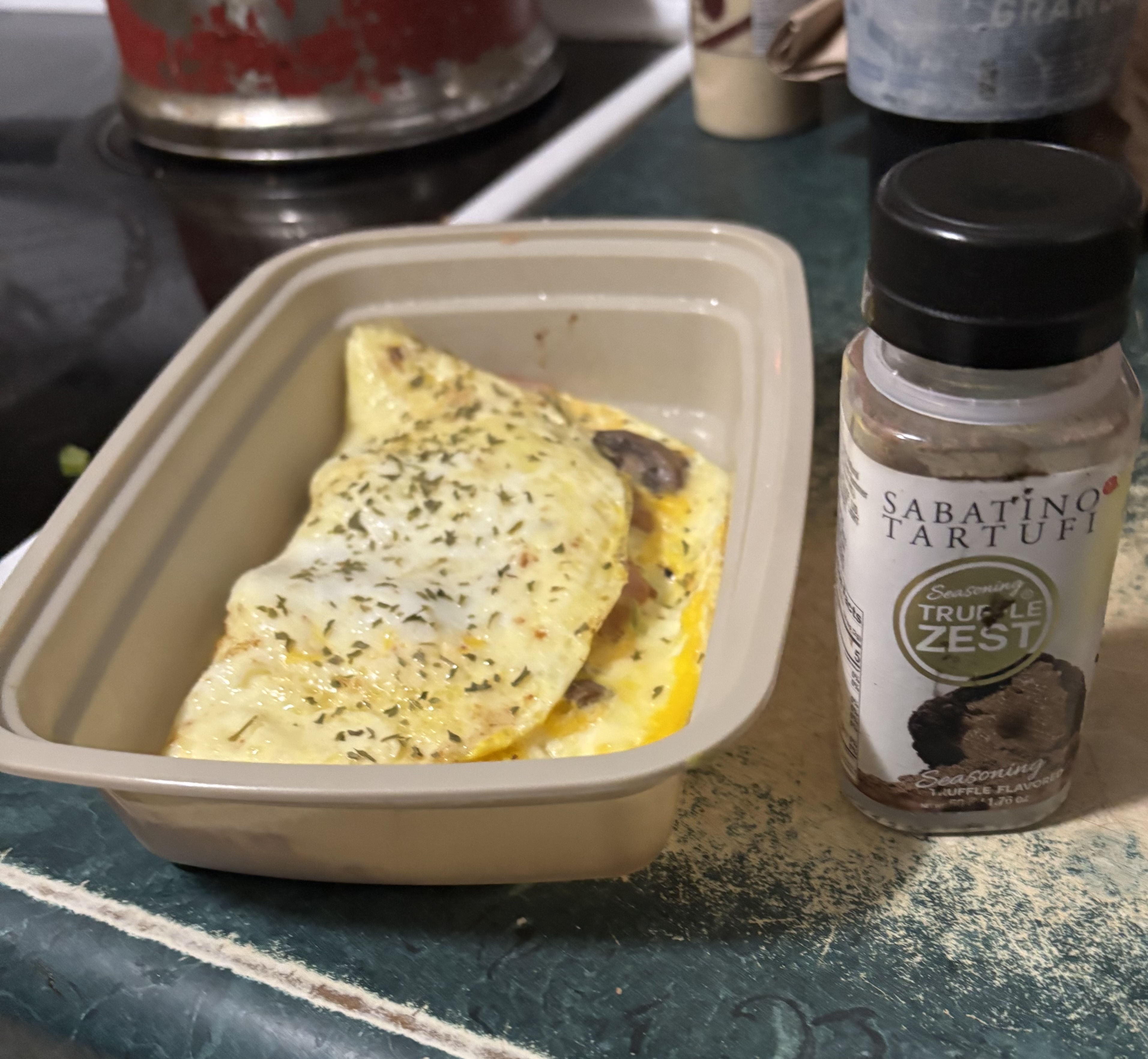
By golly, that’s not bad. A 2 1/2 egg omelet (eggs and egg whites) with cheese, sauteed bacon, peppers, mushrooms and red onions. I made three of ’em for Elizabeth and our sons. The magic ingredient is that truffle spice. It goes on the inside. Parsley flakes on the outside. Ciabatta bread with avocado spread added to the omelet.
I think I’m up because I have a meningioma, a benign tumor attached to the brain lining, and that’s a common side effect. I have at least two sleepless nights a week.
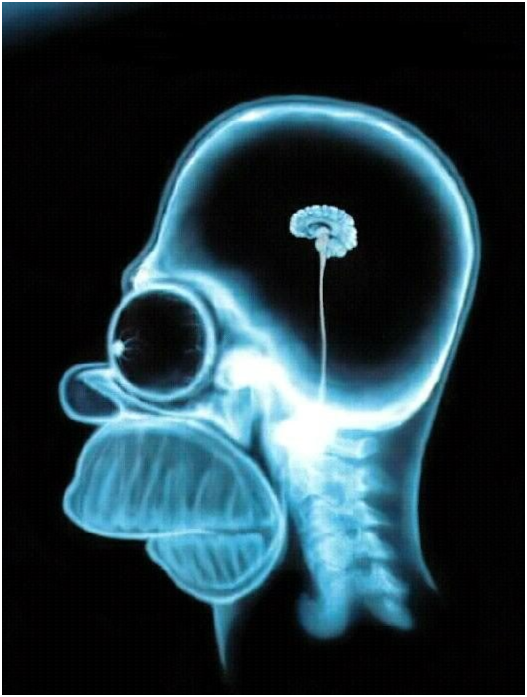
My brain.
I’m having surgery at Stanford in June to remove what I call Manny the Meningioma, so I’m sure anxiety plays a part.
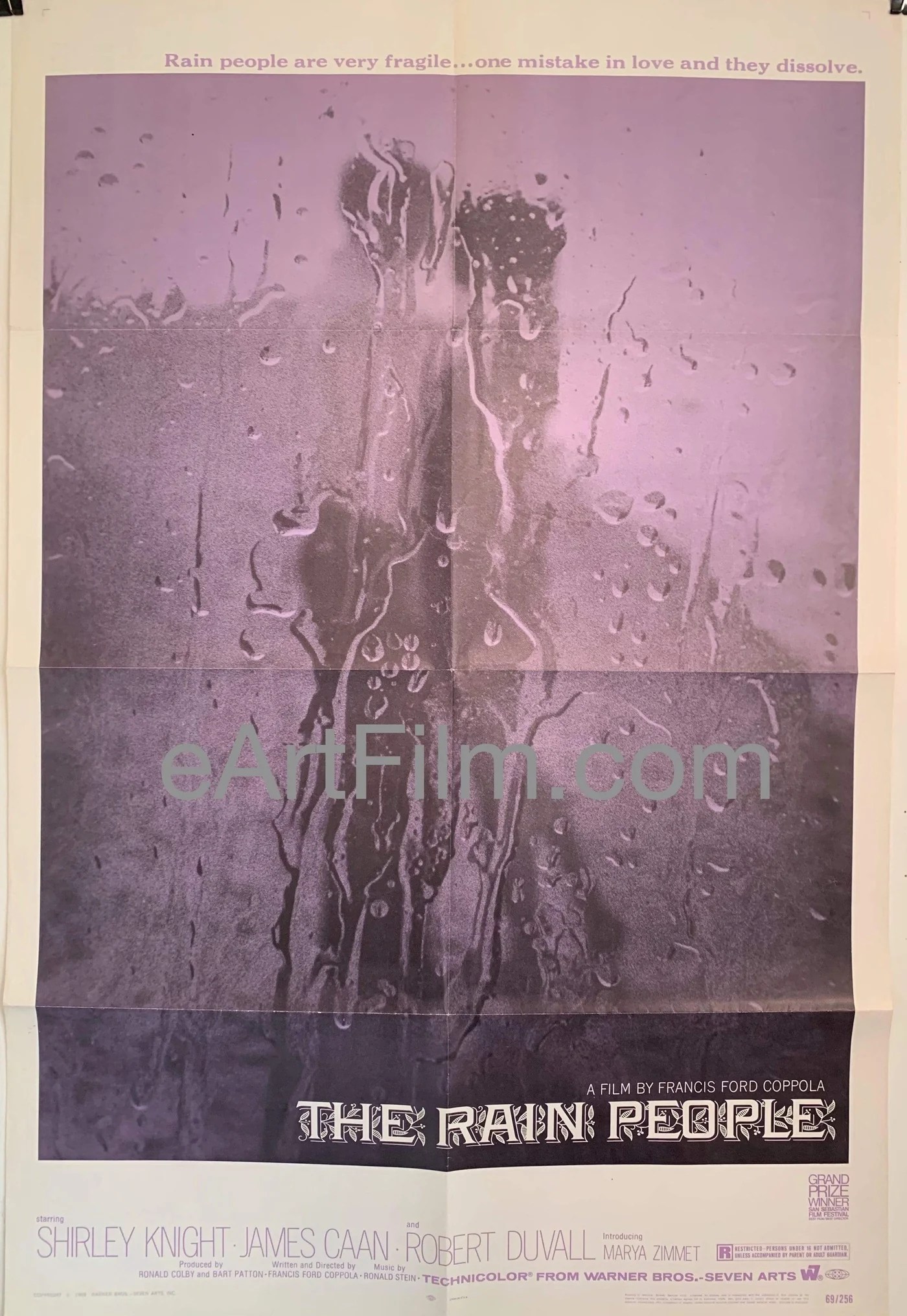
But why waste a sleepless night? So I make omelets. And I watch movies on Turner Classic Movies. Tonight it was this one.
To be truthful, it wasn’t all that good. The lead, Shirley Knight, is very attractive, a woman running away from her husband in a Ford Galaxy station wagon the size of USS Nimitz, so it’s kind of a road picture like so many from the late 60s and early70s—Easy Rider, Vanishing Point, Sugarland Express, but not, say Rosemary’s Baby.
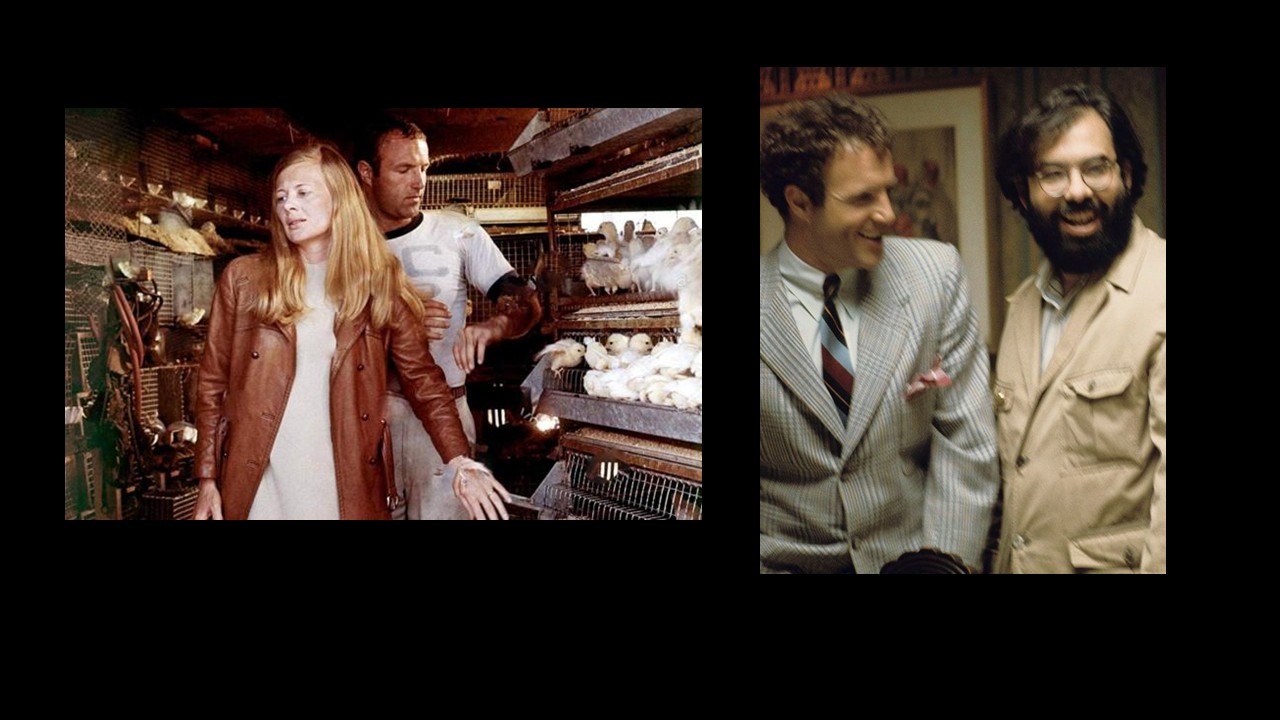
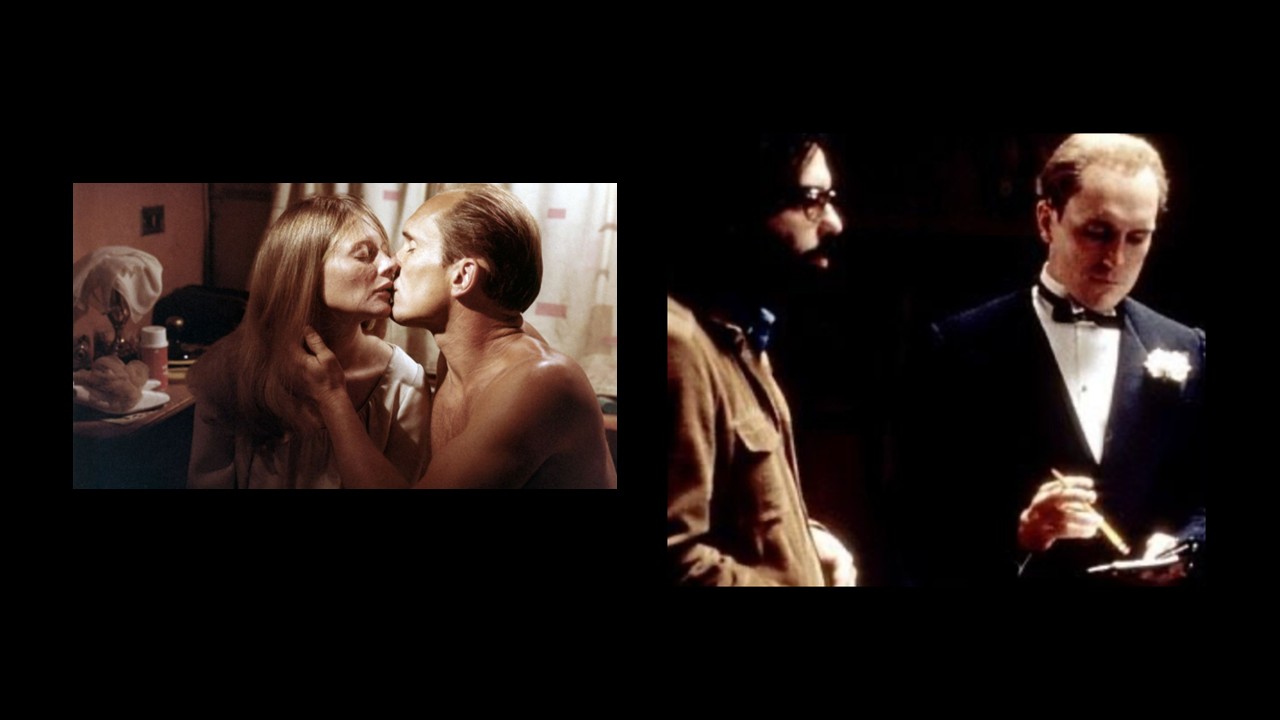
I kept watching it because she befriends James Caan, as an ex-football player with traumatic brain injury. Right up my alley. And, in mid-movie, Robert Duvall appears as a motorcycle cop who woos Knight. Not well.
It was pretty thin soup, but it kind of compelling, too. Then, at the end of the film, TCM host Ben Manciewicz informed us that the director (his fourth film) was Francis Ford Coppola.
Wowsers.
I don’t know what Wheaties Coppola ate in the next three years (maybe it was omelets?), but he gave us, with Caan and Duvall, The Godfather in 1972.
A quantum leap. Casablanca is the only film I’ve watched more than The Godfather.
And seeing Caan and Duvall, no longer with us, as young actors was an honor. I miss them.
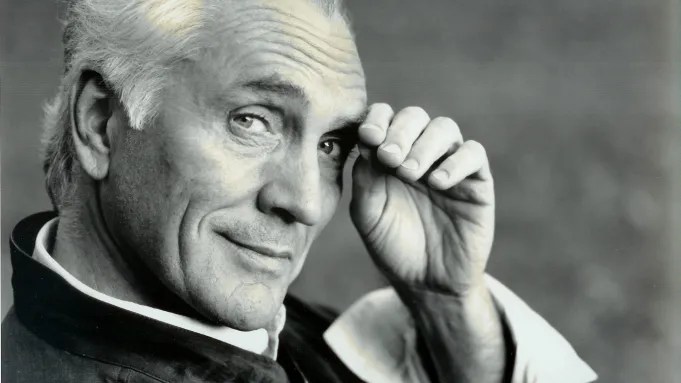
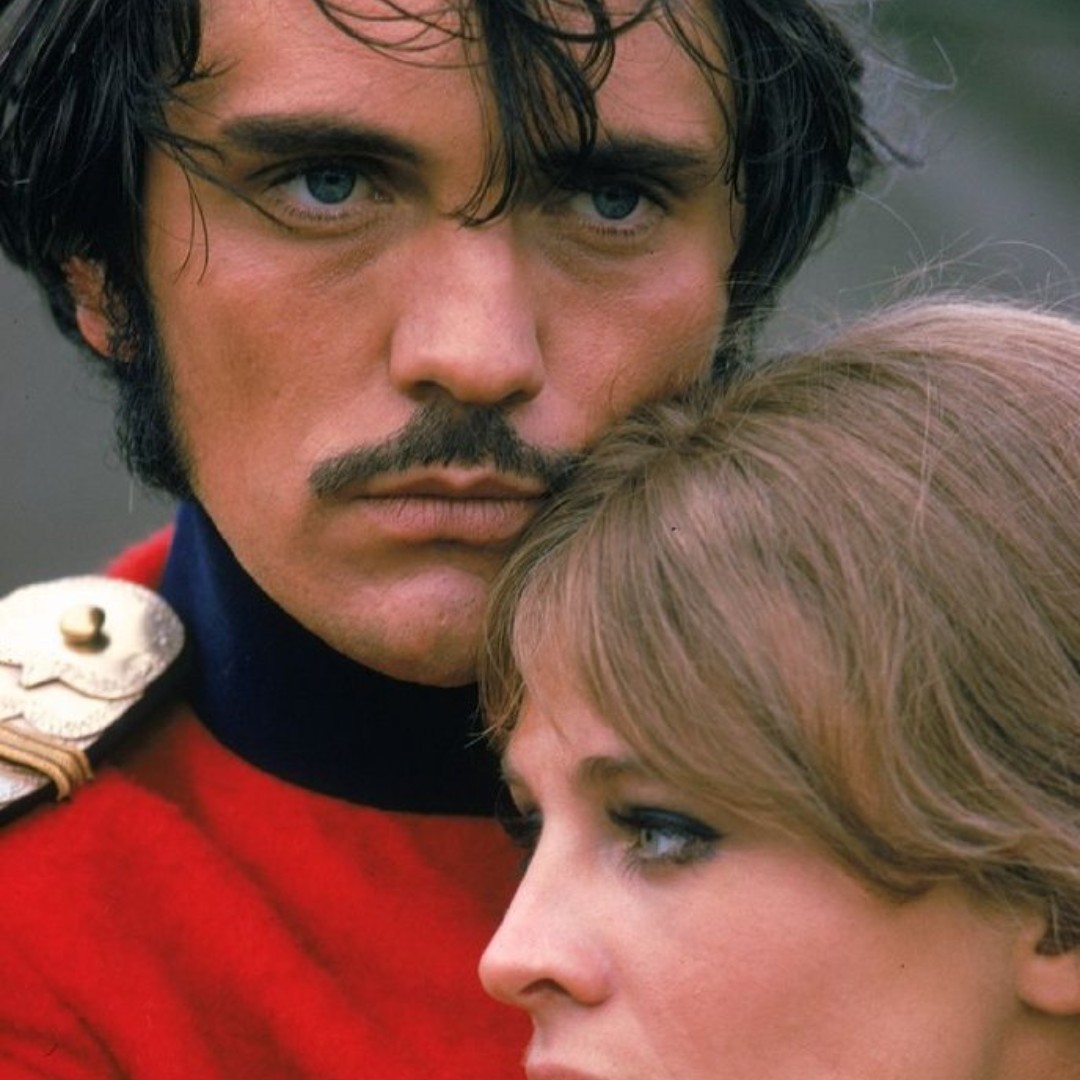
His Da was a merchant seaman and so rarely home. Home was London and, as a toddler, he survived The Blitz. Two decades later he even survived Peter O’Toole, his friend. O’Toole, common to British actors, wasn’t just a drinker. He was a carouser. Maybe this man, Terence Stamp, was among the crowd who went bar-hopping all night Friday and decided to stop into a West End theater for the Saturday matinee. They were there to hoot at the actors from their seats in the dark.
Just before the curtain, though, O’Toole leaped from his seat.
“Good GOD!” he cried. “I’m IN this!”
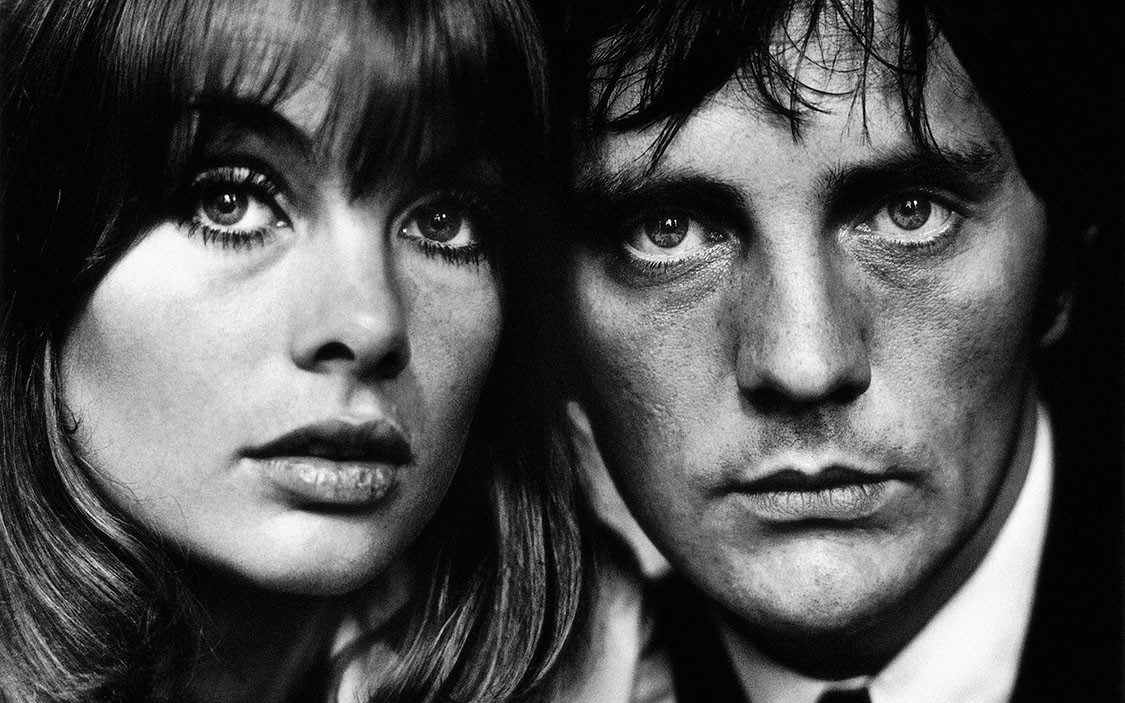
This story is, of course, apocryphal, but carousing, and booze, was a kind of second Blitz that Stamp survived. He even survived a relationship with the woman, Jean Shrimpton, whom many consider the first modern Supermodel, she who paved the way for Cindy Crawford, Gigi Hadid, Tyra Banks, and even Shrimpton’s contemporary, Twiggy. (Shrimpton is now eighty-two.)
An older O’Toole outside a Soho watering hole.Shrimpton and Stamp, about 1965.
We Yanks take some credit in the creation of this marvelous actor. He was smitten by Gary Cooper when his Mum took him to see Beau Geste when he was a little boy; when he was a teen, James Dean cemented his decision to become an actor.
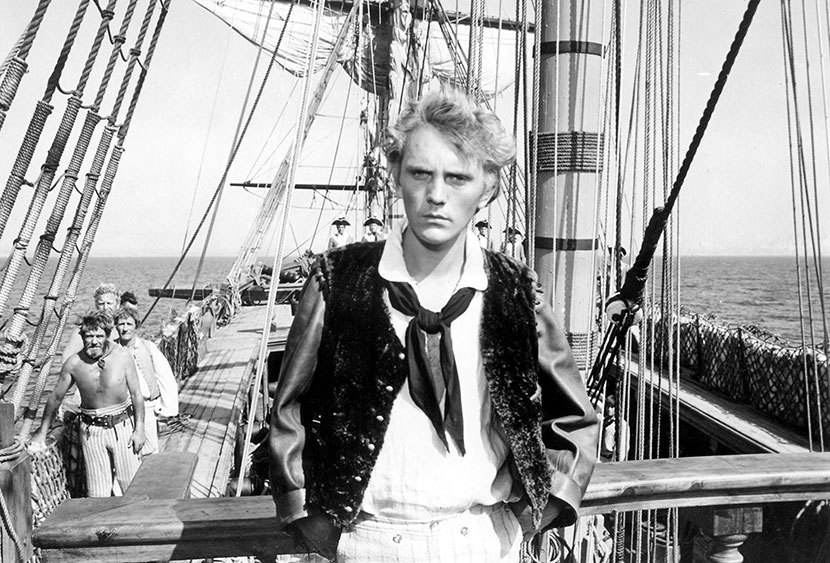
It was a sound choice. At the very beginning of his film career, Stamp’s range was already extraordinary: He was the guileless and doomed young sailor in Billy Budd, and a few years later was the brooding and paranoid soldier, the flame to Bathsheba’s moth in the first film production of Thomas Hardy’s Far from the Madding Crowd. (I enjoyed both that version, with Julie Christie, and the later one, with Carey Mulligan. The earlier version led me to Thomas Hardy novels, and that was a good choice on my part. For one thing, I learned as much about dairying from Hardy’s Tess of the d’Urbervilles as I had about whales from Moby-Dick, and the former learning was far less painful.)
For purely gratuitous reasons, Carey Mulligan’s horseback ride from the second film version. (The video link should work if you click on it.)
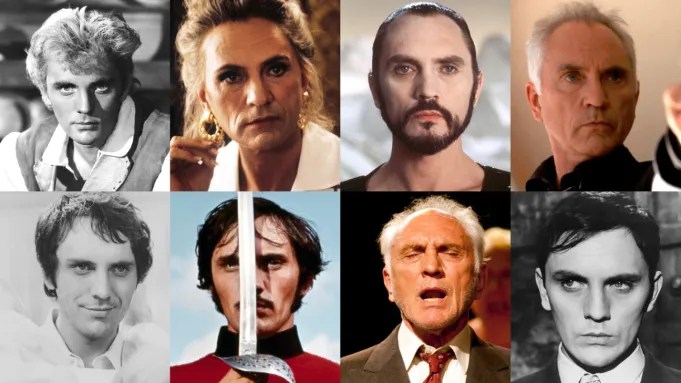
Thankfully, the news services put together a composite of some of Stamp’s roles. He made an indelible impression as General Zod in the first Superman films with Christopher Reeve. He was a superb supervillain, and those were films that he was very proud of.
Because I am a hopeless Romantic, it’s one of his supporting roles that I remember best. The film was called The Adjustment Bureau, and it’s based on a story by the brilliant American science fiction writer Philip K. Dick.
The premise is simple, and similar to The Matrix. We are not in control of our lives. They are foreordained, every moment planned from birth to death, and if someone or something threatens to violate The Plan, the Adjustment Bureau intervenes for course correction. They’re easy to spot, because all of them were slim-lined early 1960s suits. And all of them wear hats.
In the film, Matt Damon, as David, is an earnest young United States Senator who falls head-over-heels with a dancer, Elise, played by Emily Blunt. She falls in love with him. He is a button-downed traditionalist. She’s a free spirit. Can’t blame either one.
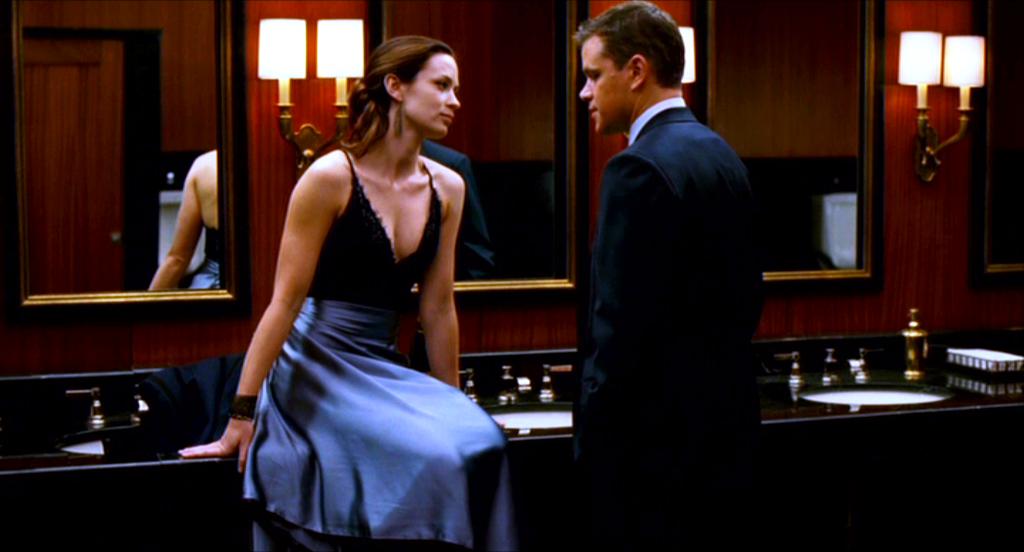
In The Adjustment Bureau, Blunt and Damon first meet in the men’s room at the Waldorf, where he’s trying to gather himself after a defeated run for office; she’s hiding in there because she’d crashed a wedding party.
But this love is NOT in the young senator’s Plan. So, the Adjustment Bureau agents, led by Stamp, intervene to separate the young couple forever. Stamp’s gravitas is expertly played in this scene, and it allows Damon’s line, at the end, the weight that it deserves. Sometimes there would be cheers from the film’s audiences at this point.
Stamp, an inherently generous actor, made those cheers happen.
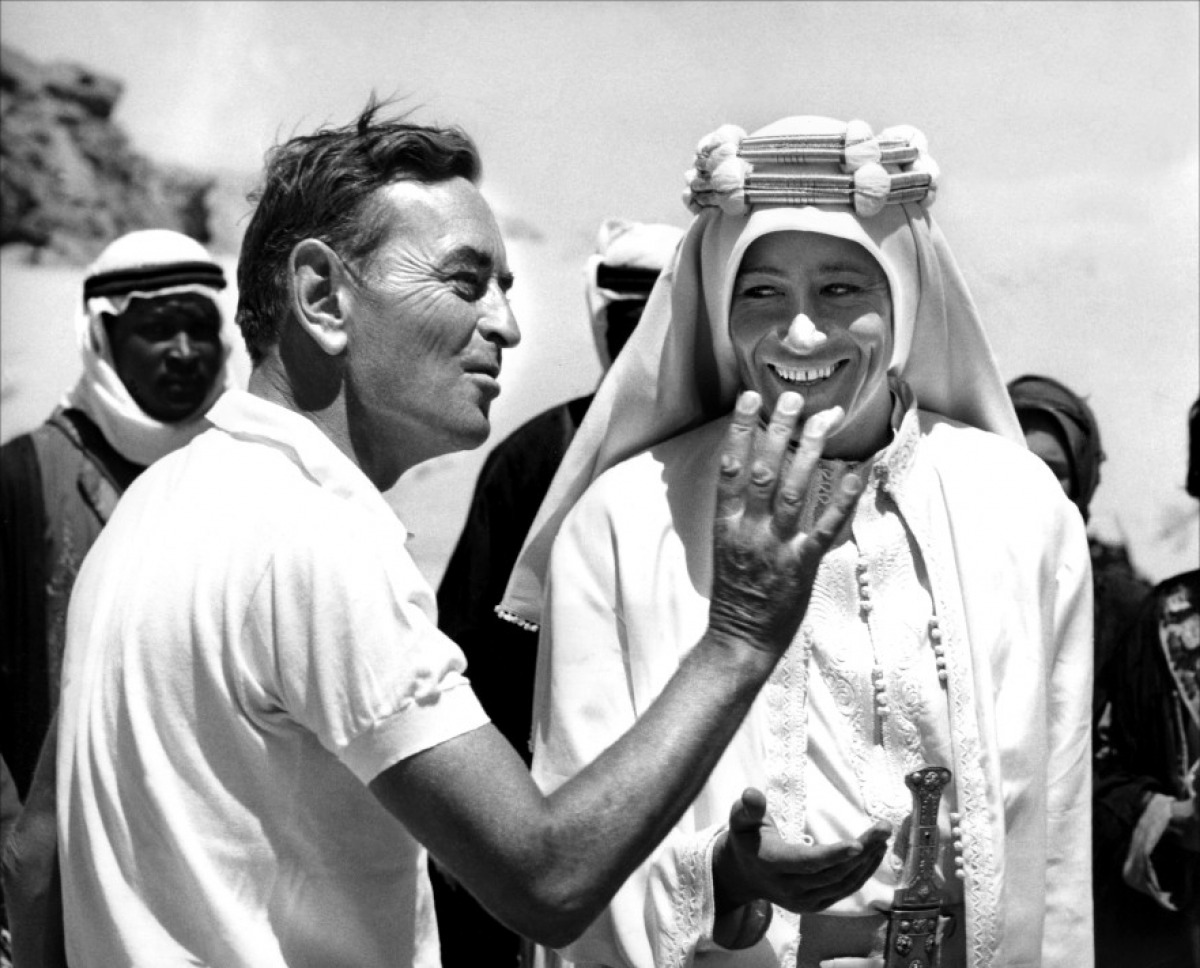
I’ve always thought of the director David Lean in terms of vastness and Technicolor. The desert scenes in Lawrence of Arabia come to mind—it’s said that thirsty theater patrons mobbed the concession stand for Cokes at the intermission. The most epic entrance in film history, I think—when Omar Sharif kills the Bedouin stealing water from his well—is an example of vastness.
And in Dr. Zhivago—theater patrons were warned to wear sweaters because that film’s cold was so vivid—there’s a set piece, where Lean communicates “cold” as Sharif’s Zhivago and Lara seek refuge from the Revolution in his family’s dacha, far, far away from Moscow or what was no Petrograd. It’s stunning and Dickensian scene, like Miss Haversham’s cobwebbed parlor and wedding cake in Great Expectations.
Dickens’ novels had as their fattest pages richly-depicted English eccentrics, from the delightful Micawber to the lizard-like Uriah Heep to the tragic Sidney Carton. In Bridge on the River Kwai, the Allied POW’s are led by Alec Guinness, who has crossed the line that divides eccentricity from madness. (The film also features one of William Holden’s finest performances.) Alert moviegoers might have spotted something off at the film’s beginning, when Guinness’s Col. Nicolson marches him POW’s into camp while whistling “The Colonel Bogey March.” It’s a little mad.
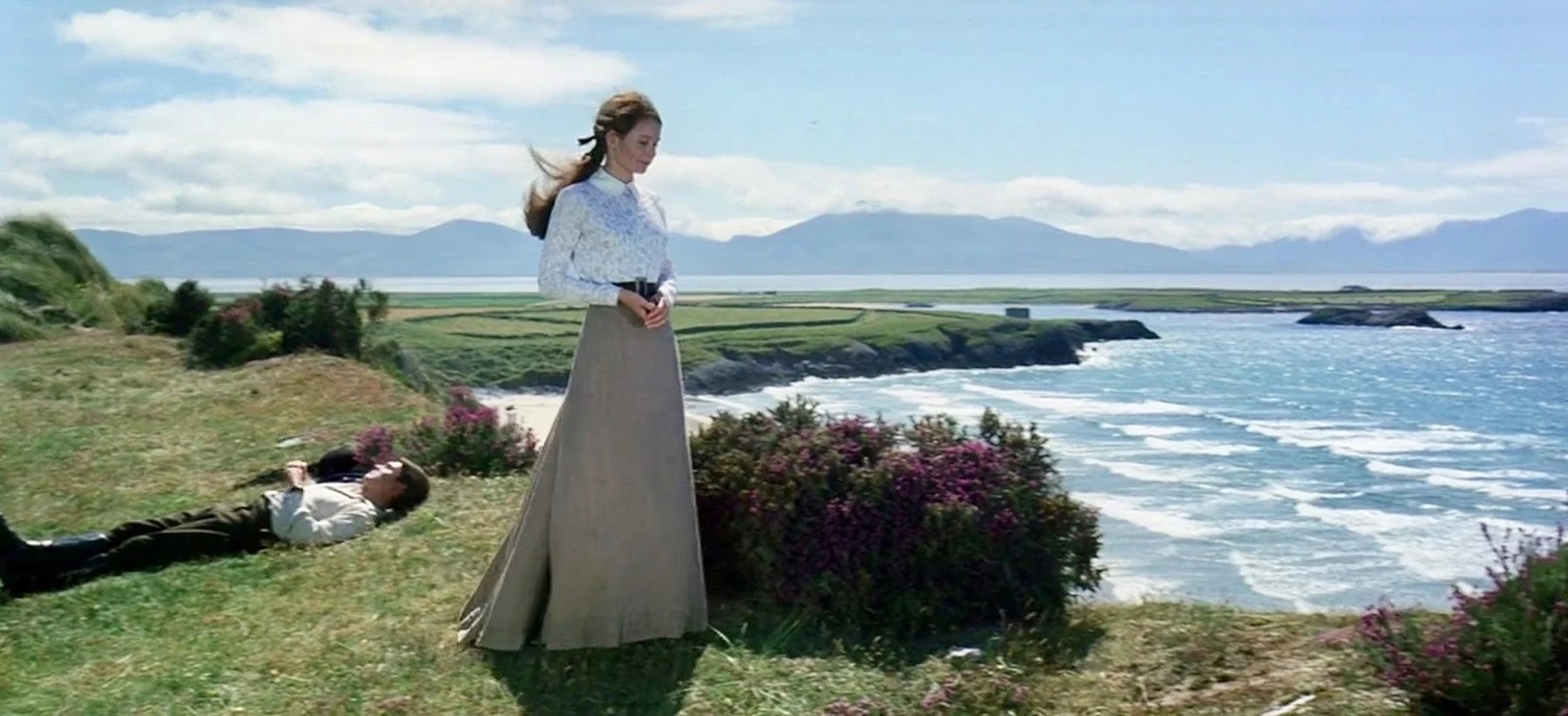
But long before Lean made grand color films–Ryan’s Daughter, while not among his great films, still made evocative use of the Ring of Kerry, a landscape far different from that of the Arabian desert.
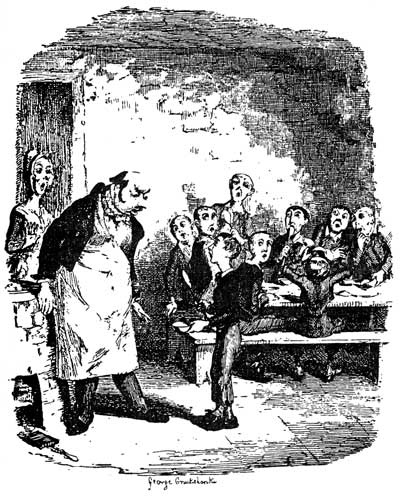
I realized that Lean’s earlier work, in black and white, is just as stunning. I’d long ago seen Great Expectations, with John Mills and Guinness, but I hadn’t seen Oliver Twist in a long time. It’s a film that makes you feels as if you’re inside a Dickens novel (Turner Classic Movies noted that the film’s dialogue was lifted almost verbatim from the novel.
Oliver asks for more. Illustration by George Cruikshank.
What struck me in yesterday’s viewing was the pathos of Oliver’s mother as she trudges exhausted, to the workhouse where she will give Oliver life and lose her own. Someone had the idea of setting the scene (the original, with its sound effects, is stunning) this one’s set to haunting music from an Australian World Music duo, Dead Can Dance. I don’t know if David Lean would approve. For what it’s worth, I do.
Feb 10, 1962: No wonder Bridge of Spies was on this morning. This is the date when Soviet spy Rudolf Abel was exchanged in Berlin, for CIA pilot Francis Gary Powers.
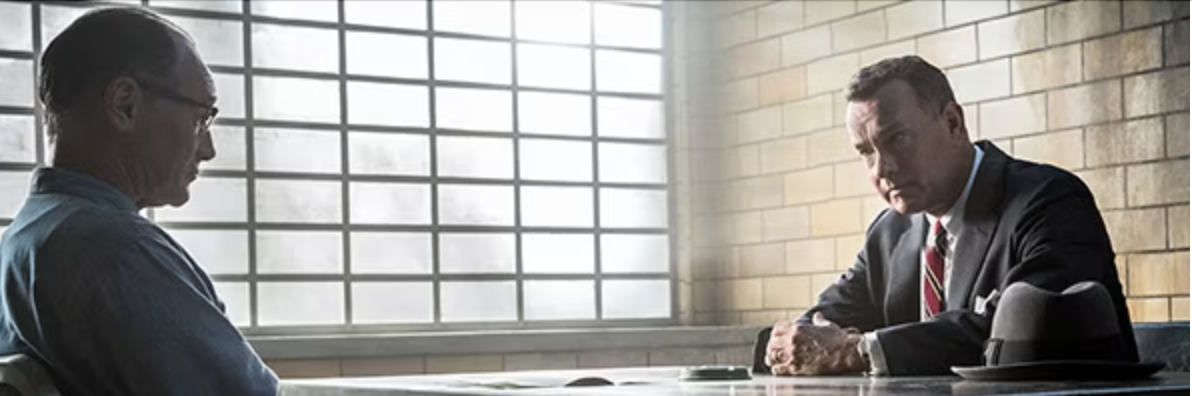
Bridge is an excellent movie on so many levels. The Spielberg-Hanks tandem is such a good fit. The script was written by the Coen Brothers (Fargo, Raising Arizona, O Brother Where Art Thou?) and the muted, faded colors, blues and grays, of Cold War East Berlin. Brooklyn is warmer, rich browns and ambers, deep red mahogany staircases,-autumnal colors and the colors subtl conveys the difference between dictatorships and democracies.
Spielberg used a Polish cinematographer, Janus Kaminski, who knew the difference.
Mark Rylance, as Abel, is a personal favorite of mine (Dunkirk, and the PBS series about Henry VIII and Cromwell, his chancellor, Wolf Hall.)
You could get the electric chair, Hanks warns Rylance at one point. Aren’t you worried?
Would it do any good? Rylance replies.
I am a sucker for movies about personal integrity (A Man For All Seasons, Julia, Dead Poets’ Society, Spotlight, Shane, To Kill a Mockingbird, Casablanca) which I guess explains why I’m so fond of this film and of Tom Hanks’s acting in it. I think he just might be my generation’s James Stewart or Gregory Peck.
And if you think my taste in films reveals me as one of those Damned Liberal history teachers, you’re right. The scene below reveals precisely the kind of Damned Liberal stuff I taught your children for thirty years. I still believe very word of Hanks’s reply to his CIA handler, and that’s because, quite simply, I have always loved my country and I always will.
Its imperfections are glaring and obvious. As Churchill noted, democracy is by far the worst of all government systems. Except for all the others. But the system that’s sliding toward plutocracy and a gerontocracy needs men and women of integrity, not destruction. The arts, including this film, reveal that truth to us.
The final scenes are moving: A woman recognizes Hanks, previously vilified as Rudolf Abel’s counsel, on the subway, and she gives him an ever-so-subtle smile for bringing Powers safely home.
Hanks’ smile, as mine would be, too, is wider. He is proud of himself.
But when he looks out the subway window and sees neighborhood kids jumping a chain-link fence–he’s just seen young men gunned down by border guards at The Wall—the smile rapidly fades. The character recedes into the ambivalence that is the lot of most of us, as human beings, every day of our lives.
It’s now hard for me to believe that so much of my life was lived during the Cold War. One day, chaff—aluminum strips designed to obscure enemy radar—came raining down on the Branch School softball field. Somewhere high above us, U.S. Air Force warplanes were practicing for World War III.