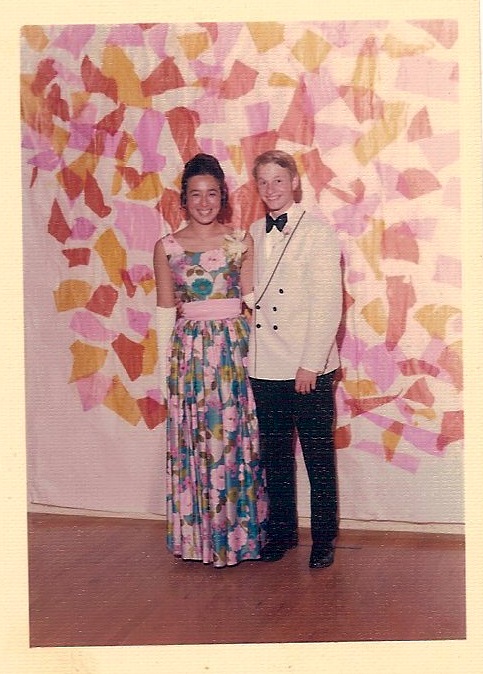
It’s struck me that write a lot about Japanese Americans. That’s Callie (Yamaguchi) Elliston and me at the 1970 Arroyo Grande High School Prom.
This is why.
Callie’s mother, Louise, known as “Dragon Lady” for her fierce protection of the Lucia Mar Superintendent—she was the District secretary–was unfailingly kind to me. She introduced me to cheesecake, which I first encountered at nineteen. Hers was magical. She and the Yamaguchi sisters introduced me to sushi, long before it was fashionable. It, too, was magical.
Many years later, due to a gross administrative error, I was named the Lucia Mar Teacher of the Year. That was for Louise.
What I owe the Hirase family is likewise beyond imagining. It was Joe Loomis and Larry Hirase who took me in after my beloved mothertook her own life when I was seventeen. Cancer takes some lives, heart disease others, and depression takes many more. Joe and Larry did me the favor on not considering me weird because of the manner of my mother’s death.
When I visited the Hirases’ home, there was a big fifty-pound sack of sushi-grade rice just inside the front door and a jeroboam of sake on the kitchen counter, an exotic counterpart to my family’s potatoes and bourbon.
I had entered a new world in which I felt completely at home.
In my home, on Huasna Road, in the late 1960s, my parents—brilliant, passionate, loving, terrifying, hopeless and endlessly inspirational–were beginning to come apart. They were beautiful. They were the finest parents anyone could’ve hope for; they made me who I am. So did staggering flaws in generations of DNA, Anglo-Irish, forged in famine, in Pennsylvania oilfields, in Missouri cornfields and milo fields and tobacco fields plowed by big, beautiful, powerful horses.
All of these were carried down to my folks, and so to me, by generations of men and women marked by integrity and fearlessness. And by failure.
When my mother died, I felt empty. With the Ellistons or the Hirases, I felt restored. Kaz Ikeda corrected the uppercut in my baseball swing. Keith Sanbonmatsu and I were chosen to greet the U.S. Congressman visiting AGHS. The Fuchiwaki sisters, as another generation had been–at least before 1942 arrived—and all of them, our dearest neighbors, were taken away from us—were instrumental to the feel that made AGHS feel like home, just as AGUHS must’ve felt for nearly all of 1941.
When I became an AGHS teacher, I taught three Kobaras, one Nakano, two Ikedas, four Hayashis.
So this is why I write so much about Arroyo Grande Japanese Americans. They are home. In some way, this wee Anglo-Irish American belongs to these people, too. I am home with them. I am safe.
 A Work in Progress
Hi! Stephanie and Reiko were/are my grandma’s sisters! My grandma passed when I was in middle school, and I feel as if there is so much history I don’t know about her family. It was nice to see Stephanie when she was young.
LikeLike