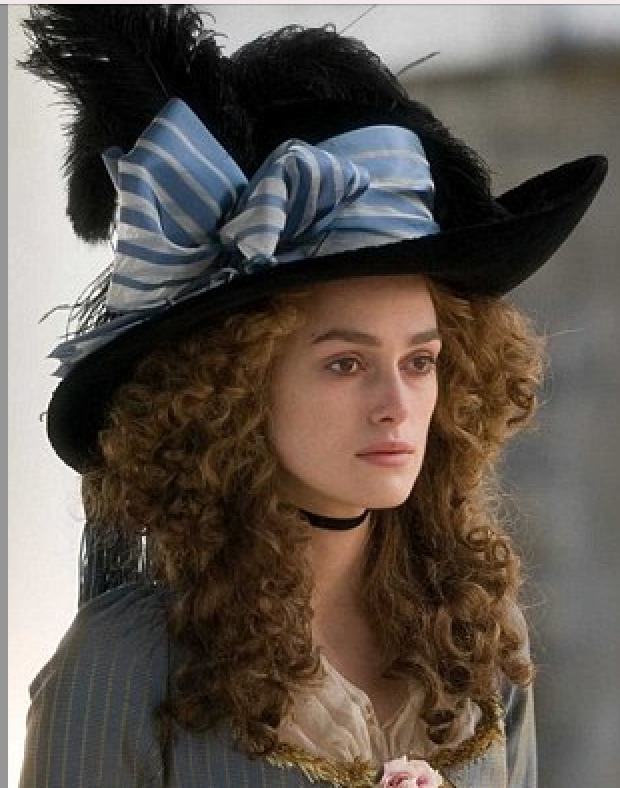
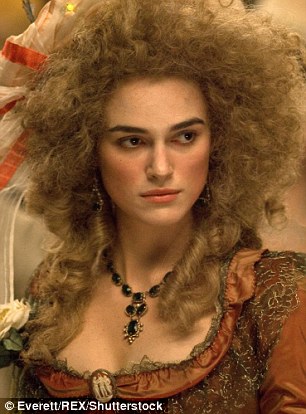
Leave it to me to wake up thinking about 18th-Century women’s wigs. A couple of weeks ago, Elizabeth and I watched again the film The Duchess, about Georgiana, the Duchess of Devonshire, the ancestral great-aunt of Princess Diana. Georgiana was played by Keira Knightley, she of the oddly beautiful underbite and delicate bone structure, and Knightley did her job well.
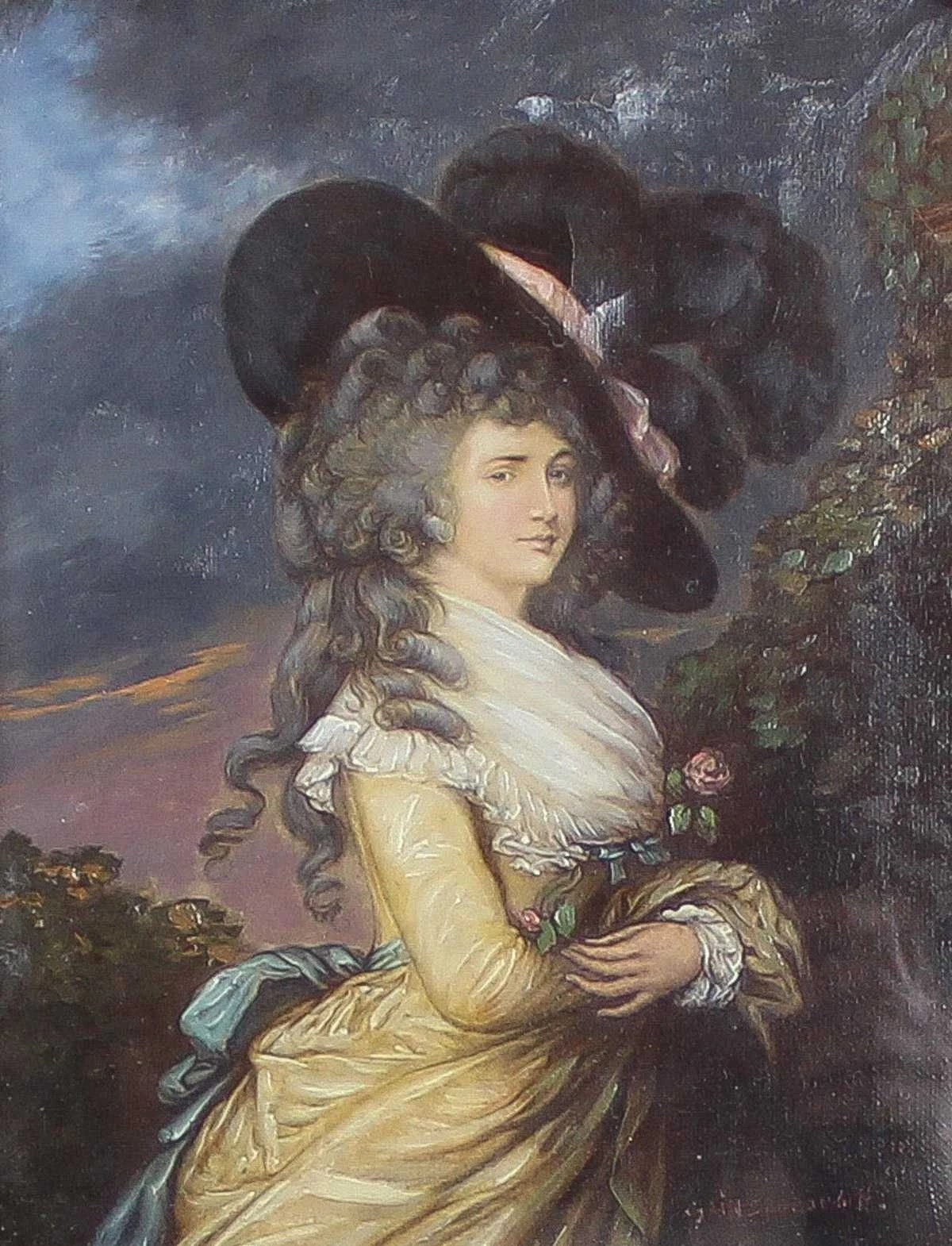
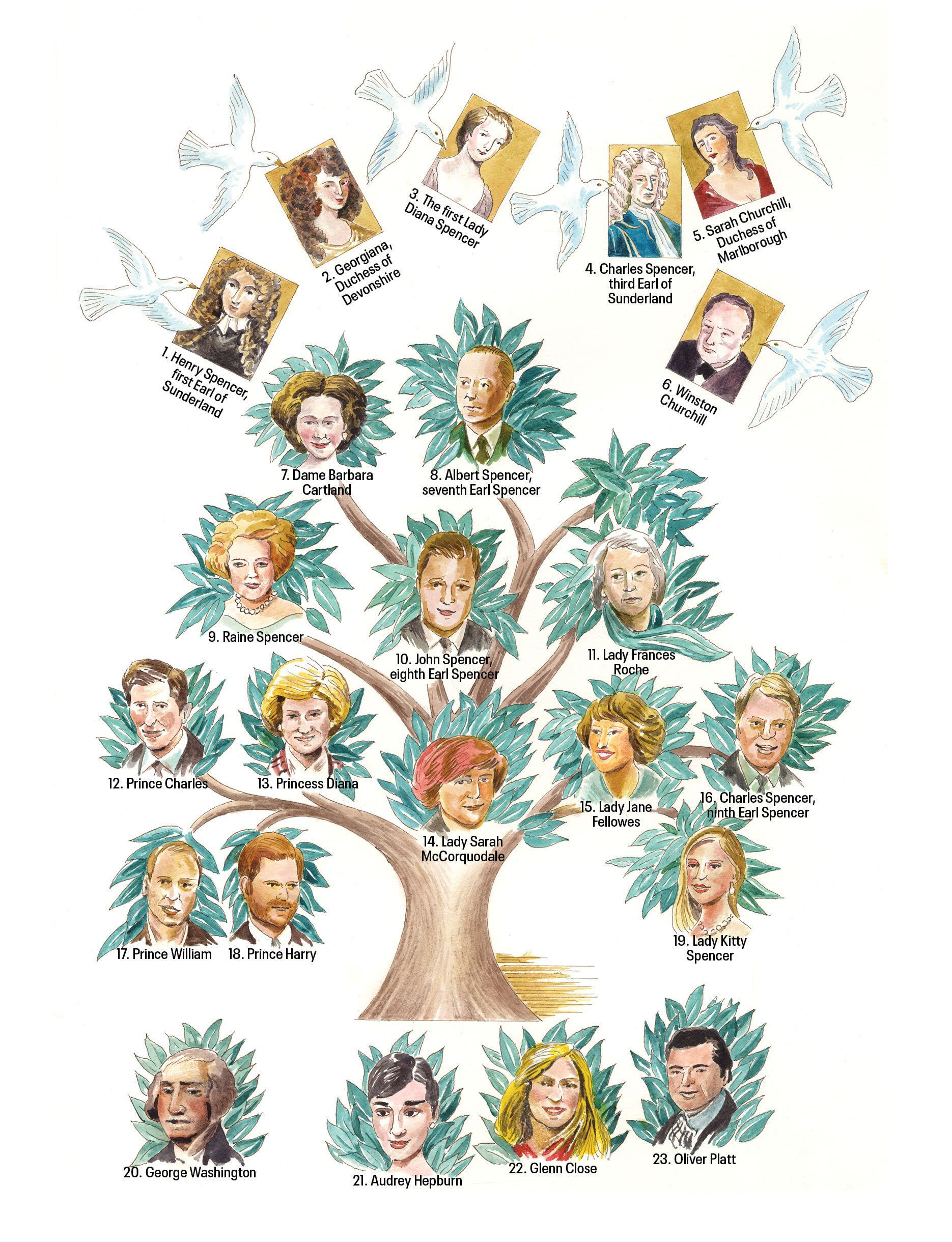
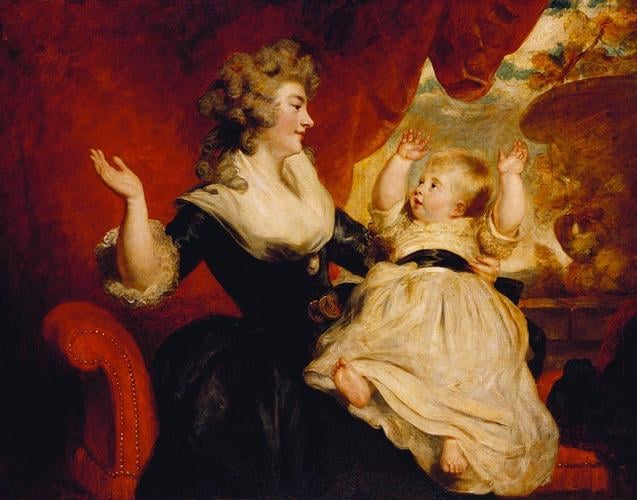
The real Georgiana—she’s portrayed by Gainsborough in the painting— had some impressive branches on her family tree, given that she was a Spencer:
He life was not so stellar. She married William Cavendish, the Duke, at 16 to bring wealth to her own family, and the marriage was not happy. Ralph Fiennes portrays Cavendish and I almost bought a bag of frozen cod the other day because it reminded me of Fiennes in the film. Not all of him was frozen: there was enough warmth in the hearth for him to invite his mistress, Elizabeth Foster, to live with him and Georgiana. (Eventually, the two women become friends and fellow-sufferers.)
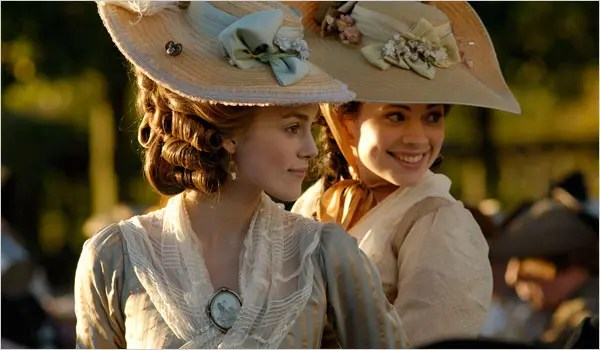
Knightley with Hayley Atwell as Lady Elizabeth Foster
Georgiana consoles herself in drinking, partying, running up immense gambling debts (although she gained entry into British politics by shrewdly choosing her gambling partners at cards) and cavorting with the handsome MP Charles Grey. In one film scene, daughter she bears by Grey is taken from her to be raised with “his people,” and the exchange of the baby is done between two carriages on a remote country road. It is gut-wrenching.
Despite all of this, Georgiana would be remembered as a loving friend and mother, good-humored and devoted to the poor, especially children. Good for her. She was also beautiful: here she is, in 1786, with one of her daughters, and, again, portrayed by the many-wigged Knightley.
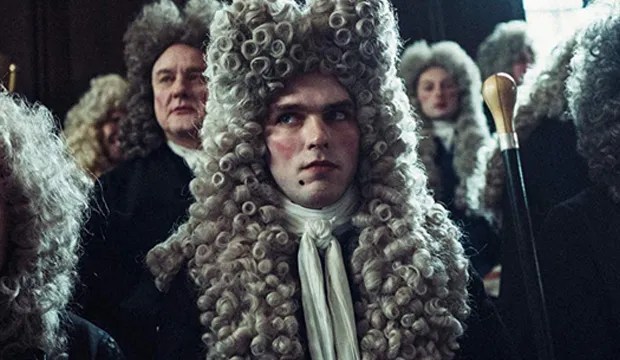
The Favourite, produced ten years after The Duchess but set in the century before Georgiana’s time, won the Academy Award for costume design, as did the earlier film. Well-deserved. But when it comes to wigs, it was the men who outdid the women in The Favourite. In that film, it’s Lord Harley’s wigs, not to mention his beauty mark, that steal the show (the young Nicholas Hoult is wonderful as the acidic and opportunistic Parliamentarian).
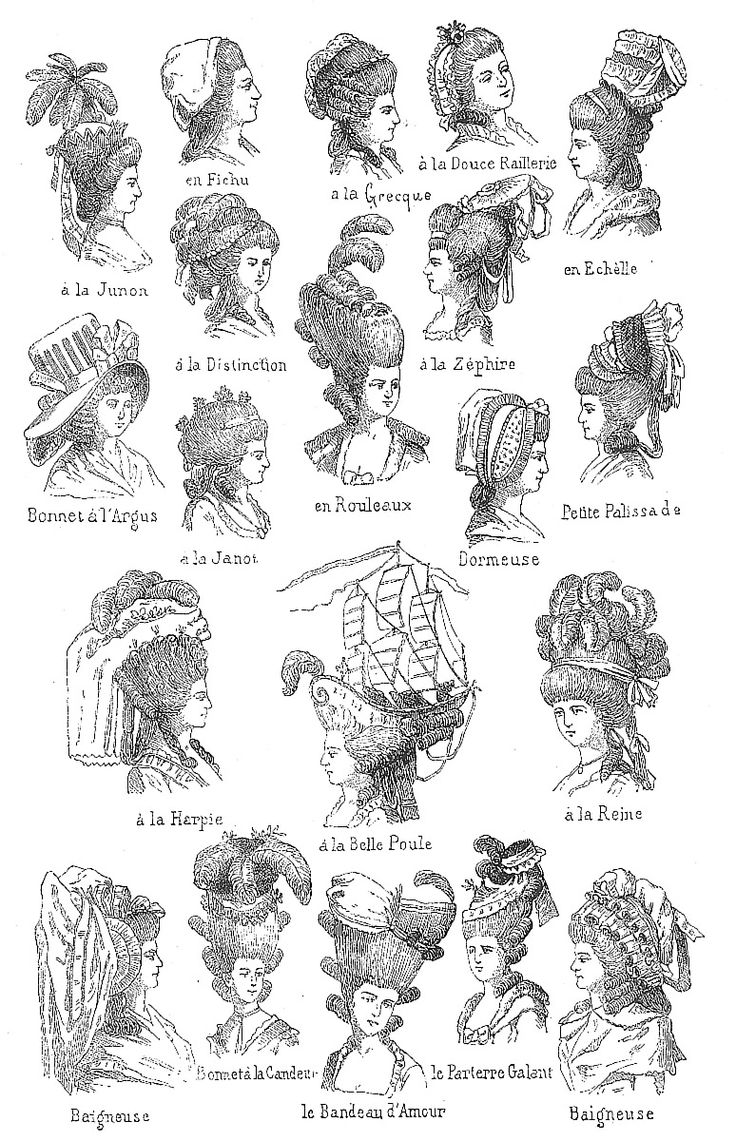
But in Georgiana’s time, even Lord Harley’s wigs would be surpassed, in this century by women’s wigs. I’ve always loved this Bow Wow Wow song anyway, and it’s appropriate to this scene from Marie Antoinette (2006).
And there were so many to choose from! I’m pretty fond of the ship model wig.
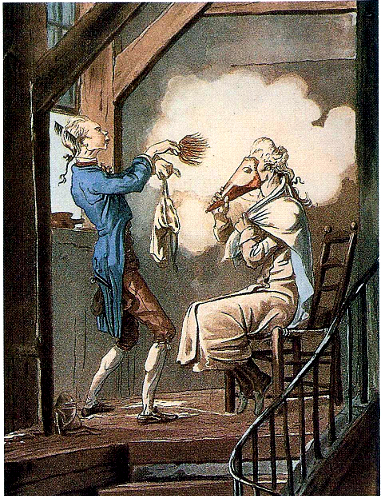
Finally, “freshening up” in Georgian England would’ve had a different meaning, because for men and women, that meant getting properly powdered before you showed your noble head to the public.
What the films don’t always show is the fashion accessory that went with 18th-century wiggery. Long-handled scratchers like this one, made of whalebone, were vital in this age of big hair, because underneath it all was a warm, dark home for lice.
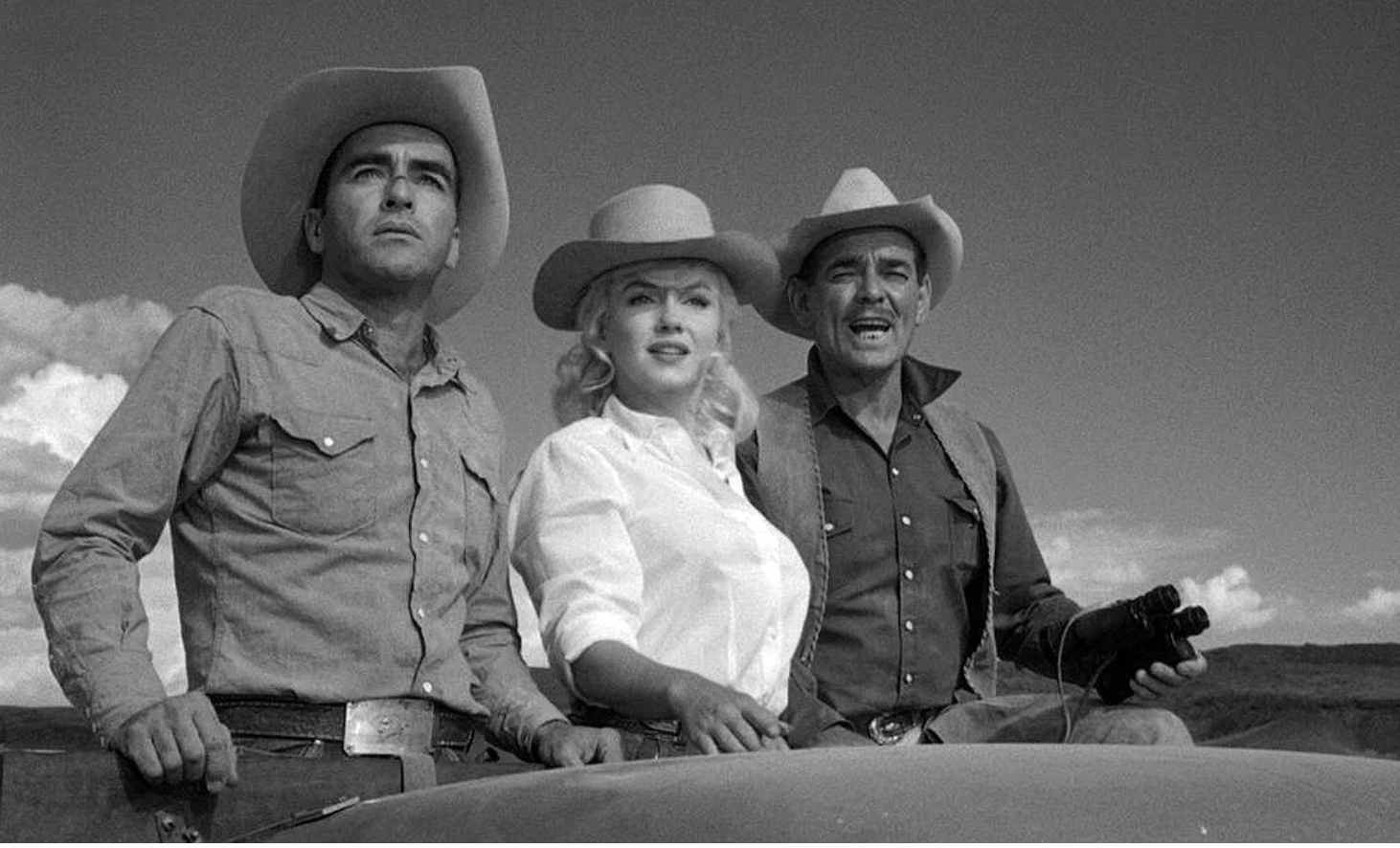
The Misfits is a heart-breaking film with three doomed leads. Their characters capture mustangs so that they can become ingredients in pet food. You’ve reached the end of your usefulness as a human being in a line of work like that.
But the actors were incredible and indelible.
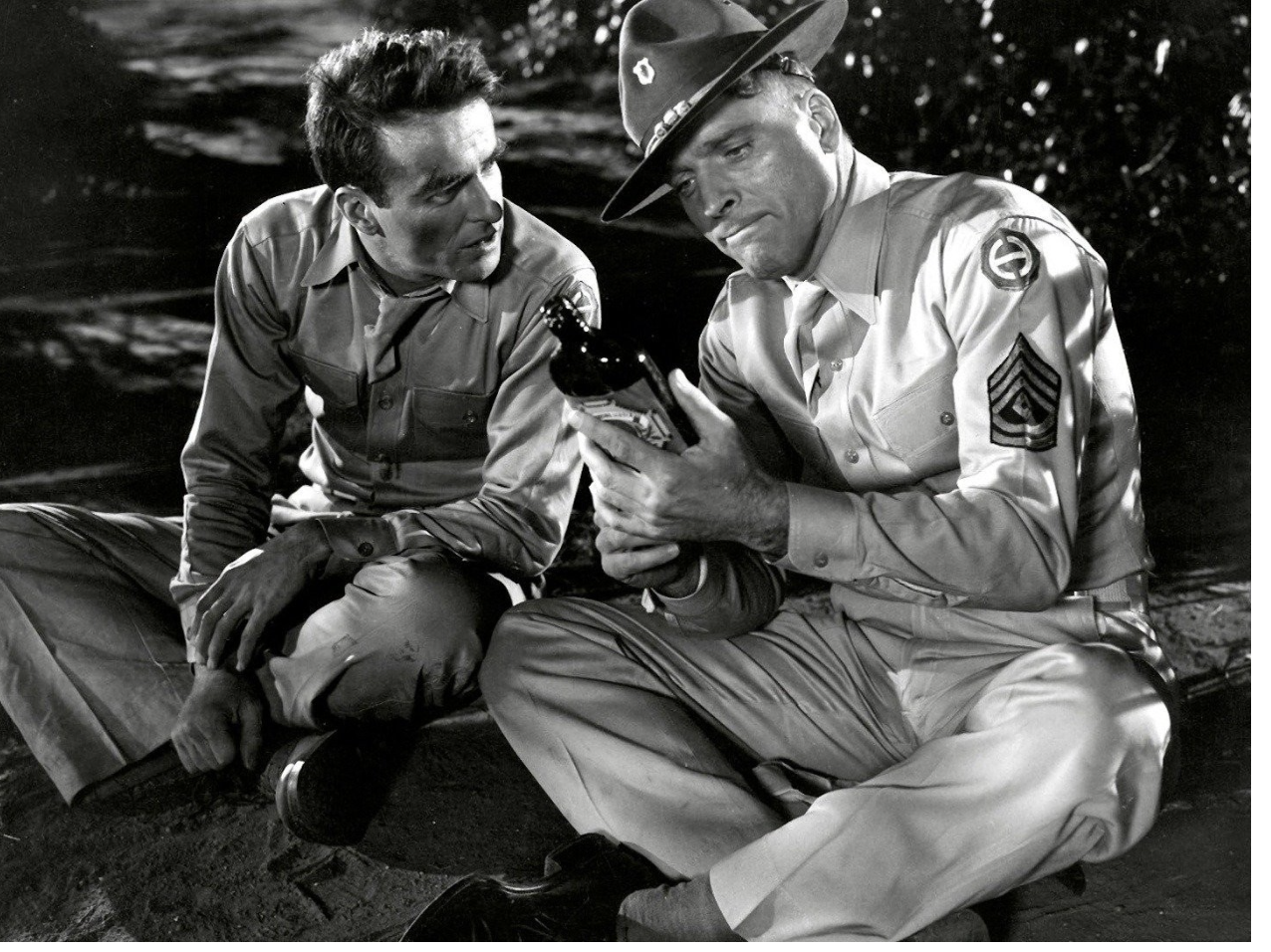
Montgomery Clift out-Deaned James Dean as Robert E. Lee Prewitt, the bugler who refused to box for the 219th Infantry Regiment at Schofield Barracks in From Here to Eternity. The erotic surf smoochery between Burt Lancaster’s Sgt. Warden and Deborah Kerr got all the attention, but in a later scene, the newfound friendship between 100% Army Lancaster and the prodigal Clift, both gloriously drunk, is touching. Clift was incredible, incredibly oily and deceitful in The Heiress, with poor delusional Olivia de Havilland, and twitchy and craven as a Nazi war criminal in Judgment at Nuremberg. Five years after Misfits, Clift was dead.
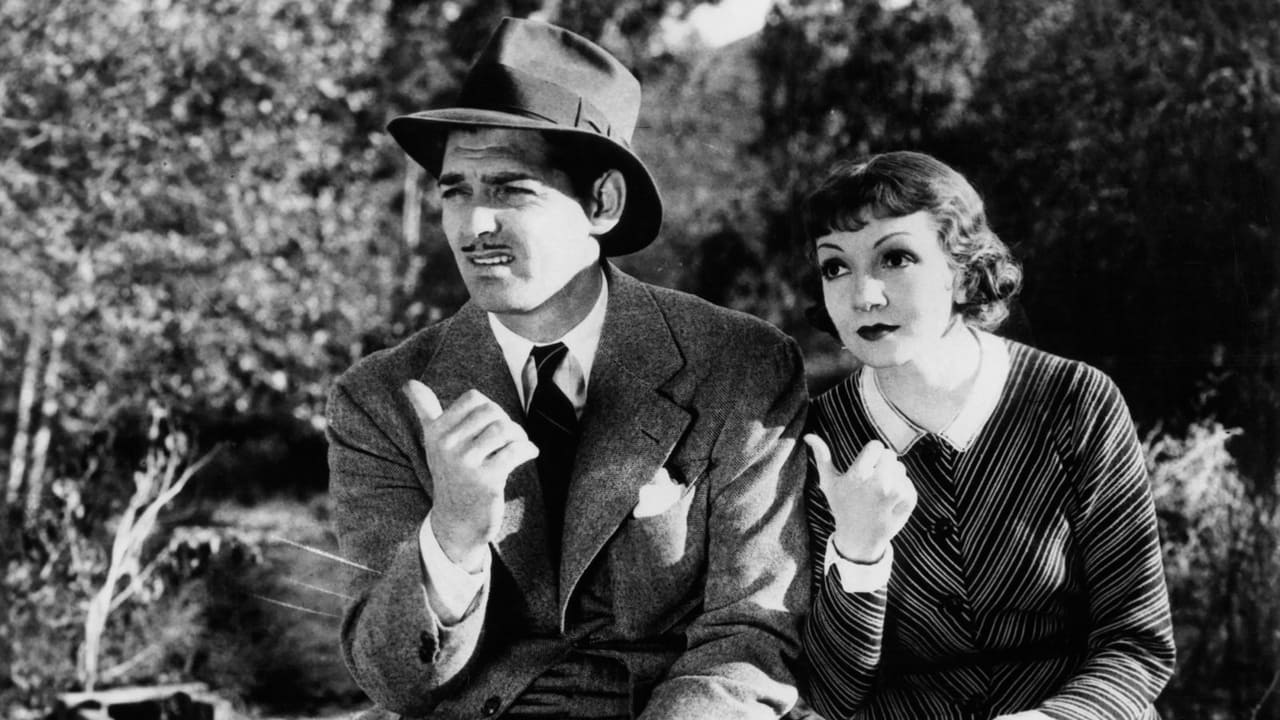
Gable was Gable. He survived the 1906 Earthquake in San Francisco but sadly failed to strangle Jeanette McDonald as she began her solo near the film’s end. I saw It Happened One Night again a few weeks ago and somehow he and Claudette Colbert are as fresh and charming now as they were in 1934. (I love the Dad in that movie, too.) A film he made about journalists, Teacher’s Pet, with, of all people, Doris Day, made me want to become a journalist long before Woodward and Bernstein.
And then, of course, there’s GWTW. My parents started dating that year, 1939, were married in September 1940, and, if you Google “Famous Films 1939,” you will understand why Hollywood made me possible. Gable, who’d once played softball with giggly San Luis High girls on Pismo Beach during the filming of Strange Cargo with Joan Crawford, died the year of The Misfits’ release.
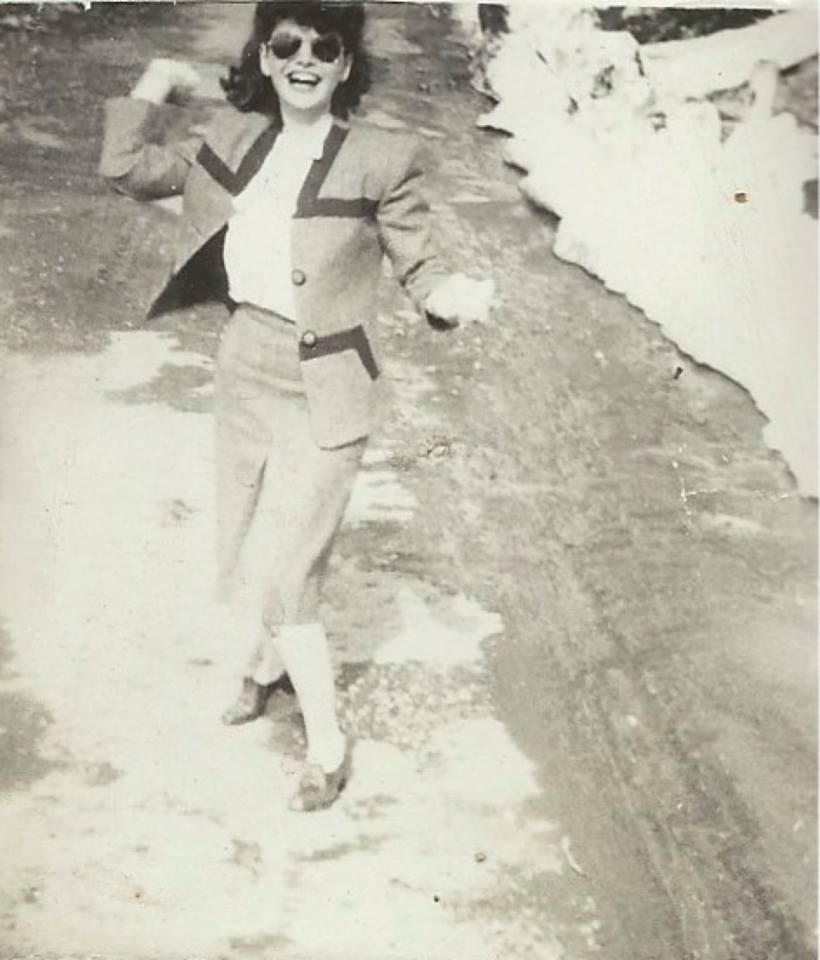
Mom launches a snowball at Dad near Frazier Park, about 1941 or 1942.
Marilyn. I was too young to understand it in 1962—and I don’t want to talk about the Kennedy dirt today— but her death, I think, touched my parents deeply. She was just a shade younger than they were–born in 1926–and I somehow think they, especially my Mom, sensed the intelligence behind the “sex goddess” image, and she sensed the actress’s fragility, too. Given my mother’s upbringing in the Great Depression, in a household wounded by my feckless, often drunken and sometimes violent Irish grandfather, she understood it.
I do know that my mother enjoyed, for example, “Diamonds Are a Girl’s Best Friend,” later stunningly plagiarized by Madonna and by Nicole Kidman, from Gentlemen Prefer Blondes. (Our own AG music teacher Lee Statom played the piano for singer Jane Russell, Marilyn’s partner in that film, at the Radisson alongside the airport runway in Santa Maria.) While I love Blondes, a lesser-known film with Robert Mitchum, River of No Return, is another favorite. She is tough and courageous, despite the tight jeans that never would have passed muster in the Old West. I apologize for thus, because Billy Wilder also brought us a masterpiece, Sunset Boulevard, but I did not care for Some Like It Hot, except for the closing dialogue between Joe E. Brown and Jack Lemmon. On the other hand, I care a great deal about Bus Stop, another modern Western, and I will use this term again only because it fits: Marilyn breaks your heart.
In The Misfits, you realize you can never put it back together again.
His mind was a museum of uncatalogued exhibits. –John Steinbeck on Hazel, Cannery Row.
Yup. Guilty.
I can’t always “access” Wes Anderson films, but there are two I’ve loved: The Grand Budapest Hotel and Moonrise Kingdom. My oddly working mind (SEE: James Burke, The Day the Universe Changed) moves laterally rather than straight ahead, so sometimes I make odd connections, in this case, between disparate directors, Terence Malick and Wes Anderson.
Maybe three directors, if you count the Andersenesque Jojo Rabbit.
All of them, by the way, make liberal use of one of my favorite actors, Sam Rockwell, whom I’ve loved ever since Galaxy Quest. Someone wisely put together all the Rockwell scenes in Jojo. I won’t show the last one, but here are a few. The film’s director, New Zealander Taika Wititi, did a brilliant turn as Hitler, who appears periodically in little Jojo’s dream dialogues.
But today’s date in history came thirteen years after the Reich collapsed. In January 1958, two teens, Charlie Starkweather and Carl Fugate went on what was called a “murder” spree” from Nebraska to Wyoming. There were eleven killings in all. Charlie got The Chair. Springsteen wrote “Nebraska” about the pair. Here, from what might be my favorite Springsteen album, the artist sings the film:
The teenaged criminals had confirmed what we all knew about teenagers anyway: They were damned dangerous. James Dean and Natalie Wood, Elvis and “Jailhouse Rock,” (Pat Boone was the Elvis antidote) Ed Byrnes (“Kookie”) and his comb, pointy sweaters (Jayne Mansfield, Marilyn Monroe), Rockand/or Roll, including Little Richard and Chuck Berry, in a time when Black people were to be invisible except for pancake mix Jemimas and Central Pacific porters. When they became visible, they often died. It was that way in the the abject horror paranoia generated when a Black youth (Emmett Till) from up north wolf-whistling at a pretty White woman down in Mississippi, a story that was probably fabricated.
So Charlie and Caril had an enormous impact, far, far beyond the Badlands. (So, thankfully, did Emmett Till, or rather, Mamie, his mother.)
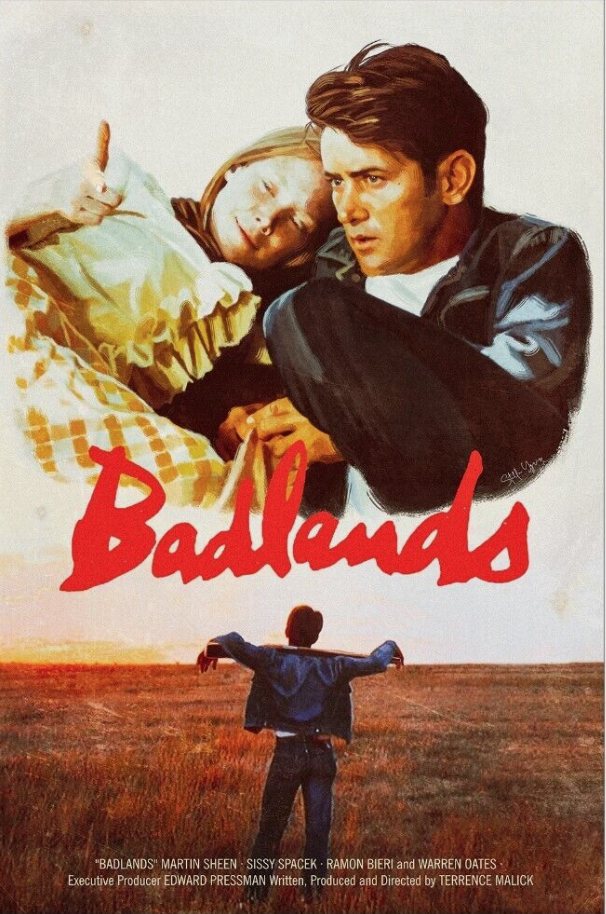
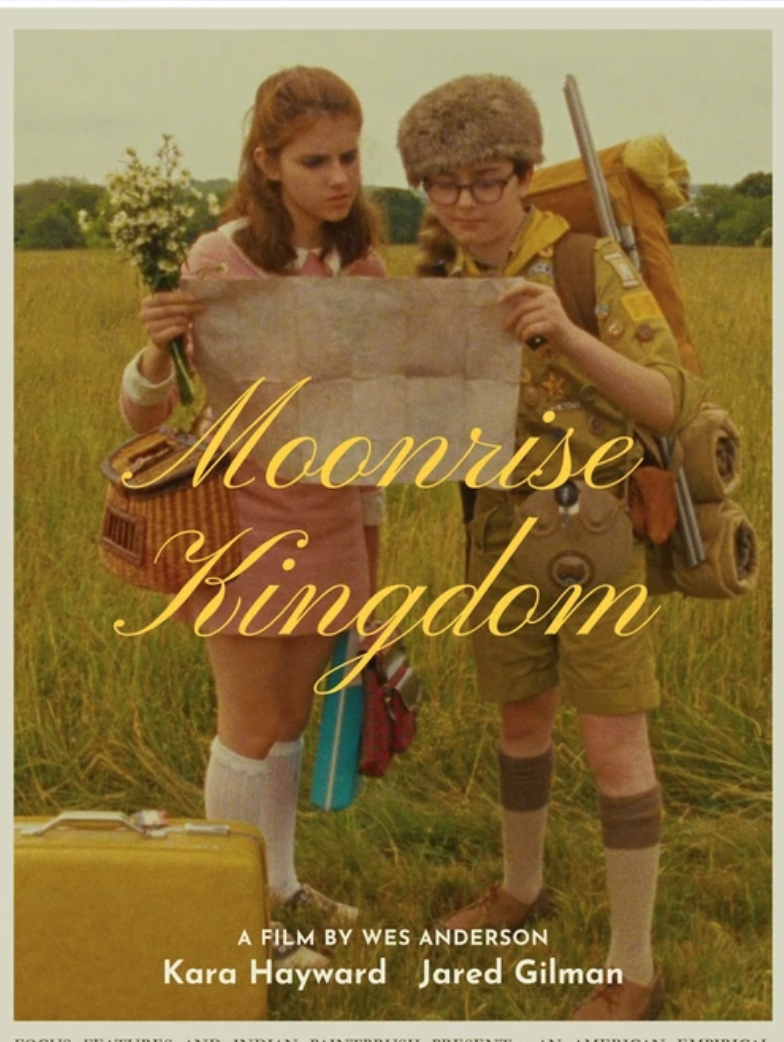
So it suddenly occurred to me, because of today’s date in history, that Moonrise was an homage to Terence Malick’s Badlands, about the two teen killers, and I am fond of Malick. I once wrote a big essay about his Days of Heaven, with Richard Gere, of whom I am not fond.
Just one similarity involves goofy dances.
When I realized the connections, I had to share it with my wife.
Elizabeth looked at me oddly. Heck, I looked at me oddly. Then I did a Google and found six or seven other people, some of them film critics, who’d already made that connection.
Two mixed-up and misunderstood kids, kind of vaguely in love but clearly devoted to each other, some random violence (a stabbing with scissors in Moonrise) police pursuit (Bruce Willis is endearing as the cop in the Anderson film) and final standoff, on the prairie in the older film and on a rooftop in a driving rainstorm on the newer. Even writing this pains me, but a dog is killed, to no purpose and for no purpose, in each film.
Badlands, thanks to its succession of cars, is a picaresque film, moving in not very much time but through an immense amount of space, in a genre invented by Cervantes, but, thanks to our vastness, perfected in America–Huck Finn, The Travels of Jamie McPheeters, True Grit and The Good Lord Bird are just a few examples
So maybe I’m not exactly Hazel after all (he was among many children and his Mom was tired the day she named him).
Maybe almost best of all, Badlands was the film whose introductory music, “Gassenhauer” (“Street Song”) enchanted me. So here it is, in the YouTube link below. There are a couple shootings in the video montage, so be advised. But this film remains indelible in my memory. So are Malick’s images of the American countryside. And, just one more point? Without all that blood dripping down her (Carrie), Sissy Spacek is luminous.
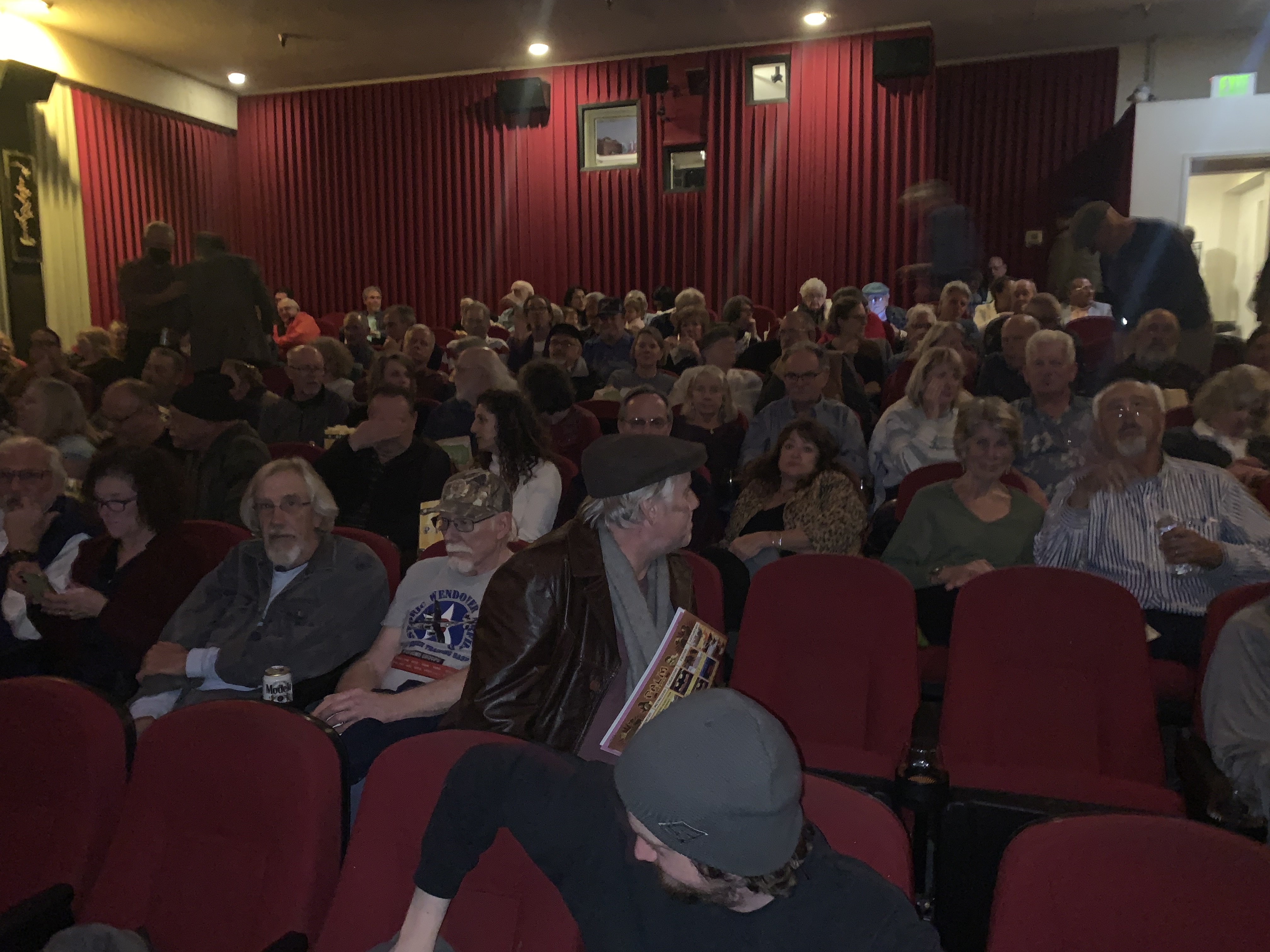
Thomas and I were among many guests at the Palm Theater for a screening last night, courtesy of the theater owners and also David and Naomi Blakely, because David’s father, Everett,is among the fliers featured in this Apple TV Spielberg/Hanks miniseries.
David was a warm and generous host and, best of all, his Mom, now 101, joined us along with other heroes of mine, including Dan and Liz Krieger, writer Tom Fulks, fellow historian and fellow TR fan John Ashbaugh, military historians Erik Brun and Preston King, the Central Coast Veterans Museum’s Bart Topham and world traveler/radio correspondent extraordinaireTom Wilmer.
Thank you, David and Naomi.
That’s my boy!
As to the miniseries—we saw the first two episodes—it was excellent, beautifully photographed, by turns harrowing, inspirational and funny, and it was all about men who in their late teens or early- to mid-twenties who fought a war that was unbelievably dangerous. We saw airmen wounded—including from frostbite— in last night’s screening. I was reminded that for every American infantryman killed in World War II, three were wounded. For every American airman wounded, three were killed.
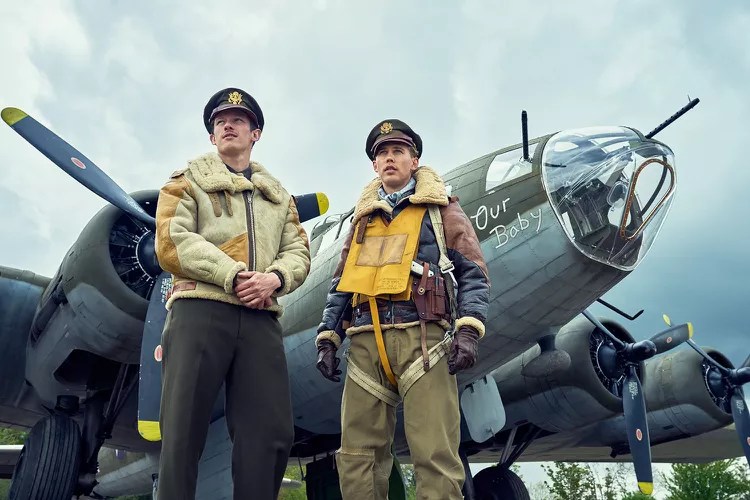
Collum Turner and Austin Butler
Two friends are at the heart of the first two episodes. Major Bucky Egan (Collum Turner) is mercurial, a grand and extravagant drinker, whose anger comes explosively. His friend, Major Gale “Buck” Cleven (Austin Butler, Academy Award winner for Elvis) is stoic, reserved, unbelievably cool under fire. It’s the same kind of dynamic that made Kirk and Spock and many years later (the film based on O’Brian’s novels, Master and Commander) Aubrey and Maturin work so well.
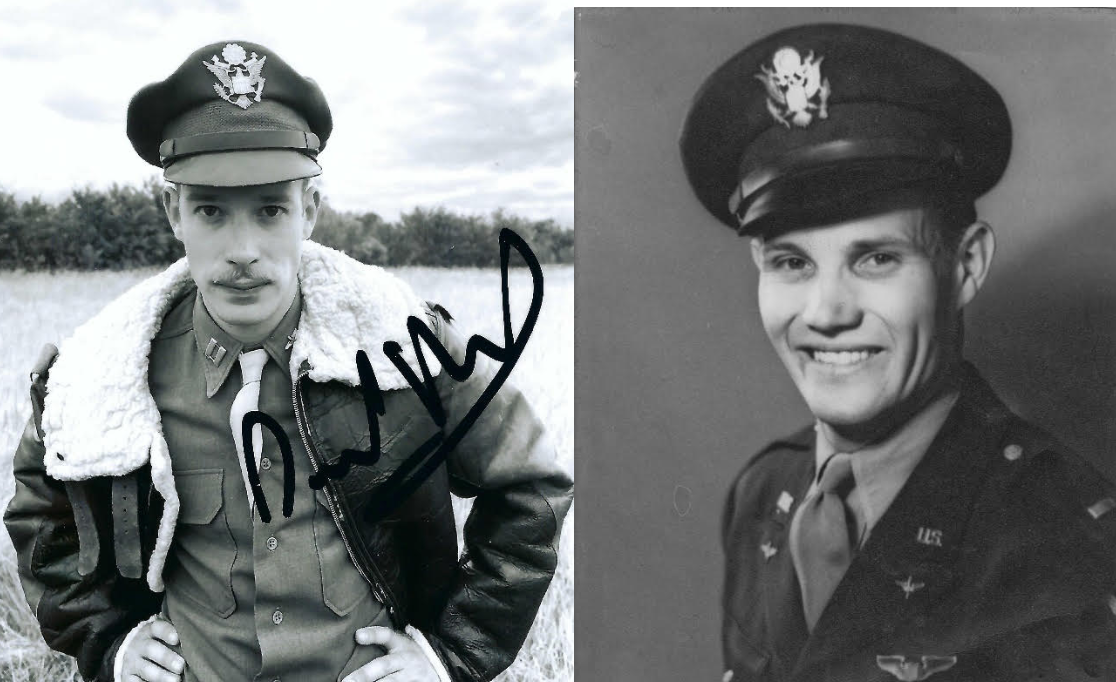
And, even though he was hidden behind his oxygen mask, there was Ev Blakely, the kind of man who, in later years, worked in the shop in the garage of his San Luis Obispo home to help Boy Scouts finish their Eagle projects or boys and girls build Christmas gifts for their parents. He was a warrior with a heart called to service, including to children.
David Shields as Maj. Everett Blakely
There were many things that struck me about the showing, and I was profoundly touched by them. In no particular order:
Grommet: The wire that gave an officer’s hat its stiffness was removed in the Army Air Forces. You couldn’t get your headphones around a grommetted hat, but the unintended side effect was a kind of rakish look that, I guess, charmed young women, and U.S. Army officers in World War II already wore uniforms that were so handsome that the Army has recently brought them back.
The “pinks and green” officer’s uniform. One—Army Air Forces Gen. James Doolittle–has liberated his service hat from its grommet.
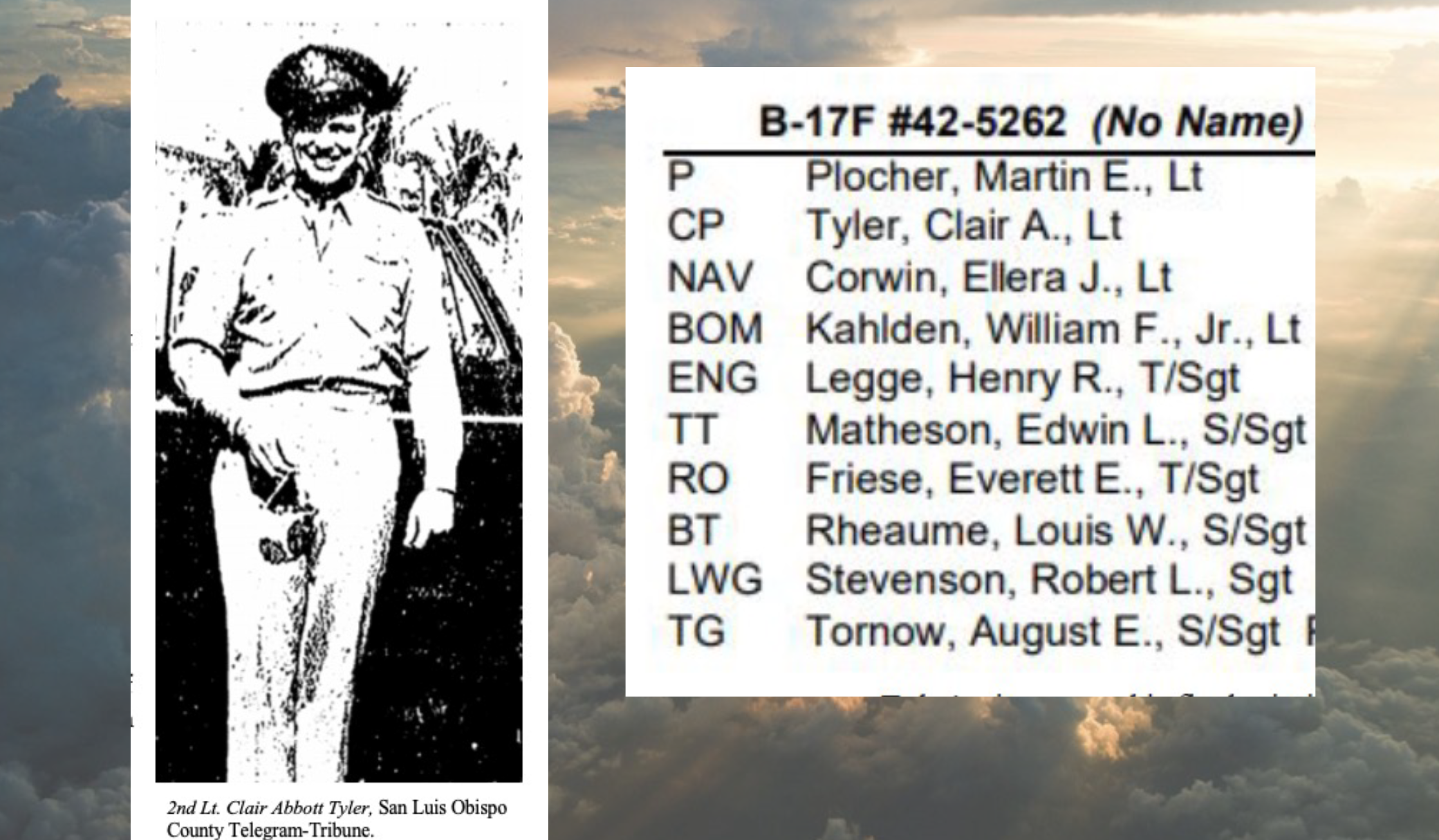
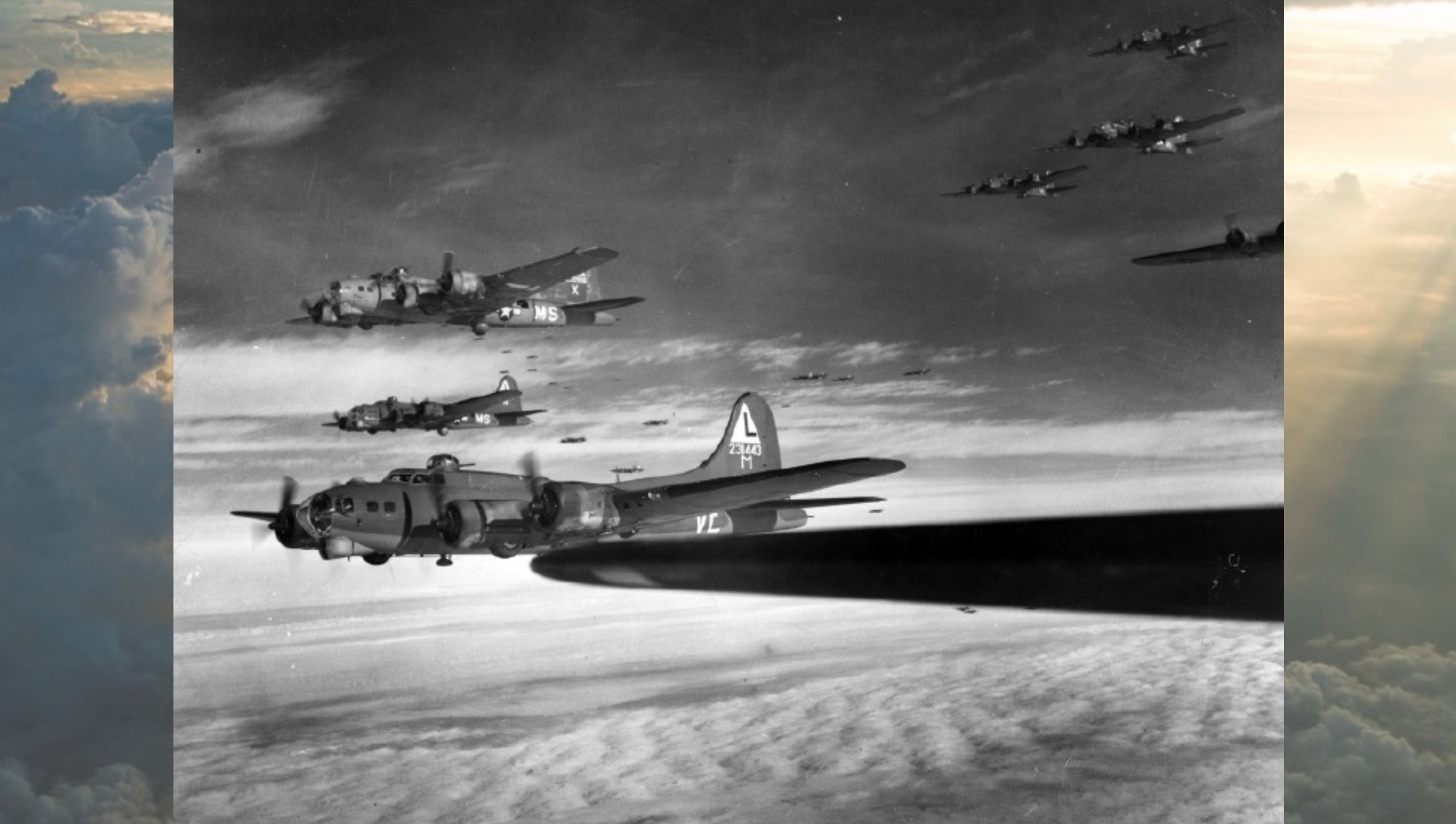
The B-17F’s weakness: Masters is set early on in the American air war, in 1943, and Ev Blakely and his fellow pilots flew the B-17F, a superb airplane with a fatal weakness: Only one machine gun in the plexiglas nose. So German fighter pilots learned quickly to attack B-17s head-on, and one of our county’s first air casualties, Clair Abbott Tyler, was a co-pilot killed in precisely this kind of attack, from a Focke-Wulf 190 that came out of the sun.
Tyler’s crew on his last mission. Alex Madonna had been the best man at Tyler’s wedding.Tyler’s B-17 in its position that day.B-17Fs from Tyler’s bomb group.A cannon shell from an FW-190 like this one killed Tyler in his seat.The “chin turret” that gave the B-17G more firepower forward.
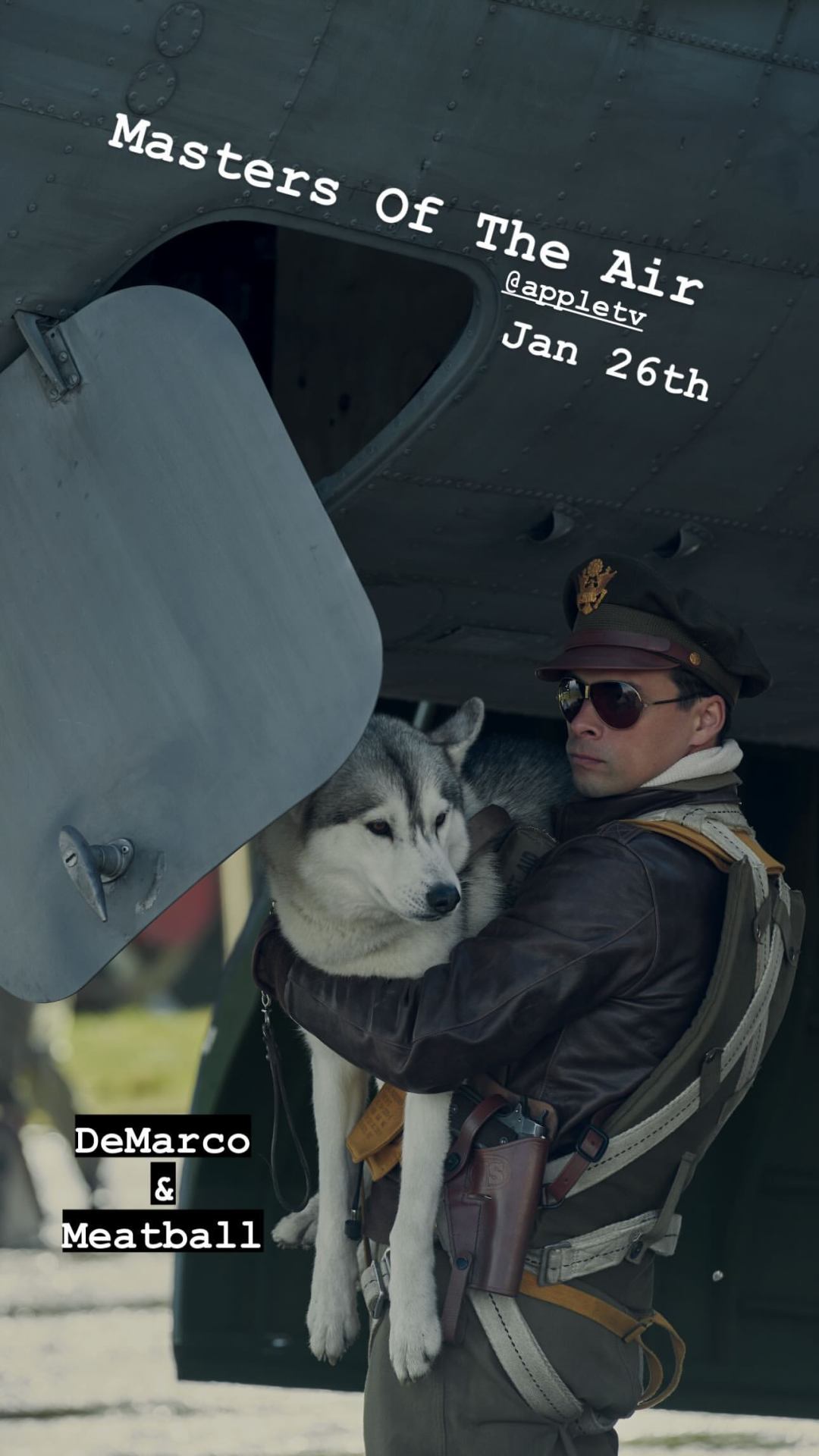
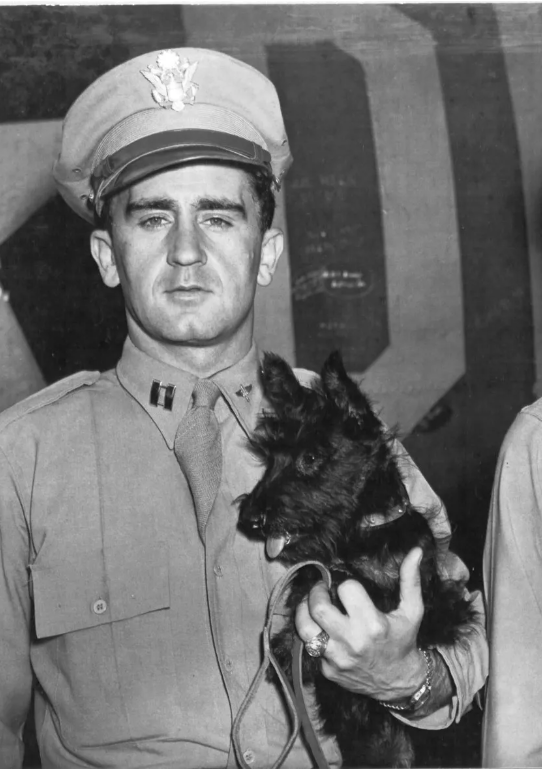
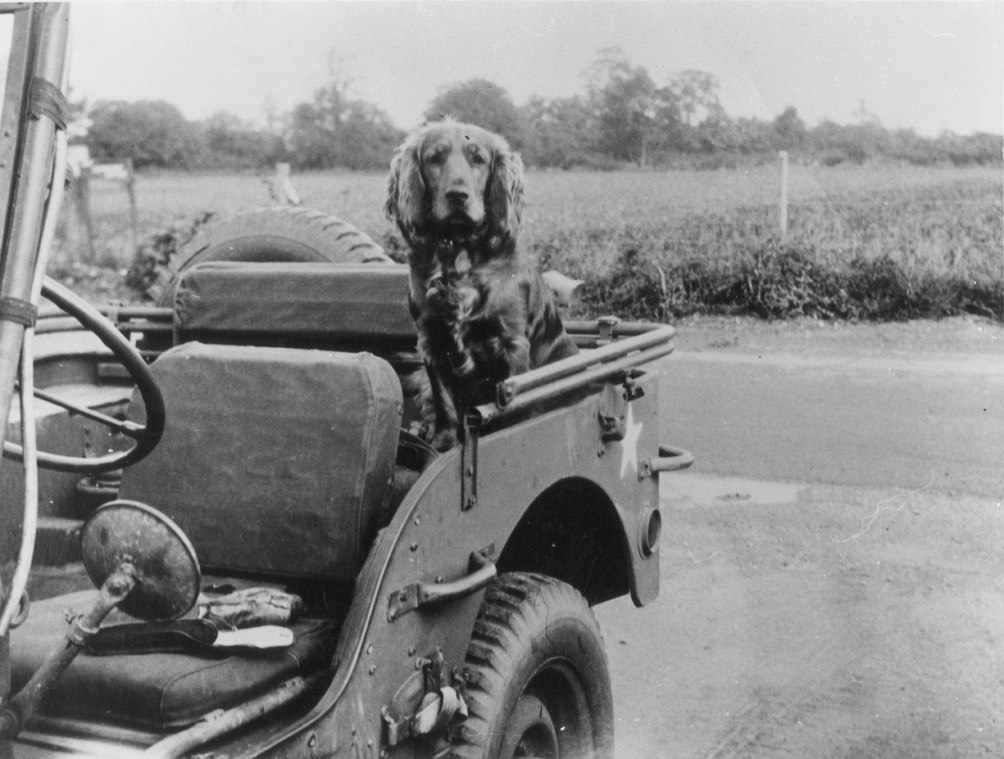
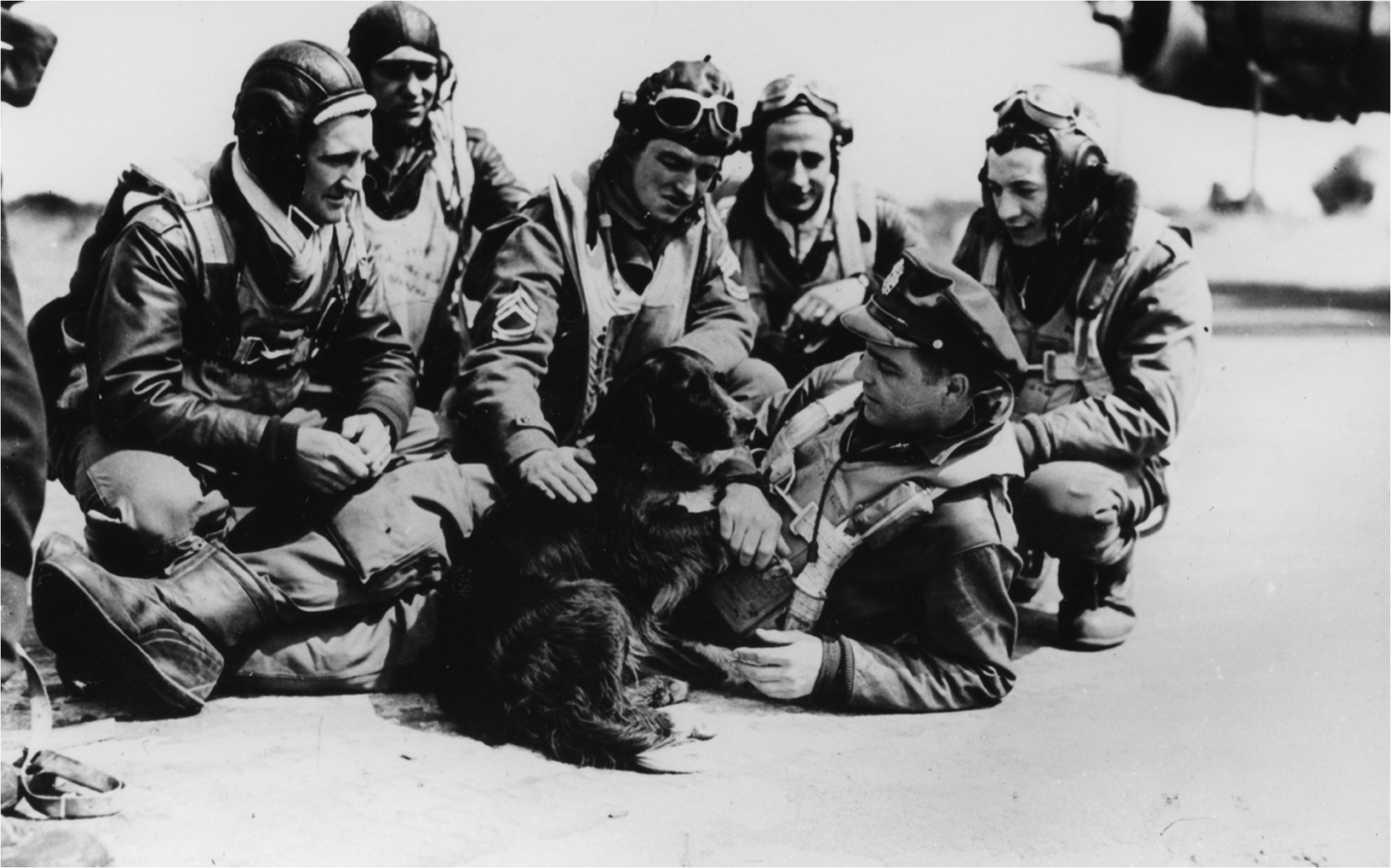
Dogs: Meatball, a gorgeous Siberian Husky, makes an appearance in the first episode. Airmen were devoted to their dogs—one of the most famous, the Scottie named Stuka, was Capt. James Verinis’ dog and the mascot of the B-17 Memphis Belle. She was in a London pet shop window and for Verinis, it was love at first sight. Stuka became a Yank after the war.
The historian for one bomb group told me that dogs not only heard the B-17s coming home first, but ground crews knew an aircrew was safe when a dog became noticeably excited. She’d recognized the individual pitch of her human’s engines. No greater love.
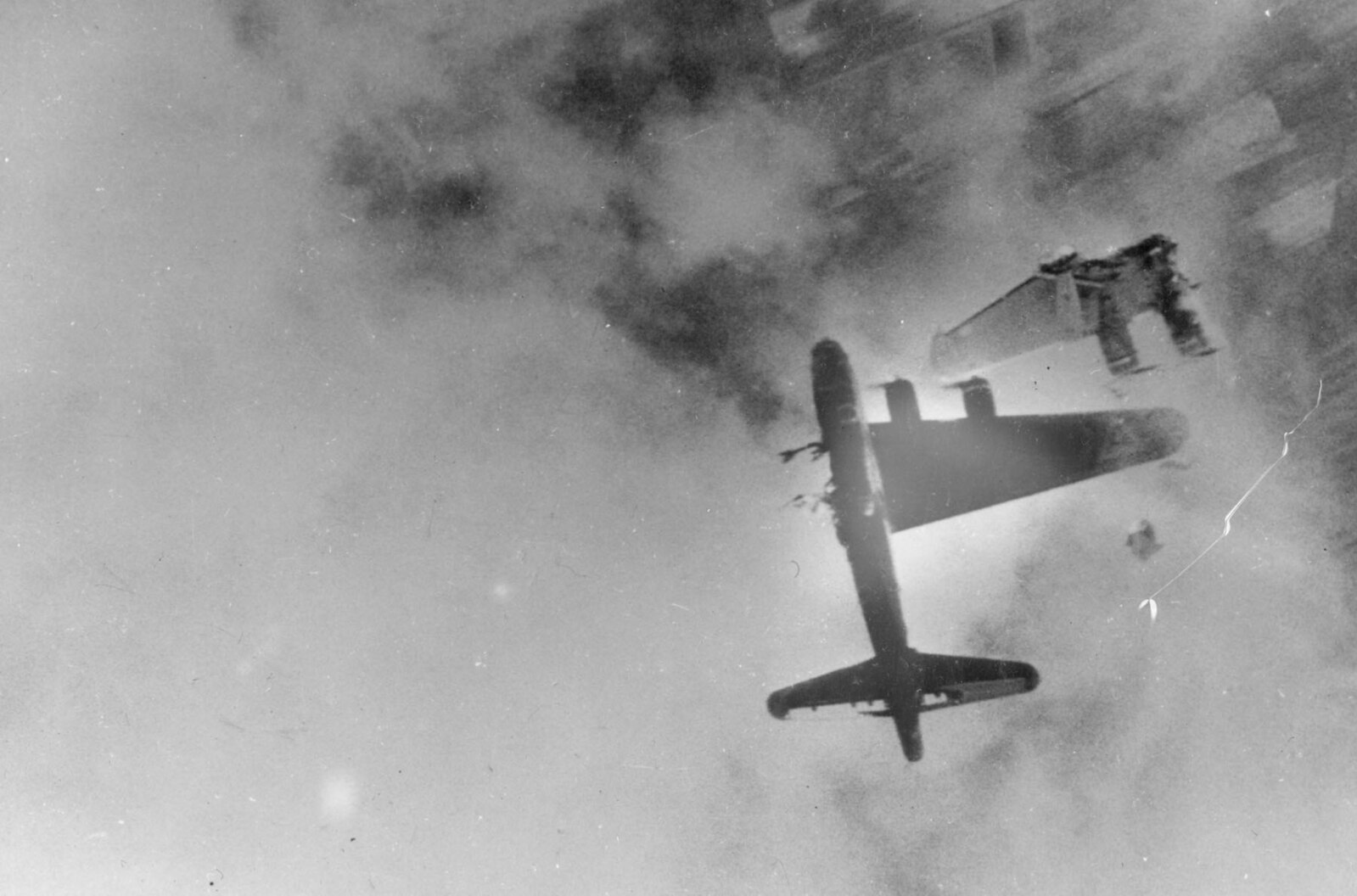
Losing the B-17: Maj. Blakely’s 100th Bomb Group suffered appalling losses—they were the “Bloody 100th”—and as many airmen were killed in World War II as Marines were killed in their deadly march across the Pacific, from Guadalcanal to Okinawa. It’s hard to watch a ship carrying ten young men, all between sixteen (some gunners were also liars in their enlistments) and twenty-two, burst into flames or come apart in midair, even in computer-generated images. On one mission, Henry Hall of Cayucos, saw the following: a shot-up B-17 lazily dropped one of its wheels before beginning its fatal plunge. On the way down, it clipped two more B-17’s and they went in, too. Another bomb wing, off-course and late, came in behind Hall’s and they were pummeled. Ev Blakely’s 100th Bomb Group sent in sixteen B-17s on that mission. Only one came home.
This B-17 was “The Wee Willie”
The Target: Two of the 100th’s missions in the first episodes are attacks on German U-boat pens, one near Bremen and another in Norway. The impact of the U-boat on transatlantic shipping was such that in a story that stayed with my father, he gifted a British family with a bag of oranges in 1944. The mother of the family burst into tears. They hadn’t seen oranges, thanks to the U-boats, since 1939.
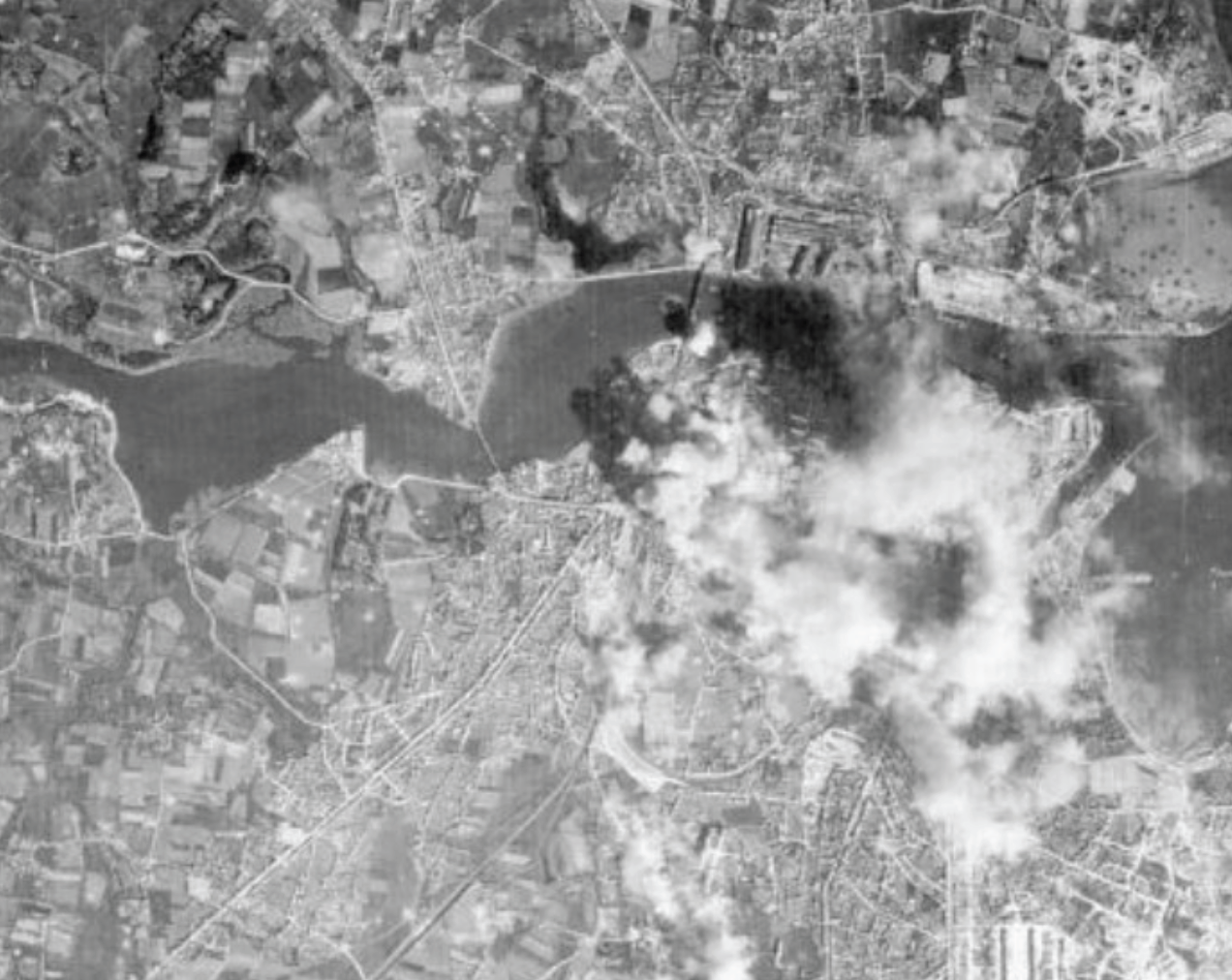
Clair Tyler was killed after an attack on the sub pens at Lorient, France. Below is a strike photo from his last mission and next to it are the sub pens. Today. They were indestructible—in fact, the Lorient pens were the base for French submarines four decades after World War II had ended.
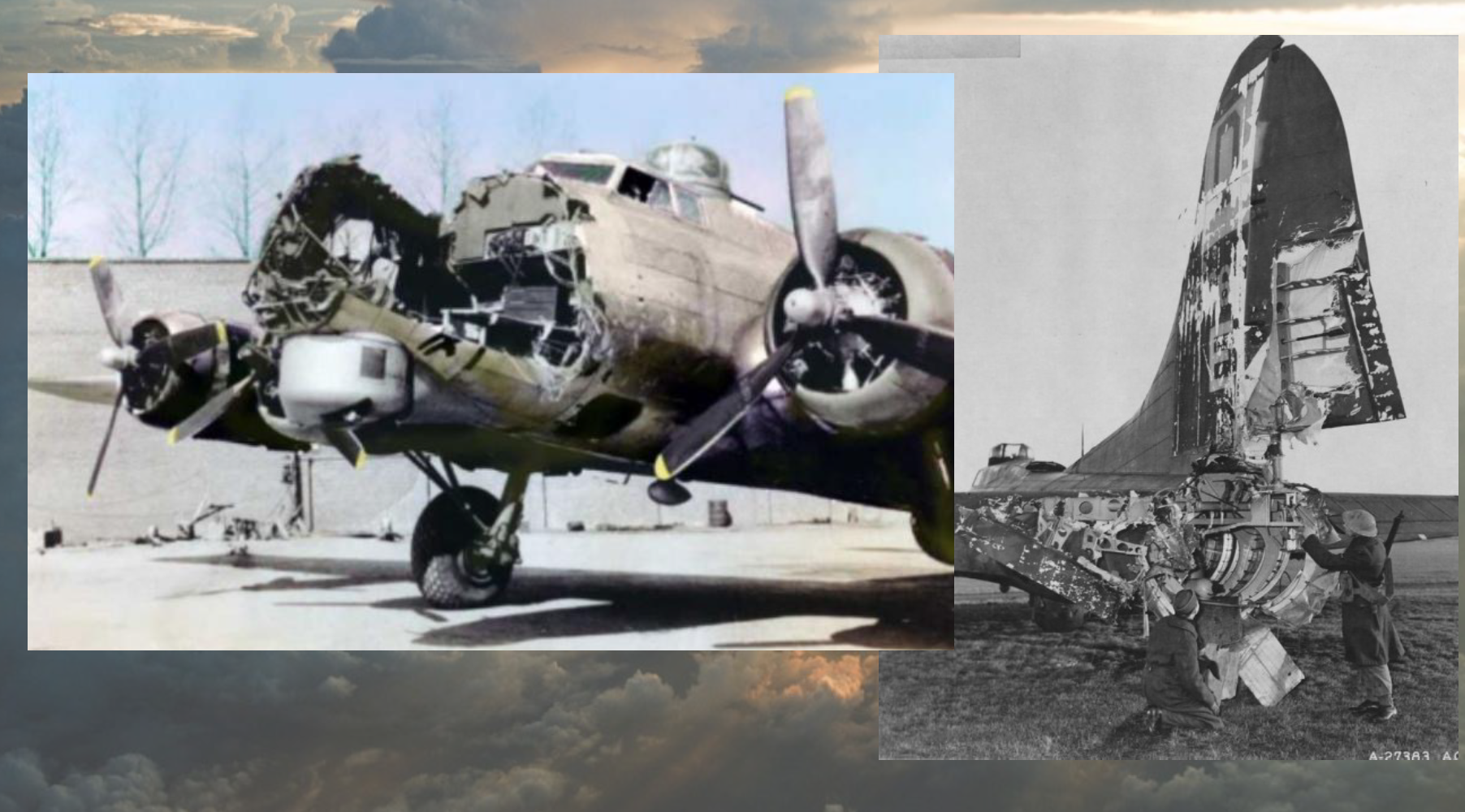
Loving the B-17: Its partner among heavy bombers, the B-24, was a little faster, carried a bigger payload and had a longer range, and there were more of them. But the B-24 lacked the B-17’s graceful Art Deco lines and it was a beast to fly—an analogy might be that the B-24 lacked the B-17’s “power steering,” and pilots of the former sometimes lost five to ten pounds on a typical mission. But the B-17’s most admirable trait may have been its ability to absorb punishment. Maj. Cleven is stunned by the damage German explosive shells (flak) have done to his ship on his return to the airfield at Thorpe Abbots. These planes returned home, too.
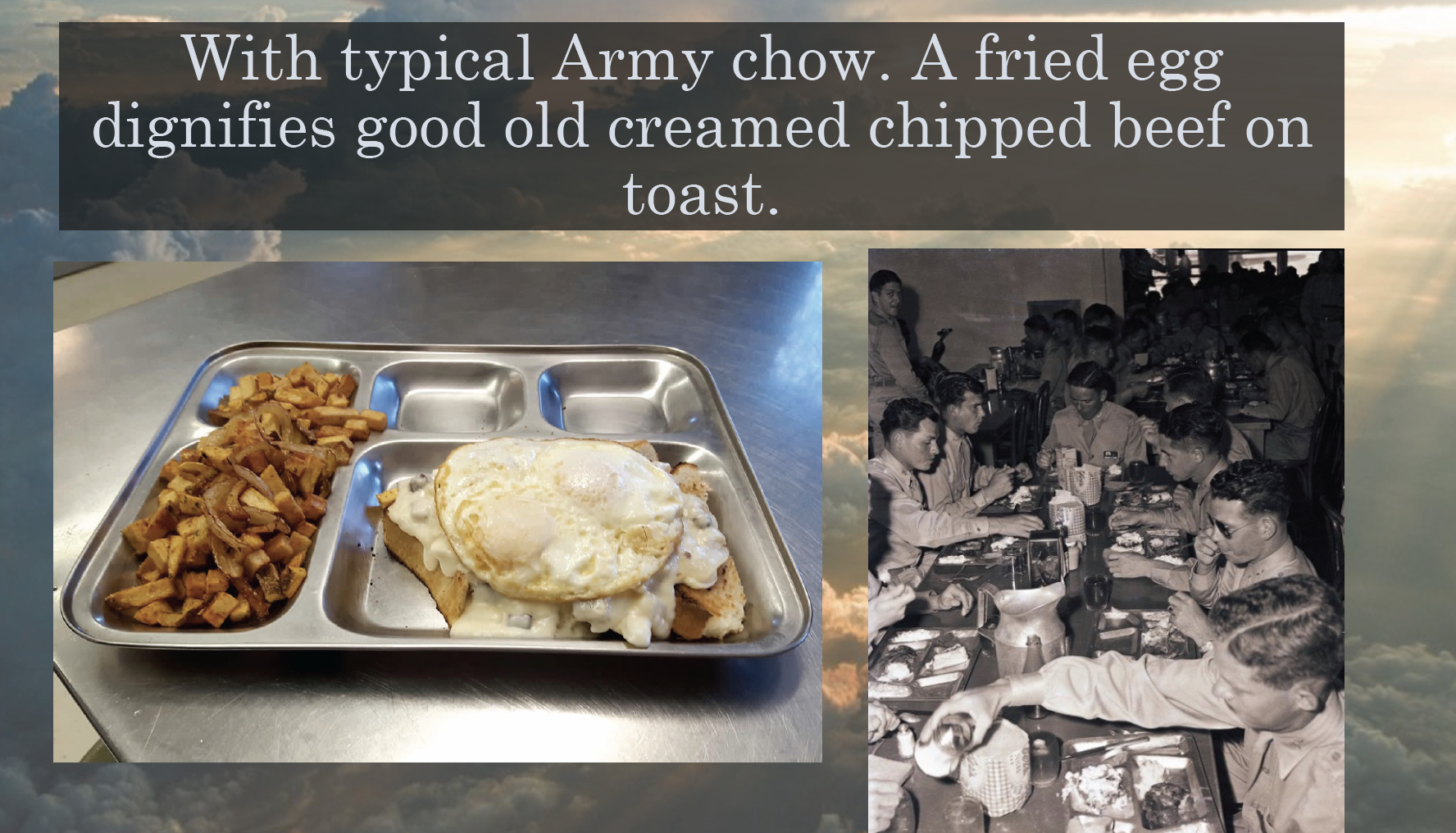
Green eggs and Spam: One of the funniest lines in the first episode is a speculative comment on the age of the powdered eggs airmen ate. This passage from Central Coast Aviators also comments on the food airmen ate:
...[E]en in the AAF, the green-hued powdered eggs, along with the ubiquitous Spam, were breakfast standards, and creamed chipped beef on toast—referred to as “shit on a shingle”—followed airmen across the Atlantic from the air bases stateside where they’d first encountered what seemed to be, to the military, a perverse culinary masterpiece.
Nine thousand Army Air Forces cadets went through Hancock’s training program, on the site of today’s college, during the war. Here are some Hancock cadets at table with you-know-what on shingle, surmounted by a fried egg, in the other photo.
British children: David made one of the best points of the night in his introduction. The series pays attention to the ground crews who kept the B-17s flying. While the aircrews slept—fitfully—before a mission, the ground crews were up all night arming, fueling, tuning engines, fine-tuning electrical and hydraulic systems. The most prized crew chief in the episode is a nineteen-year-old corporal who’s struck up a friendship with two British kids. In truth, while other Brits may have resented the Yanks, who could sometimes be obnoxious (“Overfed, overpaid, oversexed and over here”), children adored them. And their Hershey bars. If takeoff came at a decent morning hour, the perimeter fence around an airfield would’ve been lined with schoolchildren, there to wave goodbye to “their” Yanks.
In 2019, the city of Sheffield commemorated the crew of a crippled B-17G returning from a mission in 1944. As the pilot began to bring his plane down, he pulled up to avoid a park crowded with children. The bomber came down somewhere else. There were no survivors.
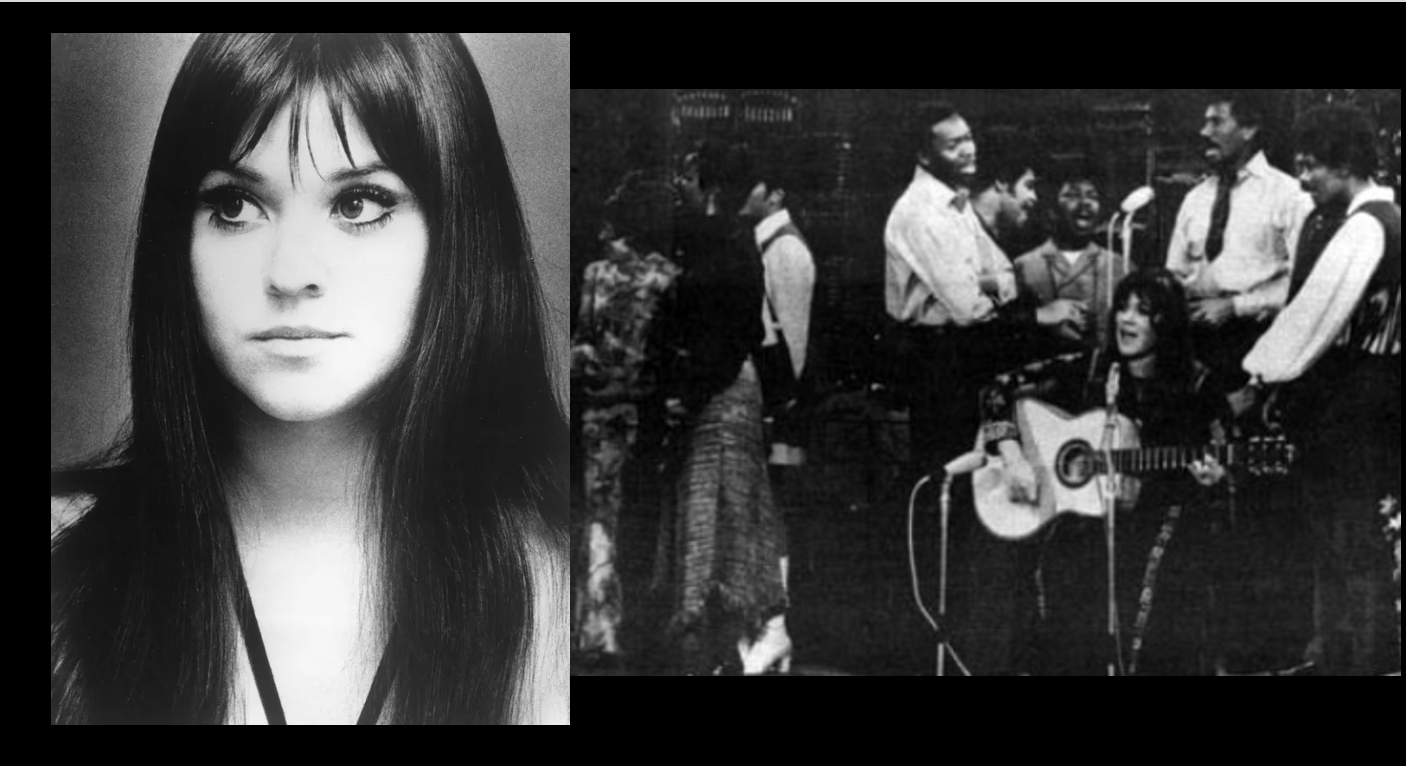
American singer Melanie, born Melanie Safka-Schekeryk in Queens of Ukrainian and Italian parents, died Tuesday at 76. If you have no idea who she is, let me introduce you to her at twenty-three, performing with the Edwin Hawkins singers on a Dutch TV show. While the audience, more than half over sixty, looks as if it were lifted from a Monty Python sketch, they eventually come around.
So I will miss her terribly, and so will, among many, Keith Richards and Miley Cyrus, with whom she sang. She might well be singing with Johnny Cash right now; the two performed “Silver Threads and Golden Needles” together.
And if you have no idea who the Edwin Hawkins singers are, let me give you a wee hint from Sister Act 2. The young soloist is Ryan Toby.
But it was the choir backing Melanie, the Edwin Hawkins singers, who first released this song in 1967. Here they are. The lead singer is Dorothy Combs Thompson.
And, of course, there is no way anyone could stop Aretha Franklin from covering this marvelous hymn. When she did, it was with the legendary Mavis Staples. Someone put together this video, intercut with Aretha (call) and the wonderful images of the congregants (response).
Melanie grew up in Queens, Dorothy in Texas, and Aretha is singing in the church where her father was pastor, in Detroit. We are in troubled times now, and perhaps music is one way we can navigate them. American music is so rich and so varied, but, after all, e pluribus unum–“In many, one.” Melanie’s song reminded me of that.
When I was little, we had a reflecting telescope that we’d set up in the back yard of our home on Huasna Road, before the city lights crept east to obscure the sky. You don’t mind the cold when you can see the lips of craters or the jagged mountain-tops on a Moon that wouldn’t be visited for five more years.
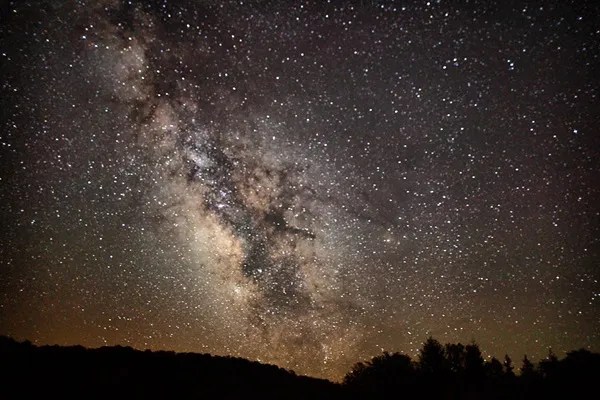
I’ve written, too, about getting home from long trips—say, to Dad’s nephew John in Glendale or to his mother Dora, in a Bakersfield rest home– climbing wearily out of Dad’s 1958 Oldsmobile 88, and the Gregory kids staring, open-mouthed, at the vastness of the Milky Way above us.
Elizabeth and I bought a ’78 Westphalia VW bus, with the pop-top roof, and I miss it so much because camping overnight at Lopez with our boys reminded me of how beautiful the stars are.
And tonight, it’s moon-bright with scudding clouds, which I discovered while taking out the recycling. How mundane. But then. since I love history so much, I thought about these things.
The Northern Chumash, the yak titʸu titʸu yak tiłhini (ytt) people, take their name from the Moon. They were sophisticated astronomers. The time has just passed, the Solstice, when they prayed fervently and sang songs that urged the sun to return, and it always did, which meant that steelhead trout likewise would return and so would mule deer and jackrabbits, and so, too would the oaks—old even then—as they began again to drop the acorns that became the bread of the ytt people. Maybe their prayers sounded like these ytt people from three hundred years later:
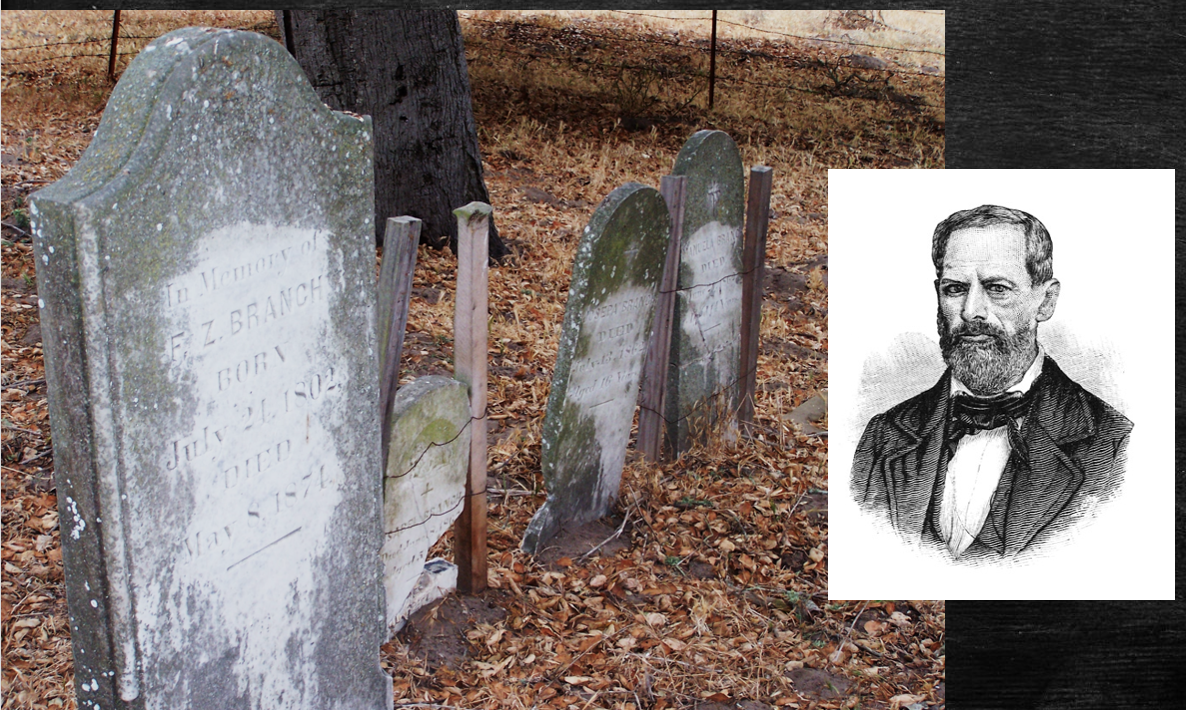
In 1862, Francis Branch rode hard from San Francisco to Arroyo Grande on receiving word that his little girls were sick. He might have seen a moon like tonight’s on that ride. By the time he arrived at Rancho Santa Manuela, in the Upper Valley, exhausted even for a man of his energy, three of his girls were dead. They are buried next to him. If the Moon had been anything like tonight’s on that ride south, he would never see it on nights like tonight without missing his daughters.
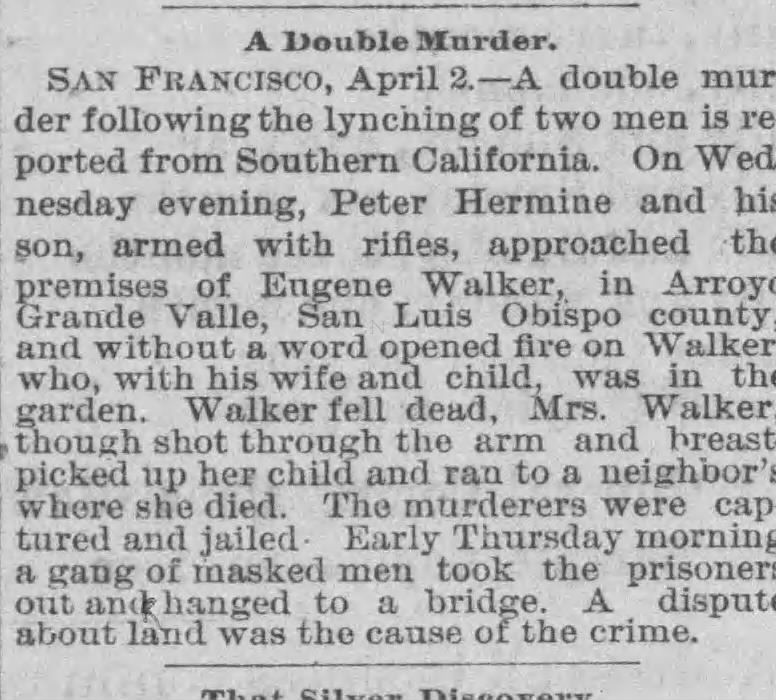
The Moon wasn’t like tonight’s at all on Wednesday, March 31, 1886. That would have suited the men with handkerchiefs over their faces fine, because their work was done best in the dark. That was the night they lynched a father and son, suspected killers, from the Pacific Coast Railway Bridge over Arroyo Grande Creek, near the foot of Crown Hill. Schoolchildren found the bodies the next day—April Fool’s Day—as they walked to school.
Buffalo, New York, April 2, 188
But the Moon would’ve been this bright on the night of December 7, 1941—it was 93% illuminated—as it is tonight. Little boys that night might have seen Japanese attack planes in the shapes of the scudding clouds, and they would have seen their imaginary foes easily everything else was was so dark. The blackout had been announced, with the same terrifying urgency as 1938’s radio broadcast of War of the Worlds, and then the Pacific Coast stations, including San Luis Obispo’s KVEC, went off the air. For little boys, what made that night terrifying is that the only inside light came from the big family radio’s hot vacuum tubes with their brightness creeping out from the shutters in the big radio’s cabinet, the only light in a darkened home. At the same time, the only sound, for a family deep in shock from the news, came from radio announcers, who were saying that enemy planes, phalanxes of them now, were headed for San Francisco.
If you, as a little boy, went outside your darkened home, you could wait for them to appear, which they finally did, if only in your imagination, and they were vivid there, in the guttural rumble of a thousand Mitsubishi 14-cylinder engines, as they turned in vast squadrons, one to the north, the other to the south, to devastate the big cities of you’d known, San Francisco and Los Angeles, on family trips in the big Ford your father drove.
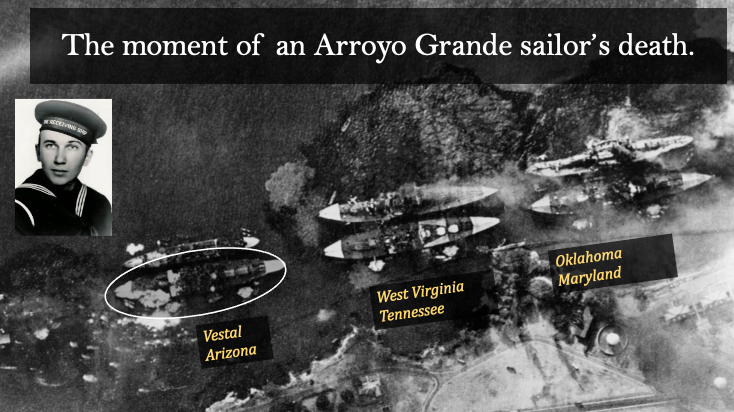
Jack Scruggs, who grew up in Arroyo Grande, was the USS Arizona’s trombonist. As the band prepared to play the National Anthem, theconcussions from these explosions off Arizona’s stern killed him. The great ship blew up after a direct hit forward about twelve minutes later.
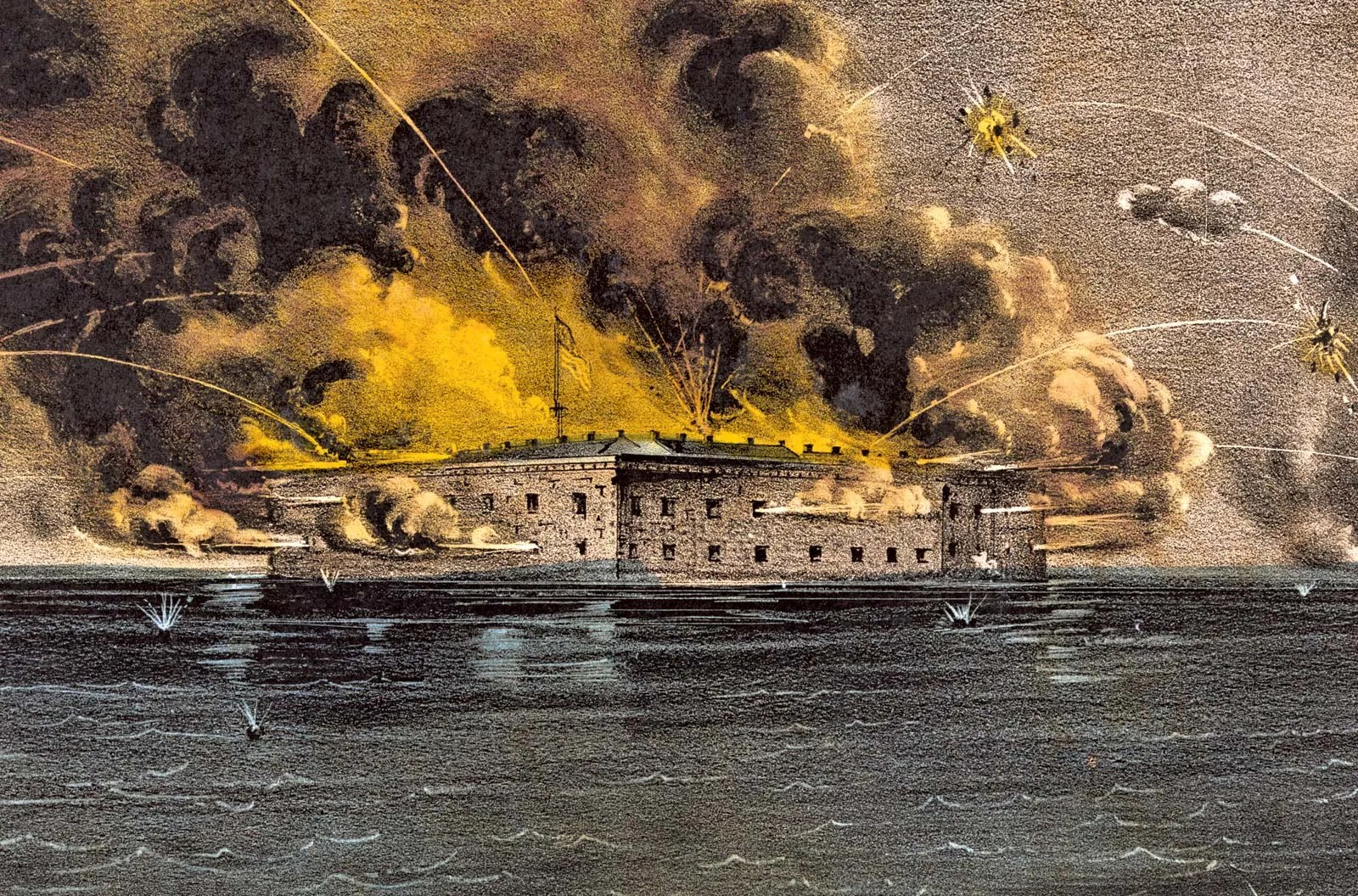
And so that Moon has come back to me tonight. We are in no less danger tonight than we were on the night of December 7. Evil forces intend to harm us, capitalizing on the very real fear that our government has abandoned us. We are in no less danger tonight than we were on the night after the December 7 attack or in the morning dark when the cannonade of Fort Sumter began in April 1861.
But in my momentary pause to regard the Moon tonight, in perfect silence, as Whitman once wrote, brought me comfort. Its brilliance will never leave us. Now it’s time to understand that we can never leave each other, even if our affection for each others waxes and wanes as surely as does the Moon.
Francis Branch’s America had already come apart by the late summer of 1862, when he learned about the smallpox that threatened his little girls. What he needed to focus was beyond politics, he was instead fixed on the road ahead in the dark ahead. His horse’s breathing was labored and his own breath would have struggled to keep up with his effort. He had to fight the pain in his back and his thighs and in the soles of his feet, trapped in their stirrups. He was riding hard to come home, in the light the Moon offered him, to the people he loved.
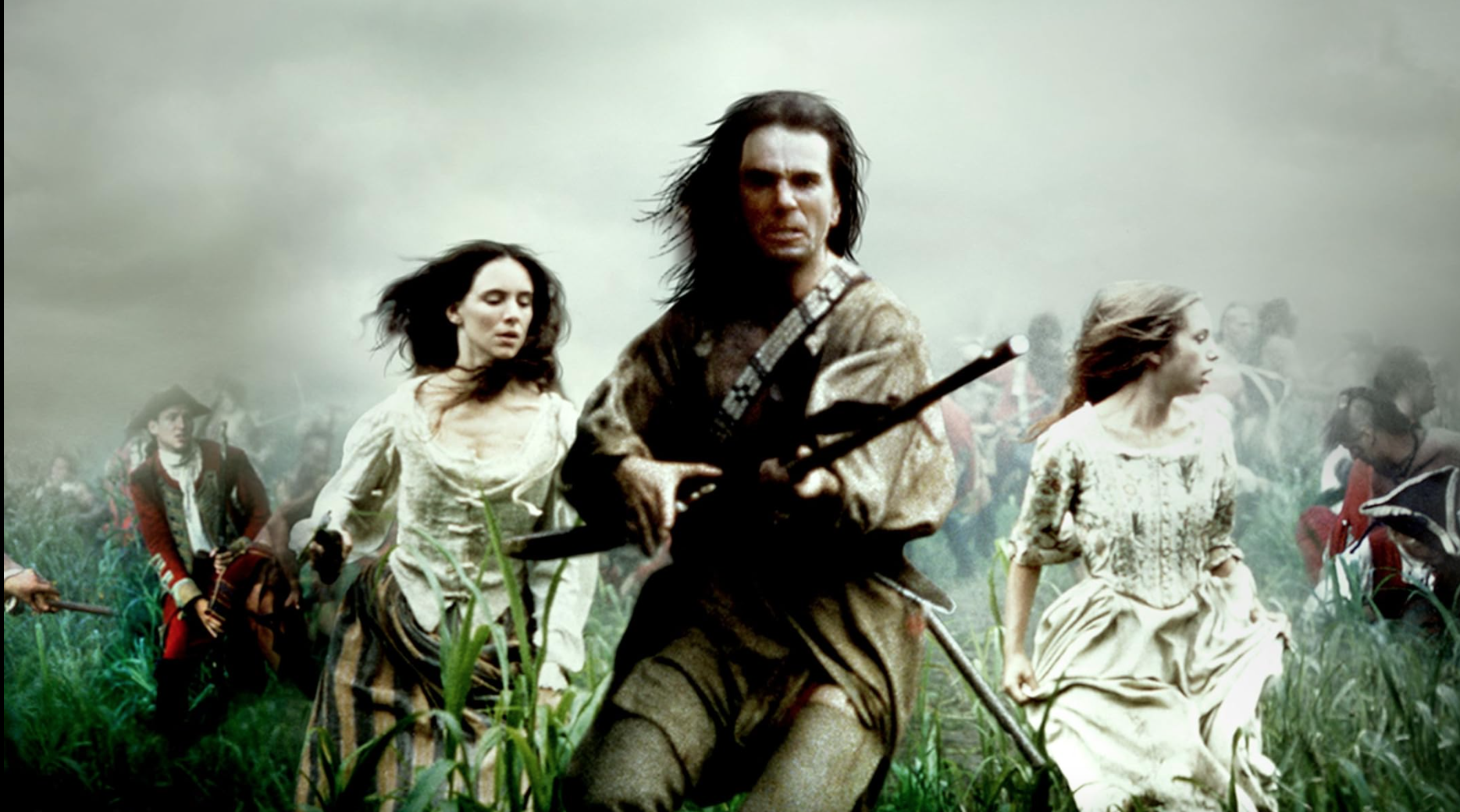
I am sorry, “Moon River” and “The Days of Wine and Roses” and “The Theme from Shaft” AND the Lawrence of Arabia theme. It’s this one, and it can’t even settle on a name. Is it “The Kiss” (it was a humdinger, in the movie) or “The Gael” or is it “Promontory” or is it simply “The Theme from Last of the Mohicans?” I don’t know and it doesn’t matter The melody comes from a Scots songwriter, Dougie McLean, and it was adopted for the 1993 Daniel Day-Lewis film, ever so much better than Fenimore Cooper’s, book by Trevor Jones and Randy Edelman. It brought out both the Irish and the Lowland Scots in me.
There have been so many treatments. Let’s start with a lone piper:
But, heck, why settle for ONE piper when a BUNCH will do? Here are the Royal Scots Dragoon Guards, and you get views of breathtakingly beautiful Scotland. You should not be overly fond of trees, you understand. Cliffs and gorse and heather and the occasional stag the size of an Indian elephant and seaside towns with doorways painted bright red and the smell of beached kelp. That’s more what Scotland’s like. And, if you feel the need to punch out Edward Longshanks, the second, shorter video features pipers at the William Wallace memorial at Bannockburn.
Here we go:
Jenny O’Connor is also called “The Hot Violinist,” which makes me sad, because she is also gifted, and the film’s theme is ideal for the violin
But, true, the same principle goes for violins as it does for bagpipes. Why not a bunch of violins?
Wait! We need more strings! Maybe a cello? The Noricum Group:
A Native American flute. Lovely:
WAIT! Where are the flippin’ DRUMS? Well, for a semi-terrifying take on the theme, here’s Clanadonia:
Whoa. I think I need to chill a little after this version. Let’s try the Prague Film Orchestra:
You may disagree with me on the theme, but the fact remains that the film is far better than the book could ever be. If you doubt that, let me quote from Mark Twain’s delightfully wicked essay, “Fenimore Cooper’s Literary Offenses:”
There are nineteen rules governing literary art in the domain of romantic fiction—some say twenty-two. In Deerslayer Cooper violated eighteen of them. These eighteen require:
1. That a tale shall accomplish something and arrive somewhere. But the Deerslayer tale accomplishes nothing and arrives in the air.
2. They require that the episodes of a tale shall be necessary parts of the tale, and shall help to develop it. But as the Deerslayer tale is not a tale, and accomplishes nothing and arrives nowhere, the episodes have no rightful place in the work, since there was nothing for them to develop.
3. They require that the personages in a tale shall be alive, except in the case of corpses, and that always the reader shall be able to tell the corpses from the others. But this detail has often been overlooked in the Deerslayer tale.
4. They require that the personages in a tale, both dead and alive, shall exhibit a sufficient excuse for being there. But this detail also has been overlooked in the Deerslayer tale.
5. They require that when the personages of a tale deal in conversation, the talk shall sound like human talk, and be talk such as human beings would be likely to talk in the given circumstances, and have a discoverable meaning, also a discoverable purpose, and a show of relevancy, and remain in the neighborhood of the subject in hand, and be interesting to the reader, and help out the tale, and stop when the people cannot think of anything more to say. But this requirement has been ignored from the beginning of the Deerslayer tale to the end of it.
6. They require that when the author describes the character of a personage in his tale, the conduct and conversation of that personage shall justify said description. But this law gets little or no attention in the Deerslayer tale, as Natty Bumppo’s case will amply prove.
7. They require that when a personage talks like an illustrated, gilt-edged, tree-calf, hand-tooled, seven-dollar Friendship’s Offering in the beginning of a paragraph, he shall not talk like a negro minstrel in the end of it. But this rule is flung down and danced upon in the Deerslayer tale.
8. They require that crass stupidities shall not be played upon the reader as “the craft of the woodsman, the delicate art of the forest,” by either the author or the people in the tale. But this rule is persistently violated in the Deerslayer tale.
9. They require that the personages of a tale shall confine themselves to possibilities and let miracles alone; or, if they venture a miracle, the author must so plausibly set it forth as to make it look possible and reasonable. But these rules are not respected in the Deerslayer tale.
10. They require that the author shall make the reader feel a deep interest in the personages of his tale and in their fate; and that he shall make the reader love the good people in the tale and hate the bad ones. But the reader of the Deerslayer tale dislikes the good people in it, is indifferent to the others, and wishes they would all get drowned together.
11. They require that the characters in a tale shall be so clearly defined that the reader can tell beforehand what each will do in a given emergency. But in the Deerslayer tale this rule is vacated.
In addition to these large rules there are some little ones. These require that the author shall:
12. Say what he is proposing to say, not merely come near it.
13. Use the right word, not its second cousin.
14. Eschew surplusage.
15. Not omit necessary details.
16. Avoid slovenliness of form.
17. Use good grammar.
18. Employ a simple and straightforward style.
Here’s the final scene from the film. The big mace is wielded by Russell Means (above), an Oglala Sioux activist who led the occupation of Alcatraz and Wounded Knee to make his people visible again.
The theme is also featured in the stunning opening scene. The animal’s death is heart-breaking, but the foot chase, and the tribute Means delivers at the hunt’s conclusion, ring true.
The “bad guy,” Magua, is played by the Cherokee actor Wes Studi, a favorite of mine. After this film came out, I saw Studi on PBS’s Reading Rainbow. He was reading a Native American version of “Cinderella,” a story that in different forms in many cultures. The children were transported by Studi’s skill and looked at him in utter and silent admiration. And affection.
Good stories live in children’s minds, and sometimes in adults’ as well, no matter how much damage the writer might do them. Good songs, I think, have that same immortality.
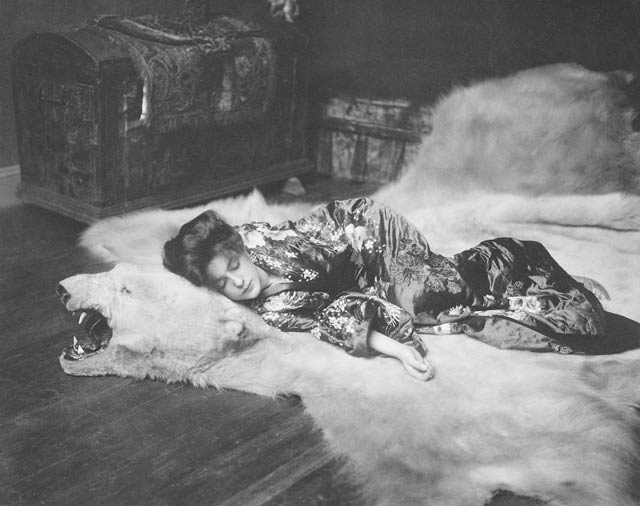
If you thought that something prurient was going to follow, you are wrong. Got your attention, though, right? And we shall return to Evelyn in just a moment. And yes, she was lovely, That was the problem.
I used to show, in my AP European History class, several episodes of The Day the Universe Changed, from the 1980s, narrated by English science historian James Burke, and this is why: He thinks like me. I am nowhere near that bright, but a typical episode of Day would take the viewer inside a French teaching hospital and then to Philadelphia, where Benjamin Franklin more or less invented hospitals, then to London laid low by cholera (the Thames stank so badly that Parliament’s window shades were soaked in lime chloride and then lowered), then to William Farr and the invention of London’s system of intercepting sewers and then to the Victorian mania for clean water (European spas) and for Victorian manly sport at British public schools and then you were back at the French hospital. He then tied the package. All these disparate events were connected. In fact, Burke who, thank God, is still with us, had an earlier show with that precise name: Connections.
Burke would stop only occasionally, to make himself a cuppa tea.
I think I enjoyed him so much because I recognized a kindred mind. And, mind, I am NOT saying that I’m as smart as James Burke. What I’m saying instead is that I think like him. I am not and never have been a linear thinker, moving from point A to point Z while shattering all the letters in between to finish my quest. Nossir. Nossirreebob.
I think laterally: I start with point A and that reminds me of something that happened to point Q—oh, and do you know that points Q and D are first cousins? and then to point R, because R was D’s tutor when she was a little girl. Eventually, we get to point Z and (most of the time) we finish our quest. But, if my mind were a Greyhound bus, it’d be a local, not an express. There are too many stops to make and things to see before I get to my destination.
Or, to put it another way, if my mind were a street, it’d be Lombard in San Francisco.
Allow me to use an example. Ahem:
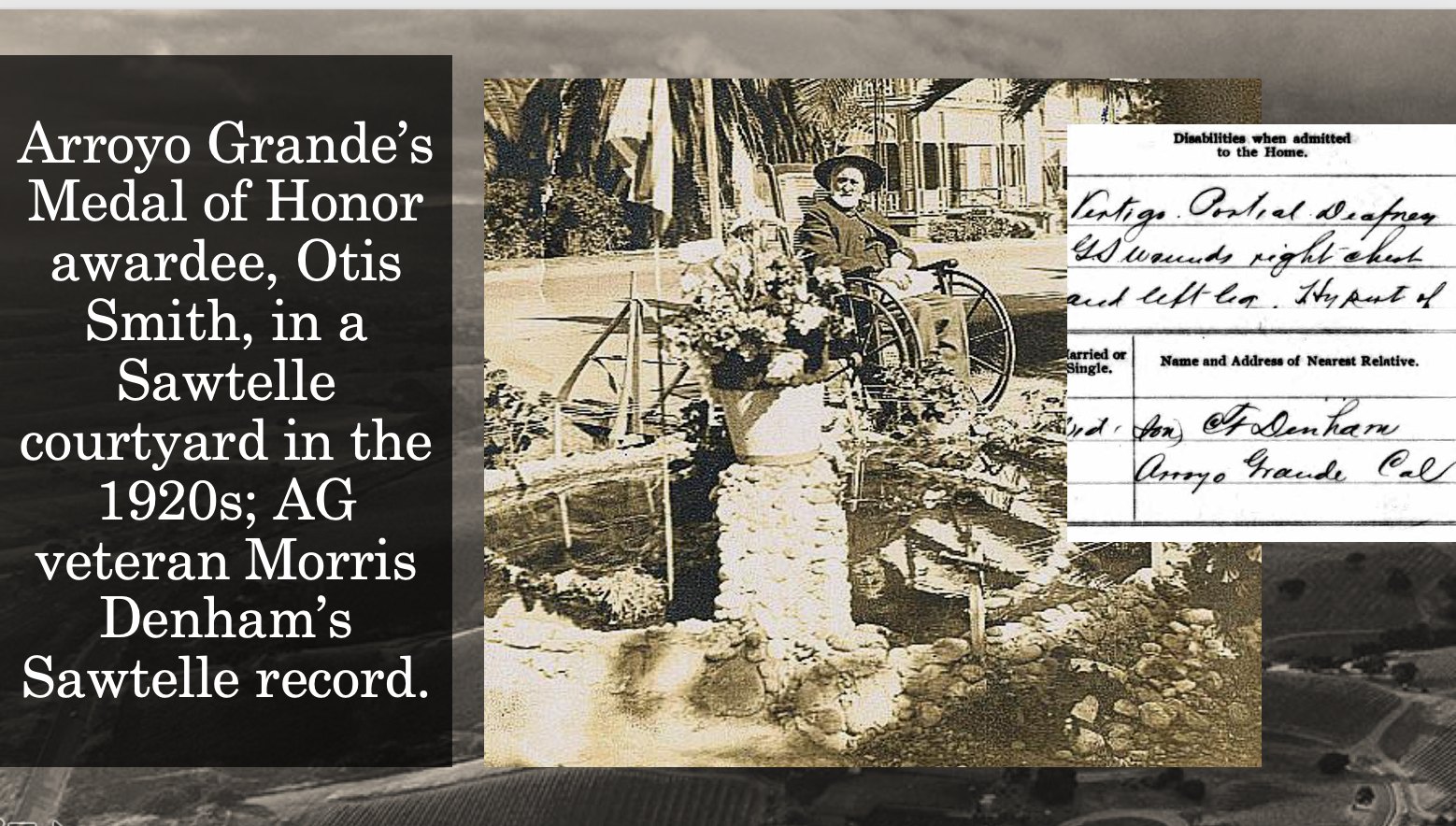
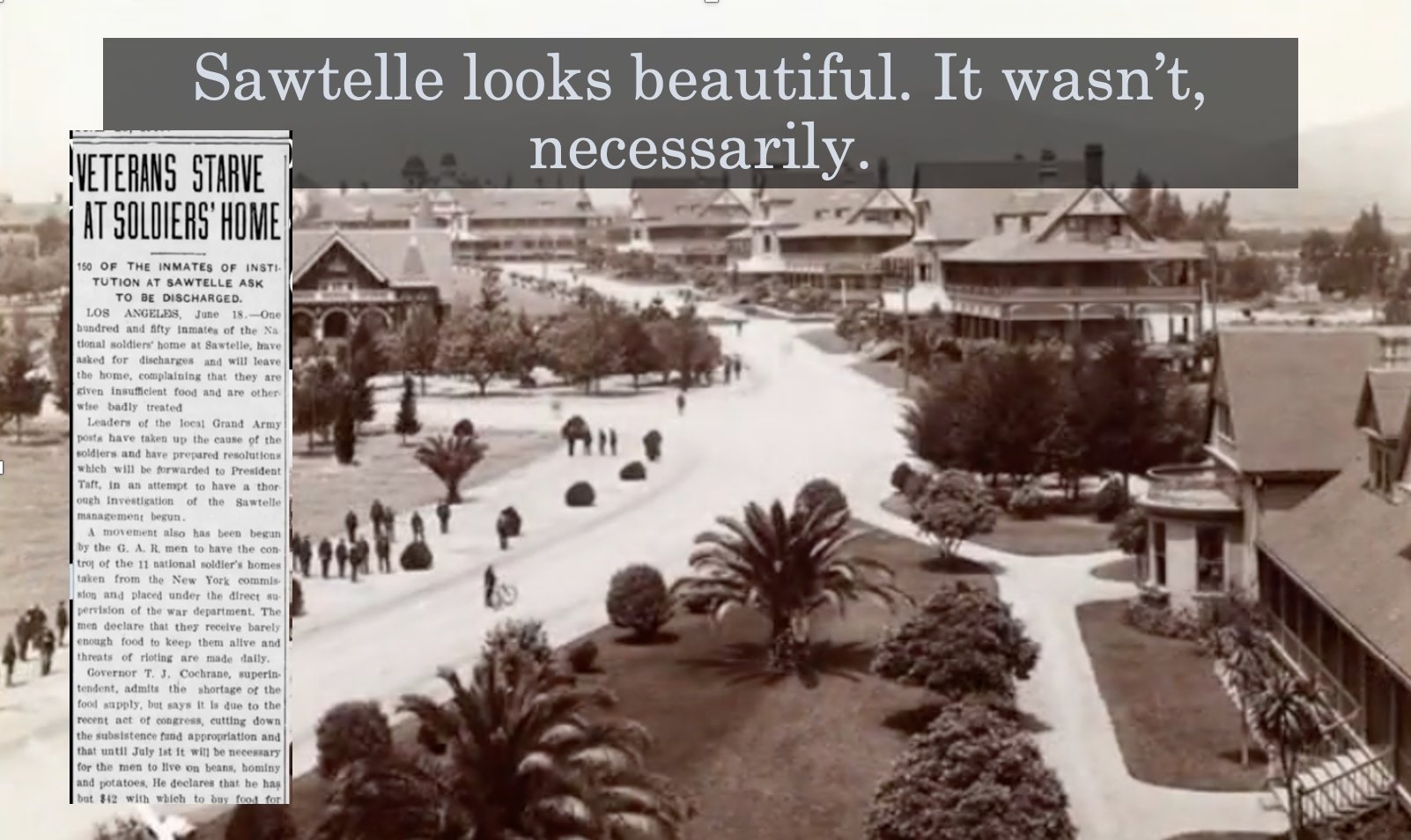
Yesterday I read a friend’s post that cited the West Los Angeles Veterans’ Hospital. I remembered that it was once called the Sawtelle (after the boulevard) Veterans’ Home. Two of Arroyo Grande’s Civil War veterans, Medal of Honor awardee Otis Smith and Morris Denham, whose home still stands on Ide Street, were patients there–as were many other South County veterans–but they were called “inmates,” which gives you an idea of how they were treated. “Prunes, toast and tea,” one of them sighed. “I know exactly what they’ll give us for dinner.”
But Sawtelle looked beautiful because it was designed by the superb American architect Stanford White.
Superb American architect Stanford White was a creep.
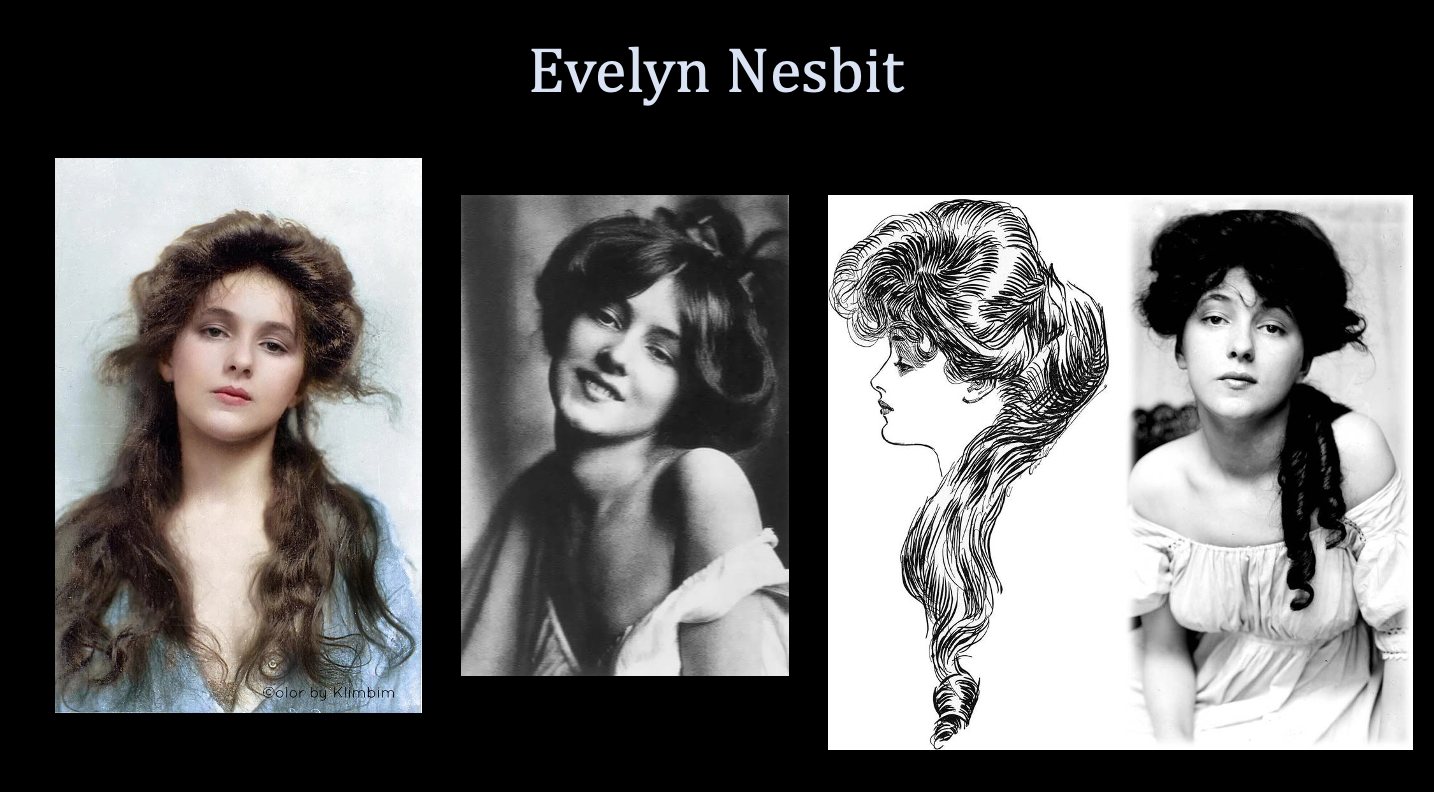
He did what we might call a “Bill Cosby” on up-and-coming model and showgirl Evelyn Nesbit. That is, he drugged and raped her. He was 48. She was sixteen. She would go on the become the archetypal “Gibson Girl.” White would go on to become richer and famouser. And deader.
Nesbit later married the mercurial Harry Thaw. Both Thaw and White were attending a 1906 show at White’s Madison Square Garden. During the song “I Could Love a Million Girls,” Thaw, after bellowing “YOU RUINED MY WIFE!” shot White three times at point-blank range.
Ruined, ruined, ruined.
White died. Thaw went to prison. Good for them.
Evelyn lived to be 82, by which time I don’t know that she’d learned anything more about men than she’d known when she was sixteen.
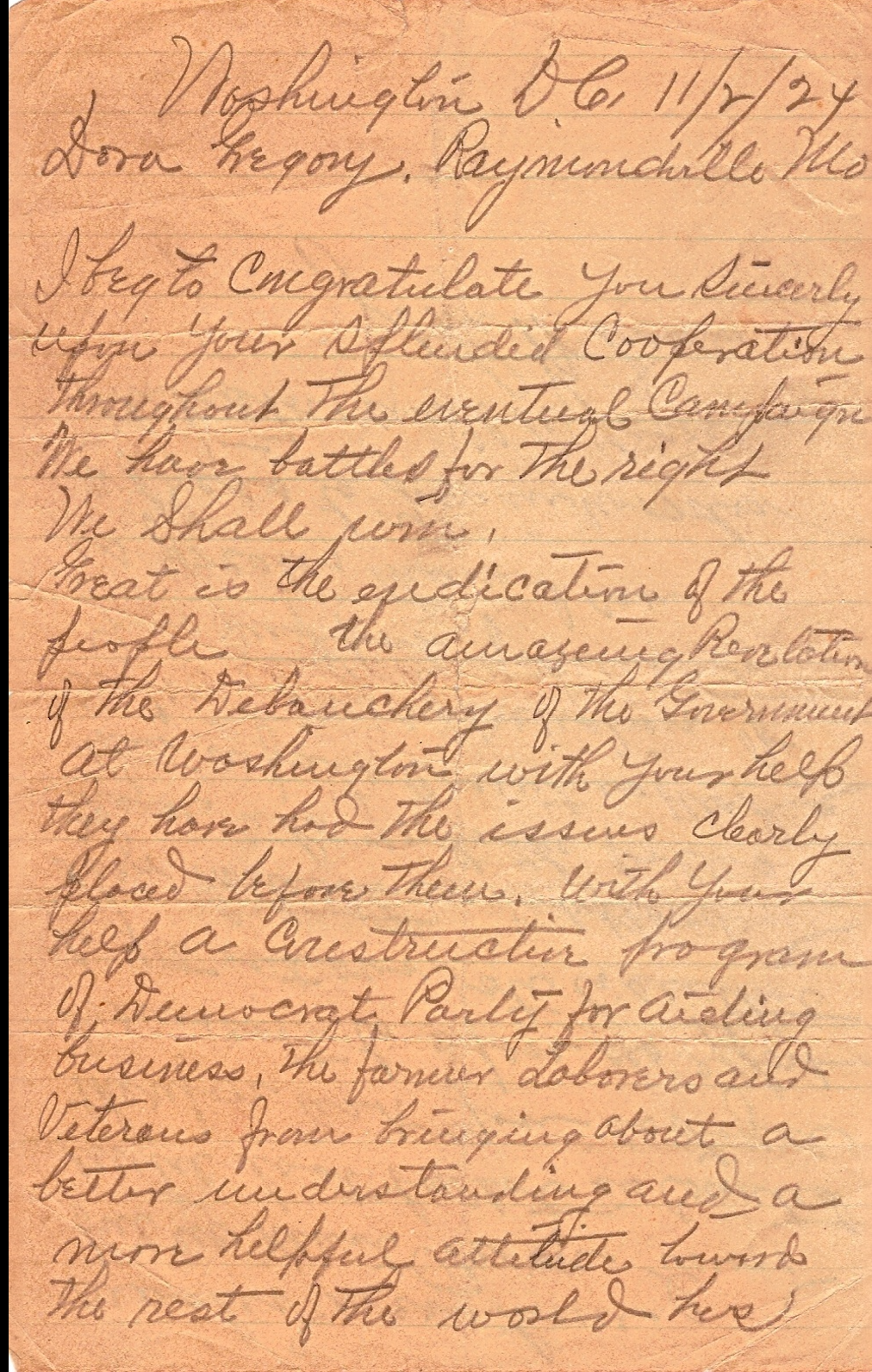
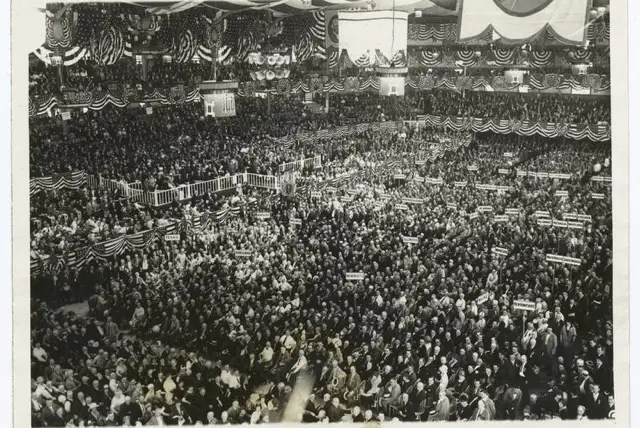
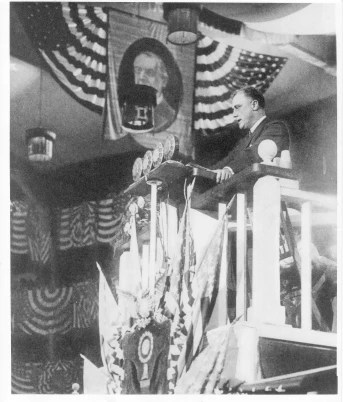
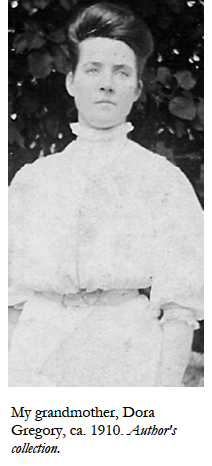
And eighteen years after the murder at Madison Square Garden, my grandmother was a delegate to the Democratic National Convention, held inside the Garden in sweltering heat. Unless she had the good luck to find a bathtub full of ice, she would’ve had the chance to hear young Franklin Roosevelt, struck down by paralysis at Campobello, make his comeback by placing Alfred E. Smith’s name in nomination.
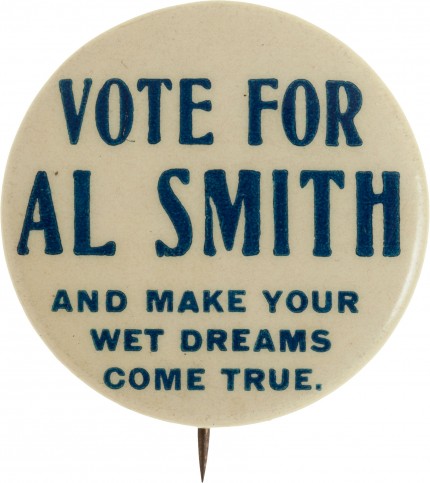
Smith didn’t win the nomination that year, but he did in 1928 and ran against Hoover. Smith was Catholic, which produced a bigoted anti-Smith campaign button, and favored repeal of Prohibition, a plank on the 1928 platform that produced the most salacious campaign button in American history. The button didn’t work, of course, Hoover won what turned out to be, thanks to the October 1929 Crash, the booby prize.
So four years earlier my Ozark Plateau grandmother had fought against the nomination of Smith and for the nomination of a compromise nonentity, John W. Davis, a man so conservative that thirty years later, he argued againstBrown v. Board before the Supreme Court. He lost in 1924, and to the effervescent Calvin Coolidge, who had stop taking rocking-chair naps on the White House portico because tourists thought he was dead.
Grandma Gregory got her way, after 103 ballots and twelve days—the longest political convention in American history, in the un-air-conditioned Madison Square Garden of Stanford White.
Nominee Davis wrote this thank-you note just before losing the general election. And so the debauchery of government continued, although certainly not on the scale of recent years.
Exterior and interior of Madison Square Garden, 1920s; FDR delivers his nominating speech.
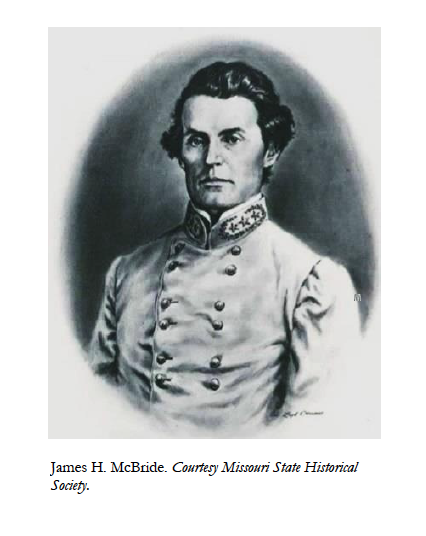
Maybe Grandma Gregory knew about the Stanford White story, but she would have no use for him, anyway. And not because he was immoral*, but because he designed a hospital for Yankees. She never let a week go by, I’d bet, to remind folks that she was the granddaughter of this Confederate general, James H. McBride, for whom I am named.
And so, here we are, right back where we started, at the Civil War.
*However, she was Church of Christ. St. Peter was showing a newcomer around Heaven when he suddenly shushed the lucky arrival. “Why do we need to be quiet?” the newcomer asked. “This is the Church of Christ section,” Peter replied, “and they think they’re the only ones here.”
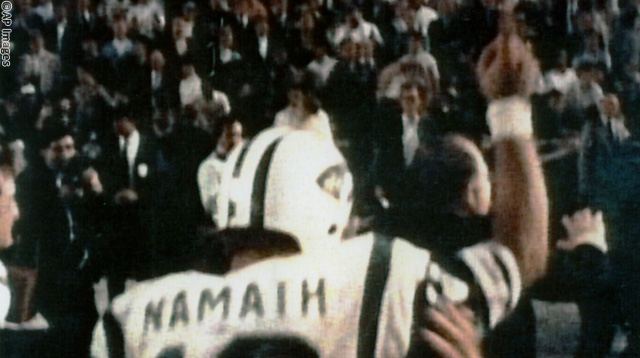
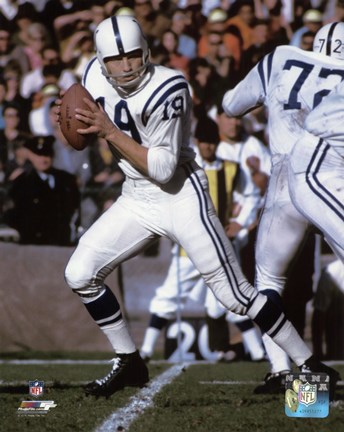
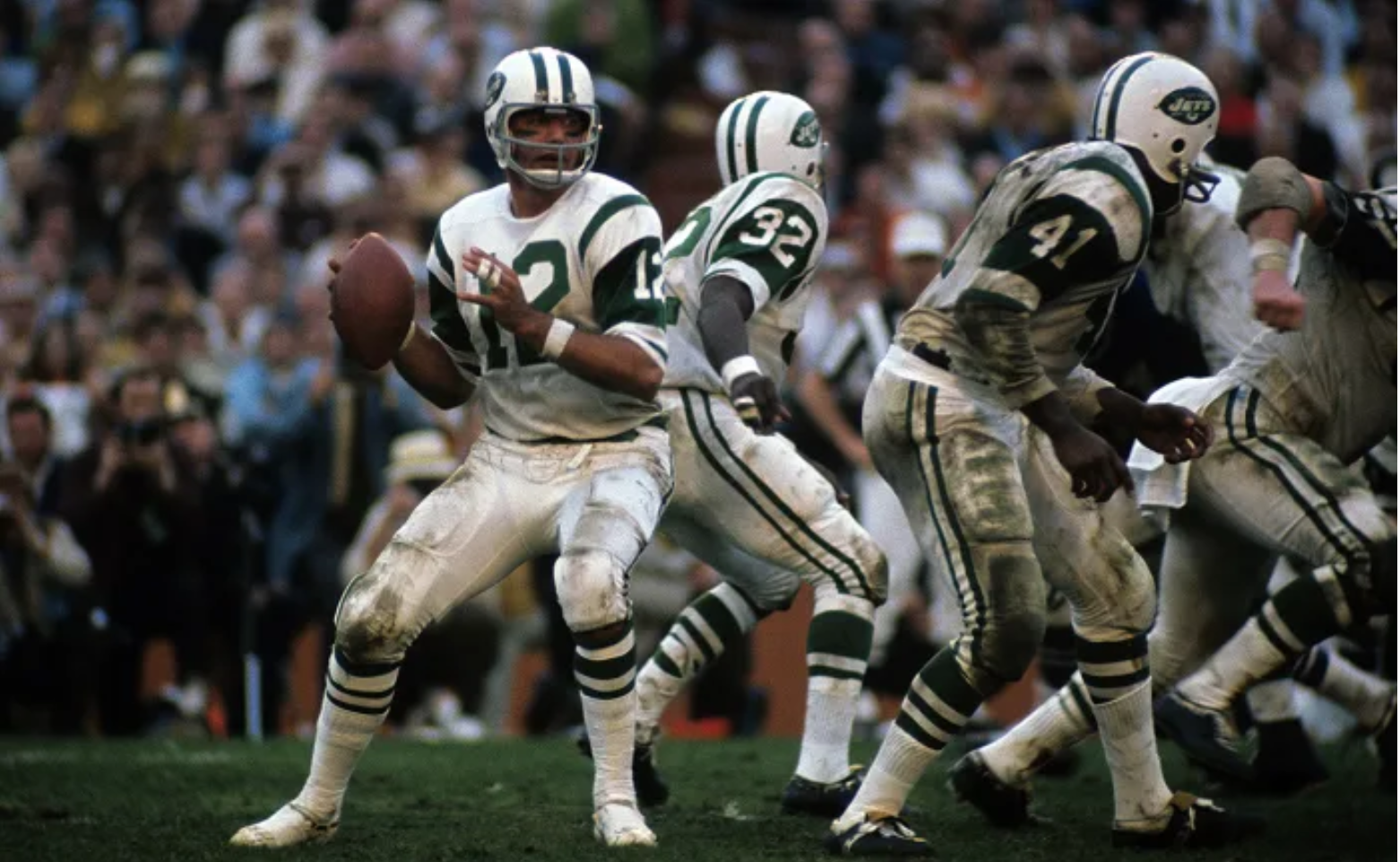
Jan. 12, 1969: Joe Namath’s New York Jets defeat Johnny Unitas’s Baltimore Colts in Super Bowl III.
Young people, this was an “8” on the football Richter Scale. AFL teams–the Chiefs and the Raiders–had been humiliated by the NFL’s Green Bay Packers in the first two Super Bowls, in the olden days, before the leagues merged.
Now it was the NFL’s Baltimore Colts’ turn to humiliate the upstart AFL team, the New York Jets.
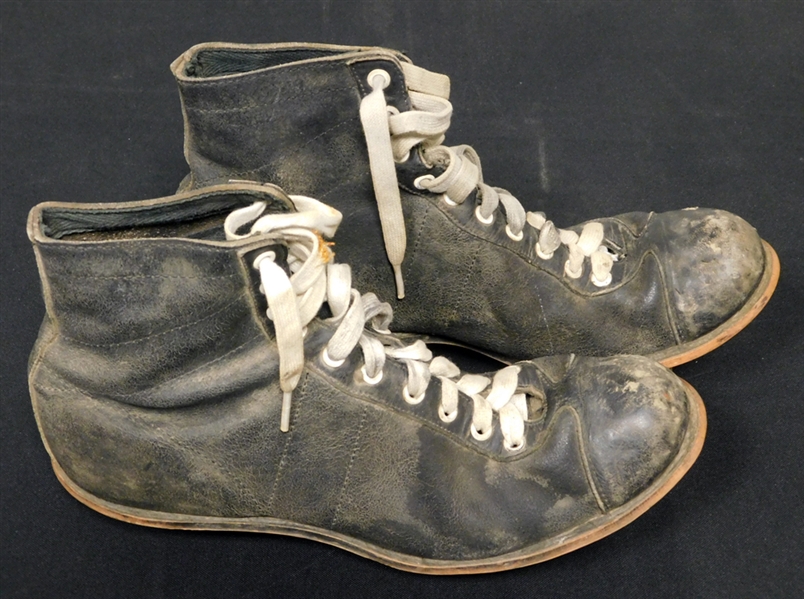
The Colts were led by Johnny Unitas, so old-school that he still wore high-top cleats (this pair sold for $6,000). If they had a Mr Rushmore (Perish the thought. Leave the Black Hills alone!) for quarterbacks, Johnny U. would be on it.
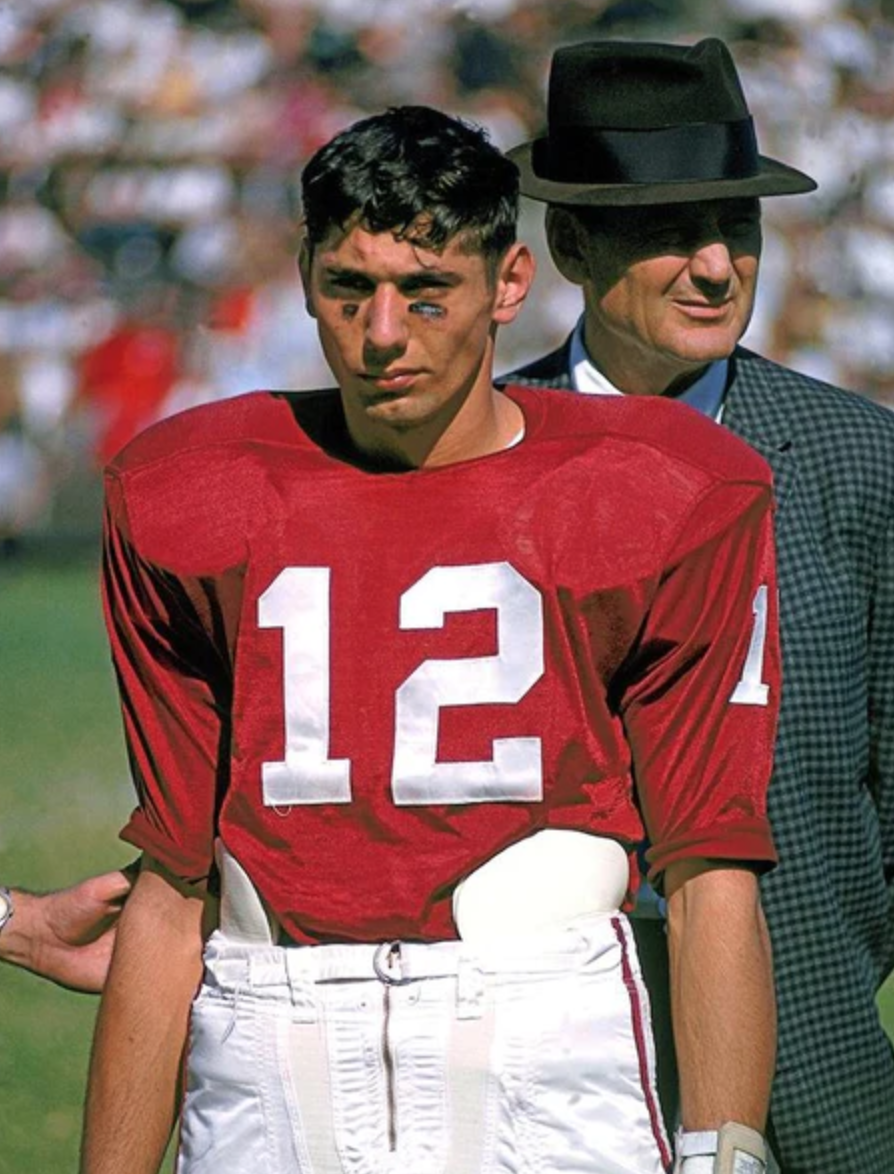
The Jets were led by a kid who’d played ball at Alabama for Bear Bryant–Forrest Gump’s coach– but had left all that behind for the Bright Lights and Big City. Willie Joe Namath liked New York City, liked to party.
His Jets were 19 1/2 point underdogs.
Namath predicted that they would beat Johnny U and the Colts. Guffaws followed.
But he was right. Final score: Jets 16, Colts 7.
You might think: What about the Jets’ defense? But if you look at the statistics, the two teams are nearly identical in offensive stats, from yards gained to first downs to time of possession.
The stat that stands out to me, admittedly no expert? Average yards gained per pass: Unitas’ was 4.4 yards. Namath’s average was 7.1 yards.
Namath threw the ball like a dart thrower. Shallow windup, violent downswing and–zip!–a spiral that resembled a 30.06 bullet exiting its rifle barrel. (Kenny Stabler and John Elway had similar deliveries.)
He was throwing darts that day.
He was throwing darts on this day in history, on January 12, 1969.
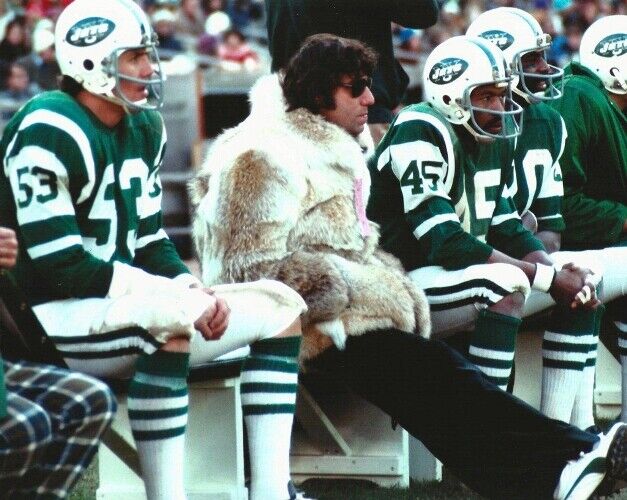
Joe, as was his right, became a superstar. He grew a Fu Manchu mustache and shaved it off for $10,000 for a TV commercial. He posed with Ann-Margaret for a motorcycle flick. (He wasn’t a very good actor.) He had a thing for fur coats. Still does.
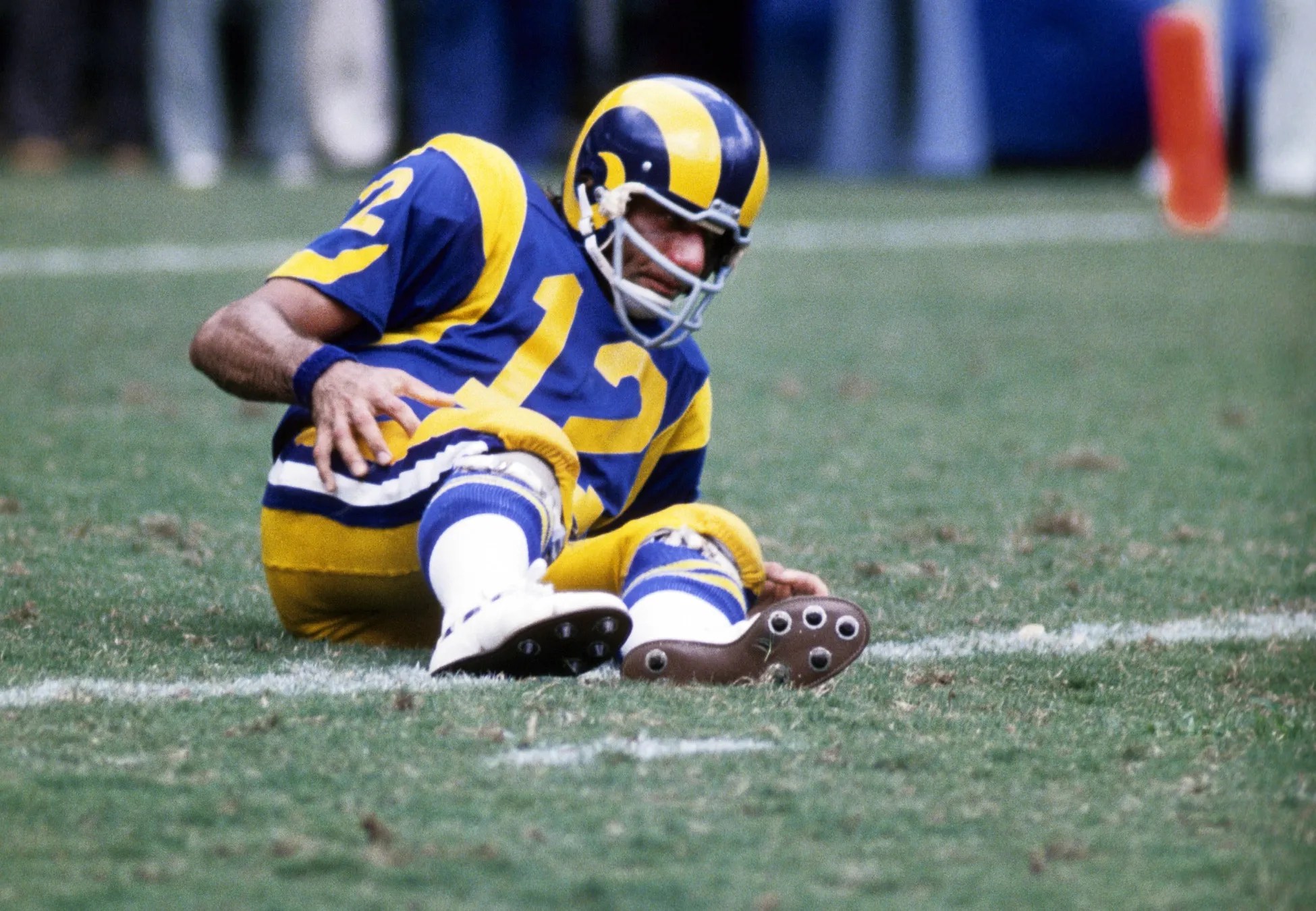
Today he’s a grandfather of six and kind of a parody because of those those Social Security spots (those people are sharks, by the way). But I can’t help but look, during those ads, at how his fingers are bent and arthritic and I remember, in his last years, as a Ram, that watching him enter and exit the field was a visual ordeal.
Football had destroyed his body.
But here’s the thing: That cheerful guy you see on those stupid commercials? I think that’s the way he is in real life. He is now a six-times-over grandfather, and my hunch is that he gets down on the floor to play with those kids even though it takes him forever to get back up.
Party animal, sex symbol, TV huckster, all of that’s true. None of it captures him. Throwing darts at Emerson Boozer out of the backfield or playing video games with his grandkids are truer pictures.
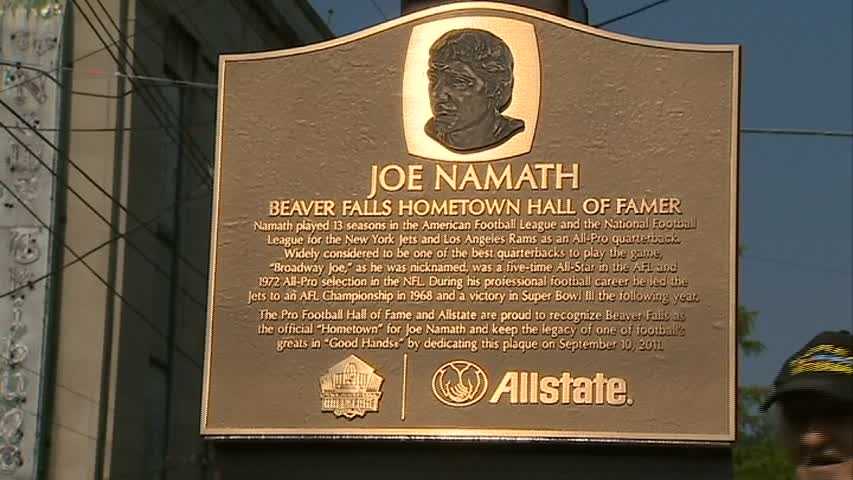
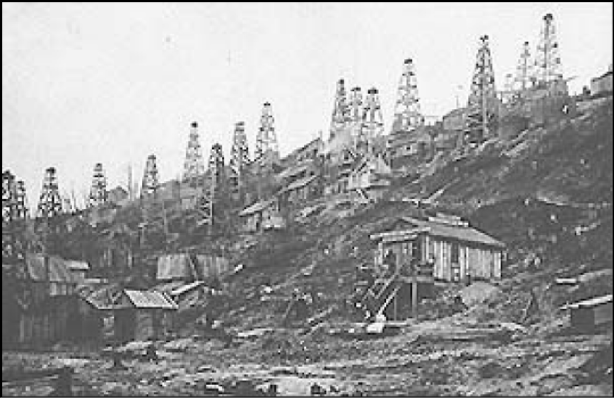
Hall of Famer. That might be the truest of all. But his Hall of Fame bust takes second place to this plaque in his hometown, Beaver Falls, Pennsylvania, pop. 8,900 in 2023, near oilfields like the ones my mother’s Irish ancestors worked during their time in Pennsylvania in the 1870s.
We had only about ten weeks left, in 1969, after that game, before we lost Mom.
But Super Bowl III was about hope, not loss. Something happened that only happened consistently in Frank Capra movies: the underdogs won.
























 A Work in Progress