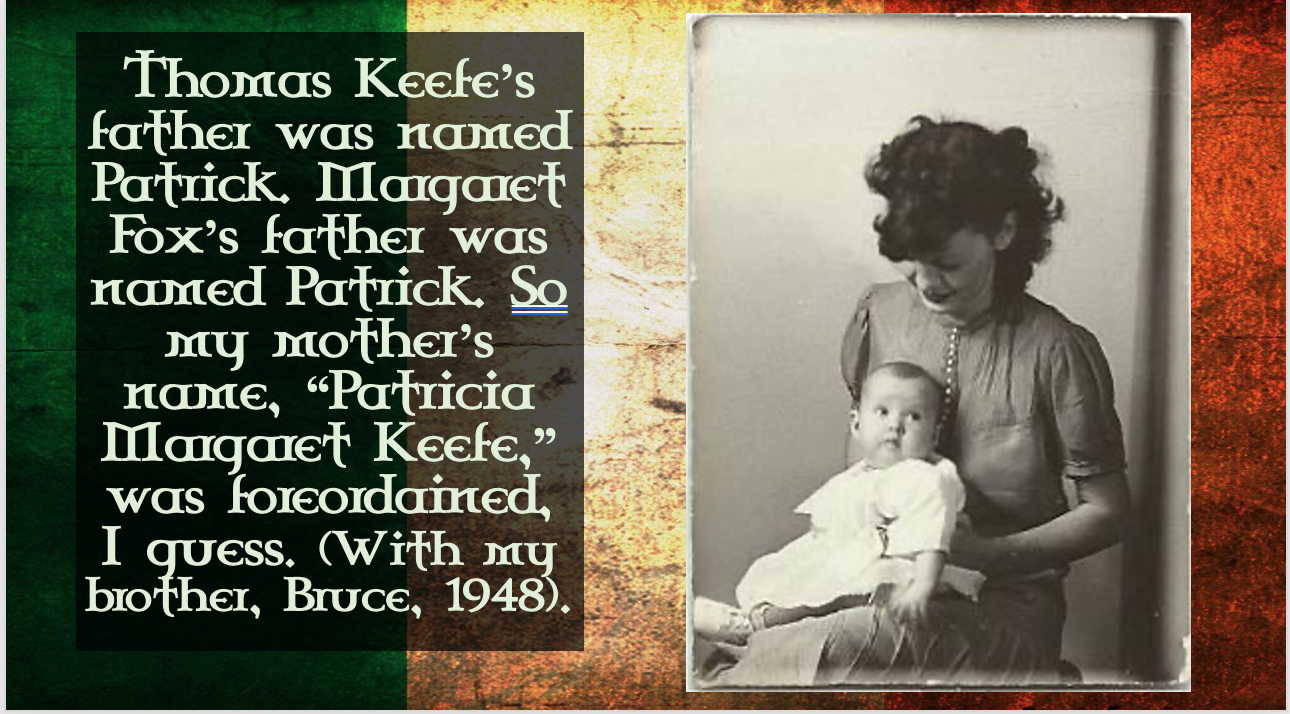
Okay, let’s be honest. I am about 40% English, 10% Ulster (Dad’s side); 40% Irish, 10% Baden-Wurttemberg (Mom’s side.) So that makes me not really Irish, but more or less half Irish.
But that’s okay, because we were married by a Cork priest, Fr. Enda Heffernan. The people from Cork assert that they are Irish and everybody else on the island is just pretending.
So I don’t care about my percentages.
And I know that corned beef and cabbage is not really Irish. (Most of our Irish ancestors lived their entire lives without once tasting meat.) But I don’t care, either, that it’s not a traditionally Irish. I will make that dish—one in the instant pot, one in the crock pot—at our house.
What I do care about is a little, elegantly-lettered sign atop a restaurant cash register—the restaurant was on a hillside with a breath-taking view of the Kerry coast below. Elizabeth and I were leading an AGHS student visit that included the first week of July.
“Happy Fourth to our American friends,” the little sign read.
That sealed the deal. I am Irish.
Oh, and the fish chowder was divine.
So let’s start to prepare for St. Patrick’s Day, shall we?
The American submarine Albacore holds one of the most distinguished service records in the World War II Navy. She is credited with ten confirmed sinkings and three probables One of her victims was a light cruiser, 3300 tons, and another, astoundingly, was the aircraft carrier Taiho, 30,000 tons, seen here in the sub’s periscope just before she was sent to the bottom.
Albacore was on her eleventh patrol when she hit a mine of Hokkaido, the northernmost Home Island, in November 1944. She sank with all 85 of her crew. This is the submarine in San Francisco Bay for her final refit in May 1944.
Albacore was lost for seventy-nine years, until last week, when Japanese marine archaeologists found her at 800 feet. This is one of the photographs they took; more will follow once they can send a submersible to more fully explore the wreck which is, of course, also a tomb. It will be treated with respect.
One of the Americans lost was a twenty-two-year-old seaman from just over the county line, from Taft, where I was born. Jerrod Reed joined Albacore’s crew on October 24, 1944, when she left Pearl Harbor. The sub topped off her fuel tanks at Midway and then headed for the Western Pacific, for Japan, and there Albacore disappeared.
It was determined later that she’d struck the mine on November 7. Seaman 1/c Jerrod Reed’s combat role in World War II lasted two weeks.
From a January 1946 edition of the Bakersfield Californian:
You can find poignant records of World War II servicemen online, on the website ancestry.com Among the records are their draft cards. Here is Jerrold’s (if you’re familiar with Taft, his home address isn’t unusual at all):
I found him again in the 1939 Derrick, the Taft Union High School yearbook. He’s at top, at far right, a trombonist in the school band. He, of course, has a counterpart here in Arroyo Grande: Jack Scruggs, the trombonist on Arizona’s band, was killed on December 7 by bomb concussions—near misses— off the battleship’s stern moments before fatal bomb forward blew the ship apart.
He’s such a nice-looking young man, and maybe that’s where the hurt comes from from a terrible event that happened seventy-nine years ago.
I think the girl with the curly hair is nice-looking, too. This photo is from the same 1939 Taft Union High School yearbook, and that girl, a senior, was a classmate of Jerrold’s.
I will be the first to admit that I am a Thomas Hardy Geek. His mid-Victorian novels, set in the English countryside, are evocative and tragic. I loved Tess, and learned more about cows in that book than I did about whales while reading, in the throes of high-school mononucleosis, Moby-Dick.
When, many years later, I became a history teacher, I liked to use film excerpts to show students what I couldn’t necessarily teach them. No better example of this than the 1965 version of Hardy’s Far from the Madding Crowd.
We had just learned about Jethro Tull, Dutch land reclamation and “Turnip” Townshend and crop rotation—when nitrogen-restoring beans or clover replenish the soil—when Hardy’s dogged but flawed farm owner, Batsheba, allows her sheep to break down a fence and get themselves into a Turnip Townshend clover field.
I saw a Quarter horse of my sister’s die of colic when I was a boy; it was agonizing to watch her suffer until the vet, with us whisked away, put her down. Luckily, Bathsheba’s sheep were rescued by her on-again/off-again foreman, the aptly named Gabriel Oak. In the first scene in this sequence, it’s amazing to see him go to work on gassy sheep.
The banquet scene, with Julie Christie singing, is just as important. The table practically bends under the weight of food; hogs the size of German Shepherds root among the children.
This was the Agricultural Revolution. Thanks to characters like Townshend, food production in Europe increased dramatically and exponentially. Children began living longer, thanks to diet, and parents, who were so shockingly callous toward their children in Early Modern Europe, began to invest their love in them instead.
As macabre as we may find it, this roughly coincided with the birth of photography, including “Death Daguerreotypes.” Parents had their dead children photographed because they didn’t want to let them go.
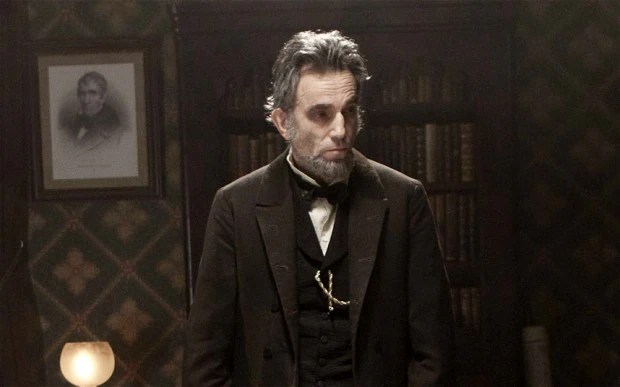
In the next sequence, with a different song, Carey Mulligan presides over a different version of the banquet scene. Until the later version of Madding, I did not know Carey Mulligan apart from Baz Luhrmann’s The Great Gatsby. I didn’t understand Leo DiCaprio’s hots for her; I wanted to throw a raincoat around her and feed her some prime rib and a baked potato with plenty of sour cream.
But in the later Far from the Madding Crowd, she more or less holds her own as a singer, and Michael Sheen’s Mr. Boldwood (another Hardy play on names) comes a little unhinged in her presence, just as Peter Finch’s had in the presence of Julie Christie’s Bathsehba.
Hardy chose the name “Bathsheba” with deliberation, too. She is the flame to Boldwood’s moth–and Oak’s, and her ne’er-do-well soldier husband, and to every other man who comes close to her. She burns them.
She is seductive, desirable and a little shameless.
Today I heard what I think was a Christian violinist playing Leonard Cohen’s “Hallelujah” in a supermarket parking lot. It may be one of the most beautiful songs ever written. But some miss the Hebrew Scriptures storyline: King David sees Bathsheba bathing nude on her rooftop, is consumed by lust, and so sends her husband Uriah off to die in battle.
That’s why Hardy chose the name.
While his Batsheba has redeeming qualities–toughness, the ability to get along in a man’s world, a formidable work ethic–she undoes the men in her life just as King David was undone.
And, yes, she is seductive. The final scene in the sequence below–Carey Mulligan on horseback in the English countryside–might have tempted me to send her Uriah off to a distant mid-Victorian imperial front where he had at least the chance of being killed by colonial insurgents. At one point, except for being mirror-opposite, she is the exact duplicate, lying on her back, of Elizabeth Siddall, the pre-Raphaelite model who nearly died of pneumonia while posting in a bathtub as Hamlet’s drowned Ophelia.
Bathsheba would’ve had no use for Ophelia. She was made of stronger stuff: let her lover do the drowning.
In a scene filmed at the Santa Maria Airport, a B-17 piloted by Steve McQueen takes aim at his British airfield’s control tower. McQueen, as a self-destructive airman in The War Lover (1962), seems to me to have been part of a trend—call it the Cult of Toxic Masculinity.
Steve McQueen and Robert Wagner, The War Lover.
Jackie Gleason and Paul Newman, The Hustler; (Below) Edward G. Robinson and Steve McQueen, The Cincinnati Kid.
Toxic masculine films seem to have a theme we need bear in mind: Men are often self-destructive.
McQueen does just that himself in The Cincinnati Kid, where his poker gambler upstart is demolished by Edward G. Robinson’s pro, just as Paul Newman’s is demolished by Jackie Gleason, “Minnesota Fats,” in The Hustler.
This occurred to me yesterday while watching The Blue Max, a 1966 film about German fighter pilots. (The title refers to a medal conferred for twenty kills.) The lead, George Peppard, who’d just finishing rescuing Cat from the rain in Breakfast at Tiffany’s, is now a self-destructive Toxic Male in this just-above average film. The flying sequences are still thrilling, and Peppard grounds us in every scene in between. He has a charming, empty smile, cares about no one other than himself, which shows in combat, where he shows no mercy. Even in his scenes with the architecturally impossible, for 1918, Ursula Andress (Richthofen’s red Fokker triplane is prettier), he is emotionally empty.
Ursula Andress and George Peppard, The Blue Max.
So you wind up wishing they’d killed him 45 minutes into the film.
Not all 1960s toxic males are as euthanizable at McQueen and Peppard in those two films.
McQueen’s Bullitt is a prime example. After the famed car chase that incinerates two mafioso and a bloody gunfight in the presence of Rome-bound nuns the San Francisco Terminal, and exhausted detective comes home to his apartment and—this with Jacqueline Bisset still warm in his bed—he washes his face, as Pilate did his hands—and looks bleakly at himself in his bathroom mirror. He hates what, and whom, he sees.
McQueen enters his fastback Mustang, with a dreadful car, a 1963 Plymouth Lancer, in the background
Toxic males need not be self-loathing to be toxic. The king of the genre, and one of my favorite actors, must be Paul Newman. His charming road-gang convict in Cool Hand Luke—look at that incredible Newman smile in the still below!— charms every inmate, including the oafish George Kennedy, and the hardboiled egg-eating scene is epic, yet Luke doesn’t seem to mind that he’s killed the bloodhounds trailing his escape, run to death, nor does he care much about his convict friends; he abandons them in the end to trying running way just one more time. Luke is as heroic as Hercules but as empty as an amphora run out of oil.
But it was Newman who perfected the Toxic Male in an earlier film, Hud, as a sociopathic Texas rancher who brutalizes his father, his lover, Patricia Neal, who drives a convertible Cadillac, womanizes in Toxic Male ways that enchant his young nephew, played by Brandon de Wilde (whom I could’ve cheerfully strangled for his bleating in Shane), and drinks more hard liquor in a weekend than Dallas does in a fiscal year.
De Wilde, thank god, outgrows Shane and finally learns to become a man by turning on Uncle Hud, so empty and so suddenly weak. He has no more substance than a tumbleweed.
Patricia Neal and Paul Newman, Hud.
Here, I think is where the great director Peter Bogdanovich and the even-greater writer Larry McMurtry arrive with The Last Picture Show (1971), a film I hated for years until I became a grownup. It’s full of Toxic Males: the oafish Randy McQuaid is an oafish predator whose fondest wish in life is the see Cybill Shepherd, Jeff Bridges’ sometime girlfriend, naked. Bridges is mostly inarticulate yet somehow appealing. He’s a football hero who has forever reached his limits. I think the movie belongs most to Timothy Bottoms, who wants to be a good man but, as a teenager, beds his despondent football coach’s wife (Cloris Leachman, who is, in a performance that won her an Oscar, incredible) but finally pursues, and wins, Cybill Shepherd, the object of every boy’s desire.
Timothy Bottoms Cloris Leachman, The Last Picture Show
She betrays him within five minutes’ screentime.
The film ends with the accidental killing of a special-needs boy, one of Bottoms’s longtime friends, Bottoms unleashes deep reservoirs of anger. It should be a depressing moment, but it isn’t. The character, Sonny Crawford, has suddenly discovered that he deeply cared for someone other than himself. The fact that he’s almost ready to kill for his lost friend means that he’s escaped the toxic masculinity that doomed character like Hud.
When Elizabeth and I drove through dying Maricopa a few weeks ago, I recognized instantly the town McMurtry wrote about. There was an abandoned coffee shop with a barstool counter; you could almost imagine a teenager like Sonny swiveling in his tool, restless from the two teaspoons of sugar in his coffee, until, you hope, he twists his hips suddenly—almost violently—and bolts out the coffee shop door, never to return.
Timothy Bottoms, Jeff Bridges, Cybill Shepherd, The Last Picture Show.
Along Huasna Road, Arroyo Grande. I saw this mountain from our picture window every day of my life between the ages of five and eighteen.
Because I grew up in a place where I woke up to the whistling of braceros going down to the fields to work, the men who taught me Spanish…
Because I cause I saw a redwood home set alight by fire, burning white-hot, like a diamond, in the middle of the night—a home built, out of devotion, by the sons of a woman who’d come to the Arroyo Grande Valley in 1837, where the principal inhabitants were grizzly bears, irritable and possessive and hungry…
Because I was lucky enough to grow up in a Valley still populated by mule deer, red-tailed hawks, flat red weasels (after my Plymouth Rocks), parade lines of baby quail following their mothers; marauding parties of of multigenerational raccoons; barn owls asleep, one’s head on the other’s shoulder; once a king snake, upright and menacing, but dead; once a mountain lioness sniffing along the baselines of our school’s softball field…
Because I grew up learning to love sushi and lumpias made by the mothers of friends and, in high school, girlfriends…
Because of those, I was arrogant enough to believe that no one could possibly feel the feelings I feel for my home for a place like Monterey Park, California. That’s a place, I assumed, that is overrun by strip malls.
I was flat wrong.
CBS ran this brief interview with an incredibly eloquent young man about his home, which is of course Monterey Park.
I admit that I was, terribly guilty to be sure, relieved that the shooter was not a White man.
In a powerful way, the young man reveals that the perp’s ancestry is almost irrelevant. The man who shot 20 people wounded all of us, because our ancestry is irrelevant, too. We are all of us Americans.
This is only about a minute long. It is a stunning piece of journalism.
Jessica Chastain as Tammy Wynette and Michael Shannon as George Jones.
From the Twenty-Five Cent Cable TeeVee Critic’s Corner: .
I missed most of George and Tammy, but the parts I saw were mesmerizing primarily because of Michael Shannon’s performance as George Jones. He was incredible.
Living in Bakersfield for awhile helped. I KNEW people like these.
They, too, drove big Cadillac El Dorados, usually yellow, with a hood long enough to land a Navy F-18 on. You’re tempted to laugh at them—Okies!—until you look at their hands and the damage cotton bolls have done them. Like many of Tammy and George’s generation, they dealt with the hand life dealt them by drinking and smoking, or with painkillers—an addiction that makes heroin look like Ovaltine— and they go out with breathing tubes in their noses and skin like paper, these people who once did the most demanding kind of field work, in cotton or in potatoes.
Their lives were measured then, when they were younger, by how much row was left to harvest in a farm field. When they looked up to see, the heat shimmered at the field’s edge.
Cotton scarred their hands, blister on blister and blood on the white fluff. For potatoes, they wore a spud belt that towed a gunny sack behind them that easily weighed fifty or sixty pounds when it was filled. Work like that would have reduced me to weeping within fifteen minutes. Work like that bent their spines forever.
The oeople who loved George and Tammy were among the people who built America, even as the work they did tore them down.
I watched the final episode last night and it was a tale, as fraught with dysfunction as the relationship was, about two people who never really stopped loving each other. They just couldn’t BE together.
And the music was wonderful: Shannon covered Jones’s “He Stopped Loving Her Today” and Jessica Chastain did a version of Kris Kristofferson’s “Help Me Make It Through the Night” that would’ve melted anybody’s heart except, of course, for Vladimir Putin’s, who’s missing his.
I wouldn’t even have watched those parts except for my hero, Ken Burns, whose miniseries on country music was, to me, a masterpiece. [So are Baseball, Jazz, and The Civil War.]
We got Netflix primarily because of Babylon Berlin, dropped it, but may have to re-up. I, like 68% of America, am hooked on Wednesday Addams’s high school dance scene.
The actress, Jenna Ortega, is stunning, and, like our niece Emmy, also stunning, a graduate of the Tisch School of Drama at NYU. She choreographed the sequence herself. She also, for reasons I haven’t divined yet, shows off some cool martial arts moves (you GO, Michelle Yeoh!) on three bullies dressed as Pilgrims.
It all looks very cool, and, by the way, I’ve never gotten over my crush on Carolyn Jones, Morticia in the 1960s Addams Family series. Elizabeth hasn’t recovered from the death of Raul Julia, sublimely charming as Gomez Addams in the 1991 film.
In July 1932, German elections energized the Nazi Party, which won 38 percent of the seats in the Reichstag, the Weimar (German) Republic’s Parliament.
The irony was that the sole reason the Party entered candidates in elections was to give it enough power within the Reichstag to destroy the Reichstag.
The past two days in the House of Representatives have revealed that the spirit of antidemocratic sabotage survives.
July 1932 marked the Party at its electoral peak. Later elections that year revealed that the Nazis were losing popular support.
But it was already too late. Even though they were a minority, the Nazis joined another antidemocratic minority party, the Communists. [Both the Communists and the Nazis turned to elections after failed armed coups—for the Communists, the Spartacist Revolt in 1919; for the Nazis, Hitler’s failed attempt to topple the Bavarian government in the 1923 “Beer Hall putsch.” I will point out the obvious: January 6 is two days away.]
When the July Reichstag met, with Hermann Goering as Speaker, he immediately called on a Communist deputy, who moved that the Reichstag session be immediately dissolved.
It was. Everyone went home.
Thanks to byzantine plotting and an enfeebled President, Paul von Hindenburg, Hitler was appointed chancellor in January 1933.
A new Reichstag, purged of all deputies except for National Socialists, would meet twenty times in the next twelve years, mostly as an obedient audience for Hitler’s bombast. It passed a total of four laws.
The emphasis below is mine.
“Our participation in the parliament does not indicate a support, but rather an undermining of the parliamentarian system. It does not indicate that we renounce our anti-parliamentarian attitude, but that we are fighting the enemy with his own weapons and that we are fighting for our National Socialist goal from the parliamentary platform.”
–Wilhelm Frick, who would become Interior Minister under Hitler. Executed, 1946.
“…[W]e National Socialists never asserted that we represented a democratic point of view, but we have declared openly that we used democratic methods only in order to gain the power and that, after assuming the power, we would deny to our adversaries without any consideration the means which were granted to us…”
–Joseph Goebbels, Propaganda Minister under Hitler. In 1945, as Soviet troops were overrunning Berlin, Goebbels and his wife murdered their six children—five girls and a boy—with cyanide before taking their own lives.
“The parliamentary battle of the NSDAP [Nazi Party] had the single purpose of destroying the parliamentary system from within through its own methods. It was necessary above all to make formal use of the possibilities of the party-state system but to refuse real cooperation and thereby to render the parliamentary system, which is by nature dependent upon the responsible cooperation of the opposition, incapable of action.”
–Ernst Rudolf Huber, Nazi legal and constitutional scholar. He was eighty-seven when he died in 1990.
Donny: Are these the Nazis, Walter?
Walter: No, Donny, these men are nihilists, there’s nothing to be afraid of.