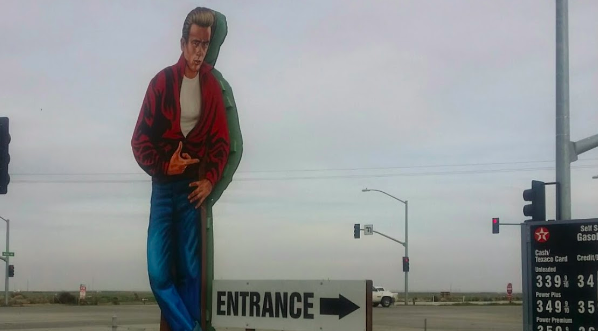
Blackwell’s Corner is a gas station and little shop at the intersection of Highway 46, which will take you east to Bakersfield, and Highway 33, which will take you south to Taft, where I was born.
It is, in other words, so remote that it is nowhere.
I was a baby at home with Mom and so couldn’t see what was possibly the happiest thing that ever happened there. For some reason the bus had dropped off my Uncle George Kelly at Blackwell’s Corner. It must have been easy for my Dad, who’d come to pick him up, to see him. My uncle was and is tall and handsome and he would have been in his dress greens–this was during the Korean War–and he would’ve had his Army duffel bag slung over one shoulder and in the other hand there would’ve been grocery bag with twine handles and it would have been full of Government Issue property.
It was an official United States Army turkey. My uncle was an Army cook and it was Thanksgiving, so he’d come to spend some time in Taft with my Mom, his sister, and his parents–my Kelly grandparents.
Of course he would have called ahead both to arrange the rendezvous with Dad and to issue a good-natured warning to start the side dishes but lay off the turkey and dressing. He would bring the former–it must have been more than a little satisfying to choose a turkey when you had the time to inspect so many suspended on hooks inside a camp freezer. The Army is not necessarily kind to privates, so that would’ve made picking out the turkey even more satisfying.
As to the dressing, it would’ve been an original–my uncle cooked instinctually and decisively–and it would’ve been divine.
I’m not sure where he was based–it might have been Fort Ord–but there’s nothing better than a long bus ride for thawing a purloined turkey. It would’ve been densely wrapped, of course, and whoever sat next to Pvt. Kelly on the Greyhound and the Orange Line buses might’ve asked what was in the bag. Anybody who started a conversation with George was in for a long haul. Still, an Uncle George monologue would’ve colored the trip through severe bareness of the southern San Joaquin Valley.
He was a natural storyteller, and telling the turkey story would’ve led to another story and then George would ask a question of his seatmate who would tell a story of his own, and for every story you had, George had one to equal it.
His might’ve been about Army life or his attempt to work his way through Cal Poly by hustling pool or about the time his Dad, the cop, had won an unequal fistfight–unequal in the sense that only three oilfield roughnecks had attacked Taft police officer George Kelly Sr. You needed to bring more guests to the table to win a fight with my grandfather.
The table in Taft, of course, at my Gramps and Grandma Kelly’s, would’ve been beautiful, dense with potatoes and yams and string beans and gravy and Uncle George dressing and cranberry sauce. The centerpiece would have been the U.S. Army turkey and it would have been done perfectly, stuffed with apples and onions and dusted with sage and rosemary and with the breast meat still moist and tender.
In all honesty, the Army, for once, had done something precisely right because my uncle is a superb cook. And Pvt. Kelly, there at the table with his sleeves rolled up but with his Army tie tucked by regulation into his uniform blouse, would have been the handsomest man alive.
I was there and don’t remember any of this because I was in my high chair eating mashed potatoes with my hands and missing my mouth with most of them. But I’ve heard, growing up, the story of Dad finding my uncle at Blackwell’s Corner three or four times, So, oddly enough, I do remember exactly what was going on and how the table looked and, by the way, how beautiful my Mom was, and I can remember it like it was last week.
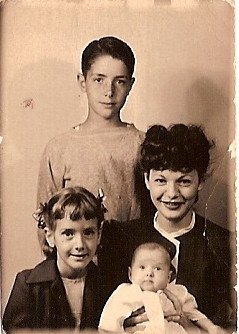
My Aunt Judy, Uncle George, Mom and my sister Roberta, about 1943
My next memory of Blackwell’s corner would have been about 1958, when we were on the road from Arroyo Grande to Bakersfield. That was three years after James Dean had made his last stop there before the Porsche Spyder’s fatal crash near Cholame. Today the Corner, then an unpretentious Atlantic Richfield gas station with a little store, is pure kitsch. There’s a figure of Dean out front, slouching slightly in his Rebel Without a Cause red jacket, and it’s obscene. I take my James Dean seriously. Neither my wife nor my U.S. History students had seen East of Eden until I showed them the film, released, of course, after his death, and the connection he made with all of them was both instant and lasting. They got him.
So Dean was three years gone and not yet a gift shop bobblehead when we stopped at Blackwell’s Corner as we did every trip to Bakersfield. This stop was at night, which was merciful, because driving at night on the 46 means you have nothing to look at out the car windows except for the scattered lights of isolated homes and metal sheds, the watchmen’s places for men who patrolled the fields with flashlights. The fields were populated otherwise only by coyotes, jackrabbits and Union Oil pumps, donkey pumps, that worked all night making Union Oil rich and powerful.
During the day you could see the pumps, most in perpetual motion and so the only signs of life in that desolate part of California where the dominant colors are a yellowish sand and purplish gray. This is where locals, for both fun and for the rueful acknowledgement of the severity of their environment, celebrate Christmas by decorating tumbleweeds, spraying them with artificial snow and stringing them with little blinking lights. What had brought them to this severe place was oil; what had brought my Dad’s cousins here from the Ozark Plateau was oil, what had brought my mother’s father here, the son of Famine immigrants who’d worked oilfields in Pennsylvania in the 1870s, was oil.
We had gotten into the habit of stopping at Blackwell’s Corner because after an hour of staring at such a dry landscape, you get intensely thirsty. So we would stop for a Coke for my Mom, a Pepsi for my big sister and Nehi orange sodas for my brother and me. Dad got a Coors.
By 1958 my Grandmother Gregory was sliding into dementia and increasingly fragile, so that must have been why we were driving the 46 at night. There was something wrong with Grandma Gregory.
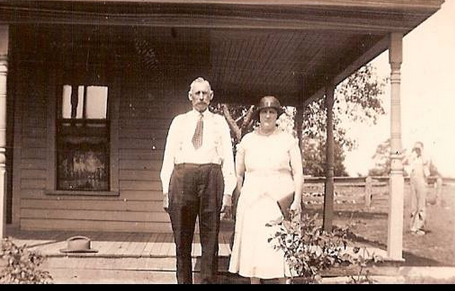
My Grandfather and Grandmother Gregory, Raymondville, MIssouri, at about at the time of his death. Grandma was a hard woman to knock down in a windstorm.
Grandma Gregory smelled like Ben-Gay and she told stories as profusely as Uncle George, but hers were all about dead people and precisely how they died and each story would end with a deep sigh and her adjusting the eyeglasses that made her eyes, now moist, so big behind the lenses. My mother called Grandma Gregory “Mother.” My father’s relationship with her was difficult, and it came from the time she’d called him back to the house when he’d been walking with my grandfather to a neighbor’s across the road. My grandfather was partly deaf and when he reached the road he never heard the Ford that killed him.
While Mom got the drinks I, being six, of course had to pee, so Dad took me into the men’s room. It was then that my epiphany happened, the beginning of my dread for this part of California. It doesn’t seem like much. But what had happened is that there’d been a sandstorm that day–the kind they describe in 1930s Oklahoma, where when you woke up there was a perfect outline of your head on the only clean part of the pillow.
The sandstorm that day at Blackwell’s Corner was so intense that the toilet bowl was filled with sand. For some reason this sight terrified me. I stood there for a long time with Dad waiting impatiently but I couldn’t make water. I told him I could hold it until we reached Bakersfield.
So we got back into our car, into the Oldsmobile, and continued east on the 46, where careless drivers forgot to dim their headlights and drunk drivers crossed into your lane and where cocky drivers miscalculated how quickly they could pass a semi truck. I don’t know that I was interested in my Nehi and I probably didn’t say much–I didn’t say much anyway–the rest of the way. I would have been thinking of sand and tumbleweeds and donkey pumps and after a few miles the irrational fear I’d felt in Blackwell’s Corner would’ve been replaced by a deep sadness.
If I was lucky, I would’ve gone to sleep. That meant, in those pre-seat belt days, asleep in the front with my feet in Dad’s lap and my head in Mom’s, with her gently stroking my hair. In my sleep, of course, I dreamed of seeing oak-studded hills and rows of crops, wet under sprinkler arcs; I would’ve dreamed most of all of seeing the ocean again.



 A Work in Progress