
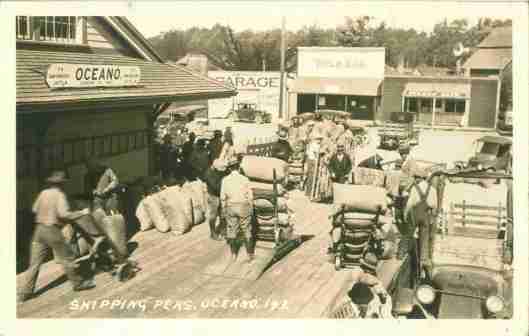
I’ve always been interested in social history, including women’s history, and military history. The same goes for a new area I’ve much to learn about but have always found fascinating: agricultural history.
It wasn’t true when I was growing up in the Arroyo Grande Valley, but twenty years before, sweet peas had been the dominant crop in the South County, from the foothills east of Shell Beach to, of course, the Nipomo Mesa, where Dorothea Lange photographed “Migrant Mother” Florence Thompson. Thompson was 33 years old in 1936, struggling to survive in a crude squatters’ camp in the midst of two disastrous annual harvests–blighted by frosts and rains like the one in the closing pages of The Grapes of Wrath–that made the suffering here real. She looks closer to her actual age in this photo, one of six Lange took after passing the camp on her way north to San Francisco.
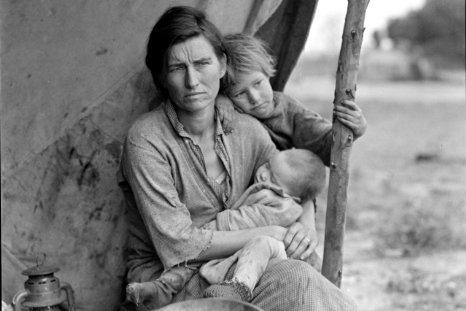
Lange already had boxes and boxes of negatives on the car seat next to her, ready to be processed, her next task, when she saw the sign for the pea pickers’ camp. She kept going. Something stopped her twenty miles up 101; she returned, took the six photographs, and left. Five were published soon after, including this one. The iconic image Lange kept. She must have been stunned with what she’d done when that version of Florence emerged in the lab. It was like a Raphael, an Our Lady of Poverty.
Despite that image, the Depression, I’d thought, couldn’t have been as acute here as it was in the East, where unemployment in Detroit was 50% and, at one point in Toledo, 80%. But then I found these figures from the County Agriculture Department. Statistically, they’re almost as poignant as Lange’s photography:
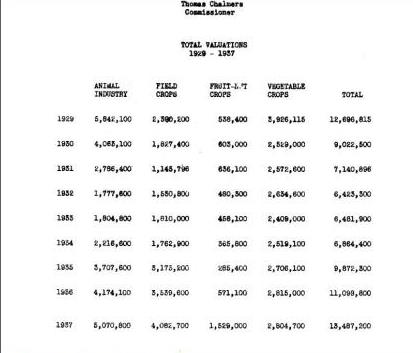
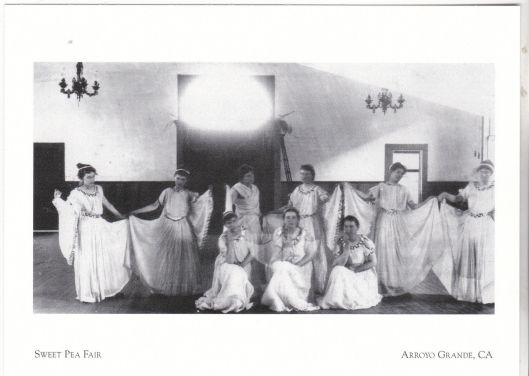
They are also appalling. The total valuation of San Luis Obispo County agriculture fell by half between 1929 and 1933, with the collapse of crop prices. Peas were the largest vegetable crop–about 5,000 acres, nearly all in the South County, were planted annually. [Lettuce came in second, at 3,000 acres planted.] Peas were important to the point of absurdity. This World War I-era postcard commemorates Arroyo Grande teen girls, like twentieth-century vestal virgins, “dancing at the Sweet Pea Fair.”
The 1929 crop was valued at $2.2 million dollars, but the harvest from roughly the same acreage four years later was valued at only $822,000. This collapse, prior to the arrival of AAA subsidies, contributed to another disaster.
Peas had been so enormously profitable during and after World War I that farmers, according to WPA Writers’ Project accounts, practiced little rotation and intensified cultivation of peas and, quite naturally, even expanded their acreage as prices began to fall after the Crash. This led to a crisis in soil erosion in places like Corbett Canyon–in 1937, the head of the Soil Conservation Service said the erosion in Arroyo Grande was among the worst he’d seen in the United States, and he’d seen Oklahoma. It would take intensive labor by CCC and WPA crews–building check dams, terraces, planting windbreaks–to save today’s Arroyo Grande from looking like today’s North Africa. It was an enormous effort and, I think, one of the most stunning achievements of the CCC, which employed young men 18 to 25 years old and paid them $27 a month, half of which they were expected to send home.
There were other kinds of crises: bitter strikes in the South County by migrant pea workers–Filipino, some Mexican, and poor white migrants from as far east as Vermont–in 1934 and again in 1937. I have much more to learn, too, about those, but, by 1939, according to a migrant nurse’s report, wages were still low for pea-picking, at one cent a pound, thirty cents a hamper, and they were cut, by mid-season, to twenty-five cents. Growers estimated that they needed to clear 3 1/2 cents a pound to make a living; what struck me wasn’t the miserliness of growers–and that most definitely existed–but the enormity of shipping costs. A hamper of peas that sold for $3.45 on the East Coast cost $1.70 to ship there. It reminded me of the days of the Populist movement, when it cost a farmer more to ship a bushel of wheat from Kansas to Chicago, by rail, than it did to ship that bushel from Chicago to Liverpool, mostly by ship.
By 1939, good years were beginning to return. A network of county camps, most on farmers’ land, operated either by labor contractors or camp bosses appointed by the contractors, housed 3,000 pea pickers at the height of the season, which ran from March through May. 426 families were “white,” 167 “Mexican” (Mexican labor had begun to return after massive deportations in 1931; many American citizens were deported during the anti-Mexican hysteria of the early Depression). There is no category for “Filipino,” but they were there in large numbers, too, though not as families. Filipinas were not permitted to immigrate: it would require Filipino men dying in combat, fighting for America in volunteer units–the first formed at Camp San Luis Obispo–to “earn” the right to marry, to bring home war brides from the islands, and to begin families, because before and during the war, California miscegenation laws prohibited their marrying outside their race.
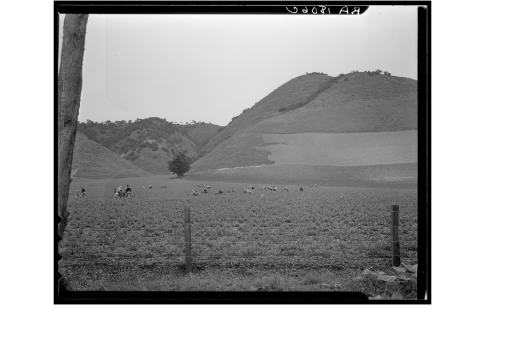
A Filipino gang working peas near Pismo Beach, photo by Dorothea Lange.
There were children in the camps, too–569, to be exact. Teachers were brought in to give lessons in the Canada camp and in a Nipomo warehouse. The migrant nurse noted that older children looked wistfully every day as the Arroyo Grande Union High School bus passed one camp, slowed, and kept going. This woman had sand. She marched into Principal Clarence Burrell’s office–Burrell was a good man–who took up the issue with the Board of Trustees, which voted to begin picking up the migrant kids to bring them to school. There were only four weeks left in the school year, but you wonder about those kids, both at how enormous it must have been for them have classes in a “real school” and you wonder, too, about how they were treated. I remember how cruel kids can be, remember us calling a poor white family “Okies” when I was in elementary school. The peas were gone, then, replaced by new Valley crops; bigotry has a long growing season.
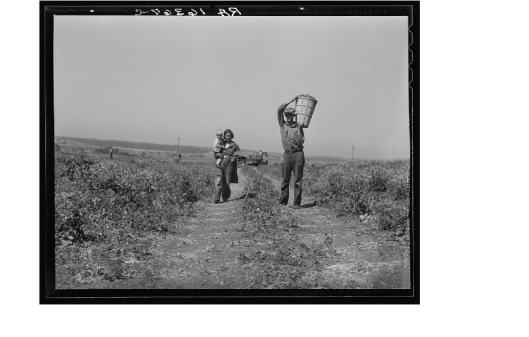
An Oklahoma father with a hamper of peas in Nipomo. Dorothea Lange photo

