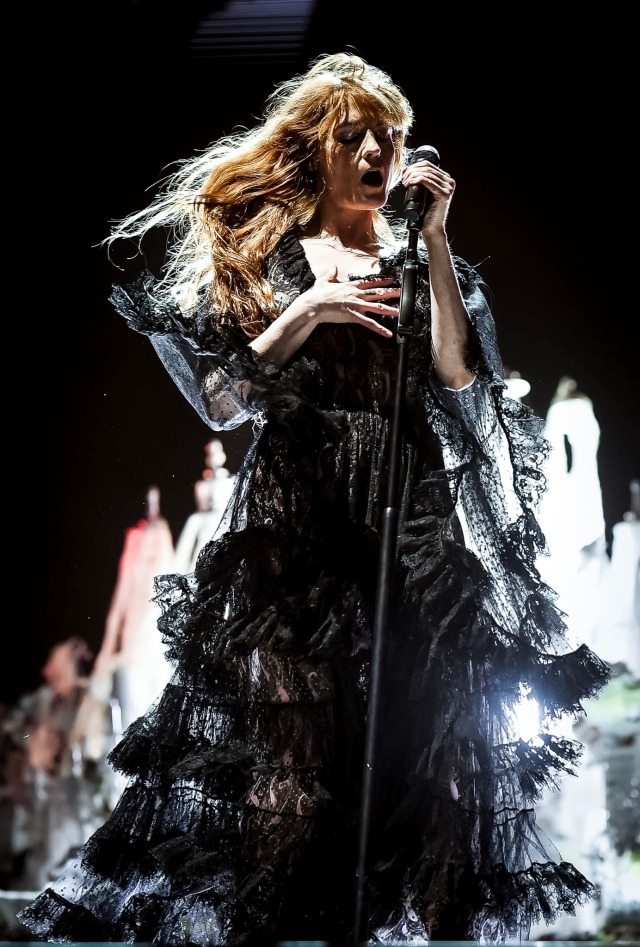
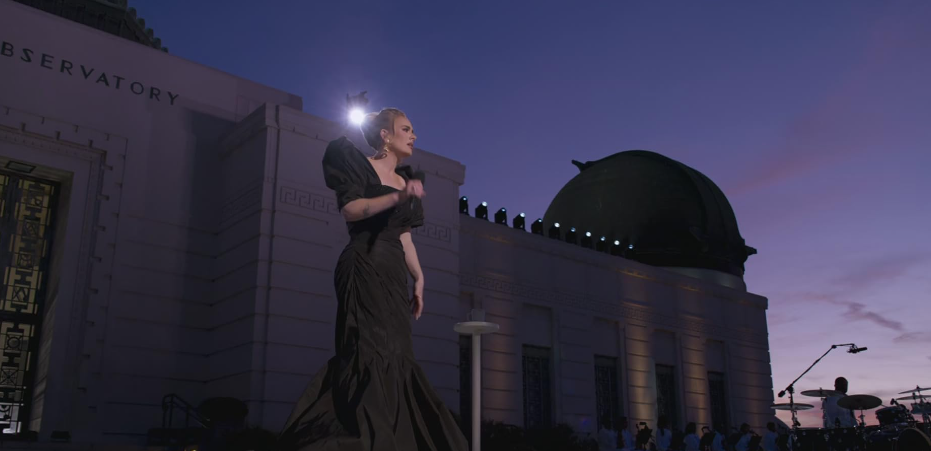
AmyMarianne FaithfullEmeli SandeFlorenceAdele at the Griffith ObservatoryDes’Ree
This NOT rocket science, and I know full well I’ve left out forty or fifty. But here, in no particular order, are ten.
Petula Clark on The Ed Sullivan Show, 1965. My Mom adored these three without reservation: Petula, Diana Ross, and Ringo.
2. Maybe a one-hit wonder, but Duffy’s performance of this song is gritty. Not “more cowbell,” but more cigarette smoke? And I love the dancers.
3. This is not a “music video,” because it was filmed, not videotaped, and thankfully preserved for us nearly sixty years later. Shirley Basseyhas pipes. I think she did two more Bond themes, as well. Check them out.
4. I had to post Emelie Sands’ photo above–she’s Scots–because she doesn’t appear in this video. Somehow, even though this is Britain’ Got Talent, I saw this performance. The song is incredibly moving. The shadow dancers are divine
5. Given the setting, I would have spent several thousand dollars I don’t have to see Adele that day, and at that place, two years ago.
6. Des’Ree’s song is, to me, a threat to the antidepressant industry. Just the song will do, thank you.
7. Marianne Faithfull, 1965. Her much-later album, Broken English, was bitter, raunchy and glorious–pre Amy Winehouse. But this Stones song stands on its own when her voice was still very young and very sweet.
8. Cilla Black, 1965. She masters this Bacharach song–they’re notoriously difficult to sing, hence Dionne Warwick and Aretha Franklin and Cilla Black They mastered the Master.
9. Florence Welch fourteen years ago, This is a bewitching performance, if you’ll forgive me, because at one point, she does a little hip movement that comes straight from Diana Ross and “Stop! In the Name of Love.” Watch for it.
10. There’s not much I can add about my admiration for Amy Winehouse, and how much I miss her. Let her do the talking instead.
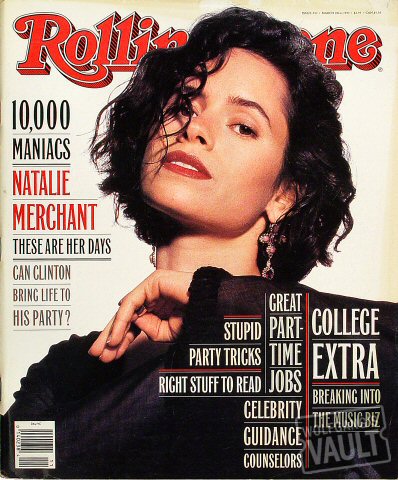
ACCORD, NY – January 23, 2016 – Natalie Merchant
credit: Jacob Blickenstaff
She left The 10,000 Maniacs thirty years ago, but nearly every song from The Maniacs’ “MTV Unplugged” is still on my playlist thirty years later. It was an enchanting performance, and it still is. Since he lived for a short time in San Luis, I’m especially fond of this song.
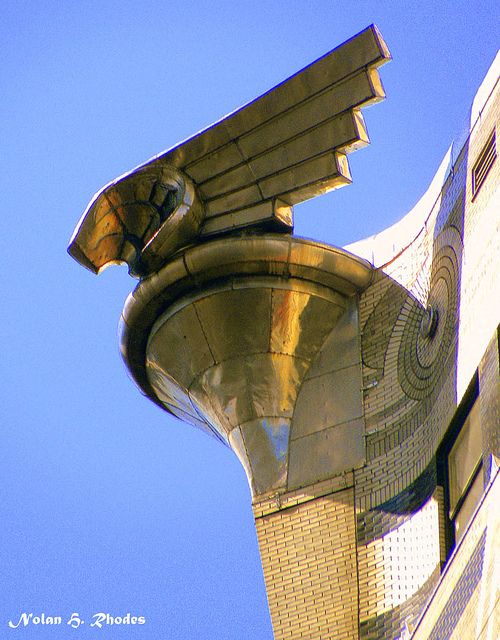
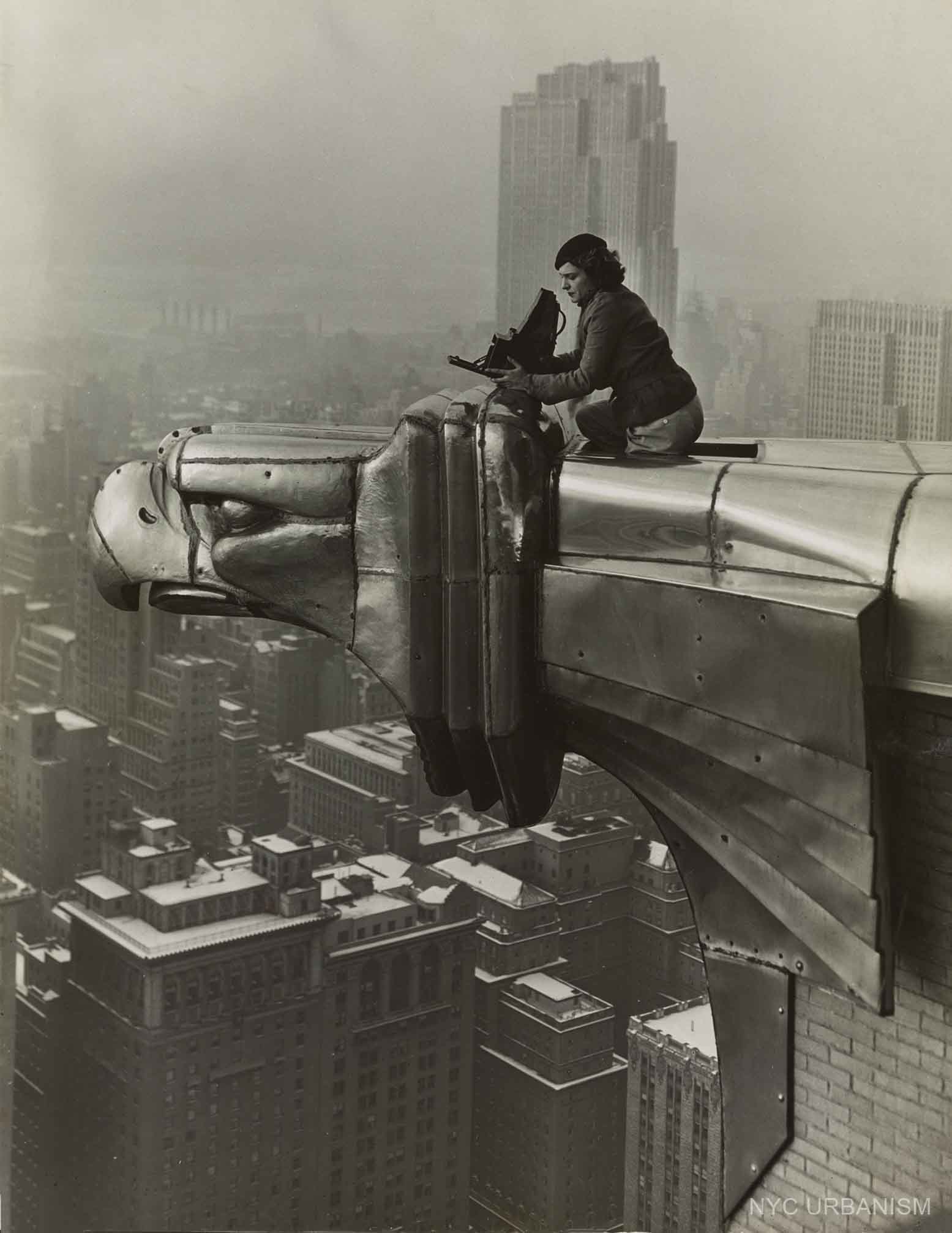
But in her green years with the Maniacs, she made this video, which I just discovered. The Chrysler building is my favorite building in the world outside of the Florence Cathedral, and when we saw our niece Emmy graduate from NYU, we stayed at a hotel where, once you opened the curtains, there it was. It was glorious. Yeah, this an old-timey video, but both Merchant and, in my opinion, the Chrysler Building, and its gargoyles, are glorious, too.
But another reason I like her is that she comes down to earth to be among us. Her songs are almost documentarian, and here she is, at street level. Walt Whitman would have liked this video.
Merchant is now sixty, maybe gong on sixty-one. She still dances like Natalie. She still sings like Natalie. Don’t let her appearance bother you. She’s still young.
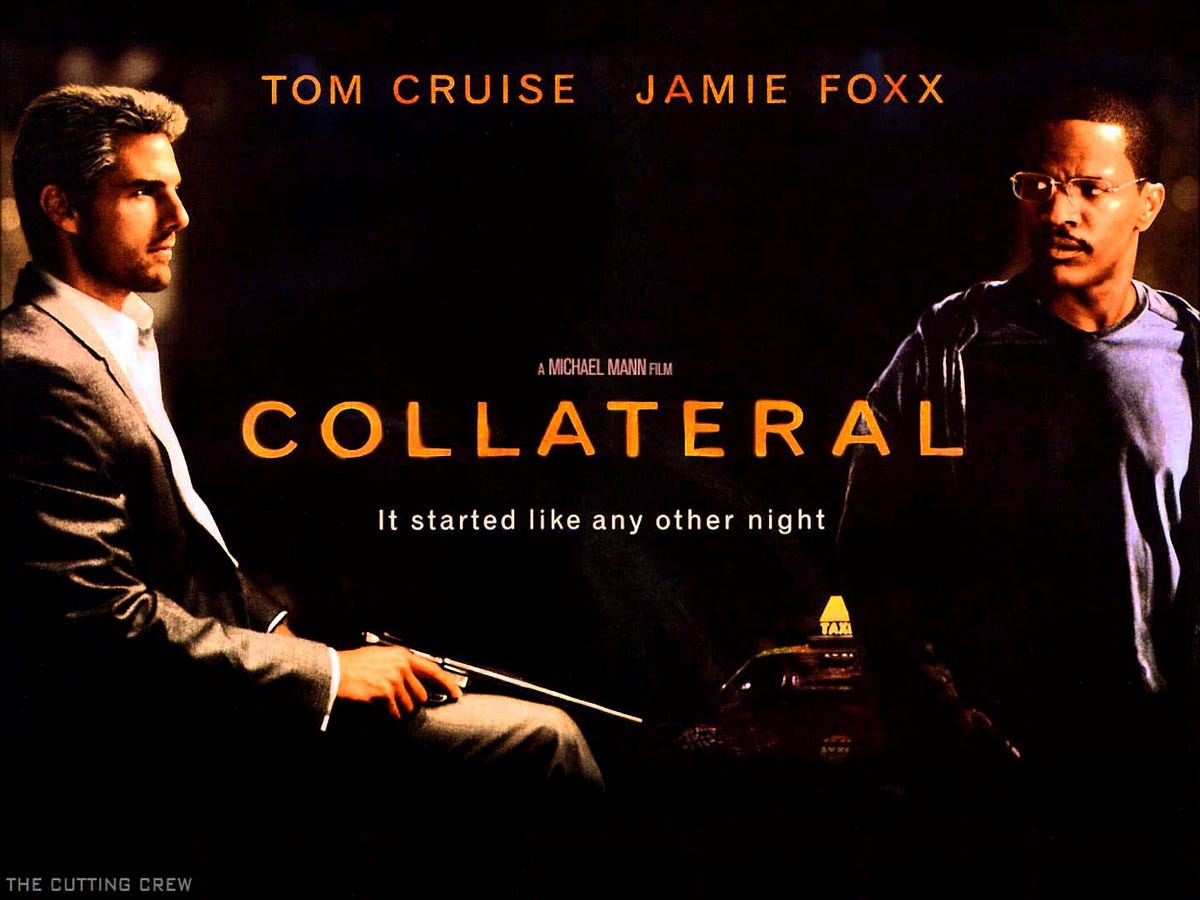
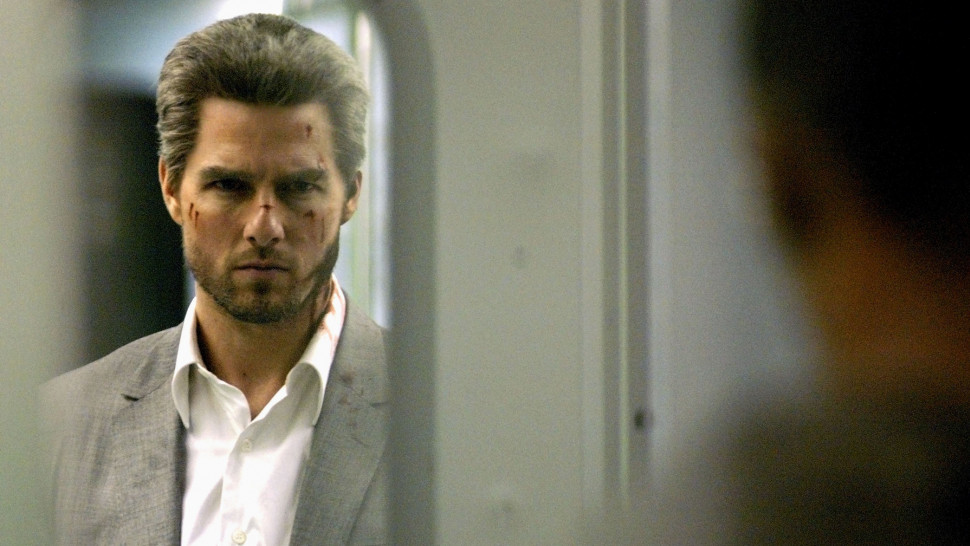
My Guilty Pleasure: 2004’s “Collateral,” starring Tom Cruise and Jamie Foxx.
I am not a Cruise fan, with the exception of his dancing movie mogul in “Tropic Thunder,” which was a generous and self-effacing performance.
But in this film, he is a slick assassin–remindful of an older film, 1973’s “Day of the Jackal,” with Edward Fox–and you almost but not quite wind up rooting for Cruise. just as you did for Fox, out to assassinate French President Charles de Gaulle.
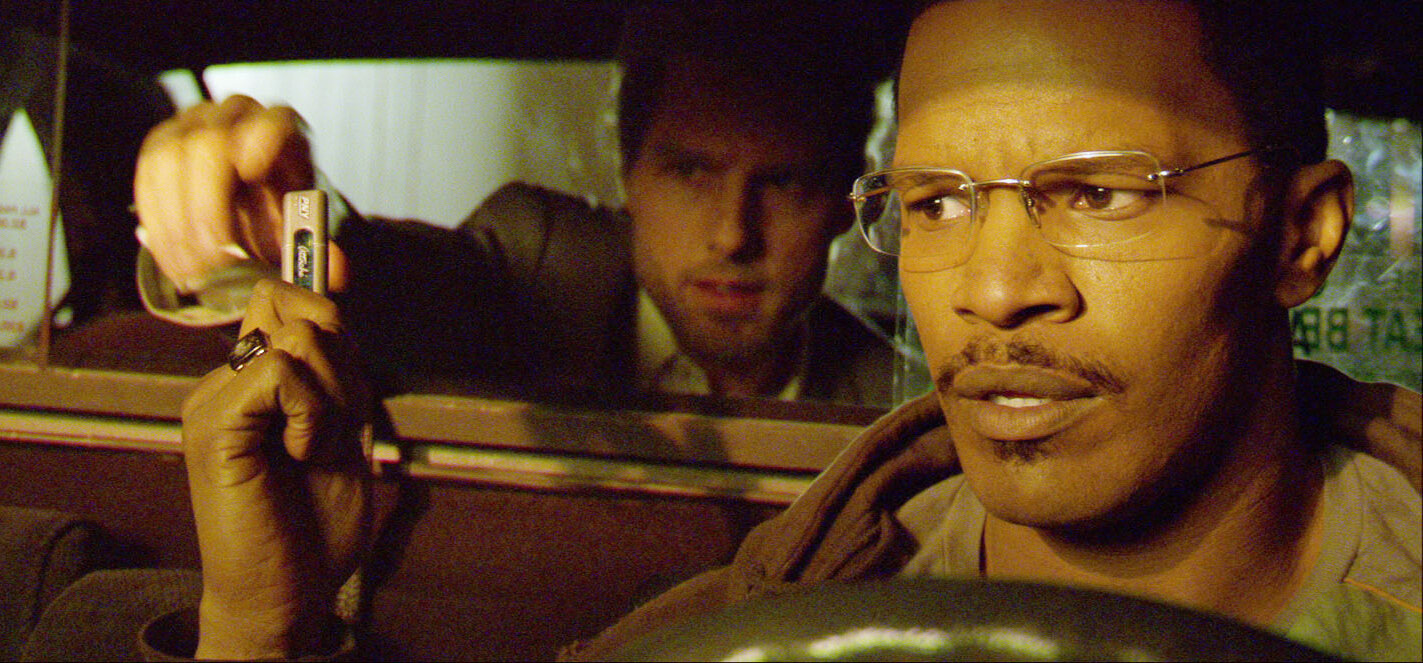
Cruise’s character has a laundry list of mob informants to murder before the Big Boss’s case goes to trial. He kidnaps taxi driver Jamie Foxx to drive him around El Lay, and along the way, you visit a South Central walk-up apartment, a slick high-rise office building, an L.A. County Morgue, a Black jazz club, a Latino dance hall and an Asian disco.
It’s like a tour, deep in the night, of modern L.A.
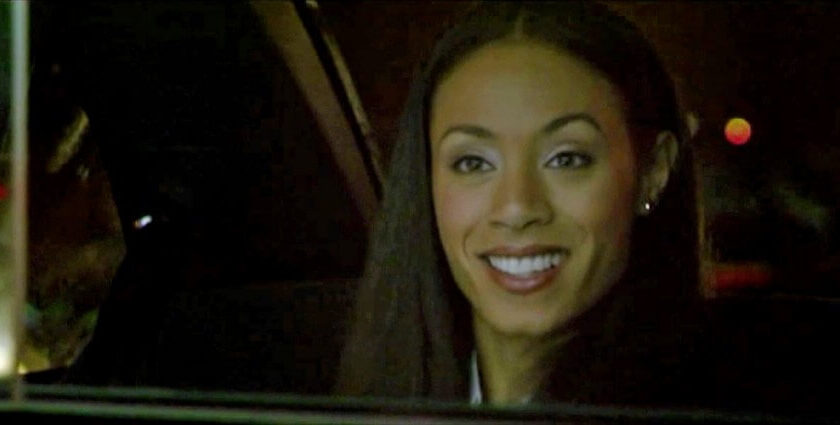
Jamie Foxx, the taxi driver, is Everyman, and one of the victims on Cruise’s hit list, Jada Pinkett Smith, is smart and beautiful. Beyond beautiful. Foxx has a crush on her. Me, too. She is luminous.
She’s not my favorite character. That honor goes to Mark Ruffalo, who’s reimagined himself from the rumpled (“Columbo” comes to mind) San Francisco detective in “Zodiac”–another favorite of mine–to an LAPD narcotics detective, street-smart, courageous and with dress and hairstyle that identifies him as a cholo.
It’s identified as “neo-noir.” I can’t argue with that.
My wife, Elizabeth, and I just made the switch from cable to streaming. No thanks to me. When eight-track tapes were popular, I had a four-track tape player. When it was universally agreed that video tapes should be VHS, Dad had a Beta player on our TV. I distinctly remember one of my high-school students, when all my music was on cassette tapes, which frequently unspooled and vomited torrents of celluloid spaghetti, about something new called a “CD.” He put one on for me—was it Flock of Seagulls? The Thompson Twins?—and we listened to it. He closed his eyes as the music played, like a dreamer in a 19th-century opium den. That CD was State of the Art.
Once upon a time, so were these television shows.
So, given my penchant for history (and for being 72 years old), I started to search for TV shows from my younger years. The only other requirement was, on our new-fangled Streaming Contraption, that they be free. Sure enough, up came my second-favorite TV theme, from one of my all-time favorite TV shows, a wicked take on life in El Lay, just a few generations removed from the arch (and evocative) writing of Raymond Chandler, the creator of Rockford’s archetype (and The Dude’s, in The Big Lebowski), Philip Marlowe.
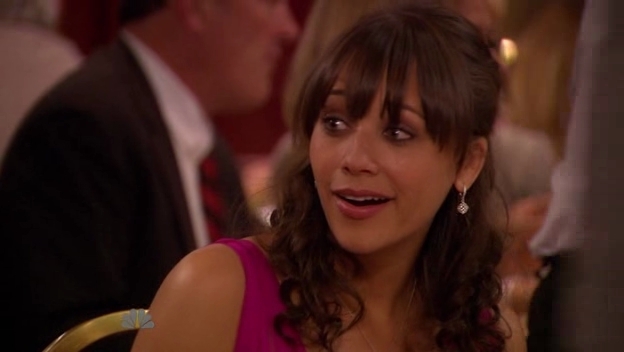
This was a detective show, too, and not one of my favorites, because it was about a bunch of snitches who worked undercover. The problems are that it’s a decent opening theme and that it includes one of the stars, Peggy Lipton, the mother of the just-as-beautiful Rashida Jones, below, in her recurring role on Parks and Rec.
Karen Valentine was adorable, too, but about all she did after Room 222, a show about high school teachers, was to appear regularly as a guest star on The Love Boat, a show I detested because it was insipid, as was its theme song. But Room 222’s theme was kind of charming. Maybe that show was one of the reasons I became a teacher. The Black teacher, Lloyd Haynes, was handsome and cool and nobody’s fool. The principal, Michael Constantine, kind of immortalized himsefl (Windex!) many years later in My Big Fat Greek Wedding.
But the second show, after Rockford Files, that I streamed was based on yet another crush from my teens. Here she is:
My family watched Marlo Thomas every week. Mom adored her, too. As to me? The lavender dress and parasol, and then, when she musses her hair at the end of the sequence, were pretty much all I needed, at fourteen, to get through the following week. (I met her father, Danny Thomas, at the Madonna Inn and got his autograph for my AGHS Christmas Formal date, Jeri Tomson. VICTORY!)
If you know that I loved That Girl, it’s not a far jump to my next favorite TV theme. The song’s not all that great. Mary Richards’ Mustang is cool, and, of course, Mary Richards Herself was Mary-freakin’-Tyler Moore, with whom most males my age had already fallen in love—when we were little boys— thanks to her Laura Petrie on The Dick Van Dyke Show.
When I was in college at the University of Missouri, about six of my (male) friends and I watched the last episode together at our fiend Tom’s house in Columbia. We were devastated, and drinking far too much after the closing credits did not help at all. We just became even more morose, and it lasted a couple of days.
Lest you think I watched shows only because of my Teen Crushes, I will remind you that I also wanted to be a spy when I grew up. Pays more than teaching, I guess. The Man from U.N.C.L.E. was a favorite—it was on Friday nights, enough to lead me to begging for a ride home after AGHS football games so I’d get there in time to watch. But my personal favorite, in the spy genre, was I Spy, with Robert Culp’s cover (a pro tennis player) and the banter with his trainer, Bill Cosby. It was revelatory to have a Black man as a lead character. Many years later, of course, Cosby would betray us—I never liked the smugness of Dr. Huxtable, anyway. My Cosby drove a stick-shift Shelby Cobra in downtown San Francsico, afraid to the point of death of letting go of the clutch and brake on Telegraph Hill. Maybe my distaste for Dr. Huxtable was a premonition. But I Spy was a terrific show and the chemistry between Culp and Cosby was brilliant.
Finally, and many of you might know this already, but our favorite spy show—my big sister Roberta and me— was Britain’s The Avengers, very camp, very spoofy, very Mod. I wanted to be the protagonist, John Steed. He was unruffled, wry, prone to popping a bottle of Moet Chandon at the drop of a (bowler) hat, drove an MG convertible. If anything, he was cooler than Culp and Cosby and just a shade shy of James Garner in whatever international measure they might use for Coolness.
So, yes, this is my all-time favorite television theme.
But let’s be real, okay? The other reason I wanted to be John Steed was the fact that his co-spy and best friend was Emma Peel, as played by Diana Rigg. Here’s the opening to the 1965 version of The Avengers.
And lest you think me alone in my regard for Emma Peel, here’s a song about her, among many alt-rock songs performed in her honor (Dishwalla, a group I love, has a song about her, too.)
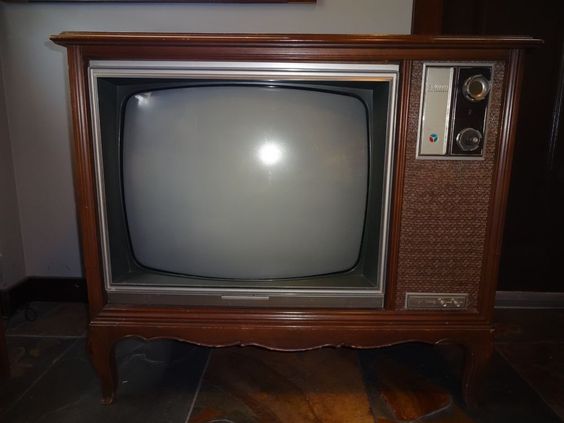
And, in case you’re wondering, we would’ve watched these shows on a TV a lot like this one, a 1964 Zenith color TV—the first color TV we had—when, out on Huasna Road, we got three channels: KSBY (NBC), KCOY (a latecomer, CBS) and, thank the gods, KEYT (ABC), because it was ABC that ran The Avengers.
I’d love to take that TV apart today and regard all its tubes and transistors, all of them now quite quaint. But the other reason I’d love to take the 1964 Zenith apart is in the faint hope that Emma Peel might still be inside.
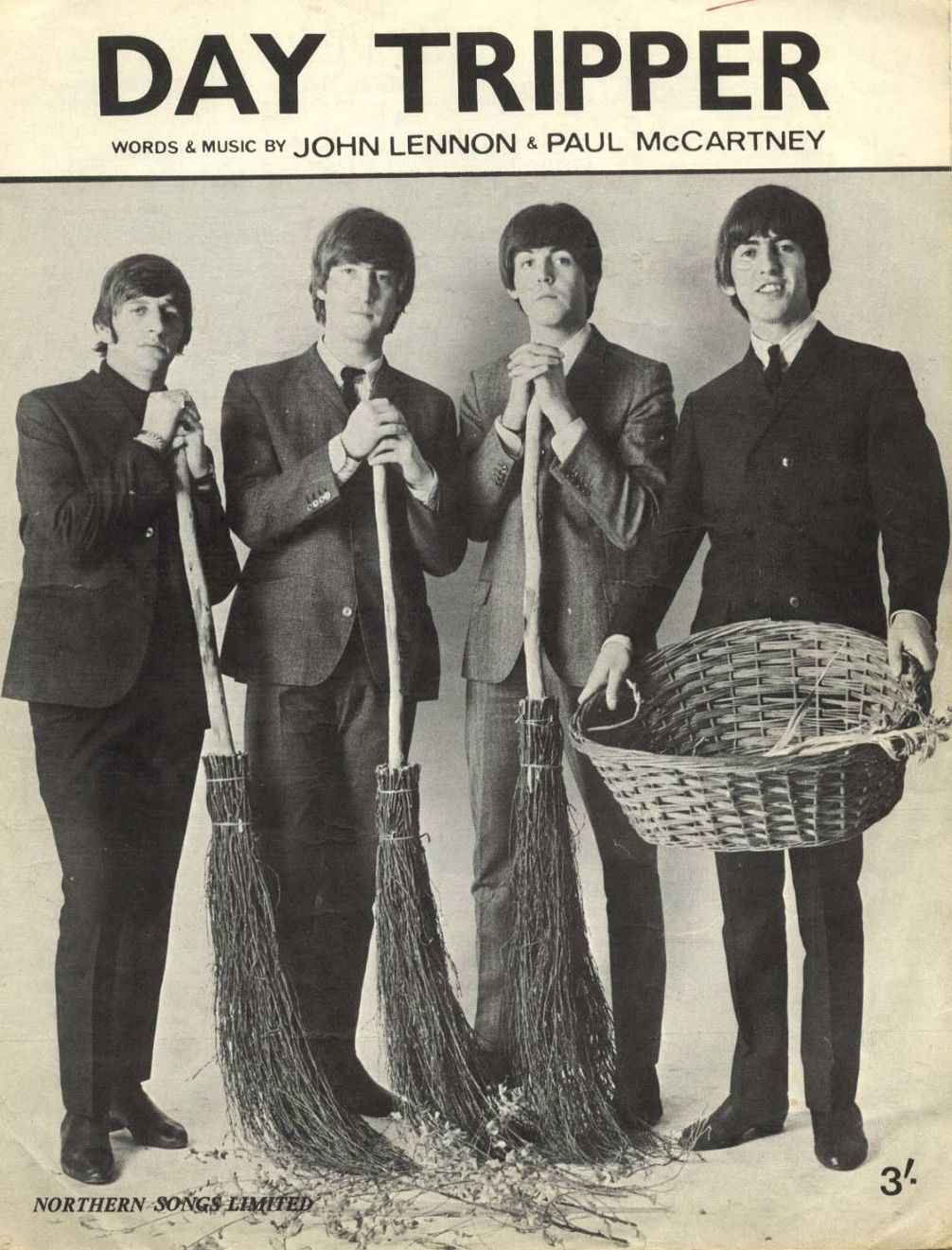
It’s one of my favorite Beatle songs, and I never really examined it beyond the fact that it makes me row faster on my rowing machine when it comes on my MP3 player. So does Taylor Swift’s “Holy Ground,,” Of Monsters and Men’s “Dirty Paws,” The Killers’ “Read My Mind,” Imagine Dragons’ “Radioactive” and, of course, The Chicks’ “Goodbye Earl.”
Go figure.
I just need to talk about the Beatles song, if you’ll indulge me, very briefly.
The intro which sizzles, was written by John Lennon. Of course.
But it was played by George Harrison, the group’s baby, on lead guitar. The lads turned it over to George, with a rare generosity of spirit that reminds me of Brian Wilson turning the lead over to Carl for “God Only Knows,” which might be both the best Beach Boys song ever and also one of the best songs in the Known Universe.
But as to this song, it’s George who sets the tone and it’s, of all people, Ringo, who drives the song. It’s an exquisite drum track, laid down by The Guy Who Replaced Pete Best.
Ringo was recently in our county in Paso Robles, and I’m damned. I wish I’d had the chance to thank him for all he’s done but most especially, for “Day Tripper.” I have mentioned this fact not more than fifty or sixty times, but our Mum adored Ringo (And Petula Clark. And Diana Ross. Pretty hip for a lady born eight weeks before Warren G. Harding was sworn in.)
Here is the song, as perfomred on some dreadful 60s rock show. The song’s still great and so, to be honest, are the dancers, but I’m still grateful that they exit soon enough to let The Lads take over.
Then, to borrow from midcentury Liverpudlian slang, it’s Gear.
P.S.: Purely gratuitous, but here’s Imagine Dragons:
And, for cryin’ out loud, here’s Of Monsters and Men, live from Austin, 2015
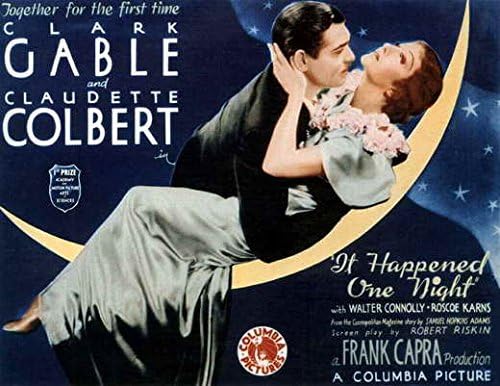
I love the Turner Classic Movie hosts because I learn so much from them. Last night’s host—it’s the annual “Month of Oscars” series—Dave Karger, taught me a lot about It Happened One Night, so his introduction made me watch it more closely than I ever have before. Among the items Karger pointed out:
–The studio that produced it, Columbia, was a shoestring operation in danger of going under. This film saved it.
–The resemblances to my favorite film, Casablanca, are amazing. Nobody expected either this film or Casablanca to be very good. Gable had gotten into the doghouse with his contract studio, MGM, so they lent him to a studio made of tin, Columbia, with the thought of disciplining him.
–No matter how much the Gable and Colbert seemed to enjoy each other, Colbert confided after It Happened had wrapped that she’d just finished the most awful film.
She was, as Bogart deadpanned in Casablanca, misinformed.
–It Happened One Night won won five of the most prestigious Academy Awards: Best Picture, Best Director, Best Screenplay, Best Actor, Best Actress. That had never happened before, on one night nor on any other in particular.
It must’ve helped hat Gable was the King of Hollywood (yes, I know about the bad teeth and the urban legend about the the fatal hit and run.) I’ve always been interested in Gable—I started out as a reporter, and it was Teacher’s Pet, with Doris Day, and not GWTW, which would’ve been one of my parents’ first “date”movies in 1940—that first attracted me. But I’ve also always been interested in Carole Lombard, too.
When I showed a similar film in spirt to It Happened One Night—My Man Godfrey—with Lombard and William Powell, to my U.S. History classes (Gregory La Cava directed), they loved it and they learned from it. That intersection between the privileged rich and us plebes attracted them immediately and it held them. They learned empathy from a film made before their grandparents were born.
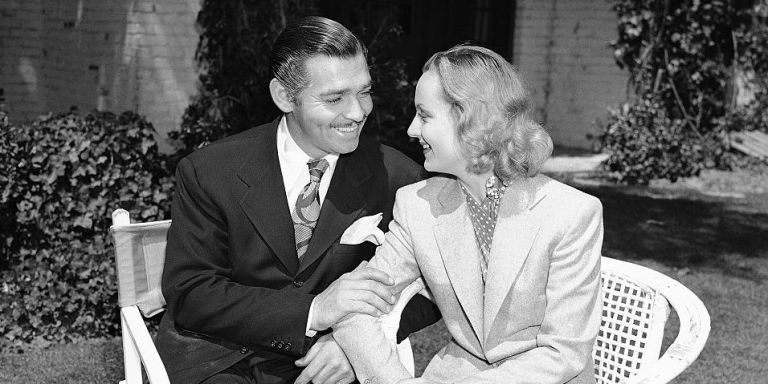
And, of course, Lombard was madly in love with Gable, learned to hunt and fish because he loved to hunt and fish. She didn’t have to learn anything about dogs—I’ve written before about her love for them—because Gable loved them, too. Including Irish Setters. (We’ve had two, among many pound puppies in our thirty-seven wedded years, named Mollie and Brigid.)
Those two, Gable and Lombard, like Elizabeth and me, finally found each other, married. Tragically, Lombard died in an air crash soon after Pearl Harbor, during a War Bond Drive. It’s an incredible and incredibly sad love story.
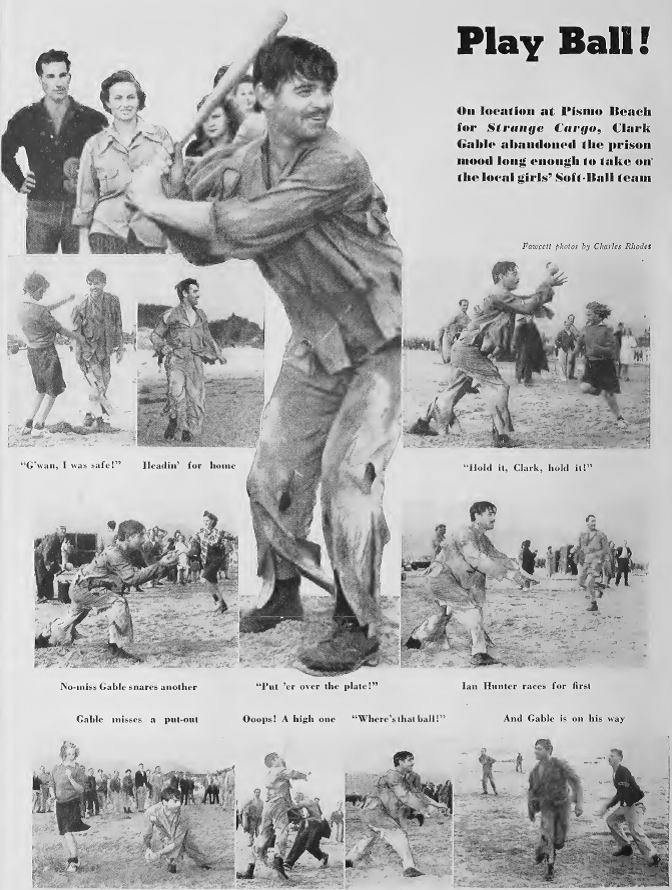
The two were part of our history, San Luis Obispo County’s history, too. They’d been guests at the Hearst Estate in San Simeon and, six years after It Happened. Gable and Joan Crawford filmed Strange Cargo in Pismo Beach, stayed at the Landmark Hotel, which is still there, on Price Street, and one day, The King of Hollywood thrilled a group of San Luis High kids by joining them in a pickup game of softball n the beach.
But here are some of the things that caught my eye in last night’s viewing, thanks to Dave Karger’s inspired introduction:
A quick summary: Claudette Colbert (Ellen) is running away from her father–she gracefully dives from his Florida yacht and swims to shore—so that she can marry a man, King Westley, an aviator who looks like Howard Hughes, as played by Bela Lugosi. He’s a creep. So she’s incognito and riding an interstate bus north when she runs into Gable’s reporter, Peter. Peter needs money and Ellen, the runaway heiress, is his scoop. Ellen needs Peter’s street smarts. So they become uneasy seatmates on a northbound bus.
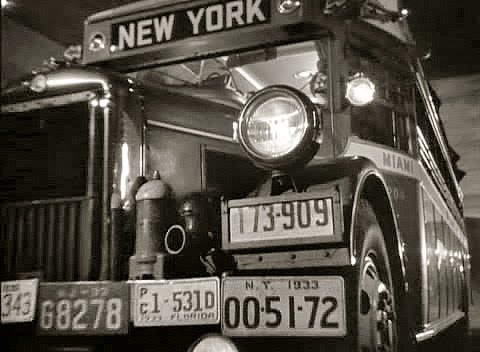
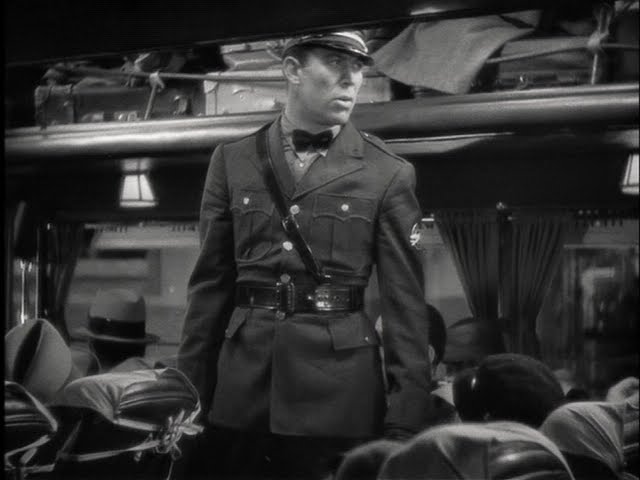
The bus alone is amazing: It’s big and square with fog lamps and headlights and an air horn that blasts when it pulls out of the terminal. It’s a damned impressive Atlantic Greyhound. So’s the driver: the first one is Ward Bond, who will have a bigger role in Capra’s postwar It’s A Wonderful Life, where he’s the Bedford Fall cop. But he’s uniformed impressively as a Greyhound driver, too, from his Sam Browne Belt to his soft high-topped boots.
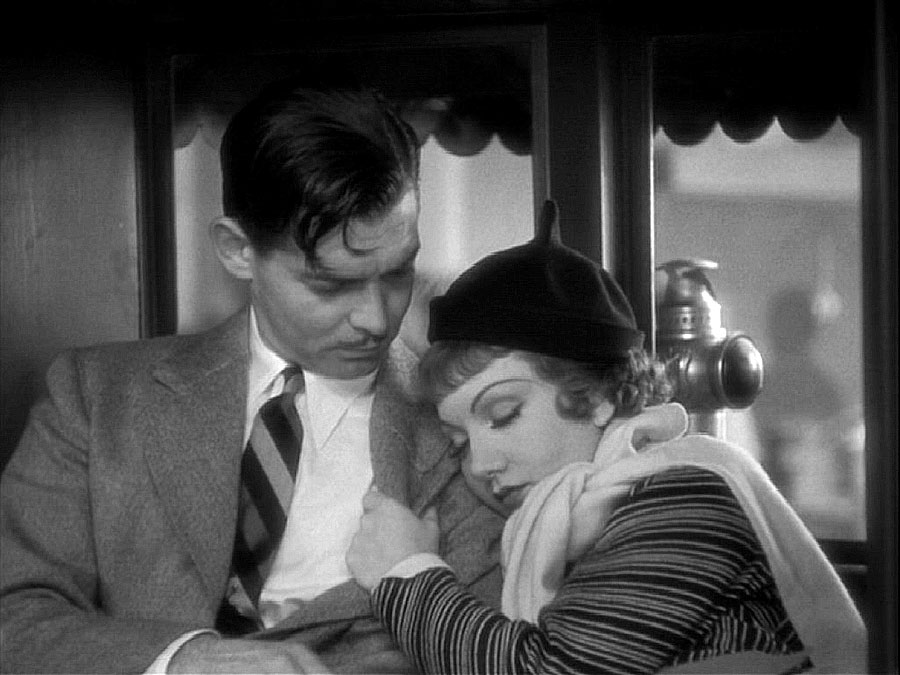
It’s all over for Gable, even though his hard-boiled reporter type won’t admit it, in the first night on the bus, when Ellen falls asleep against Peter. She is, let’s face it, adorable.
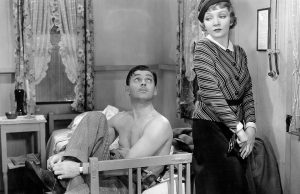
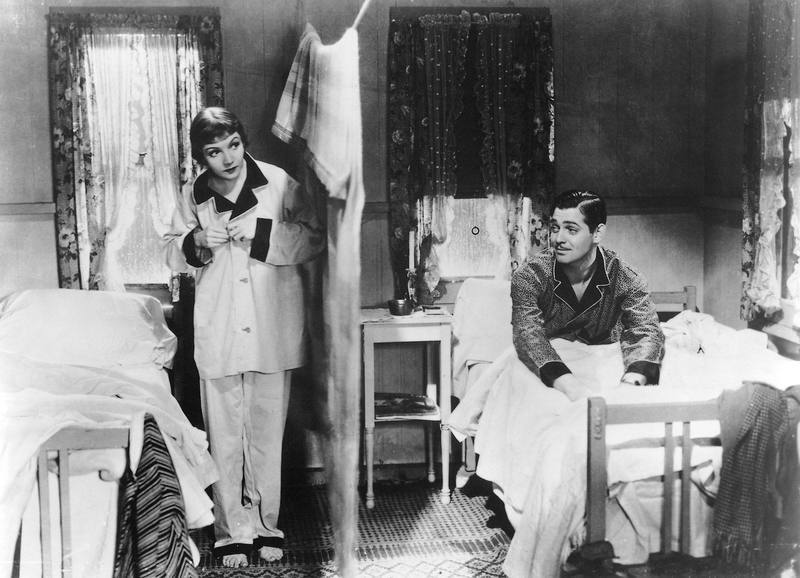
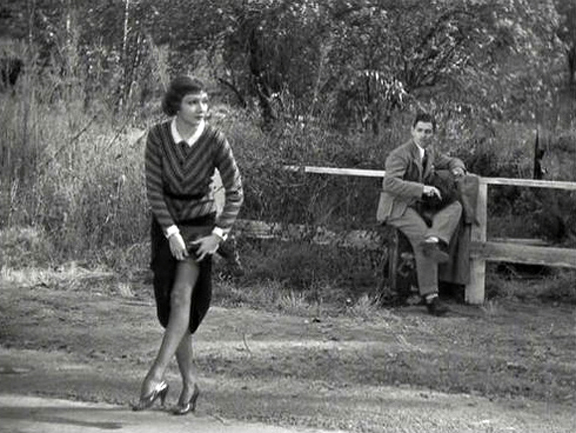
But the two, as is required, fuss and fight. She doesn’t carry cash. He doesn’t have it to begin with. So, when the bus runs up against a bridge washout, they have to share a room at an overnight camp. That, of course, leads to the film’s most famous scene, where Gable undresses and reveals to the world that Peter does not wear undershirts. I guess Jockey took a hit after that scene. He loans Ellen his best pajamas and erects a divider—“the Wall of Jericho”—between their beds for decency’s sake. The next morning, when Ellen clumps to auto court showers in Peter’s overcoat and oversized shoes, Colbert somehow makes even a clumsy walk seem charming.
Still, you’re glad when spoiled Ellen has to learn to stand in line in a place that closely resembles the Weedpatch Camp in The Grapes of Wrath. Another part of this film’s allure is its uncanny ability to transport you back to 1933, when it was shot, and to the Great Depression.
Ellen’s lucky to have that shower, and those pajamas and that overcoat and those shoes—-and the toothbrush and toothpaste that are Peter’s little gifts.
And therein lies Peter’s charm. He’s cocky, a big drinker, insubordinate and not quite as smart as he thinks he is. He passes himself off as an expert at hitchhiking, piggy-back riding and the art of dunking a doughnut. But he is also, with the exception of stealing Alan Hale’s Model T and tying the man to a tree (Hale deserved it, if only for his awful singing), he is decent. He is, to use an old-fashioned word that needs desperately to be revived, honorable. He is also generous; he is, to borrow Joseph Campbell’s remarkable observation about Han Solo, “a hero who doesn’t know that he’s a hero.”
And Peter makes breakfast, too. The doughnut-dunking scene meant a lot to me. The film was made in 1933, when the Depression was at its depths, and the care with which Peter and Ellen share a breakfast— two eggs, two doughnuts, two cups of coffee—made me a little hungry and made me, in some silly way, want to march in and add hash browns, ham, biscuits and gravy and another pot of coffee. That kind of extravagance—the big breakfasts I love so much— just wasn’t there in 1933.
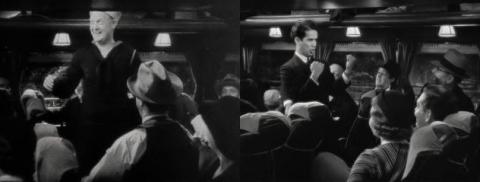
The intimate scenes between the two principals are barbed and funny and eventually they are…well, intimate…but one of my favorite scenes comes on the crowded bus, when the passengers joint in three rousing choruses of “The Daring Young Man on the Flying Trapeze,” which includes a sailor whose verse is pretty racy for 1934 (“His eyes would undress every girl in the house…”) and who looks remarkably like Popeye, who would also sing this song.
I noticed for the first time that the third and final verse is led by the director. That is Frank Capra, painfully young but already wise enough to know that we Americans are at our best when we are together, even if singing this song, than we are when we battle each other. The one painful part of the film comes when the bus stops and a Black man, ringing a bell, bellows out what’s on the menu in Stepin Fetchit English. He’s a moment of comic relief, a kind of cinematic comma, and while Capra has so much to offer modern, divided, Americans, this scene, mercifully brief, hurts.
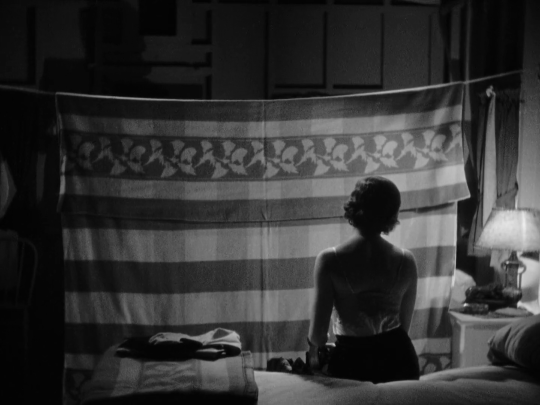
The battle between Ellen and Frank begins to end in their stay at another auto court, considerably more rustic than the first, when the blanket goes up again. This is Ellen, on her side, as she realizes that she’s in love with the arrogant man on the other side and not with the man she’s running away to for her New York wedding. This might be the film’s most poignant scene.
When her intended arrives at the wedding in his ludicrous gyrocopter—wearing a top hat, which you wish the rotors would lop off, along with his head—Peter is in the den of Ellen’s father, demanding he be paid for his efforts in returning the prodigal daughter home.
That amounts to $39.60.
That seals the deal for Ellen’s father. His sideways whispers as he takes her to the altar lead to her to dump King, Mr. Hughes-Lugosi, right then and there. Gasps ensue.
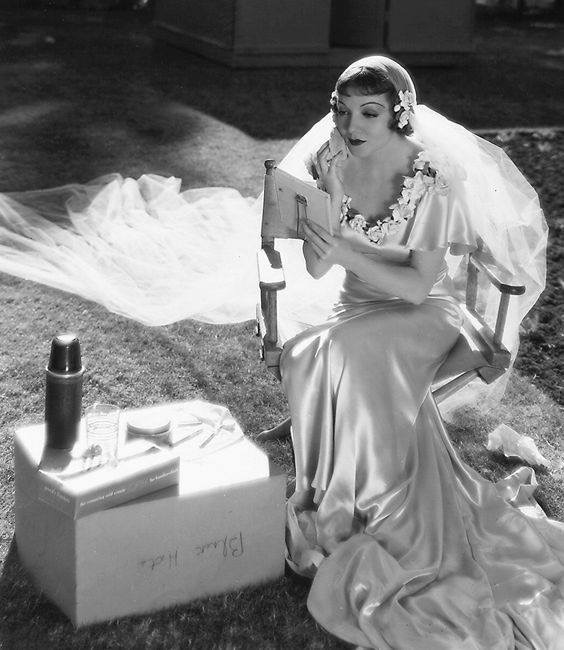
I don’t know how many runaway bride films have been made, but this one has set the standard, as far as I’m concerned. Ellen’s breath-taking wedding gown, satin, is stunning, from the cloche headdress (like Colbert’s bob, it’s on the edge of going out of style) to the train which trails behind her, by about the length of three freight cars.
A little earlier, stuck at a crossing in his Model T, Peter waves jauntily at a freight car loaded with what were called “hoboes” in 1933. My grandfather John let men like these stay the night at his farmhouse on the Ozark Plateau while my grandmother made them bacon and eggs. They were poets, engineers, one a classical violinist who played by the warmth of my grandmother’s stove.
Decency.
So Ellen, quite sensibly, runs away to her destiny.That would be with Peter.
The Walls of Jericho come down later, in a third auto court somewhere in Michigan, maybe in the Upper Peninsula, where Gable would’ve found fine fly-fishing. That would mean trout frying for breakfast, just like Hemingway’s “Big Two-Hearted River.” That’s another meal altogether, of course, but. there’s a common link between Hemingway’s prose, and Capra’s films. They are miraculous to me. They are miraculously American.
A little meal was the centerpiece of this little film. It Happened One Night, I think, is the equivalent of a breakfast of one egg, one doughnut, and one cup of coffee. By the time it’s over, you realize, in making every bite count, that it was perfect.
Claudette Colbert, in that dress, studies her lines in between takes.
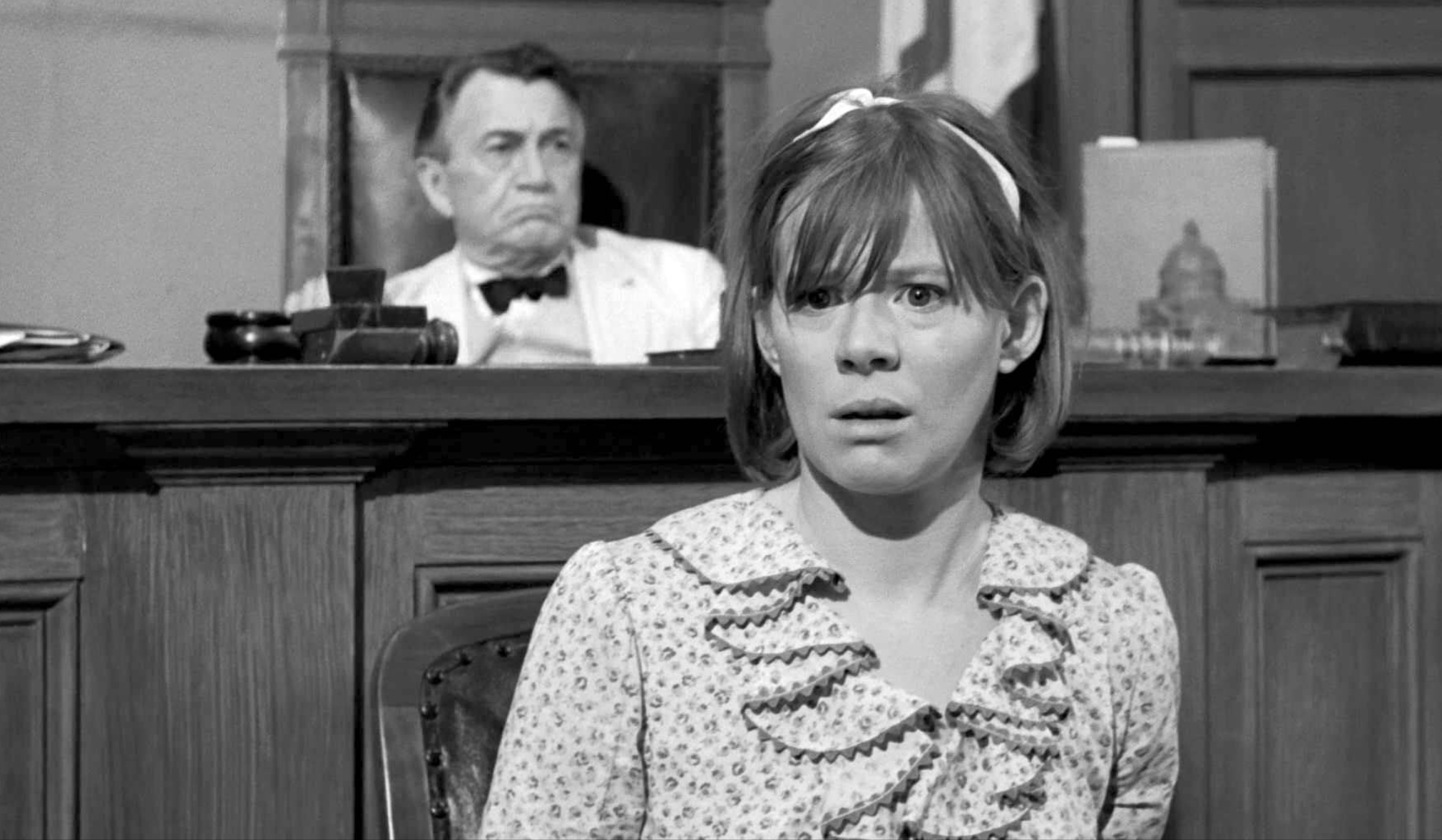
Collin Paxton as Mayella Violet Ewell, To Kill a Mockingbird
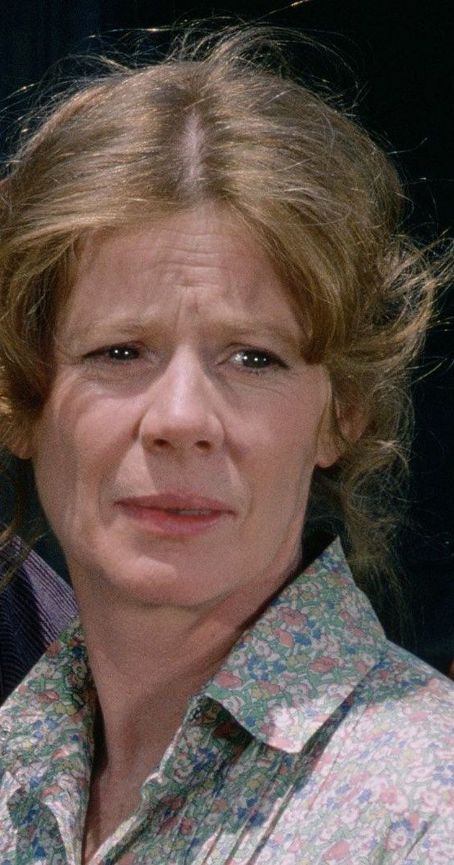
She introduced the word “chifforobe” to the rest of us. To prepare for her audition for this film, she selected her own wardrobe, which included an old blouse and dirty tennis shoes with holes in them. She rubbed cold cream into her hair to make it look disheveled and dirty. Collin Paxton (1935-2009), as Mayella, who accuses Tom Robinson of rape, has an epic breakdown on the witness stand in To Kill a Mockingbird. It’s a scene that is still, sixty-plus years later, shocking and, even more, stunning. It is masterful acting.
I’ve written before about Frank Overton’s quiet decency as the county sheriff in the film. I’ve written about our niece Emmy’s acclaimed turn as Scout in the St. Louis Metro Theater Company’s production and her getting the wonderful chance to meet Mary Badham, the film’s Scout.
Someday, I guess, I’ll have to turn to Jem and Calpurnia, too, and to Dill, Capote’s fictional counterpart. But this role is central to the film because Mayella’s testimony—bigotry trumps reason and Atticus’s empiricism—dooms Tom Robinson.
The irony? Collin Paxton was a civil rights activist, passionate about the struggle of Black Americans. When she appeared at an NAACP meeting in Monterey she got silent, sullen looks until it was pointed out the “the actress is not the person.” She did good works, including, with her husband Bill, founding actors’ studios that offered training for free.
That was in Malibu. Paxton was raised in North Carolina, so when she auditioned for the role, she stood out among the young women, pretty and made-up, who had no chance at being Mayella, the daughter of an abusive father, a character who takes his name from two Confederate generals. The role was Paxton’s. It was always meant to be.
Paxton in 1974 in one of her many television roles.
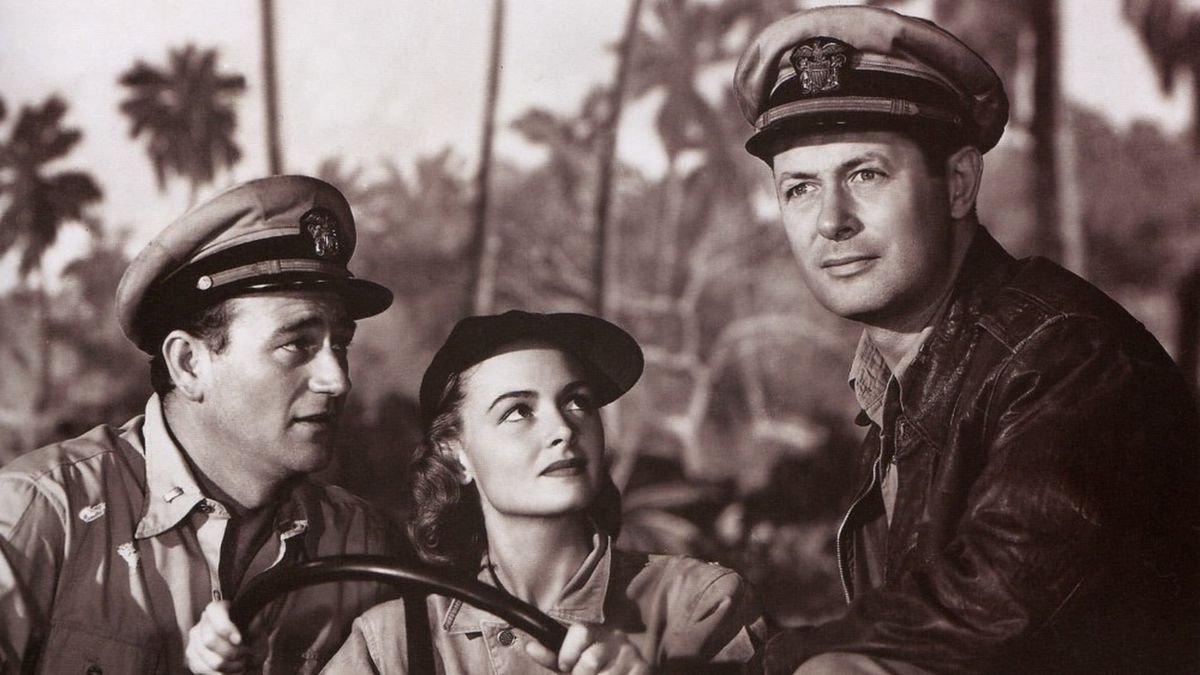
I knew this film was a four-star classic, but I’d never seen it, maybe because I wasn’t acquainted with all the leads, especially Robert Montgomery, whom I knew only as John Wayne’s PT Boat commander in They Were Expendable. More on Montgomery to follow; he was perfect in Mr. Jordan.
John Wayne, Donna Reed and Robert Montgomery in They Were Expendable.
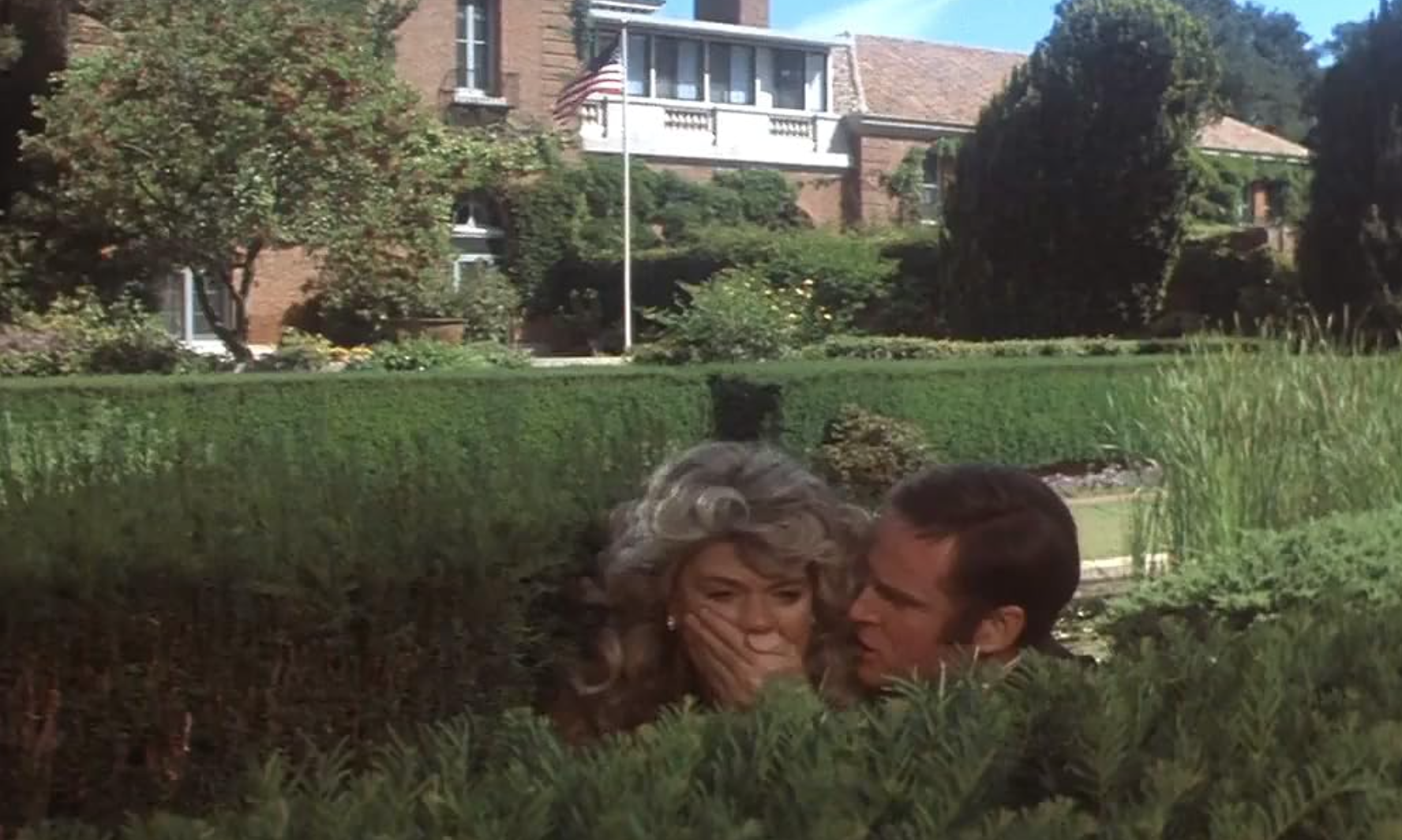
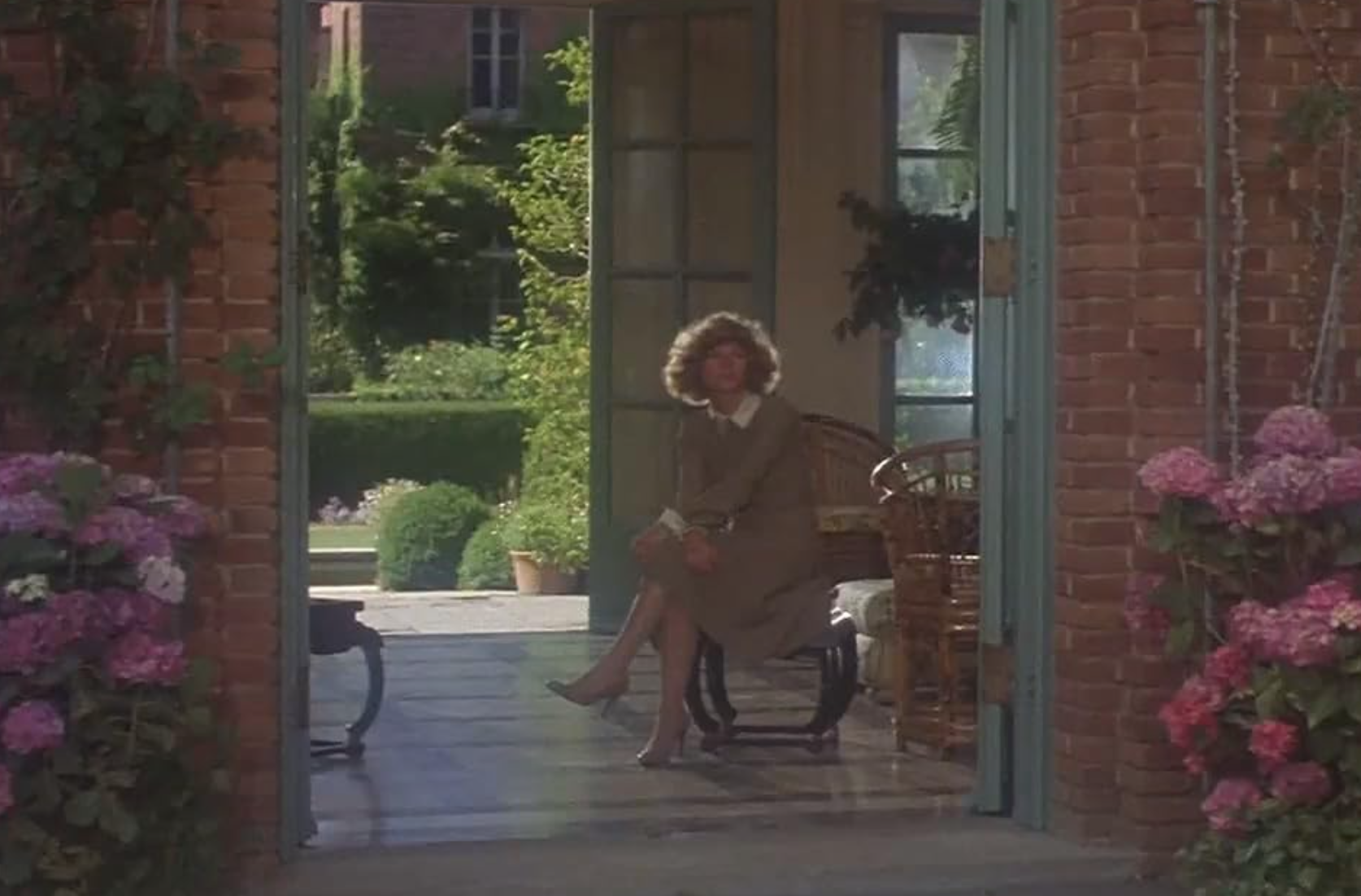
Mr. Jordan, of course, belongs to my parents’ generation—at least it did, before Turner Classic Movies (thank you, TCM). But since imitation is the sincerest form of flattery, the remake that belongs to my generation is its own classic. Heaven Can Wait. No wonder it’s a classic, too: Elaine May wrote the screenplay, Buck Henry directed it and Warren Beatty was that film’s producer and star.
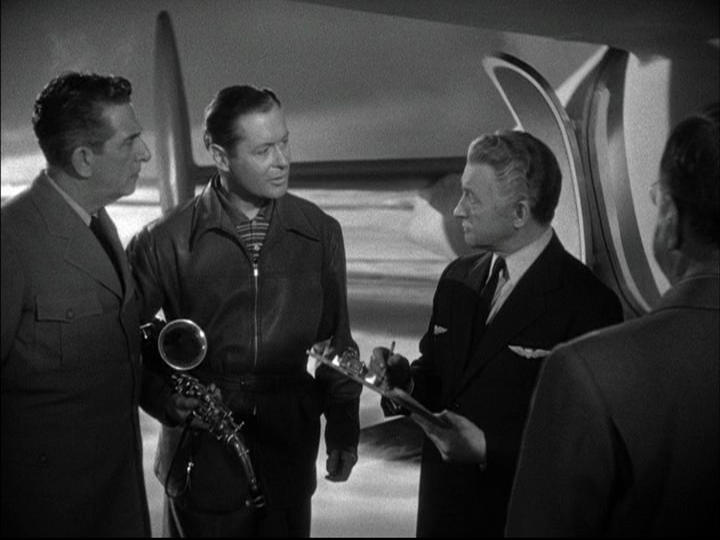
The premise for both films is that an athlete is snatched from his body just before a painful death by a well-meaning collector/angel. When he gets to St. Peter’s Gate, it’s actually an airport where a fog-enshrouded airplane awaits for another manifest of souls to board. Both the dead protagonists, Joe (Robert Montgomery) the boxer and Joe (Warren Beatty) the Rams quarterback, are not on the admittance list. It’s not there time. So both have their souls kind of transfused into not-dead-yet bodies to give them a chance to live out their lives. In both cases, the bodies belong to ruthless tycoons who have victimized countless people in their climb to the top.
Among their victims are the beautiful young women that will figure in Joe’s second chance at life.
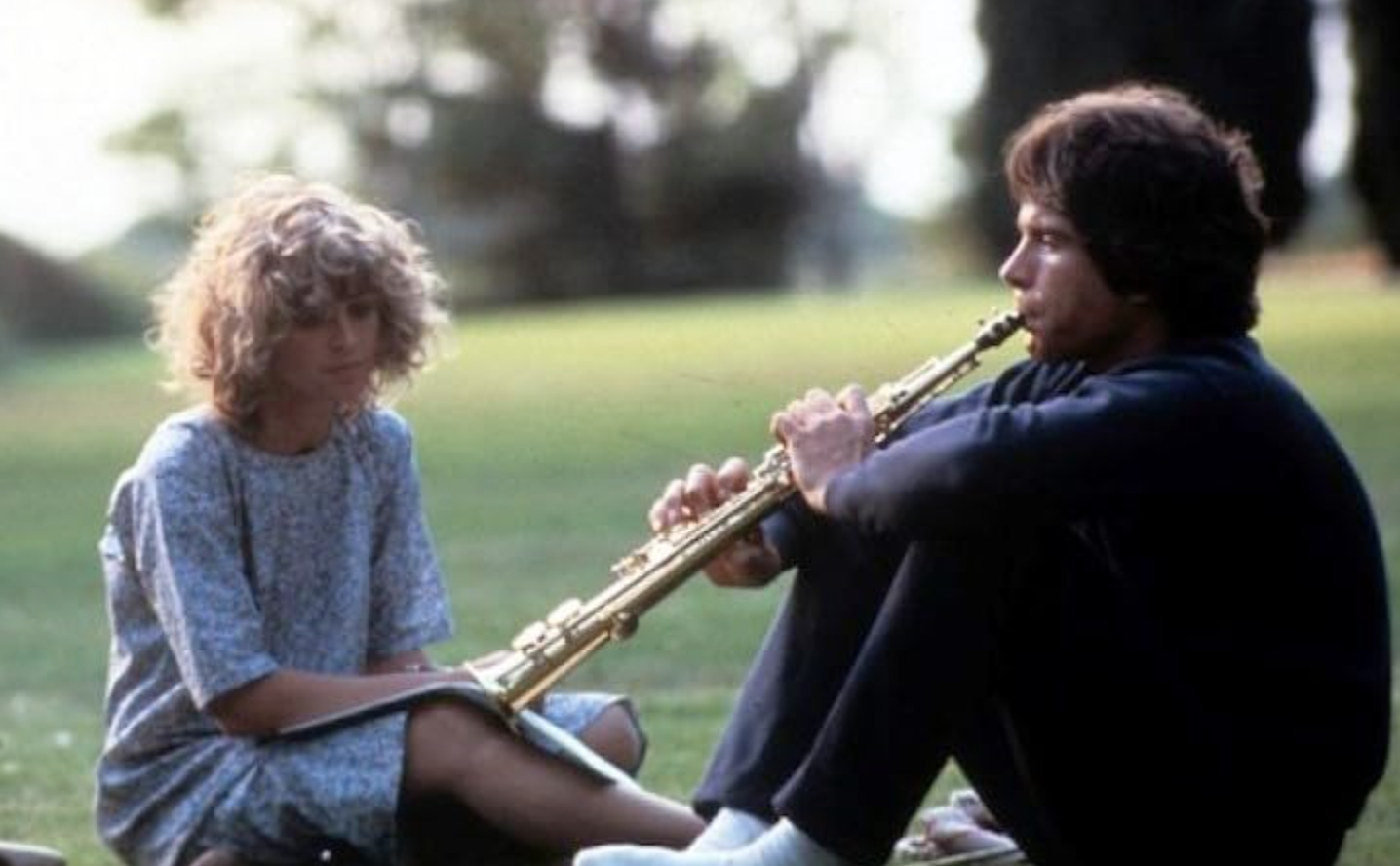
Montgomery’ s boxer—is that a Bronx accent?—is a big dumb guy who really isn’t dumb at all. He’s an innocent, a man who’s driven to be a boxing champ takes great joy in playing an atrocious sax. He’s also kind, innately generous, loves kids and he falls in love. Beatty, who is masterful at playing characters who are on the verge of incoherence, due mostly to their shyness, is likewise charming. His Joe’s a good Joe, too.
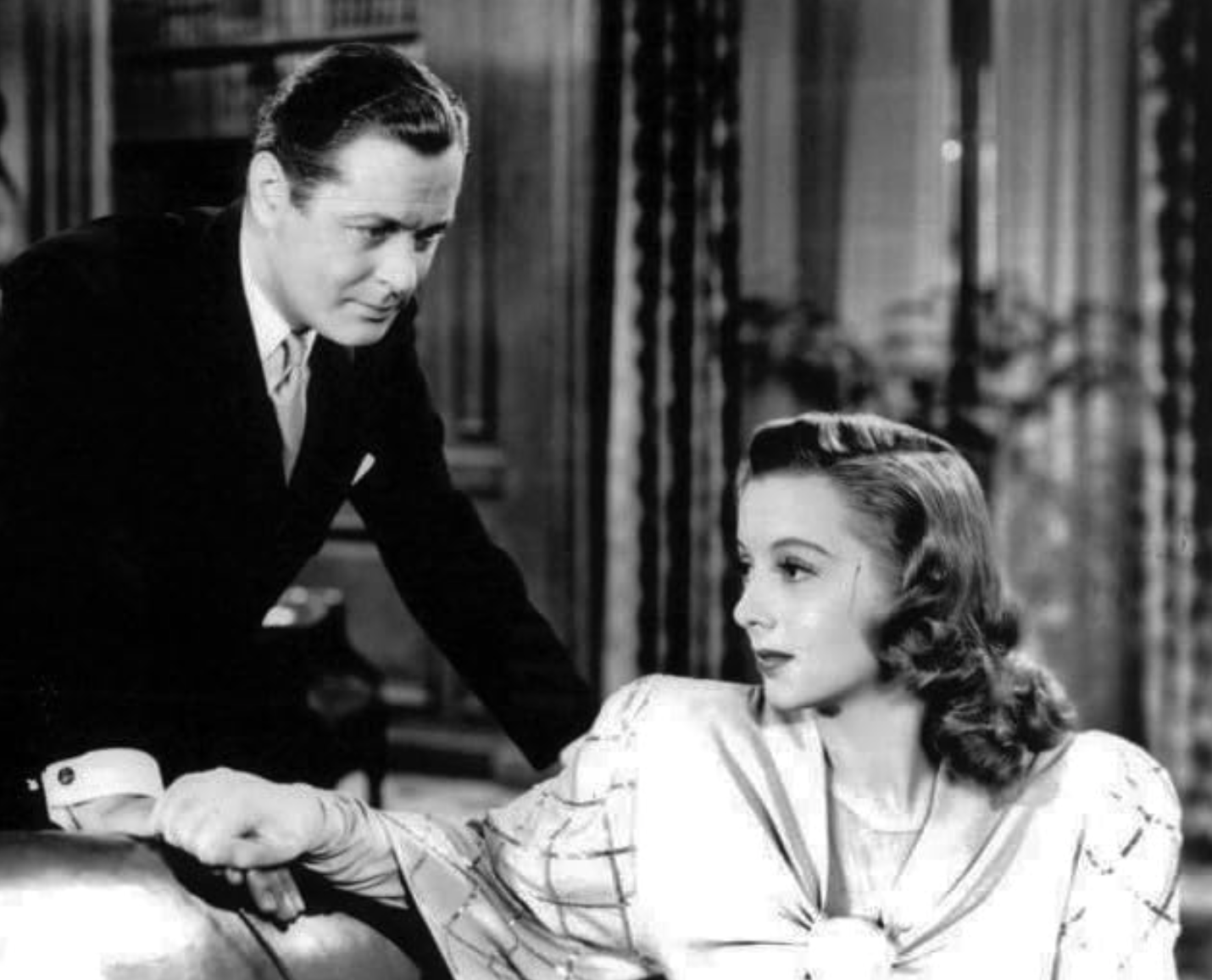
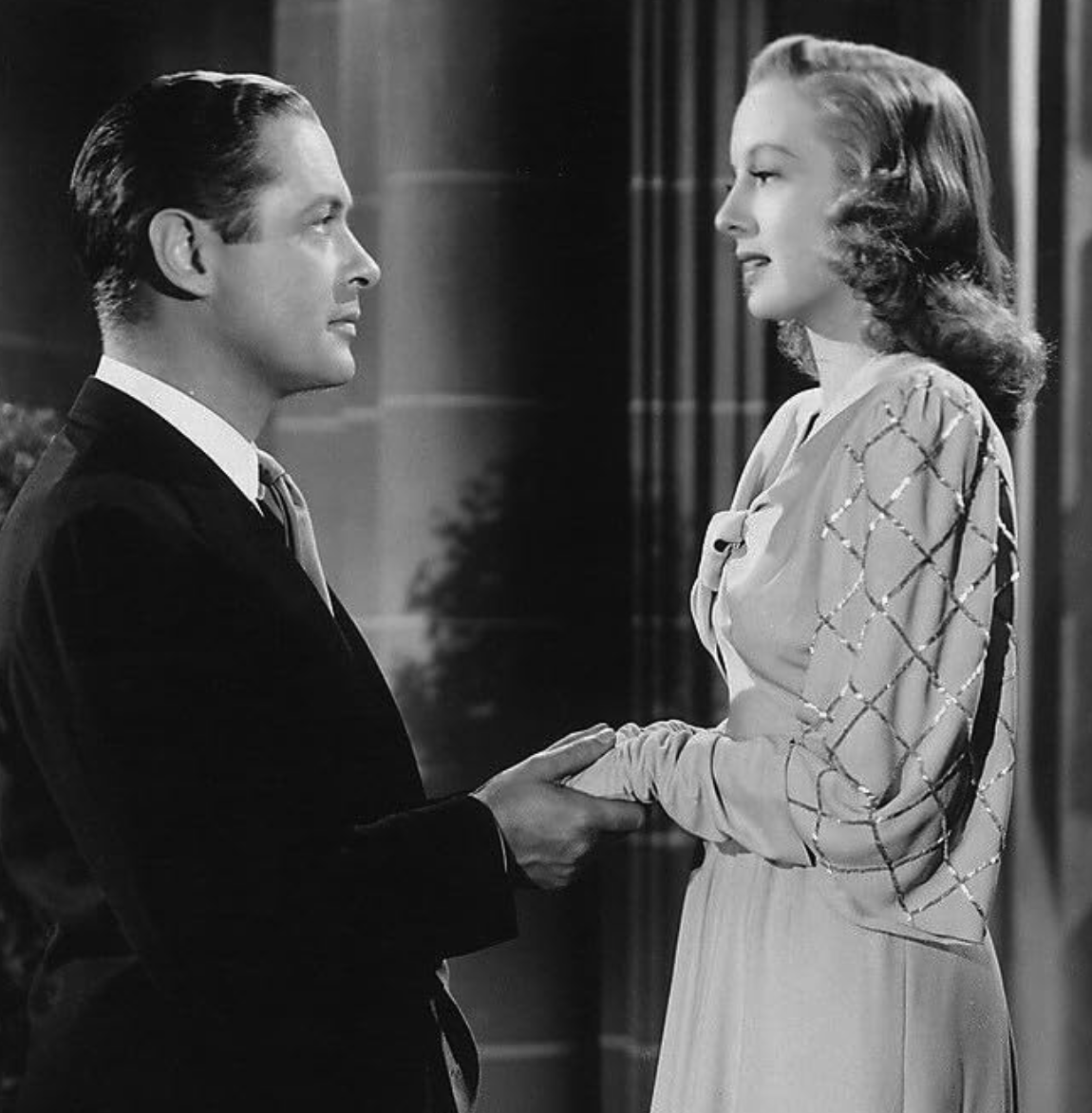
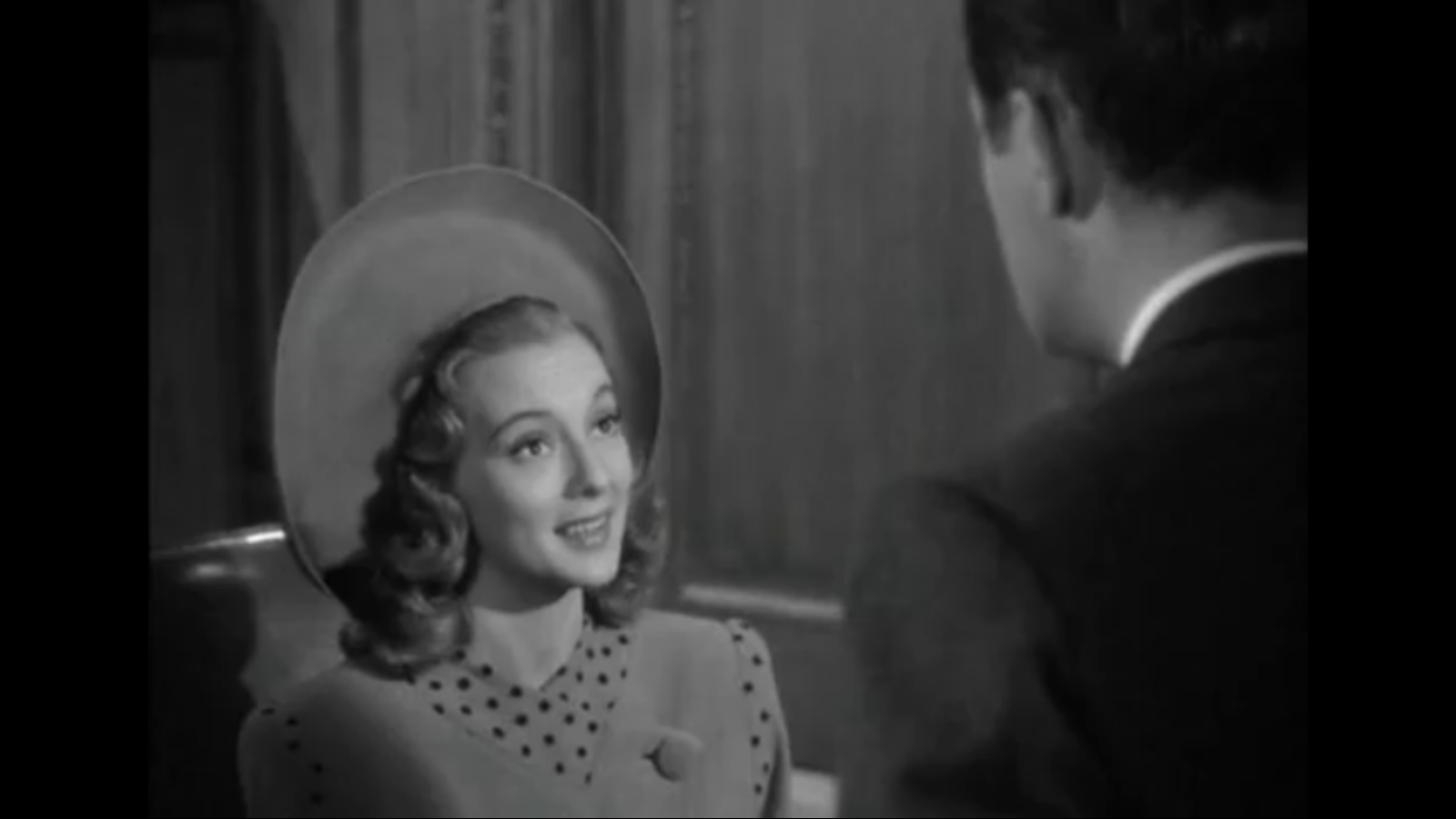
And both fall in love, hit by the thunderbolt, with young women who are very much like the Joes, pure of heart. Evelyn Keyes (Betty) plays that role in Mr. Jordan. She is stunning. I got hit by the thunderbolt, too.
Montgomery and Evelyn Keyes.
Keyes was 25 when she made this film; she was 23 as Suellen O’Hara, in GWTW, where she got two minutes’ screen time as a whiny kid sister. In Mr. Jordan, she’s so pure of heart that she’d kind of shiny. Hollywood’s a fantasy factory, of course: the real-life Keyes was married five times, had an abortion just before Gone With the Wind, and took as lovers Kirk Douglas, Glenn Ford, Anthony Quinn, Eddie Fisher (later Elizabeth Taylor’s husband), Mike Todd (ditto), David Niven, Robert Stack, Peter Lawford, directors John Huston (a husband) and Charles Vidor (another, no relation to King Vidor) and studio executives Harry Cohn and Joseph Schenck. She paid, by golly, for all those bedroom gymnastics, dying in Montecito in 2008.
She was 91.
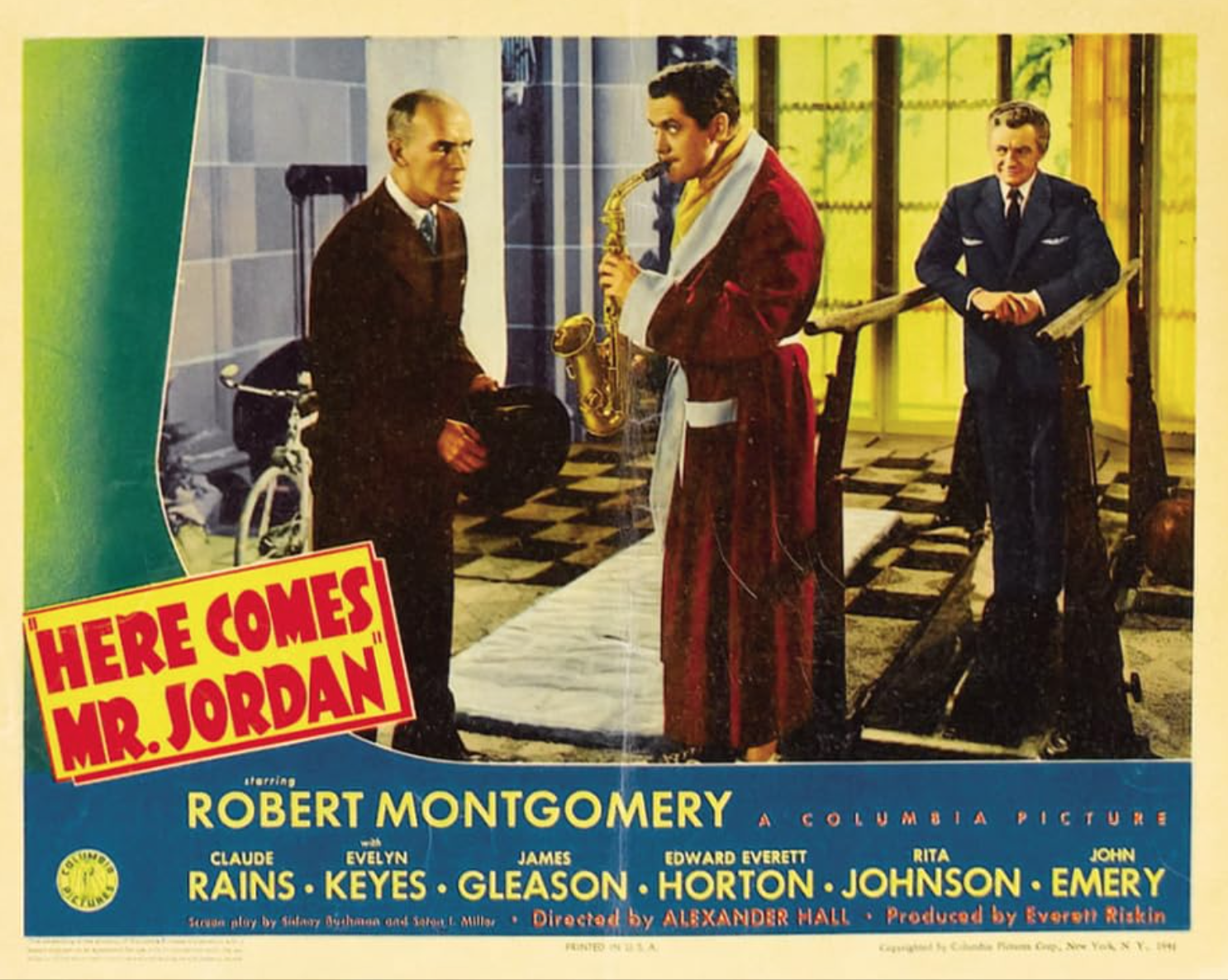
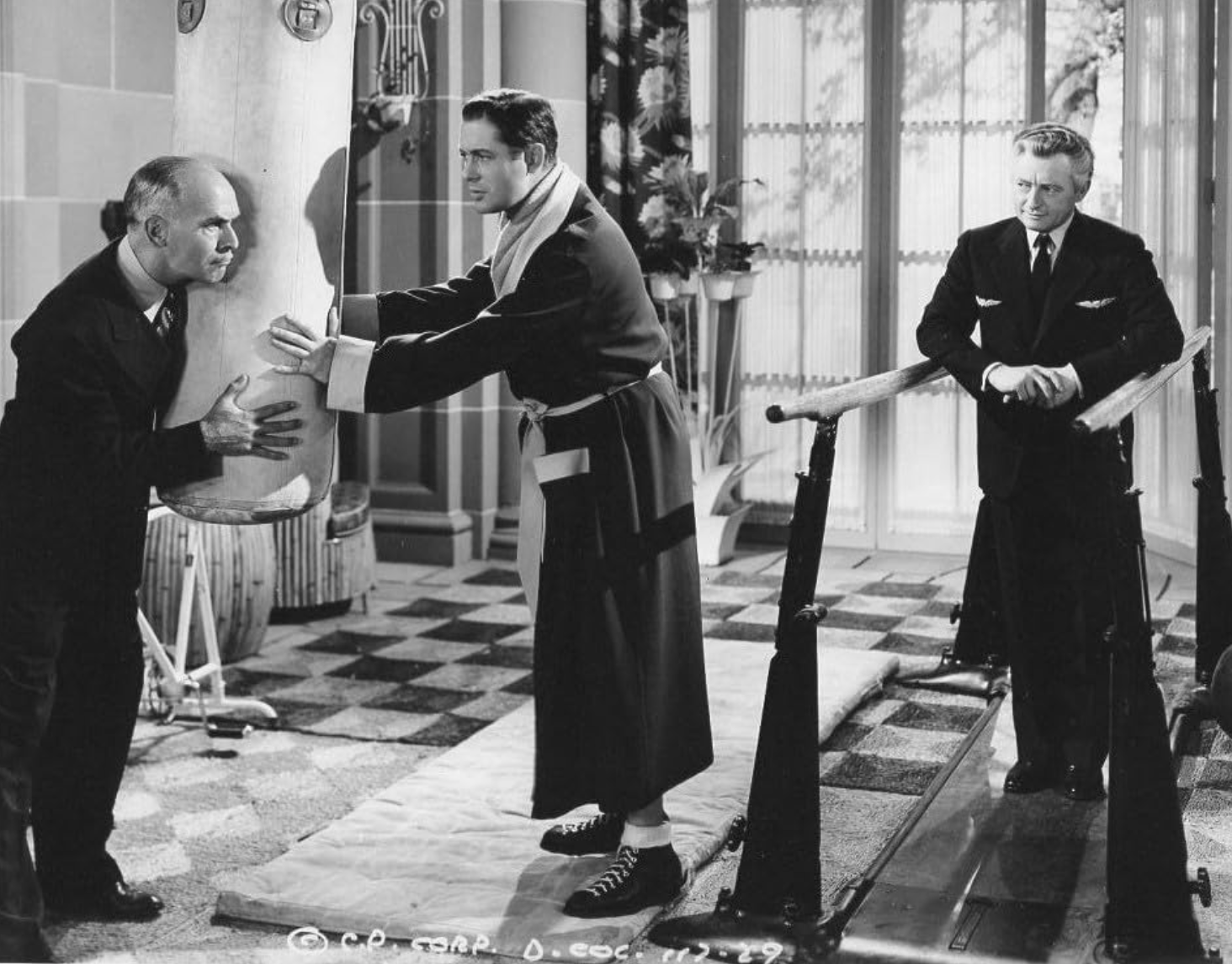
The cast of Mr. Jordan is slightly smaller, but it includes three actors I admire. Claude Rains was a pain in the ass to work with, it’s said, as demanding as a rock band that demands iced Stolicynaya and a gallon jar of M&Ms, but no green ones, in the dressing room. His arch portrayal of Captain Renault almost steals the show in Casablanca; in this film, he is suave and unrufllable, a word I just made up. That’s a wonderful character actor in the photo below, James Gleason, as Joe’s manager, Montgomery, and Claude Rains as Mr. Jordan. In the second, on the left, is Edward Everett Horton, and endearing comedic actor who became the voice of “Fractured Fairy Tales,” in an equally endearing cartoon show, The Adventures of Rocky and Bullwinkle, from my long-ago youth.
The Beatty film’s actors are just as impressive. Jack Warden is Joe’s football coach and James Mason is the perfect counterpart to Rains’s Mr. Jordan.
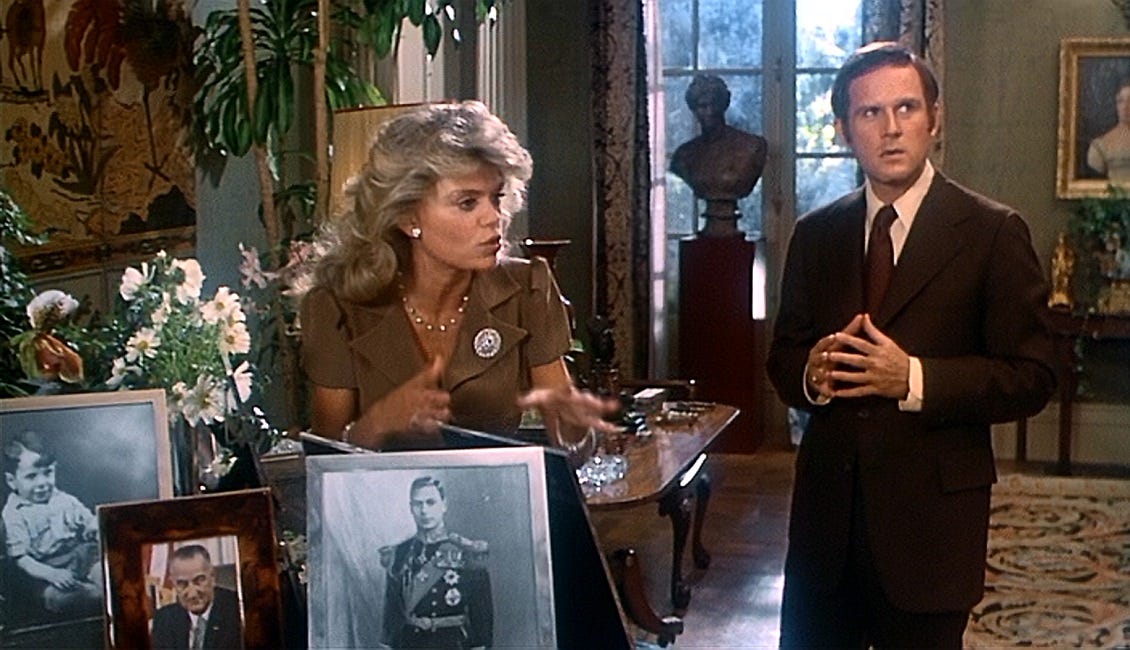
This film is nearly stolen by the two co-stars, Dyan Cannon and Charles Grodin, who plot to murder the Beatty character, now in a millionaire’s body, for his estate. Their ineptitude is spectacular. In the earlier film, Rita Johnson and John Emory are the would-be killers.
And the young woman who falls in love with her Joe in the later film is Julie Christie. (Montgomery’s tenor sax in 1941 has become a soprano sax in 1978.)
When we see both young women in both films the first time, we are gobsmacked. No wonder it wasn’t Joe’s time.
Robert Montgomery’s Joe discovers it’s not his time in the transport to Heaven way-station early in the 1941 film. Unfortunately, the plane chosen for the 1978 version is the ill-fated Concorde. But there’s one more little payoff: the co-pilot in 1941 is twenty-eight-year-old Lloyd Bridges, I wonder why Evelyn Keyes didn’t conquer that incredibly handsome young man.
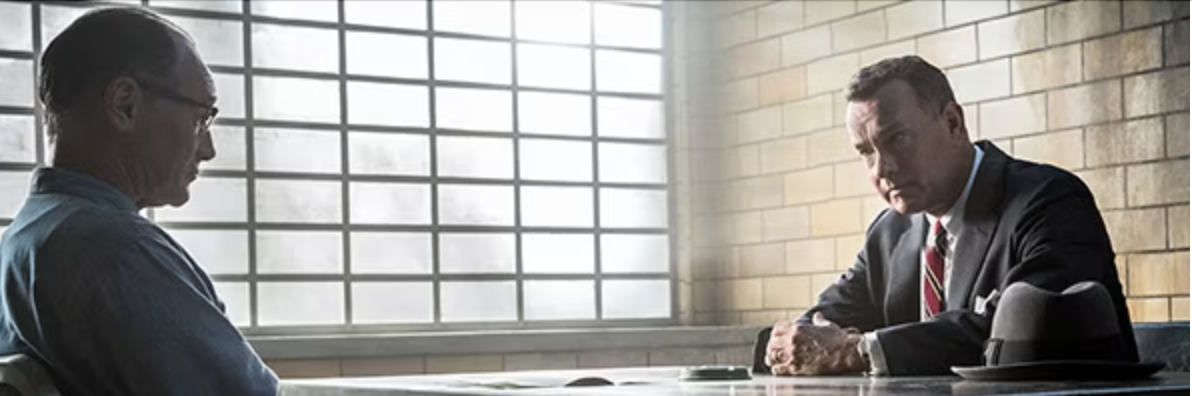
Feb 10, 1962: No wonder Bridge of Spies was on this morning. This is the date when Soviet spy Rudolf Abel was exchanged in Berlin, for CIA pilot Francis Gary Powers.
Bridge is an excellent movie on so many levels. The Spielberg-Hanks tandem is such a good fit. The script was written by the Coen Brothers (Fargo, Raising Arizona, O Brother Where Art Thou?) and the muted, faded colors, blues and grays, of Cold War East Berlin. Brooklyn is warmer, rich browns and ambers, deep red mahogany staircases,-autumnal colors and the colors subtl conveys the difference between dictatorships and democracies.
Spielberg used a Polish cinematographer, Janus Kaminski, who knew the difference.
Mark Rylance, as Abel, is a personal favorite of mine (Dunkirk, and the PBS series about Henry VIII and Cromwell, his chancellor, Wolf Hall.)
You could get the electric chair, Hanks warns Rylance at one point. Aren’t you worried?
Would it do any good? Rylance replies.
I am a sucker for movies about personal integrity (A Man For All Seasons, Julia, Dead Poets’ Society, Spotlight, Shane, To Kill a Mockingbird, Casablanca) which I guess explains why I’m so fond of this film and of Tom Hanks’s acting in it. I think he just might be my generation’s James Stewart or Gregory Peck.
And if you think my taste in films reveals me as one of those Damned Liberal history teachers, you’re right. The scene below reveals precisely the kind of Damned Liberal stuff I taught your children for thirty years. I still believe very word of Hanks’s reply to his CIA handler, and that’s because, quite simply, I have always loved my country and I always will.
Its imperfections are glaring and obvious. As Churchill noted, democracy is by far the worst of all government systems. Except for all the others. But the system that’s sliding toward plutocracy and a gerontocracy needs men and women of integrity, not destruction. The arts, including this film, reveal that truth to us.
The final scenes are moving: A woman recognizes Hanks, previously vilified as Rudolf Abel’s counsel, on the subway, and she gives him an ever-so-subtle smile for bringing Powers safely home.
Hanks’ smile, as mine would be, too, is wider. He is proud of himself.
But when he looks out the subway window and sees neighborhood kids jumping a chain-link fence–he’s just seen young men gunned down by border guards at The Wall—the smile rapidly fades. The character recedes into the ambivalence that is the lot of most of us, as human beings, every day of our lives.
It’s now hard for me to believe that so much of my life was lived during the Cold War. One day, chaff—aluminum strips designed to obscure enemy radar—came raining down on the Branch School softball field. Somewhere high above us, U.S. Air Force warplanes were practicing for World War III.
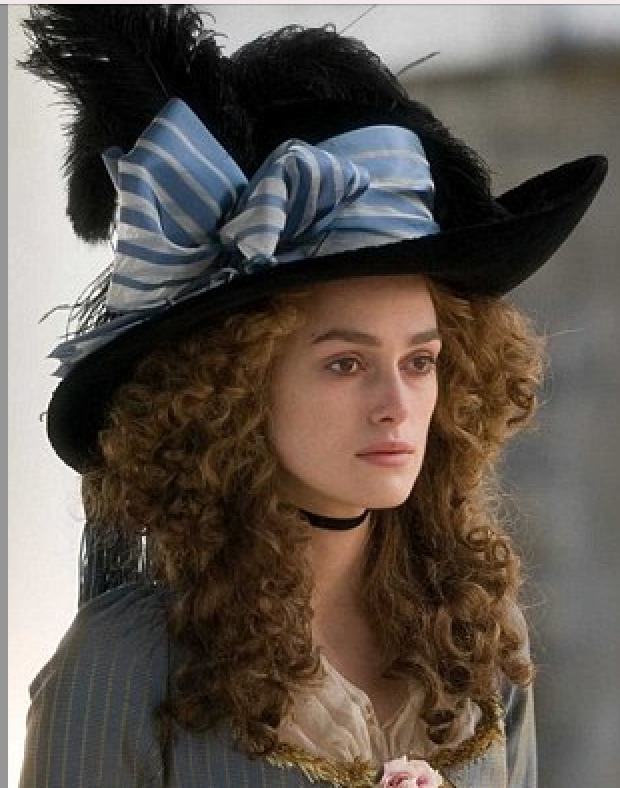
Leave it to me to wake up thinking about 18th-Century women’s wigs. A couple of weeks ago, Elizabeth and I watched again the film The Duchess, about Georgiana, the Duchess of Devonshire, the ancestral great-aunt of Princess Diana. Georgiana was played by Keira Knightley, she of the oddly beautiful underbite and delicate bone structure, and Knightley did her job well.
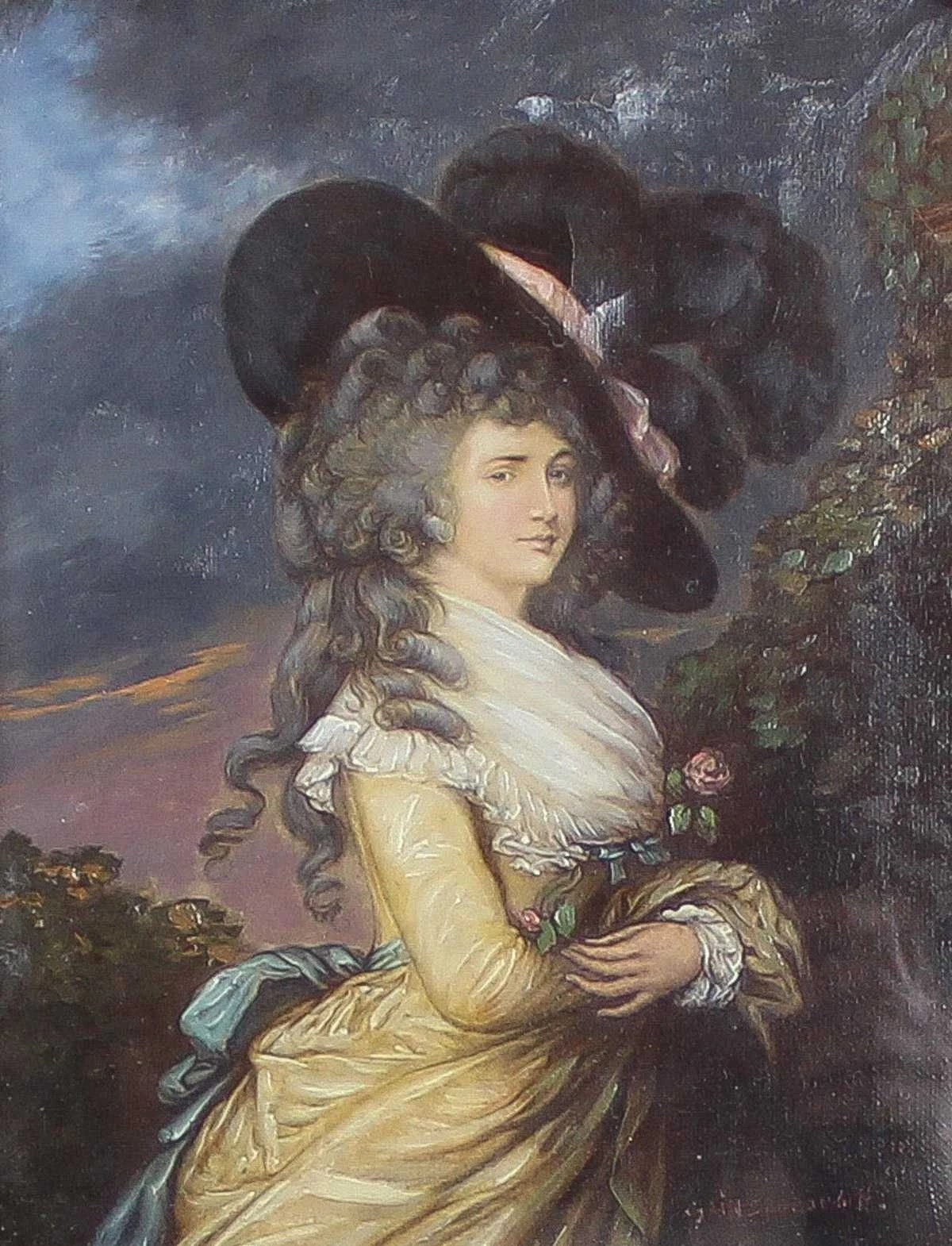
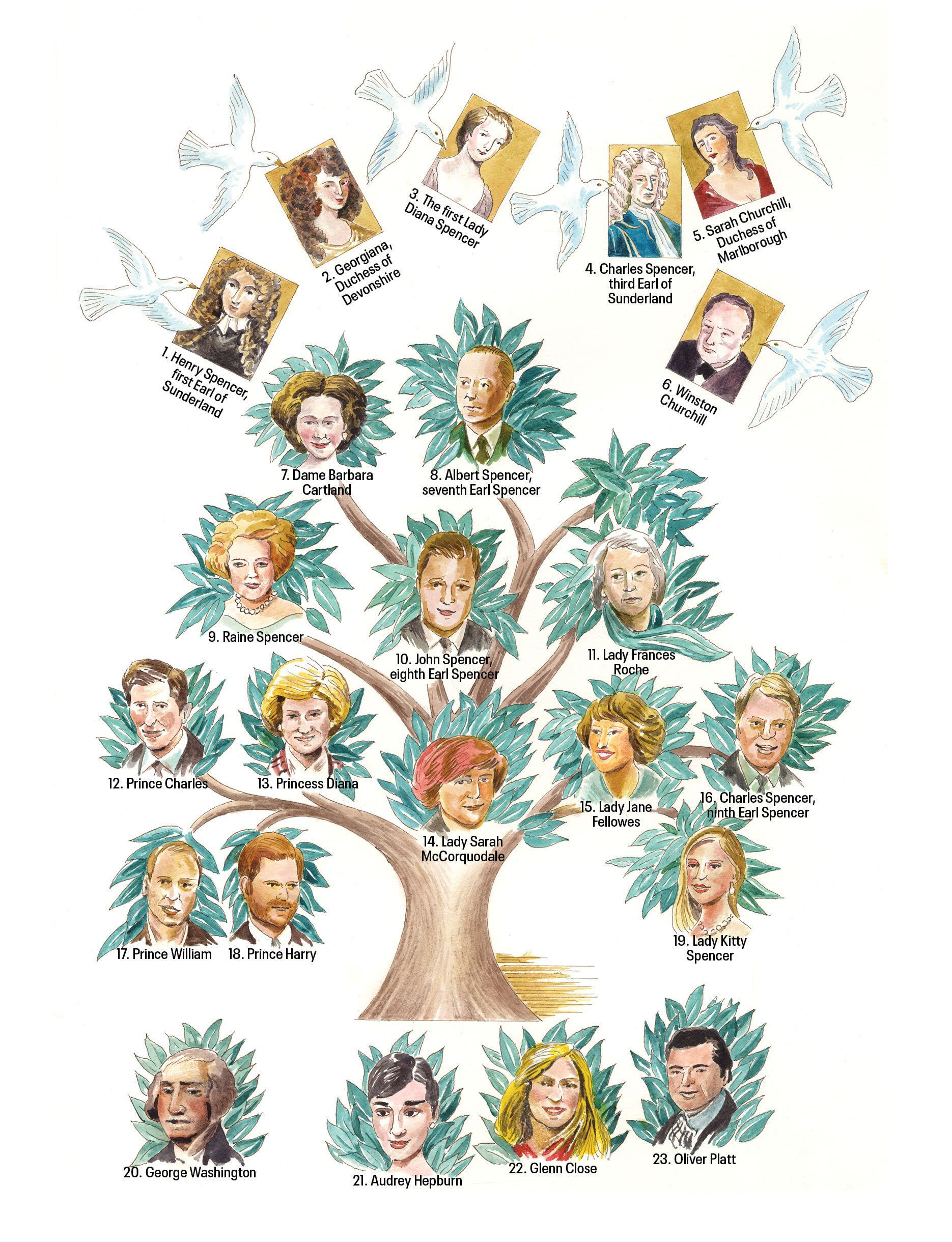
The real Georgiana—she’s portrayed by Gainsborough in the painting— had some impressive branches on her family tree, given that she was a Spencer:
He life was not so stellar. She married William Cavendish, the Duke, at 16 to bring wealth to her own family, and the marriage was not happy. Ralph Fiennes portrays Cavendish and I almost bought a bag of frozen cod the other day because it reminded me of Fiennes in the film. Not all of him was frozen: there was enough warmth in the hearth for him to invite his mistress, Elizabeth Foster, to live with him and Georgiana. (Eventually, the two women become friends and fellow-sufferers.)
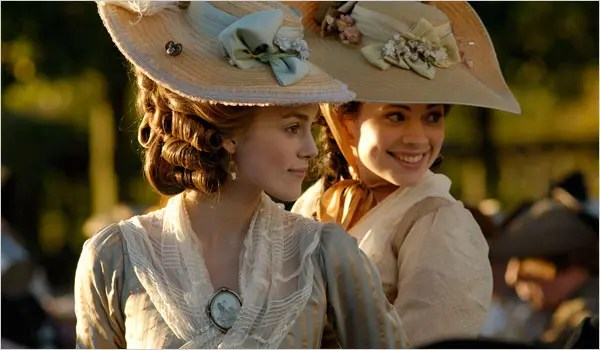
Knightley with Hayley Atwell as Lady Elizabeth Foster
Georgiana consoles herself in drinking, partying, running up immense gambling debts (although she gained entry into British politics by shrewdly choosing her gambling partners at cards) and cavorting with the handsome MP Charles Grey. In one film scene, daughter she bears by Grey is taken from her to be raised with “his people,” and the exchange of the baby is done between two carriages on a remote country road. It is gut-wrenching.
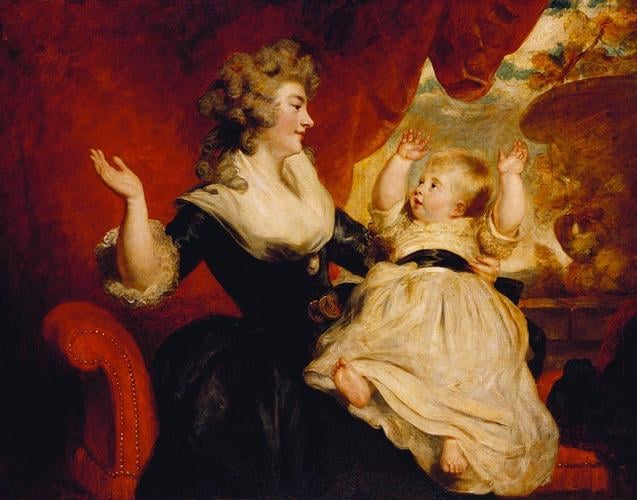
Despite all of this, Georgiana would be remembered as a loving friend and mother, good-humored and devoted to the poor, especially children. Good for her. She was also beautiful: here she is, in 1786, with one of her daughters, and, again, portrayed by the many-wigged Knightley.
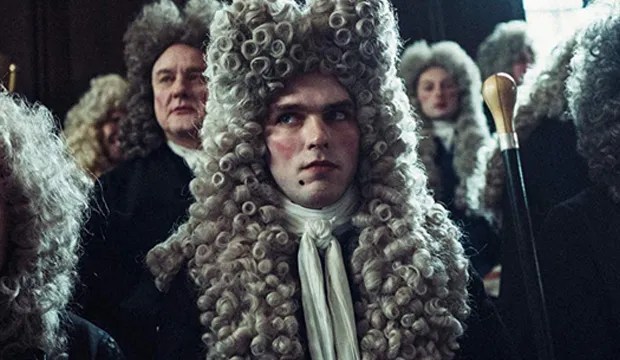
The Favourite, produced ten years after The Duchess but set in the century before Georgiana’s time, won the Academy Award for costume design, as did the earlier film. Well-deserved. But when it comes to wigs, it was the men who outdid the women in The Favourite. In that film, it’s Lord Harley’s wigs, not to mention his beauty mark, that steal the show (the young Nicholas Hoult is wonderful as the acidic and opportunistic Parliamentarian).
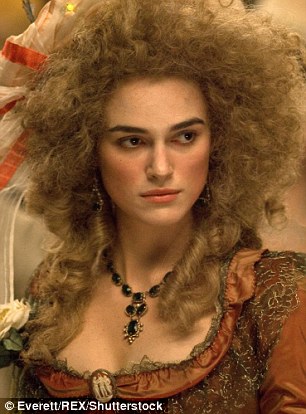
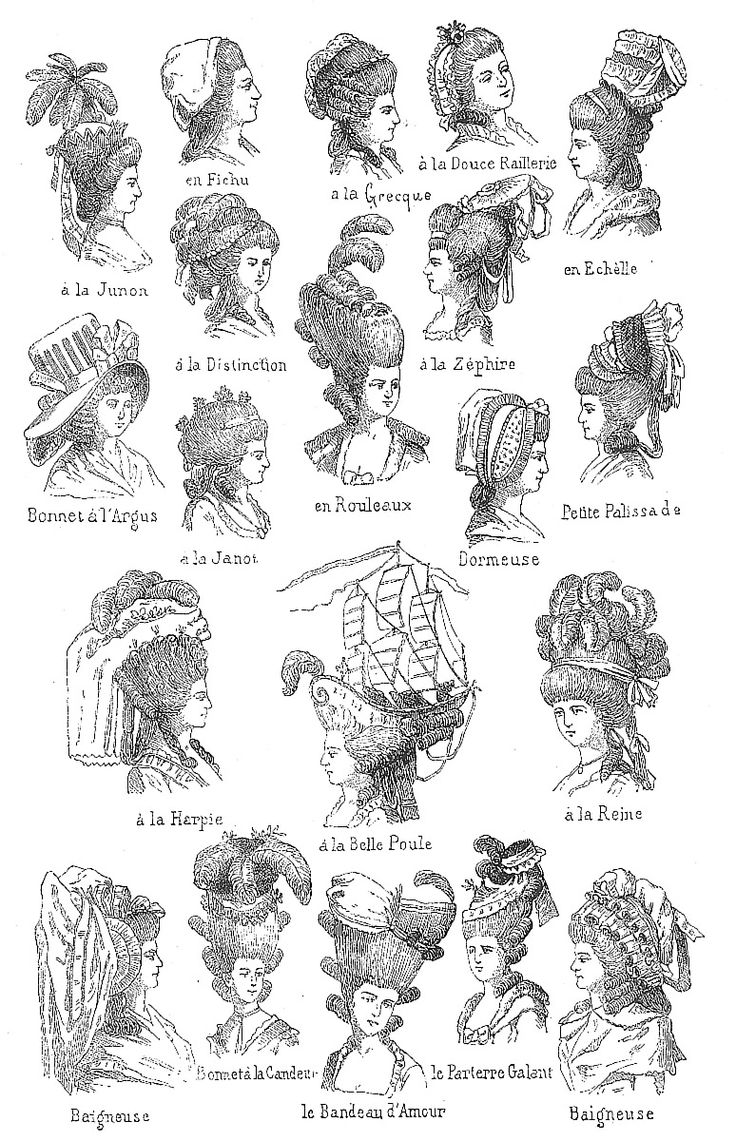
But in Georgiana’s time, even Lord Harley’s wigs would be surpassed, in this century by women’s wigs. I’ve always loved this Bow Wow Wow song anyway, and it’s appropriate to this scene from Marie Antoinette (2006).
And there were so many to choose from! I’m pretty fond of the ship model wig.
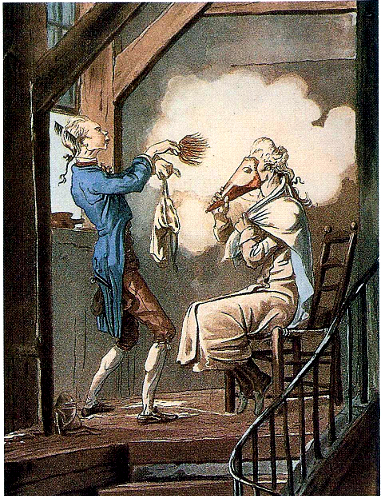
Finally, “freshening up” in Georgian England would’ve had a different meaning, because for men and women, that meant getting properly powdered before you showed your noble head to the public.
What the films don’t always show is the fashion accessory that went with 18th-century wiggery. Long-handled scratchers like this one, made of whalebone, were vital in this age of big hair, because underneath it all was a warm, dark home for lice.
















 A Work in Progress