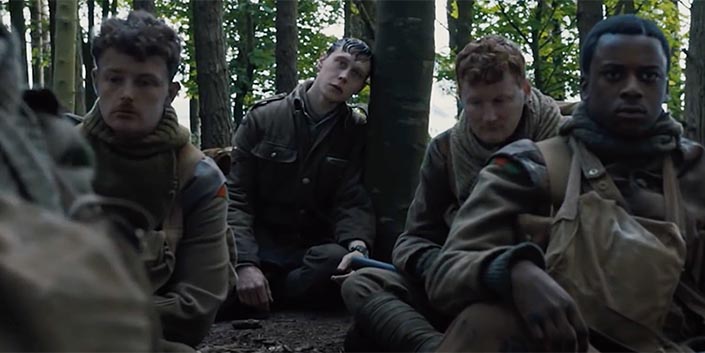
In Sam Mendes’ 1917, Lance Corp. Scholfield has survived a harrowing journey when a voice calls him into a woods. A soldier is singing an old song, “(I Am a Poor) Wayfaring Stranger,” as his regiment prepares to go into an assault that will doom most of them. It’s Schofield’s task to stop them, but he needs to regather his strength first.
It’s a mesmerizing moment. Here is the song, performed by Joe Slovick and recorded at Abbey Road:
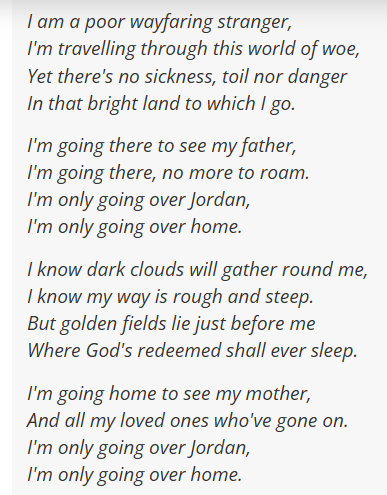
And here are the lyrics:
The irony, according to an excellent website, Counting Stars, is that the song has its origins in 1816 as a German hymn. But it gained new life recast as an American song in 1858 and became popular among other soldiers in another war–our Civil War. In the 20th and 21st centuries, it became a bluegrass staple, performed by Johnny Cash, Emmylou Harris and Jack Black in the Civil War film Cold Mountain.
This borrowed German song—it must’ve come here with the “Forty-Eighters,” the wave of German immigrants fleeing a failed revolution as their Irish contemporaries were fleeing hunger—is now completely American.
I am fond of this version, quite different from Slovick’s stunning solo but valuable because it restores the song to its bluegrass roots. The beauty of American music? This is a Norwegian band.
Fluttering eyelashes, botched beheadings, purloined pearls, bodies tumbling down the stairs, Notre Dame, Holyrood, mermaids, dispatch riders galloping over the moors, intense sexual attraction, three powerful queens, being strangled in your nightie, a thing for men’s legs, a loyal dog, secret codes and spymasters, four centuries of sweet revenge. If you’ve been sold on the notion that history is boring, you have been misinformed. Or badly informed.
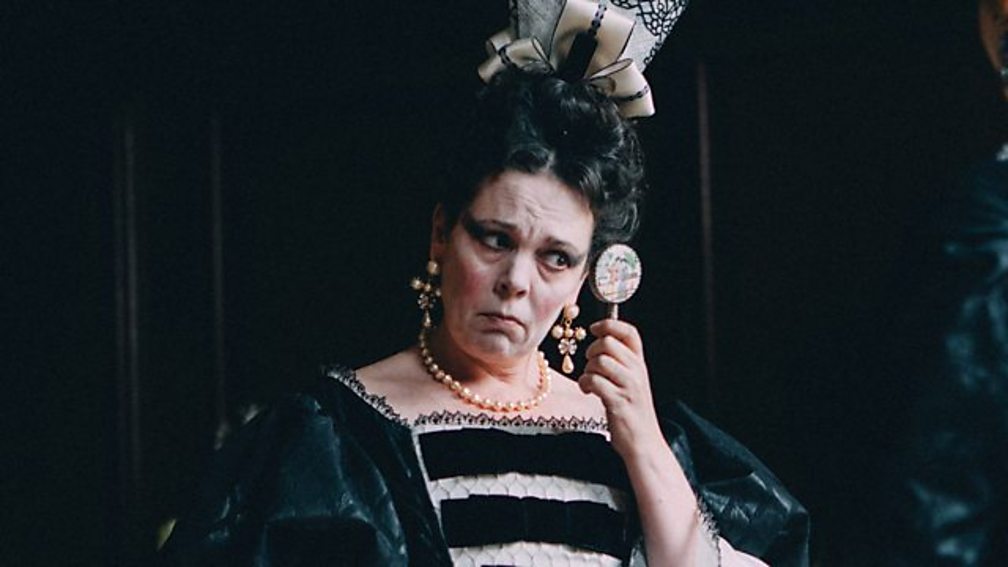
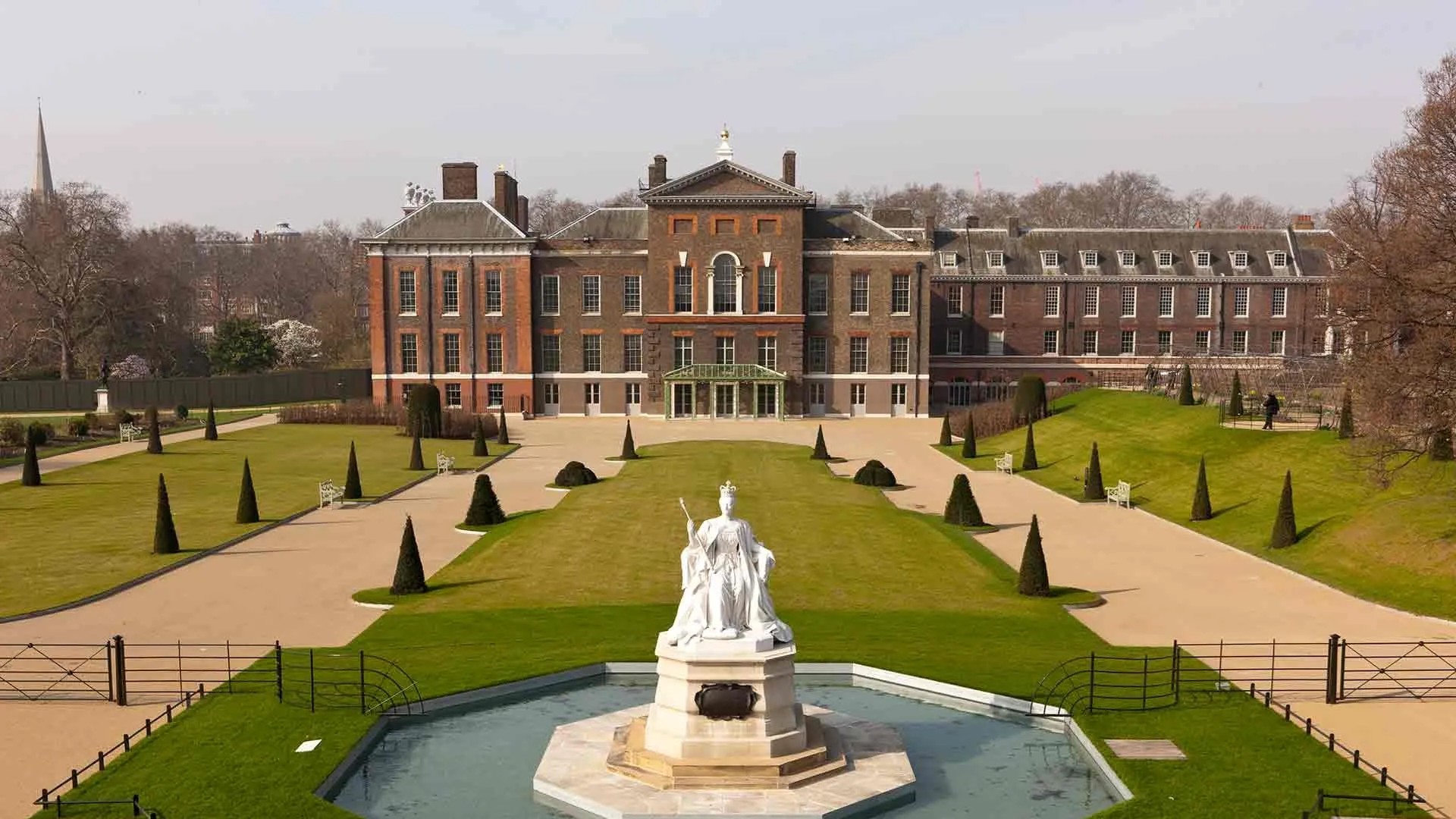
On August 1, 1714, the last Stuart monarch, Queen Anne, 49, died at Kensington Palace, today the home of Prince William, Princess Kate and their children. The eccentric, sickly and probably underrated Anne was brilliantly played by Olivia Colman in The Favourite.
Anne’s life was tragic, marked by widowhood, poor health and by the unimaginable physical and emotional pain that came with seventeen miscarriages and stillbirths. The Favourite suggests that Anne’s beloved little pet rabbits became her surrogate children.
And so the Stuart line ended with Anne, ended with her hopes for the children she’d wanted, the heirs that her duty required. England turned to Germany for the next dynasty, whose descendants make up the modern royal family.
Colman and Emma Stone in The Favourite, filmed at Hampton Court, the palace of Cardinal Wolsey, Henry VIII’s chancellor and, after his fall, the residence of Henry and Anne Boleyn. The later Queen Anne lived here, as well.
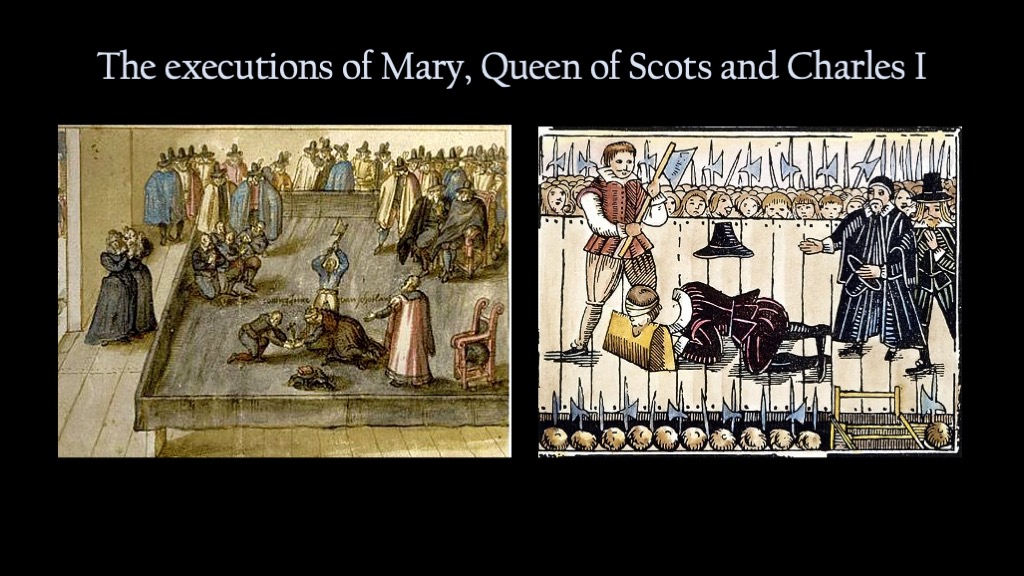
The Stuart line, of course, began inauspiciously, since these royals were descended from Mary Queen of Scots, ordered beheaded for high treason by her cousin, Elizabeth I, in 1587. Mary, the Great Catholic Hope, was dispatched while another Great Catholic Hope, the Armada, was being planned.
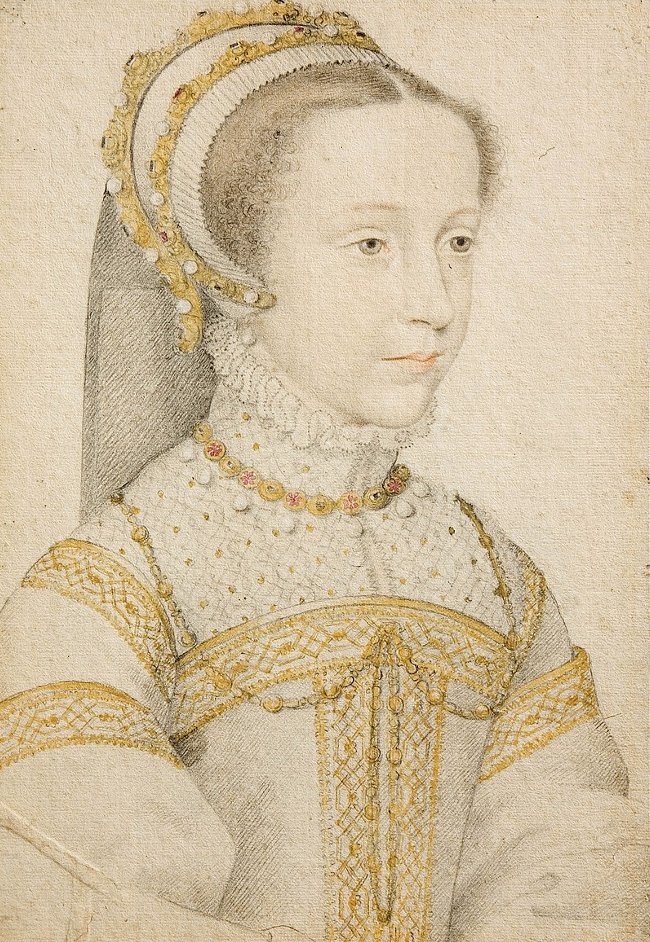
Mary in adolescence. Her eyelashes’ flutter, it was said, could reduce men to something resembling Silly Putty.
She went out with panache—blood-red petticoats beneath the shift she wore to the the block. Sadly, she drew a nervous executioner, and it took two tries to separate Mary’s head from the rest of her. Afterward, her disconsolate little Skye terrier crept out from beneath her petticoats.
No one told the hapless executioner that Mary was wearing a wig. He only discovered this when, in the ceremonial moment required of traitors’ executions, he held her head high aloft for the crowd to see.
So it goes.
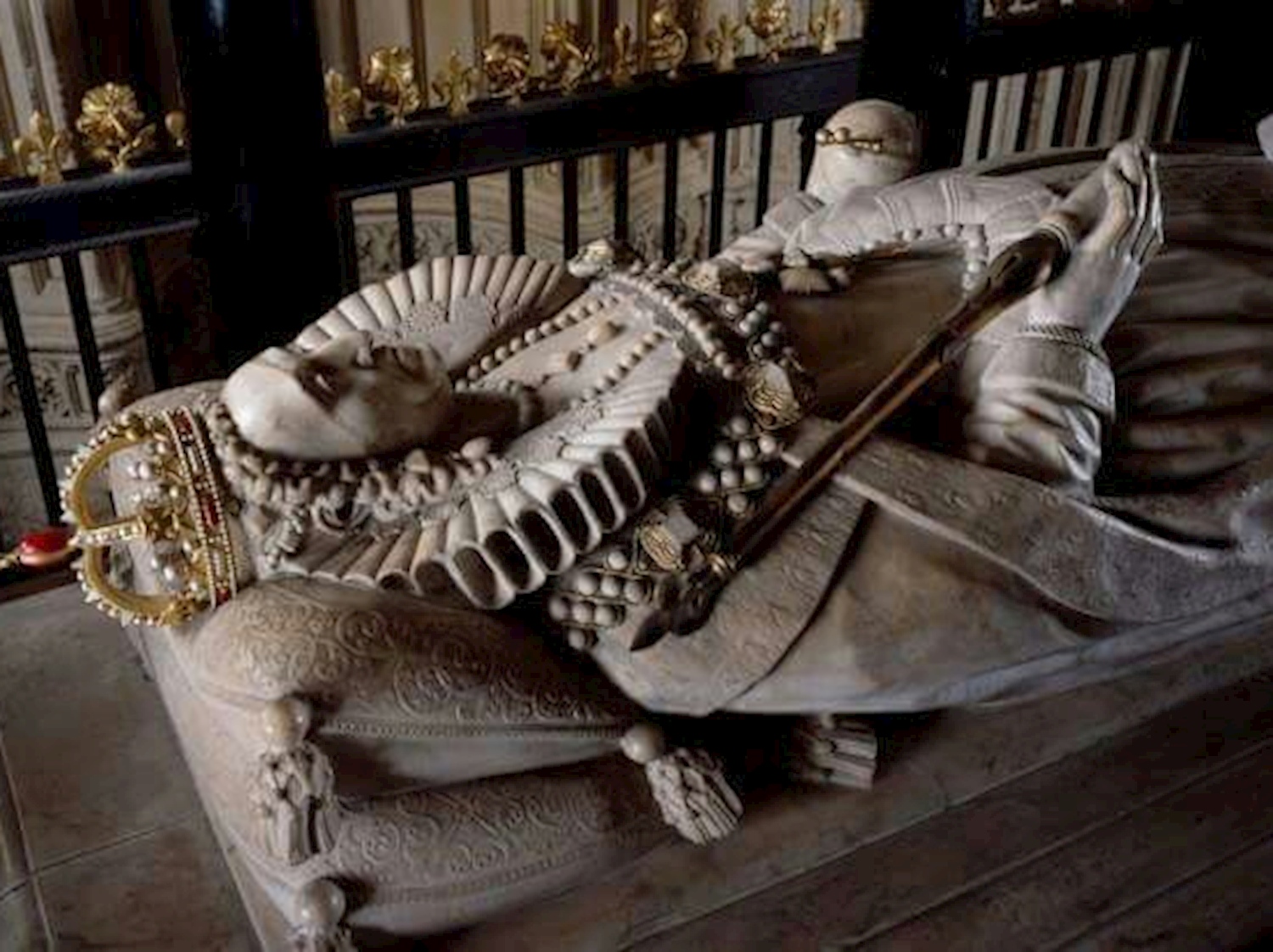
In a way, Mary got even. She lies in splendid isolation in Westminster Abbey, while her cousin, Elizabeth, is in a tomb version of bunk-beds with the half-sister who was her predecessor— and who feared and despised her—Queen Mary Tudor (“Bloody Mary”). Elizabeth is on top.
Ha.
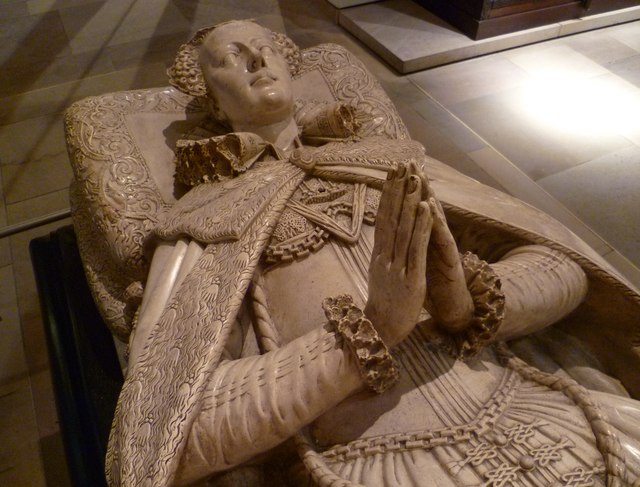
Mary, top and Elizabeth, bottom, Westminster Abbey.
Mary’s grandson, Charles I, was likewise beheaded in 1649 at the outset of the Interregnum, when Cromwell’s Puritan dictatorship interrupted the royal parade.
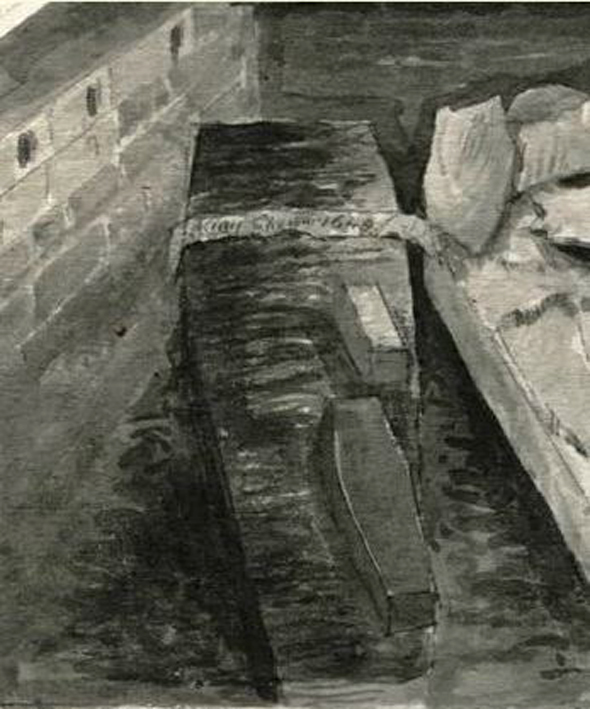
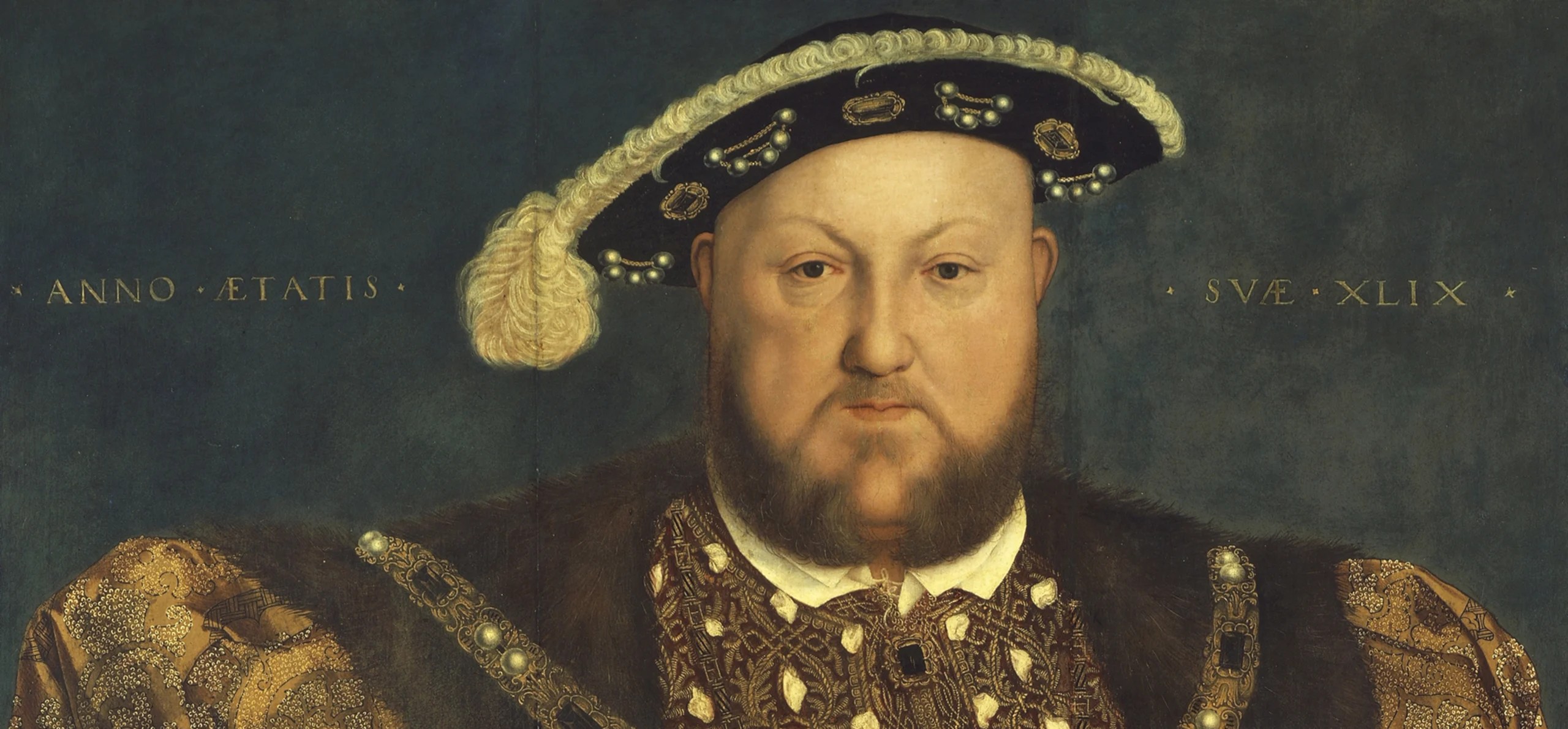
And in 1813, a funeral vault beneath the floor Windsor Castle—Philip and Elizabeth II are buried at Windsor, as well– was opened and they found Charles I’s coffin. The old boy’s head, it was reported, was in fine shape; nearby were the coffins of Jane Seymour, Henry VIII’s favorite wife, and Henry himself, who was all bones. His coffin had exploded from expanding gases, in my mind the result of the King’s gargantuan appetite. Some historians maintain he was close to 400 pounds when he expired.
So his lead coffin was large.
It was a small coffin atop that of King Charles that surprised the little crowd of morbid scholars murmuring beneath the floor. They found that it was one of Anne’s stillborn children, at rest with his great-great uncle.
Executions, lost babies, little rabbits. Monarchs are, of course, an anachronism, as Charles and Camilla so amply prove. But some of them, like Anne—who delivered a stunning inaugural speech to Parliament and whose armies vanquished those of Louis XIV—deserve a second look, and perhaps our sympathy, as well.
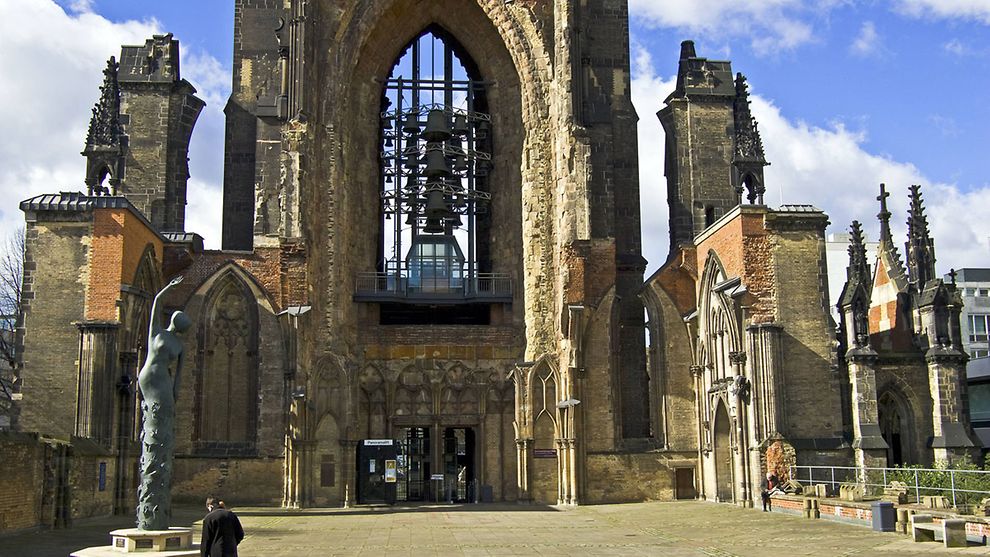
King Charles III visited Hamburg yesterday to pay tribute to the estimated 30,000 German civilians killed in the Allied firebombing of the great port city in 1943, in an operation code-named “Gomorrah.”
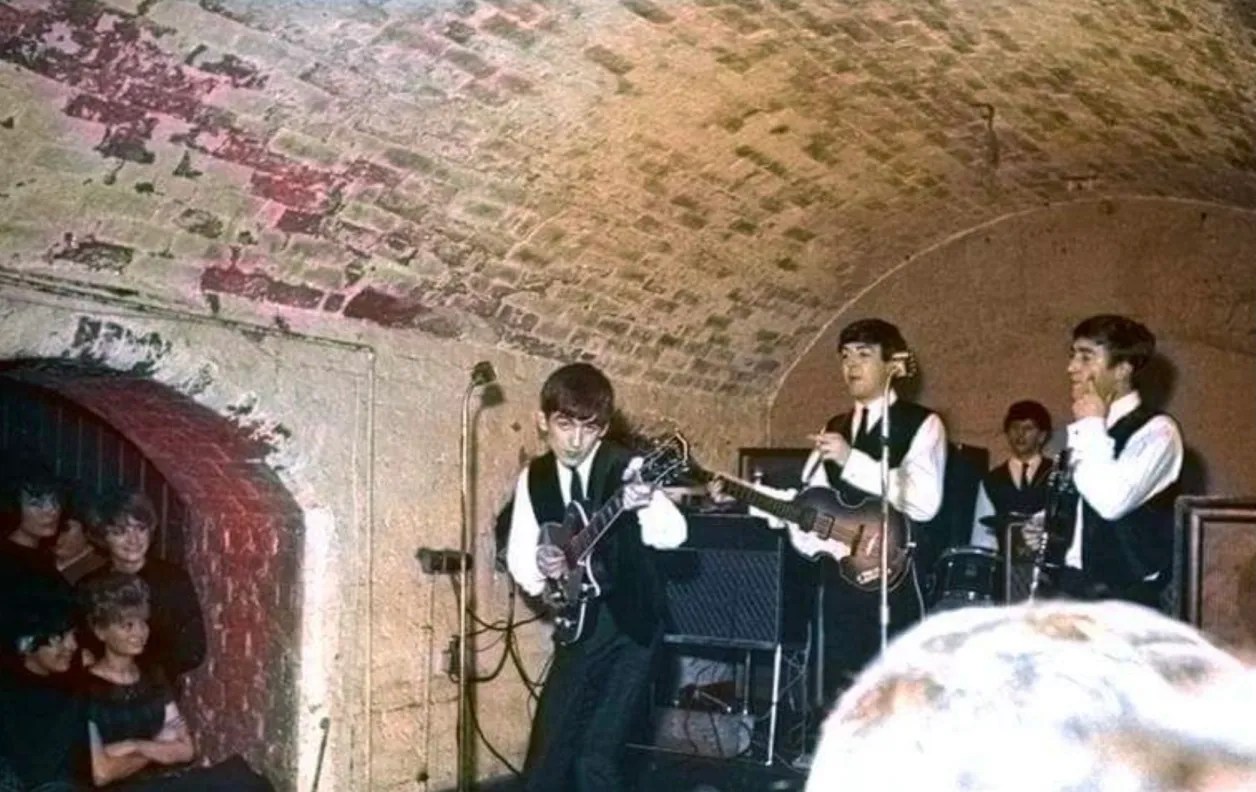
Twenty years later, ironically, the last stop for The Beatles before they hit the big time was a tiny nightclub in Hamburg called The Cellar.
It’s been replicated, exactly, in Liverpool, where the MonaLisa Twins, two young women who expertly and faithfully perform Beatles songs, perform today.
The Beatles at the Cavern, 1963. Ringo Starr has replaced Pete Best at the drums.
I wrote a book about the air war, a testament in its bulk to the immense courage of the American heavy bomber crews–in B-17s and B-24s–who contributed to the destruction of Europe.
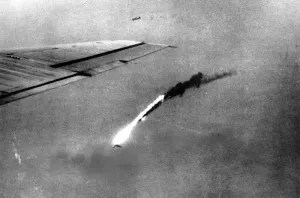
I have never liked the Superheavy, the B-29 Superfortress, which not only destroyed Japan but, in its development, killed dozens of aircrews, including waist gunners. When the cabin was pressurized, the gunner’s Plexiglas bubble, in early models, separated from the fuselage and so carried the gunner with it. The Army Air Forces’ solution was a leather harness. The plane was also noted also for the ease with which is caught fire.
I hate that airplane.
A doomed B-29 over Tokyo.
And while I will forever love the aircrews of the heavies, and I will never forget, either, what they were doing to the people below. Henry Hall of Cayucos was twenty when he saw a B-17 from his squadron, badly shot up, begin to lazily tumble toward the ground. Along the way, it clipped the wings of two more American bombers. They went in, too.
The passage below is from my book about airmen like Hall.
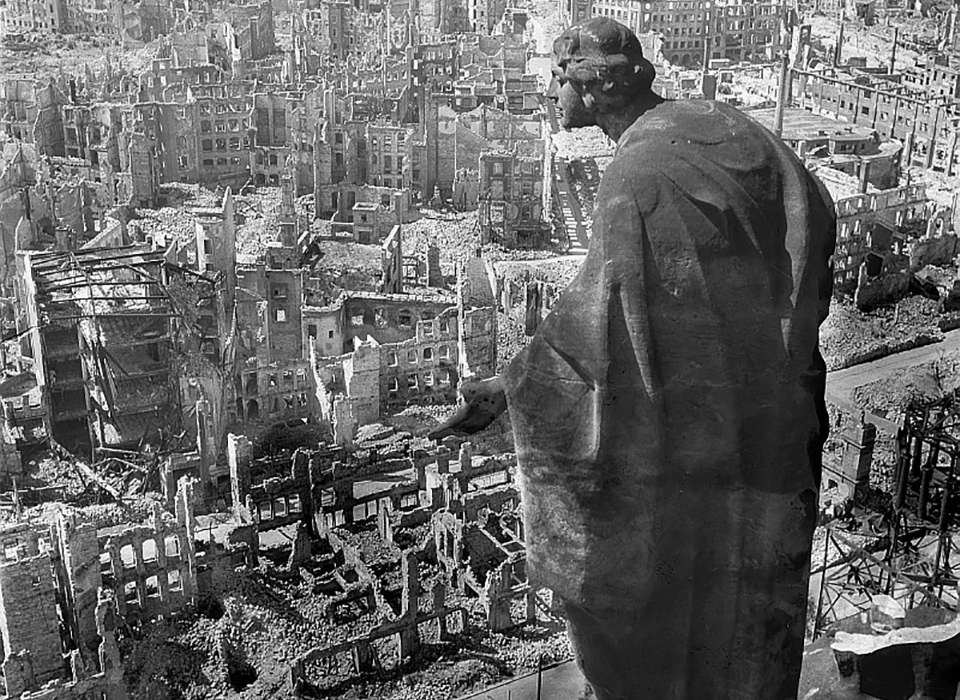
Sheila Varian’s prize cow horse, Ronteza, was an Arab and her sire was an award-winning Polish stallion, Witez II. Stablehands were desperately trying to evacuate Arab stallions from the east–horses were being eaten there by the Red Army–when they reached Dresden, the ancient city that was firebombed in February 1945. (POW Kurt Vonnegut escaped incineration in Slaughterhouse-Five).
One of the Arabs’ handlers watched in horror as the tail of Ronteza’s uncle, Stained Glass, burst into flames.
Stained Glass survived. Twenty Arabians perished. So did at least 25,000 human beings.
Dresden in ruins, 1945.
Sometimes the aircrews could smell, from 25,000 feet, wafted up to them by vast columns of black smoke, what they’d done to the children below. Even into old age, many of them would awake, in a terrified moment of cold sweat, when, in their dreams, they were smelling their combat missions again.
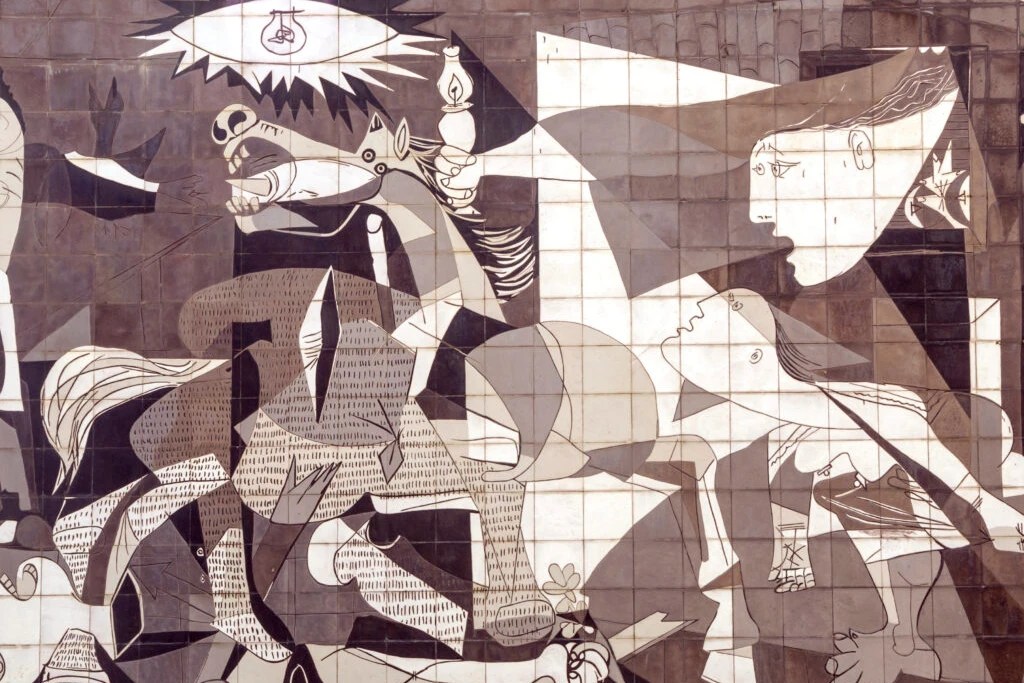
When we were still capable of outrage, Pablo Picasso’s “Guernica” was a passionate protest against Hitler’s bombing of a Basque town during the Spanish Civil War, in 1937. That painting has been replicated, exactly, in the United Nations building in New York City. It’s a reminder, albeit with the Russian Federation remaining in the Security Council, of what the UN is intended to prevent.
Guernica
And I fervently hope that I never lose my capacity for outrage. That is one quality that made be a history teacher. And that, after all, was just a cover story. My real intent was to teach my faith, by which I mean, the value of each and every single human life.
We are precious in God’s eyes. My students needed to know that. The gift of history is in reminding young people of the richness of their heritage. The stories that history teachers tell remind young people that their lives, too, enrich us beyond measure.
Without being either a proselytizer– and while being a terribly negligent churchgoer–I knew that God’s eyes were always on me when I was in the classroom. I was constantly aware of that.
She had entrusted Her children to me, you see.
Liza, a four-year-old Ukrainian child with Down Syndrome—the light of her parents’ lives—was riding in this stroller when a Russian missile struck nearby. Liza was killed.
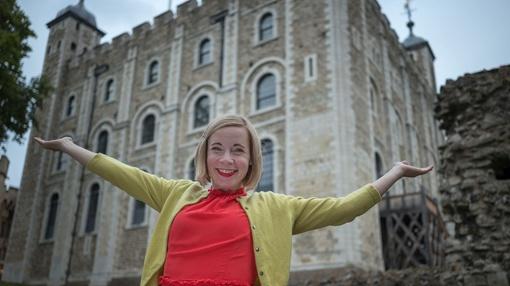
I’m kinda nuts about British historian Lucy Worsley; she is a hoot.
I first discovered her, while teaching European history, when she went to a modern grocery store to go shopping for Henry VIII.
The students were kinda nuts about her too: she’s a small person and the shopping cart was bulging at the seams, so she was huffing and puffing as she pushed it through the aisles. It was loaded mostly with meat (beef, pork, fowl, eels).
Turns out it’s no wonder Henry VIII weighed almost 400 pounds at the time of his death.
Sadly, on the tour to his final resting place at Windsor Castle, while Henry lay in repose in a church, his coffin exploded. Pent-up Royal Gas.
Gastly.
He’s Henry VIII he is; Henry VIII he is he is.
Anyway, if you get a chance, Worsley appears pretty regularly on PBS. She’s now the Chief Curator of Historic Royal Palaces.
Not a bad job, that.
She did a show that ran Sunday on three palaces:
1. The Tower of London. The oldest part, the White Tower, was intended to impress the local Saxons, whom the Normans considered imbeciles. To their horror, they’d built the privies in full view of London so that the beautiful stonework soon became, er, corrupted. Ah, who were the imbeciles NOW? So moved all the Royal Eliminatories to the back.
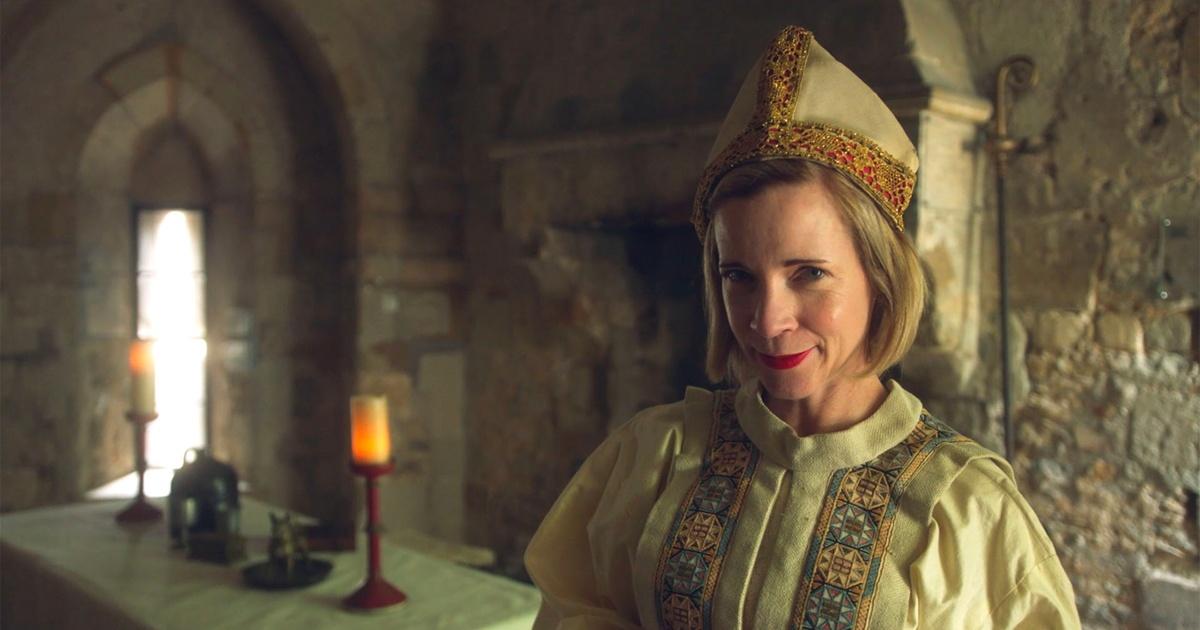
Worsley then played the first prisoner to escape from the tower–it became a prison, of course, as well as a palace– an obnoxious Norman bishop. She went clattering away down the cobblestones clutching her crozier. Oh, she also helped the Yeoman Warder, a Beefeater, feed the ravens, who are Mouseaters.
Worsley as the naughty bishop.
2. Hampton Court, once Cardinal Wolsey’s palace, was appropriated by Henry VIII once the Cardinal fell out of favor (couldn’t get the king his divorce.)
Wolsey took her show up to a nondescript room on an upper floor–desks and computers, used for training. But that was the bedroom of, in succession, Catherine of Aragon, Anne Boleyn and Henry’s favorite, Jane Seymour, who died in the room soon after giving birth to Edward, the king’s long-awaited and ultimately worthless royal heir.
But Henry was once smitten (besmitten? besmot?) by Anne, so the royal dining hall was framed by gilt and woodwork with the interlocking initials “H” and “A.” But Henry married Jane only 11 days after Anne’s head and her body went in separate directions, so workmen were in a hurry. Worsley spotted a corner where they’d missed, in the woodwork, one set of interlocked initials.
Interlocked “H” and “A,” Hampton Court. Anne, depending on which way she was facing, she would’ve resembled a lower-case “b” or “d” when she married Henry. She was thoroughly pregnant with Elizabeth.
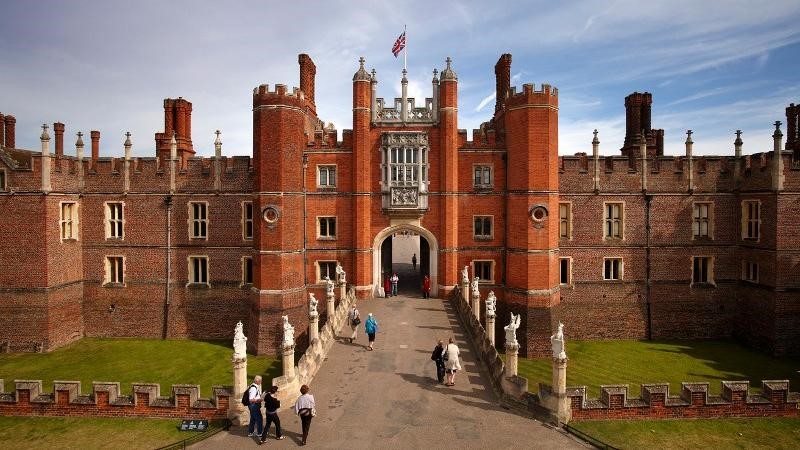
This palace was added onto, on the cheap, by the Stuarts, so it has a Tudor front, seen in the photograph, and a Palladian add-on (Queen Anne, played by the Oscar-winning Olivia Colman in “The Favourite,” would’ve lived here. With her rabbits.) It includes sharp spiky rails in some of the corners, to discourage the courtiers from relieving themselves thereupon.
Royal palaces–even Versailles–were notoriously smelly.
Hampton Court. The chimneys indicated the number of kitchens required to keep Henry VIII properly fed.
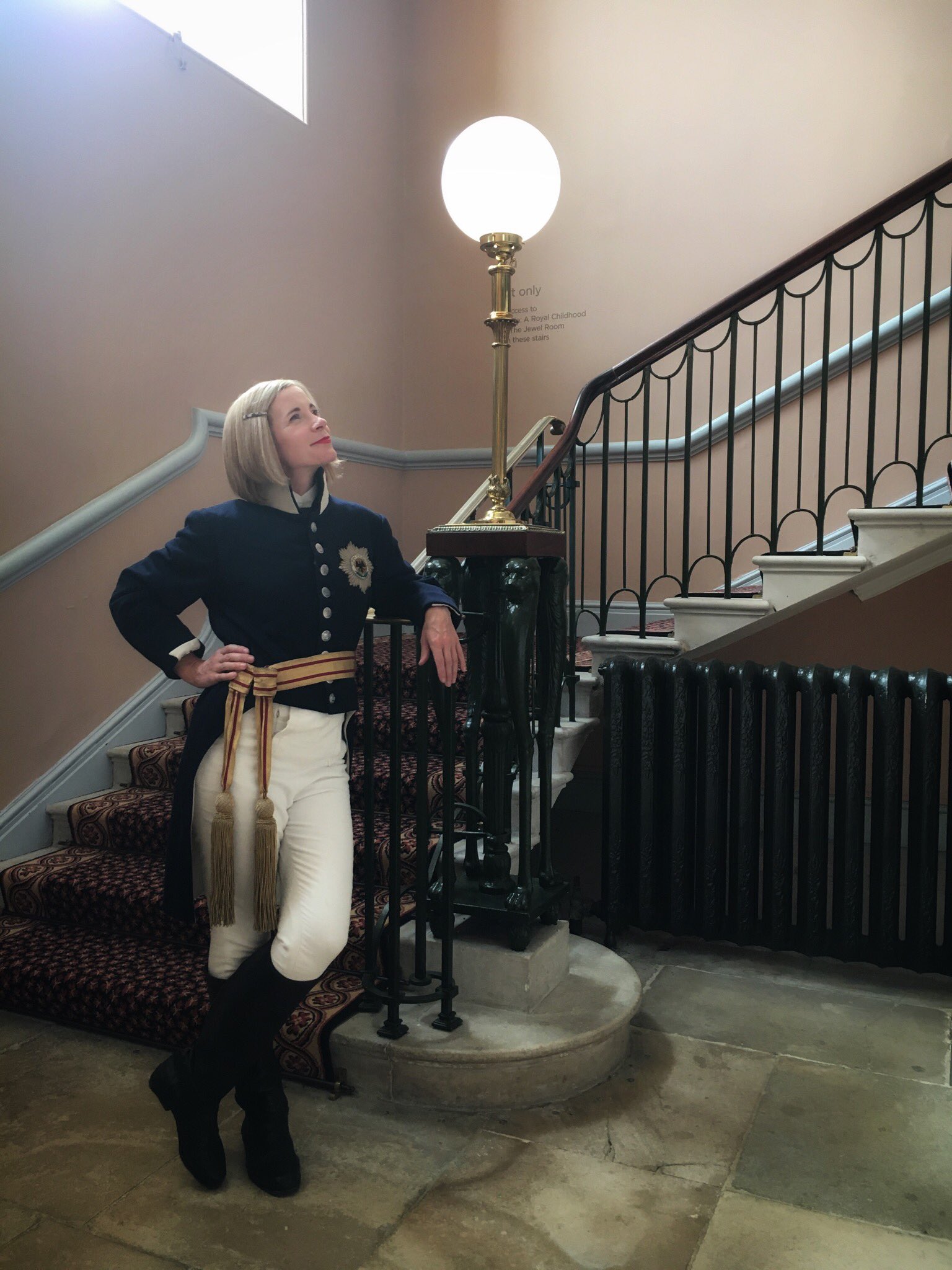
3. Kensington Palace was where Princess Victoria lived. Worsley–playing both roles, stood atop the staircase landing where Victoria first set eyes on Albert, at the bottom of the stairs. She was besmot and wrote at length in her diary about his eyes, his nose, his mouth and his limbs (“legs” was a dirty word in those days).
Albert thought she was okay.
That’s Worsley, as Albert, trying to look casual, at the bottom of the staircase.
But once the two were married, they were a lusty pair. They must’ve worn out a host of royal bedsprings. Victoria adored Albert and adored sex. The end result–children–she was less than enthusiastic about. Especially her eldest son. Poor Bertie.
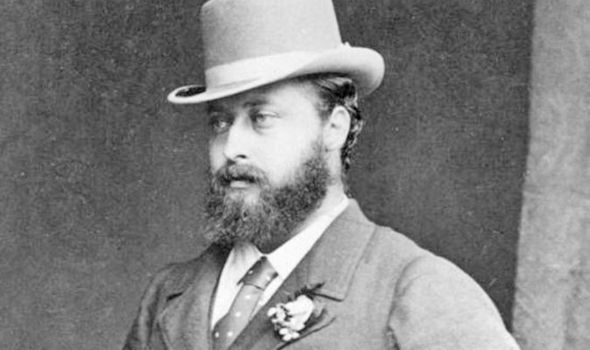
(Bertie, too, adored sex, especially with married women to whom he was not married. And he adored food. I guess he was a bit of a Henry VIII throwback. To this day, the custom of men leaving the bottom button on their sports coats or suit-coats unbuttoned was one that began with Bertie–Edward VII–who needed a little more room for the royal tummy.)
Flirty Bertie, who could never please his Mum
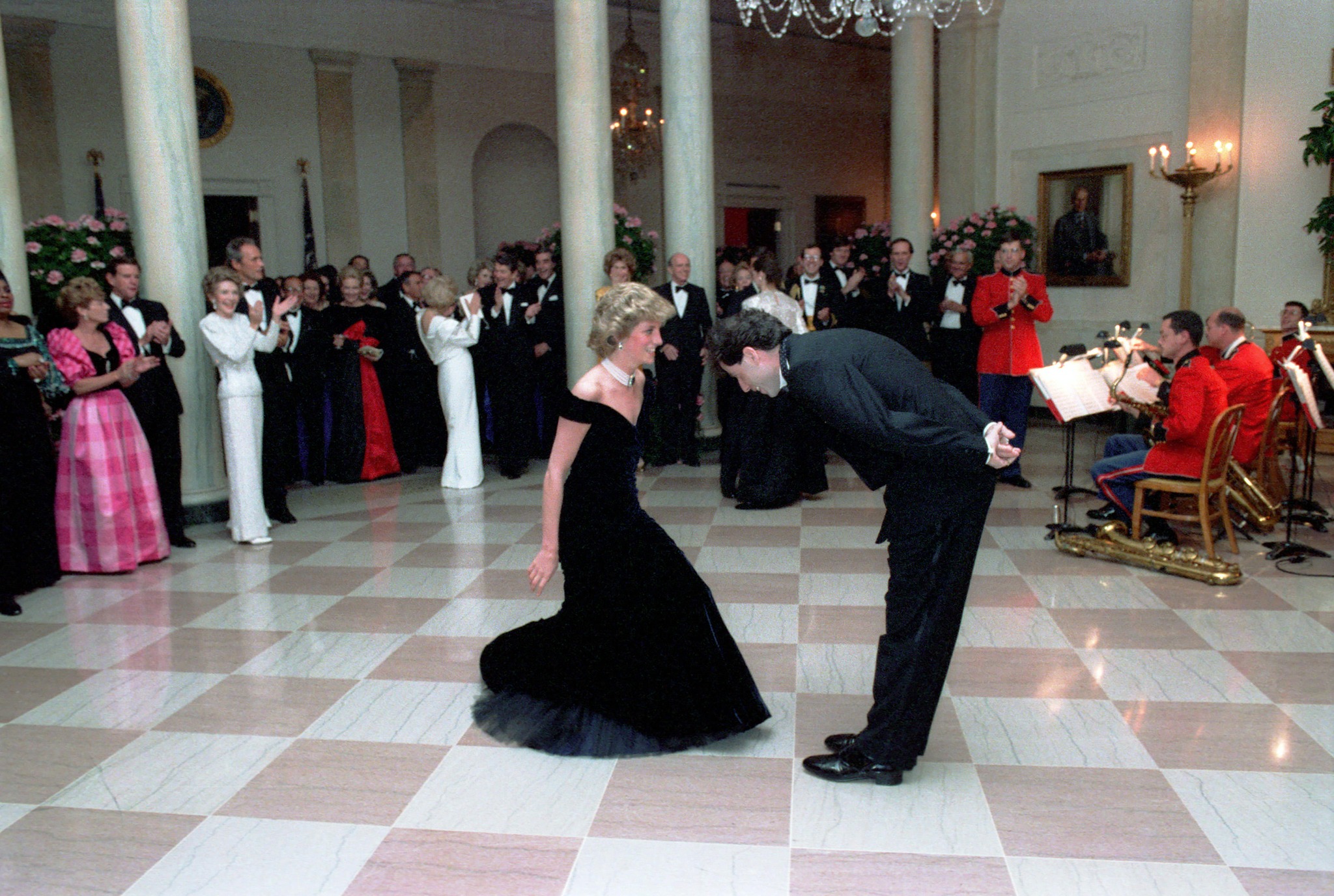
Kensington also features a big collection of court dress going back 300 years, and among them–what a prize!–is the dress Princess Diana wore when she danced with John Travolta at the White House. It’s a deep, deep blue and it’s stunning; all it lacks is, of course, Diana.
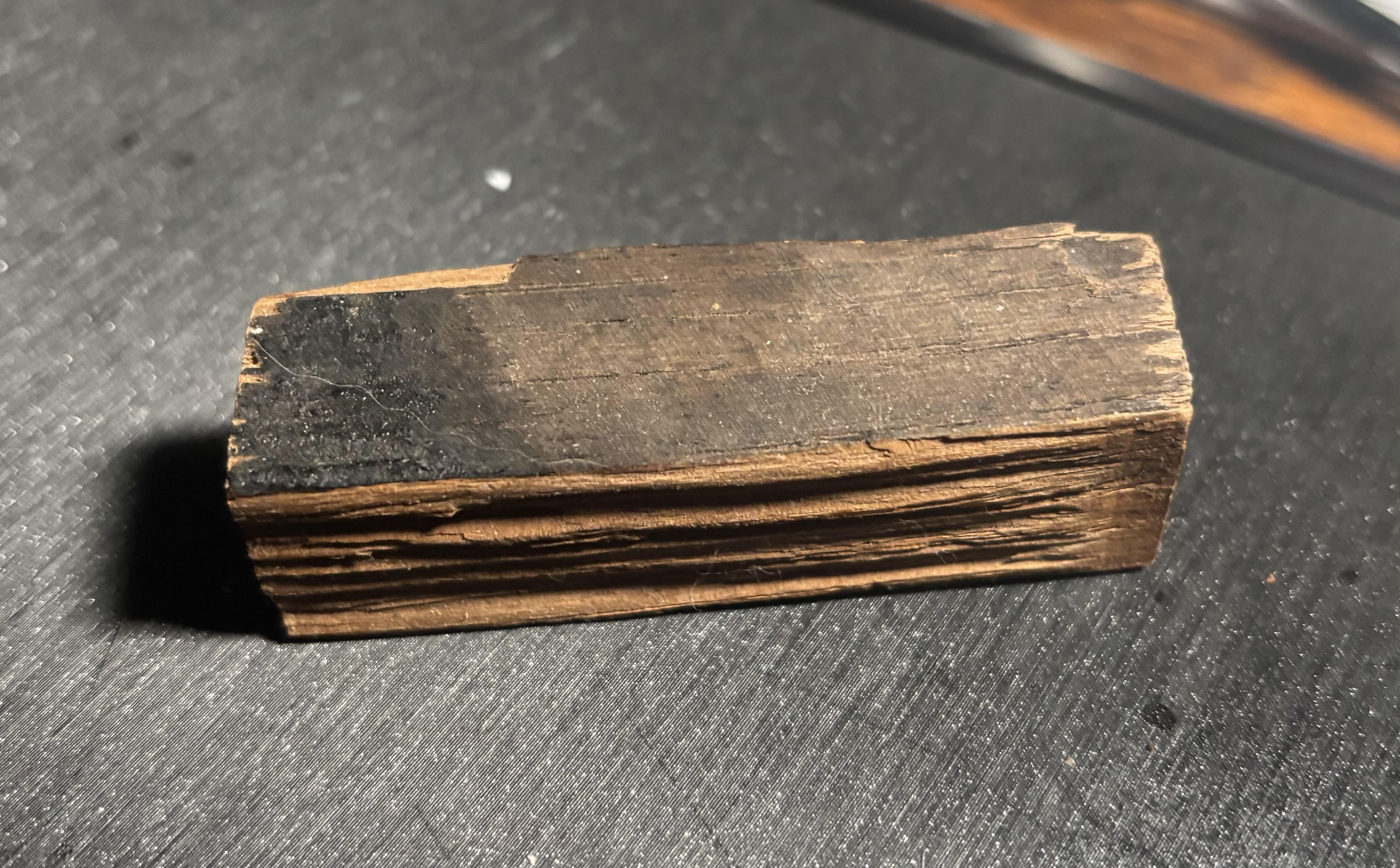
My little piece of HMS Victory, brougt home to California in 1987.
Thursday, October 21, is a big day in history.
–USS Constitution was launched on this day in 1797. A 44-gun heavy frigate so well-designed that, during a ship-to-ship duel with the British frigate Guerriere, cannonballs bounced off her hull, earning her the nickname “Old Ironsides.”
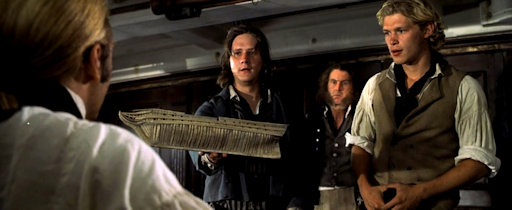
Aubrey is presented with the model of Acheron.
There’s a moment in the film Master and Commander when Russell Crowe, as Captain Jack Aubrey, studies a model of his nemesis, the Yankee-built frigate Acheron, a stand-in, I think, for Constitution. Aubrey is impressed with the ship’s construction.
“What a fascinating modern age we live in,” he remarks.
Life aboard in Aubrey’s time was, of course, terrible. In addition to the corporal punishment, casks of water soon became befouled, the salt pork that was the standard meat issue became so hardened the sailors carved ship models out of hunks of pork, and ship’s biscuits became home to weevils–it was standard practice to rap your biscuit on the tabletop to serve notice to the weevils that they were about to be evicted.
Which reminds me of another scene from Master and Commander, where Aubrey victimizes his dear friend, Dr. Maturin, with the worst pun of all time.
Beyond the flying splinters and boarding parties, the books and film are fascinating for the unlikely friendship between Aubrey and Dr. Maturin. When teaching the Romantic movement, I used Kirk (the Romantic, driven by hunches, passionate loyalty and the pursuit of Space Dates) to demonstrate Romanticism and Spock, the epitome of rationality, the earlier Enlightenment. The passionate Aubrey and Maturin, the scientist, demonstrate the same dichotomy. What unites them, even when they quarrel, is the power of their friendship.
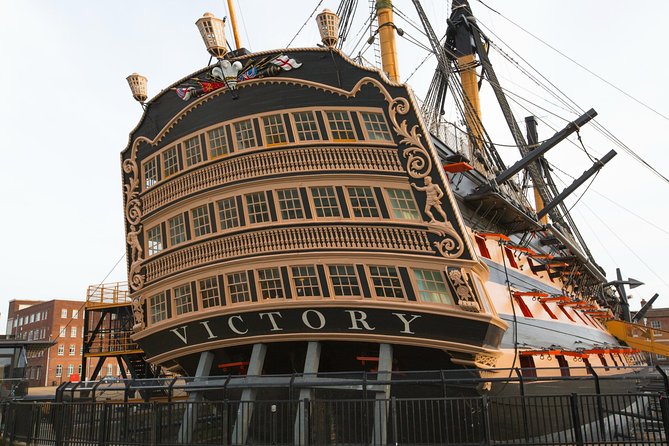
HMS Victory’s stern gallery
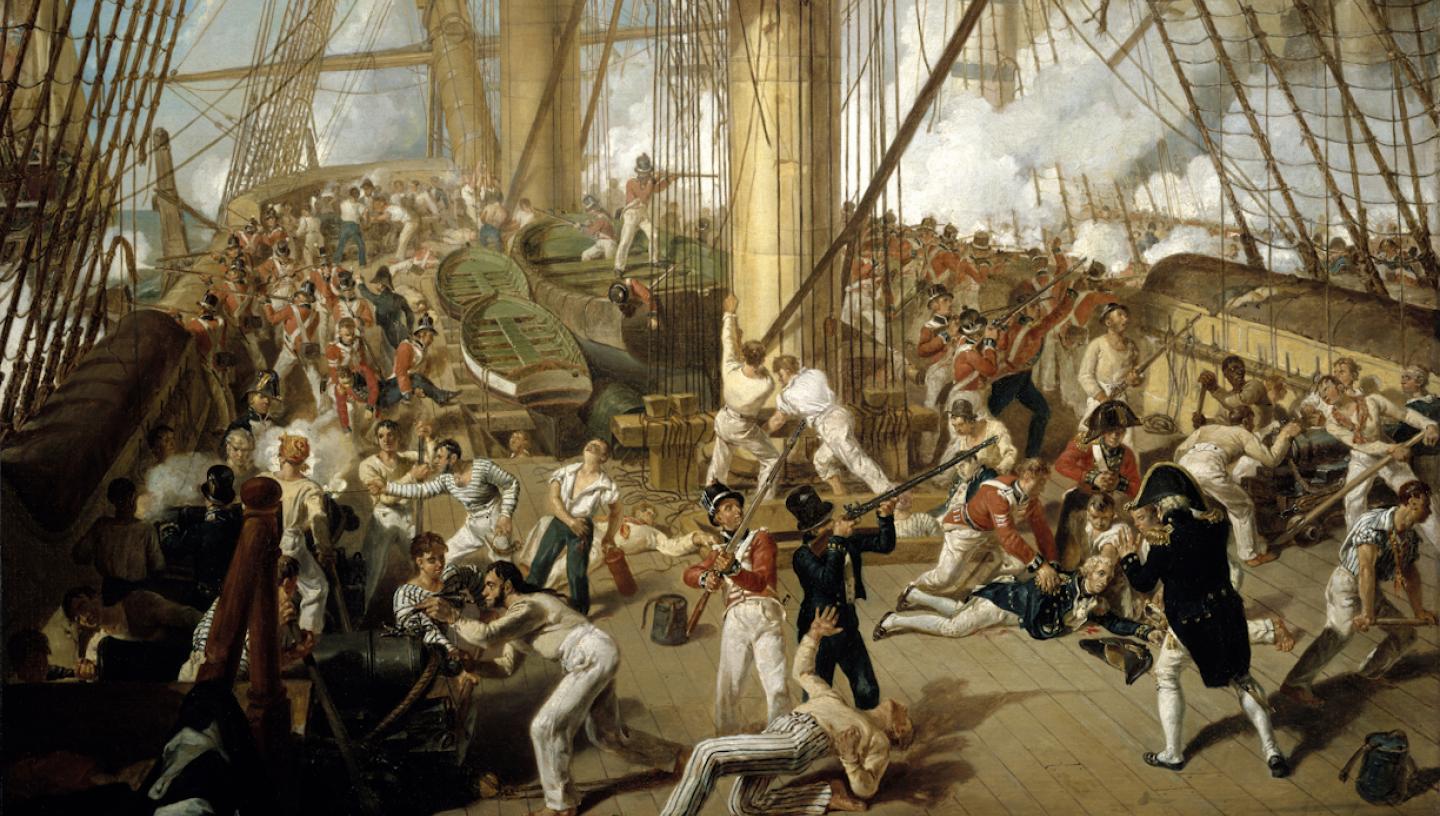
–On this day in 1805, Lord Admiral Horatio Nelson won his greatest victory–and his last, for he was fatally shot by a French sniper–at Trafalgar, off the Spanish coast. Nelson’s flagship that day, HMS Victory, a 104-gun ship of the line, is in dry-dock as a museum in Portsmouth, and I got to visit it.
It was kind of a big deal.
When Nelson was killed, they put his little body (he was about 5′ 4″) in a cask of spirits to preserve it on the voyage back to England. Rum on Royal Navy ships was known grimly thereafter as “Nelson’s Blood.” His coffin, carved from the mast of a French ship he’d defeated in battle, was immense–as is his tomb in St. Paul’s–both indicative of his ego, not his stature. He insisted on wearing his array of medals—only North Korean generals have more—which is what made the sniper pick him out. Shot in the spine, he died belowdecks on Victory, where the spot commemorated with a simple brass plaque.
Nelson is shot at Trafalgar–he’s fallen to the deck at center-right. A young midshipman, depicted here just below the mast, aiming his musket, took credit for killing the sniper.
In his years of service, he’d lost an arm and an eye. At the Battle of Copenhagen, the admiral commanding signaled the British fleet to withdraw. Nelson aimed his telescope at the flagship, but he was looking through it with his blind eye. “I see no such signal,” he remarked. And proceeded to win the battle.
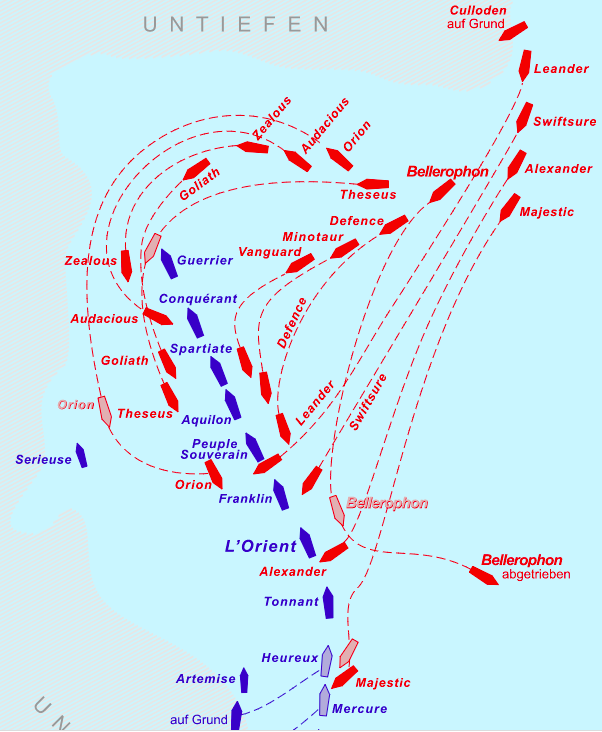
Nelson’s attack at The Nile; the British ships are in red.
And, earlier, at the Battle of the Nile, the combined French/Spanish fleet anchored their battle line in shoal water, close to the Egyptian shore. No ship, they thought, could outflank them to engage their larboard guns. That’s exactly what Nelson did, risking grounding his ships and having them blown to splinters as a result. The British lost no ships that day; they sank four enemy ships and captured nine more.
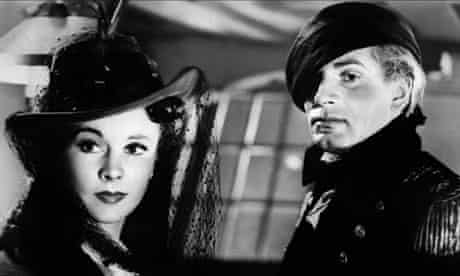
The little admiral’s life ashore was scandalous. He began a torrid affair with Emma Hamilton, the wife of a British diplomat. Eventually the two lived as man and wife, doing their daughter the great disfavor of naming her “Horatia.” When, during World War II, the film That Hamilton Woman was made—Olivier as Nelson, Vivien Leigh as Emma, it’s said that the PM, Churchill, wept copiously at its conclusion.
Leigh–not long after her role as Scarlett O’Hara–and Olivier, That Hamilton Woman.
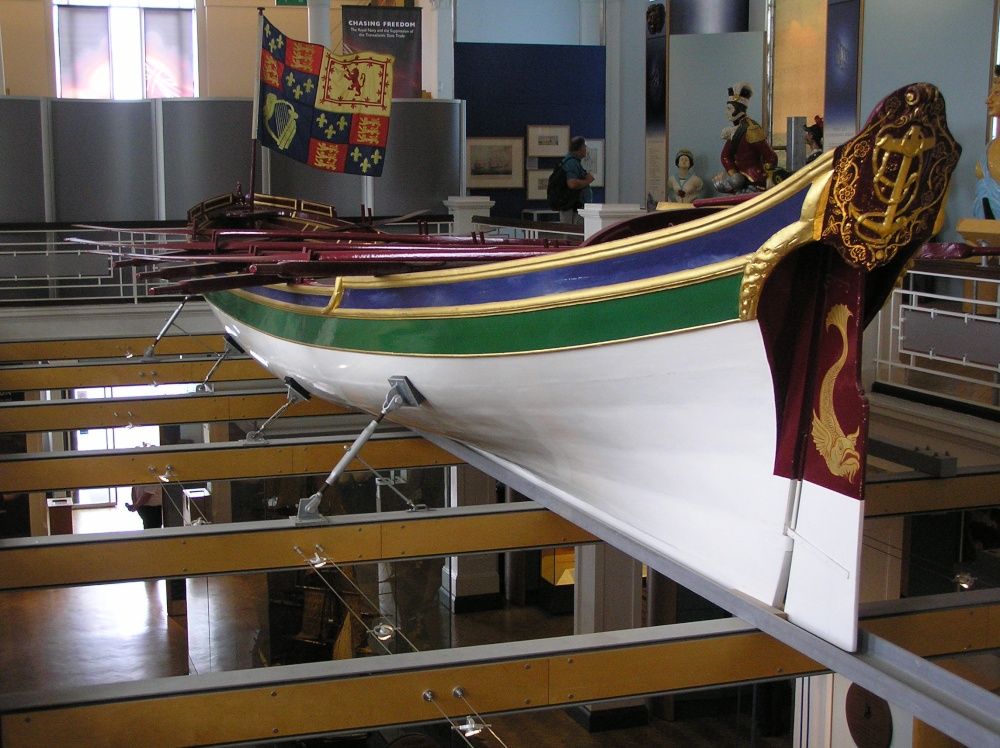
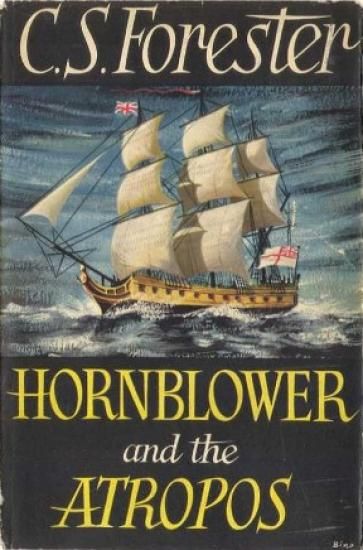
The Royal Naval Museum even has Nelson’s funeral barge on display–it processed up the Thames to St. Paul’s–and one of my favorite Horatio Hornblower moments, in Hornblower and the Atropos, has him, as a young officer, commanding the barge crew. It springs a leak and the crew has to bail desperately to prevent Nelson’s coffin from sinking into the Thames and so into the deep mud of the riverbed.
The barge that gave Hornblower so much trouble.
Hornblower had hard luck with leaks.(Like Nelson, he was also prone to violent seasickness.) As a young lieutenant, his first command was a French merchant ship taken as a prize; he was to bring it into port. Unfortunately, the ship’s hull was holed, and it began to flood. Even more unfortunate, the ship’s cargo was rice, which, of course, expands when wet. Goodbye, first command.
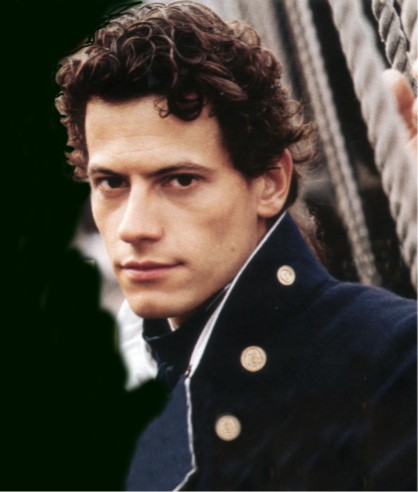
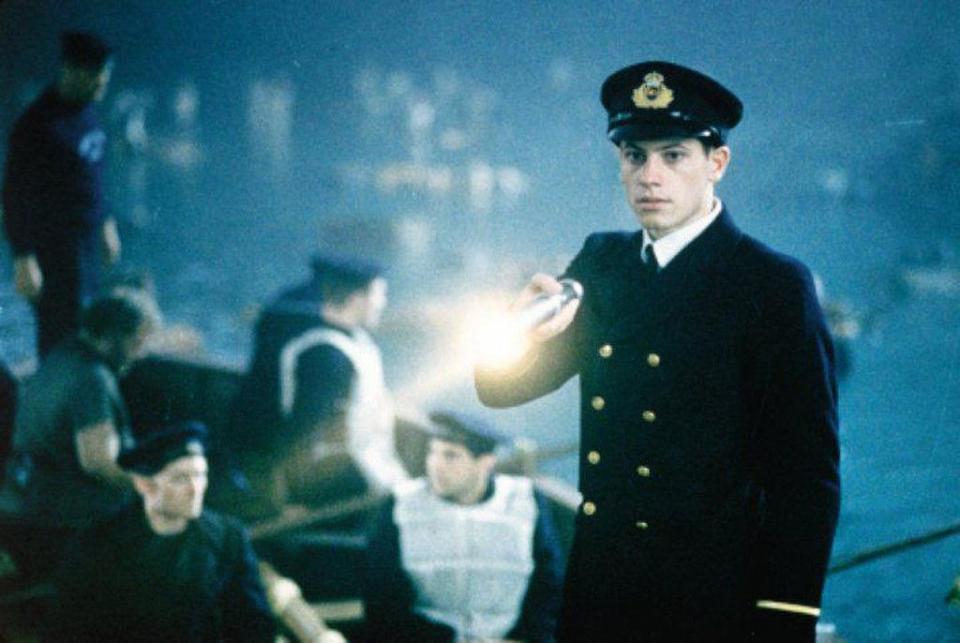
Ioan Gruffudd was the young Welsh actor who did a fine job as Hornblower in a television miniseries. Gruffudd has a nautical background–the commanded the lifeboat that rescued Rose in Titanic.
The Hornblower novels were my first “adult” reading. Dad brought a set home from the war, published by Little, Brown. Dad got to see “Victory,” too, when he was a soldier, and we had a tin, once home to a nest of hard candies. Mom used for her sewing kit; on its lid was a beautiful painting of the ship. I wish we still had it.
Victory fired cannonballs weighing 12, 24 or 32 pounds, any one of which could ruin your whole day. Gun crews worked belowdecks where the interior hull was painted red to soften the shock of casualties. Here she is delivering a rolling broadside, from bow to stern.
In a way, the Nelson-era navy lives on. Some expressions we get from the times:
Turn a blind eye: At the 1801 Battle of Copenhagen, Nelson’s superior hoisted signal flags ordering a withdrawl. When this was pointed out to Nelson, he raised his spyglass to his blind eye and announced that he saw no such signal. He continued fighting. The British won the battle.
Three squares a day: Royal Navy sailor were served their meals on square plates.
Groggy: The effect of having a bit too much “grog,” or rum. The standard issue was one-eighth of an imperial pint per day. The stuff was 95 proof (!), so it was diluted with water.
Three sheets to the wind: Another way of indicating a grog overdose.
Over a barrel: Not a good place to be. Sailors were wrapped around a cannon carriage for corporal punishment
Let the cat out of the bag: The “cat” was the cat o’ nine tails, a whip with nine knotted rope ends that could inflict terrible wounds. It was kept in a canvas bag only to be drawn out, for dramatic effect, when a ship’s company witnessed the whipping of a miscreant shipmate.
Freeze the balls off a brass monkey: A “monkey” was the receptacle–shaped a little like the holder for billiard balls–on which cannonballs were stacked. Iron contracts in cold weather, and sometimes the cannonballs would come tumbling off their stack.
Pipe down! The bosun’s mates blew a shrill whistle at 8 p.m. That was signal to glow belowdecks and rig your hammock.
Clean slate: The officer of the watch would note conditions–ship’s speed, wind direction course corrections–on a black slate. When a new officer assumed watch, the slate was wiped clean.
And, finally, two reminders of what these incredible men endured.
Flying splinters: In Master and Commander, the French superfrigate Acheron emerges from dense fog to ambush Aubrey’s HMS Surprise.
What lifts this film above your typical escapist fare is the friendship between Aubrey and his dearest friend, the ships’ doctor, Maturin. The two are replicas of Kirk and Spock: Aubrey’s passionate Romantic is pushing aside Maturin’s Enlightenment scientist. Only two things bind the two: their love for each other and their love for music. This just might be my favorite scene. Aubrey has just captured his nemesis, Acheron, only to discover that he’s been hoodwinked. So, since they have plenty of time, given this Age of Sail, Aubrey and Maturin turn to Boccherini.
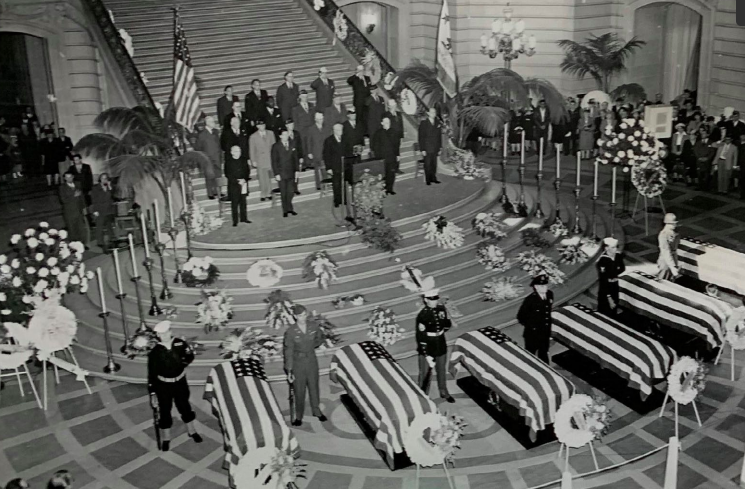
The first World War II American casualties to be repatriated, San Francisco, October 1947.US Dept. of Veterans’ Affairs
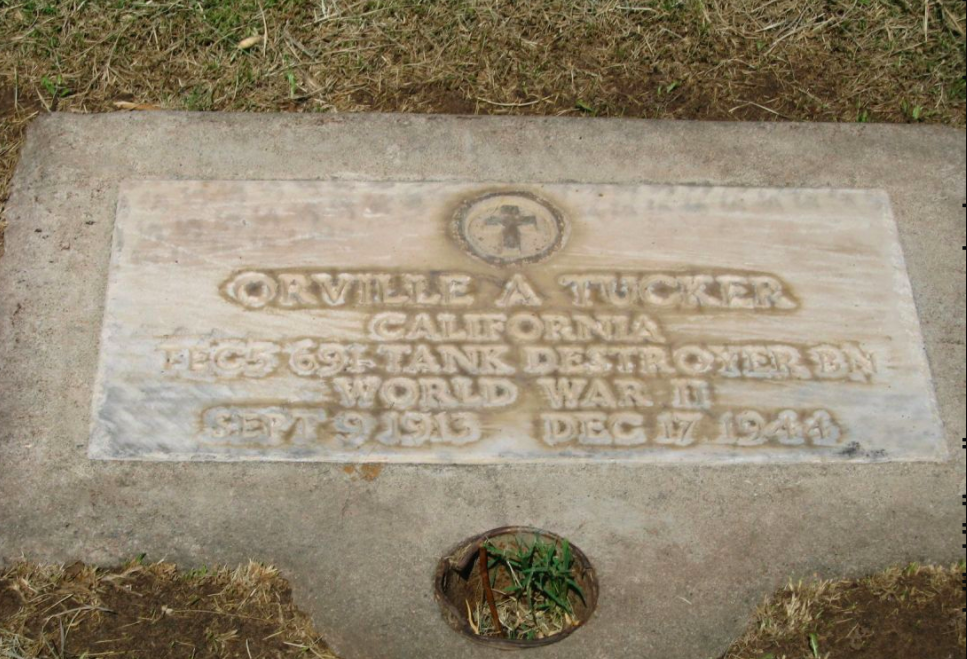
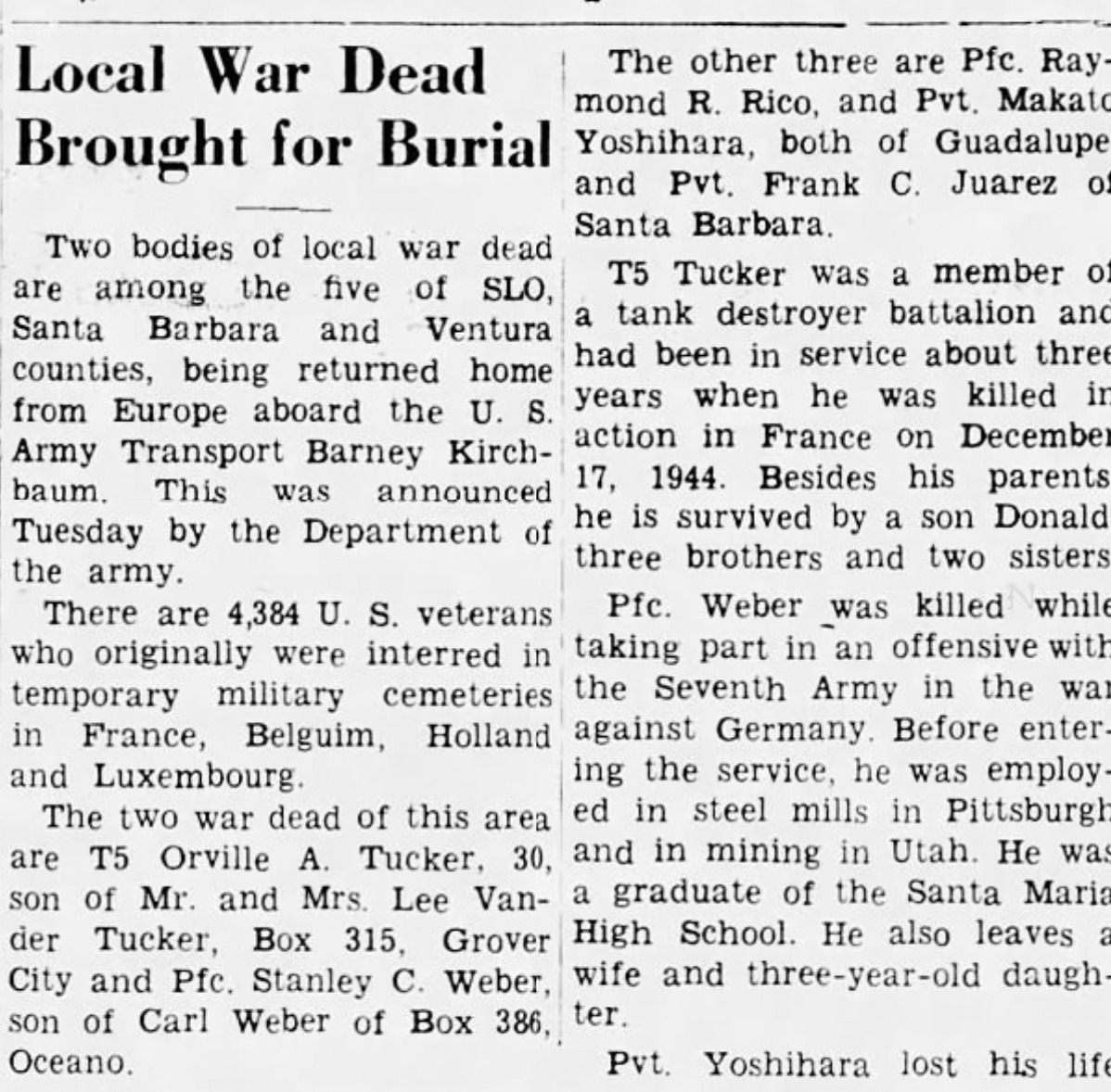
Of course I didn’t expect to meet him, but T5 Orville Tucker’s death crossed my life today. Here’s his grave, in the Arroyo Grande District Cemetery.
And there were a lot of things that struck me about him. The first was his date of death, and dates mean something to historians. We lost this American on the second day of Operation Wacht am Rhein, in what we now call the Battle of the Bulge.
It struck me, too, that he was part of a tank destroyer unit, like Frank Gularte, another Arroyo Grandean I know much better. Tucker was a member of the 691st TD Battalion, Gularte was part of the 607th. And the two soldiers died only days apart. Here’s what I wrote about Gularte on a website that memorializes fallen GI’s, killed in the war my father’s generation fought:
Sgt. Gularte served with the 607th Tank Destroyer Battalion and was killed in action 28 November 1944 near Metz, possibly outside the town of Merten. His son was born five days later in San Luis Obispo County, California. A memorial Mass was said in Sgt. Gularte’s memory at St. Patrick’s Church, Arroyo Grande, San Luis Obispo County, on Wed., 13 December 1944. Sgt. Gularte, before the war, was employed by E.C. Loomis and Son, a farm supply company; Gularte and his family were and are well-known and highly respected in the Arroyo Grande area.
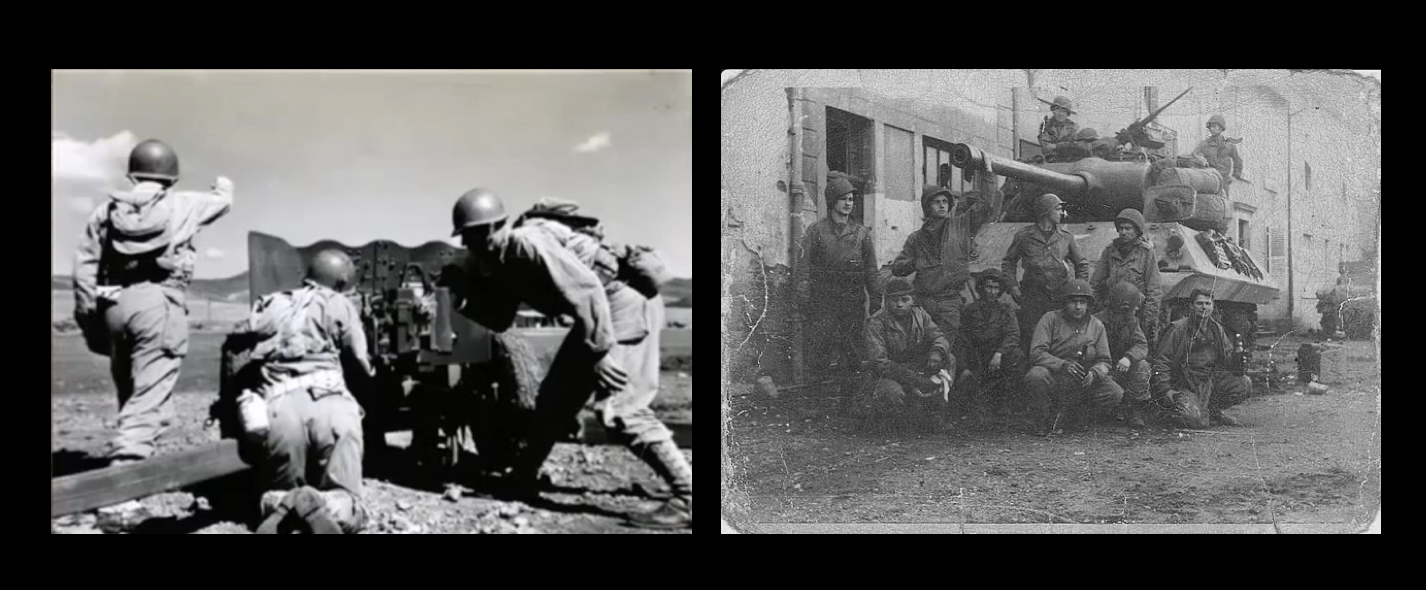
At the time of his death, Tucker’s battalion was still fighting enemy armor with the 57-mm artillery piece, like the one at left being manned by soldiers training at Camp San Luis Obispo in 1944. Frank’s 607th had graduated to the M36 tank destroyer–that’s a 607th TD in the other photo—built on the chassis and hull of the famed Sherman tank, but with a much more robust 90-mm gun.
But it was likely a Mauser rifle that killed Frank, in the hands of a German sniper, during an attack by the 607th that was to have been supported by infantry. They didn’t show, so Frank’s company went into action alone. German fire disabled three tank destroyers edging into Merten—a beautiful mountain town— and the American attack bogged down. Chaos ensued and it claimed Sgt. Gularte.
I don’t know yet how Orville died, but he’s got another tie to the Gularte family.
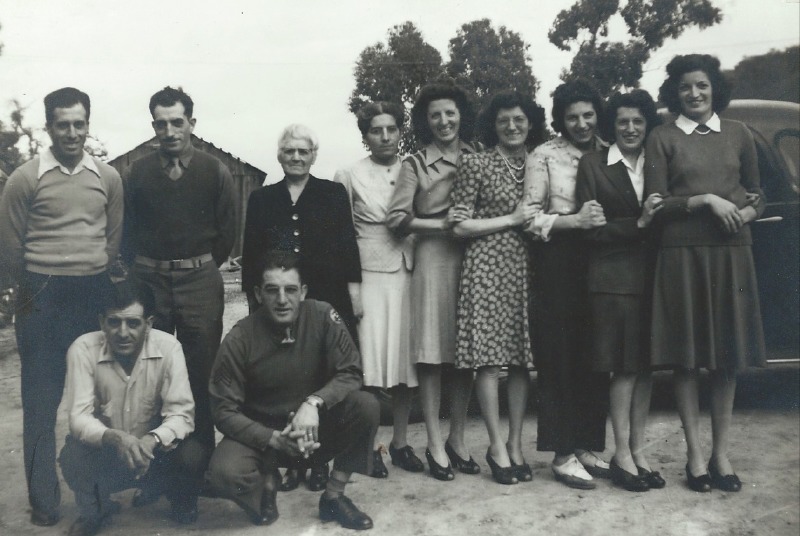
A family barbecue at the Gularte Ranch, behind the site of the IDES Hall just below Crown Hill. Manuel Gularte is standing; Frank is kneeling: Both are about to go to war in Europe.
As near as I can tell, in the opening hours of the Battle of the Bulge, Orville Tucker’s battalion was attached to the 28th Infantry Division. They were defending St. Vith, a Belgian town directly in the enemy’s line of advance and at the seam of two powerful German armies. Twenty-two thousand Americans were in the way of 100,000 Germans and their armor, including 500 tanks. The units that attacked St. Vith on December 17 included the 1st SS Panzer Division Leibstandarte SS Adolf Hitler, an SS unit that had it origins as the dictator’s bodyguard.
Their assignment was to take St. Vith by midnight December 17. It didn’t work out that way, partly in thanks to Orville Tucker and partly because of Frank’s brother, Manuel, also fighting to defend St. Vith. (Two Arroyo Grande settlers, Civil War veterans, had fought in separate regiments within 300 yards of each other at Gettysburg.) Manuel’s field artillery unit–they tended big 155-mm guns, updated versions of the artillery that stood guard over San Luis Bay here at home–and it was the accuracy and ferocity of their fire that delayed the German advance.
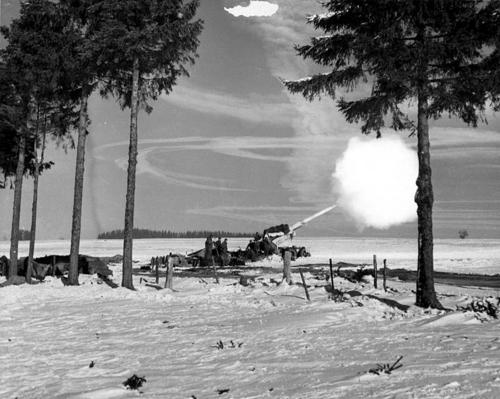
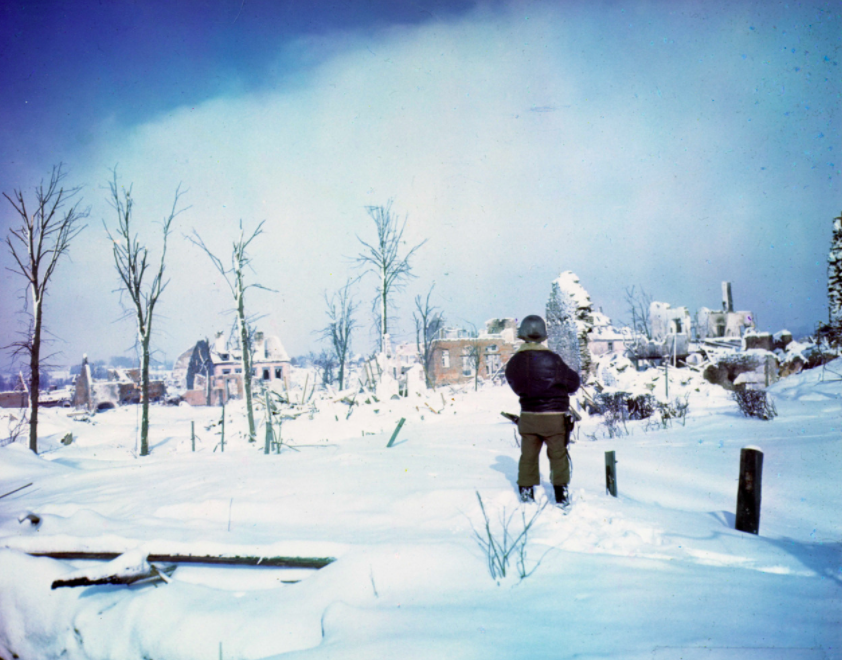
A 155-mm gun in action during the Battle of the Bulge; a GI on the outskirts of St. Vith in January 1945.The Battle of the Bulge was fought during the coldest winter in Europe in thirty years.
“Delay” was exactly what was needed. The panzers were fuel-poor (because Germany was: Berlin taxis were running on firewood in 1944) and the success of the Battle of the Ardennesdepended on speed, on objectives seized promptly, even on the hopeful seizure of vast American stockpiles of gasoline.
Those might’ve been dispatched to the battlefield by my father, a lowly Quartermaster second lieutenant whose responsibilities included providing the African-American gasoline supply companies that kept the American army on the move.
By the time the American army had stopped moving—backward—and flattened the Bulge salient, 20,000 GI’s were dead, among them Orville Tucker. And though he died 5,000 miles away, Tucker was evidently one of the first local GI’s to come home. This is from the December 31, 1948, edition of the Arroyo Grande Herald-Recorder:
A sniper killed Yoshihara on the German frontier as the young man, a medic, was trying to save a brother soldier.
And the ship that brought Orville’s body home, the Barney Kirschbaum, named for an American merchant mariner killed in a 1943 U-boat attack, was a Liberty Ship, one of the miracles of the war, one of 2,710 such freighters launched from American shipyards during the war. Kirschbaum would’ve looked exactly like San Francisco’s Jeremiah O’Brien, tied up at Pier 45. (In 1994, O’Brien had the distinction of returning to the European Theater—to Normandy, no less—where she’d been part of D-Day fifty years before.)
The war dead intersect with my father’s life, as well. Once the war had ended, his duty shifted to training GI’s, nineteen-year-olds, some of them grads from Class of ’44. They’d come to Europe prepared the fight Germans, but the war was over, so Dad’s work, and theirs, was in Graves Registration. He trained these soldiers in the ghastly work of identifying the young Americans the war had claimed. Those young men—forever young— were then to be buried in one of a network of American military cemeteries. Many of those casualties, like Orville Tucker, would eventually come home.
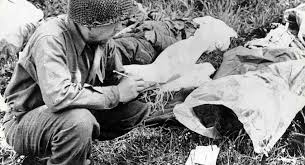
A Quartermaster, part of a Graves Registration unit, records the identities, soon after battle, of fallen soldiers.
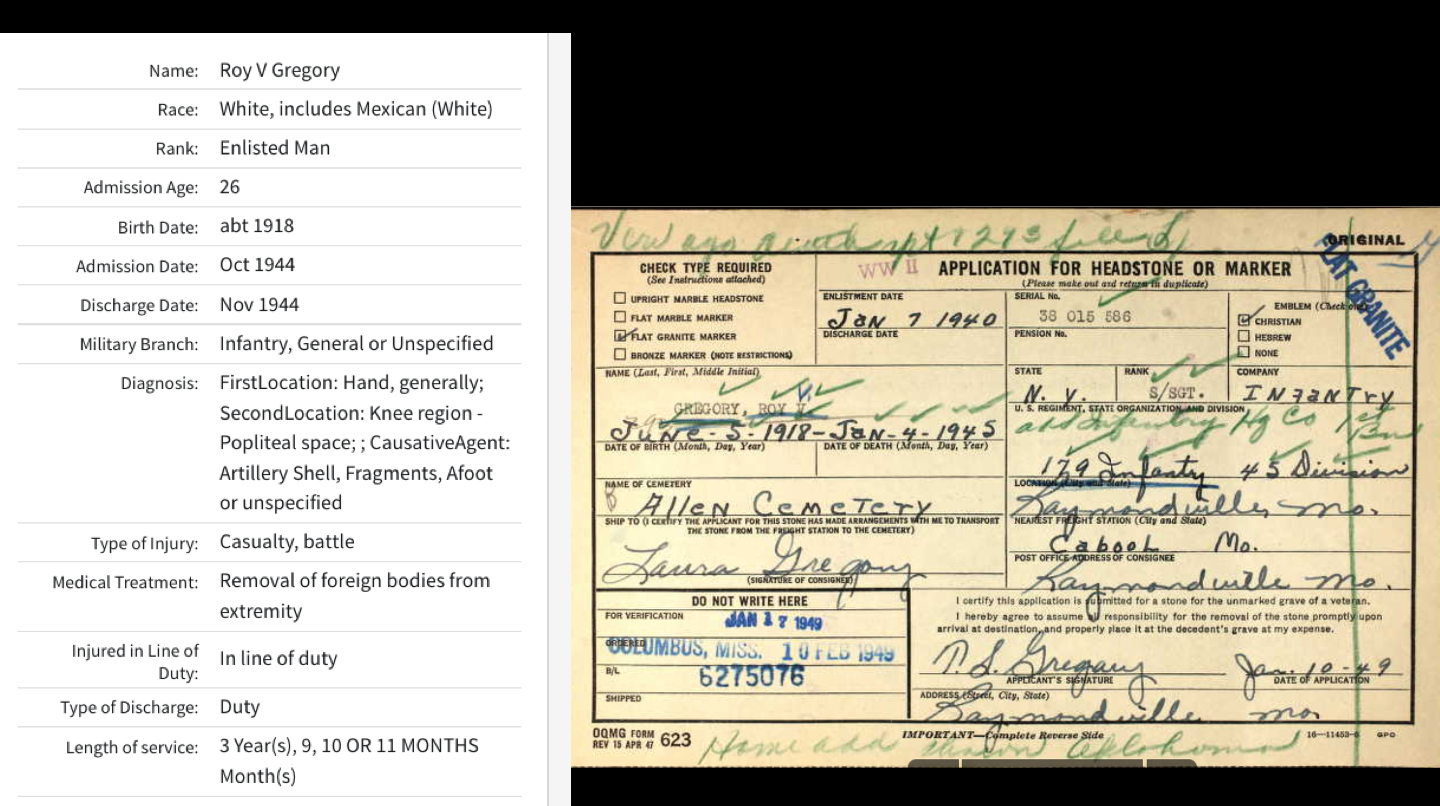
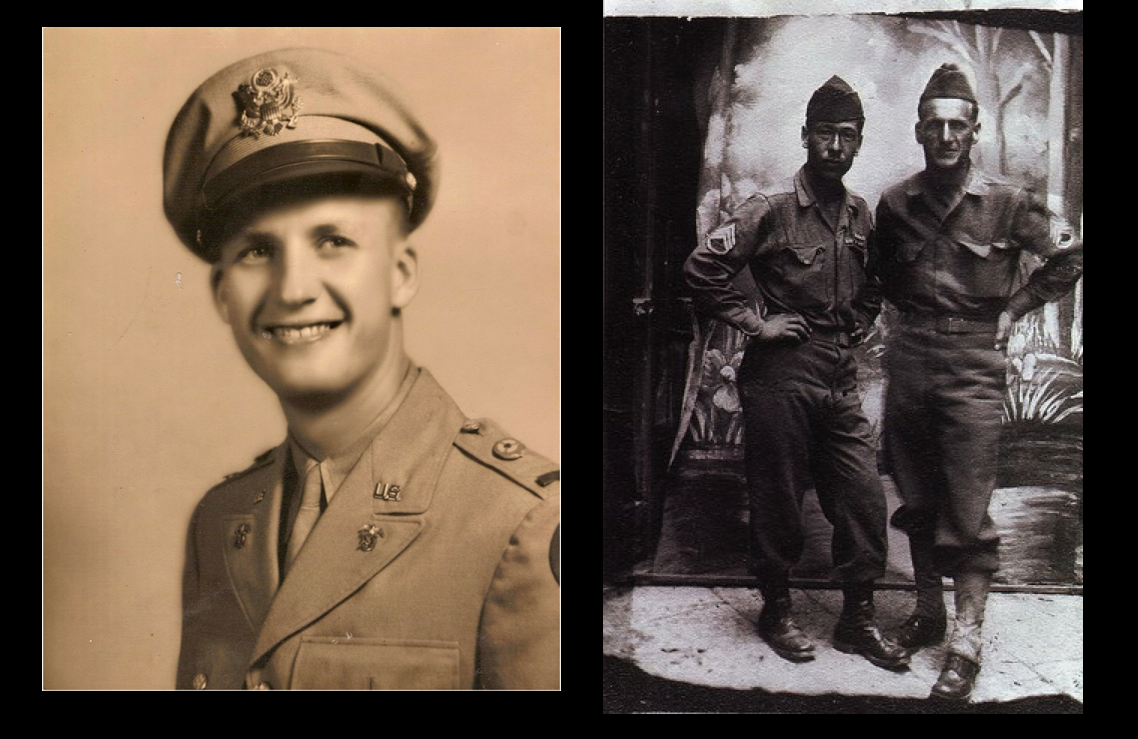
One of the soldiers who came home after the war—in my family’s case to rural Missouri— was my father’s cousin, Roy.
Roy was discharged from a field hospital, where he’d been treated for shrapnel wounds, in November 1944. He went back into action in Alsace, where, in January 1945, another elite SS unit essentially wiped out the headquarters company to which he was attached.
Roy—who’d fought with his buddy, Sgt. Chew, in Sicily, Italy, and finally France–looks remarkably like my Dad.
Sgt. Gregory’s hospital record; the family’s application for a military headstone. He is buried near my grandfather, John Smith Gregory.My father as a lieutenant; Sgts. Chew and Gregory in a studio photograph taken in Italy.
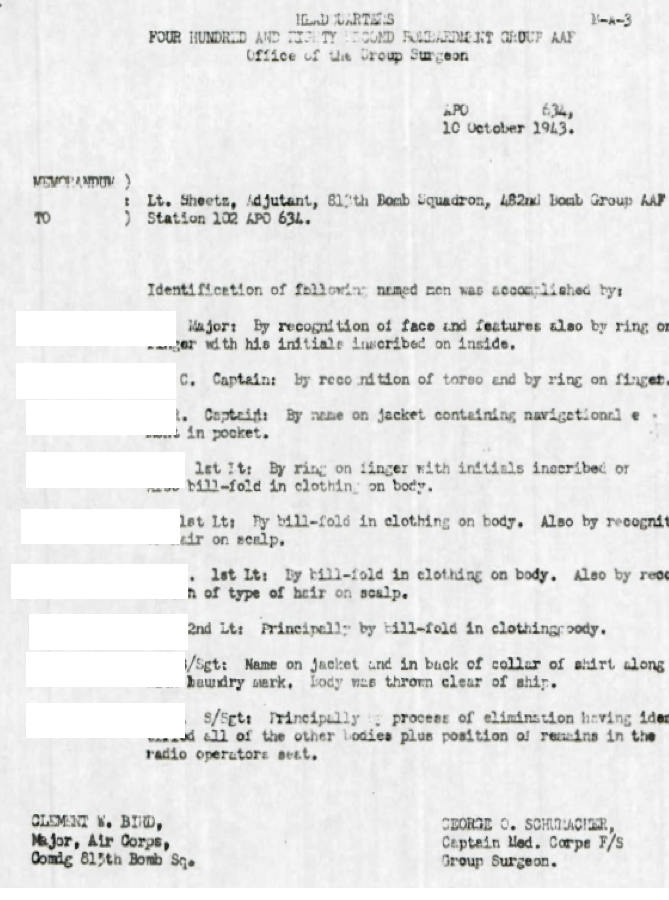
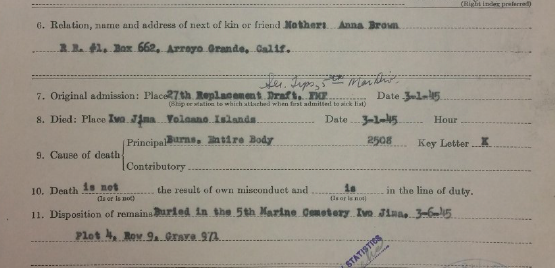
Graves registration work was ghastly, of course, because of the way these young men had died. Sometimes, in the Army Air Forces, when the flight surgeon of a bomb group had the duty of identifying the dead, the clues were circumstantial and almost always, as in the case of this Marine killed on Iwo Jima, the deaths were violent beyond imagination.
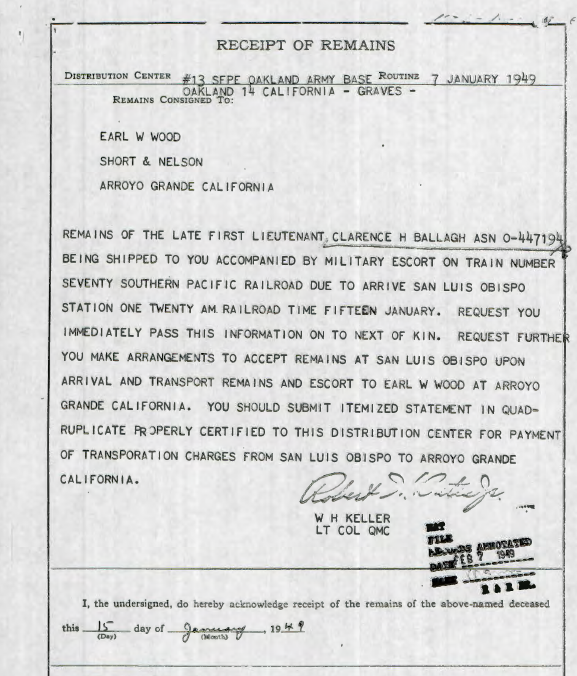
The dead recorded from this B-17 accident in northern England include Clarence “Hank” Ballagh, a young man whose ancestors came to Arroyo Grande in a covered wagon. He was the AGUHS valedictorian in 1938 and graduated from Cal with an engineering degree.
This young Marine, Louis Brown, was a farmer’s son from Corbett Canyon.
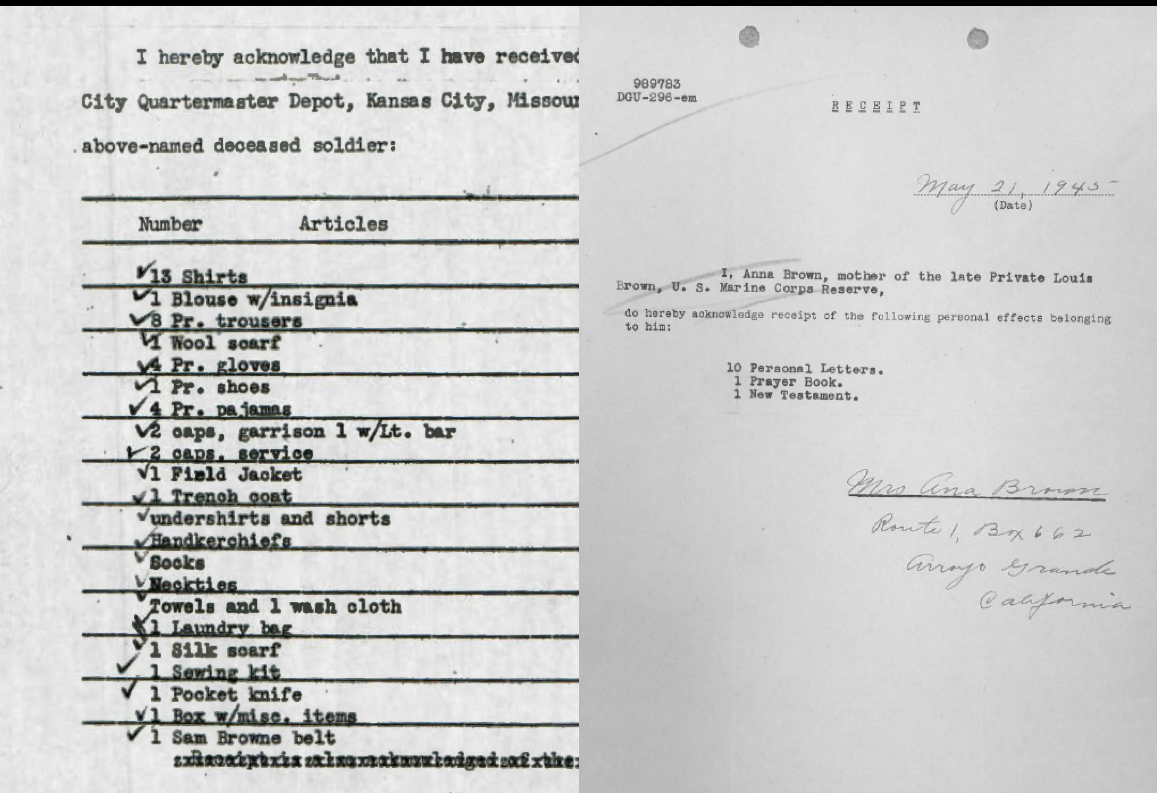
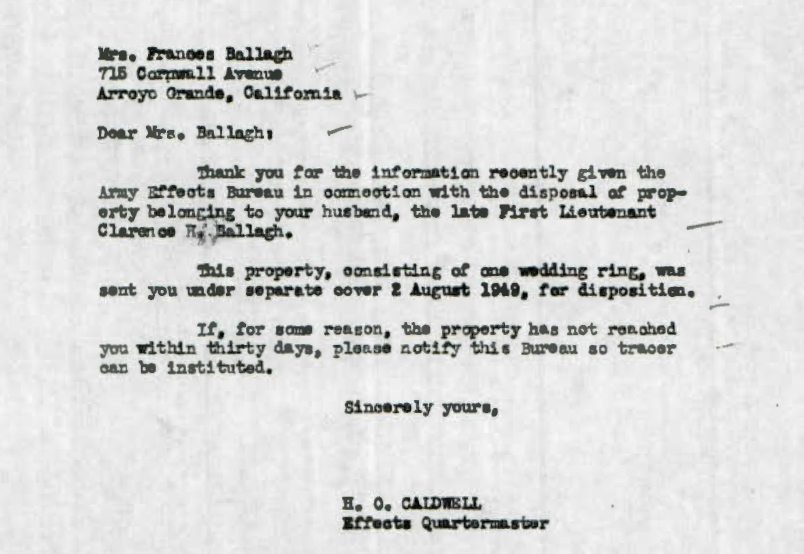
The Quartermasters also took charge of cataloguing a fallen man’s personal effects, and these reveal—with the possible exception of the Army Air Forces, where the sharp lines of rank blurred among bomber crews—that there remained a vast social gap between officers and enlisted men. These are the personal effects of Lt. Ballagh, the Berkeley grad, and Private Brown, who, like 64% of Americans in 1940, hadn’t finished high school:
Brown’s Rosary is listed in a separate Navy Department letter to his mother.
Ballagh was killed when his plane flew into the side of an English mountain; fragments of the B-17 remain there today. Brown was killed, most likely by a Japanese land mine, no more than 48 hours after he went into action on Iwo Jima. Both came home to Arroyo Grande, in a bureaucratic ballet in quadruplicate steps, that was unmistakably human. There’s no mistake that the Army wants Lt. Ballagh, even in death, to come home safely.
The records of the dead, I think, are important: they force us to confront a war now safely confined to history books and television screens. Beyond that, they reveal the terrible price that the living had to pay, as well.
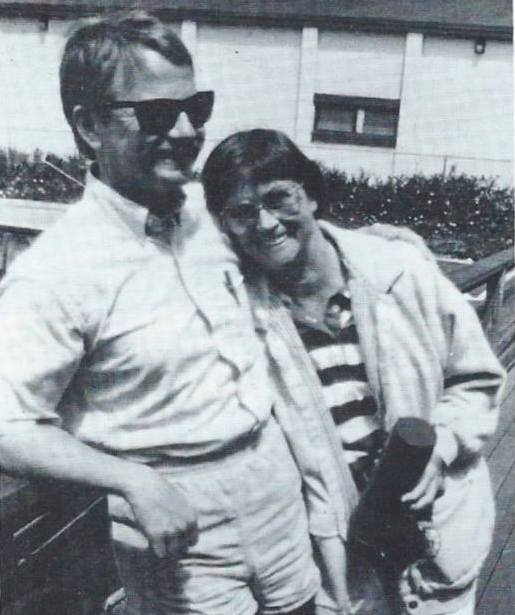
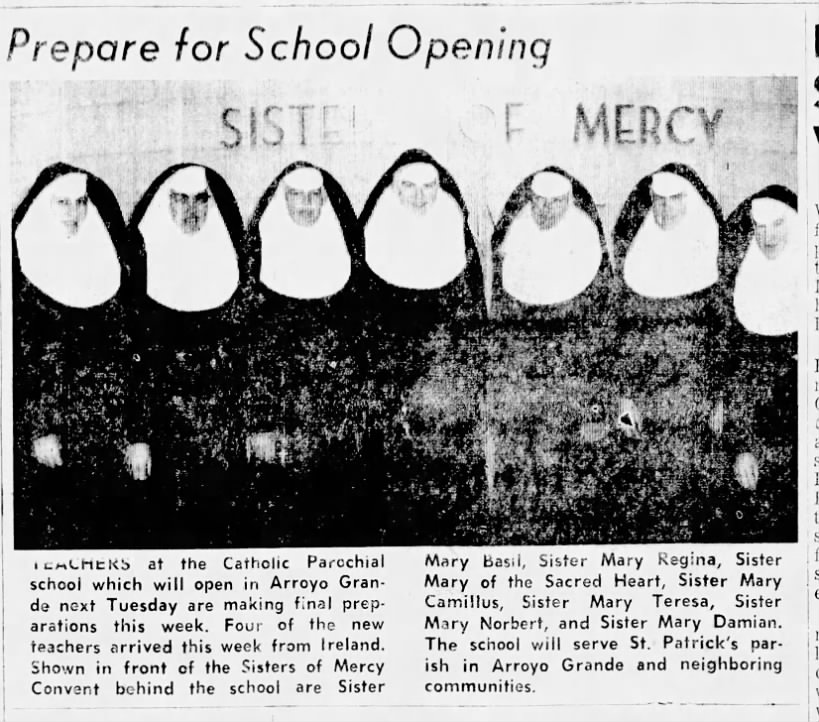
Our dear friend Sister Teresa O’Connell died in May at 90. She taught at St. Patrick’s in Arroyo Grande and Elizabeth and I taught with her at Mission in the 1980s and 1990s. Here’s the two of us back then:
As a member of the Sisters of Mercy, Teresa spent most of her life teaching young people. But when she returned to Ireland, she found a new calling in ministry to the elderly. Hers was such a rich life.
Elizabeth and I “attended” her funeral at the Ennis Cathedral–it was four a.m. our time–thanks to the internet. It was a six-priest funeral Mass with a couple of Monsignors included. Behind the altar, It was like the Irish Catholic equivalent of the 1927 New York Yankees.
It was the least they could do for her.
Here are two views of the church.
I made the mistake of starting to do some research on Ennis, because in thinking of Irish history as a road, every few miles you are confronted with a sad detour. The cathedral was built in 1828, which in itself is significant, because the Penal Laws enacted at the end of the 17th Century–that would’ve been when Great Britain, after the insolent Popery of King James II, was once again securely and relentlessly Protestant under William and Mary–forbade the building of new Catholic churches in Irish cities. The ban, then, lasted until the English were long past the Stuarts and running toward the end of their Hanoverians.
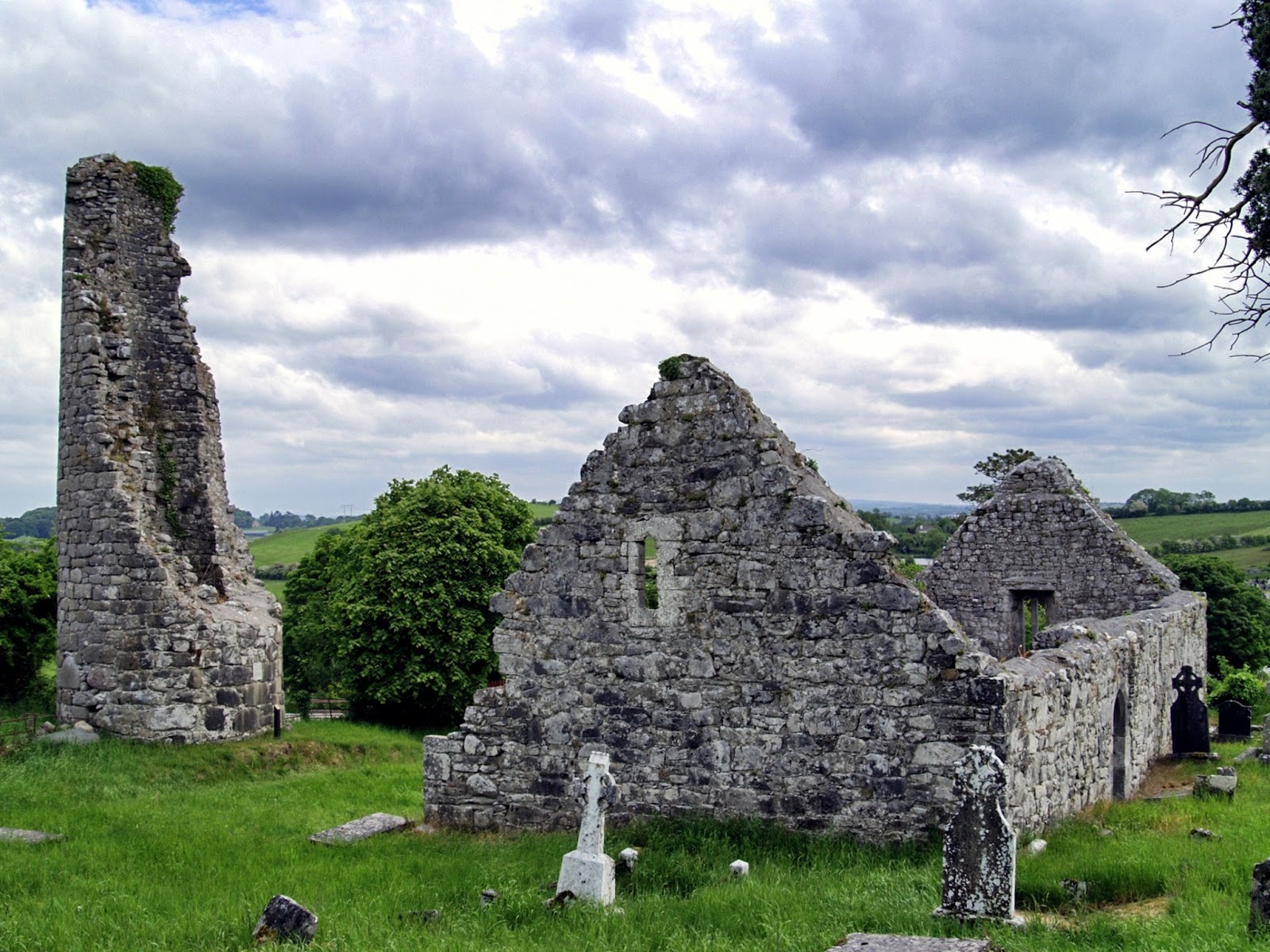
I looked up the cemetery where Sister is buried. It’s Drumcliff, Ennis, County Clare. It’s rich in Irish history, too.
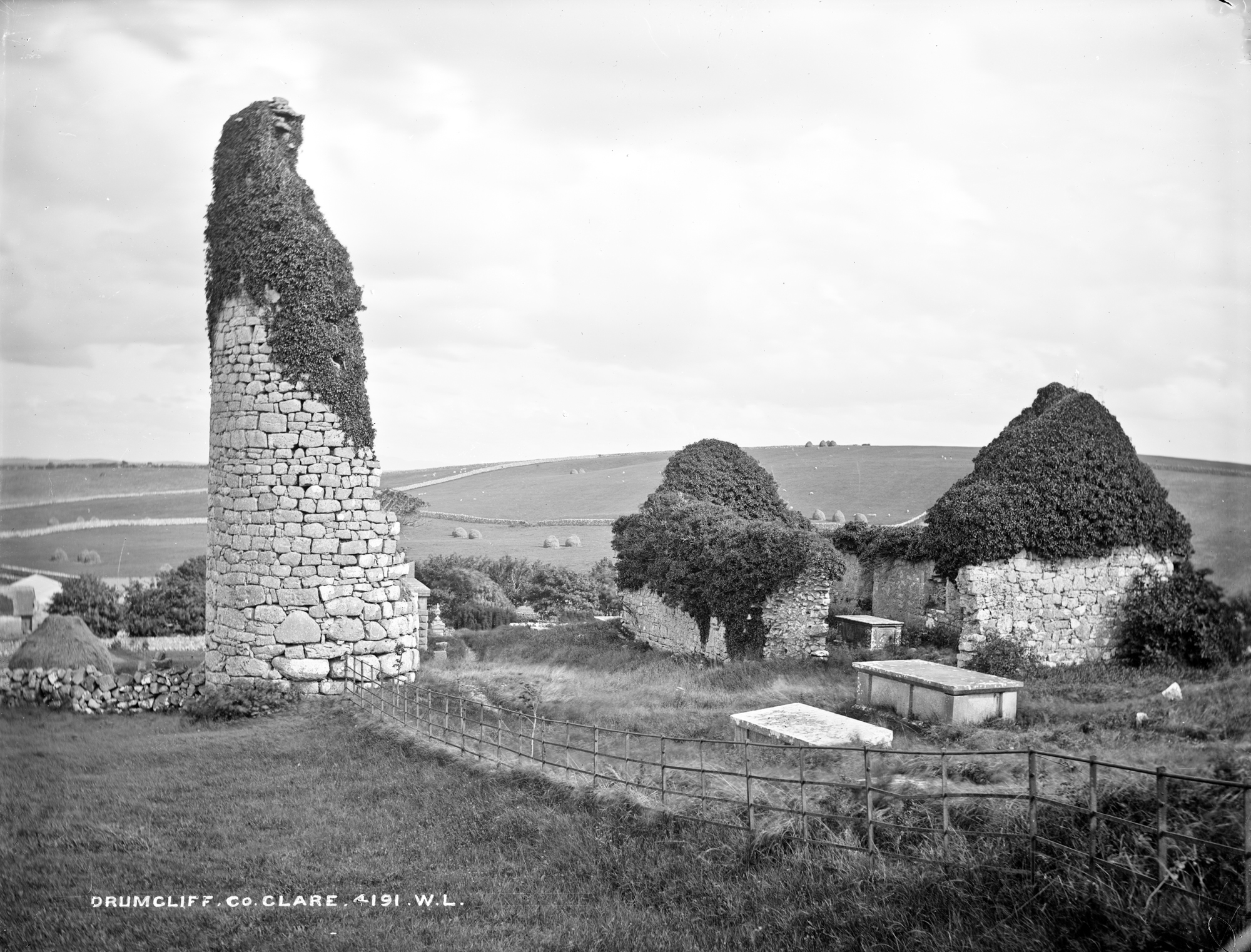
This photo shows the tower and ruined abbey church at Drumcliff. The cemetery adjoins the ruins, on a steep hill that one guide says is windy but strangely serene. Another guide says this: “The existing church ruins are from the 15th century with bits of 10th and 12th century architecture incorporated into it, suggesting it was built on the site of at least one earlier church.”
The earlier church may have been founded by St. Conall. He lived in the 7th century.
When you grow up in a place whose oldest landmark dates to 1772, your history is an eyeblink next to Ireland’s.
The cemetery itself represents one of those sad detours in that history. From a County Clare genealogical website:
Itis impossible even to guess how many persons are buried at Drumcliffe [sic]: so many graves were never marked at all, countless others have no inscriptions, and the multitudes who lie in the cholera grave, the Famine grave pit beside it and the pauper plot closer to the road, will never be identified by the names they bore in life.
Cholera was a terrible killer in the first half of the nineteenth century; it killed Londoners in their thousands, as well as the Irish, until Joseph Bazalgette designed and built a network of intercepting sewers that carried the Thames River’s sewage out to sea.
Ireland, of course, was far behind in engineering projects as grand as this one.
“The Famine grave pit” is mentioned in passing. Perhaps many of those people were on their way out of Ireland. We once saw a massive green in Galway, one of the Famine ports of exit, also in the west, beneath which thousands of destitute Famine victims are buried. They’d almost made it. It’s probable that the people buried in Drumcliff, like those in Galway, died, enfeebled by starvation, of opportunistic diseases like typhus.
At least the paupers are symbolically remembered. Many of them ended their lives in a nearby workhouse. Here is their monument:
Pauper’s Memorial, Drumcliff
The Famine Grave
It’s a windy but strangely serene place.
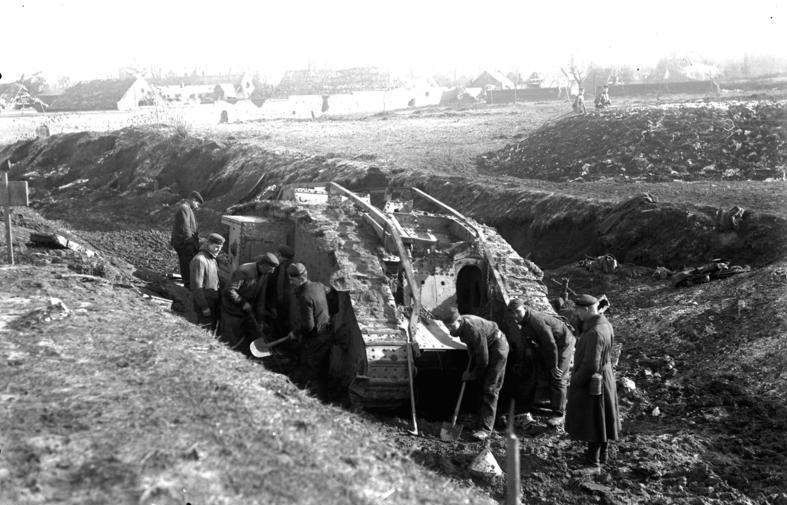
And then you reach the 20th century. There are Great War soldiers buried here: over 200,000 Irishmen fought for the British between 1914 and 1918. Drummer John McMahon served in the King’s Own’s Scottish Borderers, in a battalion that had survived Gallipoli; it’s possible that his death, in July 1917, came in Palestine. Thomas Moody served in the Irish Guards; his death, in November 1917, must’ve been at the Battle of Cambrai, which, like Bazalgette’s intercepting sewers, began as a landmark for modern technology. The British launched a massive attack spearheaded by Mark IV tanks, an innovation in warfare. By the second day of the attack, half the tanks had broken down, and that’s when the Germans responded. Moody probably died in their counterattack, the biggest assault on the British Expeditionary Forces since 1914. It was in that ealier assault–the the First Marne, in September 1914, the battle that stopped the Germans short of Paris, when Parisian taxicabs carried poilus to the front in relays–that claimed artilleryman Michael O’Brien, another soldier buried in Drumcliff.
German soldiers inspect a British tank wrecked at Cambrai.
Of course, the Great War was punctuated by the Easter Rising in Dublin. You can still the gouges British bullets left in the columns of the Neoclassic General Post Office, where the rebels held out for six days during Easter Week 1916. The Dubliners jeered the Irish Republican Army rebels as they were led away, after their surrender, by British forces.
The General Post Office, O’Connell Street, Dublin, after the Easter Rising. Nelson’s Column, to the right, was later blown up by the IRA.
Then the British began executing them, granting one, terribly wounded, the privilege of being shot while seated in a chair. That was a mistake. Now they were martyrs.
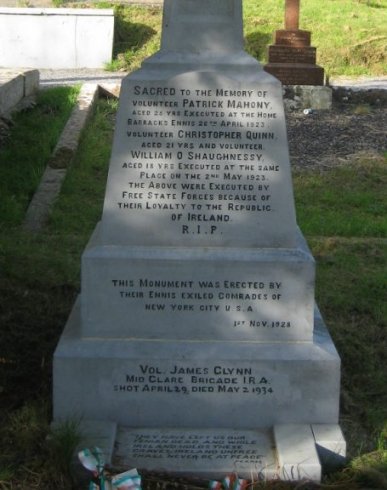
And that leads to one more place in the Drumcliff Cemetery: An IRA Memorial.
Irish rebels memorial
Maybe it’s typical that this memorial was made possible by expatriates, Irish living comfortably and happily distant in New York. What it commemorates might be too painful to remember for the people who live in Ennis today. The four Irish Republican Army men cited on this monument were killed in The Troubles, but not by the English. Three of the four were shot by firing squads made up of fellow Irishmen during the Civil War of 1922. Two were eighteen years old. They were Republicans executed by soldiers of the Irish Free State, the government that shot three times as many Irish revolutionaries in 1922 as the English had during the rising of 1919-1921.
One of the eighteen-year-olds wrote this on the eve of his execution:
Home Barracks, Ennis
Dearest Father,
My last letter to you; I know it is hard, but welcome be the will of God. I am to be executed in the morning, but I hope you will try and bear it. Tell Katie not to be fretting for me as it was all for Ireland; it is rough on my brothers and sisters–poor Jim, John, Joe, Paddy, Michael, Cissie, Mary Margaret–hope you will mind them and try to put them in good positions. Tell them to pray for me. Well father, I am taking it great, as better men than ever I was fell. You have a son that you can be proud of, as I think I have done my part for the land I love. Tell all the neighbours in the Turnpike to pray for me. Tell Nanna, Mary and Jimmy to pray for me, Joe, Sean, Mago, Julia, Mrs. Considine and family, also Joe McCormack, the Browne family, my uncle Jim and the Tipperary people which I knew. I hope you will mind yourself, and do not fret for me. With the help of God I will be happy with my mother in Heaven, and away from all the trouble of this world, so I think I will be happy...
…Dear father, I will now say goodbye – goodbye ‘till we meet in heaven.
I remain, Your loving son, Christie
County Clare is famous for goodbyes. The Cliffs of Moher (above) might have been the last many Famine emigrants to America saw of Ireland. A windy and wild place, they are remindful of the title Leon Uris chose for a book he and his wife Jill wrote about Ireland: “A Terrible Beauty.”
Sister Teresa, even in her rest, cannot escape the long road of Irish history that has carried so many travelers—including my own family—on the journeys of their lives. Hers ended in Clare, a place, like the rest of Ireland, so marked by sadness. But sadness is not a dominant Irish trait—the last thing the Irish lost during the Famine, one chronicler noted, was their sense of humor—and it was service to others, not sadness, that dominated Teresa’s life.
I’ve been to Ireland and don’t know that I’ll ever get the chance to go again. If I do, God willing, there’s a place in the Drumcliff Cemetery that needs beautiful flowers and a pinch of California topsoil, perhaps from a field that adjoins St. Patrick’s Church, a parish five thousand miles away from County Clare.
September 1963: Off the airplane and into the classroom. Teresa is third from right.
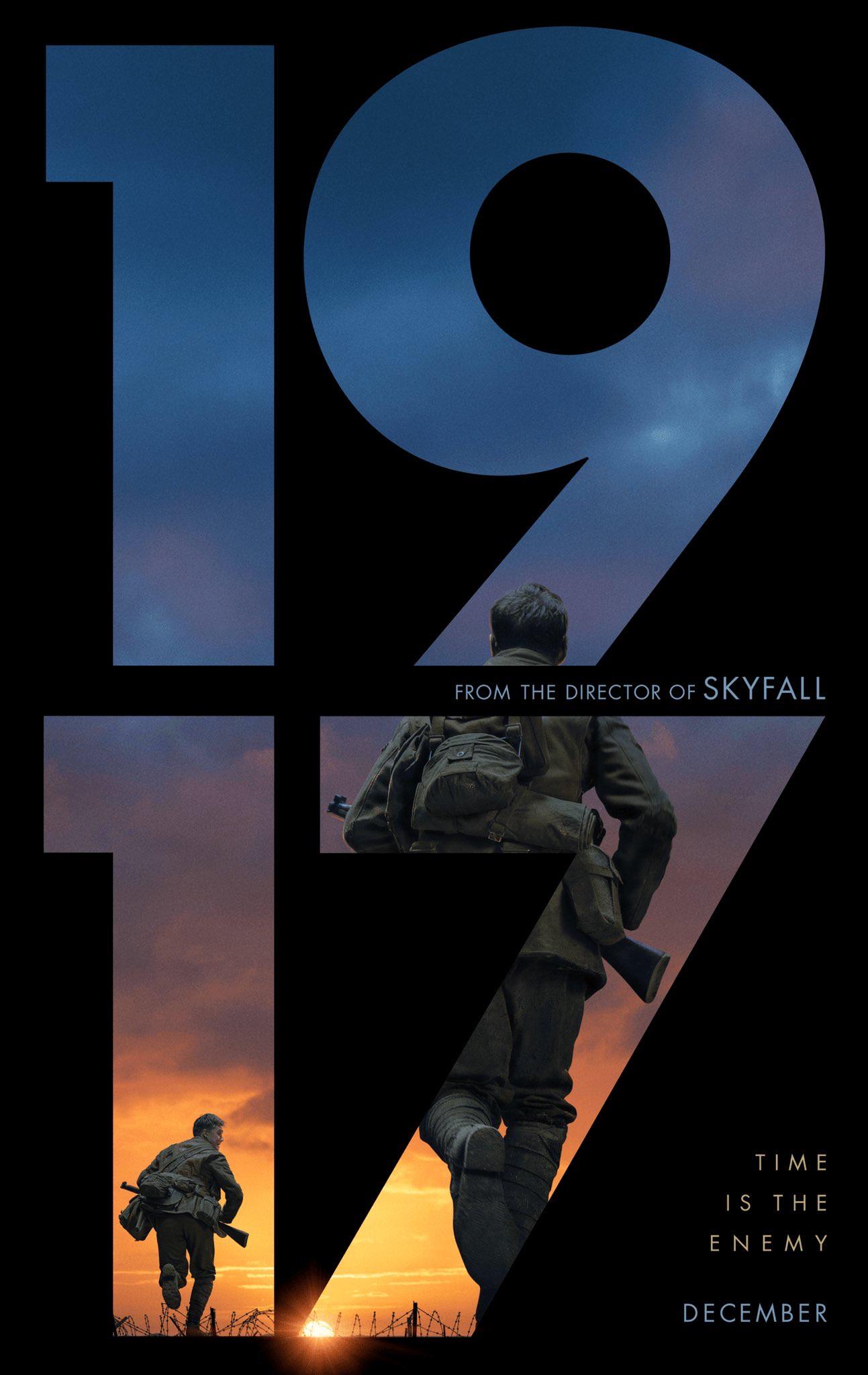
Sam Mendes, a director whose credits include spectacular Bond films, is about to release something different: 1917.
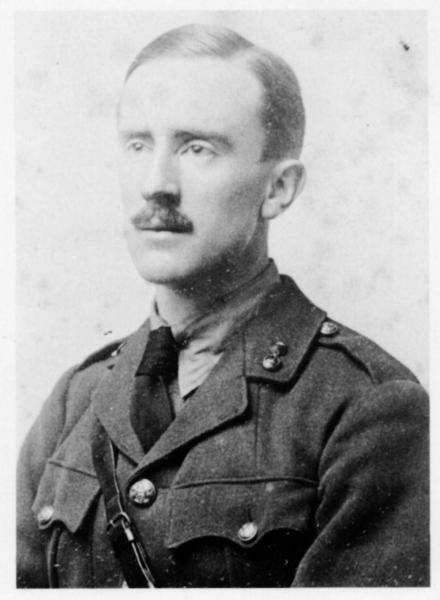
It was a JRR Tolkein’s (right) experiences in the trenchland of northern France that would lead to The Lord of the Rings in the attempt, I think, to confront the demonic forces that surrounded him when he was twenty-four years old.
Erich Maria Remarque’s All Quiet on the Western Front was the same kind of response. Writers like these two—and like Siegfried Sassoon, Robert Graves and Wilfred Owen—showed us how quickly and completely centuries of civilization could unravel.
The advance word is positive and I hope the critics are right. Gettysburg, based on a far worthier novel, The Killer Angels, lasted longer than the battle itself and I was rooting against both sides by the end; Midway made me care not a damn about human beings. Private Ryan, on the other hand, did.
So I am hopeful for this film.
1917: Benedict Cumberbatch as Colonel Mackenzie
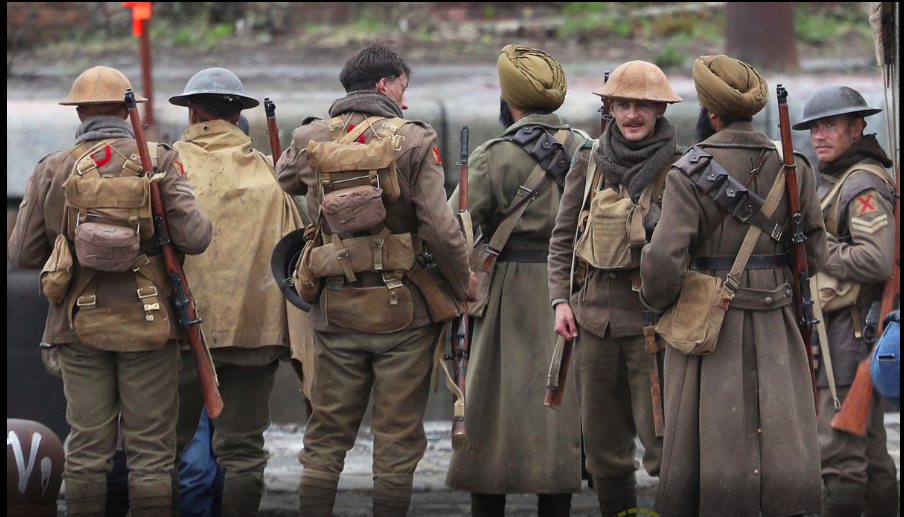
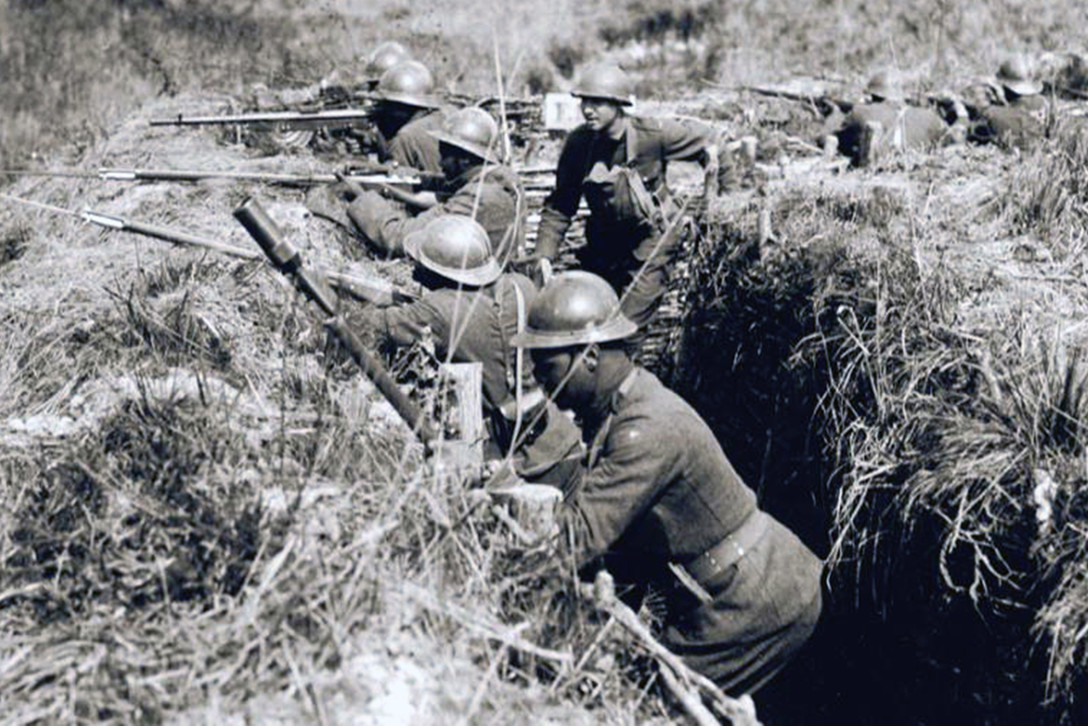
I wrote a a book about World War II which would have been impossible to write unless I’d had twenty years’ experience teaching World War I to European history students. It truly was a world war: The film still below shows actors portraying both Tommies and Sikhs fighting as comrades. Those are African-American troops from the 369th Infantry Regiment, but they’re wearing French helmets because the French begged for fighting men–we used African-Americans as manual laborers– and they responded by fighting like tigers. 170 members of this regiment received the Croix de Guerre.
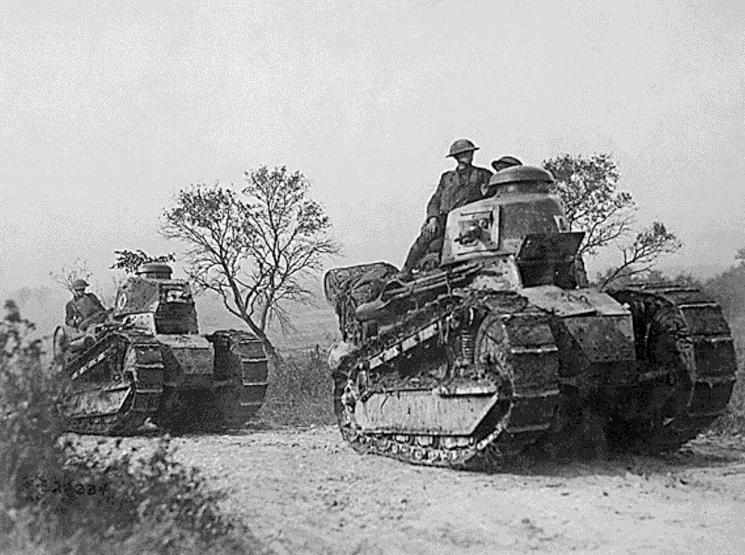
And these are American doughboys riding atop French Renault tanks; our Marines advanced on the machine gun nests in Belleau Wood carrying French Chaucat light machine guns. They fired from the hip, the Germans remembered, while smoking cigarettes. Our troops went into action in the Meuse-Argonne Offensive convoyed in French trucks driven by French colonials from a country that would someday be called Vietnam.
At the end of the year, my students and I decided that there had been no turning points in Western history quite like these three: Luther’s posting of the Ninety-Five Theses; the storming of the Bastille in 1789; the assassination of Franz Ferdinand and Sophie in 1914. The last event, which tumbled us into World War I within a month, hasn’t played itself out yet.
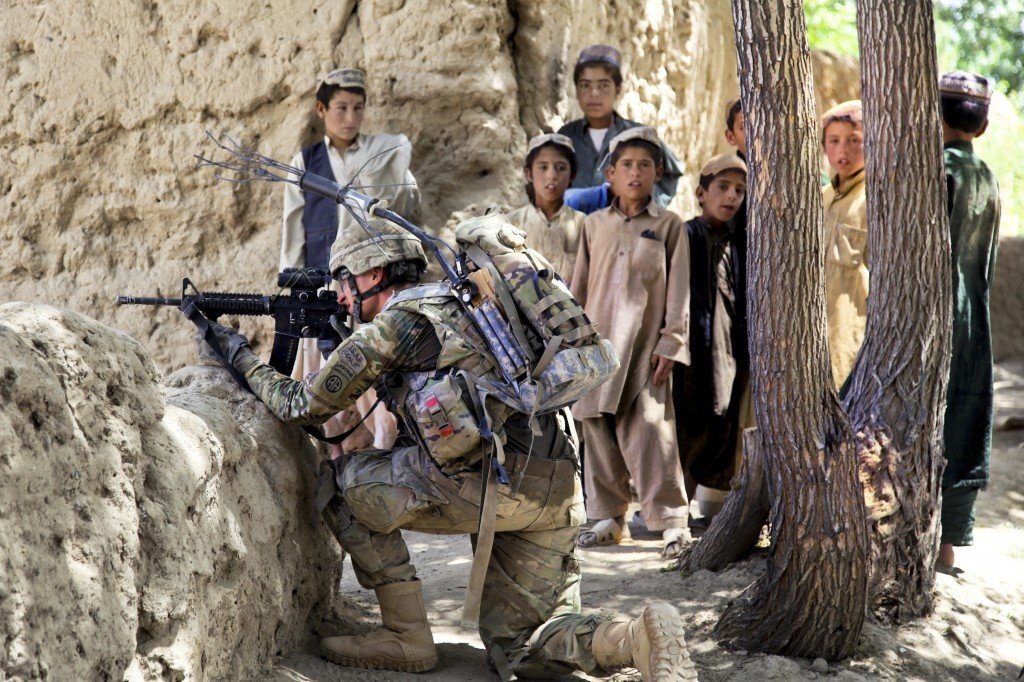
The Americans serving in Syria and Iraq are a product of this war and the ineptitude of the peace treaty never really ended it.
I tried to explain, in this passage from the World War II book, why we need to confront World War I. I have the feeling that this film will take us there.
* * *
I taught history for thirty years, and I never, never ceased to get angry every spring when I taught the First World War. It was this war and its peace treaty that did so much to make World War II possible. In 2010, I took some of my students to Western Europe’s World War II battlefields but also to Verdun, site of a horrific 1916 battle that lasted over ten months. The stacked bones in the ossuary there once belonged to boys like my two sons, whose parents had applauded at their first steps or cheered when they scored their first football goal.
I made it my business to help all of my students understand that idea— that war cheats us all so cruelly—and so I led them, every year in my classroom, into dark places, like Fort Douaumont at Verdun, so dark that it swallowed the light of five hundred years of Western culture. To go inside Douaumont, where 100,000 young men were killed or wounded, to study war doesn’t mean we glorify it. A few years ago, a student told me the First World War was her favorite unit. (Not mine—I much prefer La Belle Èpoque) I asked her why, and she replied, “Now I understand how precious human life is.”
She understood precisely why I became a history teacher.
She would have understood, as well, how in the process of writing this book, something extraordinary has happened within my heart: the more I research these young men of my father’s generation, the inheritors of the legacy of places like Douaumont, the more they become my sons.
Through no one’s fault, they’ve been mostly forgotten. This book seeks to name them and so reclaim them for a new generation. When we come to know these young men, we come to love them, and maybe that is the force that will carry us a small step farther along a path that will lead us to a world of peace. The great Jesuit theologian and anthropologist Pierre Teilhard de Chardin believed that we have a divine gift. We evolve physically and intellectually, but, he argued, we can evolve spiritually, as well. I believe Teilhard is exactly right. But I believe also that we cannot advance if we leave behind the boys and men I’ve met, the casualties of war. Their lives were, and are, precious, and if they could somehow save other young lives, I think they’d do it in an instant.
A North Vietnamese soldier-poet wrote many years ago that “the bullet that kills a soldier passes first through his mother’s heart.” If the young men I now know could somehow spare other mothers the pain theirs went through, then I think they would do that in an instant, too.
It is our responsibility to confront and understand the horrific violence that took their lives. The young men I now know who died in a Norman village like Le Bot or in the sky over the English Channel or deep in the waters of Ironbotttom Sound off Guadalcanal lit a path, in dying, for the living to follow. If we ignore them, we will lose the path, and the dark will have won after all.
Arroyo Grande High School students at Fort Douaumont, 2010.


















 something different: 1917.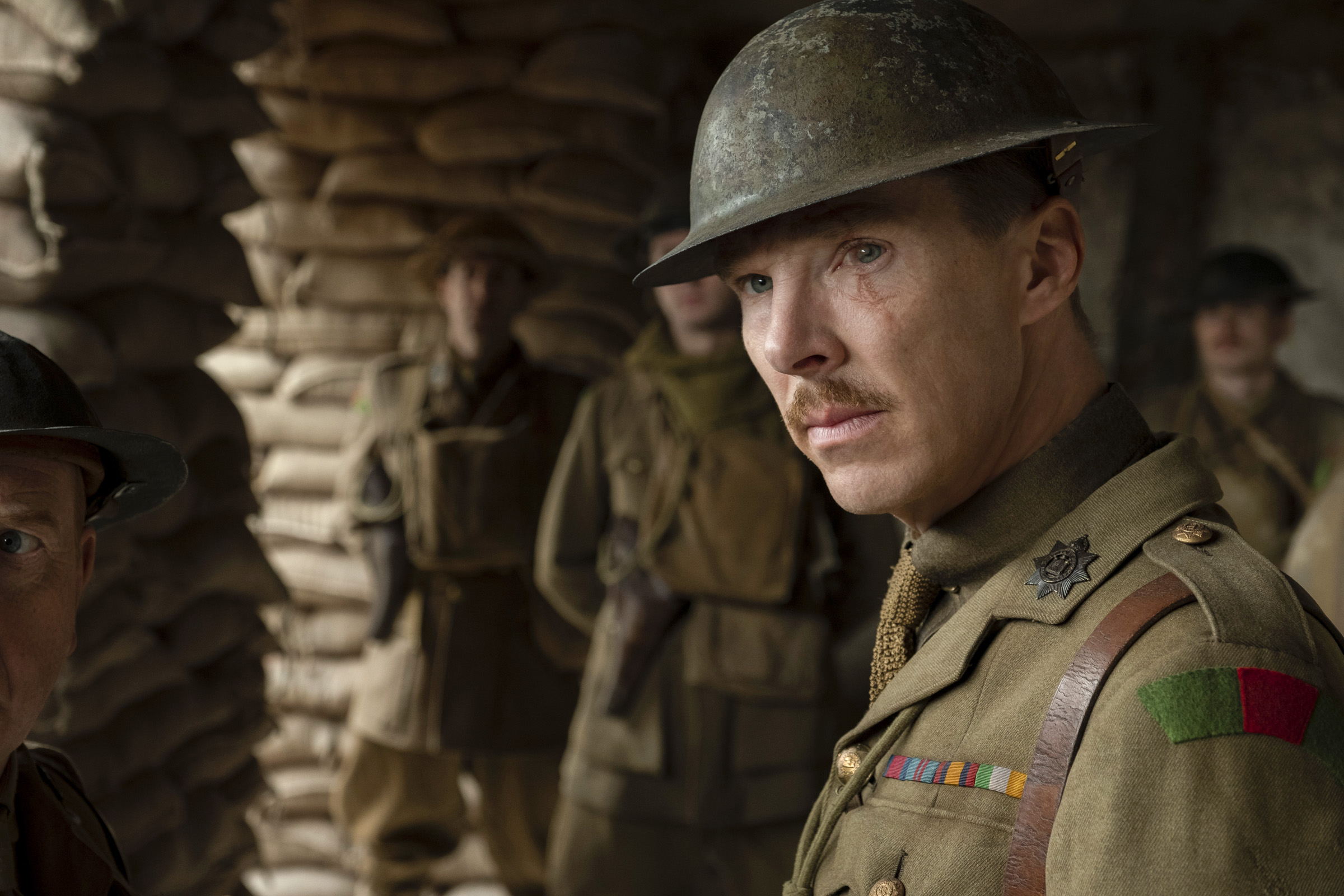

 A Work in Progress