• About
  • The Germans

A Work in Progress

A Work in Progress

Category Archives: History

Coming Home

02 Saturday Oct 2021

Posted by ag1970 in American History, Arroyo Grande, History, Uncategorized, World War II

≈ Leave a comment

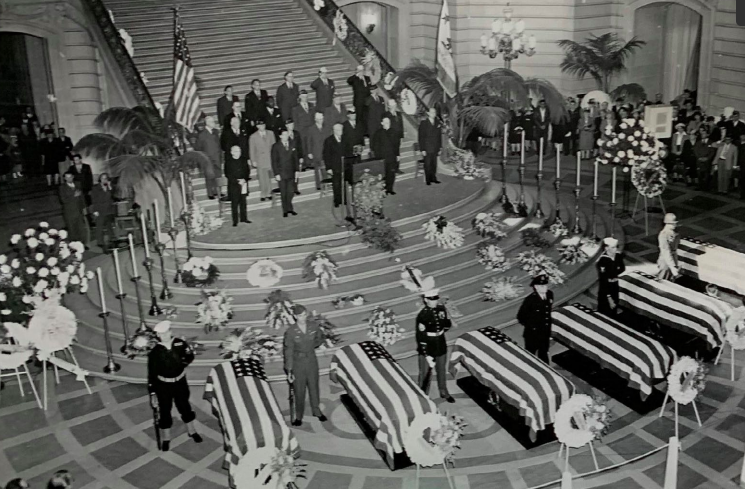
The first World War II American casualties to be repatriated, San Francisco, October 1947. US Dept. of Veterans’ Affairs

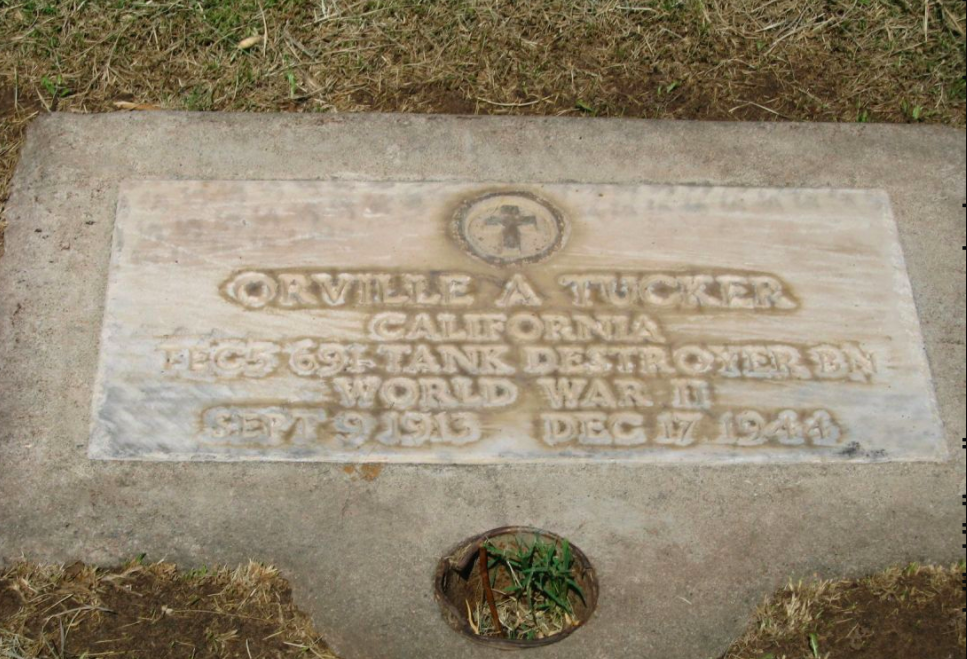
Of course I didn’t expect to meet him, but T5 Orville Tucker’s death crossed my life today. Here’s his grave, in the Arroyo Grande District Cemetery.

And there were a lot of things that struck me about him. The first was his date of death, and dates mean something to historians. We lost this American on the second day of Operation Wacht am Rhein, in what we now call the Battle of the Bulge.

It struck me, too, that he was part of a tank destroyer unit, like Frank Gularte, another Arroyo Grandean I know much better. Tucker was a member of the 691st TD Battalion, Gularte was part of the 607th. And the two soldiers died only days apart. Here’s what I wrote about Gularte on a website that memorializes fallen GI’s, killed in the war my father’s generation fought:

Sgt. Gularte served with the 607th Tank Destroyer Battalion and was killed in action 28 November 1944 near Metz, possibly outside the town of Merten. His son was born five days later in San Luis Obispo County, California. A memorial Mass was said in Sgt. Gularte’s memory at St. Patrick’s Church, Arroyo Grande, San Luis Obispo County, on Wed., 13 December 1944. Sgt. Gularte, before the war, was employed by E.C. Loomis and Son, a farm supply company; Gularte and his family were and are well-known and highly respected in the Arroyo Grande area.

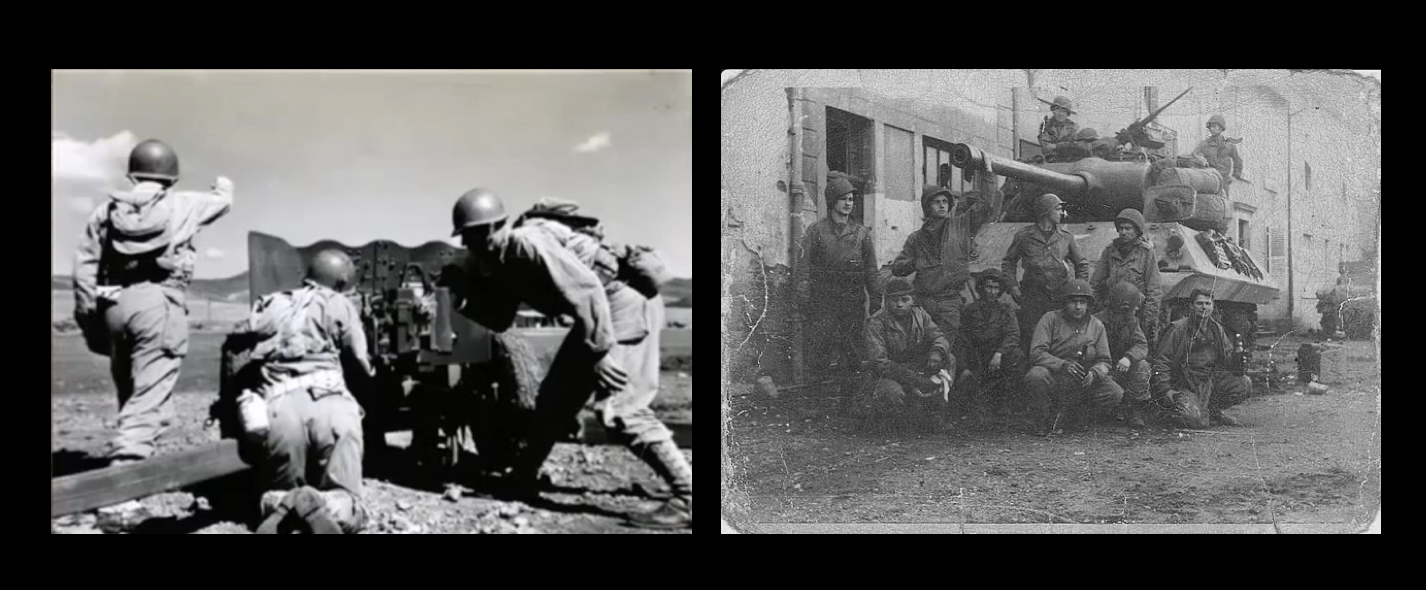
At the time of his death, Tucker’s battalion was still fighting enemy armor with the 57-mm artillery piece, like the one at left being manned by soldiers training at Camp San Luis Obispo in 1944. Frank’s 607th had graduated to the M36 tank destroyer–that’s a 607th TD in the other photo—built on the chassis and hull of the famed Sherman tank, but with a much more robust 90-mm gun.

But it was likely a Mauser rifle that killed Frank, in the hands of a German sniper, during an attack by the 607th that was to have been supported by infantry. They didn’t show, so Frank’s company went into action alone. German fire disabled three tank destroyers edging into Merten—a beautiful mountain town— and the American attack bogged down. Chaos ensued and it claimed Sgt. Gularte.

I don’t know yet how Orville died, but he’s got another tie to the Gularte family.

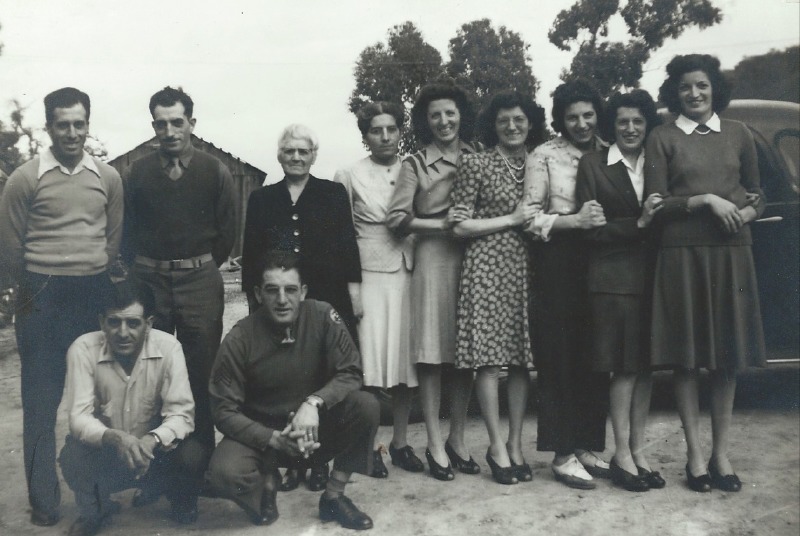
A family barbecue at the Gularte Ranch, behind the site of the IDES Hall just below Crown Hill. Manuel Gularte is standing; Frank is kneeling: Both are about to go to war in Europe.


As near as I can tell, in the opening hours of the Battle of the Bulge, Orville Tucker’s battalion was attached to the 28th Infantry Division. They were defending St. Vith, a Belgian town directly in the enemy’s line of advance and at the seam of two powerful German armies. Twenty-two thousand Americans were in the way of 100,000 Germans and their armor, including 500 tanks. The units that attacked St. Vith on December 17 included the 1st SS Panzer Division Leibstandarte SS Adolf Hitler, an SS unit that had it origins as the dictator’s bodyguard.

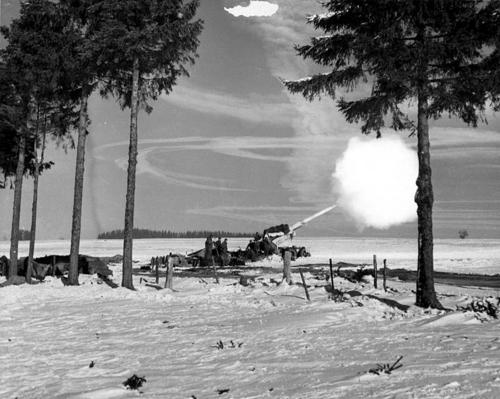
Their assignment was to take St. Vith by midnight December 17. It didn’t work out that way, partly in thanks to Orville Tucker and partly because of Frank’s brother, Manuel, also fighting to defend St. Vith. (Two Arroyo Grande settlers, Civil War veterans, had fought in separate regiments within 300 yards of each other at Gettysburg.) Manuel’s field artillery unit–they tended big 155-mm guns, updated versions of the artillery that stood guard over San Luis Bay here at home–and it was the accuracy and ferocity of their fire that delayed the German advance.

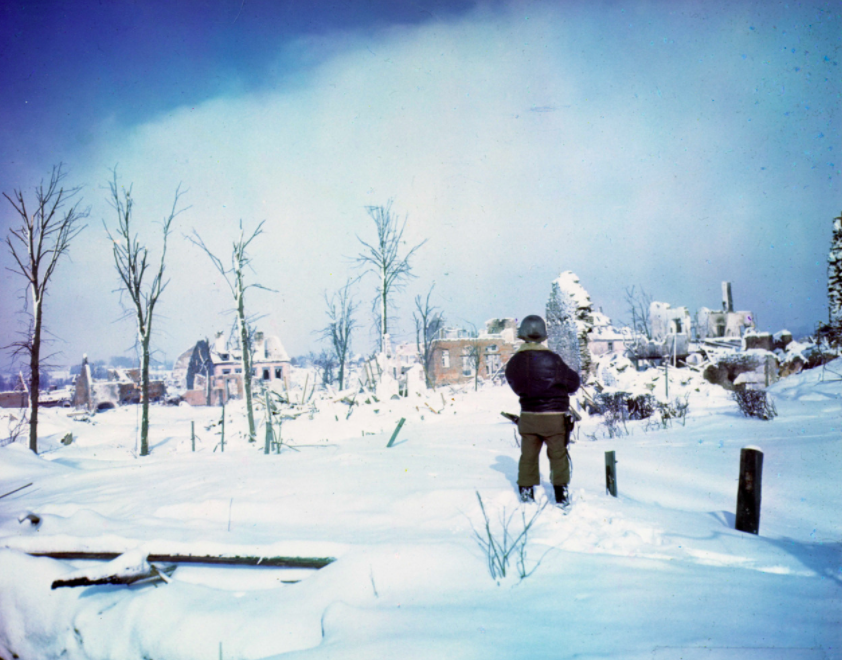
A 155-mm gun in action during the Battle of the Bulge; a GI on the outskirts of St. Vith in January 1945. The Battle of the Bulge was fought during the coldest winter in Europe in thirty years.

“Delay” was exactly what was needed. The panzers were fuel-poor (because Germany was: Berlin taxis were running on firewood in 1944) and the success of the Battle of the Ardennes depended on speed, on objectives seized promptly, even on the hopeful seizure of vast American stockpiles of gasoline.

Those might’ve been dispatched to the battlefield by my father, a lowly Quartermaster second lieutenant whose responsibilities included providing the African-American gasoline supply companies that kept the American army on the move.

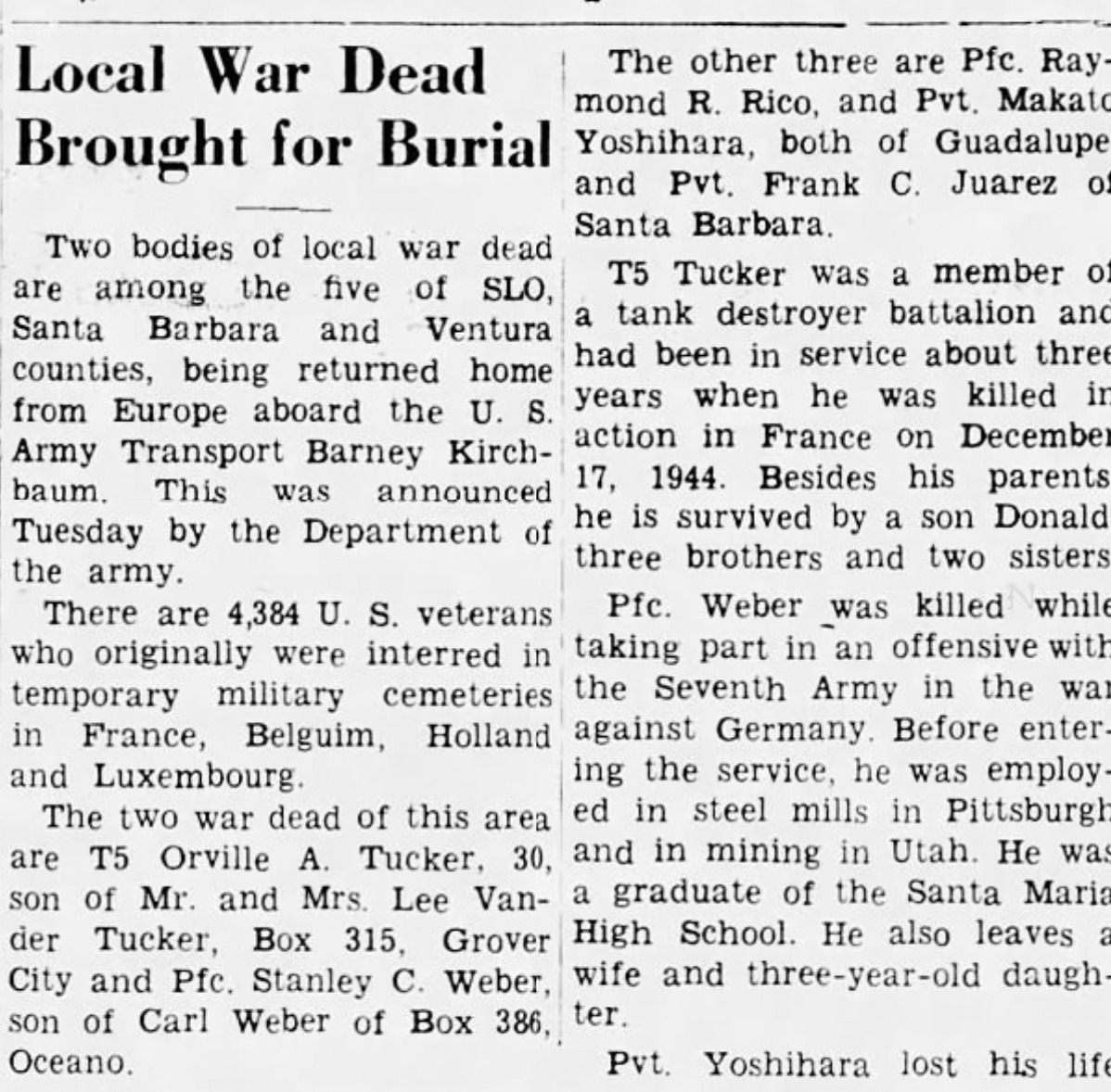
By the time the American army had stopped moving—backward—and flattened the Bulge salient, 20,000 GI’s were dead, among them Orville Tucker. And though he died 5,000 miles away, Tucker was evidently one of the first local GI’s to come home. This is from the December 31, 1948, edition of the Arroyo Grande Herald-Recorder:


A sniper killed Yoshihara on the German frontier as the young man, a medic, was trying to save a brother soldier.

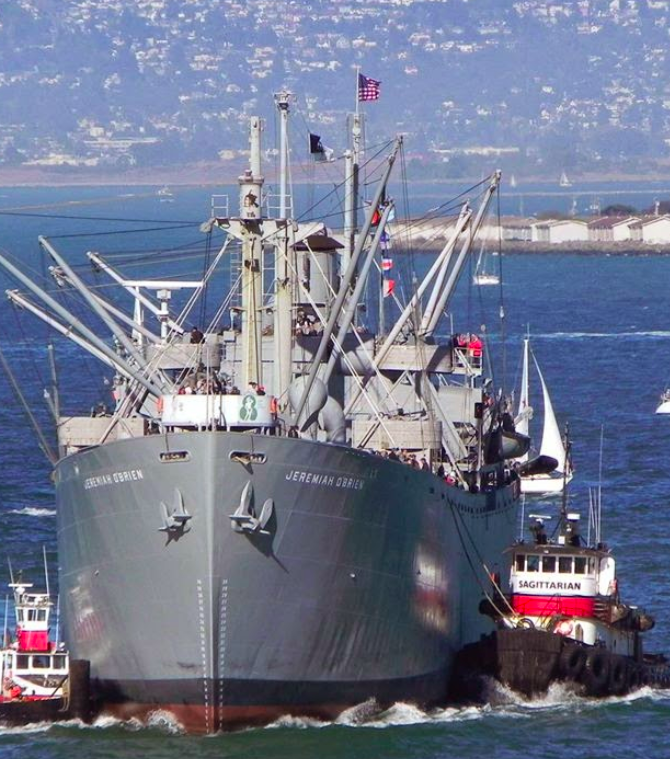
And the ship that brought Orville’s body home, the Barney Kirschbaum, named for an American merchant mariner killed in a 1943 U-boat attack, was a Liberty Ship, one of the miracles of the war, one of 2,710 such freighters launched from American shipyards during the war. Kirschbaum would’ve looked exactly like San Francisco’s Jeremiah O’Brien, tied up at Pier 45. (In 1994, O’Brien had the distinction of returning to the European Theater—to Normandy, no less—where she’d been part of D-Day fifty years before.)

The war dead intersect with my father’s life, as well. Once the war had ended, his duty shifted to training GI’s, nineteen-year-olds, some of them grads from Class of ’44. They’d come to Europe prepared the fight Germans, but the war was over, so Dad’s work, and theirs, was in Graves Registration. He trained these soldiers in the ghastly work of identifying the young Americans the war had claimed. Those young men—forever young— were then to be buried in one of a network of American military cemeteries. Many of those casualties, like Orville Tucker, would eventually come home.

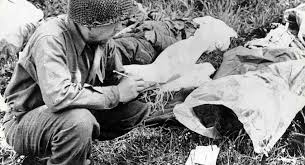
A Quartermaster, part of a Graves Registration unit, records the identities, soon after battle, of fallen soldiers.

One of the soldiers who came home after the war—in my family’s case to rural Missouri— was my father’s cousin, Roy.

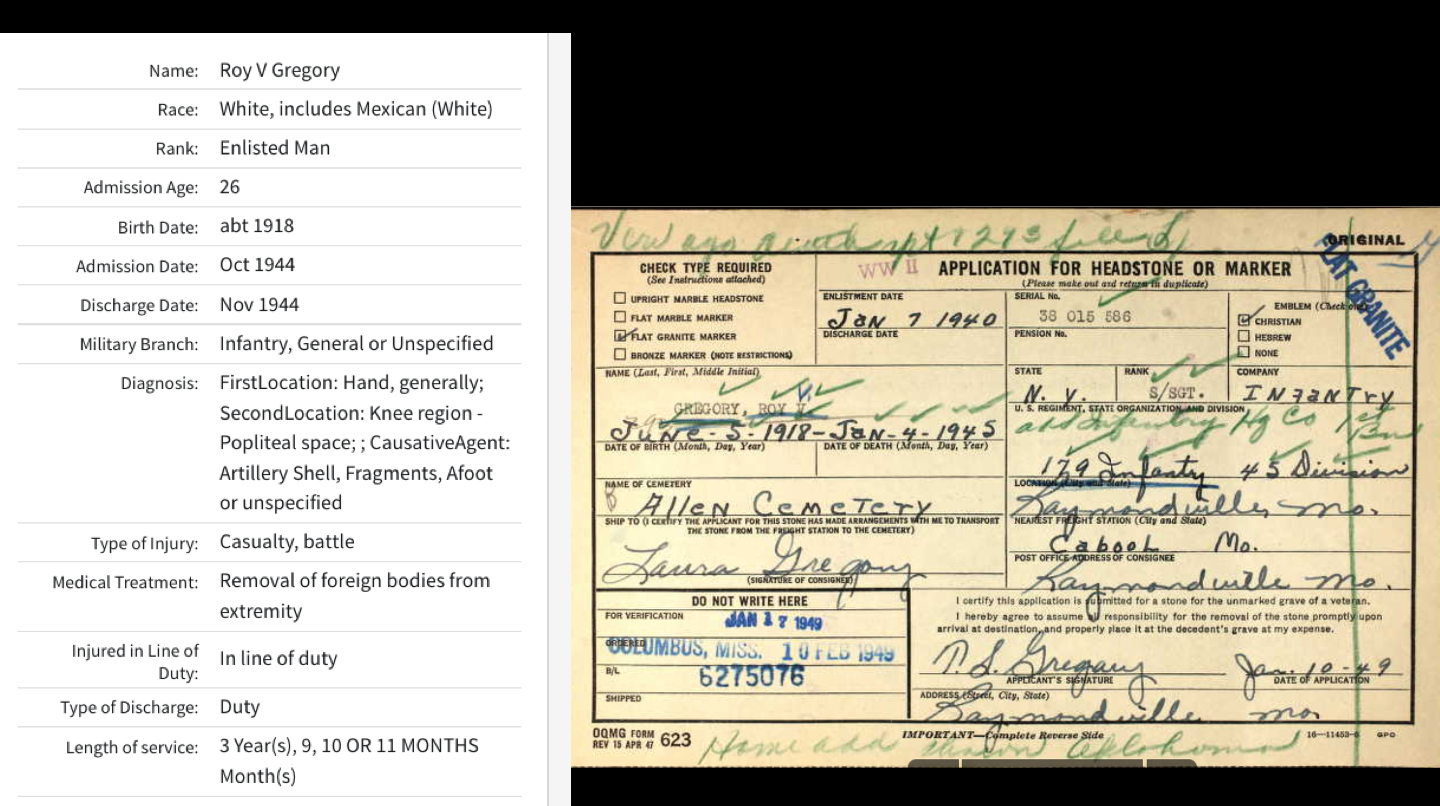
Roy was discharged from a field hospital, where he’d been treated for shrapnel wounds, in November 1944. He went back into action in Alsace, where, in January 1945, another elite SS unit essentially wiped out the headquarters company to which he was attached.

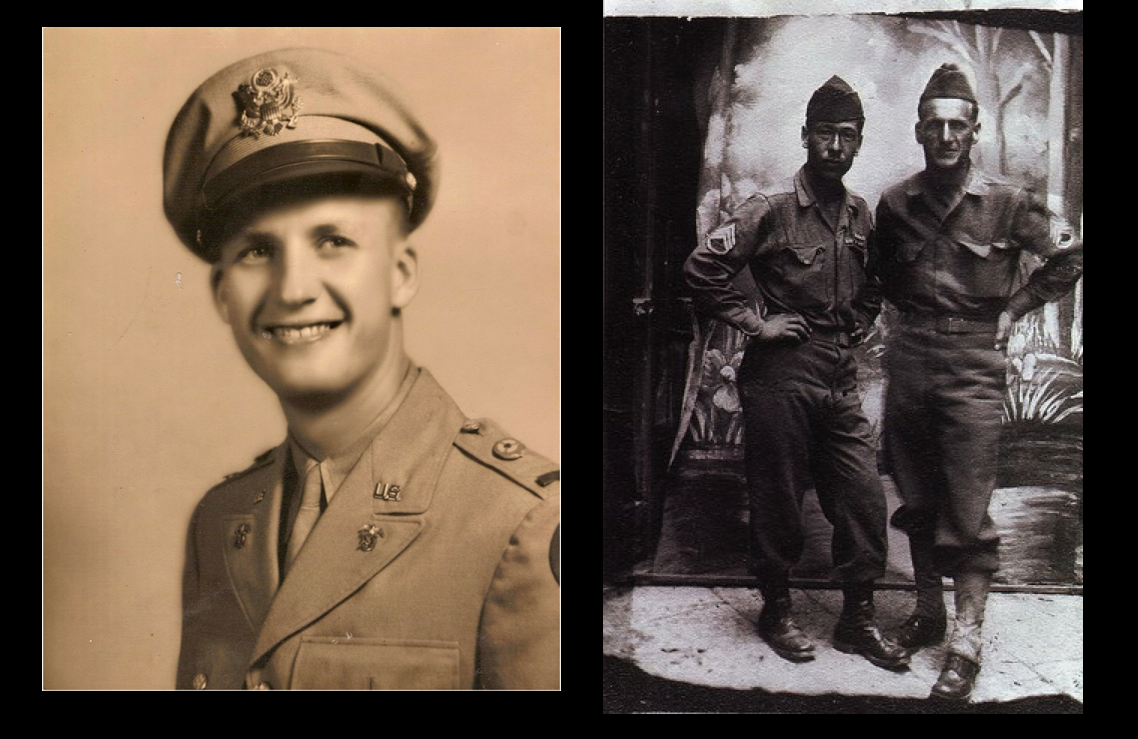
Roy—who’d fought with his buddy, Sgt. Chew, in Sicily, Italy, and finally France–looks remarkably like my Dad.

Sgt. Gregory’s hospital record; the family’s application for a military headstone. He is buried near my grandfather, John Smith Gregory.
My father as a lieutenant; Sgts. Chew and Gregory in a studio photograph taken in Italy.


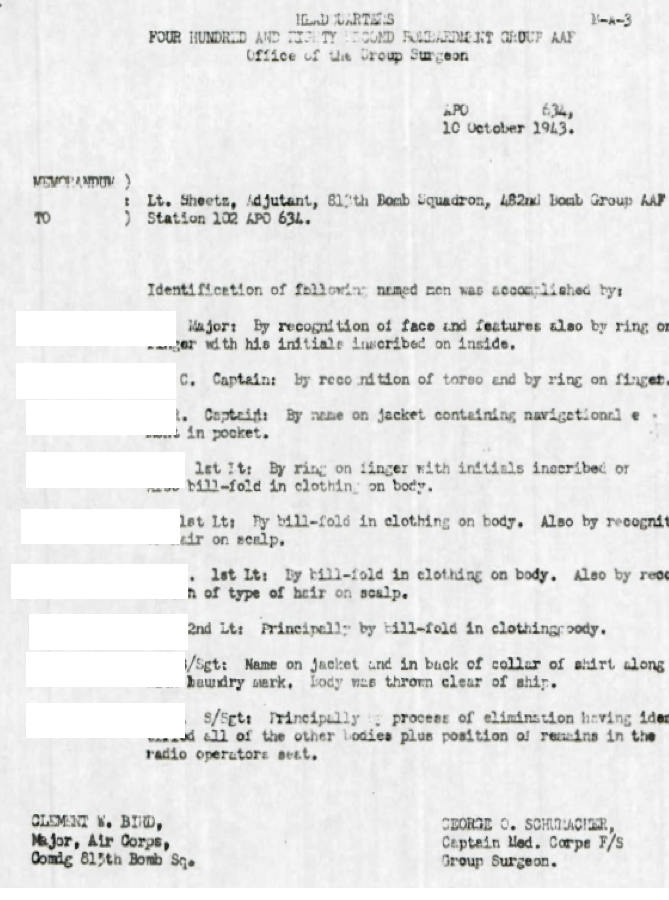
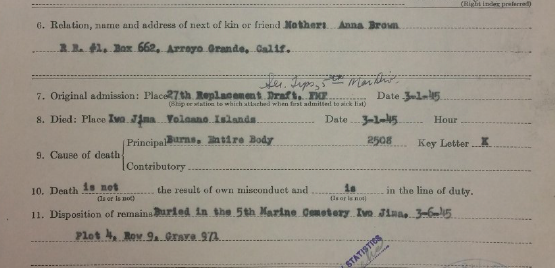
Graves registration work was ghastly, of course, because of the way these young men had died. Sometimes, in the Army Air Forces, when the flight surgeon of a bomb group had the duty of identifying the dead, the clues were circumstantial and almost always, as in the case of this Marine killed on Iwo Jima, the deaths were violent beyond imagination.

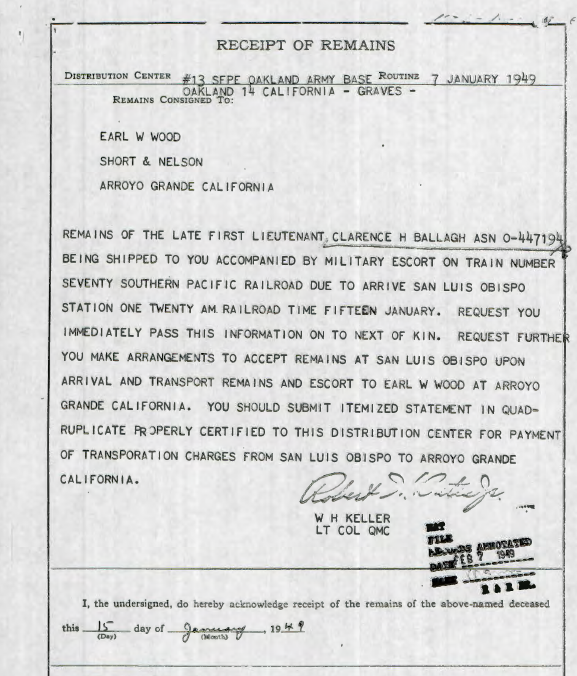
The dead recorded from this B-17 accident in northern England include Clarence “Hank” Ballagh, a young man whose ancestors came to Arroyo Grande in a covered wagon. He was the AGUHS valedictorian in 1938 and graduated from Cal with an engineering degree.
This young Marine, Louis Brown, was a farmer’s son from Corbett Canyon.

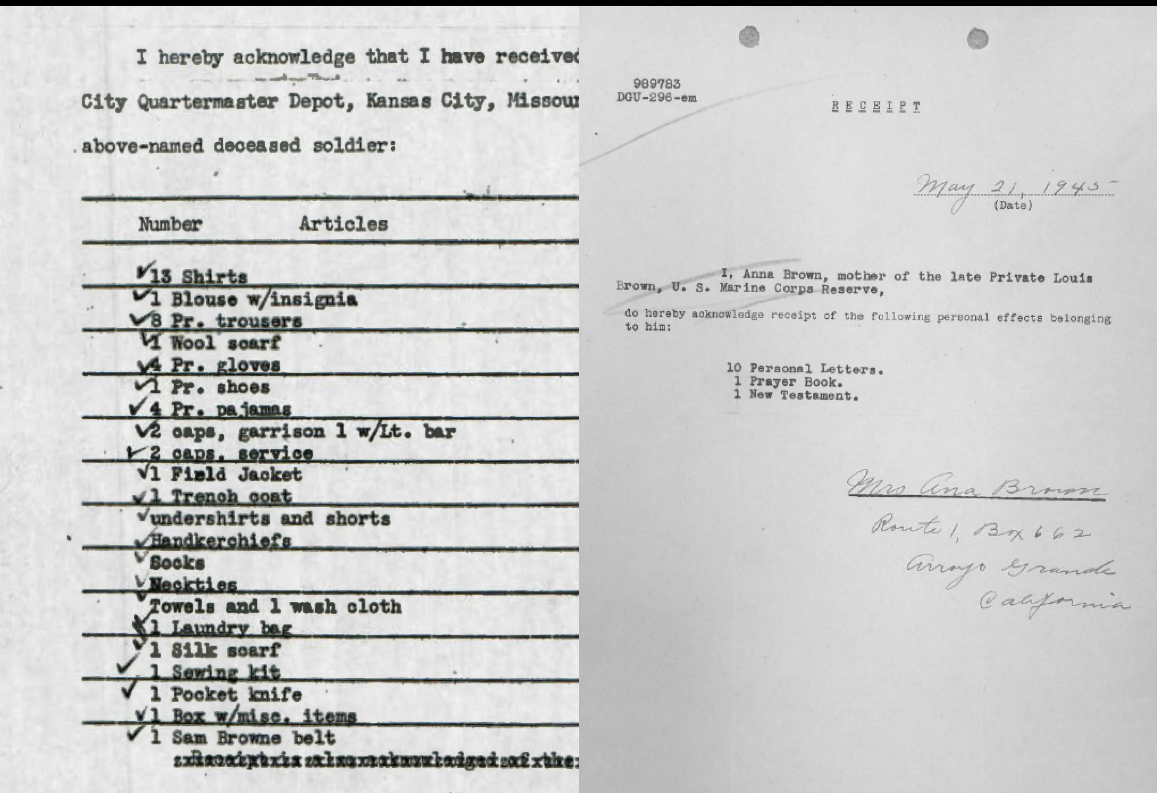
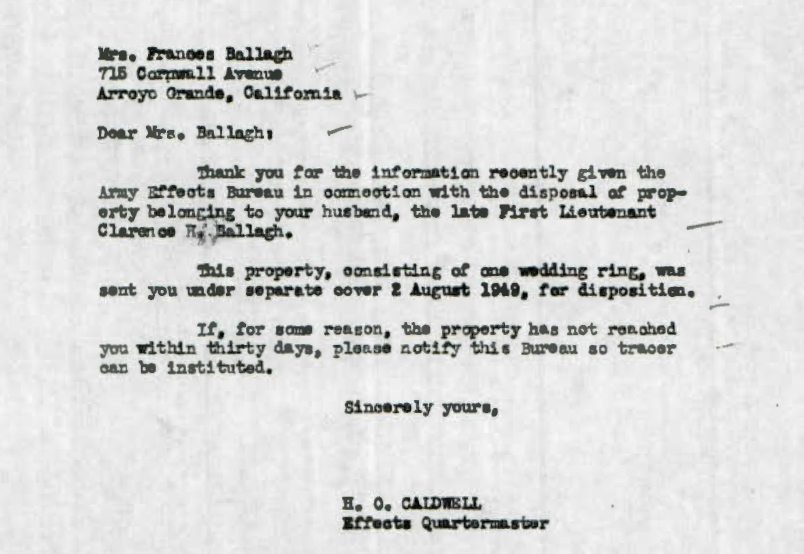
The Quartermasters also took charge of cataloguing a fallen man’s personal effects, and these reveal—with the possible exception of the Army Air Forces, where the sharp lines of rank blurred among bomber crews—that there remained a vast social gap between officers and enlisted men. These are the personal effects of Lt. Ballagh, the Berkeley grad, and Private Brown, who, like 64% of Americans in 1940, hadn’t finished high school:

Brown’s Rosary is listed in a separate Navy Department letter to his mother.

Ballagh was killed when his plane flew into the side of an English mountain; fragments of the B-17 remain there today. Brown was killed, most likely by a Japanese land mine, no more than 48 hours after he went into action on Iwo Jima. Both came home to Arroyo Grande, in a bureaucratic ballet in quadruplicate steps, that was unmistakably human. There’s no mistake that the Army wants Lt. Ballagh, even in death, to come home safely.

The records of the dead, I think, are important: they force us to confront a war now safely confined to history books and television screens. Beyond that, they reveal the terrible price that the living had to pay, as well.


A Place in County Clare

10 Thursday Jun 2021

Posted by ag1970 in Arroyo Grande, History, Personal memoirs, Teaching, Uncategorized

≈ 2 Comments


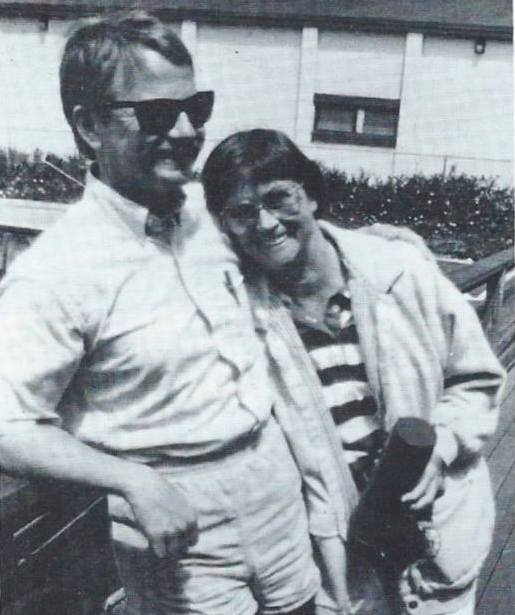
Our dear friend Sister Teresa O’Connell died in May at 90. She taught at St. Patrick’s in Arroyo Grande and Elizabeth and I taught with her at Mission in the 1980s and 1990s. Here’s the two of us back then:

As a member of the Sisters of Mercy, Teresa spent most of her life teaching young people. But when she returned to Ireland, she found a new calling in ministry to the elderly. Hers was such a rich life.

Elizabeth and I “attended” her funeral at the Ennis Cathedral–it was four a.m. our time–thanks to the internet. It was a six-priest funeral Mass with a couple of Monsignors included. Behind the altar, It was like the Irish Catholic equivalent of the 1927 New York Yankees.

It was the least they could do for her.


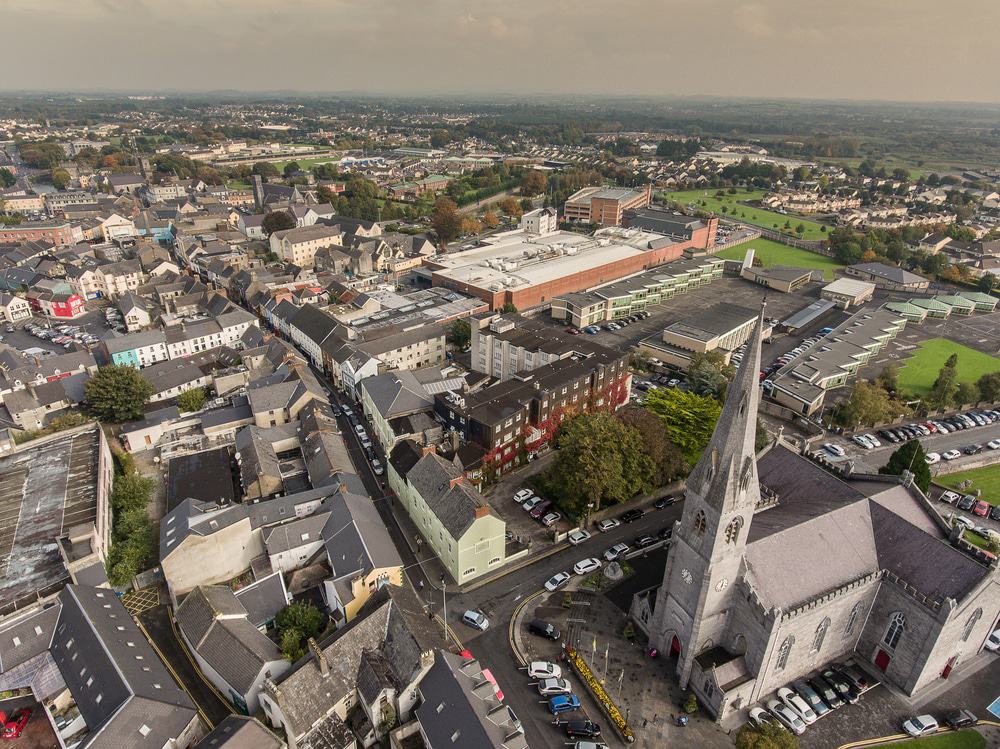
Here are two views of the church.

I made the mistake of starting to do some research on Ennis, because in thinking of Irish history as a road, every few miles you are confronted with a sad detour. The cathedral was built in 1828, which in itself is significant, because the Penal Laws enacted at the end of the 17th Century–that would’ve been when Great Britain, after the insolent Popery of King James II, was once again securely and relentlessly Protestant under William and Mary–forbade the building of new Catholic churches in Irish cities. The ban, then, lasted until the English were long past the Stuarts and running toward the end of their Hanoverians.


I looked up the cemetery where Sister is buried. It’s Drumcliff, Ennis, County Clare. It’s rich in Irish history, too.


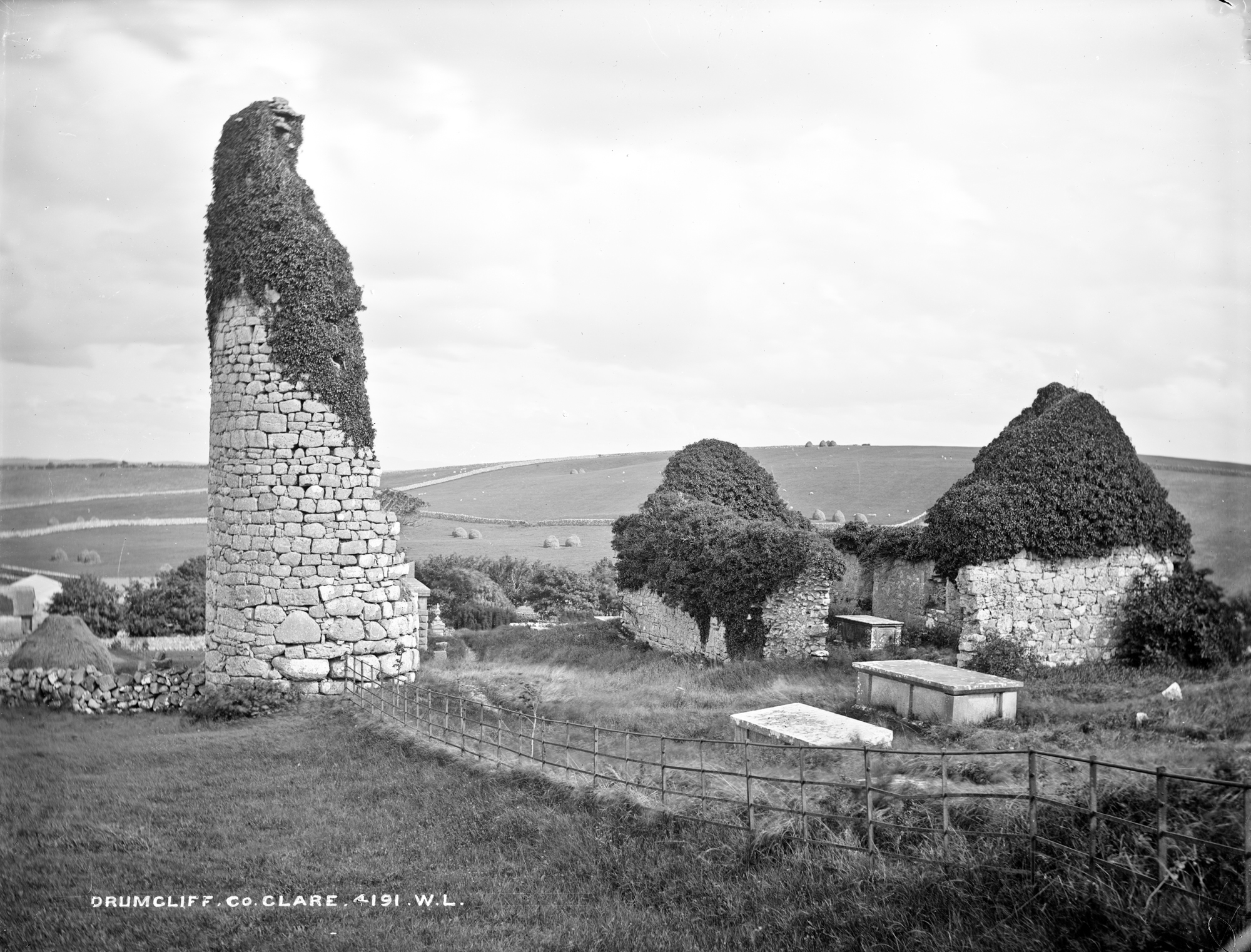
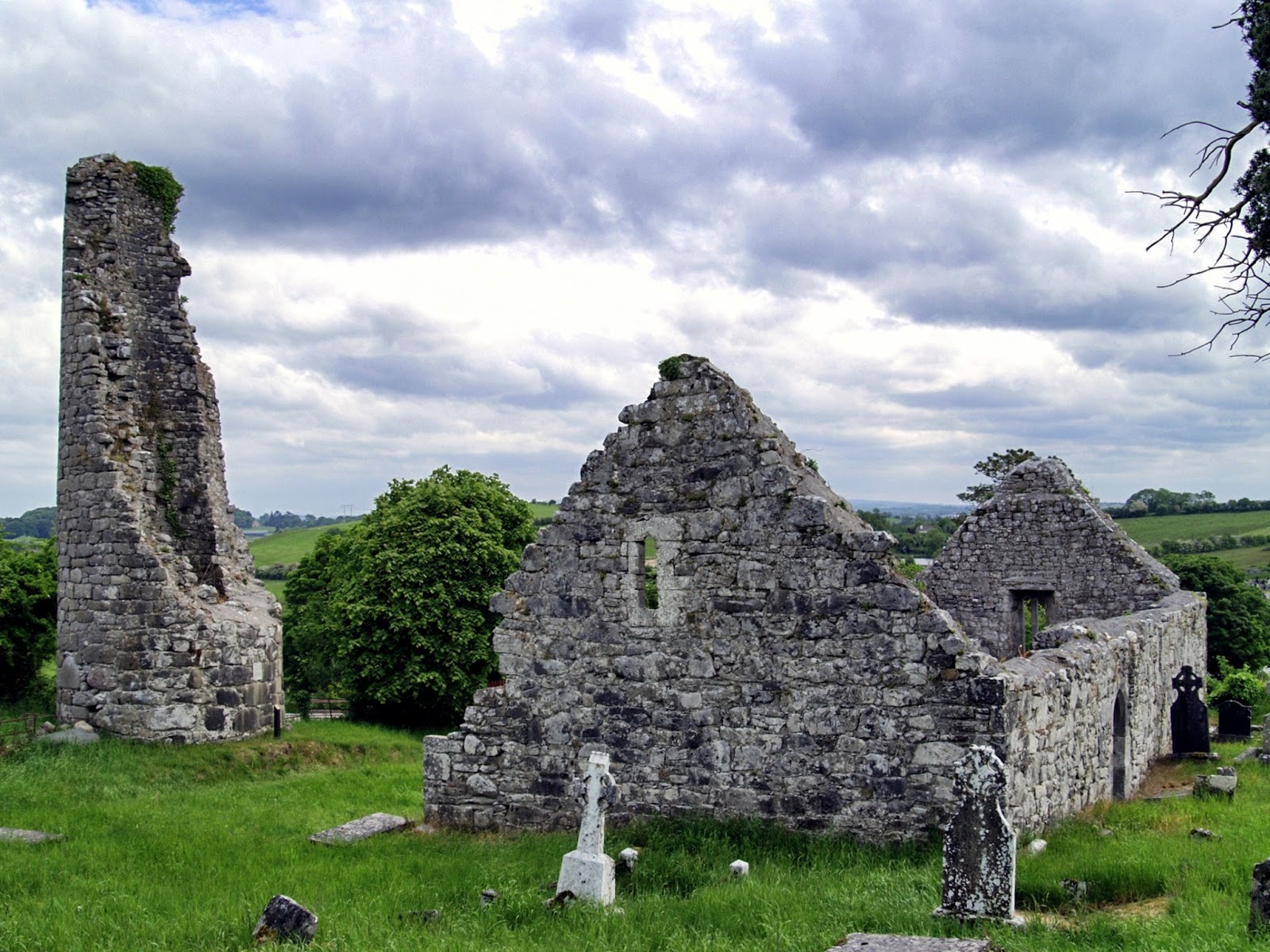
This photo shows the tower and ruined abbey church at Drumcliff. The cemetery adjoins the ruins, on a steep hill that one guide says is windy but strangely serene. Another guide says this: “The existing church ruins are from the 15th century with bits of 10th and 12th century architecture incorporated into it, suggesting it was built on the site of at least one earlier church.”

The earlier church may have been founded by St. Conall. He lived in the 7th century.

When you grow up in a place whose oldest landmark dates to 1772, your history is an eyeblink next to Ireland’s.


The cemetery itself represents one of those sad detours in that history. From a County Clare genealogical website:

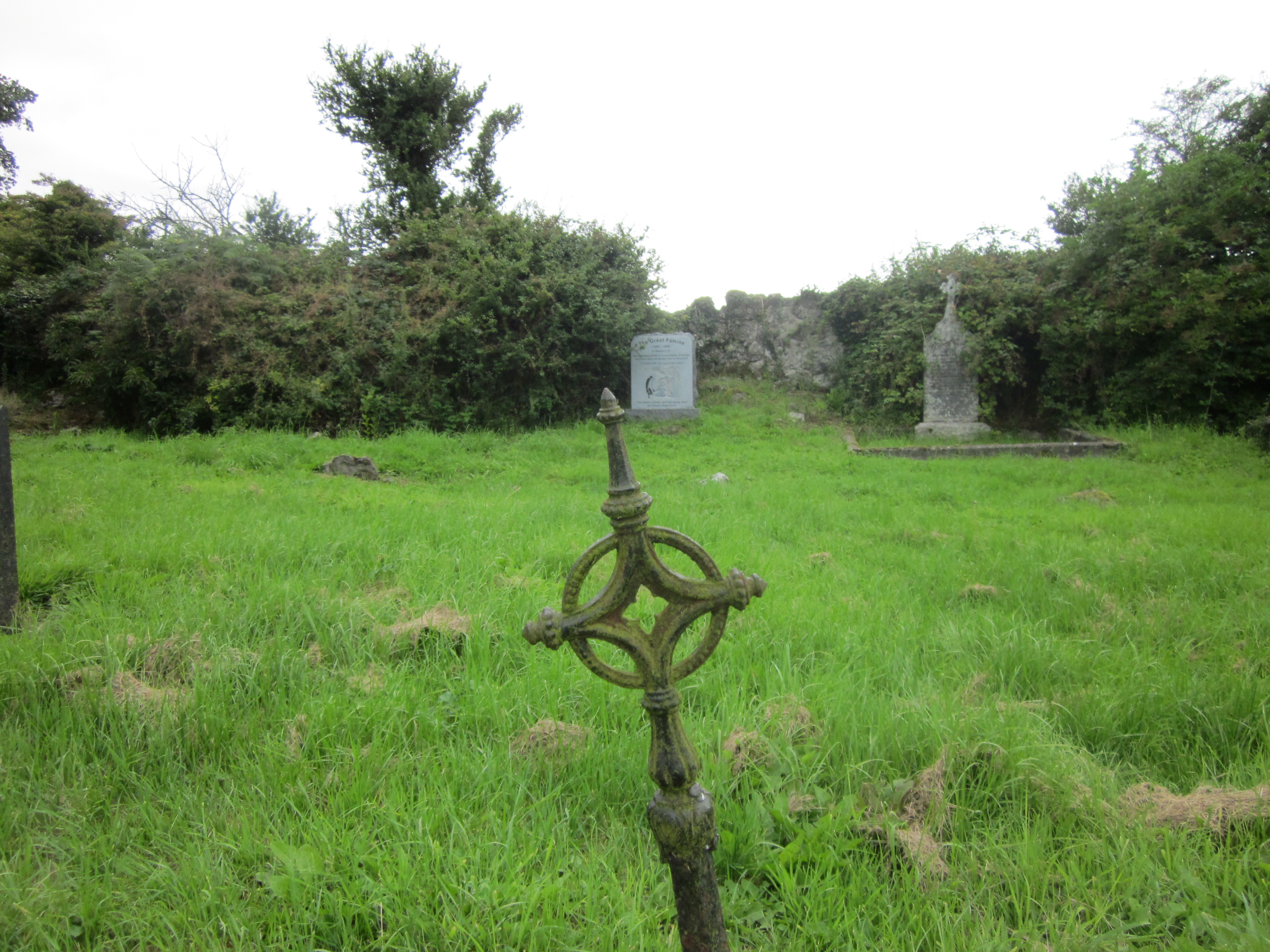
It is impossible even to guess how many persons are buried at Drumcliffe [sic]: so many graves were never marked at all, countless others have no inscriptions, and the multitudes who lie in the cholera grave, the Famine grave pit beside it and the pauper plot closer to the road, will never be identified by the names they bore in life.

Cholera was a terrible killer in the first half of the nineteenth century; it killed Londoners in their thousands, as well as the Irish, until Joseph Bazalgette designed and built a network of intercepting sewers that carried the Thames River’s sewage out to sea.

Ireland, of course, was far behind in engineering projects as grand as this one.

“The Famine grave pit” is mentioned in passing. Perhaps many of those people were on their way out of Ireland. We once saw a massive green in Galway, one of the Famine ports of exit, also in the west, beneath which thousands of destitute Famine victims are buried. They’d almost made it. It’s probable that the people buried in Drumcliff, like those in Galway, died, enfeebled by starvation, of opportunistic diseases like typhus.

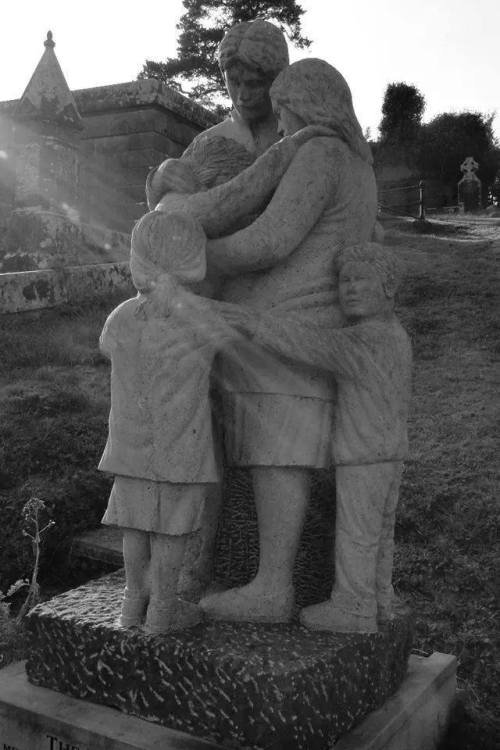
At least the paupers are symbolically remembered. Many of them ended their lives in a nearby workhouse. Here is their monument:

Pauper’s Memorial, Drumcliff


The Famine Grave


It’s a windy but strangely serene place.


And then you reach the 20th century. There are Great War soldiers buried here: over 200,000 Irishmen fought for the British between 1914 and 1918. Drummer John McMahon served in the King’s Own’s Scottish Borderers, in a battalion that had survived Gallipoli; it’s possible that his death, in July 1917, came in Palestine. Thomas Moody served in the Irish Guards; his death, in November 1917, must’ve been at the Battle of Cambrai, which, like Bazalgette’s intercepting sewers, began as a landmark for modern technology. The British launched a massive attack spearheaded by Mark IV tanks, an innovation in warfare. By the second day of the attack, half the tanks had broken down, and that’s when the Germans responded. Moody probably died in their counterattack, the biggest assault on the British Expeditionary Forces since 1914. It was in that ealier assault–the the First Marne, in September 1914, the battle that stopped the Germans short of Paris, when Parisian taxicabs carried poilus to the front in relays–that claimed artilleryman Michael O’Brien, another soldier buried in Drumcliff.

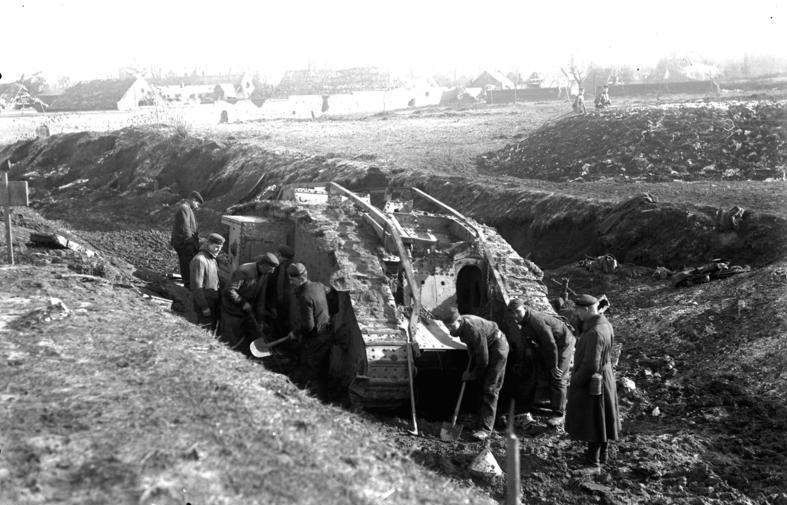
German soldiers inspect a British tank wrecked at Cambrai.


Of course, the Great War was punctuated by the Easter Rising in Dublin. You can still the gouges British bullets left in the columns of the Neoclassic General Post Office, where the rebels held out for six days during Easter Week 1916. The Dubliners jeered the Irish Republican Army rebels as they were led away, after their surrender, by British forces.

The General Post Office, O’Connell Street, Dublin, after the Easter Rising. Nelson’s Column, to the right, was later blown up by the IRA.


Then the British began executing them, granting one, terribly wounded, the privilege of being shot while seated in a chair. That was a mistake. Now they were martyrs.

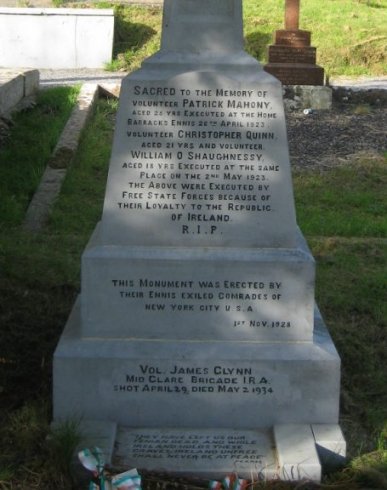
And that leads to one more place in the Drumcliff Cemetery: An IRA Memorial.


Irish rebels memorial

Maybe it’s typical that this memorial was made possible by expatriates, Irish living comfortably and happily distant in New York. What it commemorates might be too painful to remember for the people who live in Ennis today. The four Irish Republican Army men cited on this monument were killed in The Troubles, but not by the English. Three of the four were shot by firing squads made up of fellow Irishmen during the Civil War of 1922. Two were eighteen years old. They were Republicans executed by soldiers of the Irish Free State, the government that shot three times as many Irish revolutionaries in 1922 as the English had during the rising of 1919-1921.

One of the eighteen-year-olds wrote this on the eve of his execution:

Home Barracks, Ennis

Dearest Father,

My last letter to you; I know it is hard, but welcome be the will of God. I am to be executed in the morning, but I hope you will try and bear it. Tell Katie not to be fretting for me as it was all for Ireland; it is rough on my brothers and sisters–poor Jim, John, Joe, Paddy, Michael, Cissie, Mary Margaret–hope you will mind them and try to put them in good positions. Tell them to pray for me. Well father, I am taking it great, as better men than ever I was fell. You have a son that you can be proud of, as I think I have done my part for the land I love. Tell all the neighbours in the Turnpike to pray for me. Tell Nanna, Mary and Jimmy to pray for me, Joe, Sean, Mago, Julia, Mrs. Considine and family, also Joe McCormack, the Browne family, my uncle Jim and the Tipperary people which I knew. I hope you will mind yourself, and do not fret for me. With the help of God I will be happy with my mother in Heaven, and away from all the trouble of this world, so I think I will be happy...

…Dear father, I will now say goodbye – goodbye ‘till we meet in heaven.

I remain,
Your loving son,
Christ
ie

County Clare is famous for goodbyes. The Cliffs of Moher (above) might have been the last many Famine emigrants to America saw of Ireland. A windy and wild place, they are remindful of the title Leon Uris chose for a book he and his wife Jill wrote about Ireland: “A Terrible Beauty.”


Sister Teresa, even in her rest, cannot escape the long road of Irish history that has carried so many travelers—including my own family—on the journeys of their lives. Hers ended in Clare, a place, like the rest of Ireland, so marked by sadness. But sadness is not a dominant Irish trait—the last thing the Irish lost during the Famine, one chronicler noted, was their sense of humor—and it was service to others, not sadness, that dominated Teresa’s life.

I’ve been to Ireland and don’t know that I’ll ever get the chance to go again. If I do, God willing, there’s a place in the Drumcliff Cemetery that needs beautiful flowers and a pinch of California topsoil, perhaps from a field that adjoins St. Patrick’s Church, a parish five thousand miles away from County Clare.

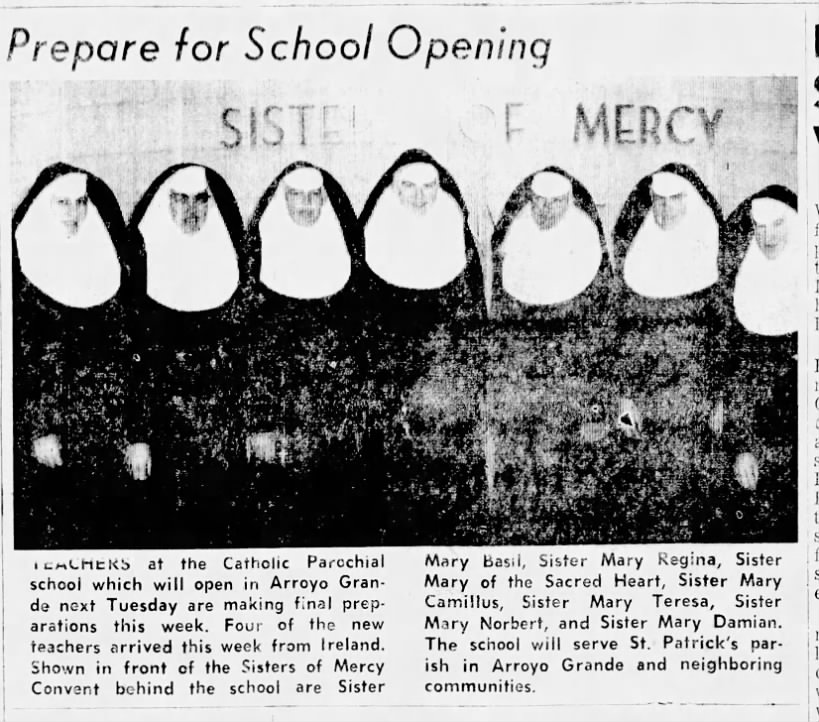
September 1963: Off the airplane and into the classroom. Teresa is third from right.

“1917:” Why confronting World War I is still important

15 Sunday Dec 2019

Posted by ag1970 in Film and Popular Culture, History, Teaching

≈ Leave a comment

MV5BOTdmNTFjNDEtNzg0My00ZjkxLTg1ZDAtZTdkMDc2ZmFiNWQ1XkEyXkFqcGdeQXVyNTAzNzgwNTg@._V1_

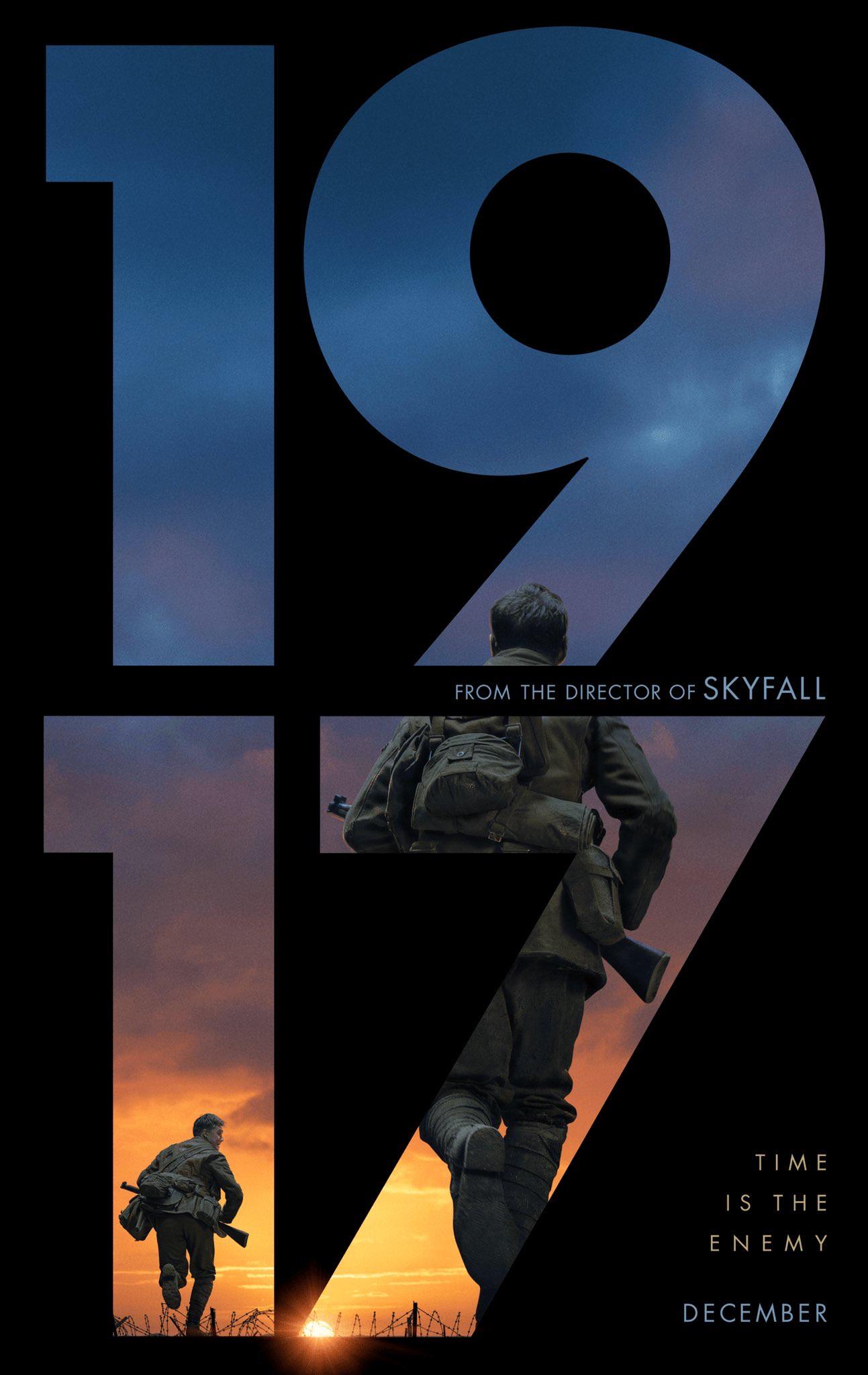
Sam Mendes, a director whose credits include spectacular Bond films, is about to release TolkienUniformsomething different: 1917. 
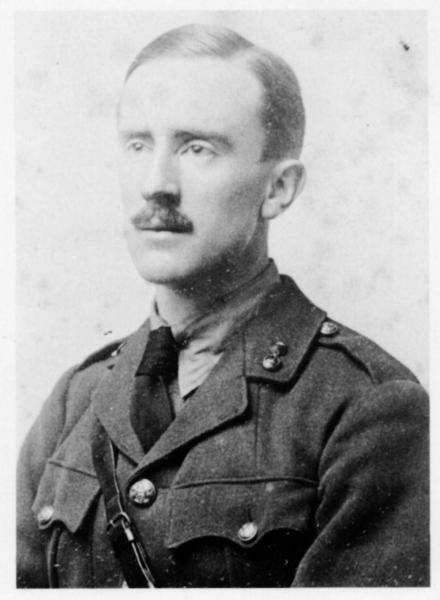
It was a JRR Tolkein’s (right) experiences in the trenchland of northern France that would lead to The Lord of the Rings in the attempt, I think, to confront the demonic forces that surrounded him when he was twenty-four years old.

Erich Maria Remarque’s All Quiet on the Western Front was the same kind of response. Writers like these two—and like Siegfried Sassoon, Robert Graves and Wilfred Owen—showed us how quickly and completely centuries of civilization could unravel.

The advance word is positive and I hope the critics are right. Gettysburg, based on a far worthier novel, The Killer Angels, lasted longer than the battle itself and I was rooting against both sides by the end; Midway made me care not a damn about human beings. Private Ryan, on the other hand, did.

So I am hopeful for this film.

1917 (2019)

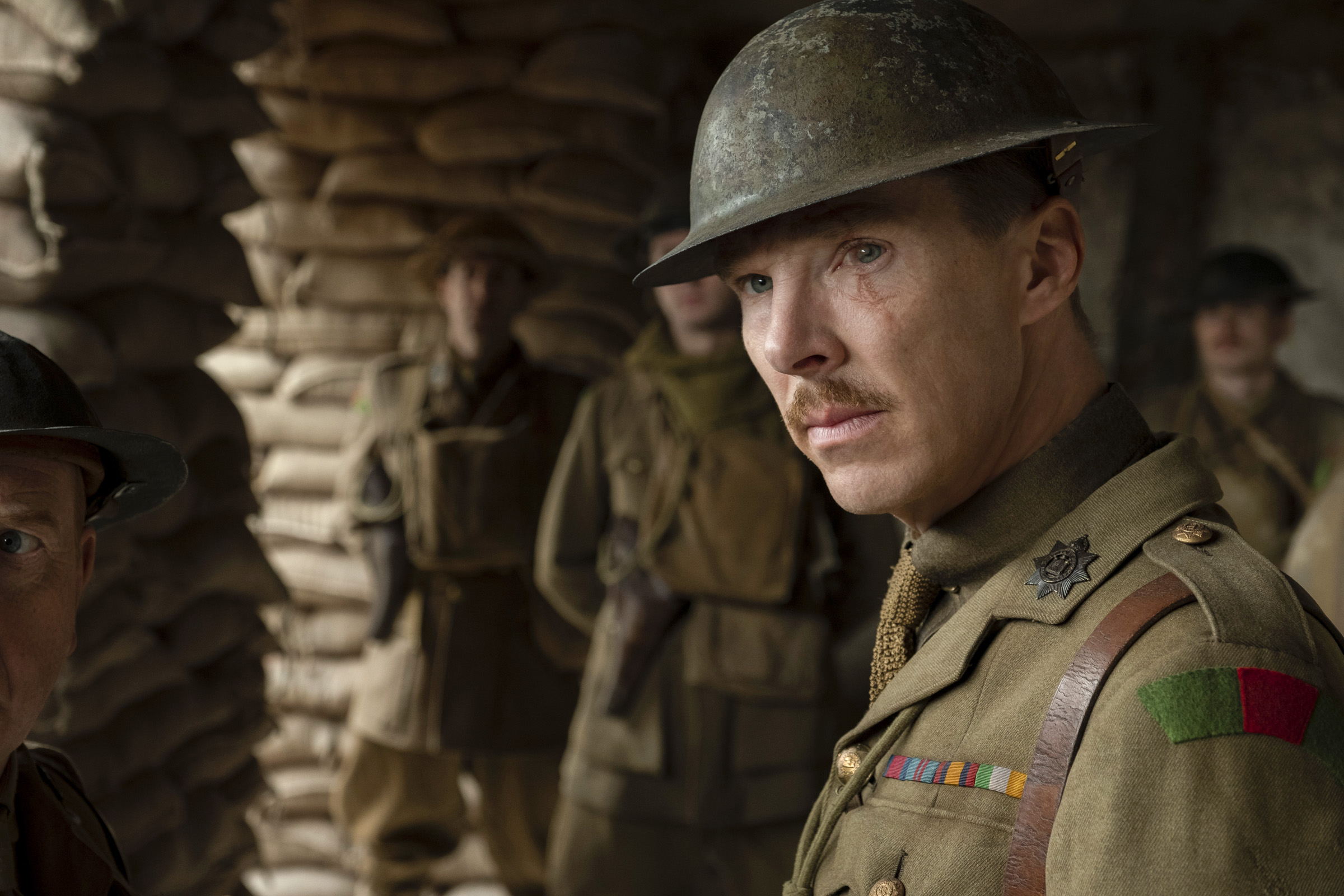
1917: Benedict Cumberbatch as Colonel Mackenzie

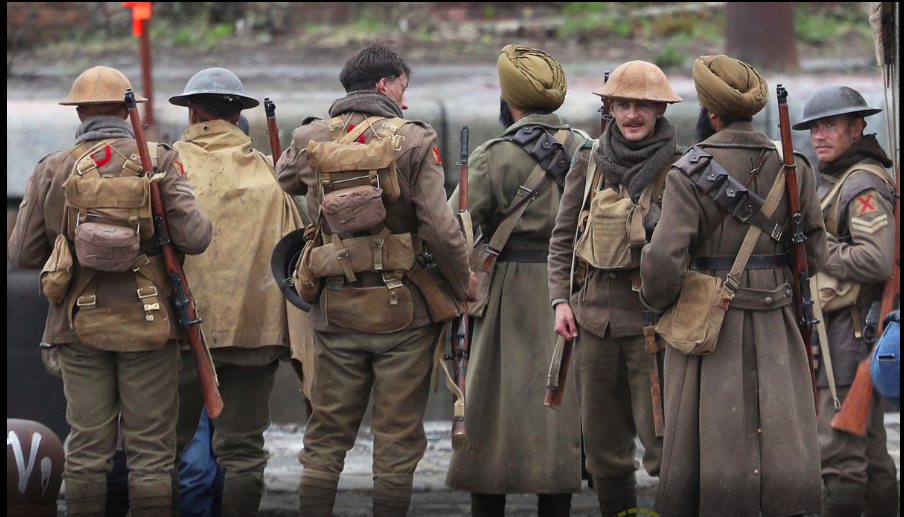
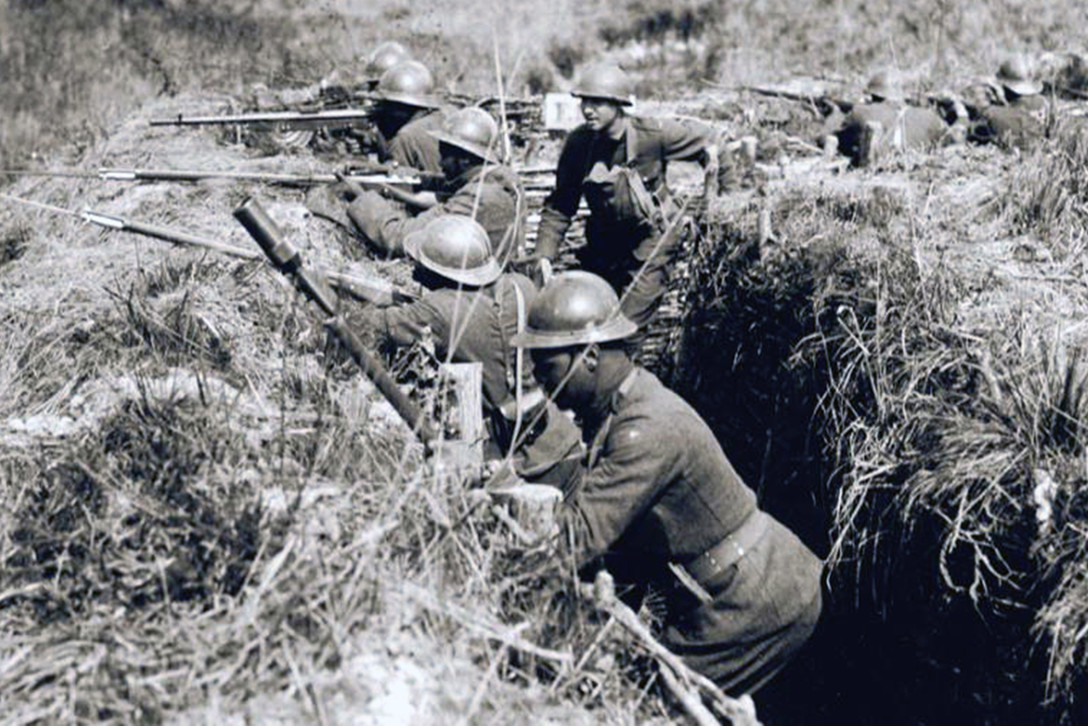
I wrote a a book about World War II which would have been impossible to write unless I’d had twenty years’ experience teaching World War I to European history students. It truly was a world war: The film still below shows actors portraying both Tommies and Sikhs fighting as comrades. Those are African-American troops from the 369th Infantry Regiment, but they’re wearing French helmets because the French begged for fighting men–we used African-Americans as manual laborers– and they responded by fighting like tigers. 170 members of this regiment received the Croix de Guerre.

Screen Shot 2019-12-14 at 5.47.58 PM

New York WWI Troops Fight to get into the Fight

Screen Shot 2019-12-14 at 6.47.53 PM

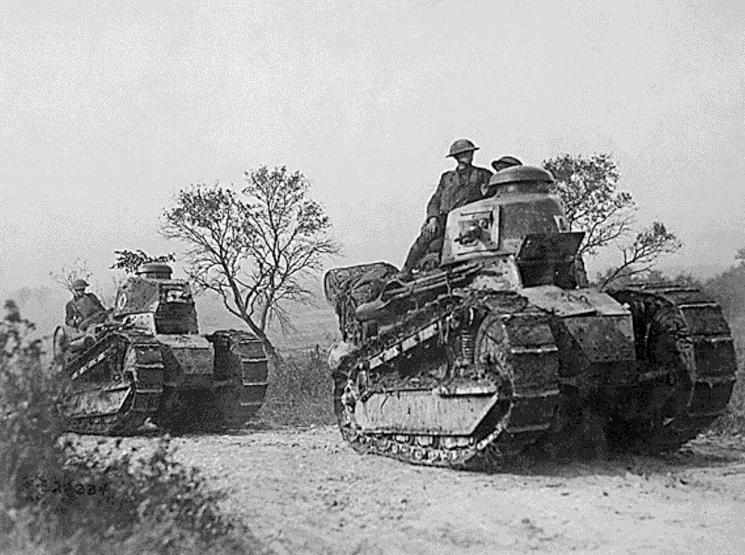
And these are American doughboys riding atop French Renault tanks; our Marines advanced on the machine gun nests in Belleau Wood carrying French Chaucat light machine guns. They fired from the hip, the Germans remembered, while smoking cigarettes. Our troops went into action in the Meuse-Argonne Offensive convoyed in French trucks driven by French colonials from a country that would someday be called Vietnam.

At the end of the year, my students and I decided that there had been no turning points in Western history quite like these three: Luther’s posting of the Ninety-Five Theses; the storming of the Bastille in 1789; the assassination of Franz Ferdinand and Sophie in 1914. The last event, which tumbled us into World War I within a month, hasn’t played itself out yet.

The Americans serving in Syria and Iraq are a product of this war and the ineptitude of the peace treaty never really ended it.

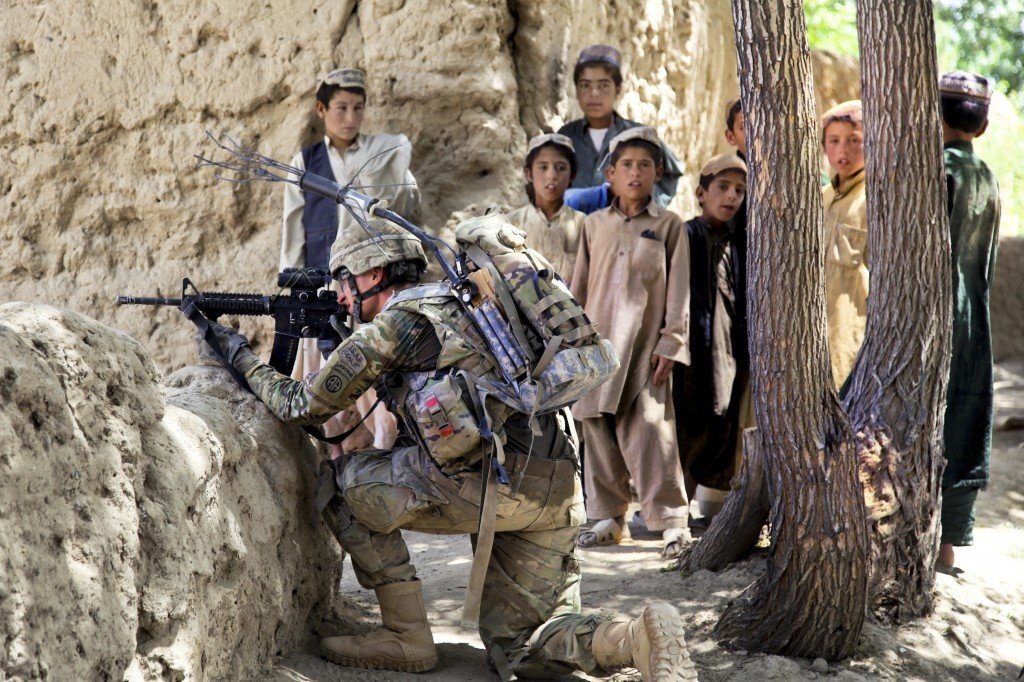
Afghanistan_children11_1024x68

I tried to explain, in this passage from the World War II book, why we need to confront World War I. I have the feeling that this film will take us there.

*  *  *

I taught history for thirty years, and I never, never ceased to get angry every spring when I taught the First World War. It was this war and its peace treaty that did so much to make World War II possible. In 2010, I took some of my students to Western Europe’s World War II battlefields but also to Verdun, site of a horrific 1916 battle that lasted over ten months. The stacked bones in the ossuary there once belonged to boys like my two sons, whose parents had applauded at their first steps or cheered when they scored their first football goal.

I made it my business to help all of my students understand that idea— that war cheats us all so cruelly—and so I led them, every year in my classroom, into dark places, like Fort Douaumont at Verdun, so dark that it swallowed the light of five hundred years of Western culture. To go inside Douaumont, where 100,000 young men were killed or wounded, to study war doesn’t mean we glorify it. A few years ago, a student told me the First World War was her favorite unit. (Not mine—I much prefer La Belle Èpoque) I asked her why, and she replied, “Now I understand how precious human life is.”

 She understood precisely why I became a history teacher.

 She would have understood, as well, how in the process of writing this book, something extraordinary has happened within my heart: the more I research these young men of my father’s generation, the inheritors of the legacy of places like Douaumont, the more they become my sons.

 Through no one’s fault, they’ve been mostly forgotten. This book seeks to name them and so reclaim them for a new generation. When we come to know these young men, we come to love them, and maybe that is the force that will carry us a small step farther along a path that will lead us to a world of peace. The great Jesuit theologian and anthropologist Pierre Teilhard de Chardin believed that we have a divine gift. We evolve physically and intellectually, but, he argued, we can evolve spiritually, as well. I believe Teilhard is exactly right. But I believe also that we cannot advance if we leave behind the boys and men I’ve met, the casualties of war. Their lives were, and are, precious, and if they could somehow save other young lives, I think they’d do it in an instant.

 A North Vietnamese soldier-poet wrote many years ago that “the bullet that kills a soldier passes first through his mother’s heart.” If the young men I now know could somehow spare other mothers the pain theirs went through, then I think they would do that in an instant, too.

 It is our responsibility to confront and understand the horrific violence that took their lives. The young men I now know who died in a Norman village like Le Bot or in the sky over the English Channel or deep in the waters of Ironbotttom Sound off Guadalcanal lit a path, in dying, for the living to follow. If we ignore them, we will lose the path, and the dark will have won after all.

Screen Shot 2019-12-14 at 8.14.52 PM

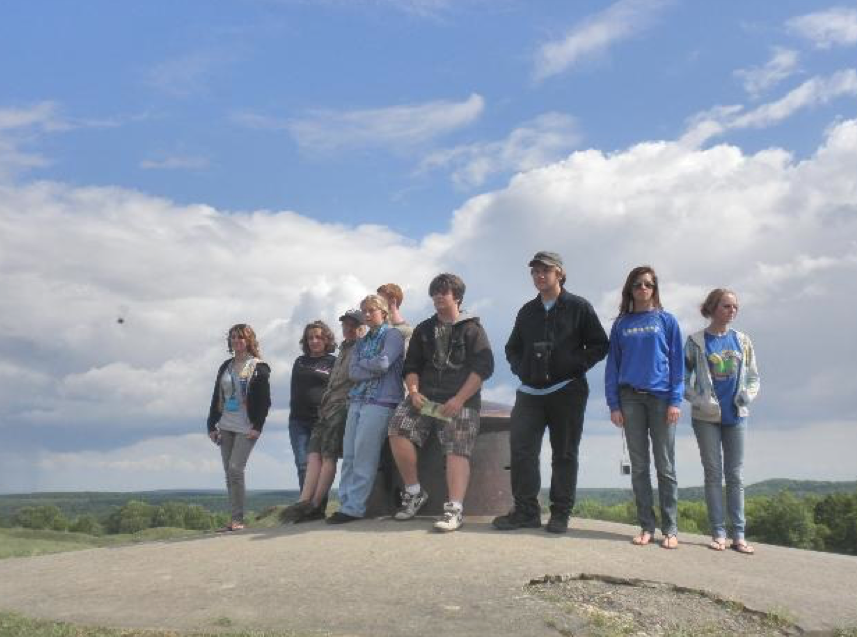
Arroyo Grande High School students at Fort Douaumont, 2010.


For Yoshi, who never came back

Featured

Posted by ag1970 in American History, Arroyo Grande, California history, History, Uncategorized, World War II

≈ 3 Comments

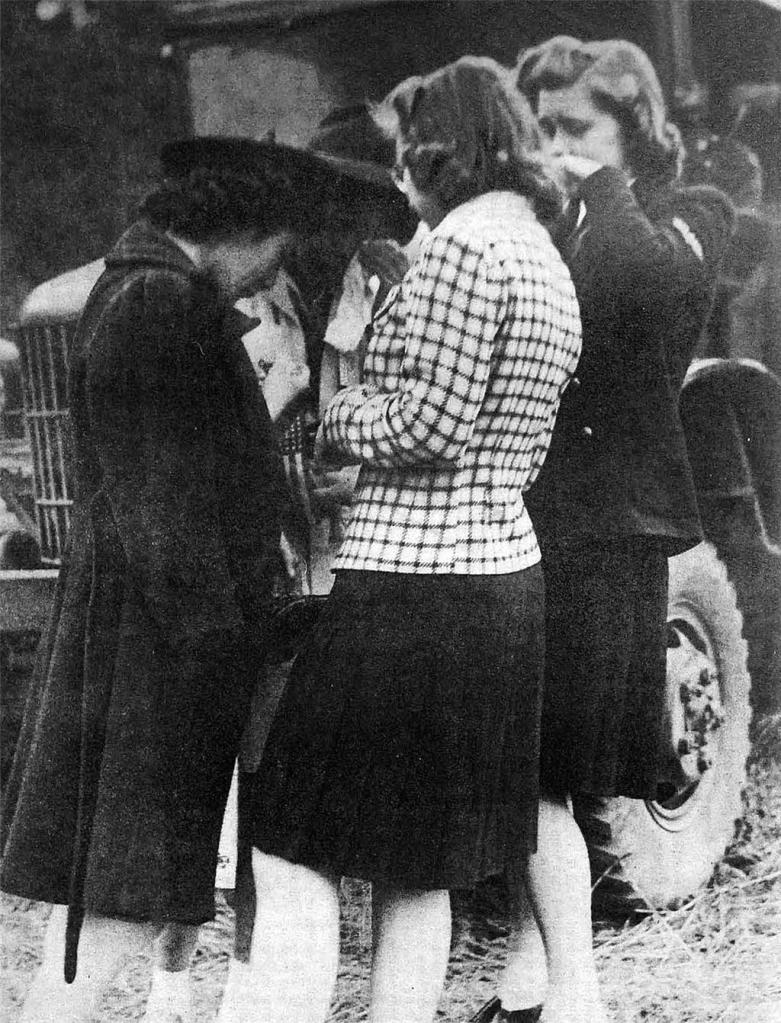
This photograph was taken on Bainbridge Island, Washington, on the day Executive Order 9066 was executed and these friends were separated.

There’s a good chance they never saw each other again.

When the buses came to take our Arroyo Grande, California, neighbors away on April 30, 1942, many of them—less than half—came back. I grew up here, and I don’t recognize many of the surnames in the old high school yearbooks.


One woman told me this: On the day the buses came to the high school parking lot, her mother saw a line of high-school girls, some Japanese, some not, walking up Crown Hill, walking up toward their high school, holding hands and sobbing.

Arroyo Grande’s Japanese-Americans went first to the Tulare County Fairgrounds, where they slept in livestock stalls, and then to the Rivers Camp in Arizona, where the temperature was at or above 109 degrees for twenty of their first thirty days there.

I interviewed a remarkable woman named Jean a few weeks ago. She is 94, is briskly intelligent, articulate and gracious. Her father owned the meat market on Branch Street in Arroyo Grande, population 1,090 in the 1940 census, and when his Japanese-American customers, farmers, came in to settle up before the buses came, he refused to take their money. “You keep it,” he told them. “You’re going to need it.”

When they came home three years later, he extended them easy credit until they could begin to bring in crops again. Jean showed me her father’s business ledgers, so I have no reason to doubt it when she told me that every one of those farmers paid her father back. In full.

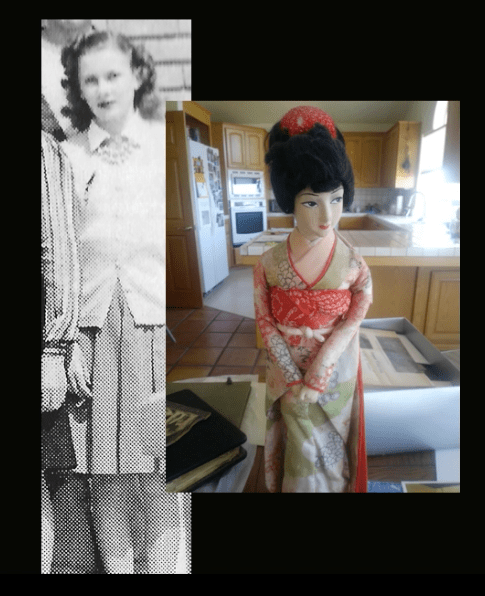
This is Jean as a high-school freshman. The doll, with her handmade kimono, came to Jean from Gila River in gratitude for her family’s friendship. For their loyalty.

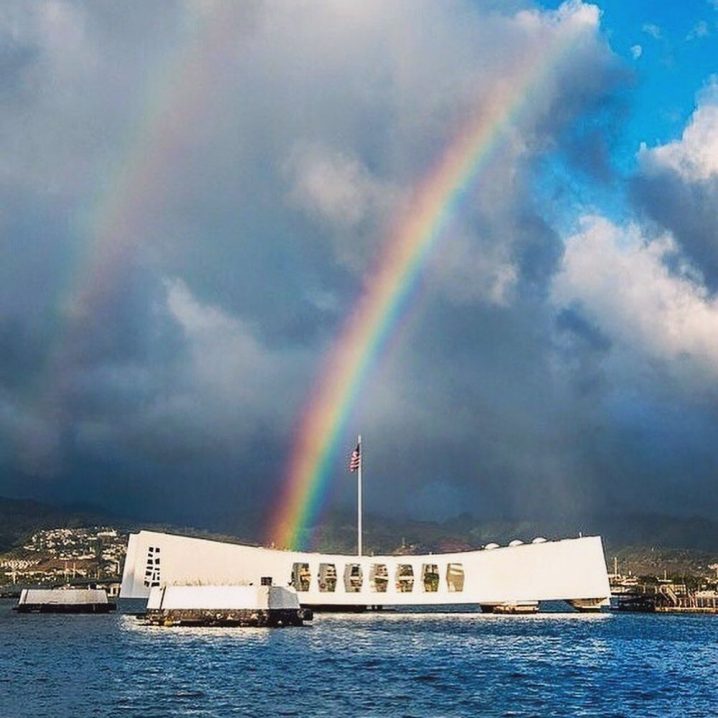
At ninety-four, that loyalty runs in Jean as deeply as it ever has. One of her best high-school friends was named Yoshi. I can find a photo of the two together in second grade. I found a photo, too, of two second-grade boys in the Arroyo Grande Grammar School in 1926. They would die, about twelve minutes apart, on USS Arizona.

Yoshi’s brother became a war hero. He won a battlefield promotion to lieutenant when he went behind Japanese lines in China to rescue a downed American flier.

Yoshi’s brother brought that flier in and made him safe. Jean never saw Yoshi again and, because of April 30, 1942, there is a part of her that can never feel safe.

The war, at its outset for America, killed two of our sailors. It would claim many more local young men, killing them in Ironbottom Sound off Guadalcanal and on the beach at Tarawa. It would kill a young paratrooper in Holland during Operation Market Garden. It would kill, with a sniper’s bullet, a tank-destoyer crewman on the German frontier three days before his first child, a son, was born.

The war killed neither Jean nor Yoshi. They remain its casualties, nonetheless.

We had to stop the interview for a moment. In remembering her friend, Jean was fighting hard to stop the tears. One escaped. That moment taught me so much history, and with such intensity, that I almost couldn’t bear it.

Classmates, Shipmates

Featured

Posted by ag1970 in American History, California history, History, Uncategorized, World War II

≈ Leave a comment

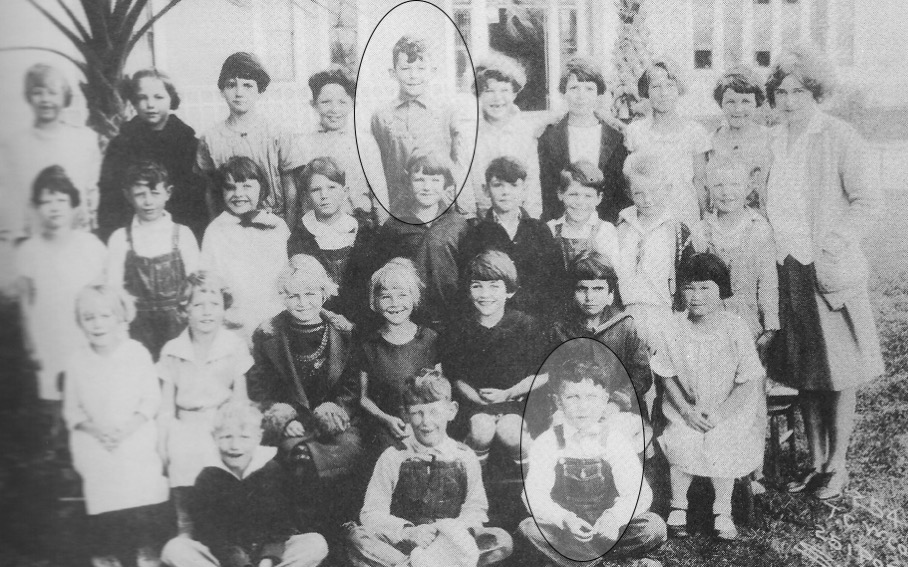
I was browsing an early 1980s version of Yesterday, Today and Tomorrow, the South County Historical Society journal, and I found this photograph of the Arroyo Grande Grammar School second grade in 1926-27.

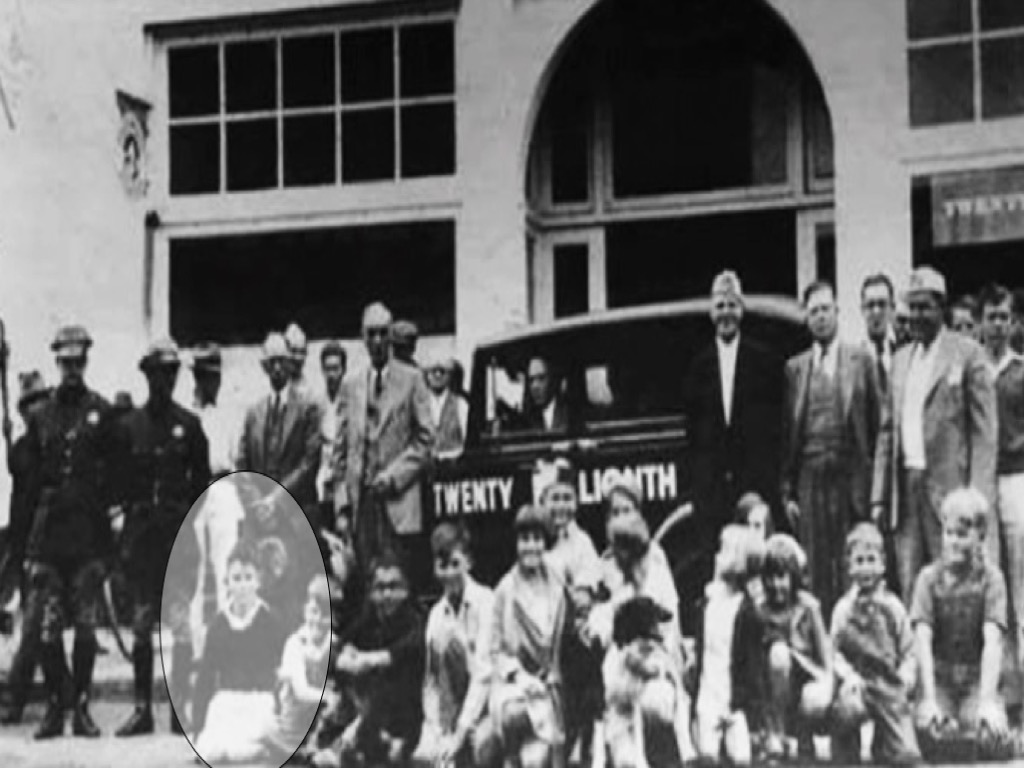
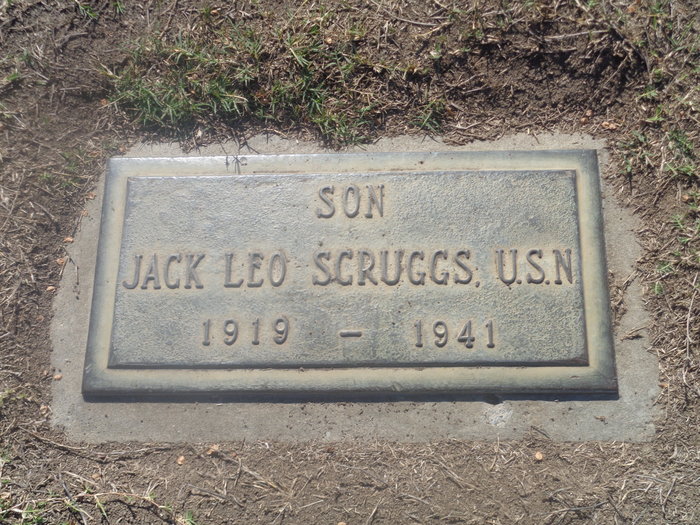
The two boys who are circled are Wayne Morgan (top) and, in the front row, Jack Scruggs. Wayne’s father, Elmer, was a partner-owner of the Ford agency, today’s Doc Burnstein’s Ice Cream Parlor. Jack’s father had lost his farm earlier in the 1920s; at the time the class photo was taken, he worked with an oil prospecting company exploring the Huasna Valley.

That’s Wayne in the front, in a photo taken during this Ford Model A’s nationwide tour in 1931 (the car, fully restored, is owned by a Michigan car collector).

Nine years later, Wayne would join the Navy.

By the time Wayne Morgan graduated from eighth grade, Jack Scruggs’s family had moved to Long Beach. Both boys were musicians–Wayne played violin in Mr. Chapek’s orchestra (he was also an avid Boy Scout), but Jack would make music his career.

In 1940, Jack joined the Navy.


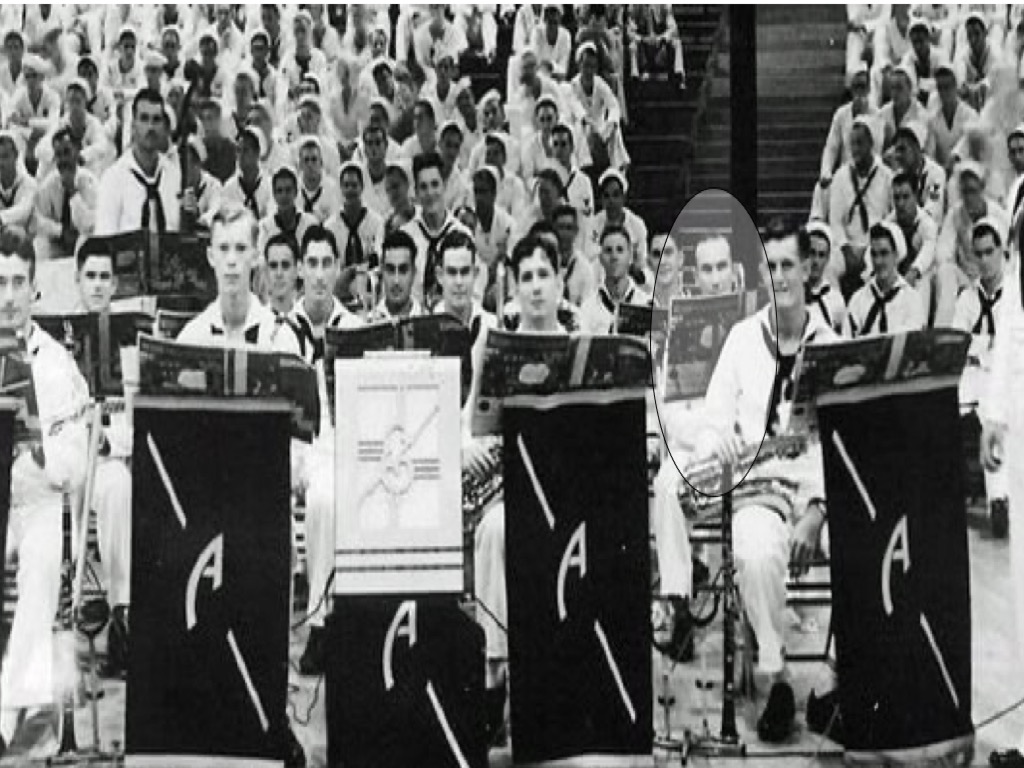
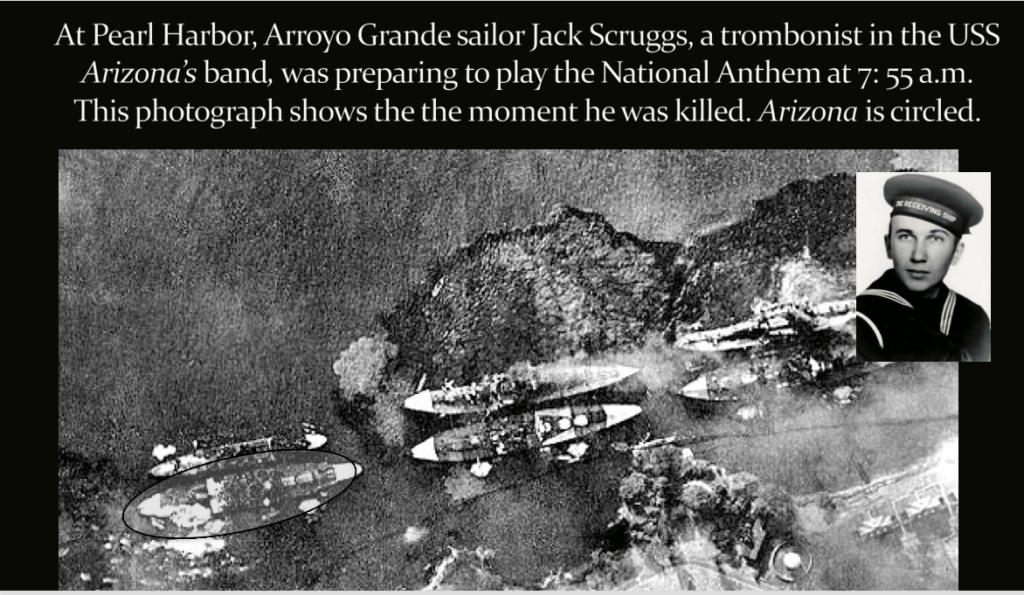
Jack is circled in this photo taken on November 22, 1941, during a Battle of the Bands competition among the ships of the Pacific Fleet. Jack was a trombonist in Navy Band 22–the band of USS Arizona.

So there’s a very good chance that the one-time classmates had a reunion on the great ship.

The tragic part of the story, of course, is that both were killed on Arizona. The concussion from a near-miss killed Jack just before 8 a.m. as the band was preparing to play the National Anthem during the colors ceremony. Wayne died about ten minutes later, when the ship blew up. So were all of Jack’s bandmates, killed at their action stations in the Number Two gun turret, just inboard from where the fatal bomb struck.

A few weeks before the attack, Jack had played “Happy Birthday” on the accordion for Rear Adm. Isaac Kidd’s wife–Kidd flew his flag on Arizona. All that was found of him after the attack was his Annapolis class ring, fused to a bulkhead.


Jack’s body was recovered; he came home to Long Beach. Wayne rests with his shipmates.

185086433_1510535707


I knew both were from Arroyo Grande, population 1,090 in 1940. I thought it extraordinary that two young men from such a small town wound up serving on the same ship. I had no idea that they were in the same grammar school class. 

Sometimes even the smallest footnotes in history tell compelling stories.


Not exactly “Nanny Dogs,” but…

12 Sunday May 2019

Posted by ag1970 in History, Uncategorized

≈ Leave a comment

1557674035972646492976
15576742080181470627974
1557674111007558841500
15576741541541791997489
1557674241641997484157
1557674069834277904576

Bear with me on this one. In AP European History, one phenomenon we studied was the mid-Victorian custom in middle-class homes of photographing dead children. What we got around to learning was that this macabre (to us) practice was actually a by-product of the Agricultural Revolution. Largely because of improved diet, more and more children were surviving to adulthood. In the 18th century and on the American frontier, both Mrs. J.S. Bach and Mrs. William G. Dana lost half of the twenty or more children they gave birth to.

Because of improved diet and improved health, by the mid 1800s children were surviving, even thriving. This meant that parental bonds between parent and child were growing stronger: you could afford to invest your love in something as precious as a child because you weren’t going to lose her. In fact, this is when the forerunners of the Dr. Spock books appeared and were almost guaranteed to be best-sellers.

So the photography of little boys and girls who had died was visible evidence of something very poignant: By the 1850s, parents loved their children so much that they didn’t want to let them go.

Which brings me to pit bulls.

While they weren’t exactly “Nanny Dogs”—it’s never wise to leave a child alone with any dog for too long—pits were the single most popular family dog in late Victorian and Edwardian England. Since parental bonds were by then far closer and more enduring, my guess is that you wouldn’t leave your child alone–or photograph her, for that matter–with a dog that’s considered vicious. I did read a study that claimed that, after Goldens, pits were the most patient breed who would endure the most pokes from children. And we did have a pit cross, Honey, who was one of the sweetest dogs we’ve ever owned. But she’s anecdotal.

Still, it again makes me wonder if the problem is less with dogs and more with humans. There are strains of the pit that have been bred to fight; the “toughening” of dogs like these, and the former quarterback Michael Vick is an example, involves inflicting pain on them. I’ve known people innocently walking their dogs who were attacked by a pit, and it’s a singularly terrifying experience. They are trying to kill your dog. Or you. Or both.

It’s not only terrifying, it’s disheartening. Some pits may have a killer instinct, but it’s a trait that’s been bred into a dog, or trained into a dog, by a human who has no heart. (Or, in the recent case involving a Belgian Malinois attacking and killing a local man, a wonderful man, a dog owned by a human who has no brain.)

It’s not my intent to argue for or against the breed here.

What I am trying to say is simply this: These photographs are fascinating.

But they may demonstrate that the traditional views we hold of dogs—or of other human beings—need to be subject to examination and reflection. I’m afraid that we are much more comfortable with tradition. It’s almost as if our prejudices have been bred, or trained, into us.

The Work that Teachers Do

10 Sunday Jan 2016

Posted by ag1970 in History, Personal memoirs, Teaching

≈ Leave a comment

Tags

education


12466239_10208324640457390_4987351987083300621_o


12548856_10208324641497416_6532004896748370571_n


10314542_10208324641737422_1985620031252979684_n


I re-read the manuscript of my little book, World War II Arroyo Grande, this morning, found it brilliant, and then remembered, because of a degenerative neck disk, that I was loopy on Norco, and “The Berenstain Bears Dig a Septic Tank” on Norco would have exactly the same impact on me as the first time I read From Here to Eternity or Cold Mountain.

Here’s the Magic part.

There are three books, out or about to be released, written by former students of mine. I take no credit for anything they write–except for their history essays–but I am every bit as happy for these books as I am for mine, and now that I know how hard the work in writing a book truly is I don’t even have the words for how proud I am of three young writers: Alex Bittner, Maeva Considine, and Evan Devereaux.

No work is more demanding and more lonely than the craft of writing. With one exception, and that is teaching.

What we do every day in the classroom isn’t work–for me, it was the greatest joy to teach young people like these in my years at Mission Prep and then in Lucia Mar. Nowhere was I more authentically myself than in a classroom, in the time I shared with teenagers.

For most of us, the “work” begins at three o’clock and ends in the dark. The weekends are just two more workdays: we write our weekly plans at our kids’ Babe Ruth games and we grade our essays at Cafe Andreini–seething a little at the guy at the next table burrowed deep inside the Sunday “Times” or the fiftysomethings in bicycle tights about to head up the Huasna. It’s galling to see leisure flaunted so shamelessly while we work in such anonymity.

It takes a toll. My serum cholesterol levels dropped 61 points in the five months after I retired.

We work hard, but the toll is exacted most in the extra work we are required by distant decision-makers to do–mandated in a fantasy world where we actually have the time to do it–and what we do for them is eventually written up in a barbaric language, Educationese. It’s work that almost always has no meaning and does almost nothing to make us better teachers, when wanting to be a better teacher is a constant hunger every good teacher feels. A good teacher would never force her students to do this kind of work because she respects children.

And the work we amass really is meaningless, because within three years it’s all thrown away. A new model rolls into Education–NCLB, OBE, Integrated Teams, The Common Core–so a new paradigm shift sweeps us away and we start a new round of what is most accurately called “busywork.” We feel a little like Rose Parade princesses, with fixed smiles that make even a princess’s jaw ache and endless Rose Princess waves that will eventually numb her arm. We’re like prisoners on a pedagogical Rose Float whose petals will turn brown as quickly as the last one’s did.

And we are told, every time, that we should not fear change. This is insanity, of course, not “change,” what we do to teachers. It’s the kind of busywork that crushes the second-greatest gift a classroom teacher has: her idealism.

Her greatest gift, of course, is the roomful of children entrusted to her, the complex and precious aggregate of human beings she has to face every Monday morning.

I hated Monday first period. I am an introvert and I was terrified every first period of every Monday for thirty years. My hands trembled every Monday for thirty years. But we force ourselves to begin because we worked so hard, when we were alone and anonymous, on our lesson plan. Plans. Mine usually went through two and sometimes three revisions.

Sometimes they don’t work at all and you have to learn to throw the plan out in the middle of a class and fly by wire.

A lot of good teaching is like that: it’s not meant to be weighed, measured and stored in the Skinner boxes the distant decision-makers build for teachers. A lot of good teaching is instinctual, improvisational, and attuned to what the students need in the moments where they depend on your leadership and on your humanity.

By the way, thank God, the anxiety of starting a class dissipates and in a few minutes: we are so absorbed in teaching the plan well and clearly that we really have just the faintest connection to it. Even in the lessons that go well, we teach instinctively, because now we are in a deep, living and constantly evolving relationship with our students.

We aren’t dispensing information. We’re inspiring, infuriating, affirming, correcting, evoking, and confronting.

There is nothing in my life–only the births of my sons come immediately to mind– that has made me happier than my time with children, and the captivity of all the unseen we work we do to prepare is transformed, as if it were alchemy, into the kind of freedom only a teacher understands.

What other career gives you something that approaches the sensation Orville Wright might have felt that day at Kitty Hawk?

And then young adults like these three remind us that what we do is important and powerful. It makes an old teacher like me very quiet inside. My little Wright flyer is safely on the beach again, and the miracle of what we’ve done together is overwhelming.

Huasna Road spirituality

09 Saturday Jan 2016

Posted by ag1970 in American History, California history, Family history, History, Personal memoirs, Teaching

≈ Leave a comment


1929425_1124481235982_1907209_n

Mom and Roberta, 1943


I think about my Mom a lot in January, the month when she was born, and in March, the month when she died. She never said any of the things below, but I decided to try to say them for her as authentically as I could. What lessons did I learn from her when I was a little boy?  I decided on ten. I’ll never get the wording exactly right, and I’ll never be able to articulate all the lessons, because so many of them were nonverbal and taught by example. Ours was not a peaceful home, nor was it always a happy one, but there were times when my mother’s parenting was, as I think about it more than fifty years later, actually quite inspired.


Ten Lessons

  1. Each of our lives is tuned differently, so each of us produces a different tone. It’s the melodies that please God most.
  2. Books, and music, and ideas, and politics, and God, and talk. That makes this place, five thousand miles away from Ireland, an Irish house.
  3. You young people might be all right after all. Ringo makes me think so. He looks just like a Basset hound!
  4. Faith is stronger when it’s tempered by doubt. The men they tried at Nuremberg were True Believers.
  5. Those people working the pepper field over our pasture fence don’t look like us, and they don’t speak our language. How lucky we are to have them so close.
  6. You’re the one that burns a little hotter than the others. I need to be patient because I love you.
  7. We owe the poor our love and respect; we owe the rich prayers for good eyesight. It’s so hard to see a carpenter’s son planing His father’s wood from the great heights that they inhabit.
  8. There is no forgiving intentional cruelty.
  9. I will raise singular daughters and honorable sons.
  10.  Life inflicts terrible wounds and unbearable pain. Just hang on. If the pain continues, just hang on. A time may come when you need to let go of it. Say goodbye with love.

Dad and the German Major

06 Wednesday Jan 2016

Posted by ag1970 in American History, Arroyo Grande, Family history, History, World War II

≈ Leave a comment


003 (1)


I’ll be sending two copies of the book World War II Arroyo Grande to young active-duty soldiers. This makes me a happy new/old writer: one reason I wrote the book, I think, was to reintroduce the World War II generation to my generation and to my students, and I’ve always had a soft spot for students who’ve gone into the service. I’m also very happy that I’ll be sending a copy to Judith, a favorite student who achieved the highest grade ever in my U.S. History classes. Judith is from Germany. She loved learning American history.

The photo is of my father when he was a young man on active duty in 1944. I’ve told Judith this story, but once the war had ended in the spring of 1945, Europe went hungry–the Continent’s infrastructure had been obliterated by ground combat and by the Allied air campaign. The footage of German kids eating out of garbage cans in 1945, in the long months before the Marshall Plan, always stunned my students. In the meantime, thousands of POW’s in our care died of hunger or of opportunistic diseases because civilians got first priority for food, and there never was enough.

A Wehrmacht major, who outranked my father, then a U.S. Army captain on occupation duty, somehow latched onto him and for a few weeks became his personal bodyservant: the German officer cooked for him, cleaned his quarters, washed and pressed his uniforms, the works.

He did that because Dad was a Quartermaster officer and so had access to food. (A year before, my father repaid an English family’s kindness to him with a bag of oranges. The mother’s British reserve crumbled. She wept. Her family hadn’t seen oranges in five years.) The young German officer wanted to live: his pride meant nothing when compared to the wife and children he wanted in his arms again once he was cashiered. My father was his ticket home.

In summer, he would begin the long walk home along roads choked with refugees and gaunt, tired soldiers. Dad never learned what happened to him but hoped, in talking about him years later, that the German major had lived a long and happy life. What started as a relationship of expedience had begun to edge into a friendship. Perhaps, very faintly in the recesses of my imagination, there was the unspoken thought that my student Judith was the major’s great-granddaughter. I owed it to this soldier to be the best teacher I could be for her.

The tough American soldiers of Easy Company–-the “Band of Brothers”–-liked the English, for the most part, loved the Dutch, but, like my father, felt most at home with Germans.

It does make you wish that British Pvt. William Tandey had shot Hitler in 1918, when he had the man in his sights at Marcoing. We could have done without Clemenceau as well, I guess, in his 1918-19 incarnation, but a younger Clemenceau had done great good for France and for the revolutionary ideals of tolerance and of the equality that citizenship confers.

These are ideals that Hitler despised because, of course, they included Jews, like Alfred Dreyfus. Clemenceau had been one of Dreyfus’s most adamant defenders. Dreyfus was a good French soldier, but the older Clemenceau dominated the drafting of a foolish, vindictive peace treaty dictated, in his mind, by a generation of good French soldiers whose bones littered the nation’s soil. Even today, farmers in northern France, in turning over fields there, find the bones of boys their harrow blades.

A generation after that war, there were more good soldiers, good young men on both sides who in a better world should never have been enemies. But they didn’t live in a better world; theirs had been penetrated by evil.

Americans had fought a war in the face of great evil once before. There was a lull in a Civil War campaign that gave a Union army band, its vast audience in bivouac, time enough for a concert. Confederates on a nearby hillside were listening. One of them called “Yank! Play one of ours!” So the band played “Dixie,” and at the song’s conclusion, both sides erupted, thousands cheering, tossing their caps in the air. They embraced a vivid moment when they were at peace together, before the close-quarters murder so characteristic of that war—and, sadly, so necessary for its resolution—resumed.

Similarly, once their war was over, a German soldier reached across the divide to make a necessary peace with my father. I hope my book will allow two young soldiers today to reach across the divide that time imposes to meet other young soldiers, including some who died such a long time ago. In a small way, it gives them life again.

Walt Whitman may have articulated this idea best in what I think is one of his finest poems, “Crossing Brooklyn Ferry.” Time and distance avail not, Whitman wrote. They are irrelevant. Indeed, when you read the poem you have the uncanny sense that Whitman is reading with you, just over your shoulder, or that you’re leaning on the ferry’s rail, together with the old man, the harbor’s breeze in his whiskers.

In the same way, we are all of us on the road together in the journeys of our lives. I think that sometimes, without recognizing them, we walk alongside our ancestors, and among them is the German major who yearns for home.

Gisela’s murder

03 Sunday Jan 2016

Posted by ag1970 in American History, History, News

≈ Leave a comment


Gisela Mota


Gisela Mota became the mayor of Tenmixco, Mexico–in Morelos, the state of a hero of mine, Emiliano Zapata–on Friday. She’s seen here at her swearing in. Yesterday, Saturday, drug cartel gunmen shot her to death outside her home.

I hate drugs because they are so much more insidious than bullets. So it’s jarring when a little research reveals that recent marijuana legalization may have been the most effective tactic yet used against the Mexican cartels. They are losing a significant part of the immense flow of dollars that sustains them. They are hurting.

So was a recovering heroin addict I knew once. But he was having a far, far easier time than the guy trying to kick his—legal—prescription painkillers. That man was going to pieces. Both  were sick men; I’m not sure why they’re alive, but not this vital young woman. None of this makes sense to me.

Two more things, in our relationship with Mexico, don’t make sense to me, either:

  • In the wake of NAFTA, American corn producers dumped their product on the world market a decade ago. They generated a wave of foreclosures on small Mexican farms and the resultant migration, now subsiding, that Mr. Trump wants to end with a wall.
  • If you know our history of alcohol abuse, from the very beginning of the nation (it was, ironically, corn alcohol at the beginning), then you know that we are not noted for our impulse control. So it’s not supply, but instead American demand for drugs that helps to fuel the cartel crossfire that kills so many innocent Mexicans.

“Poor Mexico,” the poet Octavio Paz once wrote. “So far from God, so close to the United States!”  Few nations are so tightly linked yet so insistent on denying their kinship. The first victim of the Mexican Revolution was an El Paso housewife hanging out her laundry, killed by a bullet that crossed the border. More than a century later, the cartel murders represent the worst violence since the Revolution, which killed a million people, or one of every ten Mexicans.

Somehow, the drug violence must stop. I don’t know how to stop it. But I know that this not what Zapata died for when he, too, was assassinated in 1919. I know, looking at Gisela’s image, that the Mexican people have been cheated again, robbed of a young woman of promise in the young part of a year that now promises nothing at all.


← Older posts
Newer posts →

Subscribe

  • Entries (RSS)
  • Comments (RSS)

Archives

  • April 2026
  • March 2026
  • February 2026
  • January 2026
  • December 2025
  • November 2025
  • October 2025
  • September 2025
  • August 2025
  • July 2025
  • June 2025
  • May 2025
  • April 2025
  • March 2025
  • February 2025
  • January 2025
  • December 2024
  • November 2024
  • October 2024
  • September 2024
  • August 2024
  • July 2024
  • June 2024
  • May 2024
  • April 2024
  • March 2024
  • February 2024
  • January 2024
  • December 2023
  • November 2023
  • October 2023
  • September 2023
  • August 2023
  • July 2023
  • June 2023
  • May 2023
  • April 2023
  • March 2023
  • February 2023
  • January 2023
  • December 2022
  • November 2022
  • October 2022
  • September 2022
  • August 2022
  • May 2022
  • April 2022
  • March 2022
  • February 2022
  • January 2022
  • December 2021
  • November 2021
  • October 2021
  • September 2021
  • August 2021
  • July 2021
  • June 2021
  • April 2021
  • March 2021
  • February 2021
  • January 2021
  • December 2020
  • November 2020
  • August 2020
  • July 2020
  • June 2020
  • May 2020
  • April 2020
  • January 2020
  • December 2019
  • November 2019
  • October 2019
  • September 2019
  • August 2019
  • May 2019
  • April 2019
  • March 2019
  • February 2019
  • January 2019
  • December 2018
  • November 2018
  • October 2018
  • September 2018
  • July 2018
  • June 2018
  • May 2018
  • April 2018
  • March 2018
  • February 2018
  • January 2018
  • December 2017
  • November 2017
  • October 2017
  • April 2017
  • March 2017
  • December 2016
  • November 2016
  • October 2016
  • September 2016
  • August 2016
  • July 2016
  • June 2016
  • April 2016
  • March 2016
  • February 2016
  • January 2016
  • December 2015
  • November 2015
  • October 2015
  • September 2015
  • August 2015
  • July 2015
  • June 2015
  • May 2015
  • April 2015
  • March 2015
  • February 2015
  • January 2015
  • December 2014
  • November 2014
  • September 2014
  • August 2014
  • July 2014

Categories

  • American History
  • Arroyo Grande
  • California history
  • Family history
  • Film and Popular Culture
  • History
  • News
  • Personal memoirs
  • Teaching
  • The Great Depression
  • trump
  • Uncategorized
  • World War II
  • Writing

Meta

  • Create account
  • Log in

Blog at WordPress.com.

  • Subscribe Subscribed
    • A Work in Progress
    • Join 69 other subscribers
    • Already have a WordPress.com account? Log in now.
    • A Work in Progress
    • Subscribe Subscribed
    • Sign up
    • Log in
    • Report this content
    • View site in Reader
    • Manage subscriptions
    • Collapse this bar

Loading Comments...