

Monterey County Sheriff, right, 1936, and deputies.
This photo reminded me immediately of Rod Steiger’s superbly-acted redneck sheriff in the film In the Heat of the Night. But these are Californians, not Mississippians, and these men, according to the scholarship I’ve been trying to digest so far, were representative of an alliance of reactionary forces that dominated California between 1933 and 1938. Whether they were representative of San Luis Obispo County remains to be seen.
What made up that coalition? To borrow Renault’s quote from Casablanca, they were the usual suspects: Harry Chandler’s L.A. Times, the Hearst newspapers, the L.A. District Attorney and the LAPD, the Chamber of Commerce, Pacific Gas and Electric Co., and Associated Farmers, a powerful anti-labor lobby (they blocked literally hundreds of bills in the state legislature that would have provided laborers with a minimum wage, with decent housing, even a bill that would have required employers to provide drinking cups) that also organized resistance to and suppression of strikes. They had professionals whose specialty was busting strikes. They wore revolvers on their hips, like Henry Sanborn, a national guard officer who organized hundreds of paramilitary “deputies” in the 1936 Salinas lettuce strike, a strike provoked by the growers themselves when they locked workers out of the packing sheds. The growers, in fact, had already built a big stockade, complete with concertina wire, in anticipation of a strike. “Don’t worry,” they told alarmed packing-shed workers before the lockout. “That’s for the Filipinos.”
By the way, the one dissident in the state’s economic power structure, an ardent New Dealer, was A.P. Giannini, founder of the Bank of Italy, by now the Bank of America.
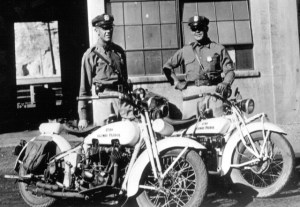
Another disturbing trend was the extent to which this coalition depended on the newly-founded California Highway Patrol. In Salinas and other places, including in a brief mention in an article about Nipomo, the CHP constituted a kind of rapid-repsonse strike suppression force and one, unlike the “deputies” and their baseball bats in Salinas, that was heavily armed.
In the history of American labor disputes, like the 1894 Pullman Strike, this traditionally had been the role of government: to uphold capital and to suppress labor. TR’s intervention in the 1902 Pennsylvania Coal Strike represented a rare departure, because he demanded that both sides come to the bargaining table or he’d use the army to take over the mines. Neither management nor labor were pleased with the president, but the strike was settled. When TR’s cousin became president, capitalists, including California growers, were outraged that the government seemed to side so clearly with workers, what with the Wagner Act (which did not extend to agricultural workers; FDR didn’t want to alienate Southern Democrats and their planter-supporters), with health inspections of labor camps, and with occasional attempts by the federal government to settle strikes (one such attempt had a Labor Department official beaten, stripped, and left in the desert of the Imperial Valley). The Arroyo Grande Herald-Recorder at this time regularly railed against the excesses of this activist government on its editorial page while its news page primly reported another schedule of AAA subsidy payments.
Frustrated as they were with FDR, growers and their allies obviously took on the strikers, not the federal government.The easiest way to sanction strikers, and to make labor organizers “disappear” (Temporarily. Usually.) was to arrest them for vagrancy, since they clearly weren’t working. That was the pretext used by SLO County Sheriff Haskins, backed by 200 instant deputy sheriffs, in the 1937 pea strike, in April. It worked; that strike, centered in Nipomo, ended pretty quickly. So had another one farther north, in January, in and around Pismo Beach, organized by Filipino laborers against Japanese growers. It was over in thee weeks, with some violence–fights between strikers and scabs–and it ended with a negotiated settlement. The growers didn’t negotiate with the strikers, by the way. They negotiated with the Chamber of Commerce, which dictated the settlement. Curious.
California Filipinos were militant and angry–the late-breaking little story below is from 1934–and probably for good reason. Several sources I’ve read place them at the bottom of a kind of racist continuum with whites at the highest level, followed by Japanese, then Mexicans, and finally Filipinos, who were housed in filthy camps, frequently harassed by police, and seen as sexual predators, with their invariable target, of course, white womanhood.This, too, sounds like 1930s Mississippi as much as 1930s California.
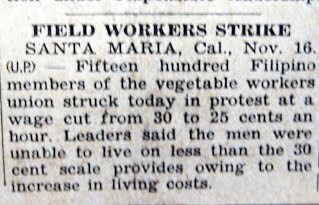
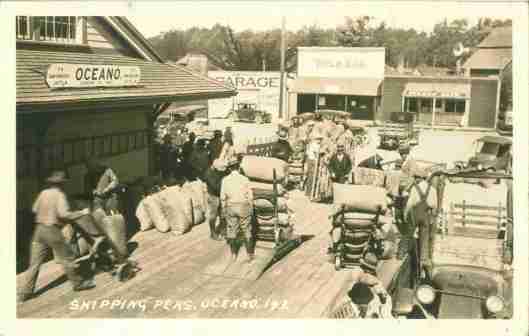
There was racial tension, as well, between Japanese growers, who had a generational head start, and their Filipino workers. Japanese growers in the Los Angeles area did not have a good reputation for treating their workers well, but LA was, again, a focal point for anti-labor resistance. I’m suspending judgment on local Japanese growers–my friends are from some of those families–until I can learn more. I’ve found no connection so far with between them and Associated Farmers, and, unlike the growers in the Salinas Valley or the San Joaquin Valley, these were small-scale farmers: the Ikeda family, for example, farmed no more than 100 acres, and much of that land was leased. The problem with that analysis is that these growers worked in concert, in what is today POVE, so potentially they might have represented thousands of acres of peas under cultivation. But it’s the Herald-Recorder that really comes off badly–this was before editor Newell Strother’s time–its editorial columns are firmly on the side represented by Associated Farmers, and its news columns, especially in their treatment of Filipinos, are openly racist.
One 1937 story details an Oceano raid on a hall holding taxi dances–Filipino men would buy a ticket and dance with a female, invariably Caucasian, since Filipinas were not allowed to immigrate. The raiders were sheriff’s deputies, including the baseball-bat variety seen in the Salinas lettuce strike. Several, including the girls, were arrested, and the Herald-Recorder reported that one Filipino laborer had bought more than 200 dance tickets from one of the arrested taxi dancers.
I guess this detail in the story was meant to provoke a sharp intake of breath on the part of its white readers. The taxi dancers were white, their patrons weren’t, and the miscegenation laws were still on the books in California.
Tensions began to ease by 1938, partly because the economy was beginning to recover, partly because a reactionary governor, Frank Merriam, was replaced by a more moderate one, Cuthbert Olsen, but also because both state investigations (one young attorney-investigator was Clark Kerr, the future UC President) and a federal one, led by Progressive Sen. Robert LaFollette, embarrassed Associated Farmers with their own conduct: they’d denied their workers basic civil rights, including due process, relied on violence, were indifferent toward inadequate and unhealthy housing conditions, used industrial espionage on a large scale, and frequently cut wages, continuing to claim that they could only pay what the market would bear when, after their 1933 low point, crop prices had begun to recover and would rise steadily into the war years.
If it sounds like I’m taking sides, I’d agree cheerfully. Objectivity demands that historians sometimes take sides, because historians must make informed judgments based on empirical evidence. History does not judge this alliance of big business, big agriculture and state police power well. The powerful brought that judgment, in their seeming victory over the strikes of the mid-1930s, on themselves.
 A Work in Progress