• About
  • The Germans

A Work in Progress

A Work in Progress

Category Archives: Uncategorized

A roomful of inspiration: Women pilots, Paso Robles, California

21 Saturday Sep 2024

Posted by ag1970 in Uncategorized

≈ 1 Comment

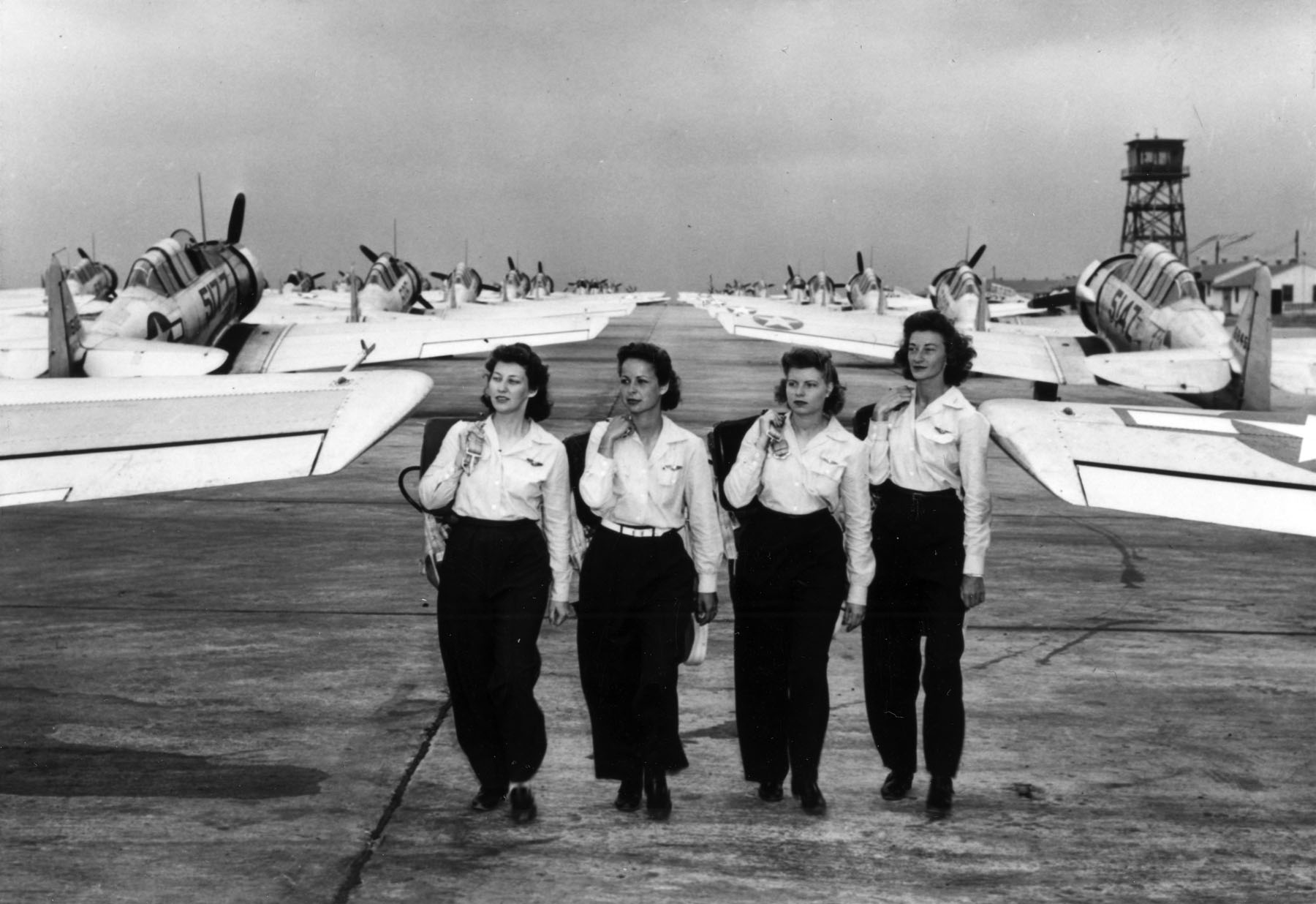
WASPs walk a flightline of AT-6 Texans, World War II

I was honored to speak to the Southwest Section of the 99s, the women pilots’ organization, at the Estrella Warbirds Museum, another favorite, last night. I have to admit that it was a thrill. For one, it was a packed house. For another, I was happy to see that the pilots were of all ages, from their early twenties to women who have been 99s for over 40 years.

I talked about the history of local aviation, including women pilots, and then about the Women’s Airforce Service Pilots (WASPs).

Over 1,000 WASPs augmented the military flying force by ferrying combat airplanes from factory to field, test-flying repaired trainers, towing targets and other tasks. Thirty-eight died for their country, but since they were technically “civilian contractors,” the Army refused to pay for their funeral expenses. They were summarily fired in December 1944.

It took thirty-two years for Congress to finally recognize them for what they really were: Military veterans of World War II.

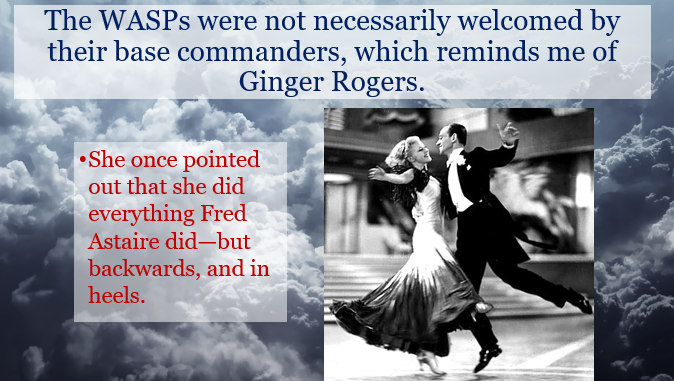
In talking about these incredible women last night, I’ve rarely had a livelier audience. They cheered when the name of Elizabeth Dinan, a legendary local pilot and flight instructor, appeared, and when the image of Blue Angel Amanda Miller appeared. (Elizabeth’s P-40 Warhawk earrings endeared her to me, immediately.) They liked this slide, and they laughed, a little ruefully, at its message. (The cadets in training did not share their commanders’ view. Many came to the WASPs for advice: “What should I do if my plane….?”)


The 99s were so much fun for me. Afterward, folks came up to me to talks awhile. A man suggested I research “Lucky” Penny, the Air Force fighter pilot who was ordered to scramble, unarmed, on 9/11. She decided that if it came to that, she would ram one of the hijacked jets. I met another local woman, now retired, who became a DC-10 pilot. I was so thrilled that I almost started hopping up and down, like I did the time the B-17 “Sentimental Journey” passed over AGHS and interrupted me, happily, in the middle of a lecture on the Thirty Years War. I ran outside my classroom and began hopping up and down—“A B-17! A B-17!”— with my students staring at me. They looked a little worried.
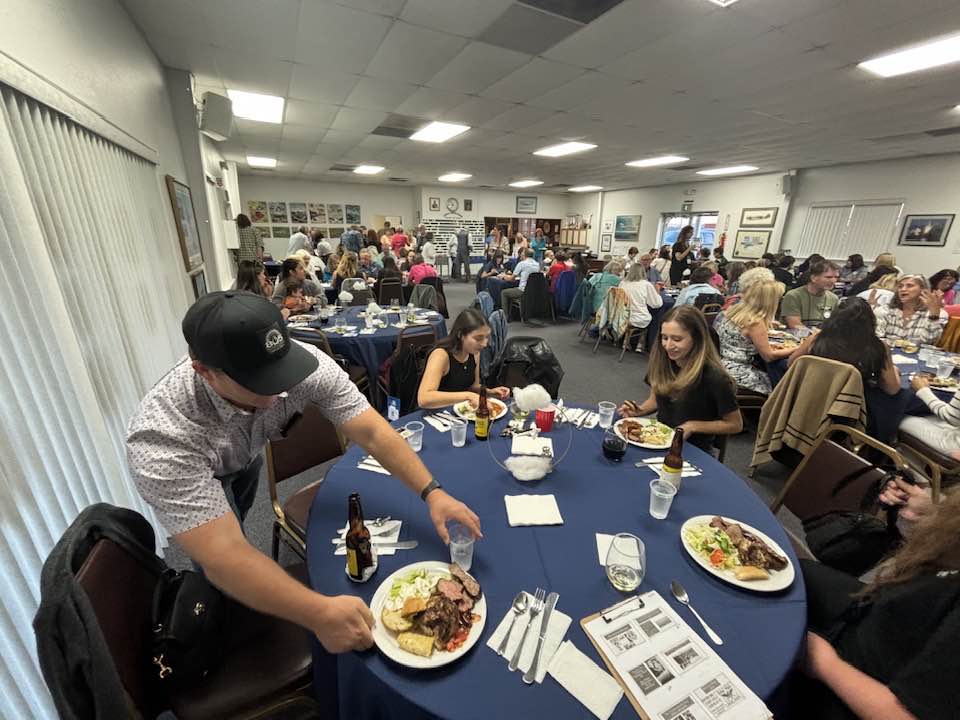
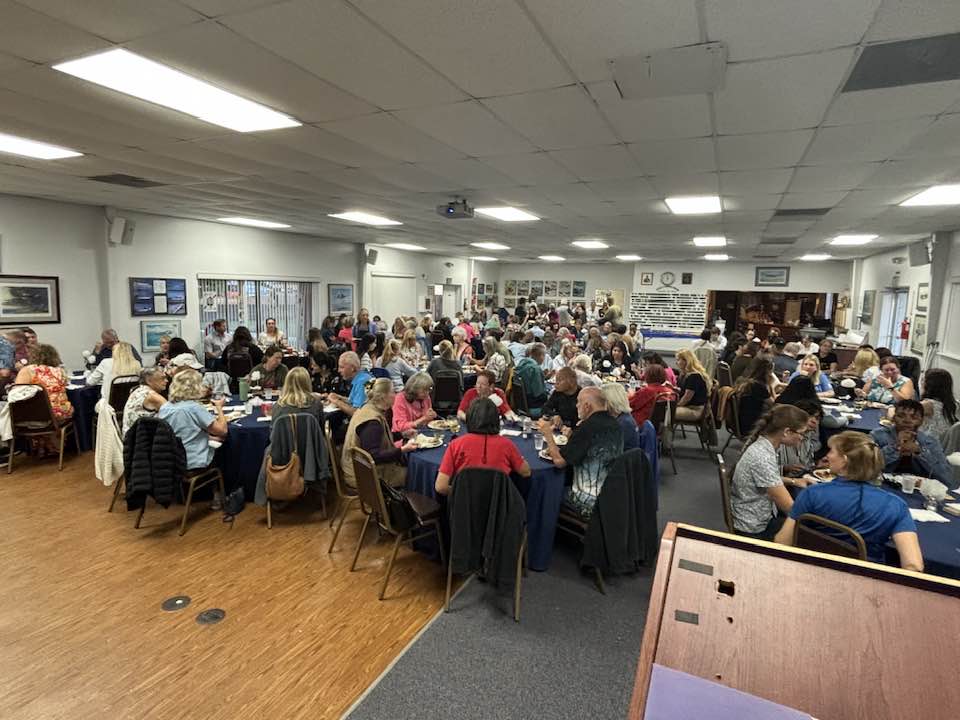
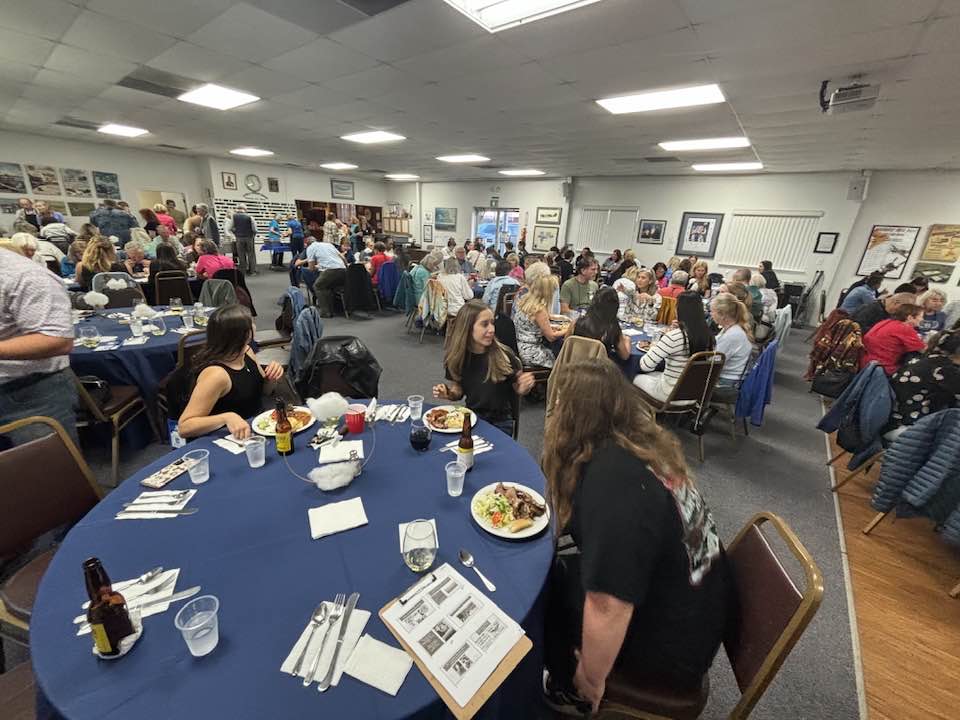
What the 99s did was validate the interest I discovered in teaching women’s history as part of the AP Euro course at AGHS. It’s part of a larger topic, social history that, along with military history, is important to me.

Thank you, San Luis Obispo 99s, for your invitation to speak.


David Lean and Oliver Twist (1948)

16 Monday Sep 2024

Posted by ag1970 in Film and Popular Culture, Uncategorized

≈ Leave a comment

Tags

david-lean, drama, film, movies, reviews

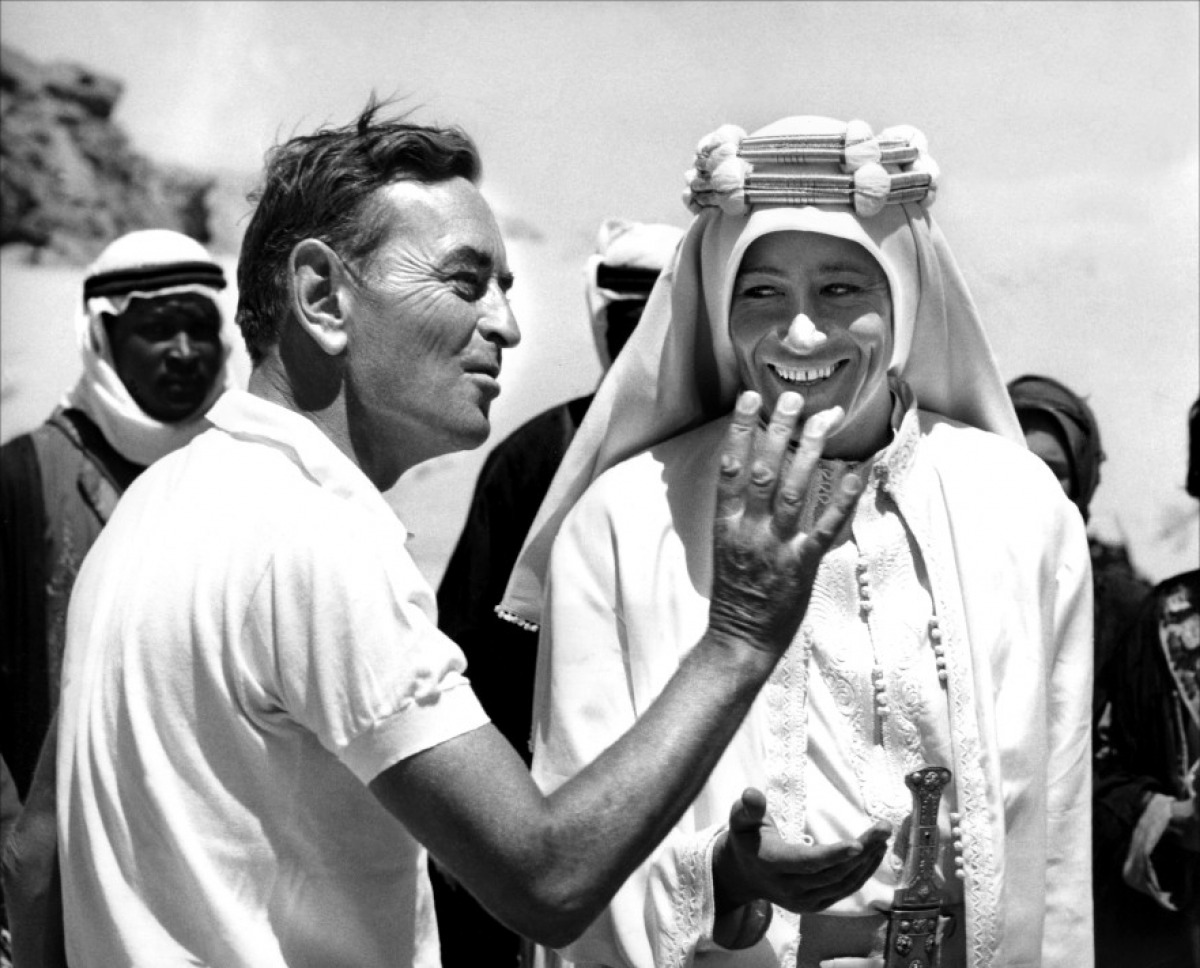
Lean and Peter O’Toole, Lawrence of Arabia

I’ve always thought of the director David Lean in terms of vastness and Technicolor. The desert scenes in Lawrence of Arabia come to mind—it’s said that thirsty theater patrons mobbed the concession stand for Cokes at the intermission. The most epic entrance in film history, I think—when Omar Sharif kills the Bedouin stealing water from his well—is an example of vastness.

And in Dr. Zhivago—theater patrons were warned to wear sweaters because that film’s cold was so vivid—there’s a set piece, where Lean communicates “cold” as Sharif’s Zhivago and Lara seek refuge from the Revolution in his family’s dacha, far, far away from Moscow or what was no Petrograd. It’s stunning and Dickensian scene, like Miss Haversham’s cobwebbed parlor and wedding cake in Great Expectations.


Dickens’ novels had as their fattest pages richly-depicted English eccentrics, from the delightful Micawber to the lizard-like Uriah Heep to the tragic Sidney Carton. In Bridge on the River Kwai, the Allied POW’s are led by Alec Guinness, who has crossed the line that divides eccentricity from madness. (The film also features one of William Holden’s finest performances.) Alert moviegoers might have spotted something off at the film’s beginning, when Guinness’s Col. Nicolson marches him POW’s into camp while whistling “The Colonel Bogey March.” It’s a little mad.


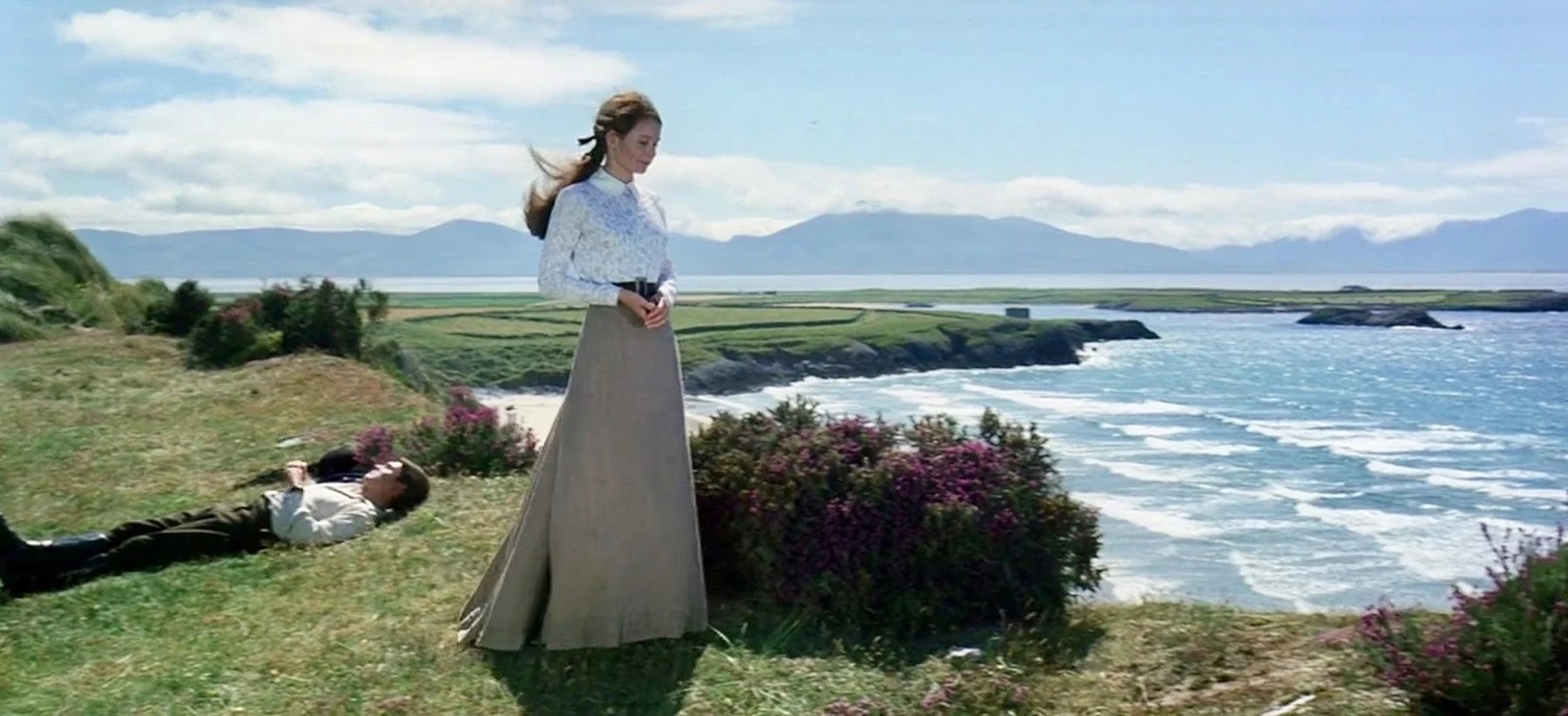
But long before Lean made grand color films–Ryan’s Daughter, while not among his great films, still made evocative use of the Ring of Kerry, a landscape far different from that of the Arabian desert.


I realized that Lean’s earlier work, in black and white, is just as stunning. I’d long ago seen Great Expectations, with John Mills and Guinness, but I hadn’t seen Oliver Twist in a long time. It’s a film that makes you feels as if you’re inside a Dickens novel (Turner Classic Movies noted that the film’s dialogue was lifted almost verbatim from the novel.

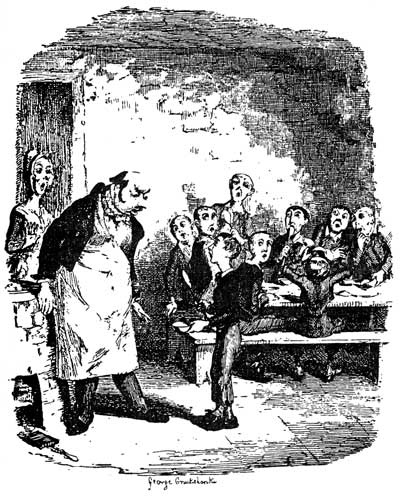
Oliver asks for more. Illustration by George Cruikshank.

What struck me in yesterday’s viewing was the pathos of Oliver’s mother as she trudges exhausted, to the workhouse where she will give Oliver life and lose her own. Someone had the idea of setting the scene (the original, with its sound effects, is stunning) this one’s set to haunting music from an Australian World Music duo, Dead Can Dance. I don’t know if David Lean would approve. For what it’s worth, I do.


Why Arroyo Grande’s history may be far more important than we realize

04 Wednesday Sep 2024

Posted by ag1970 in Arroyo Grande, Uncategorized

≈ Leave a comment

I don’t post this to be bragging.

Wait. Maybe I do.

But I post so much, espeically on Facebook, about history stuff that I hate the idea of me sounding like I am bragging.  My Irish-American mother had, as one of her central teachings, that there was no sin quite so terrible as the sin of Pride.

Here’s the deal, Mom. I am now seventy-two, and I have enough stories inside me for two lifetimes. Each story I write takes days of research. Each of the little books I’ve written represent a year of work.

If I don’t get the stories I have left out, they will be lost.

Mom died when I was seventeen, but, as I once told my high school students, she was alive in me every day I taught them. She was right there beside me. Her passion was social justice.

It was Dad’s voice alive in me in the stories I told the teens I loved to teach, at both at Mission Prep and then at my Alma Mater, AGHS, and there’s no better way to teach history than to tell stories.  My father was a mesmerizing storyteller. He was right there beside me, too.

Me, being emphatic, as usual, Mission Prep.

So the little stories I post on Facebook—and the marvelous, evocative stories told by my friend Michael Shannon, who grew up near us in the Upper Arroyo Grande Valley–are begging to come out. Michael’s stories a lyrical and vivid and, given his four generations in Arroyo Grande, they have roots that make them even more authentic and timeless.

As soon as Michael and I think of one story, another one surfaces. I was asked recently to give five or six examples of acts of kindness, selflessness or sacrifice from Arroyo Grandeans from our past.

I wrote twelve.

Seven more are waiting to be written.

Michael could double those.

Both of  us are in our seventies. Neither of us, I think, writes to show ourselves off. We write, instead, to show off people from our hometown’s past whose lives were marked by grace, or generosity, by sacrifice or by courage.

Most of all, Michael and I are drawn to stories about people whose lives were marked by kindness.

These people are our heroes.


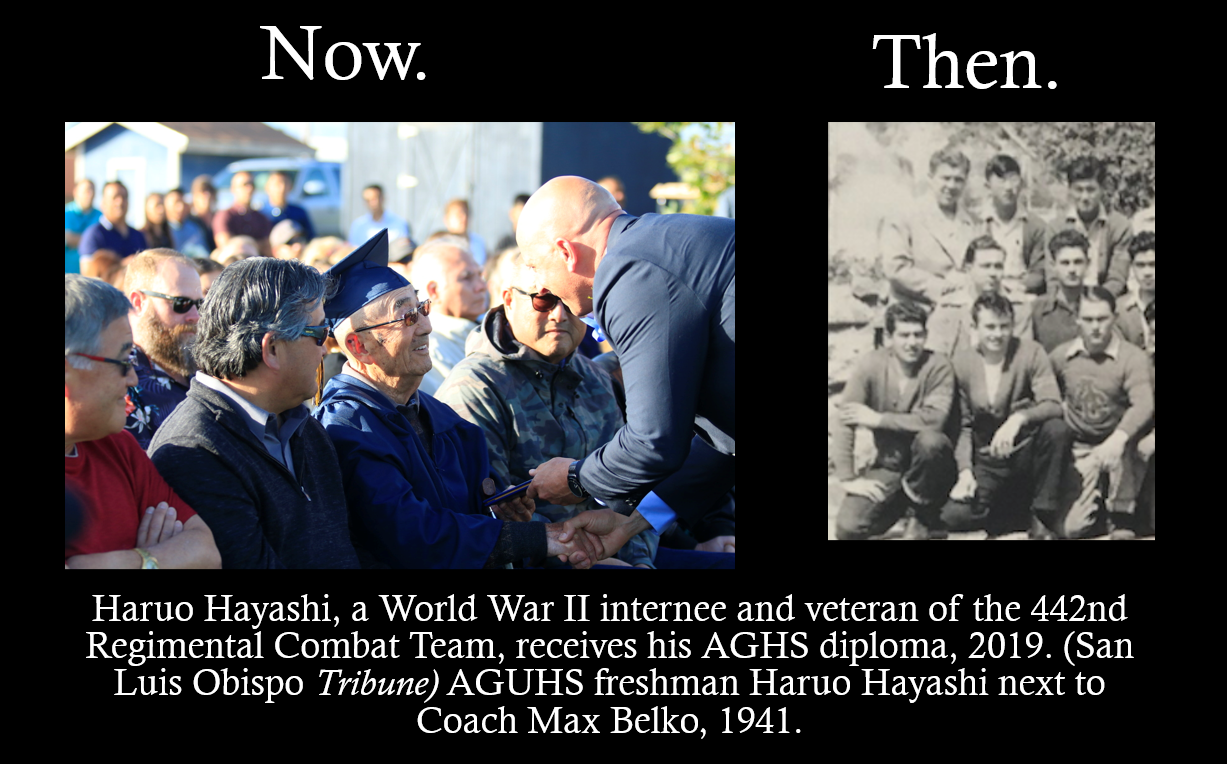
I’ve written, too, about our town’s failures–the mob that descended on Chinatown in 1886 and forced the residents to flee, the double lynching a few weeks later, the ugly bigotry directed at Filipino immigrants, the few locals, motivated by envy directed toward the Japanese immigrants who’d become so successful, who applauded Executive Order 9066.

The fact remains that the heroes far, far outnumber the cowards from our past.

They have to be written about. They have to be remembered. In however many years I have left to me, I want to be part of remembering them.

Sgt. George Nakamura

Here is one of my favorite stories; I’ve told it many times before, but for some of you, this might be the first time.

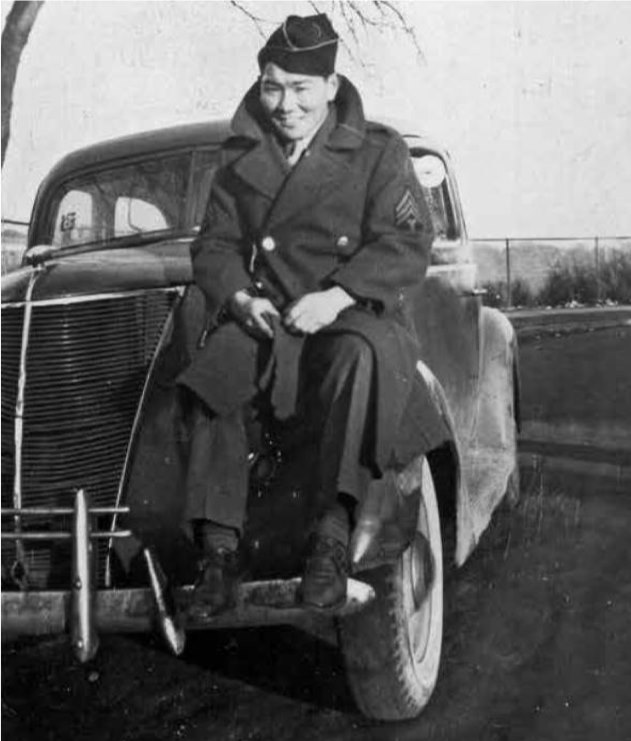
AGUHS grad and Army Intelligence Officer George Nakamura, posing on the car (note the bald wartime tires) when he was studying his family’s Japanese in, of all places, Minnesota. Some of his instructors would’ve been intelligence officers, too. Many of them were women.

Nakamura was part of a team attached to–and meant to spy on–Mao Zedong’s guerrillas as they fought the Japanese in the mountains of Ya’Nan Province.

Nakamura disguised himself as a Chinese peasant to go behind Japanese lines to rescue a downed American flier. He was twenty years old.

When he turned twenty-one, the former sports editor of the AGUHS “Hi-Chatter” had so charmed his hosts that they threw him a birthday party. Somebody had a record player.

So the female fighters took turns dancing with the former editor of the AGUHS “Hi-Chatter.”

One of them was a famous prewar film actress, Jiang Qing.

She was the boss’s wife. The woman who danced with Nakamura would be far more famous by her married name: She was Madame Mao.

That’s a hell of a story. There are thousands more from this little town. There are so many stories; there is not nearly enough time.

Well, I’m proud to be a kid from Arroyo Grande/A place where even squares can have a ball…

02 Monday Sep 2024

Posted by ag1970 in Uncategorized

≈ Leave a comment

When my friend and fellow historian Shirley Bennett Gibson posted this a few days ago, I just couldn’t let go of it. I just had to write some lyrics. So here they are, inspired by Merle Haggard’s “Okie from Muskogee,” a monster hit in September 1969. Two caveats: I know that the first line is a bald-faced lie, and Haggard was one of our finest songsmiths. Admittedly, in September 1969, this one troubled me just a mite.

I’m Proud to be a Kid from Arroyo Grande

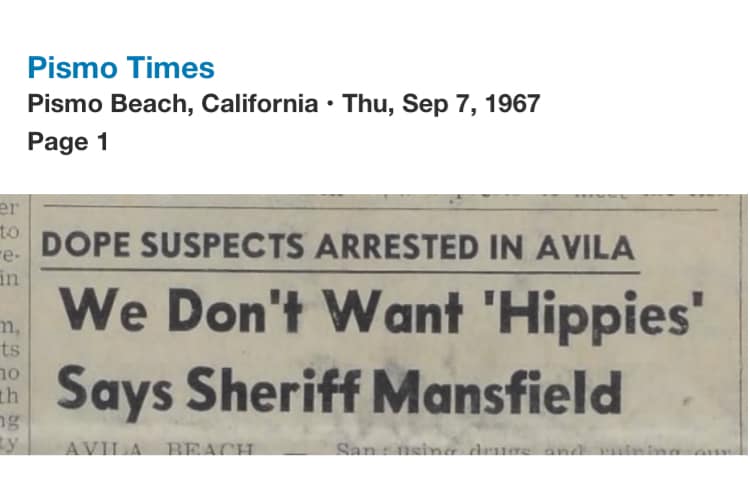
We don’t smoke marijuana in Arroyo Grande

We take our trips to SLO, not on LSD

We don’t want no pot farms in the Huasna

We like Rotta wine and just-grilled lingui-cee

Well, I’m proud to be a kid from Arroyo Grande

Where steelhead still make their way upstream

Y’all can keep you’re your flowers and your love beads

Me, I’m, rootin’ Fridays for our football team


We don’t allow short skirts on our co-eds

God forbid they come to school in jeans

And boy, you better trim up them sideburns

Or do hard time in the office of the dean

Well, I’m proud to be a kid from Arroyo Grande

We drive Ford pickups, not lovebugs, along Branch Street

We get our hair cut every two weeks at Buzz’s

We don’t want no longhairs or smelly feet

Our deputies wear handsome cowboys hats made out of straw

Their silver prowl cars leave blisters on the road

So if you’re considerin’ some teenaged nonsense

Get ready for the visit to your folks’ abode


Yes, I’m proud to be a kid from Arroyo Grande

A place where even squares can have a ball

‘Less you think I’m spinnin’ a kinda fairy tale

You ain’t danced and sipped sopa at the Portuguese Hall.


Now, here’s Merle. Of course.

Admission Day

01 Sunday Sep 2024

Posted by ag1970 in Uncategorized

≈ Leave a comment


School used to start a little before California Admission Day (that would be Sept. 9, 1850), when I was a little kid at Branch School, but now school lets out around June 8 and seems to resume, goodness sakes, about six weeks later.

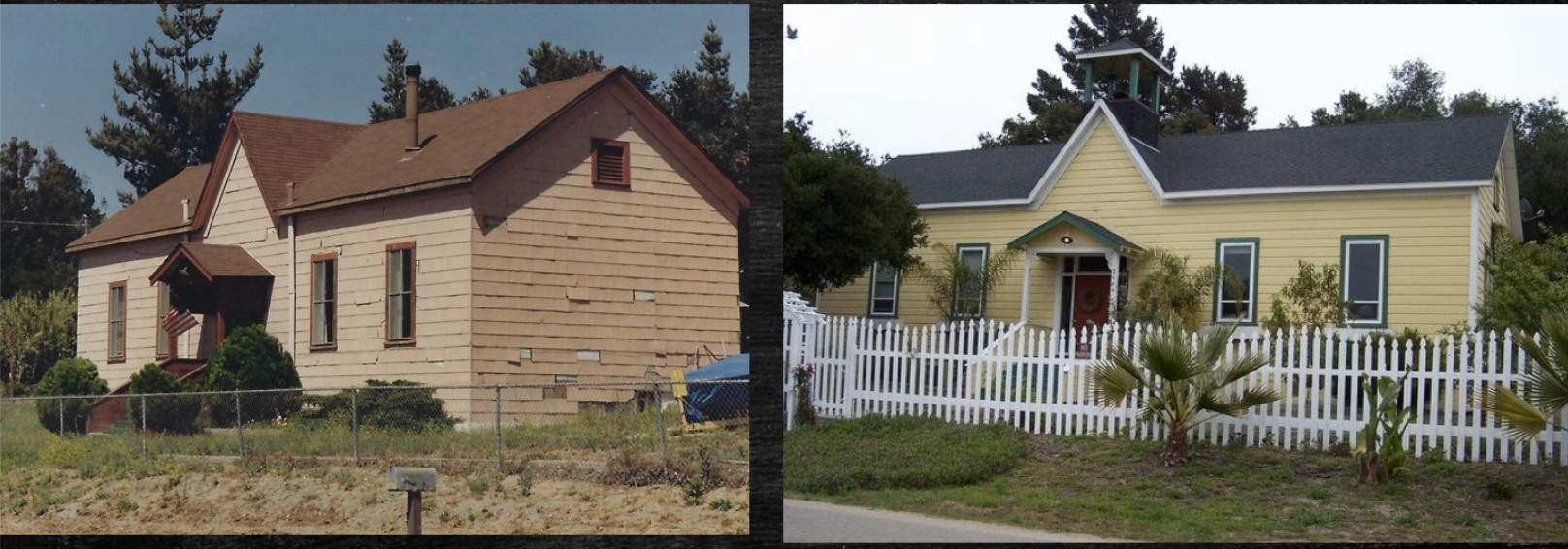
The two-room 1888 Branch schoolhouse, before and after its restoration by the Andrews family. Today it’s white, carefully maintained by the Vangelos family.


But Admission Day is not such a great thing, other than the fact that California gold flushed Salmon Chase’s coffers–Lincoln’s Treasury Secretary, as in “Chase-Manhattan Bank,” who thought himself immensely superior to the president, as did his daughter, Kate, a Washington D.C. beauty. So our gold killed a lot of Confederates. At least one of my ancestors (Douglass, my middle name) among them.

Kate Chase


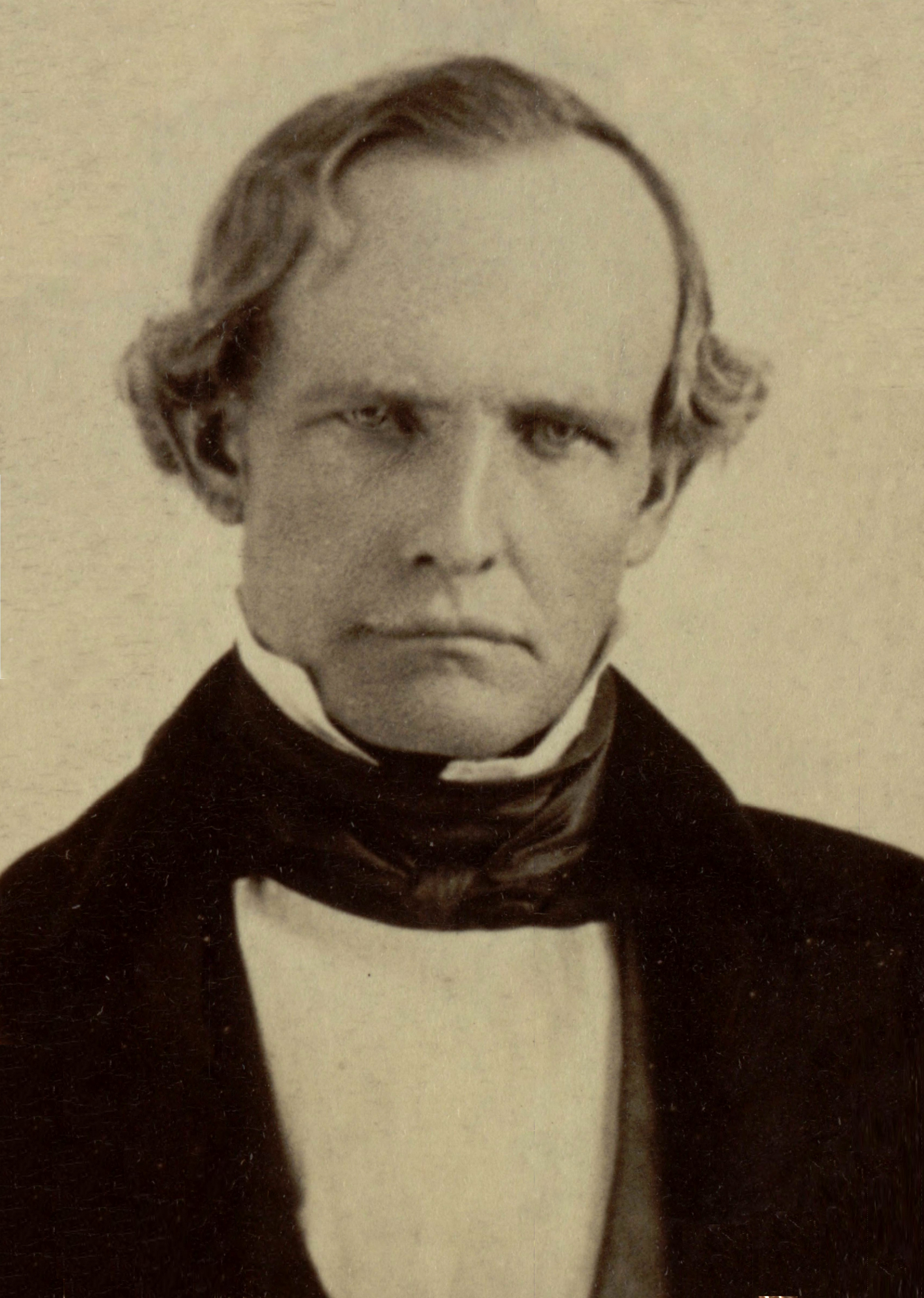
Which leads me to Peter Burnett–in the photograph at the top of this entry–a slave-owning Missouri transplant and our first governor. Burnett’s administration included a pledge to exterminate every Native American in the state.

He didn’t, but he made damn good progress. There were an estimated 20,000 ytt (Northern Chumash) people in California in 1500. By 1900, only 62 identified themselves as such.

In San Jose, the statistics are similar: There were 30,000 Muwekma Ohlone people before Burnett and sixty-two survived him.

Yes, the attrition is in part due to the influx of European/American diseases, like smallpox, measles and syphilis.

But Burnett actively recruited expeditions, some of them doubtless made up of amateur soldiers, lubricated with whiskey, to hunt down Native Californians and kill them.

The constitutional convention at Monterey in 1850 included the passage of a measure for the protection of California Native Americans. They were protected, in the act–and especially minors–by becoming indentured servants to the White folks who deserved California, after all.

The Census reveals that even in our county, Native American children are routinely identified as “servants.”

Our representative to the constitutional convention, young Henry Tefft, luckily left before that law was passed to take up a judgeship in San Luis Obispo County.

He later drowned in San Luis Bay when his ship’s little rowboat capsized.

Mrs. Tefft remarried.

For the YTT people of our county, there was almost no one left to marry. There were only bones, displaced for Chorro Street water mains or ground into fertilizer or dumped into mass graves at the southern edge of town or collected by amateur anthropologists.

Some YTT bones wound up in medical schools in England.

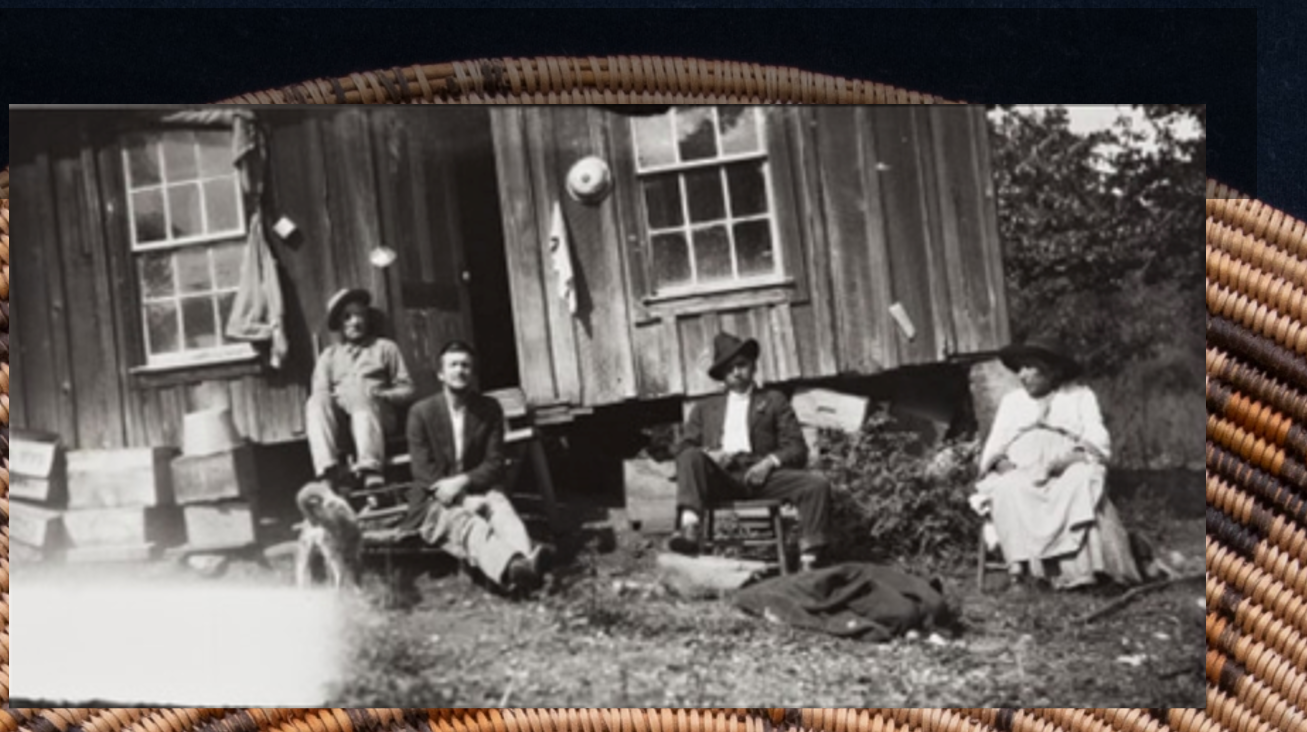
I once wanted, very earnestly, to write about Rosario Cooper of Lopez Canyon, the last speaker of her Chumash dialect and something of a celebrity in anthropology, in linguistics.

Lopez Canyon, about 1916. Rosario Cooper’s husband atop the steps, her son in the chair, second from right. Lower on the steps is anthropological linguist J.P. Harrington, on the right is Rosario.


My source, a YTT elder, refused to talk about Rosario. My ancestry, in Leicestershire and in County Wicklow, did me not one bit of good. It took me a long time, but I finally understood her refusal. Her people had been burned too many times by well-meaning White people, almost as dangerous in their way as Gov. Burnett was in his.

But you can still hear Cooper singing, her voice recorded on Edison wax cylinders in 1916, carefully preserved at Cal’s Bancroft Library.

I had the great honor of teaching two extraordinary young women AP European History at AGHS, both of them Cooper’s descendants.

But I didn’t teach them this history. I didn’t know it then. I didn’t want to know it when I finally learned it. It was too painful.

And I’m not so thrilled about Admission Day anymore. 

Yes, I smoked pot fifty years ago. There’s a little more to that story.

31 Saturday Aug 2024

Posted by ag1970 in Uncategorized

≈ Leave a comment


I don’t mean to shock anybody. Wait. Maybe I do. Maybe I don’t much care.

In the early 1970s, when I was editor of the Cuesta College newspaper, The Cuestonian–-a job I’d inherited from my big brother, Bruce (AGUHS ’66; me, AGHS ’70), among the many favorite human beings on that staff, and there are many, was a reporter named Mike Partain, who had a bushy bushy blonde hairdo, and his girlfriend, Cathy, who went to work every day on a 500 cc Honda.

Mike and Cathy loved me, for reasons that still elude me. What is uneludable is the fact that I loved them, too.

When The Cuestonian was put to bed, to be printed by the Blankeburgs, who were kind to us, we were exhausted. It was a good paper, from a little podunk community college housed in World War II barracks, and it won statewide awards for photography and writing and layout. So I would celebrate with Mike and Cathy, because we knew that newspaper we’d sent to the printer was good and we all knew that we’d worked hard to make it good.

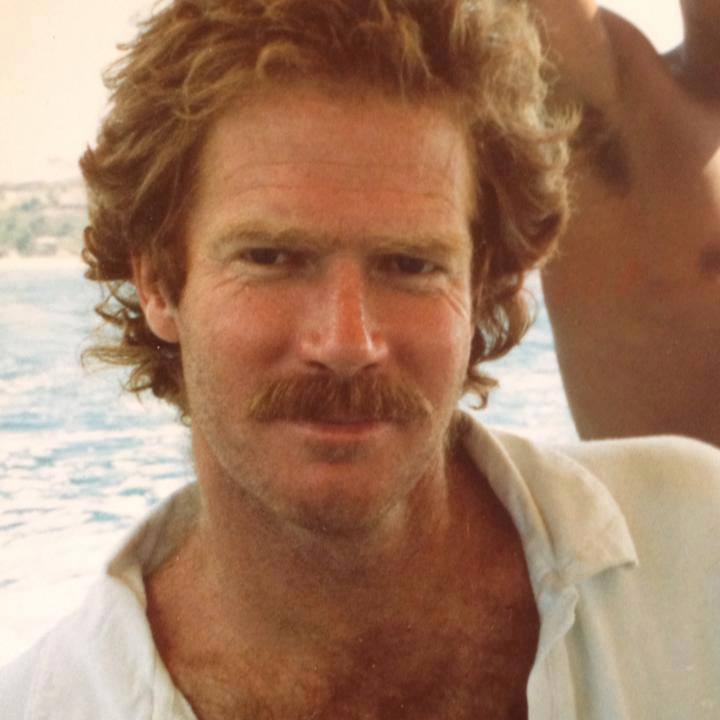
So we would barbecue and drink wine—red, usually—which is exactly the same pattern I followed took many years later with the dearest friend of my life, Joe Loomis, who taught me many things including generosity, kindness, and Neil Young and Crazy Horse. There is no one on Planet Earth that I loved, and still love, quite so much as Joe. But we, too stayed up so late. There is no one who I feel the need to apologize to quite so much as Joe’s wife back then, Carol, when they lived on Mr. Boysen’s place (where I learned that garbanzo beans, the supply-and-demand agent that Mr. Avila used to make sense of macroeconomics to me at Cuesta, were like caviar to mule deer. Joe Loomis was an economics major in college. That fact amazed me. Fareed Zakaria was among the authors on his bookshelf in a little house in the Huasna Valley when he died suddenly of a heart attack. His intellect, and his appetite for learning—among the books he left behind were those written by Fareed Zakaria—were as as moving and joyful as a Vermonter’s first visit to a California In N Out Burger.

Mr. Boysen’s farm, where Joe and Carol lived, was beyond the “T” intersection of Foothill and Los Osos Valley Road, and I used to come over to visit. I’d like to think that it was all the time, but it was, maybe, only twice. A finned and oxidizing maroon Mercedes Benz graced the front yard. Someday, Joe was going to make it drivable again. I don’t know that he did, since there was wild mustard emerging from the engine block, but before we went inside, Joe and I regarded the Mercedes for a few moments. We admired its promise.

Four hours later, and I think of this with shame, we’d wake Carol and baby Gram up with our laughing. I owe Carol, a beautiful woman/human being/friend who makes beautiful art—I had an immense crush on her— forty years’ worth of apologies. We were incorrigible, Joe and I, though not nearly as much as Joe’s father John Loomis and his uncle, Gordon Bennett. But I kept Joe Loomis’s photo atop my teacher desk at Arroyo Grande High School thirty years after Mr. Boysen’s place.

Sometimes, in Room 306 at AGHS, I’d look down aet Joe’s face—that’s the face I saw, just below, and my heart would soften. His image made me a better teacher.


Years before that, at Mike and Cathy’s house, after many hours of ribs and red wine and pot and deep philosophical conversation (I liked to imagine that we were the heirs to Ed Ricketts, John Steinbeck and Joseph Campbell at Pacific Biological on Cannery Row in the 1930s), it was just about time for me to go home when I asked Mike to play two songs on his lovely Warehouse Sound turntable, with his lovely Pioneer amp and his tombstone-sized Harmen Karden speakers. So here they are.

,

Devotion

31 Saturday Aug 2024

Posted by ag1970 in Uncategorized

≈ Leave a comment

Please forgive this reflection, but this is how I think, and this is how I taught history.

* * *

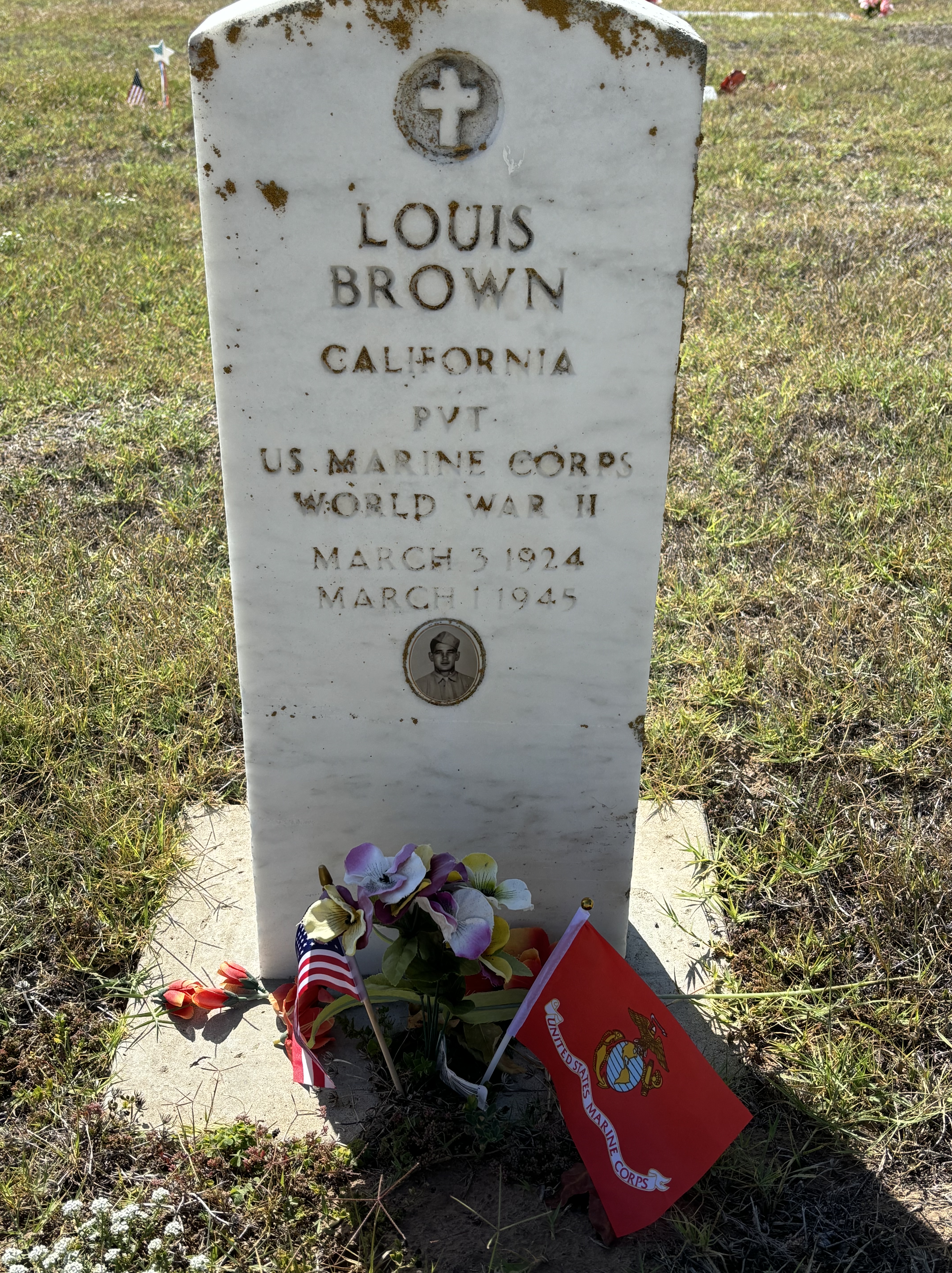
Pvt. Brown’s flags were threadbare–the American flag was gone–so I needed to take care of business.

On the way to his grave, in he IDES section of our cemetery, a big Dodge pickup was parked in the drive-path, the driver’s side door open. . Next to it was an older woman, a term, at seventy-two, that I use heedlessly, kneeling in front of a grave that was almost knee deep in flowers, surmounted by a happy pinwheel.

I don’t know why I say things like this, but I do.

“That is beautiful!” I told the lady.

She smiled and then her shoulders sagged. “My daughter. She’s been gone twenty-seven years.”

“I am so sorry.” The obligatory and stupid response. “I’m going to visit a Marine killed on Iwo Jima.” I had to repeat it. We’re both a little hard of hearing.

She put her hand over her mouth for a moment. “He died for his country.”

“Yes, he did, and he helped me to write a book about Arroyo Grande and World War II. He was the inspiration. I owe him so much.”

She liked that, I think, but we were still standing by her daughter’s grave, in the sun, and it was a little warm.

I don’t know why I do this, but I do. I had Private Brown’s flags in my left hand, so I reached out to her with my right. We held hands for a moment. I didn’t squeeze hers too tightly; she was wearing rings, one of them I am sure a wedding band.

“God bless you,” I said. I do know why I said this. Yes, I do. That’s the way my mother raised me.

After I’d tended to “my Marine”–he got fresh flags (needs new flowers), I ran my fingers over the smooth glass that covers the oval portrait on his tombstone, used the tombstone to get my my 72-year-old feet again, and gave its rough top a few pats with the palm of my hand. Then I began to walk back to my car.

The woman was still there, but this time, in the shade, thank goodness. She was kneeling at another grave, like her daughter’s, rich with flowers.

I didn’t bother her this time. I left her alone there, in the shade. She was by now standing but looking intently at the tombstone.

The past, Faulkner famously wrote, isn’t dead. It isn’t even past. I hope that the devotion the woman showed has been inherited by her grandchildren and great-grandchildren. I suspect that it has.

Tragedy at the In-N-Out Burger

14 Wednesday Aug 2024

Posted by ag1970 in Uncategorized

≈ Leave a comment


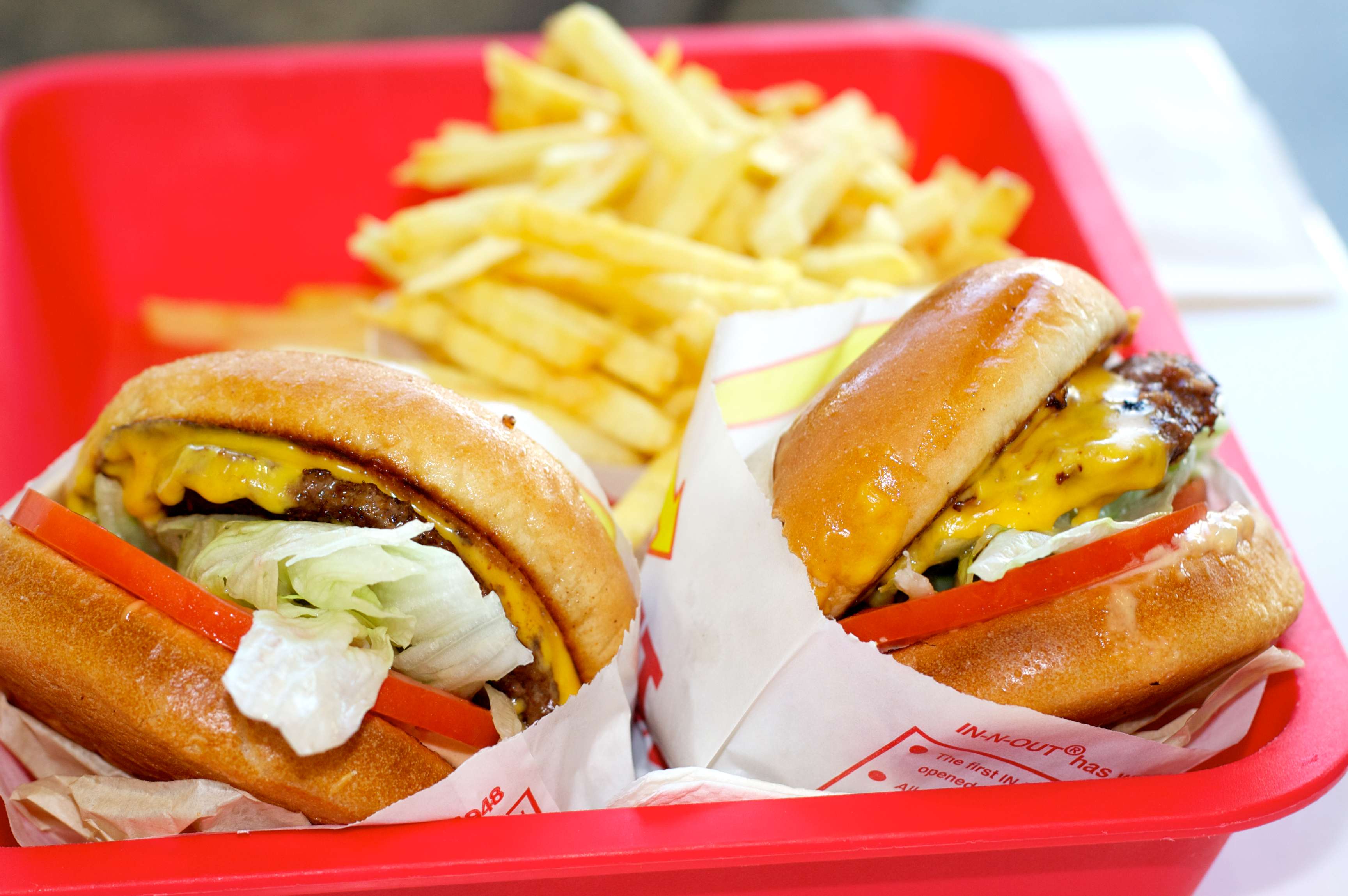
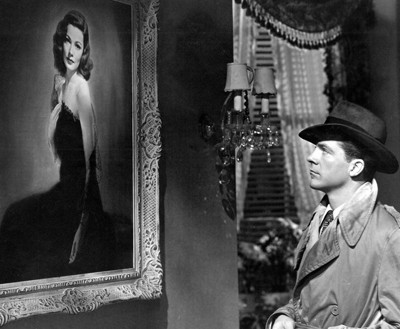
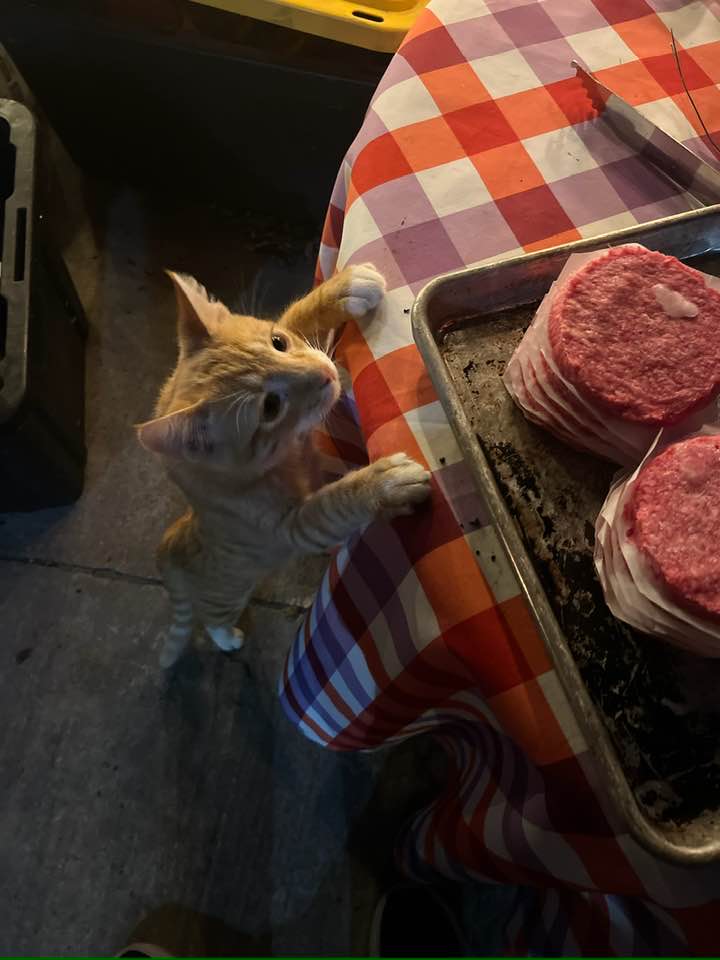
I have long been an In-and- Out burger fan. Unless you count those photos of World War II wives saying goodbye to their husbands, there’s nothing quite so heart-breaking as the last bite of one of their cheeseburgers. You don’t have room for another, but you don’t want to let this one go, kind of like Joseph Cotten in Laura or James Stewart in Vertigo. Poor saps.


My family and I have loved In-N-Out burgers when the only franchise was in Ventura. off the Seaward Ave. offramp, where we’d stop on the way to a Dodger game or some other catastrophe. The crowds inside were thicker than the extras in The Ten Commandments. Then the franchise inched closer, to Santa Maria and then—O Happy Day!—Arroyo Grande finally got one!

That wasn’t the franchise we visited yesterday when, after the first bite, I realized that the bun was faintly stale, This has never happened before! I thought, but the Counter Lady was so engrossed with a six-year-old girl (they were discussing the first day of school) that I didn’t want to interrupt the flow of that conversation. So I finished my burger, which was adequate, and focused on the fries, which were mighty fine.

So that led me to ponder mighty fine burgers, which In-N-Out’s usually are. Here we go:

—Bob Gregory Burgers. Back when $20 would fetch four bags of groceries (Young’s Giant Foods, 18th and Grand Ave, Grover, George the Happy Butcher), my father’s grilled burgers were so thick that we learned to unhinge our jaws, like Boa Constrictors, so we could take a bite. Like Boa Constrictors, we did not have to eat again for a long, long time.

Winston approves of my burgers.


—Teen Burgers, A & W Root Beer (across from Young’s Giant Food). The idea of pairing cheese AND bacon to a hamburger was once novel and, when you’re twelve, you could inhale at Teen Burger and get away with it. My cardiologist would not be thrilled today. Best accompanied by a root beer freeze.

—Village Grill. For some reason, I am not a fan of shredded lettuce, but everything else about this burger is quite good. So are their onion rings, a dish that remains atop the pyramid of my personal food groups, thank you very much.

—Gradburgers. Alas, The Grad, now closed on Industrial Way in SLO, made an epic burger, served on a big square fluffy bun that you could see being prepared. The first bite of a Gradburger, I think, was kind of like (someday, and hopefully) St. Peter informing you that you’d made it into The Show. My great and good friend Randy Fiser and the best man at our wedding, Rob Rosales, were bouncers there. Gradburgers gave them the protein they needed to heave drunks deep into the parking lot.

Alas, I never had a Scrubby and Lloyd burger, mythical in SLO. We just never got up to the Big City often enough.

—Sylvester’s Hawaiian Burger (Los Osos). Burger, teriyaki, pineapple, the usual trimmings. While it decomposes faster than a Reese’s in Oildale at noon, the Hawaiian, when accompanied maybe by a beach towel to keep yourself kind of pristine, is divine.

A Jimmy fried egg burger, brioche bun, side of slaw.

—Whoever that lady was who babysat me in 1956. When we lived on Sunset Drive in Arroyo Grande, my parents, for some unfathomable reason, decided to go out on the date. They deposited me with some elderly lady—she had to be fifty, for cryin’ out loud—and she made me a burger for dinner. She added a tomato, also unfathomable to me at age four, that I found so delicious that I raved about hamburgers with tomatoes until the next morning. Maybe until the late afternoon.*

By then, of course, I was ready for a Breakfast Burger. I’ve made those, too, if not for breakfast, then with a fried egg on top. They are incredible.

Don’t tell my cardiologist.


* Here is your cultural reference for 1956:


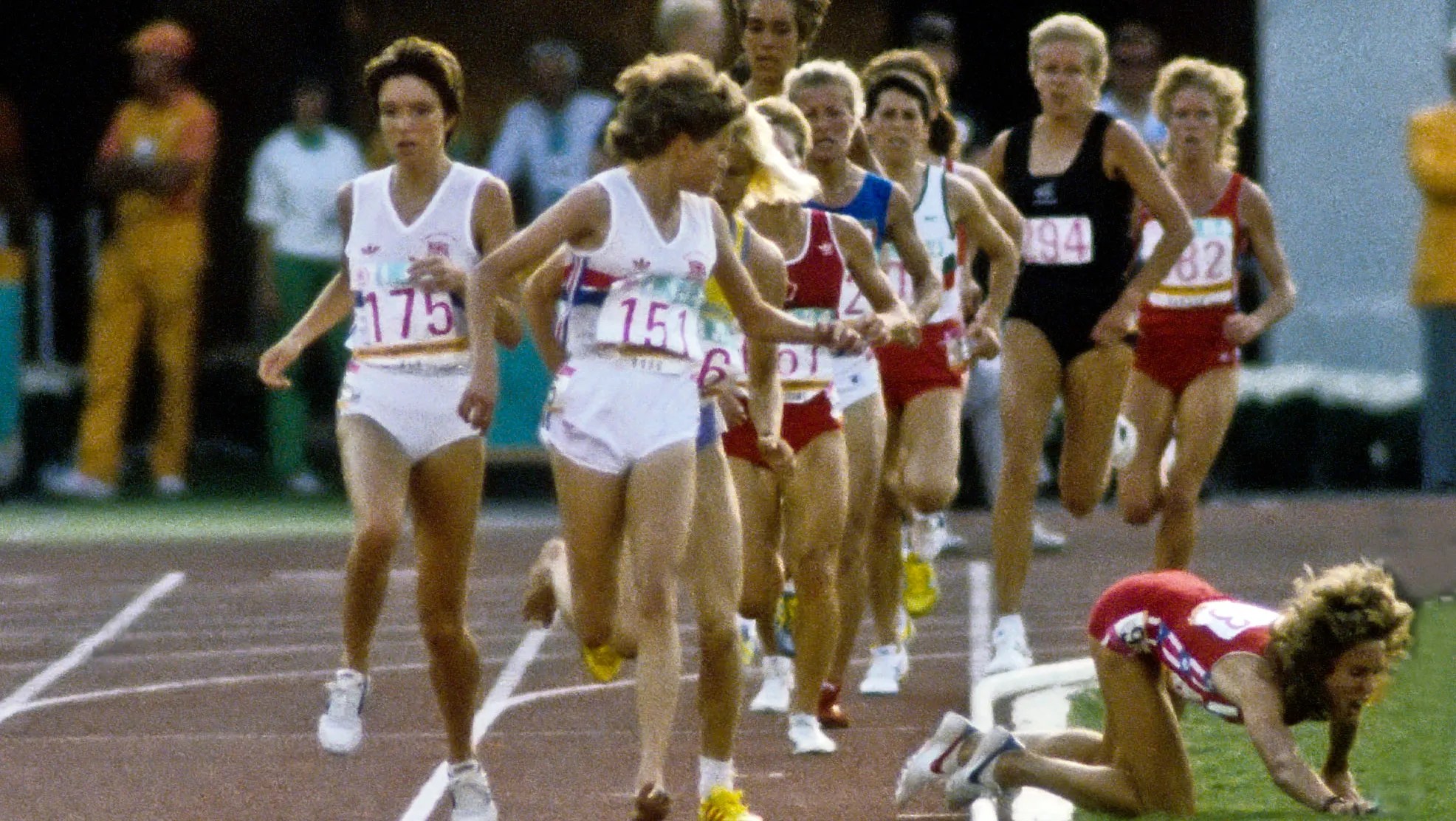
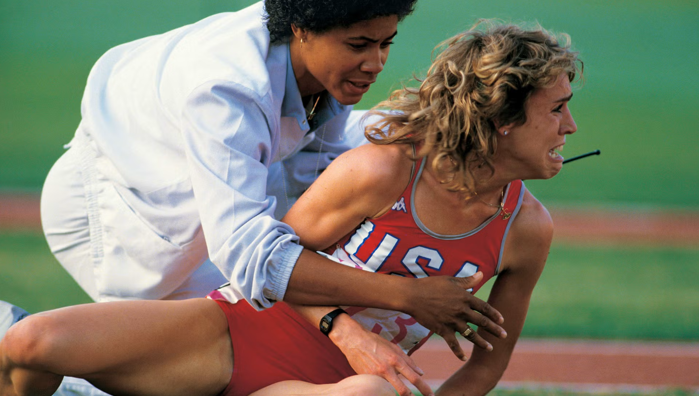
The L.A. Olympics, 1984

13 Tuesday Aug 2024

Posted by ag1970 in Uncategorized

≈ Leave a comment

Still suffering Olympic withdrawals.

For those of you who weren’t even around then, the 1984 Olympics–maybe they’ll shoot Tom Cruise out of a cannon in 2028?–were in L.A., too.

The street art, murals inspired by artists like Diego Rivera and Jose Clemente Orozco, were amazing. Many of them, alongside the freeways, were painted over; some are being restored.

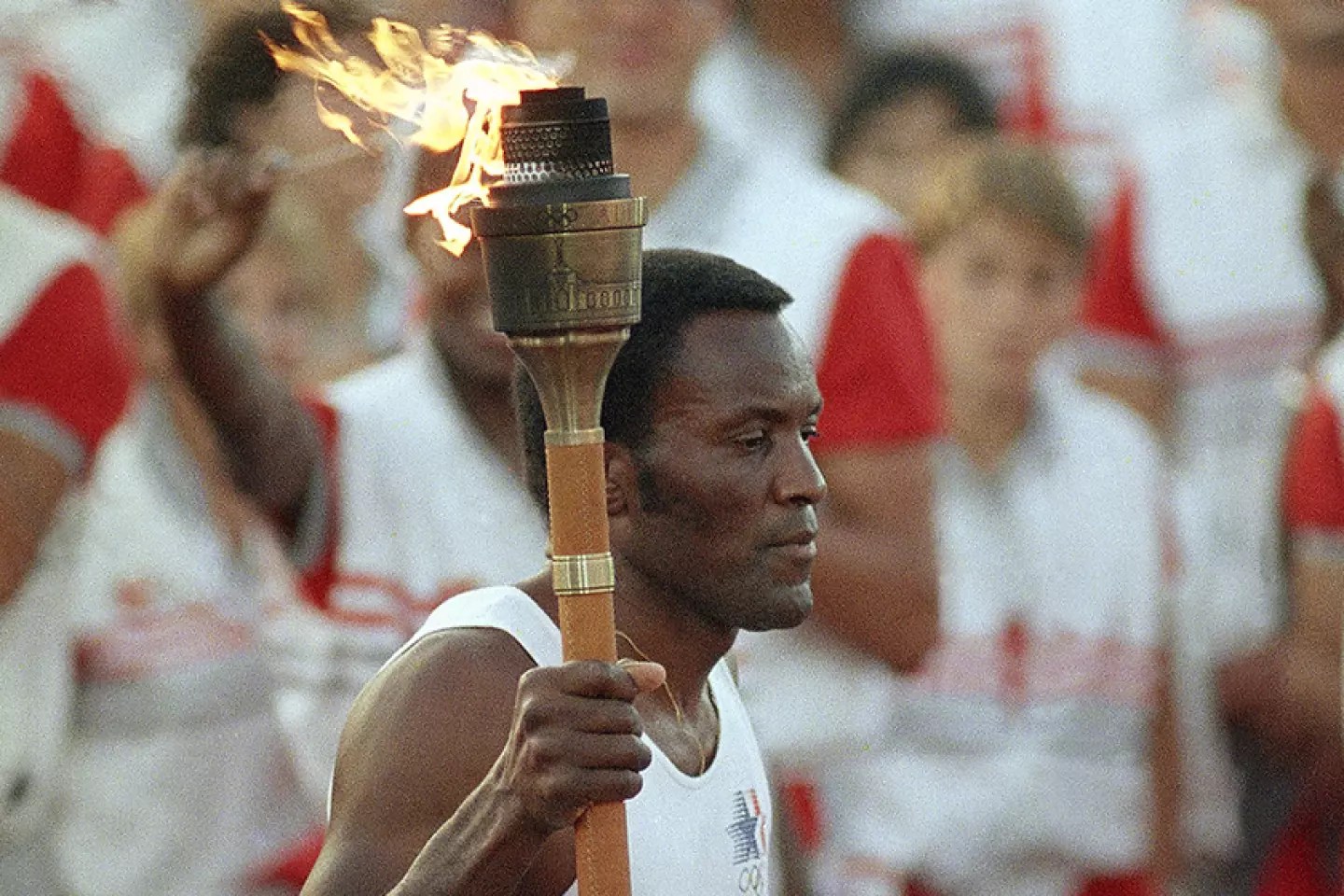
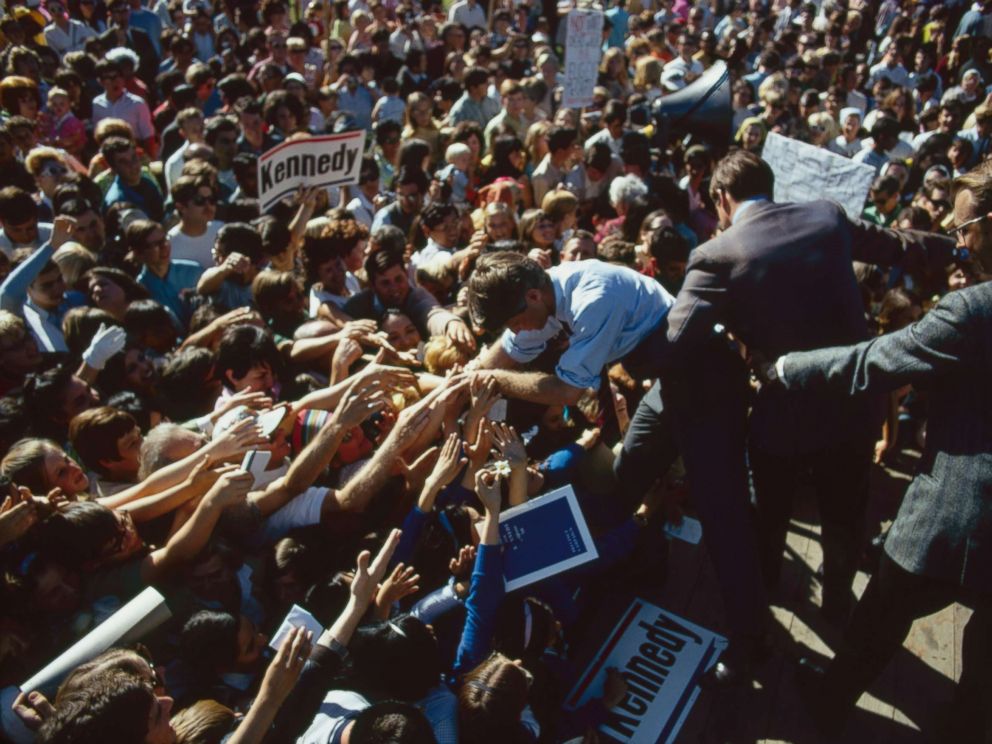
The torch was carried into the Coliseum by onetime decathlete Rafer Johnson, a simply beautiful man who’d been one of Bobby Kennedy’s bodyguards in 1968. Johnson, L.A. Ram Roosevelt Grier or the Secret Service had to hold onto Kennedy by the waist or hold tightly onto his belt to keep the crowds–neither Trump nor Harris could top those crowds–from kind of absorbing him.

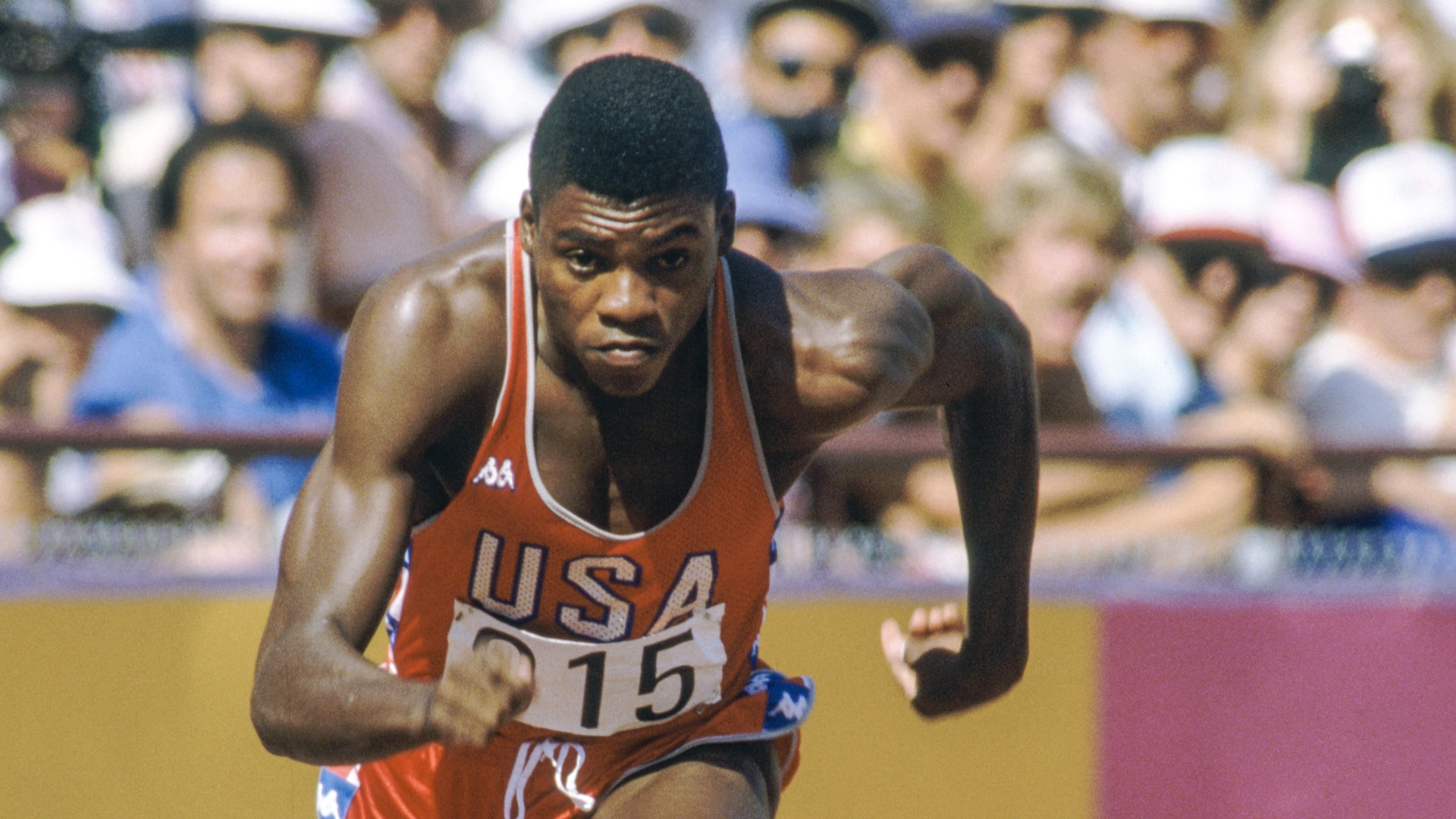
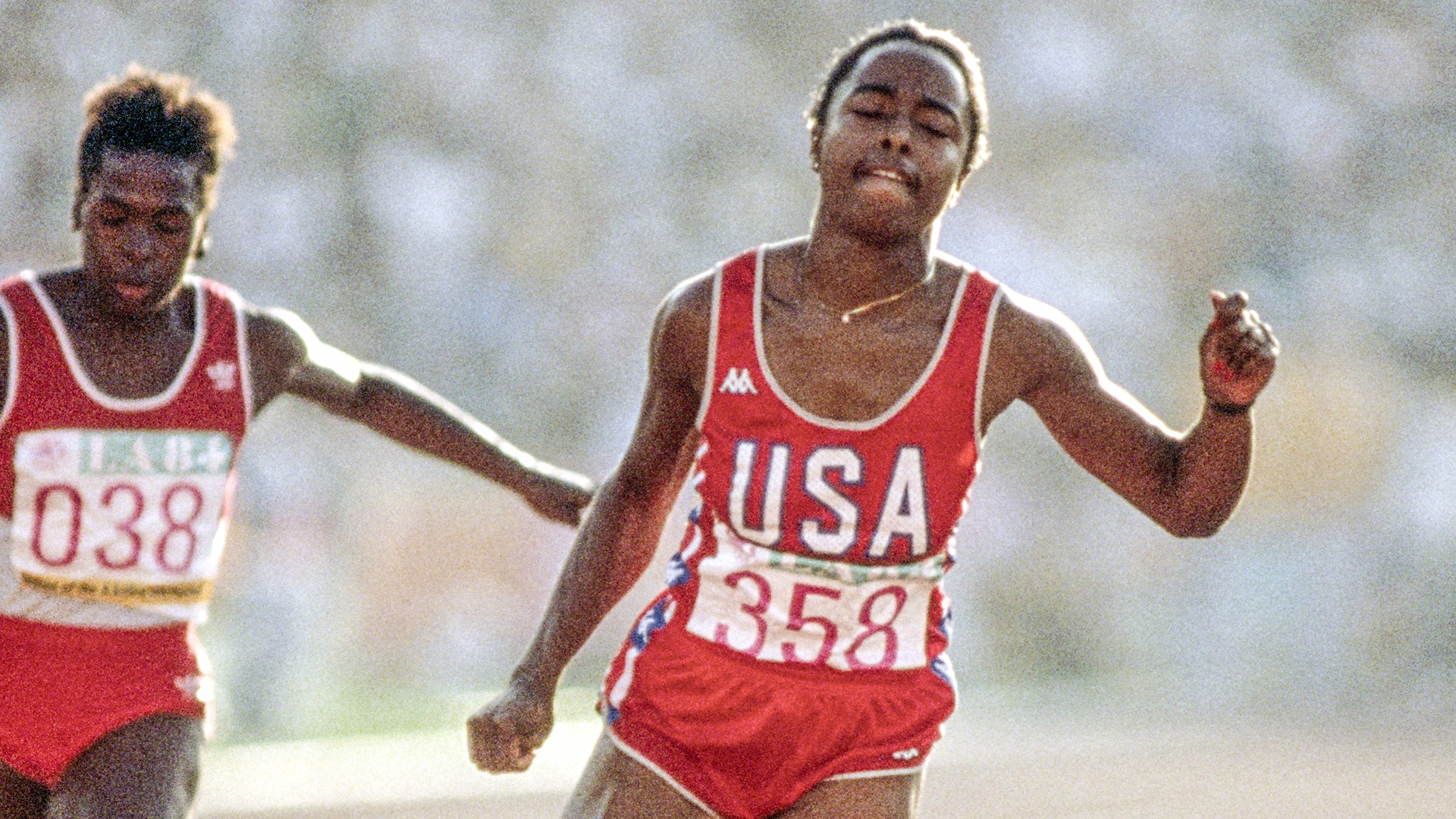
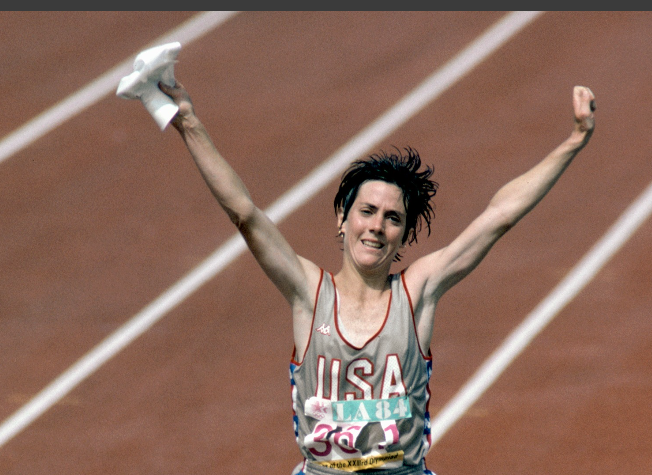
Carl Lewis was a star American sprinter, as was Evelyn Ashford. Lewis also won the long jump. Rowdy Gaines, who called swimming with such enthusiasm in the Paris Olympics, was a multiple medalist. American Joan Benoit was the marathon gold medalist.

And, darn her perkiness, Mary Lou Retton, who recently nearly died from Covid—we are, all of us, mortal—was the star American gymnast. (This was before we found out how brutal her trainers, the Karolyis, were.)


This is the Olympic flame in the Coliseum in 1984. It burned from the same place in 1932. There would be one more Olympics, in 1936, but this time in Berlin. For twelve long years, the flame went out. The fires that burned in between, from Kursk to Normandy, from Stalingrad to London—most of the all, the fire that burned at Auschwitz-Birkenau, would consume millions of lives.

It’s life that the Games celebrate.

At no charge: Jimmy’s Grocery Store Reviews, Arroyo Grande, California

11 Sunday Aug 2024

Posted by ag1970 in Uncategorized

≈ Leave a comment

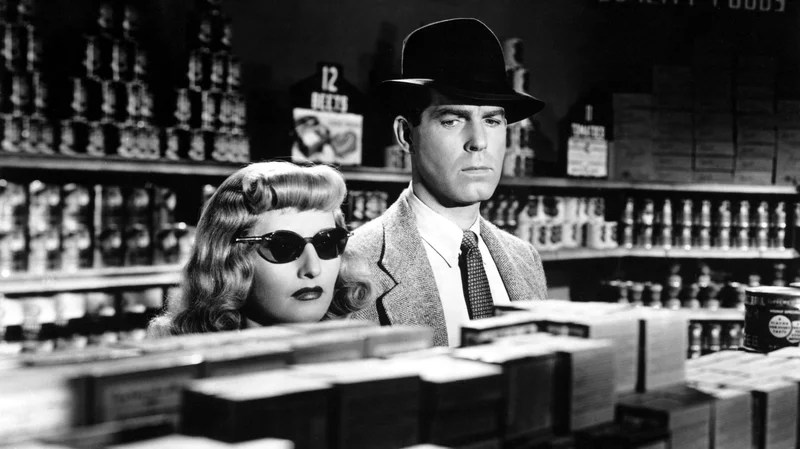
Barbara Stanwyck and Fred MacMurray, Double Indemnity


Vons, Grover Beach: Here is a store that’s clearly in violation of Brown V. Board (1954), which struck down the “Separate But Equal” doctrine laid down in Plessy v. Ferguson (1896). This Vons is nowhere near equal to the store in San Luis Obispo, which is luxurious, with their salmon and cod laid out in mink-lined trays, and makes me feel like Poor White Trash on the scarce occasions when I stop there. The Vons in Nipomo is almost as classy. No, the Grover Beach Vons is shopped by Bakersfield refugees, massively obese women in motorized carts who enjoy gunning down the aisles in search of bargains or shoppers, especially small children, to run over. Negative: The Bake-o’s have the habit of showing up simultaneously and thus shutting down checkout lines when they reach critical mass. Far too many MAGA bumper stickers in the parking lot. Positive: If you order online, the clerks who bring out your groceries are unfailingly polite and sometimes even cheerful. And, while waiting for the checkout stand to FINALLY open up, I get to try out my Spanish on latino families in line with me, who smile at me indulgently and wonder why the old gabacho is speaking to them in Afrikaans.

Smart and Final, almost but not quite Grover Beach: Marvelous produce, pretty decent meat department, a vast array of one of my favorite foods: cheese. Negative: Counterintuitive entrance/exit doors, weird parking lot. The aisles are as narrow as arteries in need of immediate bypass surgery. Online ordering is terrible unless you order delivery. Why not go out and buy a new Porsche instead? It’s cheaper. Positive: The checkout people are usually very pleasant and positive. The customers are even pleasanter and positiver. You don’t mind much when the clerk listens happily to the old, old man in front of you who talks about his sopa recipe. Also, it’s great fun to call it “Fart and Sminal.”

Trader Joe’s: On the site of Elsie Cecchetti’s dairy farm, where she learned to drive a tractor when she was a little girl (she later drove our Branch School Bus). Negative: The worst parking lot in the Western Hemisphere. I strongly suspect the TJ’s has illicit business partnerships with local body shops. Positive: Stunning array of coffees, wines, and one of the best frozen aisles around. Pleasant, helpful clerks, some of the obviously the children of parents who came of age in The Haight during the Summer of Love. Yummy treats at the checkout stands, damn you, TJ!

(Below: A typical TJ parent; the TJ parking lot at 8:12 a.m. on a Tuesday)

HE6767-001


Aldi: The relatively new kid on the block; a partner with the TJ people, German-based and so with organized Teutonically. Negative: Checkout Lines of Death. Sometimes the last cart in line has it back wheels in Los Berros. Quirky inventory: You can buy Bavarian Spaetzel AND rain boots on the same shopping trip, but sometimes they’re out of both, because said inventory seems to depend on Mr. Aldi’s mood that day. Go tomorrow, because a young German golfer earned a Silver in the Olympics golf tournament. Positive: Great prices, especially in the meat section, nice frozen foods, decent pickup service, pleasant checkers most days. If you don’t bring your own, they have PAPER BAGS, unlike the plastic bags that overrun, sadly, places like Tijuana. The real problem with Tijuana isn’t the cartels. It’s the Vons plastic grocery bags.

Aldi’s corporate executives
← Older posts
Newer posts →

Subscribe

  • Entries (RSS)
  • Comments (RSS)

Archives

  • March 2026
  • February 2026
  • January 2026
  • December 2025
  • November 2025
  • October 2025
  • September 2025
  • August 2025
  • July 2025
  • June 2025
  • May 2025
  • April 2025
  • March 2025
  • February 2025
  • January 2025
  • December 2024
  • November 2024
  • October 2024
  • September 2024
  • August 2024
  • July 2024
  • June 2024
  • May 2024
  • April 2024
  • March 2024
  • February 2024
  • January 2024
  • December 2023
  • November 2023
  • October 2023
  • September 2023
  • August 2023
  • July 2023
  • June 2023
  • May 2023
  • April 2023
  • March 2023
  • February 2023
  • January 2023
  • December 2022
  • November 2022
  • October 2022
  • September 2022
  • August 2022
  • May 2022
  • April 2022
  • March 2022
  • February 2022
  • January 2022
  • December 2021
  • November 2021
  • October 2021
  • September 2021
  • August 2021
  • July 2021
  • June 2021
  • April 2021
  • March 2021
  • February 2021
  • January 2021
  • December 2020
  • November 2020
  • August 2020
  • July 2020
  • June 2020
  • May 2020
  • April 2020
  • January 2020
  • December 2019
  • November 2019
  • October 2019
  • September 2019
  • August 2019
  • May 2019
  • April 2019
  • March 2019
  • February 2019
  • January 2019
  • December 2018
  • November 2018
  • October 2018
  • September 2018
  • July 2018
  • June 2018
  • May 2018
  • April 2018
  • March 2018
  • February 2018
  • January 2018
  • December 2017
  • November 2017
  • October 2017
  • April 2017
  • March 2017
  • December 2016
  • November 2016
  • October 2016
  • September 2016
  • August 2016
  • July 2016
  • June 2016
  • April 2016
  • March 2016
  • February 2016
  • January 2016
  • December 2015
  • November 2015
  • October 2015
  • September 2015
  • August 2015
  • July 2015
  • June 2015
  • May 2015
  • April 2015
  • March 2015
  • February 2015
  • January 2015
  • December 2014
  • November 2014
  • September 2014
  • August 2014
  • July 2014

Categories

  • American History
  • Arroyo Grande
  • California history
  • Family history
  • Film and Popular Culture
  • History
  • News
  • Personal memoirs
  • Teaching
  • The Great Depression
  • trump
  • Uncategorized
  • World War II
  • Writing

Meta

  • Create account
  • Log in

Blog at WordPress.com.

  • Subscribe Subscribed
    • A Work in Progress
    • Join 69 other subscribers
    • Already have a WordPress.com account? Log in now.
    • A Work in Progress
    • Subscribe Subscribed
    • Sign up
    • Log in
    • Report this content
    • View site in Reader
    • Manage subscriptions
    • Collapse this bar
 

Loading Comments...