• About
  • The Germans

A Work in Progress

A Work in Progress

Category Archives: Uncategorized

Pep Talk

17 Thursday Dec 2015

Posted by ag1970 in American History, California history, History, The Great Depression, Uncategorized, World War II, Writing

≈ Leave a comment

I have never been shy about writing fan letters, so I wrote one to the UC  Davis prof who’s written a terrific new book, Right Out of California, about political, economic and social conflict in 1930s California.

I also am a shameless little man, so I included the Domingo Martinez piece from the Arroyo Grande book and told her I was looking at writing about the 30s, too.

She emailed back later yesterday:

I’m so glad to hear that my book was relevant to you. I’m also very interested to learn about your own work. The central coast has some great stories from the interwar years to tell; and it seems, from the sample you provided me, that you’re the right person to tell them.

That’s nice. That’s not the clincher, though. My big sister, Roberta, wants me to write it, too.

So I guess I will.

What’s making me dawdle, before I pitch the book idea, is knowing how miserly the pay is. For each $21.99 copy of the World War II book, over a year’s work, I get about $1.50. And I’ve done the research, the writing, located 70+ images from all over the world, some which required me to buy usage rights, and I’ve done a good deal of the marketing.

So I feel like your basic oppressed proletarian.

The other factor: The sheer magnitude of the subject is daunting. World War II, as large-scale as it was, was chronologically compressed and its events already so familiar, so it was much more manageable.

So I think I’ll expand the scope of this book to include the 1920s. That sounds counterintuitive, but I realized that I don’t have the talent or the graduate assistants for a narrative history. What I can do is to generate a thematic overview of the interwar years, to tell good stories well. Themes might include Prohibition and crime; politics, Mr. Hearst, contrasted with the poor; the collapse of farm prices and that impact; daily life, especially of young people; dissidents and dropouts; the New Deal’s impact; the coming of the war.

I’ve got to expand the locale as well, so we’ll include material from Northern Santa Barbara County, even a little from Taft, from San Simeon, of course–but the bulk of the book would come from the area between San Luis Obispo and Nipomo.

[What’s hardest to come by, and what I hunger for, are statistical data that’ll give a snapshot of the Central Coast–everything from foreclosures to crop prices, housing starts to high school dropout rates. Those are hard to find.]

So it would be The Interwar Years on California’s Central Coast or something like that. Or maybe Pete’s Dragon.

Now I’ve got to generate a proposal and go back to my two most important secondary sources and organize the margin notes I’ve taken. I also need to read again David Kennedy’s Freedom from Fear.

Not a good day to feel under the weather.

20151217_084729

Gallery

Excerpt, World War II Arroyo Grande

28 Saturday Nov 2015

Posted by ag1970 in Uncategorized

≈ Leave a comment

This gallery contains 10 photos.


Why We Write

21 Wednesday Oct 2015

Posted by ag1970 in Uncategorized

≈ 1 Comment

Screen Shot 2015-10-21 at 2.45.13 PMJust got the page proofs. Serious proofreading comes next. Kind of numb, but also happy. These are stories that deserved to be set down and, hopefully, they will be remembered.

I think now, looking back on a little book that’s almost done, that they have an unintended educational value, too. There’s so much petulance and selfishness adulterating our national character today–our polity, especially.

Much of this book is a mirror-reversal of that: it’s instead about civic duty, about sacrifice, about generosity–“the better angels of our nature,” as Lincoln put it so vividly. World War II was, after all, just as the Civil War had been, a war where the survival of democracy was at stake.

I think that’s why I need to write another book. Had it not been for a bureaucracy as prosaic as the Soil Conservation Service, Corbett Canyon would today be a desert. One of the fundamental values of the Second New Deal was the belief that we had an obligation to generations not yet born. Those generations are today walking to school on sidewalks that are stamped “WPA 1940” below hillsides that support grazing cattle only because CCC kids built check dams there in 1937.

Democracy works. It takes courage to nurture it, though, and compromise to sustain it, and we need those qualities now every bit as much as we need rain.

Dad and Gen. Patton

04 Sunday Oct 2015

Posted by ag1970 in Uncategorized

≈ Leave a comment

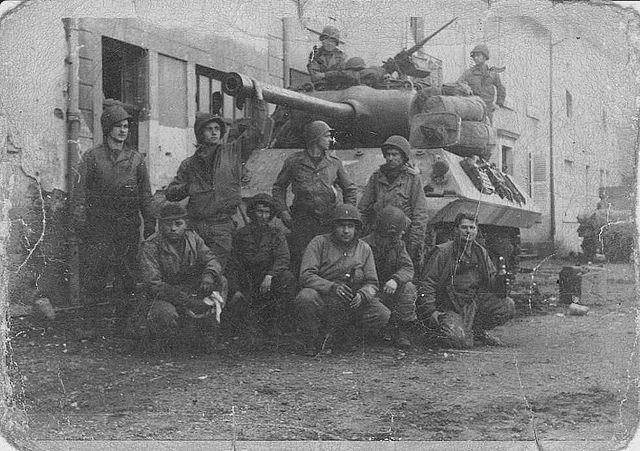
“Old Faithful,” a tank destroyer, with members of Frank Gularte’s 607th TD Battalion.

For the summer and fall, the 607th—its main armament at this point was a three-inch gun, towed by a half-track or ¾ ton truck–sprinted across France under the command of perhaps the most famous American combat general: they were a part of George Patton’s Third Army, and so undoubtedly infused with Patton’s fighting spirit. Patton wanted his tanks and trucks infused, not just his men, and in his drive during the breakout from Normandy—the grand chase across France that Domingo Martinez would not live to see—the general wasn’t hesitant about sending details back to Omaha Beach to steal entire gasoline supply companies. My father, a Quartermaster officer in London, was responsible for sending those units to the beachhead.

Their absence one day led to what had to be the most extravagantly profane cross-Channel phone call ever placed. An irate divisional commander, his division immobilized on Omaha with his men lying on their backs looking for clouds shaped like Rita Hayworth, bellowed that Lt. Gregory would be Pvt. Gregory within 24 hours, and added that there wasn’t a foxhole in northern France deep enough to protect him from the enemy artillery bombardment that the general would be happy to arrange. My father got off the hook when the gasoline’s disappearance was traced to Third Army.

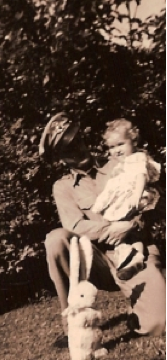
2nd Lt. Robert W. Gregory and his daughter, Roberta, 1944.

2nd Lt. Robert W. Gregory and his daughter, Roberta, 1944.

Change the Damned Title (Please)

23 Wednesday Sep 2015

Posted by ag1970 in Uncategorized

≈ Leave a comment

A crippled B-17 begins its plunge to earth over Berlin.

A crippled B-17 begins its plunge to earth over Berlin.

[Dear Editor Lady]:

It was good to talk to you today! You did mention the book title in passing. Arroyo Grande in World War II, to me, has the kind of appeal that would sell twelve—maybe fifteen—books. I am thinking and consulting Lincoln, Shakespeare, Exodus, Wilfred Owen and Ernest Hemingway. Nothing yet. Then there are several passages in the book that come from soldiers’ or sailors’ letters home. I was re-reading Elliot Whitlock’s—he would win the Silver Star for his conduct in bringing his crippled B-17 back to base in England—and a particular sentence arrested me:

…At that time Jim’s parachute caught fire as did an extra one we carried. Mine was burnt but not seriously. With his chute gone, Jim couldn’t jump. I decided to stay with the ship while Jim put out the fire. He succeeded in getting it under control, but his hands were so badly burnt that he couldn’t do anything the rest of the trip.

   He held the ship level while I finished putting the fire out…Somebody handed a fire extinguisher through a hole the fire had burnt, and so I looked back and everybody was there (in the tail) for which I thanked God. Nobody…had bailed out. They had not heard the order.

    …I had dived the ship immediately after the fire so that nobody would pass out it the oxygen was cut off. Suddenly we started to get an awful lot of flak (anti-aircraft fire from the ground) so I had to hurry back to the cockpit to do some evasive action which worked okay, incidentally. I had one of the boys get the maps…and had the radio operator get fixes so I plotted a course for home with as little flak as possible. The radio operator did a fine job so we came out on course and landed OK. All this was above the clouds, so I think I can qualify for navigator now as well as pilot…

   …Your prayers are standing by me. I was praying up there and all the rest of the men were praying, too…

Lots of love,

Elliott

So, this came to mind:

Your Prayers Are Standing by Me

A California Town in World War II

One of the major reasons I wrote this book was to connect an obscure and seemingly unimportant little town with events both famous and world-changing. These events happened so far away, so the theme of distance—spatial, temporal, emotional–is one that comes up over and over in the book. The book shifts between those distant events and the home front. Elliot’s poetic sentence represents, to me, a bridge between the distant and Home, between a plane in trouble over Berlin and a father and mother running a little grocery on Branch Street—in their prayers, almost willing the plane safely home. The book, likewise, is intended to be a bridge between Arroyo Grande and the war, and even more, between living generations and one that has almost disappeared. Frankly, I like it also because it’s organic: it comes from a kid who was in the AGUHS Drama Club and the Diction Club and not from Thucydides, whose high-school yearbook I can’t find. The fact that this is a religious sentence is, to me, irrelevant: it’s a bridge.

Here are just a few examples of that idea of “distance” and of “connectedness:”

>…its characters will enter the Arroyo Grande Valley, many after long and dangerous journeys; World War II will call their descendants—part of “The Greatest Generation”– away on journeys more dangerous still…

>…there were deep hurts that would need time to heal, hurts inflicted all the way from the hedgerows of Normandy to the desolate, shell-blasted landscape of Iwo Jima and, finally, to now-empty baseball fields in internment camps like Gila River.

>…the war, for Americans at home, was both distant and, for grieving families, painfully intimate…

>…Winds had carried the copper-red soil as far east as the mid-Atlantic to drop it, like gritty rain from a place that had none, onto ships still sailing freely between continents…

>…The U-boats would someday kill that young field worker, if indirectly, as part of a inexorable chain of events that would lead him to Normandy, so far away from the fields that border Arroyo Grande Creek, and to pastures bound by hedges and grazed by fat dairy cows…

>… The first gunshot heard in the Arroyo Grande Valley came a few weeks before Victoria ascended the English throne. It was probably fired from an 1825 Hawken rifle…

>… By the early part of the new century, some of the workers in those fields, their wide-brimmed straw hats like mushroom caps as they bent to their work, would figure prominently in the American history that Clara loved. They were first immigrants to arrive from Japan, most of them from the southern island, Kyushu, but a few of them from farther north, in the prefecture that surrounded the city of Hiroshima.

>…The next day, he and his classmates at Arroyo Grande Union High School gathered in their new gymnasium—a New Deal WPA work project that still serves as the Paulding Middle School gym today—to listen to Franklin Roosevelt’s dramatic eight-minute address…

>… Many years later, [a local cattlewoman] would tell Port San Luis Harbor Commissioner Donald Ross that she’d seen a sub—during I-21’s combat patrol– surface offshore during her shift on a volunteer shore patrol, somewhere along the beach in what is today Montana de Oro State Park. She let fly with her 30-30 carbine. The range was too great, she told Ross, but she had the satisfaction of seeing the crew scamper below and the captain dive the boat…Within weeks, I-21 would be sinking shipping off the coast of Australia, would shell Sydney Harbor, and would be lost with all hands near Tarawa in 1943.

>–I just saw one of the swellest sights. You will never believe it when I tell you. It was fresh green peas in a field…if you had been where we were and as long as we were, you would know why we thought so much of seeing a field of vegetables. We saw many wonderful sights….We saw country that reminded my of the Cuyama, some places reminded me of the scenery between San Simeon and Monterey. For the past few months we have seen nothing but country like that at Devils’ Den, except there is more wind and sand here.

–A letter home from North Africa

>That was Frank Gularte’s last full day of life. On the 28th, the 607th was ordered to take another town, Merten. Everything that could go wrong did… Somewhere in the melee, a German sniper took the life of the young man who would never see his son.…Five days later, Sally Gularte gave birth to Frank Jr. Only a few days after that–after she’d first held her son close in her arms–she received the War Department telegram that took her husband away from her.

>Juzo Ikeda’s life had been a successful one, too, marked by hard work. But his workplace had been beautiful—green hillsides, fields of black earth and, in the distance, above the ears of his team of horses, he could see shimmering white sand dunes. He could smell the sea…Japan had destroyed his family’s fortunes and so had trapped those who stayed behind; in coming to America, Juzo had set himself and his sons free.

But when death came for him in 1943, Juzo was in a makeshift hospital in a barren desert camp. He died not long after asking his son to remain loyal to the nation that had made them prisoners.

–On the other hand, I could be full of beans.

Jim

My Greatest Strength

22 Tuesday Sep 2015

Posted by ag1970 in Uncategorized

≈ Leave a comment

1522176_10202851582434360_407912915_n

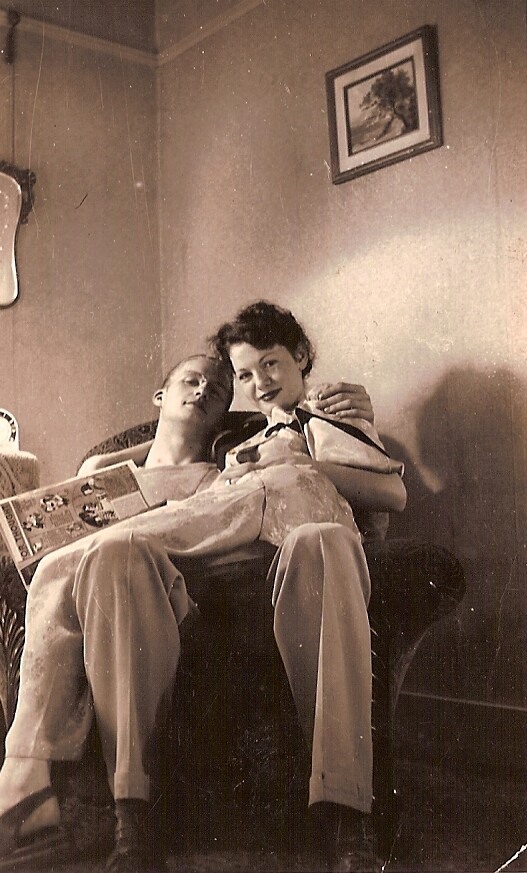
I took Mom some flowers yesterday (I also said “Howdy” to a lot of people. If you are of Portuguese or Japanese descent, I probably visited your ancestors.) and realized this week would have been Mom and Dad’s 75th wedding anniversary.

He came from the Ozark foothills to Taft, at 21, on a technically illegal baseball scholarship–Dad was a gifted and graceful athlete–and she was a soda jerk,18, and I think they fell in love over the ice-cream sundae she made for him. And, what a year–1939–to date! “Gone with the Wind,” “Wizard of Oz,” “Goodbye Mr. Chips,” and so on. Thank you, Hollywood, for making us four kids possible!

He was incredibly quick-witted and funny, an absolutely mesmerizing storyteller, brilliant (especially with numbers); she was sensitive, artistic, a brilliant, lifelong learner, intensely spiritual and she had a powerful sense of social justice. Me? I was lucky.

But if you know me, you know them.

Forty-six years after my Mom’s death, I still miss her, and she still inspires me. Each and every one of my life’s accomplishments was meant as a gift for her, and, if you’ve been one of my students, my Mom loves you every bit as much as I do.

I also inherited their deep and destructive flaws–Dad’s temper and his alcoholism, too, Mom’s struggles with depression–and the truly marvelous thing about getting older is how you begin to appreciate those things, as well. In confronting and enduring them, they become your strengths.

My parents may be my greatest strength of all.

Happy 75th, Mom and Dad. I love you forever.

Honoring the Greatest Generation: The debt we owe our elders

11 Tuesday Aug 2015

Posted by ag1970 in Uncategorized

≈ Leave a comment

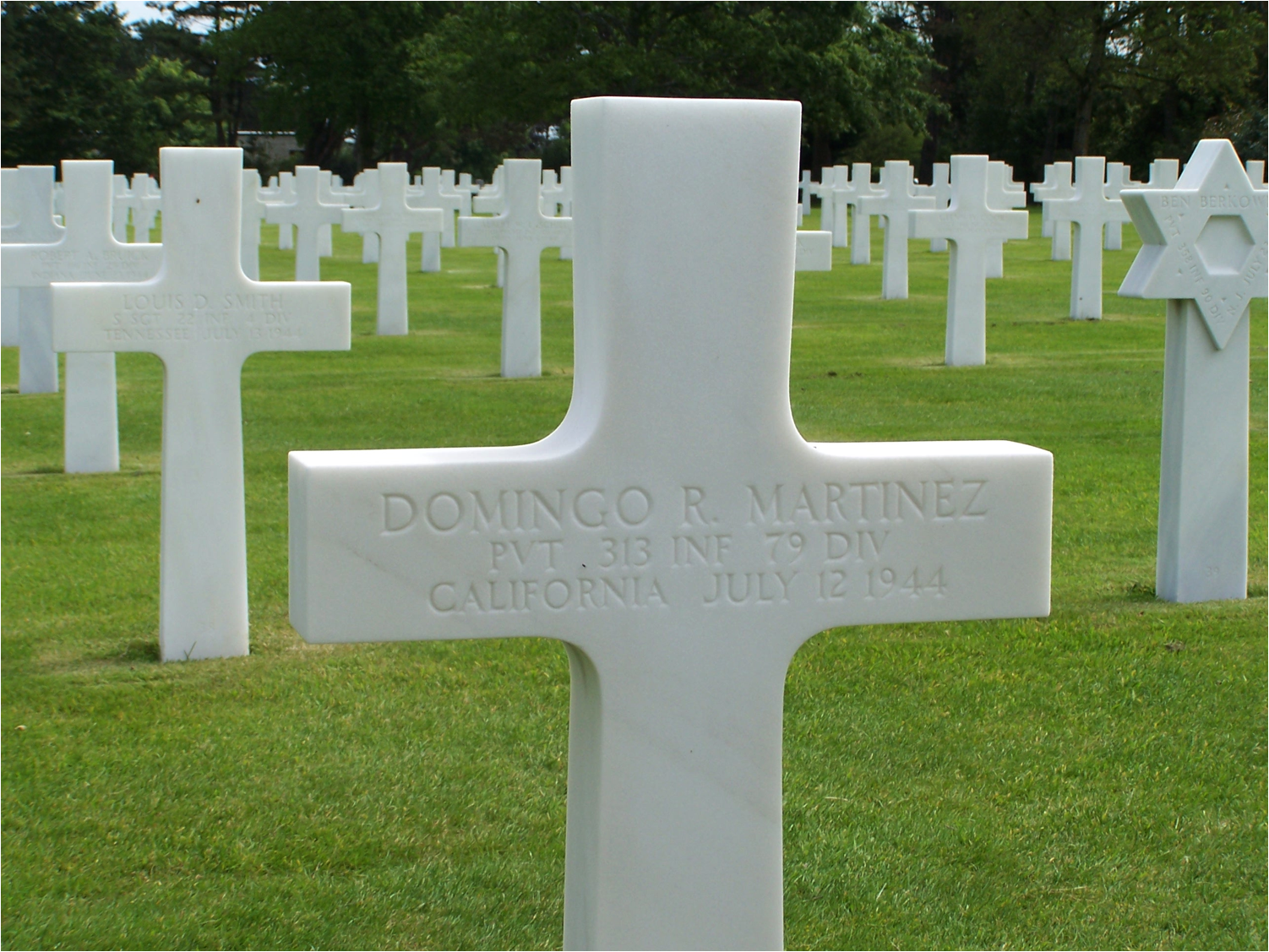
Martinez

Some good Arroyo Grande folks– which is the reason I’m writing a book–have set aside this Saturday as a day to honor our elders in the Heritage Square Park in Old Arroyo.

I was supposed to have written several books by now, according to my Arroyo Grande High School classmates, from forever ago, but Life intervened, and I am easily distracted, with a short attention span. That intensified the shock I felt when my book proposal, about Arroyo Grande’s role in World War II, was accepted by an actual, real live publishing company. Now I am nearly finished.

I spent a rewarding career as a high school history teacher, mostly at AGHS, because I was taught so well: my father, a World War II veteran, was a masterful storyteller. My Dad is one reason for the book.  My love for my home town, Arroyo Grande, is another.

What has struck me, over and over again, in researching my father’s generation, is how capricious and perverse war can be in taking the lives of young men whose first steps, or first words, first school play or first home run brought such joy to their parents.

The war would not spare Arroyo Grande this cruelty.

–There is the little boy who learned to play piano here, when the grammar school stood where Mullahey Ford is today; he would eventually pick up the trombone and the accordion and, when his family later moved to Long Beach, he would start his own dance band.  He opted for the Navy specifically to stay out of the Army and he was about to join a detail from his ship’s band in the National Anthem when a bomb straddled Arizona’s stern and blew him, dead, into Pearl Harbor. Moments later, his bandmates would be vaporized at their action stations in the No. 2 turret, just inboard from where the fatal bomb struck. The trombonist was named Jack Scruggs.

–The 1938 Arroyo Grande Union High School valedictorian was so brilliant that after his graduation from Cal, the Army Air Force selected him for a special program: He would be among the lead pilots, called “Pathfinders,” in over the target, equipped with the new radar, and his bomb group would drop their payload on his signal, when he let his bombs go. Three weeks before his first mission, he was hitching a ride on another B-17 whose inexperienced pilot flew the bomber into the side of Mt. Skiddaw in northern England. The wreckage is still there today.  His name is Clarence Ballagh.

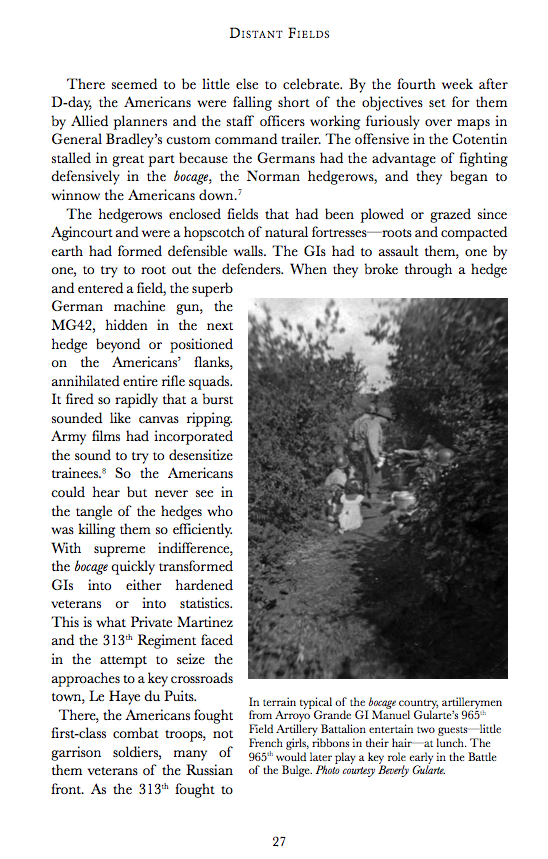
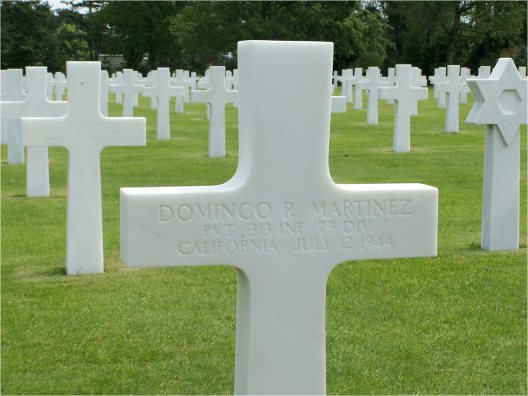
–The farmworker first fought with the 79th Infantry Division to capture Cherbourg. Afterward, the division fought through Normandy’s hedgerows, in the death-traps the Germans had set in the bocage, but seemed to score a coup in seizing the heights above a key crossroads at Le Haye de Puits. The enemy was unwilling to let the town go. SS-Panzer units–some of the most hardened and highly-motivated soldiers in the German Army– launched a counterattack on his regiment’s position and it failed. The 79th Division eventually took Le Haye de Puits in house-to-house fighting, but Private Domingo Martinez was gone by then. He’d been killed during a furious series of assaults on Le Bot, a village just to the south.

–The Filipino-American mess attendant, the only rating to which a man like him could aspire to in the racist wartime Navy, wrote the funniest, most endearing letter a serviceman could write home. It was published in the Arroyo Grande Herald-Recorder, and it was the kind of letter that made you wish you had known him. Three weeks after he wrote it, near Guadalcanal, a Japanese Long Lance torpedo blew the bow off his destroyer, Walke.  He died along with a third of her crew, including the captain, and many of them died in the water. They survived the torpedo hit but were killed by the concussion of Walke’s depth charges as they tumbled to the bottom of Ironbottom Sound.  His name is Felix Estibal.

-–Before the war, he had worked at the E.C. Loomis feed store, and since he worked for the Loomises, he would have known virtually everybody in Arroyo Grande–population 1,090–and they would have known him. He served in a tank destroyer company in France–big tanks with 90 mm cannon, a counter to the German 88. On Nov. 27, 1944, his company, vastly outnumbered, blunted an enemy infantry attack that would earn the lieutenant in command a Silver Star. The next day was perverse: his platoon advanced toward a village called Merten when the lead tank destroyer ran into a ditch. A German round knocked the tread off a second, and the whole column, stalled, was destroyed. In the melee, a sniper killed Sgt. Frank Gularte. Frank Gularte Jr. was born five days later; the joy of his arrival would be muted by the War Department telegram that followed.

–His father farmed land in Corbett Canyon. In March, 1945, on Iwo Jima, he died as a replacement–in the World War II Marine Corps, the lowest form of life imaginable–a short-termer in the famed 28th Regimental Combat Team. It had been a squad from the 28th, immortalized by AP photographer Joe Rosenthal, that had raised the flag on Mt. Suribachi early in the battle. He might have seen the distant flag, but he was just a stevedore then, offloading supplies and waiting his turn to be assigned to the strangers with whom he would die. That death would come during an assault on Hill 362A, honeycombed with caves and machine gun nests. His total combat experience in the Second World War was, at most, 48 hours, and he was killed 48 hours before he turned twenty-one. Louis had been born when his parents were in their forties: his death had to leave a space, for Antonio and Anna Brown, that never could be filled.

It strikes me that what kills men most often in warfare is not glorious bayonet charges but mistakes, in inferior equipment, in misguided orders, in inexperience, and, most of all, because of mistakes on which nothing can be blamed.  They are fate.

Maybe it’s a different kind of fate that led me to write this book.

When you research men like these something powerful happens.  They are of my father’s generation, but the more I get to know them, the more they become my sons. I miss men I have never met.

Their deaths may seem to have been impersonal and illogical, but they have great meaning. Here is why.

I am amazed at the way the young men and women who survived the war came home and put themselves back to work.

They built schools, started Babe Ruth leagues and Boy Scout troops, ran for office, started hardware stores, incorporated a hometown bank, and poured everything they had into my generation to make sure our lives were safe, to make sure our stomachs were full, to inculcate in us the need to get a good education and the desire to make something of our lives.

It is no coincidence that I grew up loving Arroyo Grande. When my family moved here in 1955, the veterans of World War II had already prepared a home for me.

They worked so hard, I think, because they knew that’s what Jack Scruggs, Clarence Ballagh, Domingo Martinez, Felix Estibal, Frank Gularte, and Louis Brown would have done, too. The generation, raised in depression and in war, to whom we owe so much, would not allow themselves to rest until they had paid their debt to the men who would never see the Arroyo Grande Valley again.

The last barbecue

01 Saturday Aug 2015

Posted by ag1970 in Arroyo Grande, Uncategorized

≈ Leave a comment

Joe, Tony, Manuel, Frank, Mom (Clara), Mary, Edwina, Clara, Rose, Annie, and Barbara

Joe, Tony, Manuel, Frank, Mom (Clara), Mary, Edwina, Clara, Rose, Annie, and Barbara

Eighty-eight photographs with captions and credits, check. I would like to thank Mrs. Clara Gularte for lining up her six daughters in age order–I think I’ve got them right– in this 1944 photograph, at a family barbecue on the ranch at the entrance to Corbett Canyon. It was taken just before her two soldier-sons went overseas. She made it easy, lining up those girls, on us History Types. This is a beautiful photo of a beautiful family, and many thanks to Annie and John Silva.

The tragedy of the photo is that Frank, kneeling, wouldn’t make it home. He would be killed in France on November 29, 1944; his little boy would be born five days later. Shortly after the joy of Frank Jr.’s birth, his wife, Sally, and the family got the worst telegram, from the War Department, that a family could possibly get.

On December 13, a memorial mass was said for Frank at St. Patrick’s. Four days after that, his brother, Manuel, standing in this photo, went into action with his artillery battery at St. Vith to cover the American retreat in the Battle of the Bulge. That was the day that Arthur Youman entered Bastogne with his outfit, the 101st Airborne Division.

It was Youman’s twenty-third birthday.

I’ve been living with this war for a year now. It’s getting a little overwhelming.

Our Airborne Brother

26 Sunday Jul 2015

Posted by ag1970 in Arroyo Grande, Uncategorized

≈ Leave a comment

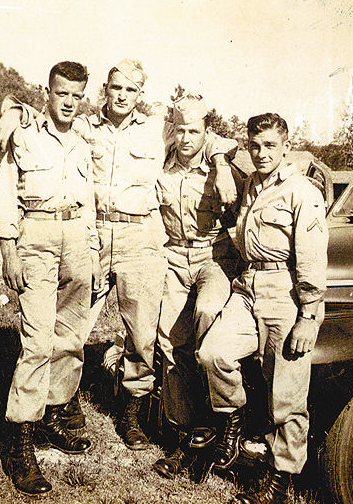
Arthur Youman, second from left, in training with the 101st Airborne.

Arthur Youman, second from left, in training with the 101st Airborne.

…Frank’s brother, Manuel, and his 965th Field Artillery Battalion began a desperate fight around St. Vith, Belgium, in support of elements of the Seventh Armored Division. The Americans would lose the town to the Germans, but the 965th’s heavy guns—155 mm cannon—would be one of the factors that would make them pay dearly for it, wrecking the enemy’s timetable: the Seventh Armored abandoned the town four days after the German target date for its seizure: December 17, 1944.

That was the day that the 101st Airborne Division arrived to take up defensive positions in and around Bastogne. Their stubborn resistance in holding this town, in the rear of the German advance, was another decisive factor that prevented the Bulge from becoming the breakthrough that Hitler so desperately wanted: the German drive to the west lost momentum as thousands of Wehrmacht soldiers were thrown into the attack on Bastogne. There, among the tough and battle-wise Americans—some of their foxholes are faintly visible today– was a young sergeant from Arroyo Grande, Arthur C. Youman. He arrived in Bastogne on his twenty-third birthday.

Youman was Kentucky-born and was raised in Kern County, but he’d been living in Arroyo Grande when he enlisted in 1943. He and his comrades were told that the 101st faced, at most, three days in the line. It didn’t work out that way. For nine days they were surrounded, relying on scattered airdrops of food and ammunition to keep going. George Patton’s Third Army launched a furious attack on the southern shoulder of the Bulge and finally broke through: the first of Patton’s tankers to make contact with the 101st, on December 26, was Creighton Abrams, the future commander of American forces in Vietnam. But German resistance continued, with Youman and the paratroopers fighting into February, when they were finally pulled off the line. They had meantime endured not just the last great German offensive of the war, but also the coldest winter in Europe in thirty years.

Youman was a good soldier in one of the best combat units in American military history. He’d dropped into Normandy on D-Day, helped to capture the key Norman town, Carentan, and then joined the 101st in the ill-conceived Operation Market Garden, Field Marshal Montgomery’s attempt, in Holland, to seize the Rhine River bridges and deliver a thrust into Germany. Market Garden was a fiasco: it would claim another Arroyo Grande paratrooper, Lt. Francis Eberding, a member of the 82nd Airborne Division.

The 101st fought in Holland from September until the end of October: one high point came when Youman’s company rescued 100 British soldiers stranded in Arnhem, the centerpiece for Cornelius Ryan’s A Bridge too Far. It was during Market Garden that Youman would be promoted to sergeant; he’d impressed his boss.

The young officer who promoted Youman was Lt. Richard Winters, the commander of Easy Company, 506th Parachute Infantry Regiment, 101st Airborne Division. Youman was one of historian Stephen Ambrose’s “Band of Brothers.”

Little Moe’s Boys

13 Monday Jul 2015

Posted by ag1970 in Uncategorized

≈ Leave a comment

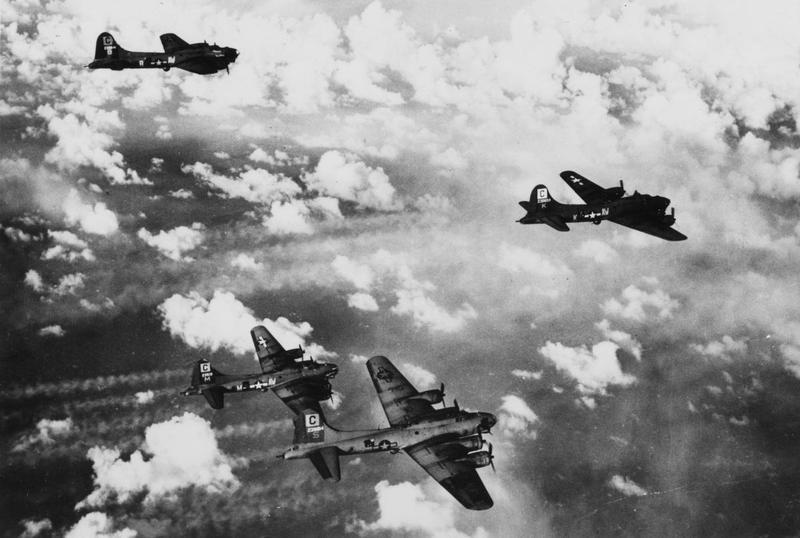
media-408635 The average age of a World War II B-17 pilot was 22; gunners were around 18. These are B-17 G’s  from the 8th Air Force’s 96th Bomb Group, and an Arroyo Grande flier, Elliott Whitlock, was a 22-year-old co-pilot in a 96th squadron based at RAF Snetterton Heath in Norfolk.  His dad owned the Commercial Co. Market, in the building that now houses a cafe at the corner of Branch and North Mason.

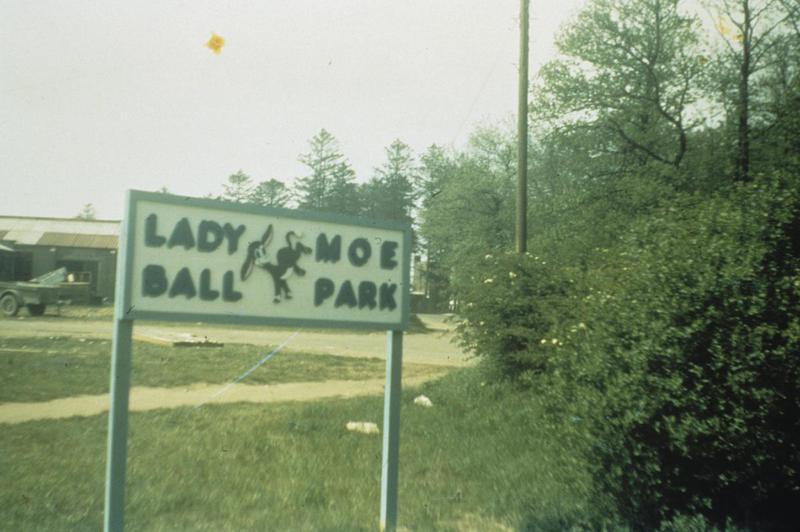
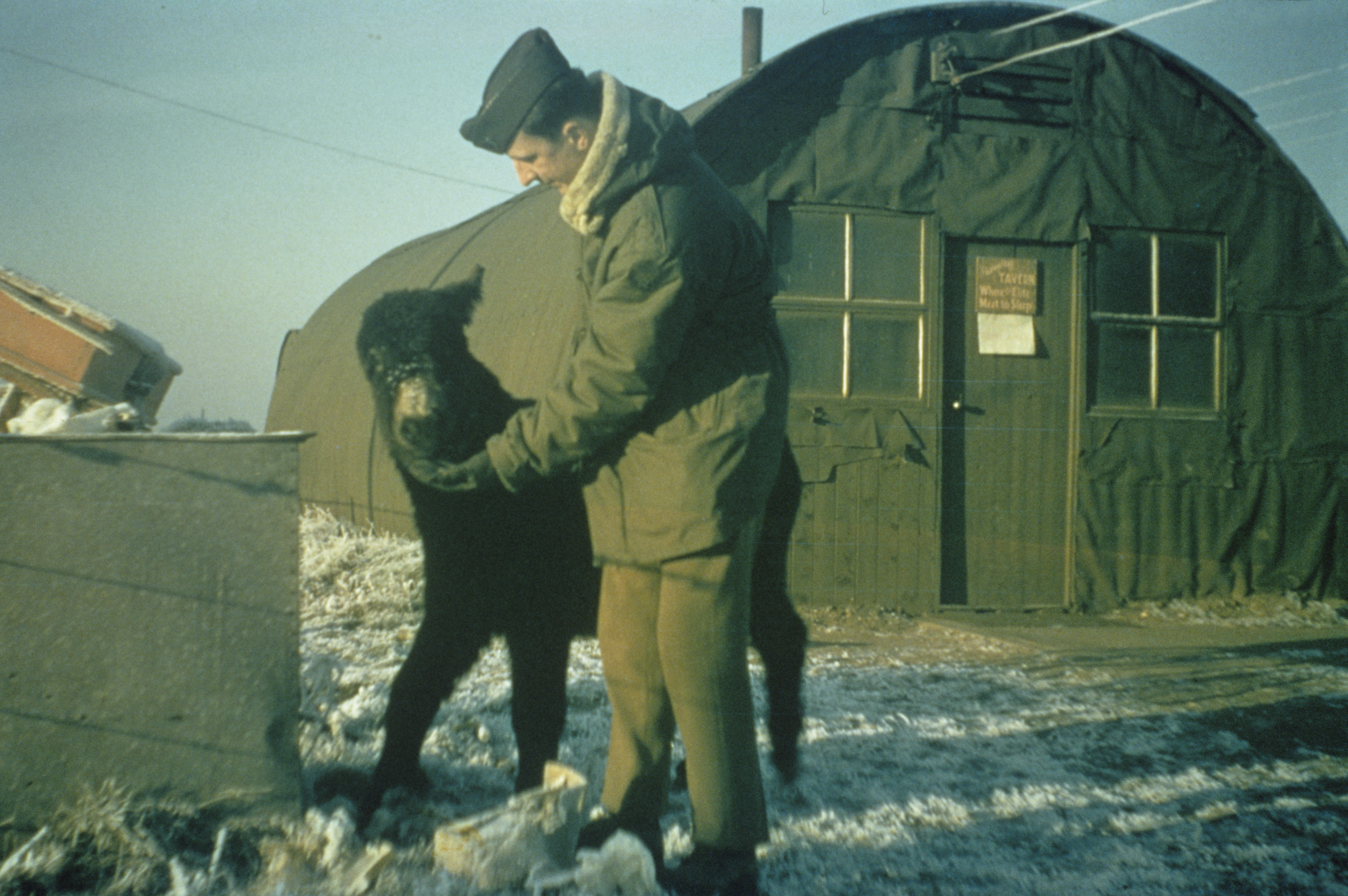
Besides the visiting Yanks, another resident of the Heath was a small donkey that the squadron adopted and christened “Lady Moe, Queen of the Heath.” Her young admirers played baseball at the Lady Moe Ball Park and watched movies at the Lady Moe Theater. She had unlimited visiting privileges; some say she even flew a combat mission. She liked American cigarettes. Eating them.

media-387751 Lady Moe reciprocated the affection lavished on her. She began to appear with the ground crews at the control tower, waiting with them as they anxiously counted B-17’s on the return of her boys from their missions.

FRE_005880

Moe almost lost Elliott during the 24th of his 25 missions, after a March 1944 raid on Berlin. The “High ‘n’ Mitey” was on her return trip when the plane caught fire, and the pilot, Capt. Jim Lamb, was burned trying to put it out.

Lamb gave the order to bail out. Whitlock saw three chutes forward but, looking backward, he saw that the crew in the waist hadn’t responded. The fire had disabled the intercom: they never heard Lamb. Whitlock then saw how badly hurt Lamb was, saw that his chute was partly burned away, and he countermanded his skipper’s order.

Somehow a fire extinguisher appeared in Whitlock’s hands–he was unclear later as to how. He put out the cabin fire and took over the control yoke. Lamb’s hands were burned, and it took a young man’s strength to fly a B-17: pilots could lose ten pounds on a typical mission.

He would dive “High ‘n’ Mitey” to extinguish the remainder of the fires onboard, then, at painfully low altitude, bob and weave the ship through a gauntlet of German flak, back to the Channel—back, finally, to Lady Moe. His conduct that day earned Whitlock a Silver Star. He’d admit in a letter home that he, and his crew, had been terrified. In an arresting sentence, he told his parents that “your prayers are standing by me.”

A few weeks later, the same B-17, with a new crew, would be shot down over the Pas-de-Calais. The tail gunner was the only survivor.

Whitlock would survive the war to become an attorney in San Bernardino County. At the time of his death, more than sixty years after that 24th mission, a local bar journal praised his wisdom and his kindness; he was a mentor to many young lawyers. He had led a good life.

The British were sometimes dubious about the goodness of the young Yanks, including fliers like Whitlock, in their friendly invasion. We were boisterous, comparatively affluent in drab wartime England and, as one Arroyo Grande soldier wrote home, we thought “those English girls, with their accents, sure are cute.”

But there was something else the British felt, too. In 2005, they opened a little museum, in a Quonset hut near the old airfield, so that future generations could have the chance to know Whitlock and his comrades.

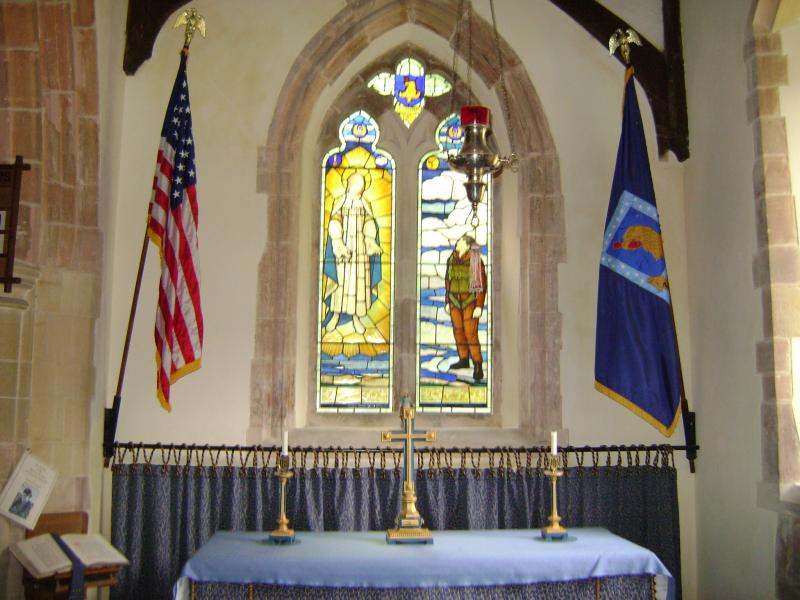
And, before that, there was the figure incorporated into a stained-glass window of the local parish church. It would be reasonable to expect a traditional image: an angel, for example, looking earthward to proclaim Christ’s birth.

There is, instead, an American in his flight suit, looking heavenward, toward a risen Christ. The window is a poignant reminder of the constancy of the people of Norfolk, who learned to love the young men who had made little Lady Moe their queen.

media-14870

← Older posts
Newer posts →

Subscribe

  • Entries (RSS)
  • Comments (RSS)

Archives

  • March 2026
  • February 2026
  • January 2026
  • December 2025
  • November 2025
  • October 2025
  • September 2025
  • August 2025
  • July 2025
  • June 2025
  • May 2025
  • April 2025
  • March 2025
  • February 2025
  • January 2025
  • December 2024
  • November 2024
  • October 2024
  • September 2024
  • August 2024
  • July 2024
  • June 2024
  • May 2024
  • April 2024
  • March 2024
  • February 2024
  • January 2024
  • December 2023
  • November 2023
  • October 2023
  • September 2023
  • August 2023
  • July 2023
  • June 2023
  • May 2023
  • April 2023
  • March 2023
  • February 2023
  • January 2023
  • December 2022
  • November 2022
  • October 2022
  • September 2022
  • August 2022
  • May 2022
  • April 2022
  • March 2022
  • February 2022
  • January 2022
  • December 2021
  • November 2021
  • October 2021
  • September 2021
  • August 2021
  • July 2021
  • June 2021
  • April 2021
  • March 2021
  • February 2021
  • January 2021
  • December 2020
  • November 2020
  • August 2020
  • July 2020
  • June 2020
  • May 2020
  • April 2020
  • January 2020
  • December 2019
  • November 2019
  • October 2019
  • September 2019
  • August 2019
  • May 2019
  • April 2019
  • March 2019
  • February 2019
  • January 2019
  • December 2018
  • November 2018
  • October 2018
  • September 2018
  • July 2018
  • June 2018
  • May 2018
  • April 2018
  • March 2018
  • February 2018
  • January 2018
  • December 2017
  • November 2017
  • October 2017
  • April 2017
  • March 2017
  • December 2016
  • November 2016
  • October 2016
  • September 2016
  • August 2016
  • July 2016
  • June 2016
  • April 2016
  • March 2016
  • February 2016
  • January 2016
  • December 2015
  • November 2015
  • October 2015
  • September 2015
  • August 2015
  • July 2015
  • June 2015
  • May 2015
  • April 2015
  • March 2015
  • February 2015
  • January 2015
  • December 2014
  • November 2014
  • September 2014
  • August 2014
  • July 2014

Categories

  • American History
  • Arroyo Grande
  • California history
  • Family history
  • Film and Popular Culture
  • History
  • News
  • Personal memoirs
  • Teaching
  • The Great Depression
  • trump
  • Uncategorized
  • World War II
  • Writing

Meta

  • Create account
  • Log in

Blog at WordPress.com.

  • Subscribe Subscribed
    • A Work in Progress
    • Join 69 other subscribers
    • Already have a WordPress.com account? Log in now.
    • A Work in Progress
    • Subscribe Subscribed
    • Sign up
    • Log in
    • Report this content
    • View site in Reader
    • Manage subscriptions
    • Collapse this bar
 

Loading Comments...