• About
  • The Germans

A Work in Progress

A Work in Progress

Category Archives: Uncategorized

Mama, don’t let your babies grow up to be historians.

15 Friday Jan 2016

Posted by ag1970 in Uncategorized

≈ Leave a comment

us-coast-guardsmen-assisting-a-wounded-marine-returning-from-the-fight-on-iwo-jima

Coast Guardsmen and a wounded Iwo Jima Marine.

I got wounded today–nothing at all like what this young Marine is going through. I left something out of the book, and I got reamed for it. I’d let a reader down who deserved to be in the book. A lot of it went back to the maddening business about the photographs. I submitted 104; they used 70, of the 70, I had to re-submit about thirty.

It has to do with megapixels and dpm’s, which are beyond my understanding. What it meant was that a story and image–this man’s story and his family’s story– that deserved to be shared didn’t make it into the book. There were other images that didn’t get in, each with its own story, that included:

–My friend Will Tarwater

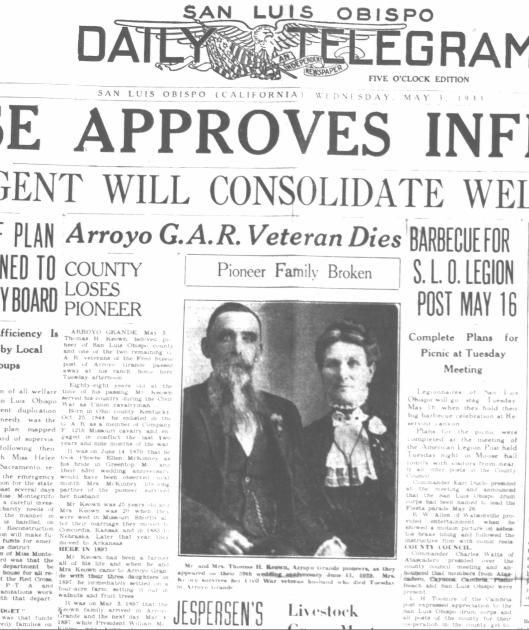
–Vard Loomis and the Arroyo Grande Growers baseball team–Vard’s first name was “Joseph,” as in Joe, one of the best friends of a lifetime.

–The Dohi family; it took me weeks to get permission to use this photo. Didn’t make it.

–Jess Milo McChensney and his B-24 crew

–A photo of Clara Paulding, just dismounted from her bicycle, in front of 1898 Branch Elementary School–the same schoolhouse where my education would begin sixty years later.

–Pvt. Francis Fink, a relative of an Arroyo Grande family that means a lot to me.

–A photo I thought essential, of two Filipino men in the garden of their Allen Street home, inundated with ten-year-old boys who were their pals.

–A photo donated by my friend Gerrie Quaresma, of a Portuguese wedding of an ancestor of hers at old St. Patrick’s.

–The senior portrait of Elliott Whitlock, who won the Silver Star for bringing his B-17 and her crew home to their base in Norfolk.

Not getting those in and not having the chance to tell the story the way you want to is  heart-breaking.

I was so disgusted with their photo policy that I decided, at one point, to give up the book entirely. I had put too much work into it and changed my mind.

But one part of the reaming that grated was the insinuation that I hadn’t worked hard enough in my research, that I didn’t do enough homework.

Getting called on the carpet for an accusation like that is bullshit.

The “Notes” section only lists those works I actually cited in the manuscript. If I’d had a bibliography, here are the sources I consulted to learn about one Marine’s family, his service, and his death (I got his whole personnel file, including his fitness reports, his last will and testament, the last effects recovered from his body, the pitifully small list of his personal belongings kept back home, at Pendleton, and some things that were none of my damned business. I used it and then trashed it. It seemed an invasion of the young man’s privacy, and he’d led a good and hard-working life.):

I don’t have all of them, but here are the at least most of the sources I consulted to learn about Marine Pvt. Louis Brown, about one man:

  • “Azoreans and Madeirans,” Minority Rights Group International—Workingto Secure the Rights of Minorities and Indigenous Peoples, http://www.minorityrights.org/1820/portugal/azorea.
  • Yesterday, Today, and Tomorrow, vol. 5 (Arroyo Grande, CA: South County HistoricalSociety, 1981–89).
  • Antone [sic] Brown, “Headstone Applications for Military Veterans,” Ancestry.com.2009.
  • “Certificate of Death,” Private Louis Brown, Bureau of Medicine and Surgery, Navy Department, Washington, D.C., June 1945.
  • Antone [sic] and Anna Brown, “Family Tree,” Ancestry.com
  • 1920 Census
  • 1930 Census
  • 1940 CensusComplete personnel file, Pvt. Louis Brown, Records of the United States Marine Corps, Department of the Navy, National Archives (that cost $100)
  • Arroyo Grande Valley Herald-Recorder, 6 April 1945
  • World War II Navy, Marine Corps, and Coast Guard Casualties, 1941-1945. (where I discovered Louis’ name had been spelled “Louise.”)
  • The First Battalion of the 28th Marines on Iwo Jima: A Day-by-Day History from Personal Accounts and Official Reports, with Complete Muster Rolls, by Robert E. Allen.
  • MUSTER ROLL OF OFFICERS AND ENLISTED MEN OF THE U.S. MARINE CORPS FIRST BATTALION, TWENTY-EIGHTH MARINES, FIFTH MARINE DIVISION, FLEET MARINE FORCE, C/O Fleet Post Office, San Francisco California.
  • The United States Marines on Iwo Jima: The Battle and the Flag Raisings. By Bernard C. Nalty and Danny J. Crawford
  • Fifth Marine Division Daily Summaries, Iwo Jima. 19 Feb. 1945-24 March 1945.
  • The Ghosts of Iwo Jima. Robert Burrell, 2006.
  • Action Report on Iwo Jima, Part 1, Vol I: Schmidt, K.E. Rockey, 7 February 1945-24 May 1945.
  • “Closing In: Marines in the Seizure of Iwo Jima,” by Colonel Joseph H. Alexander,U.S. Marine Corps (Ret.)
  • “Team Find Two Possible Sites in Search for Remains of Marine From Iwo Jima Flag-Raising,” (Bill Genaust) AP, June 27, 2007
  • Map: “ Iwo Jima: Nishi Village and Hill 362-A.” jacklummus.com
  • Records of War: Casualties of Iwo Jima. http://www.recordsofwar.com/iwo/dead/dead.htm
  • “Iwo Jima Retrospective,” by Cyril J. O’Brien. http://www.military.com/NewContent/0,13190,NI_Iwo_Jima2,00.html
  • From Leatherneck: Iwo Jima: “Hell With The Fire Out” – See more at: https://www.mca-marines.org/gazette/leatherneck-iwo-jima-hell-fire-out#sthash.G6FJ7IHq.dpuf
  • Sergeant Christopher Zahn, “Echoes of Iwo Jima Heard by Present-day Marines,”Quantico Sentry Online, http://www.quanticosentryonline.com.

The sum total of that research was a 640-word passage in a small (35,000-word) book. And for every $21.99 book The History Press sells, I get less than $1–this is for work that lasted over eighteen months. I will break even for that work. Maybe.

It may sound like it, but this isn’t meant to be sour grapes. I’m a happy historian. I deserved the knock—and besides, it was just the corrective I needed—but I’m still proud of the work I did. I knew from the beginning that I would miss some stories that needed to be told–one that comes to mind is of an Army nurse who would’ve pulled duty during the Bulge in 1944-45– but that story didn’t happen after eight phone calls that were never returned. Sometimes, though, I just wish folks would wait a minute before they let fly. I can be accused of many, many things. Laziness isn’t one of them. It wasn’t true of me as a teacher, it’s not true of me as a writer, and, like my critic, I’ve gotten my hopes up as a writer and had stories, story ideas, and essays rejected by more editors than I can count. It was crushing.

What I did, though, was pick myself, up and keep writing–until I wrote a book that is imperfect, but  writing the book filled a hole in my town’s heritage that no one realized was there at all.

Oh, and the other criticism, that there were too many Japanese in the book? 25 of the 58 members of the Class of ’42 were Japanese-American. I just emphasized the “American” part.


Gallery

A casualty of war.

14 Thursday Jan 2016

Posted by ag1970 in Uncategorized

≈ Leave a comment

This gallery contains 17 photos.

Buyer, Beware! Confessions from a guy who wrote a book

10 Sunday Jan 2016

Posted by ag1970 in Uncategorized

≈ Leave a comment

Screen Shot 2015-11-28 at 6.36.09 AM


  1. It is not perfect. I made mistakes—word choice here, a caption there (one cites walnut trees that aren’t there because they switched photos; I won’t cop to that one), and there will be factual errors that, for someone trained as newspaper reporter, are sins that send a writer to hell, postage paid. There were about 35 revisions to the book, and sometimes things I corrected were counter-corrected in a manner that wouldn’t have happened with good old typewriter drafts. Other mistakes I made because sometimes I am stupid. Also, the young woman who edited the book and I have a deeply philosophical disagreement over comma usage. And there were gaps in her knowledge: she didn’t appear to know all that much about World War II; she turned all ships from “shes” into “its,” and she was not clear on what school the word “Cal” denoted.  She also did some wonderful and necessary corrections that made my draft better.
  1. Two of the chapters are not about World War II. My audience was my friends from Arroyo Grande, but I also wanted to introduce strangers to my home town, so Chapter 2, “Pioneers,” goes back to 1837 and Branch, and Chapter 3, “Immigrants,” focuses on the waves of immigration from the Azores, Japan and the Philippines, which became necessary because the children of those people would play such a prominent part in the book, in fighting and enduring the war.
  1. There are not enough Mexicans in the book, and this from someone whose college major’s focus was Latin American, and particularly Mexican, history. Part of this is because we deported so many early in the Depression—many of them, by the way, American citizens. Part of it’s because my publisher didn’t understand the “South County” concept, the Five Cities familiar to you and me, and while there were many Mexican-American veterans from Oceano, she wanted the book’s focus on A.G. Most of the servicemen I discuss have a common thread, and that’s their attendance at the Arroyo Grande Union High School. Because of the Great Depression, there were many World War II servicemen who’d achieved only an eighth-grade education because they lived in the kind  of poverty that made high school a luxury. They went to work. At the time of the War, the dominant immigrant groups here, and represented in the yearbooks, were of Portuguese or Japanese descent. 43% of the Class of 1942 was Nisei.
  1. There are not enough women in the book. Had we more industry here, that would have been a different story. There’s some detail about a woman Marine; nine phone calls to learn more about an Army nurse proved fruitless and I am sad about that. But women—like Clara and Ruth Paulding, Gladys Loomis,Eileen Taylor, Kimi Kobara, Evelyn Betita—who appear only briefly in the book still have important roles to play, and some of them are staggeringly heroic.
  1. For a book about Arroyo Grande, we sure spend a lot of time in places like Normandy and the South Pacific. That’s one of the major reasons for me writing the book. I think our kids—my students—feel sometimes that history is something that happens somewhere else, to someone else. That’s not true, because Arroyo Grande has unique links to wartime London, to Bastogne, to Iwo Jima, and even to Hiroshima. I wanted to make that connection because even a little farm town of 1,092 people was—and is—important to all history, and so to all Americans.
  1. The worst part was the photographs. I am heartbroken because photos of new and dear friends like Will Tarwater, or the fathers of friends—Pvt. Francis Fink—or heroes who need their faces to be seen, like Jack Leo Scruggs, killed on Arizona, did not have images that fit the peculiar digital requirements of modern publishing. The photographs I mention here were submitted and re-submitted; I made alternate versions or hunted down alternate versions on my own, and submitted those, but they didn’t make the cut. This turned, for me, out to be the most hurtful aspect of writing the book and the one area where I feel like a failure.
  1. This is not academic history. This is this is a very personal book. I use the pronoun “I” in several places, something I will not tolerate in my students’ essays, because this is a book that is deeply rooted in my life experience, and that life experience includes events, like the death of a Marine on Hill 362A on Iwo Jima, that happened a long time before I was born. When I found that Marine’s grave in the Arroyo Grande cemetery, he, like so many soldiers and sailors I wrote about, became part of my family. These young men are from my father’s generation; in writing about them, they became my sons.
  1. I know that there are many, many stories that I missed. I regret those almost as much as I do the photographs, but I had a word count limit–it’s just a little book– and I had a deadline. They made me stop. Good thing. If I’d been the editor for Gone with the Wind, the movie would still be on the cutting-room floor.

What to do on a rainy day in California…

19 Saturday Dec 2015

Posted by ag1970 in Uncategorized

≈ Leave a comment

Let’s see. If we leave right now, we’ll get to The City well before the twinkly lights come on along the Bay (Emperor Norton) Bridge…

441369_1280x720


No need to rush, we’ve got the reservations set at the Mark Hopkins. Well, hello, Dennis! Your granddaughter’s started Cal this year, right?

Mark


Good man, Roger. The usual room. Happy Hour at 4:30, Tapas at 5:00? Very good.

hotel-lobby


Always love the view. I’m gonna change into my Mr. Rogers sweater and some slippers. They won’t mind.

intercontinental-mark-hopkins-san-francisco-deluxe


Now, to zippy up to the Top!

img_9893-copy


Perfect! Just getting dark!

Top-of-the-Mark


Can’t decide, either? Okay, one  of each?

vodka


Ah, yes. This will do nicely…

thumb_275


We’re in luck! For a modest tip, the barman, Jean-Claude, is always happy to carry you back to your room…

intercontinental-mark

Nighty-night!


Ode to dead walnuts

19 Saturday Dec 2015

Posted by ag1970 in Uncategorized

≈ Leave a comment

I despise walnuts,

Both nut and tree

I don’t mean all nuts–

Just these, right by A.G.

10996561_10205969307775545_8531163215019887538_n

I thought of them because of rain

An errant cloud? All hands on deck!

Grab the tarps! was Mom’s refrain!

Cover ’em up or they’ll mildew to


Heck!

img_2136

I hate ’em, being pointy and hard

At harvest. They fall like longbow arrows

Upon your cranium, they do retard

Your feelings for them. Sorrow, sorrow.

hqdefault

Pick ’em and your hands turn black

Thrown, when green, by Certain Sibs,

And you have to say, hit in the back:

“Walnuts, Doc.” as he tapes your ribs.

dsc_0335

Oh thank you, thank you, husk fly larvae

You may be slimy, but you’re always famished

You killed the walnuts; I think that’s marvy

When in high school, I took Spanish!


Rhagoletis_completa-larvae

Pep Talk

17 Thursday Dec 2015

Posted by ag1970 in American History, California history, History, The Great Depression, Uncategorized, World War II, Writing

≈ Leave a comment

I have never been shy about writing fan letters, so I wrote one to the UC  Davis prof who’s written a terrific new book, Right Out of California, about political, economic and social conflict in 1930s California.

I also am a shameless little man, so I included the Domingo Martinez piece from the Arroyo Grande book and told her I was looking at writing about the 30s, too.

She emailed back later yesterday:

I’m so glad to hear that my book was relevant to you. I’m also very interested to learn about your own work. The central coast has some great stories from the interwar years to tell; and it seems, from the sample you provided me, that you’re the right person to tell them.

That’s nice. That’s not the clincher, though. My big sister, Roberta, wants me to write it, too.

So I guess I will.

What’s making me dawdle, before I pitch the book idea, is knowing how miserly the pay is. For each $21.99 copy of the World War II book, over a year’s work, I get about $1.50. And I’ve done the research, the writing, located 70+ images from all over the world, some which required me to buy usage rights, and I’ve done a good deal of the marketing.

So I feel like your basic oppressed proletarian.

The other factor: The sheer magnitude of the subject is daunting. World War II, as large-scale as it was, was chronologically compressed and its events already so familiar, so it was much more manageable.

So I think I’ll expand the scope of this book to include the 1920s. That sounds counterintuitive, but I realized that I don’t have the talent or the graduate assistants for a narrative history. What I can do is to generate a thematic overview of the interwar years, to tell good stories well. Themes might include Prohibition and crime; politics, Mr. Hearst, contrasted with the poor; the collapse of farm prices and that impact; daily life, especially of young people; dissidents and dropouts; the New Deal’s impact; the coming of the war.

I’ve got to expand the locale as well, so we’ll include material from Northern Santa Barbara County, even a little from Taft, from San Simeon, of course–but the bulk of the book would come from the area between San Luis Obispo and Nipomo.

[What’s hardest to come by, and what I hunger for, are statistical data that’ll give a snapshot of the Central Coast–everything from foreclosures to crop prices, housing starts to high school dropout rates. Those are hard to find.]

So it would be The Interwar Years on California’s Central Coast or something like that. Or maybe Pete’s Dragon.

Now I’ve got to generate a proposal and go back to my two most important secondary sources and organize the margin notes I’ve taken. I also need to read again David Kennedy’s Freedom from Fear.

Not a good day to feel under the weather.

20151217_084729

Gallery

Excerpt, World War II Arroyo Grande

28 Saturday Nov 2015

Posted by ag1970 in Uncategorized

≈ Leave a comment

This gallery contains 10 photos.


Why We Write

21 Wednesday Oct 2015

Posted by ag1970 in Uncategorized

≈ 1 Comment

Screen Shot 2015-10-21 at 2.45.13 PMJust got the page proofs. Serious proofreading comes next. Kind of numb, but also happy. These are stories that deserved to be set down and, hopefully, they will be remembered.

I think now, looking back on a little book that’s almost done, that they have an unintended educational value, too. There’s so much petulance and selfishness adulterating our national character today–our polity, especially.

Much of this book is a mirror-reversal of that: it’s instead about civic duty, about sacrifice, about generosity–“the better angels of our nature,” as Lincoln put it so vividly. World War II was, after all, just as the Civil War had been, a war where the survival of democracy was at stake.

I think that’s why I need to write another book. Had it not been for a bureaucracy as prosaic as the Soil Conservation Service, Corbett Canyon would today be a desert. One of the fundamental values of the Second New Deal was the belief that we had an obligation to generations not yet born. Those generations are today walking to school on sidewalks that are stamped “WPA 1940” below hillsides that support grazing cattle only because CCC kids built check dams there in 1937.

Democracy works. It takes courage to nurture it, though, and compromise to sustain it, and we need those qualities now every bit as much as we need rain.

Dad and Gen. Patton

04 Sunday Oct 2015

Posted by ag1970 in Uncategorized

≈ Leave a comment

“Old Faithful,” a tank destroyer, with members of Frank Gularte’s 607th TD Battalion.

For the summer and fall, the 607th—its main armament at this point was a three-inch gun, towed by a half-track or ¾ ton truck–sprinted across France under the command of perhaps the most famous American combat general: they were a part of George Patton’s Third Army, and so undoubtedly infused with Patton’s fighting spirit. Patton wanted his tanks and trucks infused, not just his men, and in his drive during the breakout from Normandy—the grand chase across France that Domingo Martinez would not live to see—the general wasn’t hesitant about sending details back to Omaha Beach to steal entire gasoline supply companies. My father, a Quartermaster officer in London, was responsible for sending those units to the beachhead.

Their absence one day led to what had to be the most extravagantly profane cross-Channel phone call ever placed. An irate divisional commander, his division immobilized on Omaha with his men lying on their backs looking for clouds shaped like Rita Hayworth, bellowed that Lt. Gregory would be Pvt. Gregory within 24 hours, and added that there wasn’t a foxhole in northern France deep enough to protect him from the enemy artillery bombardment that the general would be happy to arrange. My father got off the hook when the gasoline’s disappearance was traced to Third Army.

2nd Lt. Robert W. Gregory and his daughter, Roberta, 1944.

2nd Lt. Robert W. Gregory and his daughter, Roberta, 1944.

Change the Damned Title (Please)

23 Wednesday Sep 2015

Posted by ag1970 in Uncategorized

≈ Leave a comment

A crippled B-17 begins its plunge to earth over Berlin.

A crippled B-17 begins its plunge to earth over Berlin.

[Dear Editor Lady]:

It was good to talk to you today! You did mention the book title in passing. Arroyo Grande in World War II, to me, has the kind of appeal that would sell twelve—maybe fifteen—books. I am thinking and consulting Lincoln, Shakespeare, Exodus, Wilfred Owen and Ernest Hemingway. Nothing yet. Then there are several passages in the book that come from soldiers’ or sailors’ letters home. I was re-reading Elliot Whitlock’s—he would win the Silver Star for his conduct in bringing his crippled B-17 back to base in England—and a particular sentence arrested me:

…At that time Jim’s parachute caught fire as did an extra one we carried. Mine was burnt but not seriously. With his chute gone, Jim couldn’t jump. I decided to stay with the ship while Jim put out the fire. He succeeded in getting it under control, but his hands were so badly burnt that he couldn’t do anything the rest of the trip.

   He held the ship level while I finished putting the fire out…Somebody handed a fire extinguisher through a hole the fire had burnt, and so I looked back and everybody was there (in the tail) for which I thanked God. Nobody…had bailed out. They had not heard the order.

    …I had dived the ship immediately after the fire so that nobody would pass out it the oxygen was cut off. Suddenly we started to get an awful lot of flak (anti-aircraft fire from the ground) so I had to hurry back to the cockpit to do some evasive action which worked okay, incidentally. I had one of the boys get the maps…and had the radio operator get fixes so I plotted a course for home with as little flak as possible. The radio operator did a fine job so we came out on course and landed OK. All this was above the clouds, so I think I can qualify for navigator now as well as pilot…

   …Your prayers are standing by me. I was praying up there and all the rest of the men were praying, too…

Lots of love,

Elliott

So, this came to mind:

Your Prayers Are Standing by Me

A California Town in World War II

One of the major reasons I wrote this book was to connect an obscure and seemingly unimportant little town with events both famous and world-changing. These events happened so far away, so the theme of distance—spatial, temporal, emotional–is one that comes up over and over in the book. The book shifts between those distant events and the home front. Elliot’s poetic sentence represents, to me, a bridge between the distant and Home, between a plane in trouble over Berlin and a father and mother running a little grocery on Branch Street—in their prayers, almost willing the plane safely home. The book, likewise, is intended to be a bridge between Arroyo Grande and the war, and even more, between living generations and one that has almost disappeared. Frankly, I like it also because it’s organic: it comes from a kid who was in the AGUHS Drama Club and the Diction Club and not from Thucydides, whose high-school yearbook I can’t find. The fact that this is a religious sentence is, to me, irrelevant: it’s a bridge.

Here are just a few examples of that idea of “distance” and of “connectedness:”

>…its characters will enter the Arroyo Grande Valley, many after long and dangerous journeys; World War II will call their descendants—part of “The Greatest Generation”– away on journeys more dangerous still…

>…there were deep hurts that would need time to heal, hurts inflicted all the way from the hedgerows of Normandy to the desolate, shell-blasted landscape of Iwo Jima and, finally, to now-empty baseball fields in internment camps like Gila River.

>…the war, for Americans at home, was both distant and, for grieving families, painfully intimate…

>…Winds had carried the copper-red soil as far east as the mid-Atlantic to drop it, like gritty rain from a place that had none, onto ships still sailing freely between continents…

>…The U-boats would someday kill that young field worker, if indirectly, as part of a inexorable chain of events that would lead him to Normandy, so far away from the fields that border Arroyo Grande Creek, and to pastures bound by hedges and grazed by fat dairy cows…

>… The first gunshot heard in the Arroyo Grande Valley came a few weeks before Victoria ascended the English throne. It was probably fired from an 1825 Hawken rifle…

>… By the early part of the new century, some of the workers in those fields, their wide-brimmed straw hats like mushroom caps as they bent to their work, would figure prominently in the American history that Clara loved. They were first immigrants to arrive from Japan, most of them from the southern island, Kyushu, but a few of them from farther north, in the prefecture that surrounded the city of Hiroshima.

>…The next day, he and his classmates at Arroyo Grande Union High School gathered in their new gymnasium—a New Deal WPA work project that still serves as the Paulding Middle School gym today—to listen to Franklin Roosevelt’s dramatic eight-minute address…

>… Many years later, [a local cattlewoman] would tell Port San Luis Harbor Commissioner Donald Ross that she’d seen a sub—during I-21’s combat patrol– surface offshore during her shift on a volunteer shore patrol, somewhere along the beach in what is today Montana de Oro State Park. She let fly with her 30-30 carbine. The range was too great, she told Ross, but she had the satisfaction of seeing the crew scamper below and the captain dive the boat…Within weeks, I-21 would be sinking shipping off the coast of Australia, would shell Sydney Harbor, and would be lost with all hands near Tarawa in 1943.

>–I just saw one of the swellest sights. You will never believe it when I tell you. It was fresh green peas in a field…if you had been where we were and as long as we were, you would know why we thought so much of seeing a field of vegetables. We saw many wonderful sights….We saw country that reminded my of the Cuyama, some places reminded me of the scenery between San Simeon and Monterey. For the past few months we have seen nothing but country like that at Devils’ Den, except there is more wind and sand here.

–A letter home from North Africa

>That was Frank Gularte’s last full day of life. On the 28th, the 607th was ordered to take another town, Merten. Everything that could go wrong did… Somewhere in the melee, a German sniper took the life of the young man who would never see his son.…Five days later, Sally Gularte gave birth to Frank Jr. Only a few days after that–after she’d first held her son close in her arms–she received the War Department telegram that took her husband away from her.

>Juzo Ikeda’s life had been a successful one, too, marked by hard work. But his workplace had been beautiful—green hillsides, fields of black earth and, in the distance, above the ears of his team of horses, he could see shimmering white sand dunes. He could smell the sea…Japan had destroyed his family’s fortunes and so had trapped those who stayed behind; in coming to America, Juzo had set himself and his sons free.

But when death came for him in 1943, Juzo was in a makeshift hospital in a barren desert camp. He died not long after asking his son to remain loyal to the nation that had made them prisoners.

–On the other hand, I could be full of beans.

Jim

← Older posts
Newer posts →

Subscribe

  • Entries (RSS)
  • Comments (RSS)

Archives

  • June 2026
  • May 2026
  • April 2026
  • March 2026
  • February 2026
  • January 2026
  • December 2025
  • November 2025
  • October 2025
  • September 2025
  • August 2025
  • July 2025
  • June 2025
  • May 2025
  • April 2025
  • March 2025
  • February 2025
  • January 2025
  • December 2024
  • November 2024
  • October 2024
  • September 2024
  • August 2024
  • July 2024
  • June 2024
  • May 2024
  • April 2024
  • March 2024
  • February 2024
  • January 2024
  • December 2023
  • November 2023
  • October 2023
  • September 2023
  • August 2023
  • July 2023
  • June 2023
  • May 2023
  • April 2023
  • March 2023
  • February 2023
  • January 2023
  • December 2022
  • November 2022
  • October 2022
  • September 2022
  • August 2022
  • May 2022
  • April 2022
  • March 2022
  • February 2022
  • January 2022
  • December 2021
  • November 2021
  • October 2021
  • September 2021
  • August 2021
  • July 2021
  • June 2021
  • April 2021
  • March 2021
  • February 2021
  • January 2021
  • December 2020
  • November 2020
  • August 2020
  • July 2020
  • June 2020
  • May 2020
  • April 2020
  • January 2020
  • December 2019
  • November 2019
  • October 2019
  • September 2019
  • August 2019
  • May 2019
  • April 2019
  • March 2019
  • February 2019
  • January 2019
  • December 2018
  • November 2018
  • October 2018
  • September 2018
  • July 2018
  • June 2018
  • May 2018
  • April 2018
  • March 2018
  • February 2018
  • January 2018
  • December 2017
  • November 2017
  • October 2017
  • April 2017
  • March 2017
  • December 2016
  • November 2016
  • October 2016
  • September 2016
  • August 2016
  • July 2016
  • June 2016
  • April 2016
  • March 2016
  • February 2016
  • January 2016
  • December 2015
  • November 2015
  • October 2015
  • September 2015
  • August 2015
  • July 2015
  • June 2015
  • May 2015
  • April 2015
  • March 2015
  • February 2015
  • January 2015
  • December 2014
  • November 2014
  • September 2014
  • August 2014
  • July 2014

Categories

  • American History
  • Arroyo Grande
  • California history
  • Family history
  • Film and Popular Culture
  • History
  • News
  • Personal memoirs
  • Teaching
  • The Great Depression
  • trump
  • Uncategorized
  • World War II
  • Writing

Meta

  • Create account
  • Log in

Blog at WordPress.com.

  • Subscribe Subscribed
    • A Work in Progress
    • Join 69 other subscribers
    • Already have a WordPress.com account? Log in now.
    • A Work in Progress
    • Subscribe Subscribed
    • Sign up
    • Log in
    • Report this content
    • View site in Reader
    • Manage subscriptions
    • Collapse this bar

Loading Comments...