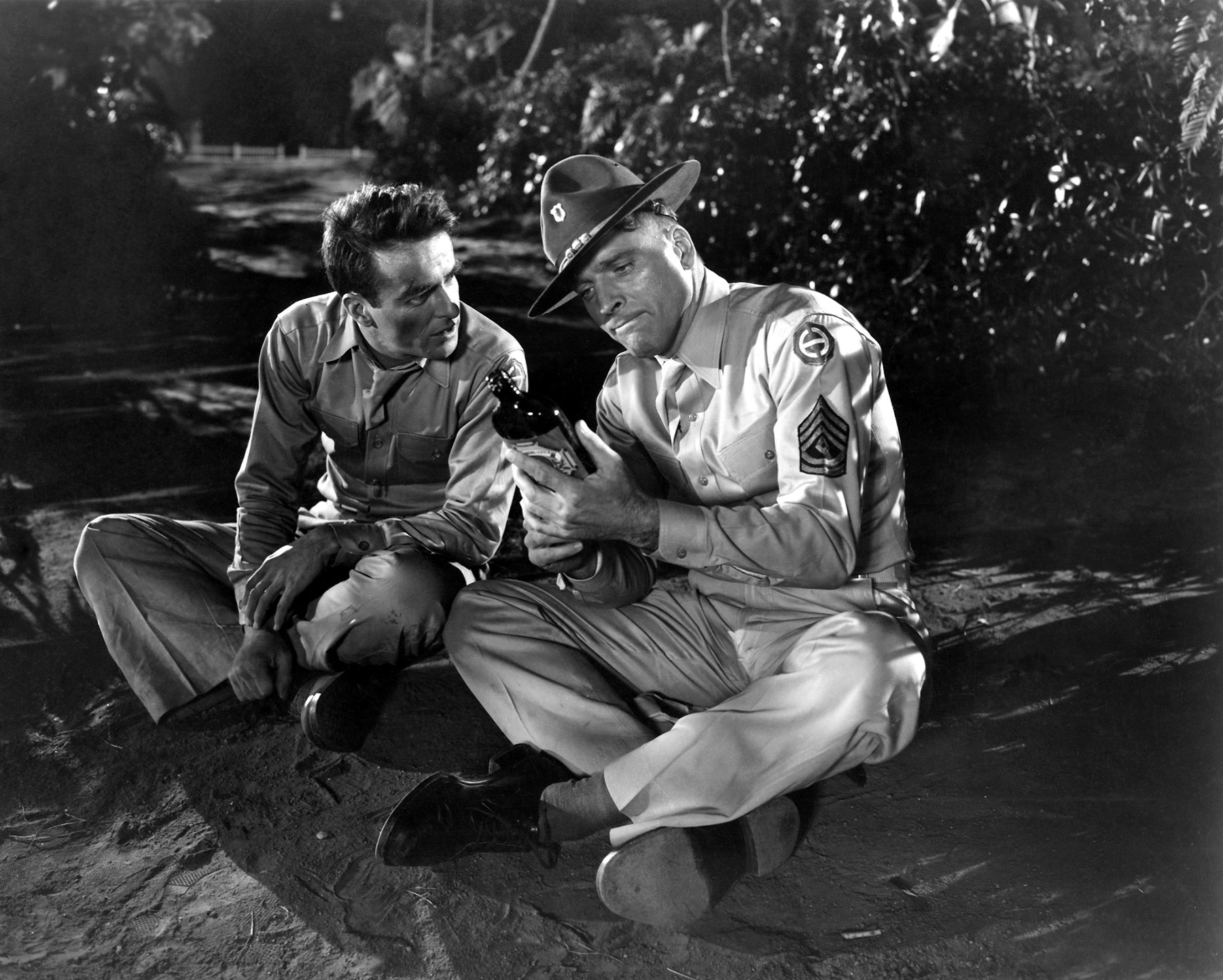
Montgomery Clift, as Prewitt, and Burt Lancaster, as Warden, share a bottle in the middle of the road.
From Here to Eternity was on television again last night and I watched it again; in fact, it may be catching up to John Ford’s The Searchers and Milos Forman’s Amadeus as among those films I’ve watched the most.
James Jones’s novel was brilliant and compelling, and Hollywood managed to make a film, an Academy-Award winner, that was just as good. It’s one of the most satisfying films for me to watch, which doesn’t mean it has happy endings: instead, everything that must happen to the major characters eventually happens. You don’t even necessarily root for them because you know full well that they’re all condemned, in some way, by forces too powerful for them to master and too complex for them to articulate, so any cheerleading is futile. But you genuinely admire them: this is my favorite Burt Lancaster film (Elmer Gantry is a close second) and what his Top Sergeant Warden shares with the defiant Montgomery Clift’s Prewitt is an incredible integrity and, in the end, a fierce devotion to The Company that will cost Prewitt his life.

The kiss: Burt Lancaster and Deborah Kerr.
Of course, the most famous, and most parodied, scene in the film is the kiss in the surf between Warden and Karen Holmes, the frustrated, defeated wife of Capt. Holmes, the company commander so insistent on returning Pvt. Prewitt to the boxing ring. Holmes deserves everything he gets–one of the most enjoyable scenes is watching him get his just reward at the hands of Schofield Barracks’ C.O.–and it is Warden who gives Deborah Kerr’s Karen Holmes, if only briefly, the passion and the hope that you want her to have. She’s not a bad person–she’s made, in her marriage to a weak man, a bad choice. She knows it, which makes her decision at the film’s end noble, heroic, and tragic. She has integrity enough to match Warden’s.
This is the film, of course, that revived Frank Sinatra’s career, and he is terrific as Maggio. He has both a Brooklyn toughness and a kind of lost-puppy vulnerability and–that word again–his foolhardy integrity in standing up to the sadistic stockade sergeant, Fatso Judson, seems to be something that Maggio is compelled to do. It’s his destiny. When he finally does go to the stockade, where he’s beyond Prewitt’s protection, it’s a death sentence, and when he describes how he dies while in Prewitt’s arms, it’s a superb piece of acting.
So is the drunk scene between Lancaster’s Warden and Clift’s Prewitt. It is so arresting because it is so funny–you wonder if the two really were lit when they filmed it–but it’s also so revelatory because nowhere in the film, even with Karen Holmes, is Warden so tender and compassionate as he is with the company troublemaker, Prewitt. It’s this scene, and one shortly after, where bugler Prewitt plays two stanzas of the purest, most evocative version of “Taps” ever recorded, that makes the two protagonists’ devotion to The Company and to The Army so understandable.
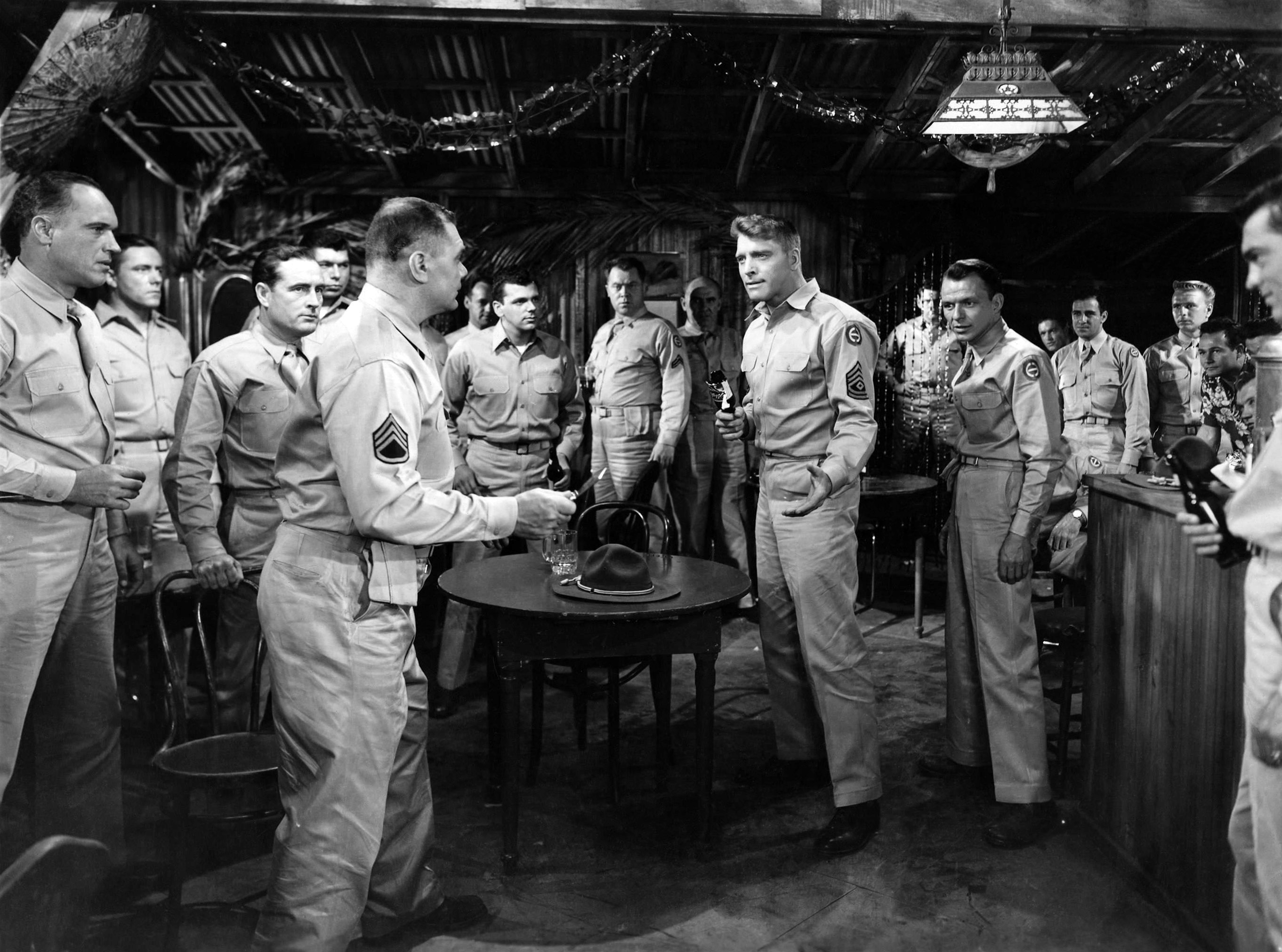
Warden intercedes to protect Pvt. Maggio (right, Frank Sinatra) from stockade Sgt. “Fatso” Judson (Ernest Borgnine).
The film also has a compelling fight, though tame stuff by the standards of today’s gore, between the hapless Prewitt and a sadistic noncom, Sgt. Galovich, who proceeds to beat Prewitt to a pulp. Prewitt, who refuses to box for The Company, won’t fight back. When he finally does, with a flurry of body blows, you want to cheer, and when the tide begins to turn against Galovich, you don’t want the inept Capt. Holmes to stop it. You want Galovich obliterated. But when Holmes does finally step in, late, it’s the captain who’s the victim, because the fight has been witnessed by two of his superiors at Schofield who decide to investigate Holmes’s feckless command of The Company.
It’s Warden who is the real company commander. As a master of red tape, an almost clairvoyant anticipator of The Company’s crises and needs, contemptuous of weakness in his subordinate noncoms and even more contemptuous of all officers, especially his C.O., Warden is the perfect bureaucrat. Until Pearl Harbor. Then you see the Top Kick rise to the occasion and become the one man in The Company who keeps his head, giving rapid-fire and perfect orders to his men (“Make a pot–no, a barrel!– of coffee!” he snaps to the company cook.), then climbing to a barracks rooftop to bring down an attacking airplane with a .30-caliber machine gun. He becomes a warrior. Part of me doubts that Warden would survive the war, because so many good leaders like him would be weeded out by attrition as we learned to fight in places like Guadalcanal or North Africa, places with unforgiving learning curves. The war would cheat us of our Wardens.
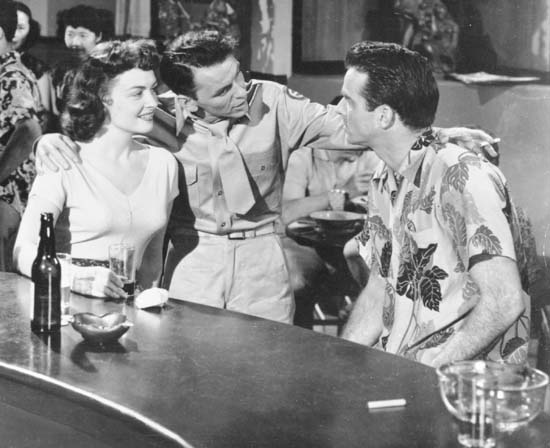
Lorene, Maggio and Prewitt at the bar of The Congress Club.
The only careless element in a terrific ensemble cast is, to me, Pvt. Prewitt’s love interest: Donna Reed’s character, Lorene, a working girl at The Congress Club, a bar/brothel that Schofield’s GI’s frequent. It’s as if the scriptwriters and director Fred Zinnemann can’t quite decide what to do with her. They’ve got to fly a prostitute under the radar of 1950s film standards, so she winds up coming off as more of an undergrad at a Midwestern university instead of a Honolulu bargirl. Her earnest, intellectual roommate has their house full of books. So she is unconvincing, which I don’t think is Reed’s fault: she’s a victim of the one bit of indecision and timidity in a film that is otherwise so honest.(To be honest, Reed may be a victim of my own Baby Boomage and her housewife/mother role from The Donna Reed Show, but Borgnine’s malevolent Fatso is sublime; he transcends his turn in McHale’s Navy.)
But Reed earns redemption as an actress in the film’s denouement, when she speaks of Prewitt as a war hero and you realize that Lorene, with her fantasy of making enough at The Congress Club to build herself and her mother a little home in Oregon, is and always has been gently unhinged. Nothing good will come of Lorene: she will drift away, like the leis the women toss onto the ocean’s surface from the rail of their steamer bound for the States. Only one character will never drift away and will always have a home, and that’s Top Sergeant Warden.
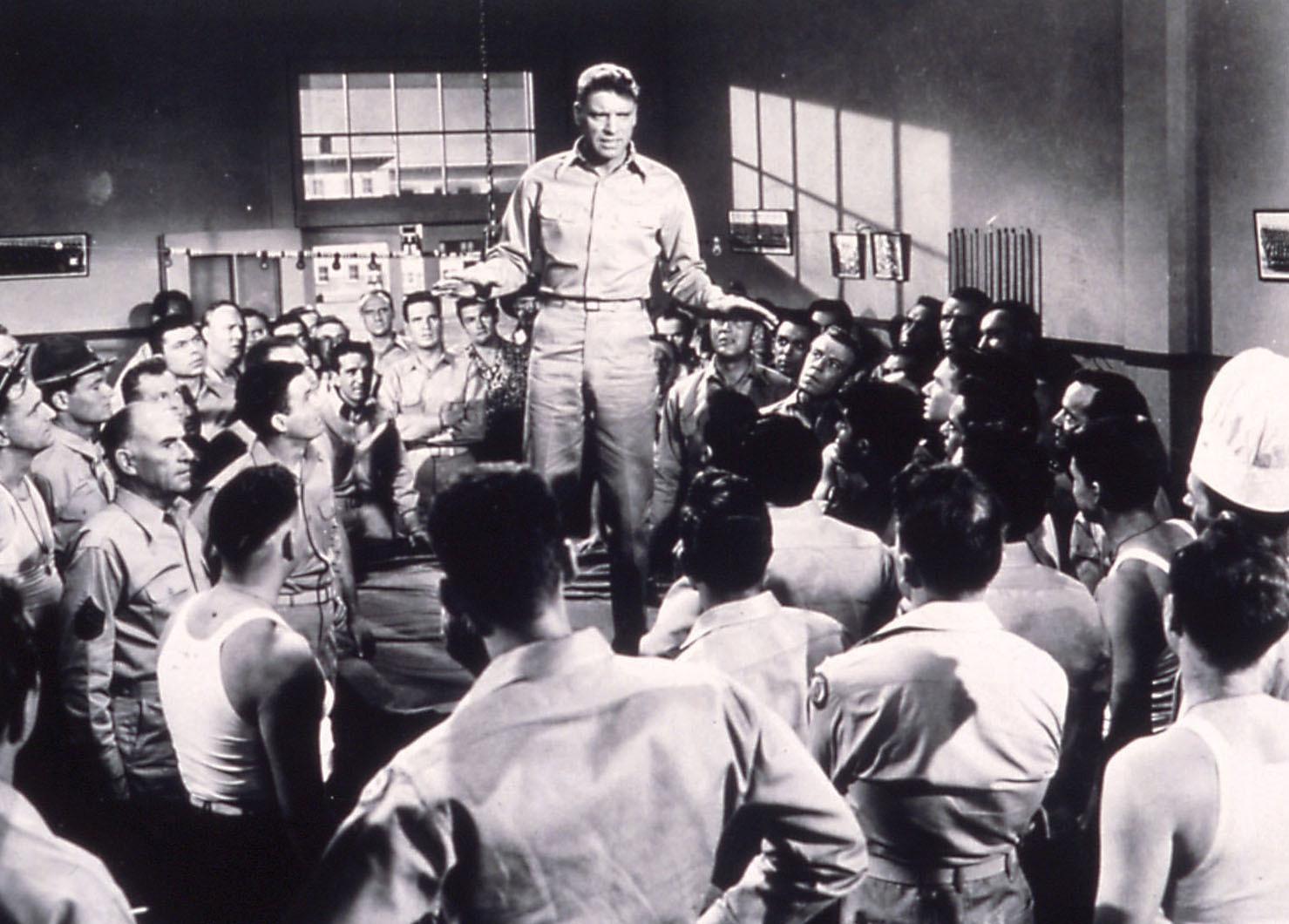
Top Kick Warden takes command, December 7.











 A Work in Progress