This day means so much to me because Tony Bennett was our American Corrective.
Where there is division, he reached across divides.
Where there is rudeness, he said “thank you” at the end of his duets.
Where some among us live misshapen lives, crushed by the weight of privilege, he was born the son of a grocer and a seamstress from Calabria, in southern Italy.
Where there is mean-spiritedness, he was unfailingly kind.
Where there is crudity, he was class.
Where there is despair, he radiated happiness.
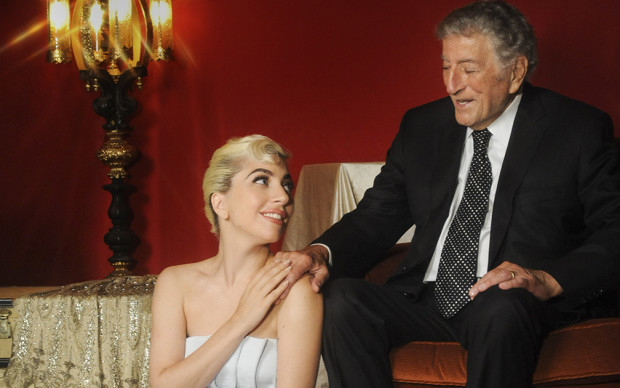
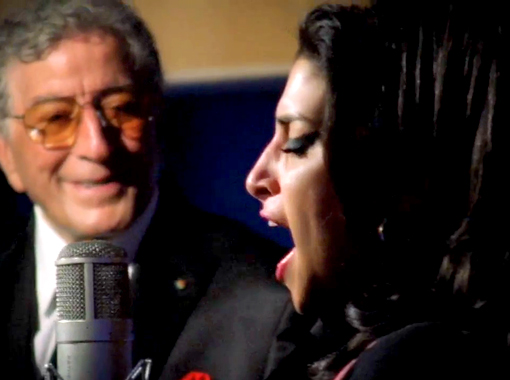
Where there is misogyny, he welcomed women—Lady Gaga, Amy Winehouse, Faith Hill, Aretha Franklin, KD Lang— as his equals. Look at the expression on his face here:
Where there is selfishness and self-absorption, he was generous and open-hearted.
Where there is ugliness, he was Grace.
Where the the notion of “duty” is dismissed, he sang “San Francisco” every time as if it were the first time.
Where there is falsity and deceit, he sang that song with an honesty that would’ve embarrassed performers less sure of themselves and their gifts.
Where there is failure, he failed, too.
He came back from drug addiction to us. He came back FOR us.
It took a 96-year-old man to show us what we’re capable of in our future, if only we’re willing to listen to voices that call us to higher places, where cable cars climb halfway to the stars.
I’m a little obsessed with this song, but I’m not the only one. The Los Angeles Times reported that the original video has reached one billion views on You Tube, and why not? The video was creative, compelling, told a story, and, let’s face it—how fun it would be to be pulled into a fantasy world when you’re idling in a restaurant whose specialty is cold milk?
And the song is charming. It’s been covered by so many bands, but let’s start with the opening of the the original video:
My friend and former student Kristin introduced me to the Mariachi Sound Machine version a few years ago, and I still love it. My favorite part is the trumpeter and his little boy. But I love all of it.
First to Eleven is a band from Erie, Pennsylvania. I love the grunge touch (the drummer is cool); the lead singer, Audra Miller is—let’s face it—kinda sexy. Jeez! Is it okay that I said that? Here’s that version in its entirety:
I always love to find songs I know covered by the high-school-aged School of Rock kids. Look at how happy they are!
But of all the A-Ha variations, there’s none quite like the unplugged MTV performance by Morten Harket (the band was Norwegian), which is elegant. And it’s almost as much fun to watch the women in the audience react to a pop song which still has such power almost forty years later.
We are rejoicing 80-year-old Harrison Ford’s fifth and probably final Indiana Jones film, and we are right to do so. I have enjoyed the series, perhaps the interplay with Sean Connery in The Last Crusade the most—oh, and that zeppelin scene.
Both Indy and Han Solo are heroes. For Ford, that’s a problem, even though the mythologist Joseph Campbell aptly described Solo as a hero who didn’t know that he was a hero.
In an interview with Chris Wallace on CNN, Ford himself bristled at the interviewer’s use of the word “hero.” He was not a hero, he insisted, and he didn’t play heroes. He was instead an actor playing the roles of fallible men.
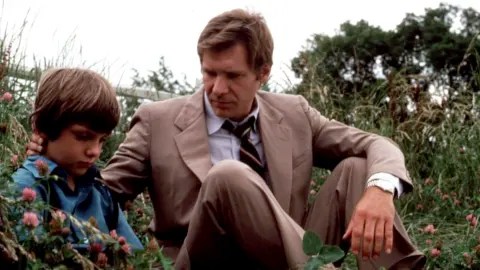
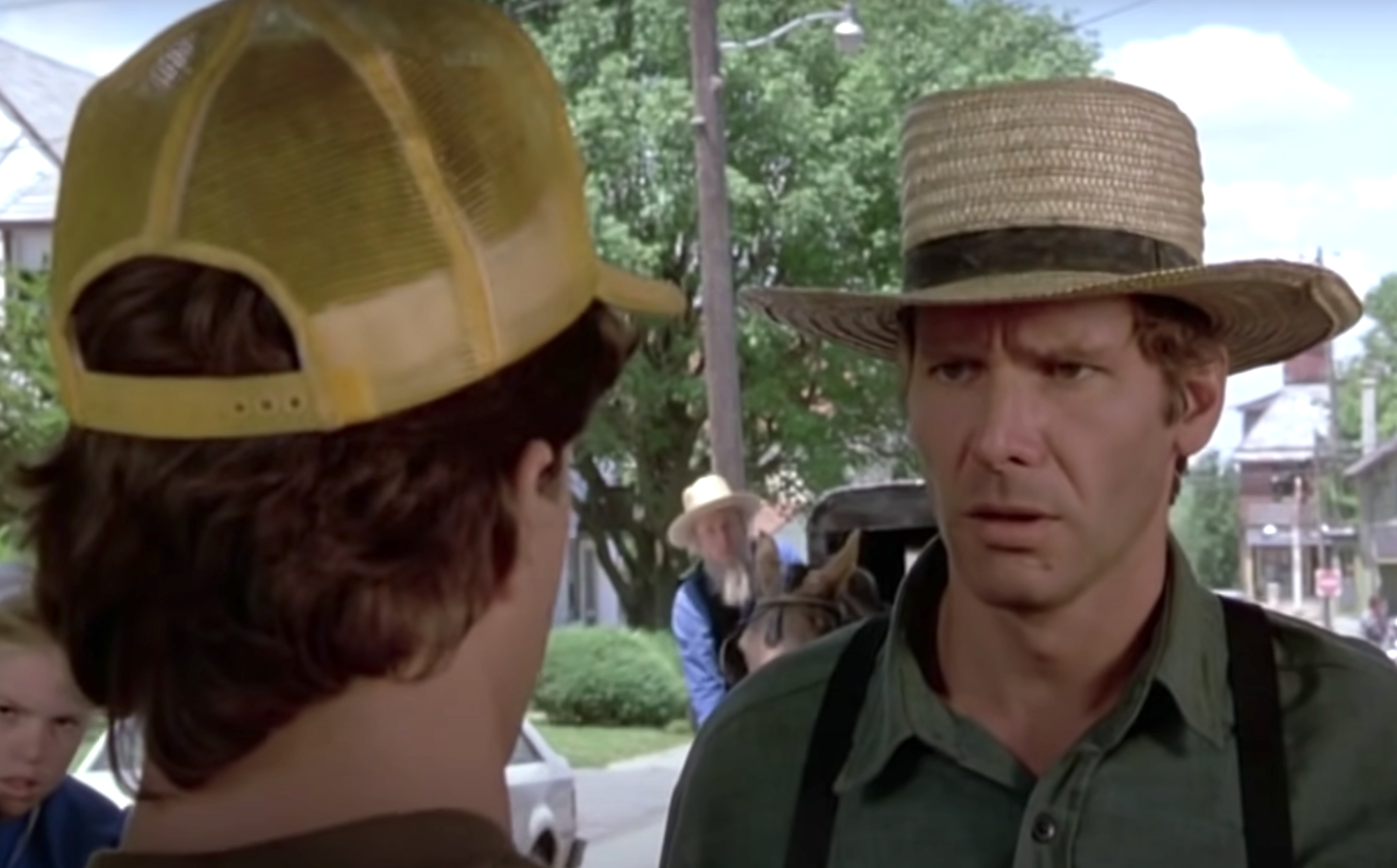
That’s what is so appealing, to me, about John Book in Witness, a film I’ve watched three times in the last month. (It’s a good Dickensian name, by the way: Ford’s detective is honest; he lives by the book, but, unlike the Amish, he’s not of the book.)
Book is a fallible man, but in his bedrock integrity—and in his vulnerability, a dangerous term to use because of its Wokiness—he reminds me of another Harrison Ford detective, Deckard, in the remarkable 1982 film Blade Runner.
In Witness, Ford’s character is allowed so many unheroic moments, including in the way he wolfs down a Philadelphia hot dog to pause, a little ashamed, when he realizes that the witness and his mother are praying over their meal. (It pains me a little, too, to see Detective Book drinking bleak squad-room coffee out of a Styrofoam cup, but that’s another subject altogether.)
Yes, the audience cheered when Book punched out the lout with the tight jeans and the razor-cut hair who was decorating Alexander Gudonov’s face with the ice-cream cone, but that was chum for the movie sharks. Me, too. I cheered with everybody else.
The moments that amazed me, though, came in Ford’s eyes, in his terror as the two detectives search for Book in the barn (The suffocation in corn scene was borrowed from Frank Norris’s muckraking novel The Octopus. The villain is suffocated in a ship’s hold being filled with San Joaquin Valley wheat.), or in the intensity of his look as he urges the little boy, Lukas, to run to the neighbor’s farm.
Lukas begins to run, but returns, rings his grandfather’s barnyard bell and so summons the neighbors, who run to the Haas farm. It’s there where John Book, backed by Amish in dense cornfield ranks, confronts his nemesis, Detective Capt. Schaeffer, and in a near-tearful fury, wears him down.
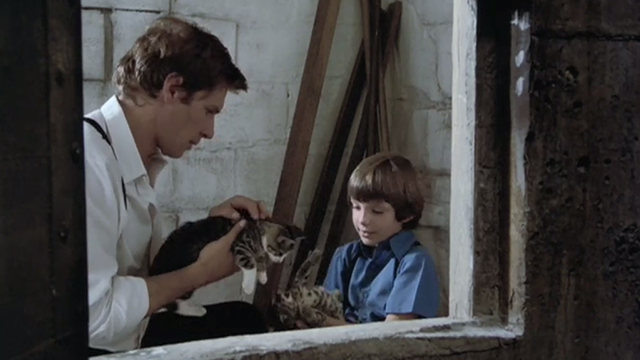
The love story is inevitable, and Kelly McGillis is radiant, but to me, the real heart of the story is John Book’s love for the little boy. One of the film’s small miracles is the perpetual motion machine Book builds for his friend, the witness—Ford was a carpenter once, too, and that’s where the scar on his chin came from—and another is the brief scene where Lukas introduces Book to what is miraculous to all little boys, a litter of kittens.
I love this film, too, because it was directed by Peter Weir, an Australian and one of my favorite directors, who gives us such a sensitive and powerful look into Amish life. I do not know how he did it.
Maybe it’s a romanticized look, and yes, I flinch at the seeming subservience of women, but the barn-raising scene is so evocative to me, especially today, because we Americans are so bitterly divided. The embrace, even if it’s temporary, of Book into the wider community in this scene reminds me of the better angels of our nature.
It took an outsider, an Aussie, to give us such an authentically American vision— one, again, that has such potential power in what it teaches us.
I cautioned against romanticizing the Amish, but it’s a bigger mistake to underestimate them and their faith. I made this video to introduce my high-school history students to these people. The word “remarkable” seems appropriate, I think.
And it’s a remarkable film, down to its end.
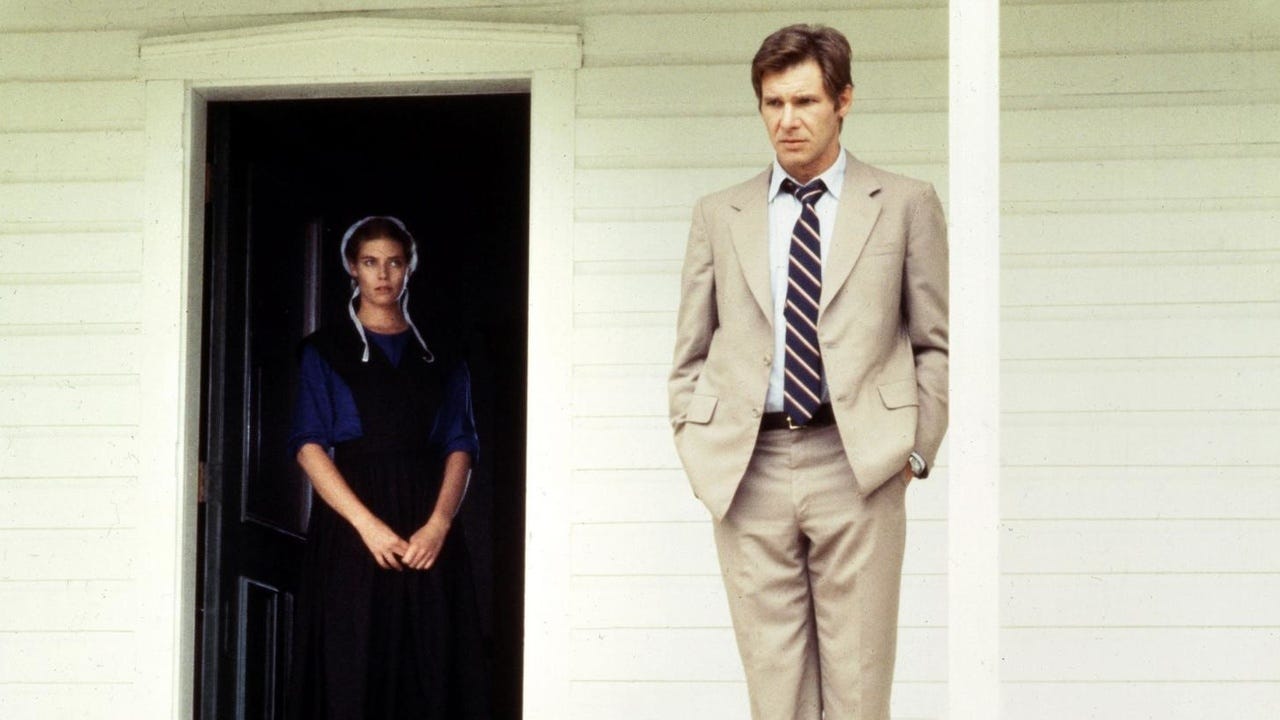
John Book stands on the porch and Rachel in her doorway at the film’s’s end, in a scene framed the way John Ford would’ve composed it as he did in My Darling Clementine and The Searchers. Like Wayne in the latter film, Book in his frame, on the porch, is straddling a no-man’s land. Rachel, in hers, stands in doorway shadows that are Rubenesque, as is the generosity of her body, as, most of all, is the brilliance of her beautiful eyes. McGillis’s Rachel would’ve made Rubens weep.
And what is Book to do?
He takes so long to make up his mind, and when he finally walks away to that beat-up little VW wagon, his body is heavy with grief. Even that wordless moment is a tribute to Ford’s acting.
Why did he leave in such pain? Well, there were Rachel and Lukas and Eli, the grandfather. and Book was a man without a family. He was was profoundly urban and secular and modern. But in his world, poisoned by crooked cops, he’d escaped for a short time to find that there is such a thing as moral certainty.
That is a dangerous concept, to be sure—one National Socialism held dear, for example. What makes Witness true to the heart is that the moral certainty Book encounters, ironbound as it is by 17th-Century dogma, is leavened by compassion and generosity. Gott ist die liebe.
You don’t have to believe me. Look at Mama Cass’s reaction. Janis covers “Ball and Chain,” by Big Mama Thornton, the same woman who gifted Elvis with “Hound Dog,” and sails with it. I don’t know if human pain has ever been so exquisitely expressed.
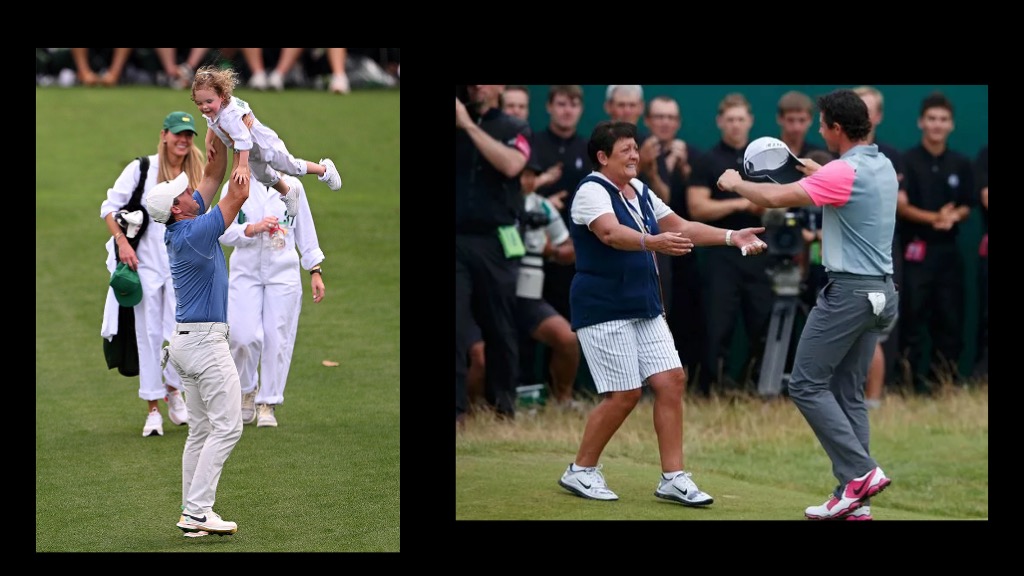
McIlroy, his daughter Poppy and his wife Erica during a Family Day before the Masters; with his mother Rosie after a win.
Given Saudi Arabia’s execution of 81 people in a single day in March, I am not following the PGA tour lately.
So I missed the Scottish Open, and I will break my fast next week, I guess, for the British Open.
I paid for my beliefs. That darlin’ Ulster lad, Rory McIlroy, whom I love (his Ma looks like a real person and he has a beautiful little daughter) won the Scottish Open Sunday.
He was behind by one at the 17th and had won by one once he’d finished the 18th.
Back on the 7th hole, he’d hit a 427-yard drive. If you look at his finish, I haven’t been that flexible since I was eighteen months old and could insert my foot into my mouth (literally, not figuratively, which I still do frequently.)
Here are other comparisons to a 427-yard drive:
–Paul Bunyan getting tired in the desert one day and dragging his axe behind him. The trail it left we call today The Grand Canyon.
–In 1963, Warren Spahn’s Braves beat Juan Marichal’s Giants 1-0. Both men pitched 16 innings.
–Mom Angela Cavallo, in 1982, lifted a 1964 Chevy Impala to free her teenaged son, who was pinned underneath. He survived.
On the 17th hole, he hit a 5-iron cut–look at the difference in the finish–and look where it wound up. Birdie.
The young man looking bereft after that shot was leading at the time. He knew just what was about to happen. The same must have occurred to Custer that hot day in 1876.
On the 18th, McIlroy hit a two-iron, a club that’s faintly terrifying (the clubhead, at the end of the shaft, seems no bigger than a soup spoon) into the teeth of a howling Scots wind. It was a low screamer, the kind of shot Lee Trevino learned to master growing up in Texas winds.
Birdie.
The two-iron, from Golf Magazine.
My rough-tough father-in-law, the ex 49er, was once asked what the toughest sport was. Because of the combination of physical skill and emotional self-control, he took no more than two seconds.
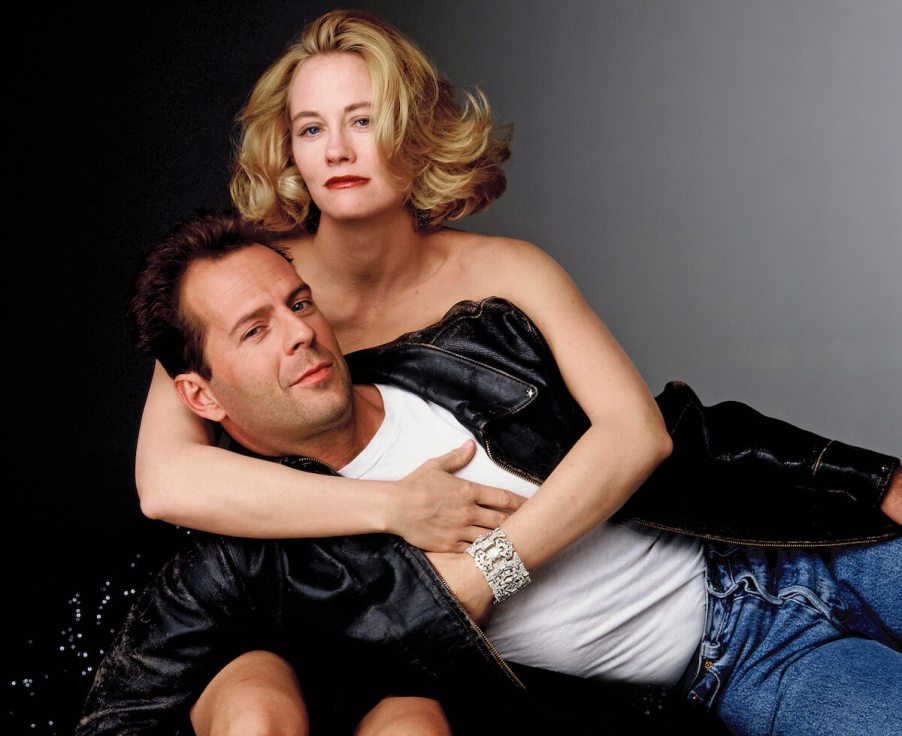
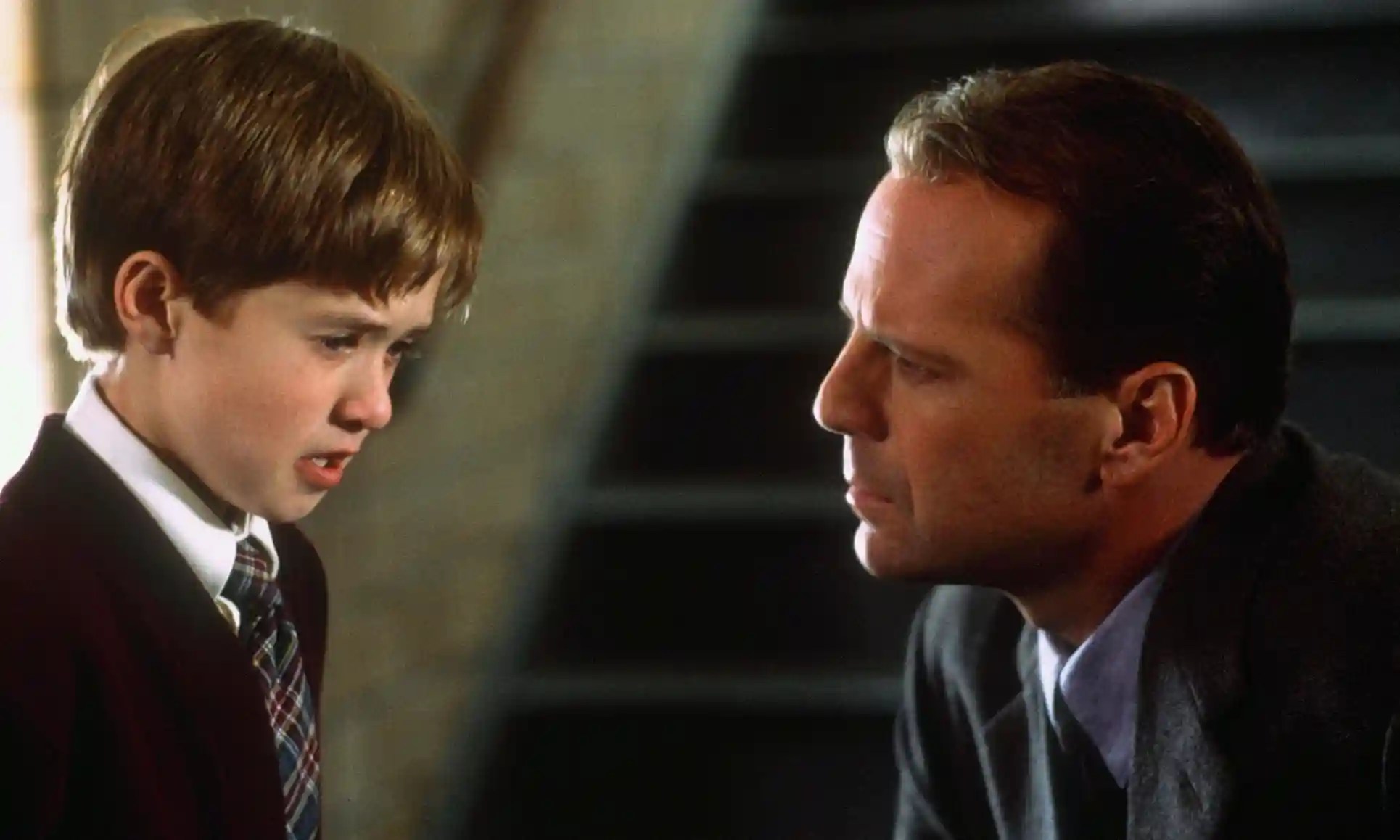
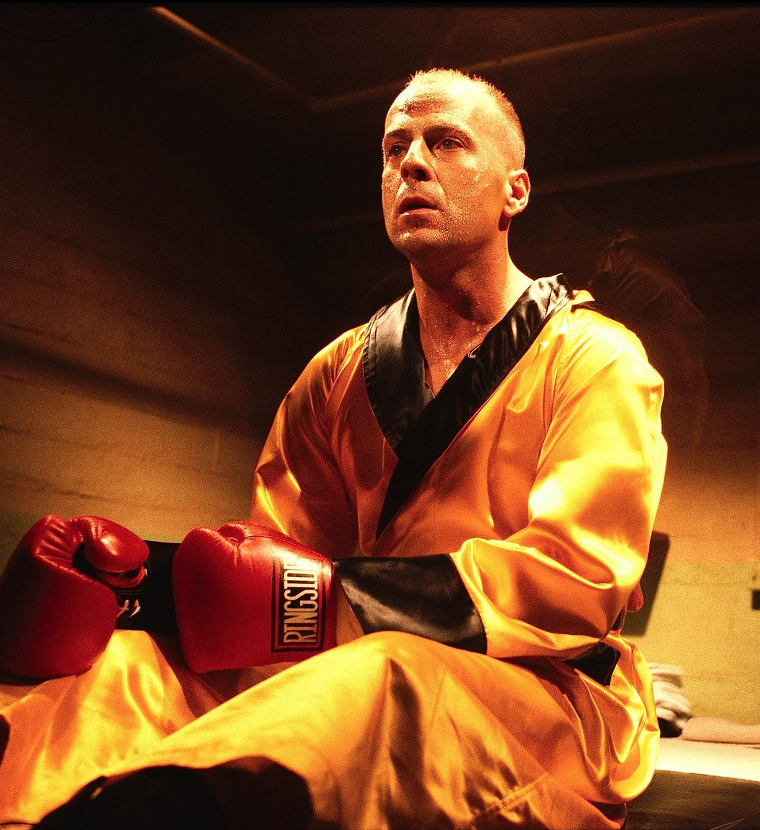
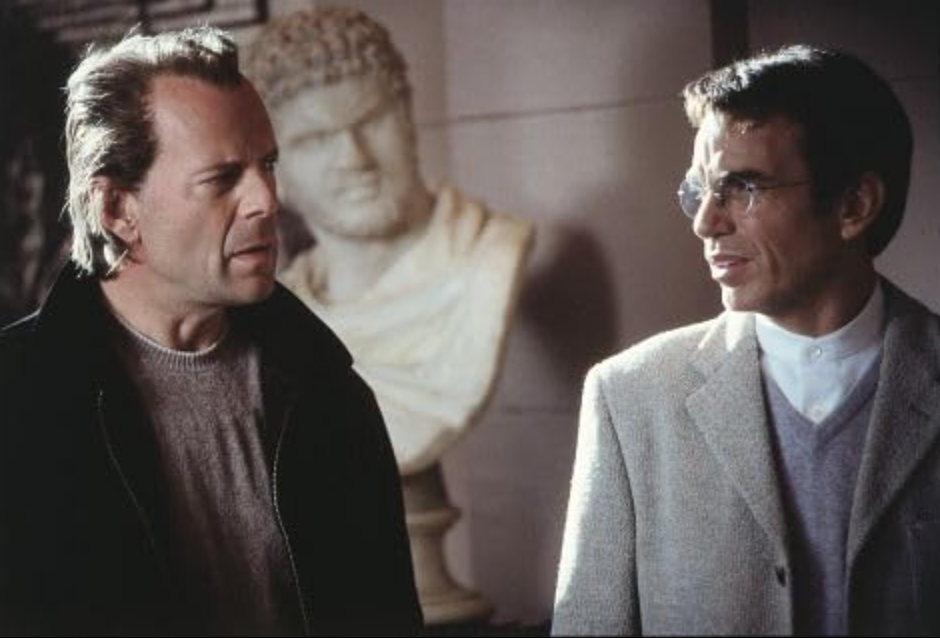
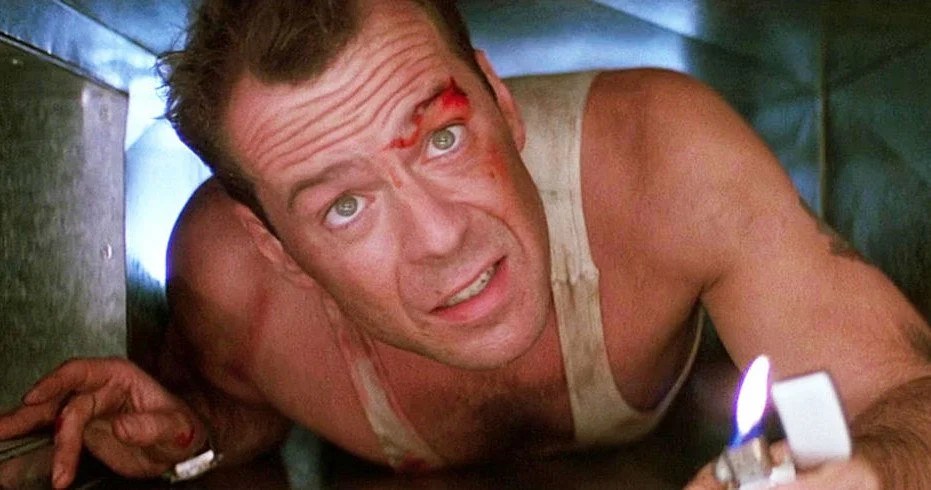
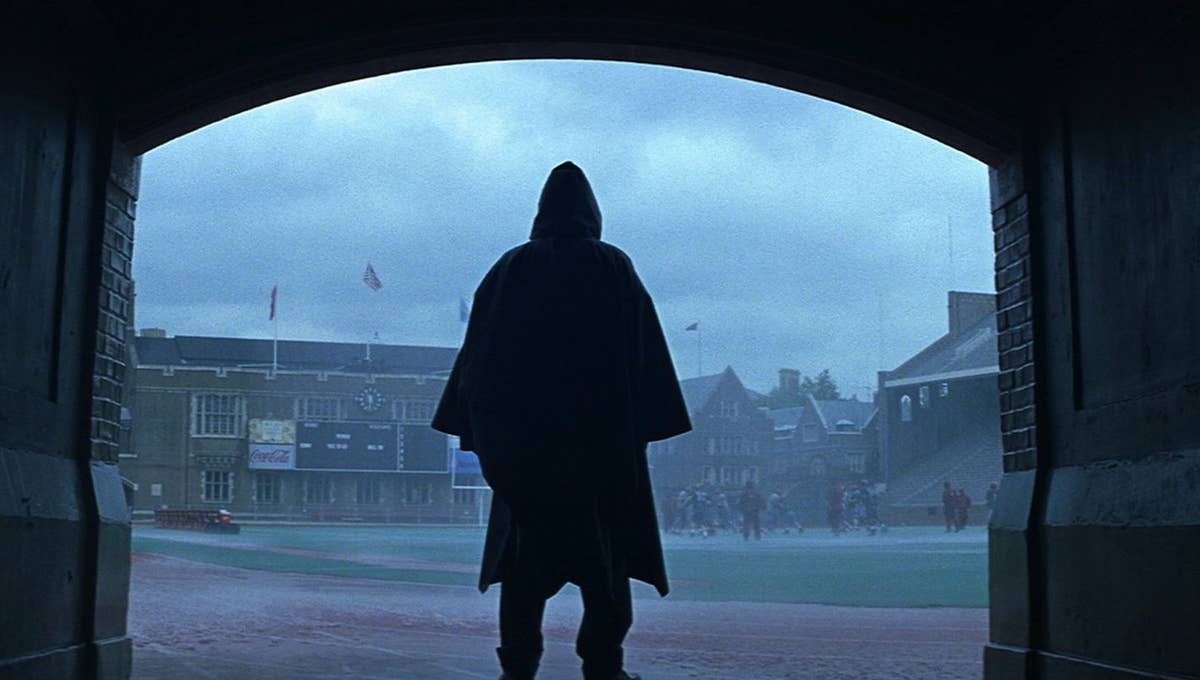
For some reason, for three days now, I’ve been obsessing about the 1985-89 ABC series Moonlighting, with Cybill Shepherd, once “just” a model, and Bruce Willis, who was kind of shiny and new, and with his hairline pretty much intact. I’ve been obsessing about him especially, but the two were brilliant together. Shepherd proved herself a deft comedienne, and I later became a big Willis movie fan. My favorites aren’t the Die Hards but the two films he made with M. Night Shyamalan, The Sixth Sense and Unbreakable, where his performances were nuanced and, to me, deeply moving.
But this show was charming and innovative. Breaking the Fourth Wall in this season opener, for example:
And sometimes it had the audacity to get philosophical:
And it was never afraid to allude to literature. Dr. Seuss, for example:
Or Shakespeare. In “Atomic Shakespeare,” the show took on Taming of the Shrew. Hit it, Bruce:
Shepherd’s Maddie could sing, too. This is lovely:
And sometimes they danced. Willis was surprisingly good. And Shepherd was at least game.
The show lasted four seasons but probably should have ended at two and a half or three. It burned out its stars, who couldn’t sustain the high bar it had set or the toll it had taken on their professional relationship. It burned out its writers, too, who lapsed into cutesiness and destroyed the sexual tension between David and Maddie by having them give into it.
But it was a grand ride; when it was good, Moonlighting was very good.
As was Willis, an actor I enjoy immensely.
What probably brought on this Moonlighting musing is his struggle with aphasia. God has graced him with a supportive and loving family. Willis has graced me with a host of memorable characters—including Moonlighting’s David Addison, Jr.
I was born in 1952, so if you do the math, I was around at just about the right time to fall madly in love with girls (a little older than I) on shows like Shindig and Hullabaloo. We all did, boys my age. Some of the dances included the Watusi, the Jerk, the Swim, the Slauson, the Frug. I danced ineptly but admired those with ept.
Especially those girls on TV.
But it occurred to me today that they were marvelous dancers who were exploited. That doesn’t mean that I still can’t have fun watching them. But it does remind me of how much the world has changed and how ingrained in us was a certain dismissiveness of women.
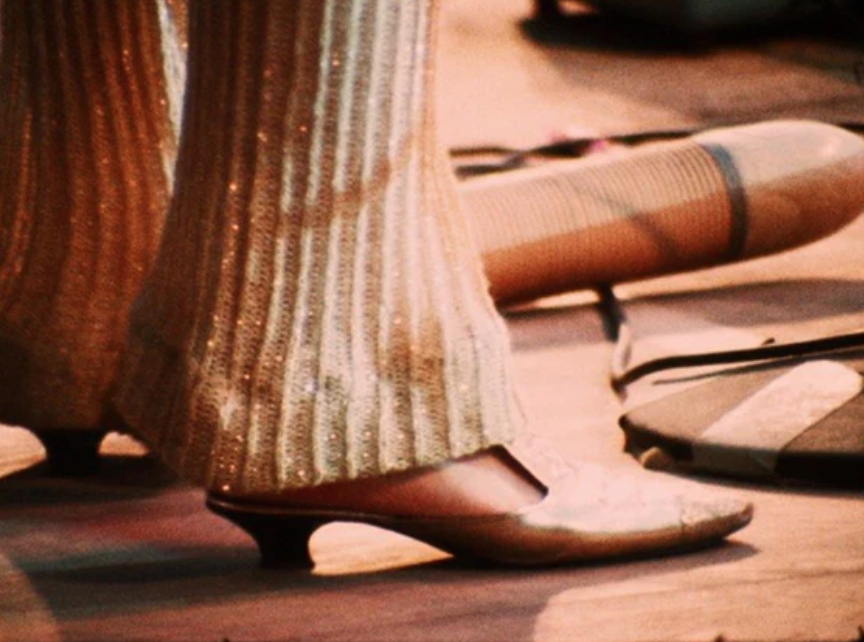
I got a little sadder thinking about this, about me fifty-five years ago, but the girls in the 1970 clip in the included in this video looked sad to me, too. Something has changed by 1970. If it was painful, it was probably needed, too.
Many years ago, we went rowing on the Cherwell River, which joins the Thames near Oxford University. Well, Elizabeth rowed. I was attending to our picnic lunch, which needed attending to.
So, for some reason this morning, I was thinking of movies filmed on the Thames, and here they are some that I found.
My favorite remains Henry VIII’s arrival via royal barge in A Man for All Seasons. The music is magnificent, too, and the way the crews raise their oars and glide into shore is elegant. Okay, I like the James Bond boat chase, too.
1. The World Is Not Enough. Bond films are always good for chase scenes, but this one, with a soggy Pierce Brosnan, has to be one of the best.
2. Let’s tone it down a bit. How about Ringo’s disconsolate walk in A Hard Day’s Night?
3. In Harry Potter and the Order of the Phoenix, we get an aerial view.
4. We use the Thames to assassinate model Kate Moss in Absolutely Fabulous: The Movie.
5. And, speaking of assassination, Elizabeth I’s narrow escape in 1998’s Elizabeth:
6. Joseph Fiennes woos again, trying to chase down his muse, Gwyneth Paltrow, in Shakespeare in Love.
7. Alex pulls off a coup among his group of droogs alongside the river in what remains such a disturbing film, Kubrick’s Clockwork Orange (1971).
8. Ah, but here’s the masterpiece: Henry VIII arrives for dinner at Thomas More’s home in Fred Zinneman’s A Man for All Seasons (1966). The music. by Georges Delerue, is glorious, as is the cinematography.
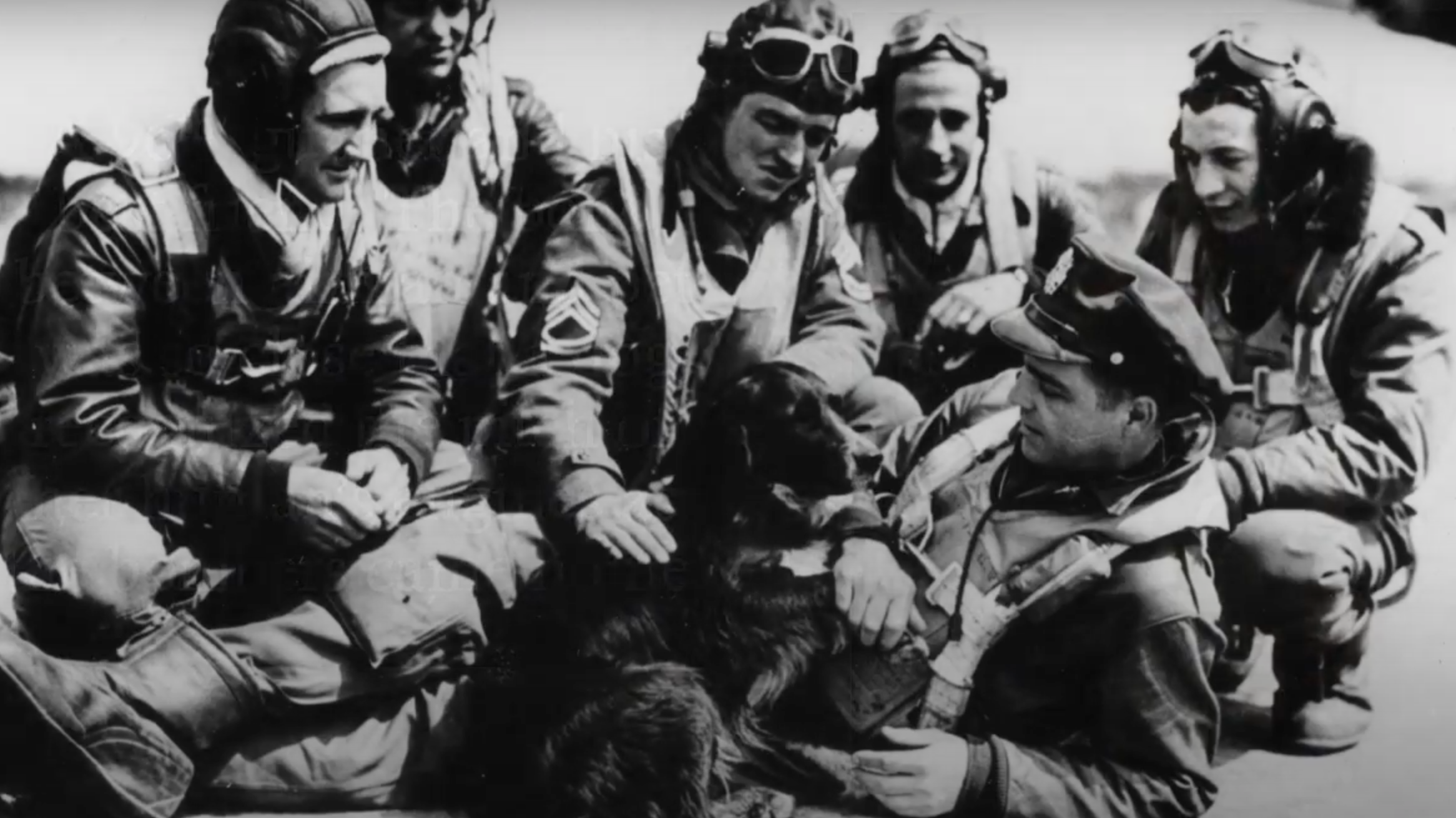
One of the best things I learned in writing a book about local World War II aviators came from the historian of the Eighth Air Force’s 95th Bomb Group, based in Suffolk, East Anglia, from 1943 to 1945. She told me that Yank airmen grew so close to the British dogs they adopted that the dog not only heard the B-17’s returning from their missions before the ground crews did, but they grew noticeably excited on recognizing the pitch of their human’s B-17 engines.
No greater love.
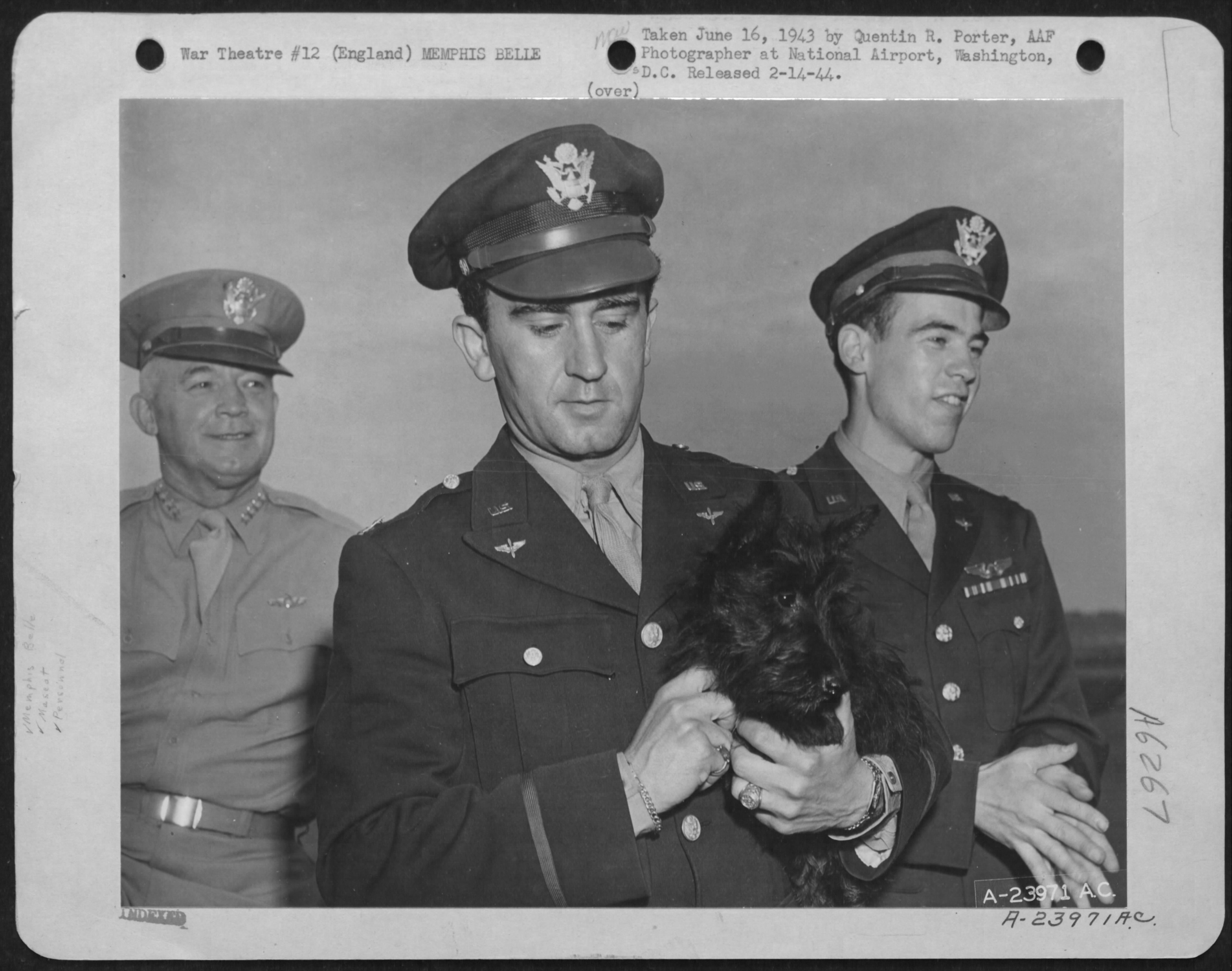
Those dogs either found homes with British families or came home with their humans, like the Scottish Terrier, Stuka, the mascot of the famed B-17 “Memphis Belle.” Stuka lived out her life as a Connecticut Yankee with her human, Capt. Jim Verinis. Verinis, on a pass to London, stopped in his tracks when the puppy pressed her nose against a pet-shop window to greet him. He bought her immediately.
Stuka, of course, was devoted to Verinis. The entire crew was devoted to Stuka.
Stuka and Verinis. Just behind Verinis is Gen. Hap Arnold, commander of the Eighth Air Force. American Air Museum in Britain.
This reminded me of yesterday.
Elizabeth was in La Jolla for a few days and she came back early last evening. About an hour before she got home, here were Walter and Brigid.
And here—forgive our messy living room— was her reception.







 A Work in Progress