My friend Judy Cecchetti–we go back to Branch School together– posted on Facebook about how much she enjoyed the story “Sheila Varian’s Perfect Horse” from the new book.
That meant the world to me.
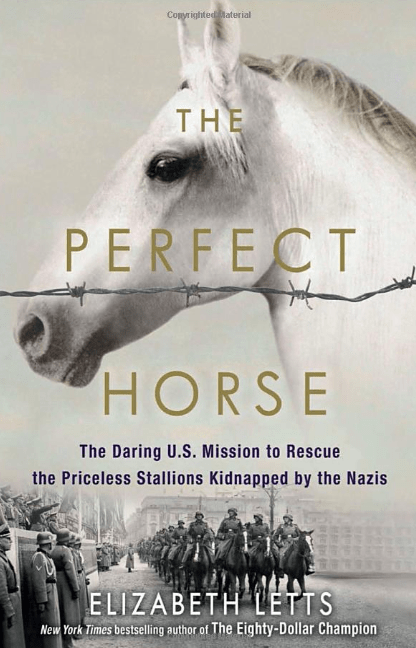
That story happened because of the Elizabeth Letts book The Perfect Horse. Letts has become one of my favorite authors. Lynne Olson (Citizens ofLondon, Troublesome Young Men) is masterful at using the colorful and telling anecdote to bring a historical character alive. My favorite popular historian is Laura Hillenbrand, whose word choice is so incredibly vivid; her writing also has a marvelous rhythm. You’re so absorbed that it’s stunning to realize how much Hillenbrand is teaching you-about the world of Thoroughbred racing, for example. She wrote Seabiscuit, which is phenomenal, during an agonizing and courageous struggle with Chronic Fatigue Syndrome–she was in constant pain–and Louis Zamperini’s story in Unbroken.
All three writers, obviously, are young women.
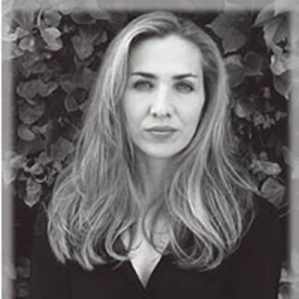
Laura Hillenbrand
I hope that the long-overdue emphasis on STEM, on teaching science and math to girls and young women, doesn’t completely overshadow our need for good writers–journalists and novelists and historians– who also happen to be young women. (That’s one reason I’m such a fan of Trib reporter Kaytlyn Leslie, a student of Janine Plassard’s when she taught journalism at Nipomo High.)
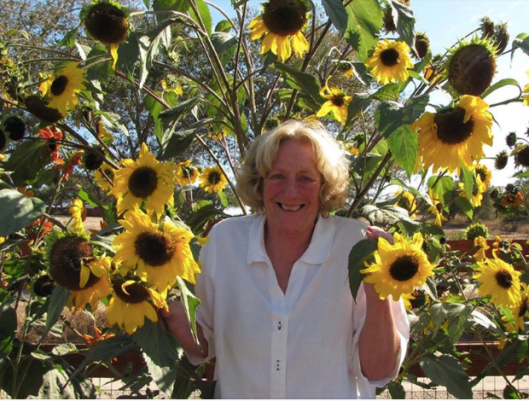
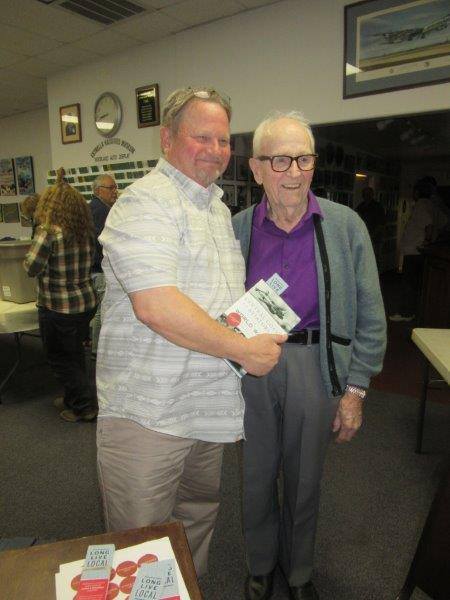
Janine Plassard
It reminds me, too, that JFK read Barbara Tuchman’s The Guns of August, about the failure in leadership that led to World War I, just before the Cuban Missile Crisis. Tuchman’s book helped to guide his thinking in October 1962, so it’s not hyperbole to say that we may very well owe our lives to a great historian who happened to be a woman.
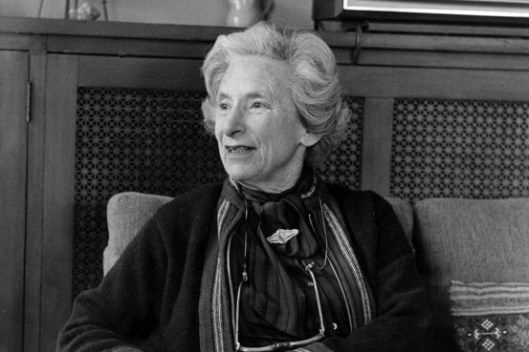
Barbara Tuchman
The Sheila story began with me asking if there might be any connection between Varian Arabians and one of the central characters in Letts’s book, Witez II. He was a famous Polish Arabian, a championship stallion, whose story was shaped by World War II, the war that began with Hitler’s invasion of Poland in September 1939.
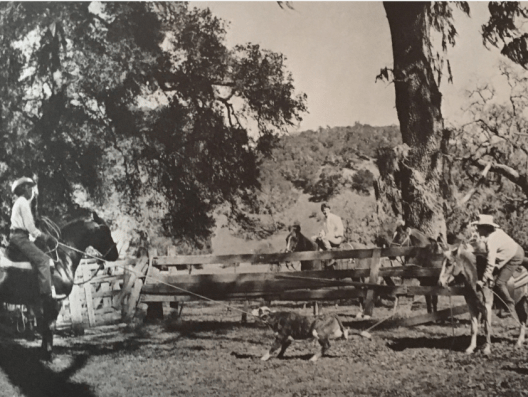
When I found out that Sheila’s mare Ronteza was Witez’s daughter, I nearly fell out of my chair. My big sister, Roberta, had ridden with Sheila, but Roberta’s Morgan mare was a product of Sid Spencer’s Lopez Canyon ranch. It was Sid who taught Sheila and her Arabian, Ronteza, how to work cattle.
Sid Spencer, Roberta, Anne Westerman on her Welsh Pony, Lopez Canyon, about 1965. Photo by Jeanne Thwaites
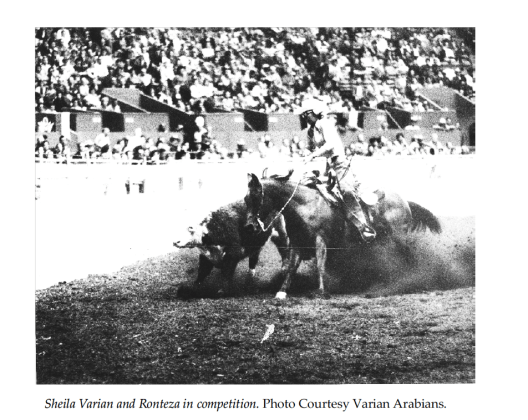
The story of the American Army’s rescue of Witez and the Lipizzaner, alongside the story of Ronteza and Sheila and their miraculous Cow Palace performance, took weeks to write. It’s so hard to interweave two stories and still keep the narrative logical and understandable, so it took many, many rewrites, too.
So Judy, it’s one of my favorite stories, too. The best part might be that it happened both in World War II Europe and in, of all places, Corbett Canyon, California. And–what a coincidence!–it just happened to be a story, too, about a courageous young woman.
Finally, I am fond of the way that story made up its mind, thanks in great part to the band U2, about the way it wanted to end:
Varian remembered a moment from the Cow Palace competition vividly: at the start of one round, she could feel distinctly Ronteza’s heartbeat through the panels of the saddle. She knew then that her mare was ready. When the signal was given, when horse and rider entered the Cow Palace arena, two hearts beat as one.
THANK YOU FOR REMINDING US THAT THE COST OF FREEDOM IS NOT FREE.
A local woman responding to an article I wrote about a World War II veteran
* * *
“That is not what I meant at all; That is not it, at all.”
T.S. Eliot, “The Love Song of J. Alfred Prufrock”
The bullet that kills a soldier passes first through his mother’s heart.
A veteran of the North Vietnamese Army (NVA)
This is a course in history, not patriotism.
Cary Nerelli, my master teacher, Morro Bay High School
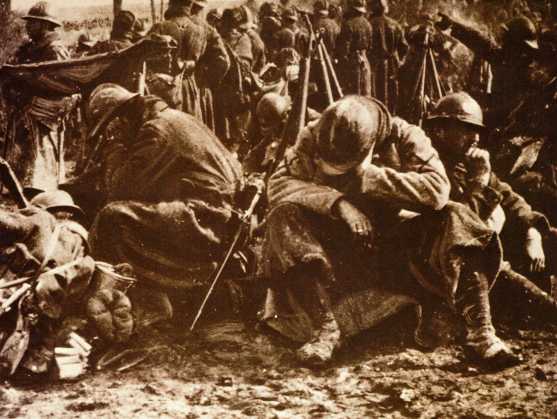
Exhausted French soldiers, Verdun
I taught history for thirty years, and I never, never ceased to get angry every spring when I taught the First World War. It was this war and its peace treaty that did so much to make World War II possible. In 2010, I took some of my students to Western Europe’s World War II battlefields but also to Verdun, site of a horrific 1916 battle that lasted over ten months. The stacked bones in the ossuary there once belonged to boys like my two sons, whose parents had cheered when they scored their first football goal.
I made it my business to help all of my students understand that idea—that war cheats us all so cruelly—and so I led them, every year in my classroom, into dark places, like Fort Douaumont at Verdun, so dark that it swallowed the light of five hundred years of Western culture. To go inside Douaumont, where 100,000 young men were killed or wounded, to study war doesn’t mean we glorify it. A few years ago, a student told me the First World War was her favorite unit. (Not mine—I much prefer La Belle Èpoque.) I asked her why, and she replied, “Now I understand how precious human life is.”
She understood precisely why I became a history teacher.
–From the introduction to World War II Arroyo Grande
But American artillery units still found many of them there—artillery spotters were nearly incoherent because there were so many targets to call in on their field radios—and the slaughter they inflicted was horrific. Seventy years later, one of the 607th’s soldiers, Frank Kunz, remembered the results in an interview with his hometown newspaper: “Christ help me. There were 6 to 8 inches of bodies and horses ground up on the road. There was nothing you could do. You had to drive through it.” People, Kunz added, don’t understand what war is.
From a member of Arroyo Grandean Frank Gularte’s 607th Tank Destroyer Battalion, on what happened to the Germans who failed to escape through the Falaise Gap in Normandy. From World War II Arroyo Grande
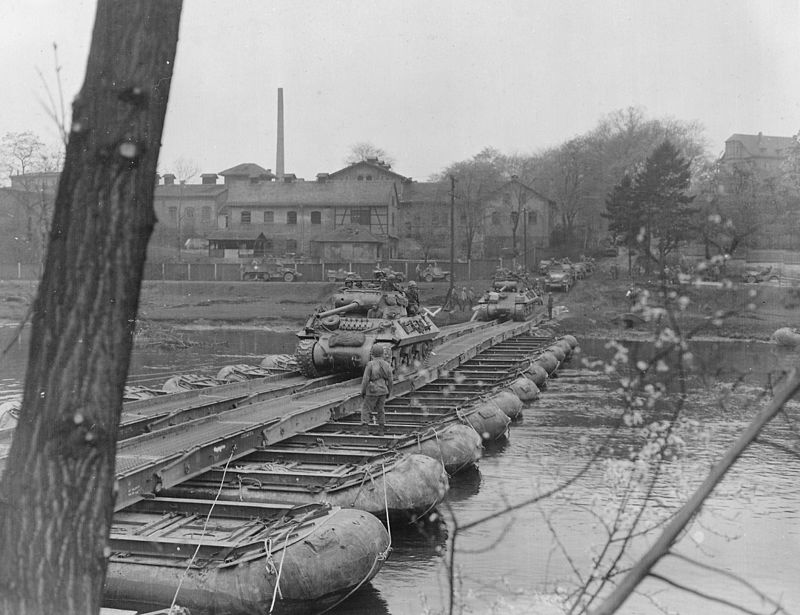
A column from the 607th crosses the Saar River into Germany, 1945. Gularte was dead by the time this photo was taken, killed by a sniper a few days before his first and only child, a boy, was born in San Luis Obispo.
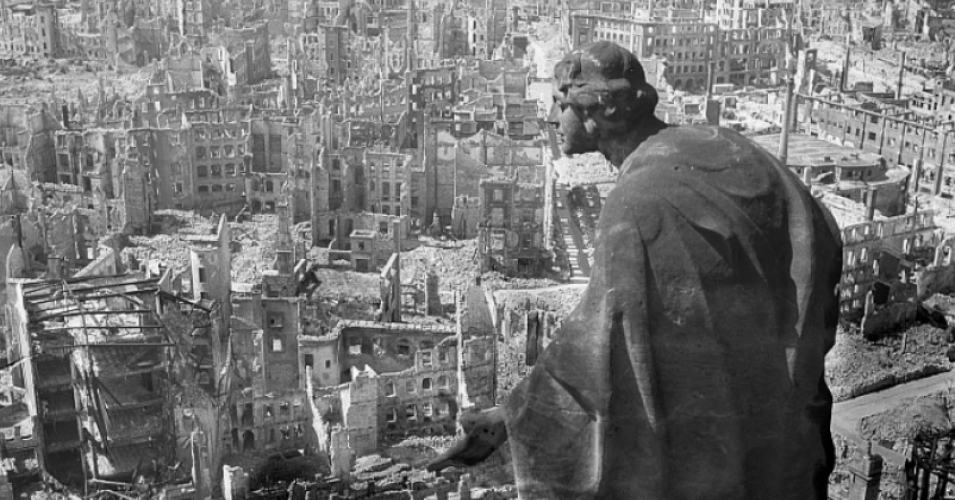
200 Arabians fled Janow Podlaski and headed west, away from the Soviets. Among them were Stained Glass and Grand Slam, two of Witez’s brothers. The exhausted horses arrived in Dresden on the night of February 13, 1945, just as the Allied command unleashed the notorious fire raid, involving over 700 British and American heavy bombers, on the ancient city.
After a wave of bombers had dropped its incendiary bombs, one of the Polish handlers watched, horrified, as Grand Slam’s tail burst into flames. He held on as best he could to the powerful horse and closed his eyes. When he dared to open them again, the flames that had engulfed Grand Slam’s tail had sputtered out and the bombers were gone. So were over half of the Polish Arabians, incinerated in the fires or asphyxiated by the oxygen-consuming firestorm the incendiaries had been intended to produce. By the time the surviving animals reached their ultimate destination in western Germany, fewer than fifty remained.
“Sheila Varian’s Perfect Horse,” from Will This be on the Test?
Dresden, after the firebombing.
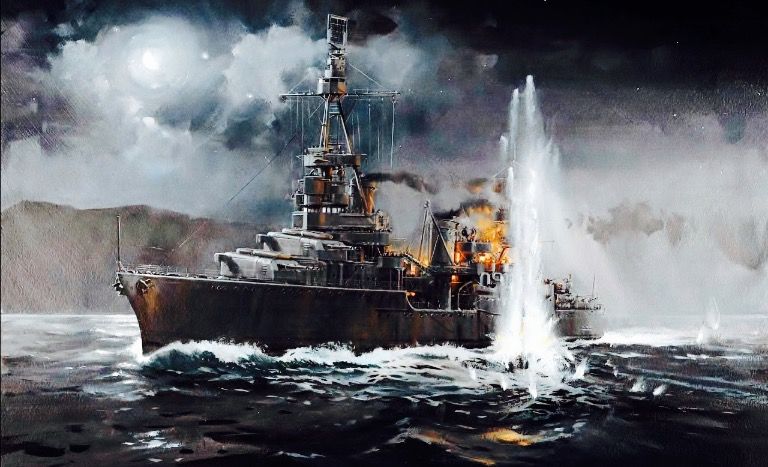
Two torpedoes struck Northampton in the engine room and stern, and the explosion that followed was so violent that men at their bridge stations on the nearby light cruiser Honolulu reacted immediately. They burst into tears.
The night action near Guadalcanal that killed Donald Runels of Nipomo, a crewman on Northampton, from World War II Arroyo Grande. The anecdote belongs to Samuel Eliot Morrison, the official United States Navy historian of World War II
Artist’s conception, the torpedo hit on Northampton. A destroyer escort would be named for Donald Runels
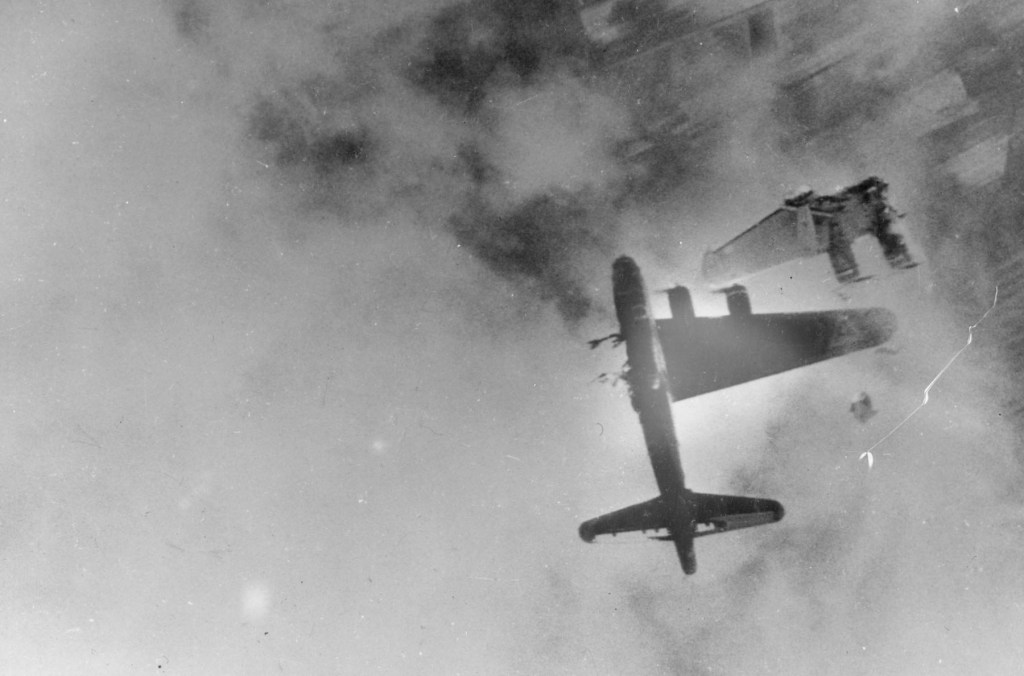
That was Hall’s first mission. He was twenty years old when he saw the three Ragged Irregular bombers plummet to earth together. Many members of his bomb group were even younger. Some of them, thanks to crafty misdirection aimed at recruiting sergeants pressured to meet their quotas, were as young as sixteen. Far below them, in German cities like Hamburg and Dresden—or in relatively obscure Japanese cities like Toyama, the size of Chattanooga, or Kagoshima (the seat of the prefecture from which most San Luis Obispo County Japanese had emigrated) the size of Richmond, Virginia—the ashen bodies of schoolchildren stained sidewalks and streets.
On B-17 crewman Henry Hall of Cayucos, from Central Coast Aviators in World War II
A doomed B-17 over Germany, 1945
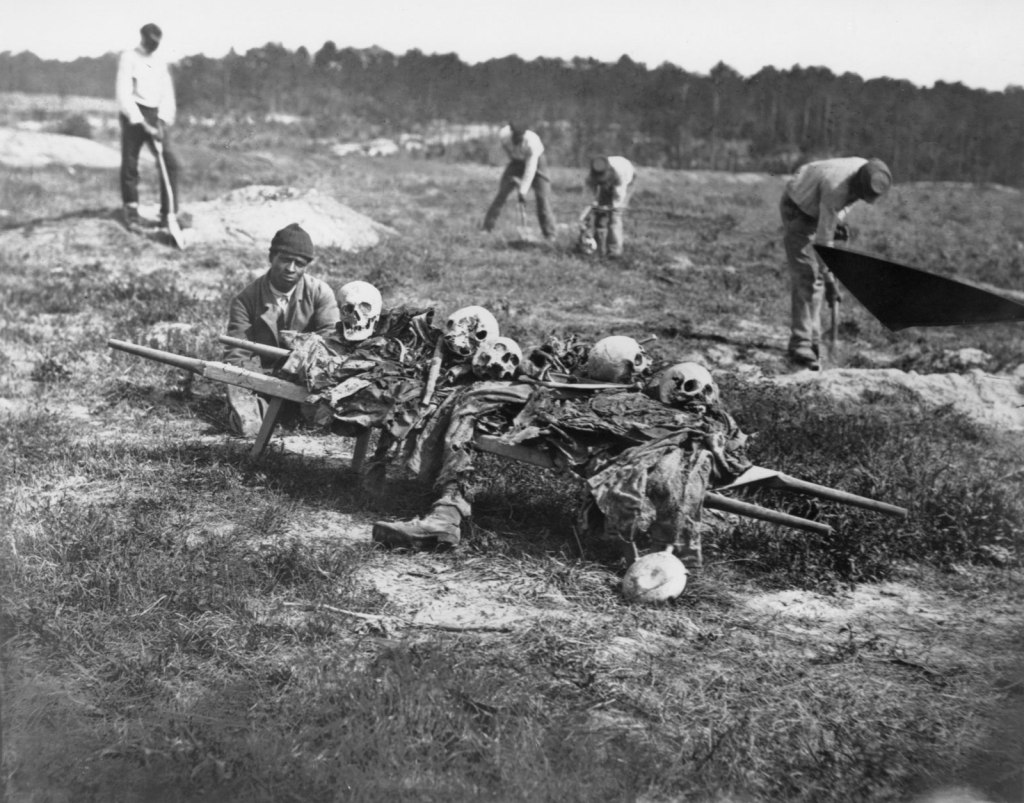
It was yet another battle, like Gettysburg, that seemed to take on a life of its own. After four days of combat, it was Adam Bair and the 60th Ohio’s turn. On the morning of June 3, the Union army, shrouded in mist, moved across the open ground that led toward the Confederate entrenchments.
The 60th was to assault Lee’s left. Unlike the general staff—coordination and communication throughout June 3 would be chaotic, and staff had not adequately scouted the ground to Lee’s front—private soldiers were fully aware of what they were up against; many wrote their names on pieces of paper and pinned them to their uniforms.
Adam Bair, later a rancher in the Huasna Valley, fought with the 60th Ohio at this 1864 battle, Cold Harbor; 7,000 Union soldiers were killed or wounded that day. From Patriot Graves: Discovering a California Town’s Civil War Heritage
Burial detail, Cold Harbor
I met my pilot, Byron Johnson, from Oklahoma; my copilot, James Gill, from California; my navigator, Robert Cramer, from California; my bombardier, Nolan Willis, from California; my engineer, Morgan Fowler, from South Dakota; my nose gunner, Homer Smith, from Texas; my left gunner, Theodore Mabee, from Illinois; my right waist gunner was James Walter…and he was from some eastern state that I don’t recall, and my tail gunner was Johnny Gates—he was from some eastern state, also. That was the crew. Plus me.
It’s hard to fault Findley for not remembering every one of his crew members’ home states. The Los Osos retiree was speaking from memory in 2013, nearly seventy years after he’d met the men who became “very dear” to him.
–Findley could not remember the home states of two B-24 crewmen he had known for two years. They were killed on his 26th combat mission in February 1945. Findley would make the Air Force a career, retiring as a Command Master Sergeant. From Central Coast Aviators in World War II
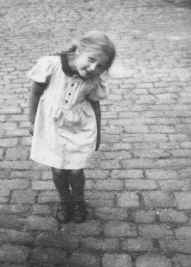
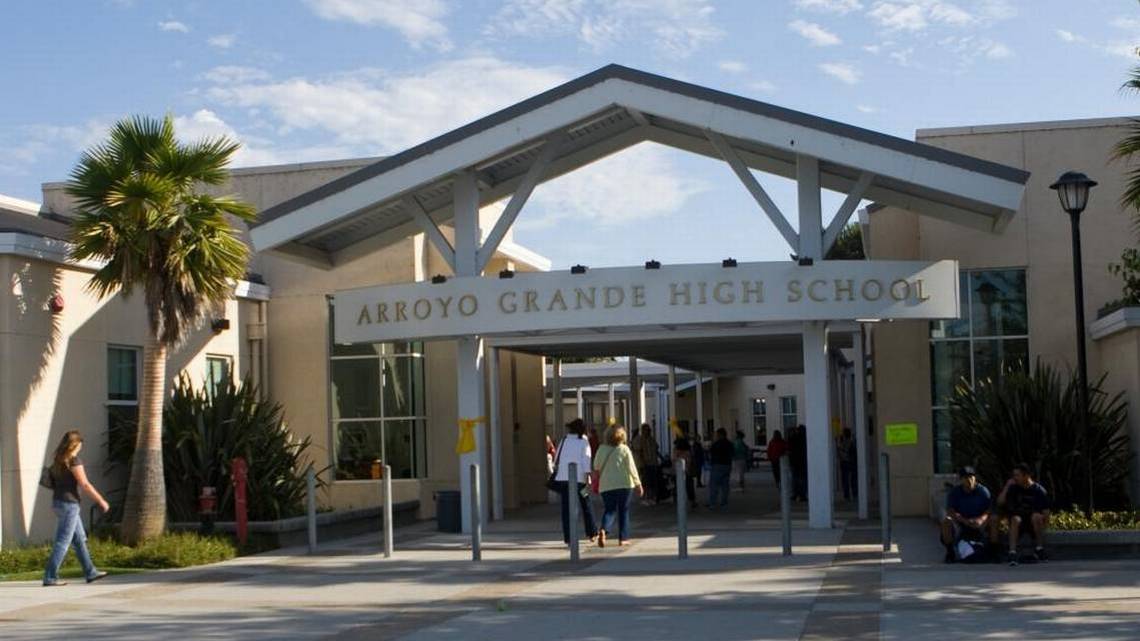
Once a Bavarian woman approached Mr. Kamin, our [Arroyo Grande High School] German teacher, and his students near Munich and thanked him and them for the kindness World War II GI’s had shown her when she was a little girl. There were tears in her eyes. Of course, many of the young Americans she remembered with such emotion had died before Mr. Kamin’s students were born.
A little Berlin girl meets her first American, a GI with the occupation forces, 1945
Young Americans, including young men like those soldiers, may be the best evidence we have of the faith we’ve had in ourselves—the faith that we will ultimately do the right thing. In my experience, there are few images more evocative of this than visits to places like the American cemeteries in the Ardennes, at Colleville-sur-Mer above Omaha Beach and in the Punch Bowl on Oahu. Those visits never made me want to wave flags or blow trumpets.
I always think instead of men who were once wavering toddlers, who took their first steps to a little smattering of applause from their parents. They waited expectantly and sleeplessly on Christmas Eves stalked by the Great Depression. When they did sleep, it would be with a dog close by. I think of boys whose hands shook when they tried to pin the corsage on the dress of their prom date. And then they aren’t boys anymore: They’re young men fresh out of Basic whose last moments in America, maybe a few free moments in San Diego or Philadelphia, were marked by ribald laughter and 3.2 beer or poker, by any distraction that would somehow increase the distance between themselves and the troopships waiting to take them into the crucible.
So I never think of patriotism at places like Colleville-sur-Mer. I think of baby shoes and I think of mothers.
–From Will This Be on the Test? Reflections from a History Teacher
From Jean Hubbard and Gary Hoving’s Arroyo Grande: Images of America (Arcadia Press)
I got the nicest thank you from the Companions of Our Lady–that’s the widows’ organization at Nativity Church in San Luis Obispo. I have to admit that I really enjoy speaking to older people, although the borderline between “me” and “older people” is eroding rapidly. I’ve made six or seven presentations at senior homes and at least three to the widows/widowers group in the South County.
Thomas was helping me, and the women loved having him. They loved it especially when he won the door prize, a succulent that he promptly named “Frazier.”
I really felt for one woman. She and her husband had lived in the same house on the North Coast for thirty years. They’d come down here and perused some mobile home communities to look for a place to live when they couldn’t take care of a big house and yard anymore.
Then he died, of course. And she still misses him, of course. There was absolutely nothing self-pitying in the way she said this. So she moved into one of the trailer parks down here and she’s having a hard time fitting in. I gave her my card and told her to give me a call for some coffee some time.
Of course, she won’t call. I’m going to have to go backwards and she if I can find out her phone number instead.
It made me wonder if there is something we’ve lost.
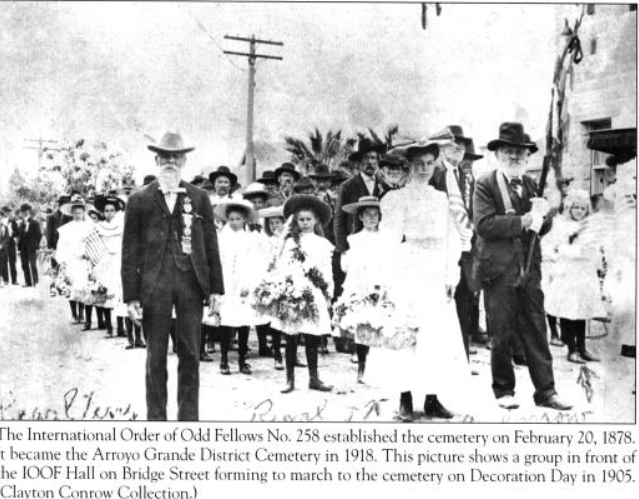
In Patriot Graves, the Civil War book, here’s what would happen every Decoration Day (Memorial Day) in Arroyo Grande.
The old veterans and local schoolchildren would start a little parade and then march to the cemetery to honor their comrades who had passed on. Their would be patriotic songs and speeches and recitations–like “Barbara Fritchie,” the poem that Churchill recited once from memory to an astonished FDR– and all the things they made kids do in 1905. They were the kinds of things we still did at Branch School in 1958.
When that was all over, the veterans and the schoolchildren would walk (or ride, for the older vets) back to the IOOF Hall or the Grand Army of the Republic Hall, then across Bridge Street, and have a big chicken dinner.
The thought charms me: I can see the image of an silky-bearded veteran of Chancellorsville or Gettysburg or Missionary Ridge sitting next to an eight-year-old girl missing those top front teeth and both of them getting a little messy eating their chicken.
Maybe that never happened, but I think it did.
The idea of two generations so distant from each other–one ascending the arc of their lives, the other nearing its end–sitting down to table together seems to me to be such a healthy and vital idea.
Civil War veterans suffered terribly from PTSD and from drug and alcohol addiction; a decade after the war, 80% of the inmates in American prisons were veterans. The psychic damage the war had inflicted on them is what brought many veterans to Arroyo Grande. This was a place where they could start over again. For some, this was their third and final chance to start over: a third of the veterans buried in our cemetery had moved at least twice before coming to Arroyo Grande or Nipomo. They’d run out of continent.
So they were restless and troubled men and kept most of this hidden, of course.
Marching alongside children and then chatting with them over chicken dinners must have healed, if just a little, so many of the wounds so many of them carried.
Their wounds were invisible, for the most part–although many local veterans died decades after the war from wounds or disease they’d suffered as young men, and they’re not counted among the 620,000 lives we lost in that war. But, of course, the invisible wounds were deep and painful and, most of all, they were fearful.
Having a child–her littleness next to your relative bigness–sitting next to eat you can either be terror-inducing, or it can be enchanting, once you begin to chat.
Then you weren’t thinking about the eighteen-year-old brother you saw die in the Shenandoah Valley in 1862. All your attention would have been riveted, as you smiled with the teeth you had left, at the little girl with the gap in her teeth trying her best to eat her drumstick.
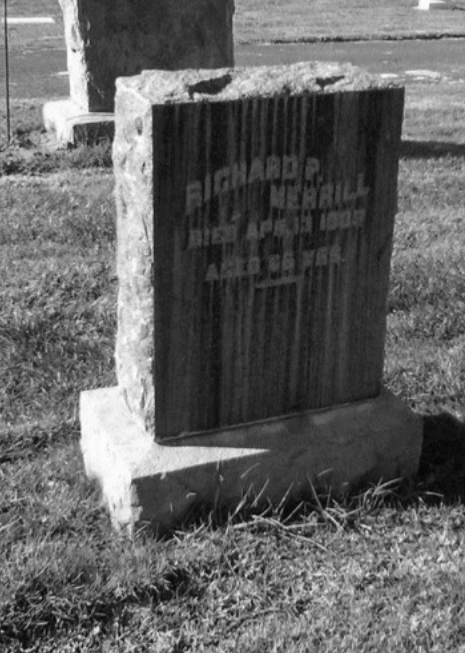
Here’s what children meant to one of those veterans: Richard Merrill, buried in our cemetery, fought at Antietam, the deadliest battle in American history, and at Chancellorsville. He contracted a disease, possibly dysentery, and was, according to a family history, “a great sufferer” for the rest of his life. He married, but his job history is a checkered one. He never joined any veterans’ group. So far as I know, he never talked about the war, not even with his wife.
His last job was at the Arroyo Grande Grammar School, on the site of today’s Ford agency. When Civil War veteran Richard Merrill, the school janitor, died in 1909, the children asked their teachers if they could have the afternoon off on the day of the old soldier’s funeral. Permission was granted them.
“Mr. Merrill,” his obituary concludes, “was a great favorite with the children.”
My friend and former AGHS history student Eddie Matthews and I talked recently about the seemingly contradictory nature of friendships. They don’t always depend on length or frequency of contact. Sometimes someone comes into your life just a few times and Eddie’s point, over our coffees, was that even a casual friendship like that can still evolve into one of the most meaningful friendships of your life.
That’s just the case with another friend, Al Findley Jr, of Los Osos, once a B-24 Liberator radioman who survived having two of his aircrew’s bombers shot down during World War II. The second time, he lost four of the most meaningful friends of his life.
Findley next to his B-24.
Al died on April 28, at 96. His time had come. He’d had a long and extremely successful Air Force career and then became fascinated with antiques and that would become his retirement avocation. He retired to a beautiful place, Los Osos, and he left behind many friends.
I only met and talked to Al maybe four or five times. He was one of my sources for a book called Central Coast Aviators in World War II. But I count him as one of the best friends of my life. And so I miss him.
That’s what happens when you write books. In fact, the people you write about don’t even have to be alive to become close to you and important to you.
Two friends, Gregory and Findley, at the Estrella Warbirds Museum.
In old newspapers, I’ve been able to follow some local World War II servicemen throughout the course of their lives. Others left letters that were funny or poignant or even enchanting. Many were killed in action, but they became–not friends, exactly–to be honest, these soldiers from my parents’ generation became my sons.
In the 1930s, American social critics condemned that generation’s teens as self-centered, pleasure-seeking and lazy.
There’s just the slightest chance that those critics were right.
But then 400,000 of those young Americans died. That’s 400,000 military men and women. In 1942, as our industrial production surged, more Americans died in factory accidents than on the battlefield.
So I am so very proud to have known a World War II veteran who had no business living beyond his twenty-second birthday. And then he had the audacity to not just live such a long life, but to become a joyful person whose optimism was contagious.
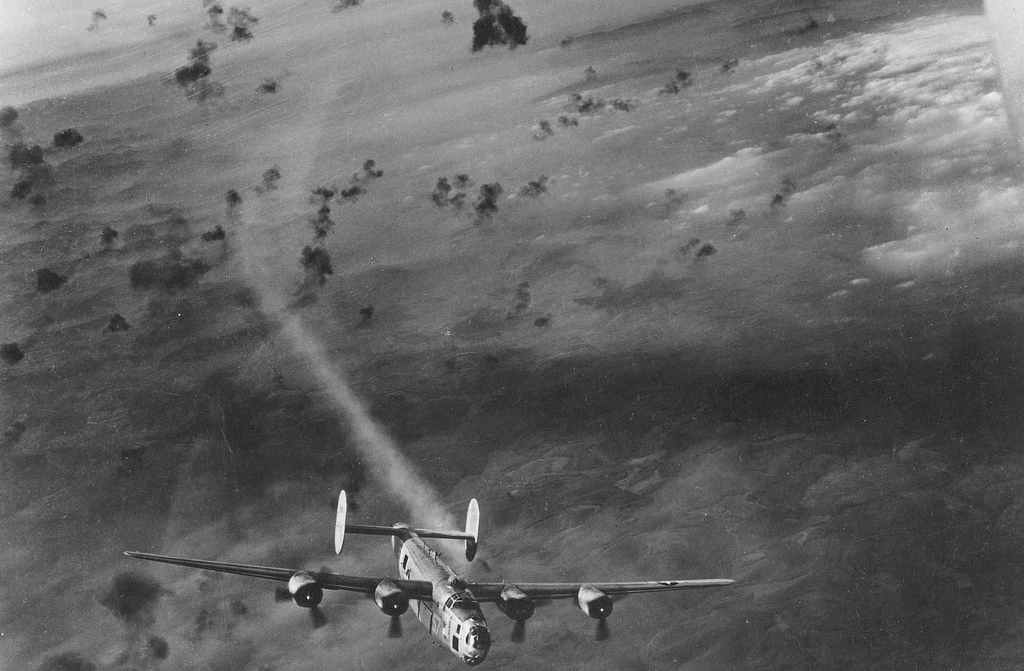
A B-24 trails smoke after a flak hit.
By contrast, much of my research begins in cemeteries. But that’s where you start to forget about death and instead begin to reconstruct lives. I write history to give lives back to the town and to the county where I grew up. I believe that old lives have the capacity to inspire us—in fact, they have the capacity to give life.
I’ve found old lives in yellowed newspapers and on tombstones, in copies of service jackets and in rifle company casualty reports. I found one in a copy of the telegram informing a Corbett Canyon farmer and his wife that their twenty-year-old had died five weeks before on Iwo Jima. I’ve found, in encounters even more fleeting than the ones Eddie and I discussed, my surrogate sons and daughters.
One of them died late last month.
Waist gunners, Eighth Air Force, World War II>
Jim Gregory lives in Arroyo Grande. He taught history at Mission Prep and Arroyo Grande High School for thirty years. Eddie Matthews, an editor at Parthian Books, earned his doctorate in creative writing at the University of Swansea, Wales. Dr. Matthews teaches writing at Point Loma Nazarene University.
Command Master Sergeant Albert Lee Findley Jr. of Los Osos died Sunday, April 28, in a San Luis Obispo hospital at age 96. Findley was a B-24 radio operator in World War II and one of the finest men I’ve ever met. These passages about Al are excerpted from the book Central Coast Aviators in World War II.
Band of Brothers
After finishing gunnery school in Yuma, Arizona, Oklahoma-born Corporal Albert Lee Findley Jr. reported to Hammer Field, just outside Fresno, and met his B-24 bomber crew:
I met my pilot, Byron Johnson, from Oklahoma; my copilot, James Gill, from California; my navigator, Robert Cramer, from California; my bombardier, Nolan Willis, from California; my engineer, Morgan Fowler, from South Dakota; my nose gunner, Homer Smith, from Texas; my left gunner, Theodore Mabee, from Illinois; my right waist gunner was James Walter…and he was from some eastern state that I don’t recall, and my tail gunner was Johnny Gates—he was from some eastern state, also. That was the crew. Plus me.
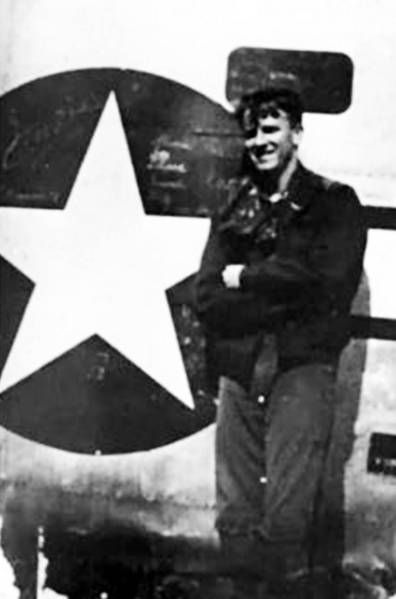
Findley next to his bomber, 1944.
It’s hard to fault Findley for not remembering every one of his crew members’ home states. The Los Osos retiree was speaking from memory in 2013, nearly seventy years after he’d met the men who became “very dear.” The feeling must have been reciprocated, because Findley, in an oral history interview that has become part of a Library of Congress collection, emerges as engaging, well spoken and warm—traits that may have failed him only once, when, two-thirds of the way through his combat tour, he was shot down over Germany.
The first thing a downed airman would do, if he was able, was seek out his surviving comrades. It was an obligation that had begun in the very last stage of training. Finally, the component parts of what would become an aircrew would meet one another and, as Findley did, their aircraft at about the same time. Findley remembered, with a sense of relief, that their brand-new B-24 Liberator came with a ball turret on its underside. Air force commanders in the South Pacific had ordered the turret removed to improve the big bomber’s maneuverability. What Findley and his new crew realized was that they were headed for Europe—a relief because of the oppressive climate and primitive conditions servicemen had to endure in the Pacific.
For most of the war, San Luis Obispo County airmen flew in two types of heavy bombers—the B-17 Flying Fortress or the B-24 Liberator. (By 1944, some would fly the B-29 Superfortress over Japan.) While crews devoted to their B-17s derided the more ungainly B-24 as “the box the B-17 came in,” Liberator crews were just as dedicated to their ships. More B-24s were manufactured—nineteen thousand, with eight thousand built by the retooled Ford Motor Company at its Willow Run plant alone—than any heavy bomber in history. If the B-17 has a more glamorous image, it’s largely due to both its sleek looks and to Hollywood: newly-minted Major William Wyler, who had directed Jezebel, Wuthering Heights and the stirring wartime drama Mrs. Miniver, immortalized the crew of the “Memphis Belle” in the 1943 documentary of the same name. Belle’s crew was the first said to have completed the required twenty-five missions over Europe (a milestone more likely attributed to a B-17, “Hell’s Angels,” part of Morro Bay’s Clair Abbott Tyler’s 303rd Bomb Group, but “Angels” had no Hollywood directors aboard), and so the B-17 became immediately and intimately familiar to Americans. Despite Wyler’s documentary, it was, in the final analysis, the Liberator that may have won the most famous Hollywood advocate: James Stewart, who’d already made films like Mr. Smith Goes to Washington and The Philadelphia Story, became the commanding officer of a B-24 squadron and flew twenty combat missions over Europe. “He was a hell of a good pilot,” one of his bombardiers remembered.
Perhaps the best way to deal with the debate between B-17 and B-24 enthusiasts is to simply leave it alone. Each plane had it advantages: the B-17 could take substantial punishment and was far easier to fly in formation—B-24s demanded considerable muscular strength from their pilots—but the Liberator was faster and carried a heavier payload. The B-17 was more numerous in the European theater while the B-24 was the more common heavy bomber, until the advent of the B-29 Superfortress, in the Pacific.
* * *
Flak
Enemy antiaircraft fire may have been even more dangerous [than German fighters]. Radioman/gunner Albert Lee Findley flew his first mission in his B-24 on September 5, 1944. As he and his crew approached the target, Findley was suddenly enchanted:
I saw a lot of silver things floating out of the air, and I thought “if that’s flak, it’s very lovely.” Shortly after that, I saw the flak, big black bursts, and it shook the airplane. The silver things I saw were chaff that some of the airplanes dropped to foul up their radar. It didn’t work that day, because a lot of the aircraft were hit over the target, including us.
In fact, Findley’s bomber was so badly damaged by flak—radar-directed ground fire from German batteries (the chaff he’d seen was made up of slivers of aluminum foil)—that the pilot had to crash-land the plane in France and, fortunately for Findley and his aircrew, on French soil that had just been liberated by American ground forces. “If this was the first mission,” a smiling Findley remembered decades later, “I wasn’t sure I could make thirty.”
A B-24 doomed by a direct hit.
Flak, from the German word Fliegerabwehrkanone, or “antiaircraft cannon,” was psychologically devastating to World War II fliers, because, unlike their encounters with fighter planes, there was simply nothing they could do to fight back. The twenty-pound enemy shells, fired from ground batteries that were dense around key targets, exploded in angry black puffs that sent steel fragments slicing through wings, fuselage and crewmen. Flight engineer Al Spierling of Arroyo Grande counted over one hundred holes in his B-17 after one mission; on another, shards of flak sliced the oxygen lines necessary to survival at twenty-five thousand feet; the waist gunners and tail gunner in Spierling’s ship kept passing out—symptomatic of anoxia—until he could repair the system. Bomber crews could hear the flak fragments hit as the shell exploded close by, like gravel scattered on a tin roof. They would watch in amazement, as Spierling did on several missions, as gaping holes appeared in the airframe or, in Albert Findley’s case, as an engine caught fire from a flak hit.
* * *
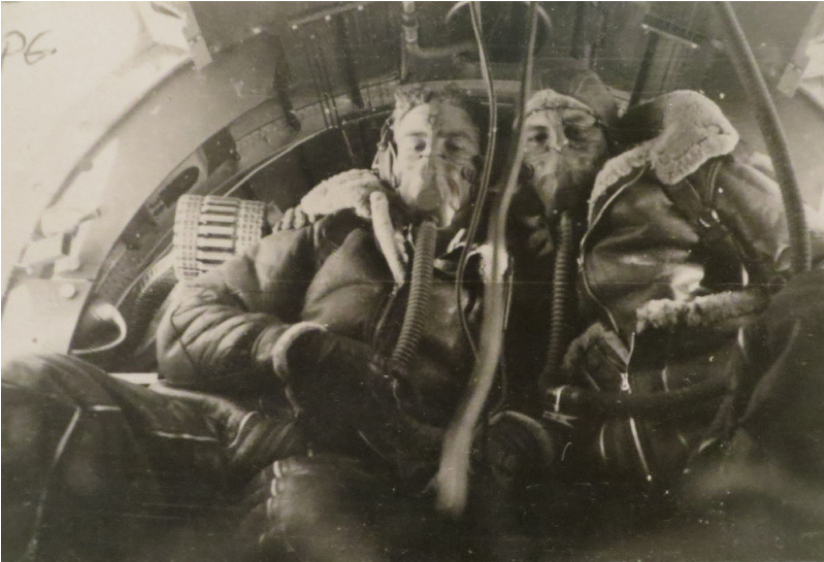
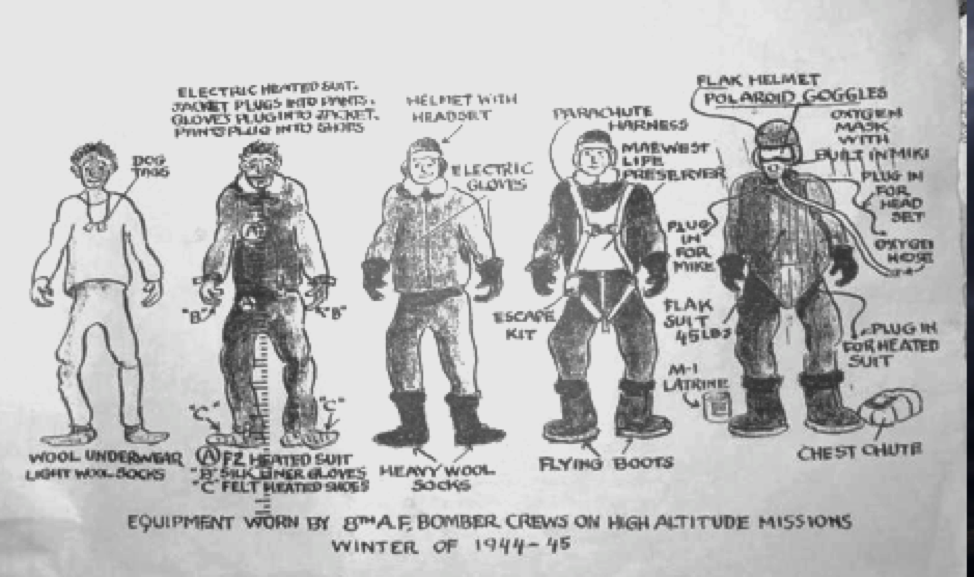
Forty below
As if enemy fighters and flak weren’t enough to worry about, bomber crews also had to deal with the elements: the oxygen supply, of course, was critical at missions flown in unpressurized cabins at twenty-five thousand feet. Masks were donned once the aircraft reached ten thousand feet, and it was the bombardier’s responsibility to do “oxygen checks”—to check in, via intercom, with each crew member every five minutes. But the cold—Radioman Findley remembered temperatures at forty below zero—impinged on breathing, as well; any moisture inside the oxygen mask froze, blocking the air supply, something a crew member might not notice until one of his comrades lost consciousness. (Urine froze as well, so the “relief tube” provided each bomber crew frequently proved useless; veterans used buckets or just relieved themselves inside their clothing..
An airmen demonstrates the kind of layering required for survival at 25,000 feet.
* * *
Powdered Eggs and Creamed Chipped Beef on Toast
Army food wasn’t country club fare. Bill Mauldin, the great cartoonist who created the imaginary Willie and Joe, his comrades in the Italian campaign, once remarked, without malice, that his mother was the worst cook in the world. Then he encountered army food, which was infinitely worse. At least airmen understood that they were fed better than men like Mauldin, dogfaces, who commonly used GI powdered lemonade to wash their socks. Still, even in the AAF, the green-hued powdered eggs, along with the ubiquitous Spam, were breakfast standards, and creamed chipped beef on toast—referred to as “shit on a shingle”—followed airmen across the Atlantic from the air bases stateside where they’d first encountered what seemed to be, to the military, a perverse culinary masterpiece. Radioman/gunner Albert Lee Findley Jr. found little relief off base. “English food took some getting used to,” he admittted tactfully. (Many years after the war, Findley and his wife would live in England as the proprietors of an antique shop.) One vegetable, brussels sprouts, was as common to English fare as Spam was to American mess halls, and at war’s end, many English-based GIs swore they would never eat them again.
* * *
Vive les Américains !
Al Findley was the B-24 Liberator radioman who had the distinction of being shot down on his first combat mission. Luckily for him, his pilot, fellow Oklahoman Byron Johnson, was [a talented pilot] and he brought the bomber down near a French town in Champagne, Epernay, that had just been liberated by the Allies. The good people of Epernay were delighted with their unexpected guests, and…they insisted on wining and dining the young Americans—one of the villagers, Jean-Louis, became pen pals with Findley’s mother back in Oklahoma. The good times lasted for a week, when their squadron commander buzzed Epernay and dropped a testy message: Lieutenant Johnson and his crew were to report to Reims immediately and hitch a ride on an Army C-47 back to base in Attlebridge. The second shootdown, over Germany, would lack the first one’s charms.
Epernay
* * *
“For You, the War Is Over”
The second time B-24 radioman Al Findley was shot down, in February 1945, was on his twenty-sixth mission. The target was Magdeburg, a city once famed for Martin Luther’s preaching but now important to the German war effort for its production of synthetic fuel from lignite coal and so integral to Spaatz’s “oil campaign.” Findley’s bomber had released its payload and was on its way home, over the Ruhr Valley, when it was hit by flak bursts on the tail and on the left wing. Three gunners were injured. Control cables were severed. The pilot ordered Findley and the uninjured aircrew to throw out everything that was loose to lighten the load, but the radioman realized how serious the situation was when he saw the copilot putting on his parachute. “Bail out!” he yelled at Findley. Findley obeyed and, on his way down, saw two more parachutes. He landed hard, was knocked unconscious and woke up to see three German farmers—two with pitchforks, one with a shotgun—standing over him
* * *
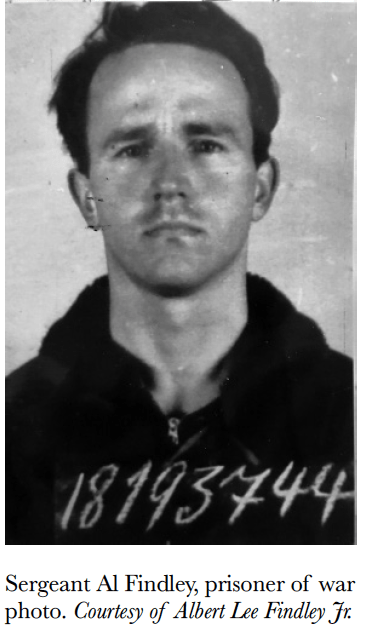
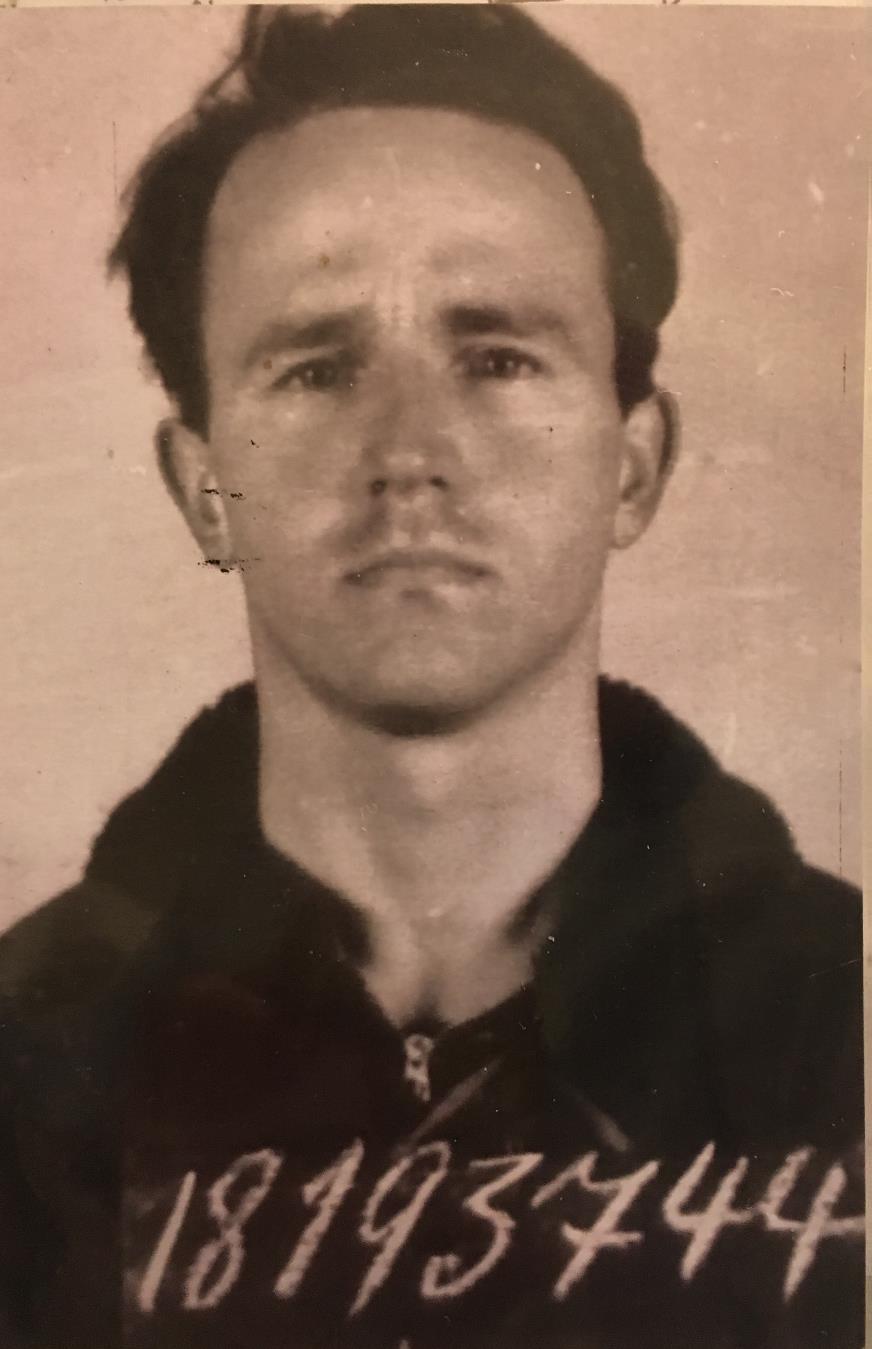
Both Findley and [San Luis Obispo] B-17 copilot 2nd Lt Robert Potter] Dwight were captured as the war entered its final months. Findley would later learn that he’d lost four crewmates; five others, besides Findley, became prisoners of war—it was two weeks before his pilot, Byron Johnson, was captured. The twenty-year-old radioman was put on a train to an interrogation center in Oberursel, north of Frankfurt, where he spent eleven days in solitary confinement, living on a diet of coffee, brown bread and “some kind of soup.” He was finally interrogated by a Luftwaffe major who asked him about the impact of the new ballistic missile, the V-2, that was the last of Hitler’s “miracle weapons” to be unleashed on Britain. Findley responded with his name, rank and serial number. He was a little rattled, as most captured airmen were, when his interrogator, in a little show, started talking about Findley’s bomb group, the 466th—“he probably knew more about my outfit than I did,” the American remembered.
* * *
Once downed fliers had been interrogated, their usefulness was at an end, and they then became part of the Luftwaffe-administered prison camp system. Al Findley was part of a prisoner-of-war shipment bound for an overcrowded camp, Stalag XIII-D, near Nuremberg, Bavaria, sited on a parade ground that was once the scene, in Hitler’s heyday, for Nazi Party rallies. Findley remembered a camp that was overcrowded—Allied airmen in other camps had been brought to this one as the Red Army began to overrun eastern Germany—and rife with dysentery, bedbugs and fleas. “I think I spent half my time in the chow line,” he remembered ruefully, where standard fare was soup with bugs in the beans, which he and his comrades decided were their meat supply. (In reality, the diet for German civilians wasn’t much better.) The poor conditions were relieved by a reunion with his B-24 crew, with the pilot the last man to come into the prison camp. Pilot Byron Johnson cried when Findley and the other survivors told him about the four lost crewmen, including the lost flight engineer, the only married man with a child among the crew, who had gone back to get the gunners out and wound up dying with them.
* * *
Findley’s confinement ended on April 4, 1945, when the prisoners of Stalag XIII-D were ordered out and into the countryside as George Patton’s Third Army closed in. While on the march, Findley and his fellow prisoners had to endure friendly fire: they were strafed by American fighters who mistook them for German troops. (Findley’s boxcar, on its way to Nuremberg, had likewise been strafed by Allied fighters.) At their stopping point the next day, the prisoners garnered enough toilet paper to spell out “POW” in the field where they were to sleep. Fighters passed over them, but this time the planes waggled their wings and departed. The bedraggled column finally stopped at Moosburg, ninety miles south of Nuremberg, where they were united with prisoners of war herded from Stalag VII. A week later, Findley and the mass of prisoners realized one morning that the Germans were gone. Third Army arrived at Moosburg at about noon, and Al Findley was free. Both Findley and Dwight would be flown to a recuperation center near Le Havre, Camp Lucky Strike, where their injuries would be tended to (Dwight’s shoulder would eventually require surgery) and where, as Findley noted, “they fattened us up again.” They were then put on ships and sent home.
Al Findley’s POW photograph.
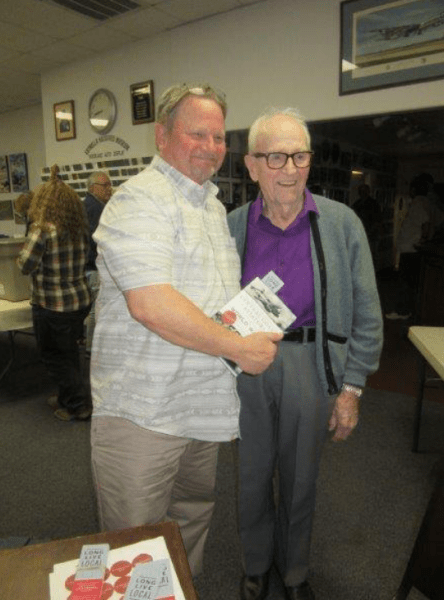
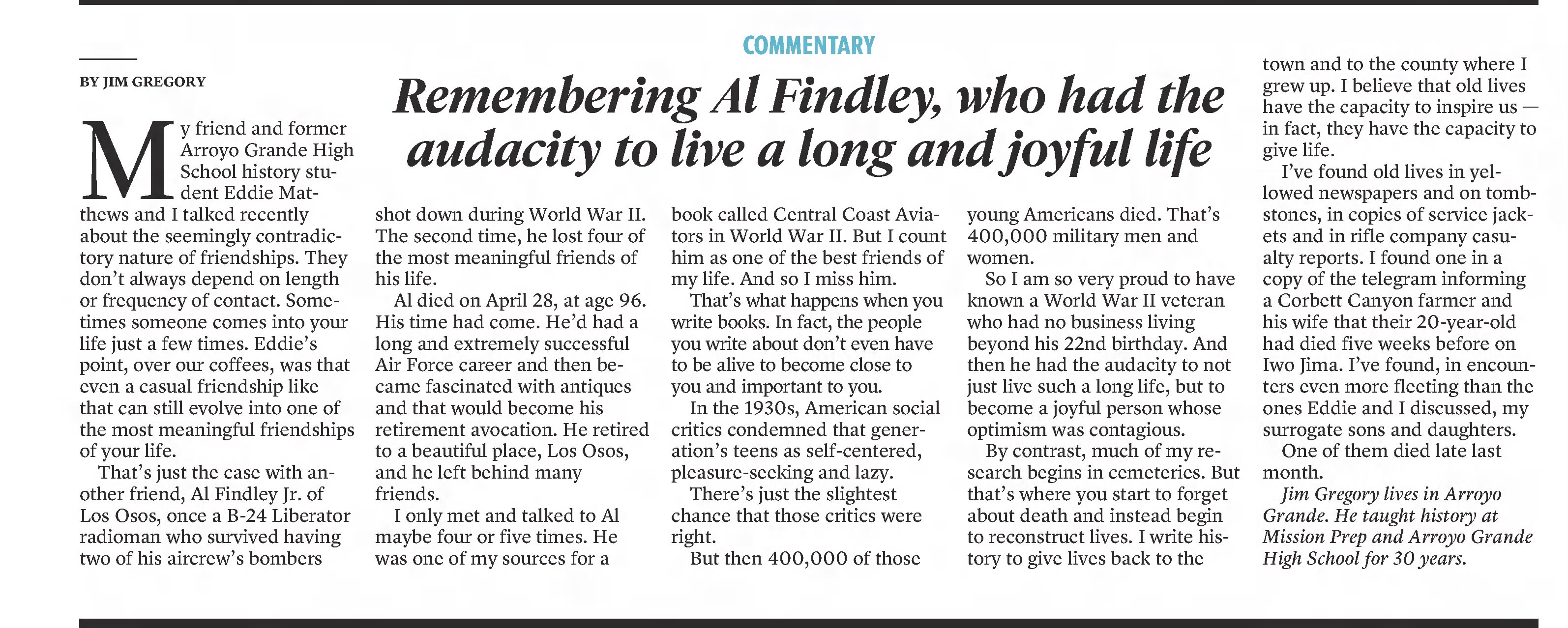
Al Findley and me at the Estrella Warbirds Museum, about a year before his death.
Yes, I’m up at going on 3 a.m. after coming home from the doctor’s with good news. But whatever it is that’s still following me saps a lot of the energy out of me because it gets me out of bed at odd hours.
I almost didn’t want today’s news to be good news.
This is why. I was thinking all day of people like Janine Plassard and old friends like my teacher Jim Hayes or Jim Watson, a student Elizabeth and I just lost, and the news they got wasn’t good. Believe me, people prayed for them, too.
These are just three lives of so many that ended too early or are in such peril while my life is neither over nor in any imminent danger. It’s not fair.
So I’m angry with God now. Please allow me to be. We fight all the time; our arguments are fundamental to my faith. That’s the way He intended me to be when He gave me life.
Janine led the kind of life that gave life to others. So did my journalism professor at Poly, Jim Hayes, who made me a better writer and a better human being. It was Jim who first steered me toward teaching. When I was twenty, he made me a writing coach for other Poly journalism students. I found that I loved it, loved teaching. Jim knew that about me before I did.
Janine loved teaching, too. This was her profession, her passion, her vocation and, even though she’d hotly deny it, her ministry. Like Jim, she made better writers–there’s no better example than Kaytlyn Leslie, a superb Tribune reporter who has so much promise. Janine was her first journalism teacher at Nipomo High. She was Kaytlyn’s compass just as Jim was mine.
And just like Jim–we heard this over and over again at her celebration of life last weekend–Janine made better human beings, too.
Elizabeth and I were lucky enough to have dinner with Janine and our friends JIm and Cheryl and Mark and Evie at Rosa’s a few weeks before she died. She looked frail and was just a little subdued but every once in awhile she’d say something with a little barb to it so that it made you gasp momentarily and then laugh.
I looked down at her at the end of the table and it was obvious that she was enjoying her meal–we love Rosa’s–and her wine. She was savoring it. I think she was discerning the earth and the oak and maybe even the sunlight that had ripened the grapes.
She was eating like an Italian, who are masters of the unhurried meal. Italian food is intended to be savored like Janine’s wine. An Italian dinner is about watching your table-mate take that first bite of butternut squash ravioli, watching his eyes close momentarily with pleasure at the taste; it’s about being happy for him.
Then it’s your turn to eat.
But even the eating is secondary to Italians. Janine understood that. Good food is the pretext for bringing friends and family together, for enjoying each other, for telling stories and remembering those odd relatives that we all have; it’s about arguing over baseball. This is how you find life, at the table in other lives.
I don’t know why Janine had to give up her life and I’ve still got mine. I don’t know why I nearly died as a baby but didn’t. I was born in Taft premature and blue and strangling when the doctor, who’d been out of town, suddenly burst through the door and ordered my Dad out. He’d had a hunch. These are mysteries that both bewilder and anger me. It’s not fair.
At the end of the meal at Rosa’s, Janine and I hugged and it felt so good that I said to her: “Oh! I want to do that again!”
“You better.” she said, and she said it quickly. It was a retort, even an admonishment. She meant it. She meant, too, that she knew she didn’t have much time.
So I’m not thinking much today about my luck. I’m wishing I could watch that luck happen in other lives, filling them with life just the way that good ravioli does.
I wish I could say that then it’s my turn to eat. But, to tell you the truth, I’m not all that hungry.
I would rather rest my chin on my cupped hand, elbow on the table, and watch Janine down at the other end, watch the way she drinks wine and watch, too, her eyes close with pleasure at all the flavors she discovers in her first forkful of pasta.
Blackwell’s Corner is a gas station and little shop at the intersection of Highway 46, which will take you east to Bakersfield, and Highway 33, which will take you south to Taft, where I was born.
It is, in other words, so remote that it is nowhere.
I was a baby at home with Mom and so couldn’t see what was possibly the happiest thing that ever happened there. For some reason the bus had dropped off my Uncle George Kelly at Blackwell’s Corner. It must have been easy for my Dad, who’d come to pick him up, to see him. My uncle was and is tall and handsome and he would have been in his dress greens–this was during the Korean War–and he would’ve had his Army duffel bag slung over one shoulder and in the other hand there would’ve been grocery bag with twine handles and it would have been full of Government Issue property.
It was an official United States Army turkey. My uncle was an Army cook and it was Thanksgiving, so he’d come to spend some time in Taft with my Mom, his sister, and his parents–my Kelly grandparents.
Of course he would have called ahead both to arrange the rendezvous with Dad and to issue a good-natured warning to start the side dishes but lay off the turkey and dressing. He would bring the former–it must have been more than a little satisfying to choose a turkey when you had the time to inspect so many suspended on hooks inside a camp freezer. The Army is not necessarily kind to privates, so that would’ve made picking out the turkey even more satisfying.
As to the dressing, it would’ve been an original–my uncle cooked instinctually and decisively–and it would’ve been divine.
I’m not sure where he was based–it might have been Fort Ord–but there’s nothing better than a long bus ride for thawing a purloined turkey. It would’ve been densely wrapped, of course, and whoever sat next to Pvt. Kelly on the Greyhound and the Orange Line buses might’ve asked what was in the bag. Anybody who started a conversation with George was in for a long haul. Still, an Uncle George monologue would’ve colored the trip through severe bareness of the southern San Joaquin Valley.
He was a natural storyteller, and telling the turkey story would’ve led to another story and then George would ask a question of his seatmate who would tell a story of his own, and for every story you had, George had one to equal it.
His might’ve been about Army life or his attempt to work his way through Cal Poly by hustling pool or about the time his Dad, the cop, had won an unequal fistfight–unequal in the sense that only three oilfield roughnecks had attacked Taft police officer George Kelly Sr. You needed to bring more guests to the table to win a fight with my grandfather.
The table in Taft, of course, at my Gramps and Grandma Kelly’s, would’ve been beautiful, dense with potatoes and yams and string beans and gravy and Uncle George dressing and cranberry sauce. The centerpiece would have been the U.S. Army turkey and it would have been done perfectly, stuffed with apples and onions and dusted with sage and rosemary and with the breast meat still moist and tender.
In all honesty, the Army, for once, had done something precisely right because my uncle is a superb cook. And Pvt. Kelly, there at the table with his sleeves rolled up but with his Army tie tucked by regulation into his uniform blouse, would have been the handsomest man alive.
I was there and don’t remember any of this because I was in my high chair eating mashed potatoes with my hands and missing my mouth with most of them. But I’ve heard, growing up, the story of Dad finding my uncle at Blackwell’s Corner three or four times, So, oddly enough, I do remember exactly what was going on and how the table looked and, by the way, how beautiful my Mom was, and I can remember it like it was last week.
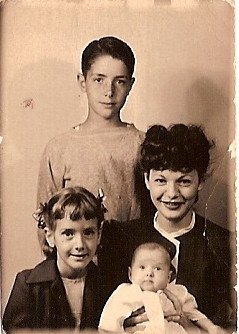
My Aunt Judy, Uncle George, Mom and my sister Roberta, about 1943
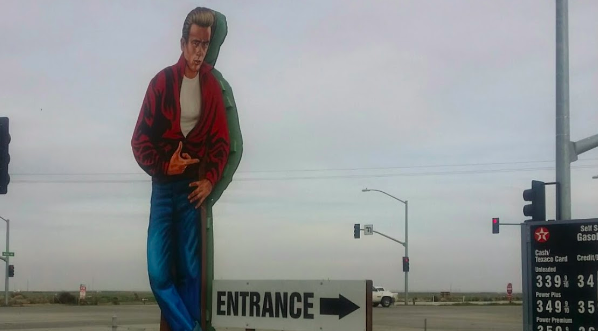
My next memory of Blackwell’s corner would have been about 1958, when we were on the road from Arroyo Grande to Bakersfield. That was three years after James Dean had made his last stop there before the Porsche Spyder’s fatal crash near Cholame. Today the Corner, then an unpretentious Atlantic Richfield gas station with a little store, is pure kitsch. There’s a figure of Dean out front, slouching slightly in his Rebel Without a Cause red jacket, and it’s obscene. I take my James Dean seriously. Neither my wife nor my U.S. History students had seen East of Eden until I showed them the film, released, of course, after his death, and the connection he made with all of them was both instant and lasting. They got him.
So Dean was three years gone and not yet a gift shop bobblehead when we stopped at Blackwell’s Corner as we did every trip to Bakersfield. This stop was at night, which was merciful, because driving at night on the 46 means you have nothing to look at out the car windows except for the scattered lights of isolated homes and metal sheds, the watchmen’s places for men who patrolled the fields with flashlights. The fields were populated otherwise only by coyotes, jackrabbits and Union Oil pumps, donkey pumps, that worked all night making Union Oil rich and powerful.
During the day you could see the pumps, most in perpetual motion and so the only signs of life in that desolate part of California where the dominant colors are a yellowish sand and purplish gray. This is where locals, for both fun and for the rueful acknowledgement of the severity of their environment, celebrate Christmas by decorating tumbleweeds, spraying them with artificial snow and stringing them with little blinking lights. What had brought them to this severe place was oil; what had brought my Dad’s cousins here from the Ozark Plateau was oil, what had brought my mother’s father here, the son of Famine immigrants who’d worked oilfields in Pennsylvania in the 1870s, was oil.
We had gotten into the habit of stopping at Blackwell’s Corner because after an hour of staring at such a dry landscape, you get intensely thirsty. So we would stop for a Coke for my Mom, a Pepsi for my big sister and Nehi orange sodas for my brother and me. Dad got a Coors.
By 1958 my Grandmother Gregory was sliding into dementia and increasingly fragile, so that must have been why we were driving the 46 at night. There was something wrong with Grandma Gregory.
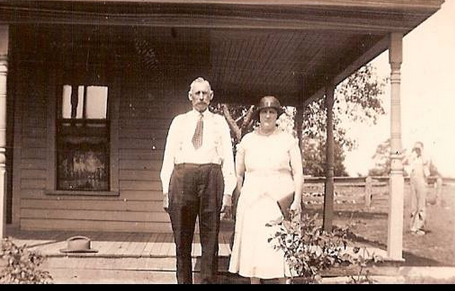
My Grandfather and Grandmother Gregory, Raymondville, MIssouri, at about at the time of his death. Grandma was a hard woman to knock down in a windstorm.
Grandma Gregory smelled like Ben-Gay and she told stories as profusely as Uncle George, but hers were all about dead people and precisely how they died and each story would end with a deep sigh and her adjusting the eyeglasses that made her eyes, now moist, so big behind the lenses. My mother called Grandma Gregory “Mother.” My father’s relationship with her was difficult, and it came from the time she’d called him back to the house when he’d been walking with my grandfather to a neighbor’s across the road. My grandfather was partly deaf and when he reached the road he never heard the Ford that killed him.
While Mom got the drinks I, being six, of course had to pee, so Dad took me into the men’s room. It was then that my epiphany happened, the beginning of my dread for this part of California. It doesn’t seem like much. But what had happened is that there’d been a sandstorm that day–the kind they describe in 1930s Oklahoma, where when you woke up there was a perfect outline of your head on the only clean part of the pillow.
The sandstorm that day at Blackwell’s Corner was so intense that the toilet bowl was filled with sand. For some reason this sight terrified me. I stood there for a long time with Dad waiting impatiently but I couldn’t make water. I told him I could hold it until we reached Bakersfield.
So we got back into our car, into the Oldsmobile, and continued east on the 46, where careless drivers forgot to dim their headlights and drunk drivers crossed into your lane and where cocky drivers miscalculated how quickly they could pass a semi truck. I don’t know that I was interested in my Nehi and I probably didn’t say much–I didn’t say much anyway–the rest of the way. I would have been thinking of sand and tumbleweeds and donkey pumps and after a few miles the irrational fear I’d felt in Blackwell’s Corner would’ve been replaced by a deep sadness.
If I was lucky, I would’ve gone to sleep. That meant, in those pre-seat belt days, asleep in the front with my feet in Dad’s lap and my head in Mom’s, with her gently stroking my hair. In my sleep, of course, I dreamed of seeing oak-studded hills and rows of crops, wet under sprinkler arcs; I would’ve dreamed most of all of seeing the ocean again.
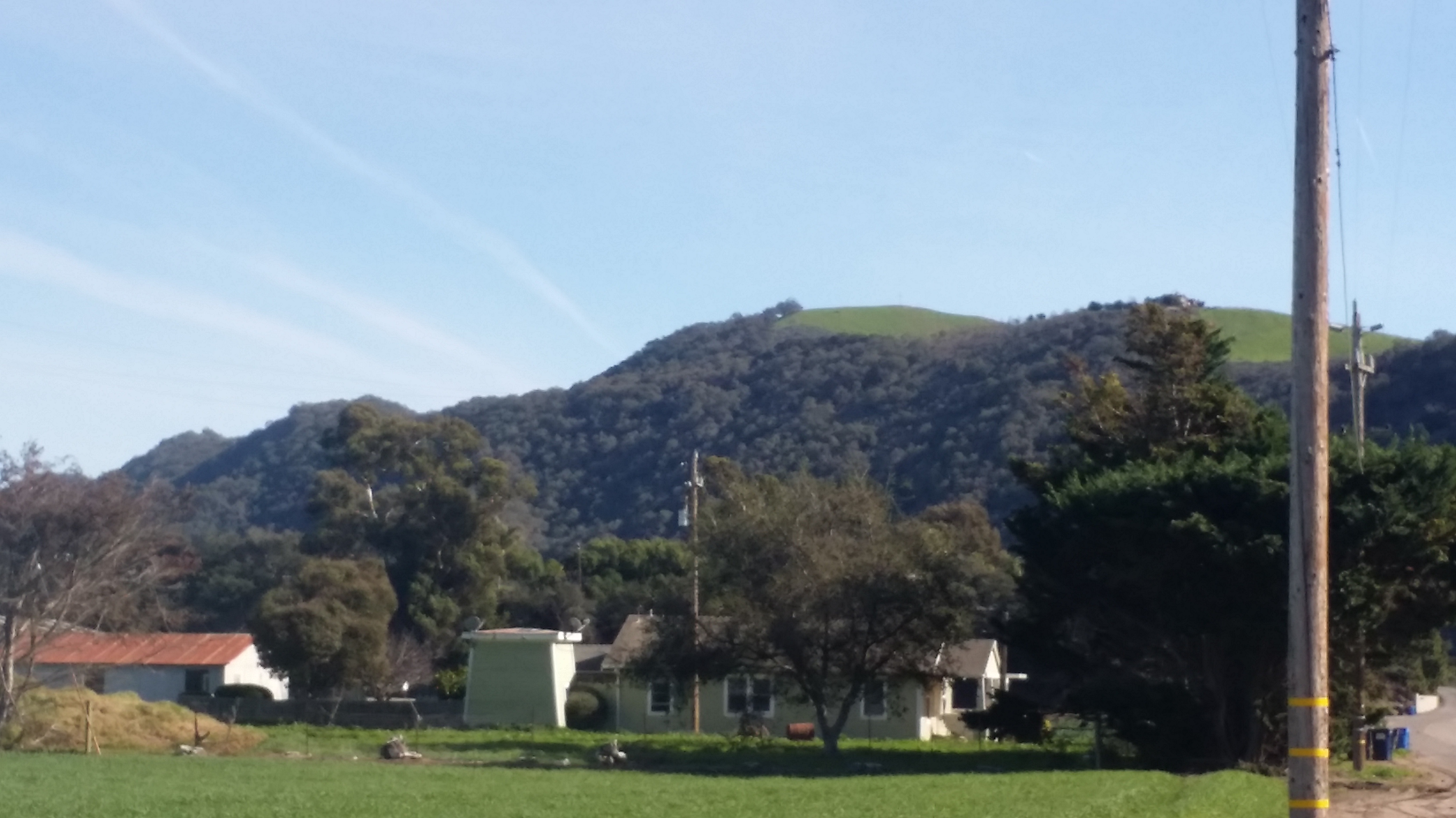
Home. This was the view. alongside Huasna Road, that greeted me every morning while growing up.
It’s been a wet winter, and trees and plants and shrubs and weeds have been engaged in a kind of reproductive bacchanalia that brings on my allergies. Very occasionally, they’re so bad that I battle allergy-onset asthma.
After four weeks of coughing, I made the prompt decision to visit my doctor. It didn’t take her long to reach a diagnosis. She looked at my ankles, which resemble Popeye’s forearms. She noted my weight: I’d gained 17 pounds in two weeks and had been forced to make a WalMart run for fat jeans.
So it wasn’t allergies and it wasn’t asthma. It is, instead, congestive heart failure.
Here’s the definition I openly plagiarized: Congestive heart failure: Inability of the heart to keep up with the demands on it, with failure of the heart to pump blood with normal efficiency. When this occurs, the heart is unable to provide adequate blood flow to other organs, such as the brain, liver, and kidneys. Abbreviated CHF. CHF may be due to failure of the right or left ventricle, or both. The symptoms can include shortness of breath (dyspnea), asthma due to the heart (cardiac asthma), pooling of blood (stasis) in the general body (systemic) circulation or in the liver’s (portal) circulation, swelling (edema), blueness or duskiness (cyanosis), and enlargement (hypertrophy) of the heart. The many causes of CHF include coronary artery disease leading to heart attacks and heart muscle (myocardium) weakness; primary heart muscle weakness from viral infections or toxins, such as prolonged alcohol exposure; heart valve disease causing heart muscle weakness due to too much leaking of blood or causing heart muscle stiffness from a blocked valve; hyperthyroidism; and high blood pressure.
I have most, if not all, of those symptoms. Of course, “prolonged alcohol exposure” is probably the most likely among a network of causes.
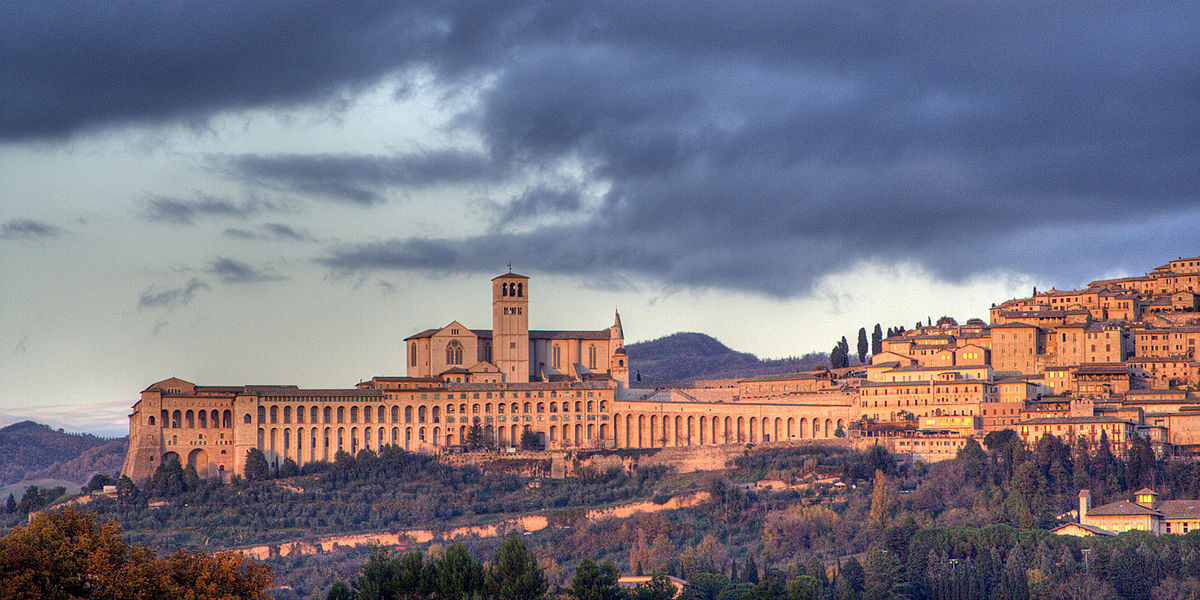
Home #2. Italy remains the most beautiful place I’ve ever seen. This is Assisi.
After the doctor visit, I do what I always do in situations like this: I Googled. Half of the hits came up and confidently predicted that I have about five years to live. Tops.
Elizabeth did some more detailed research and found those to be a worst-case scenarios. With proper diet and medication and exercise–which, right now, I am just too tired for, but I’m going to give it shot tomorrow–I could live so long and become so obnoxious that people will actually want to take a contract out on me. They might even Crowdfund to get the job done.
I have two excellent doctors and even better, the Fisers. Randy has been my friend since high school and my fellow teacher, and his heart problems, with the help of his self-discipline and his incredible wife, have been largely neutralized. He is as vigorous now as he was in high school, when he played football and swam. So they’re going to educate us.
Hearing the diagnosis was a tough call. I was so proud of myself for beginning again with sobriety and was fighting the physical and emotional pain of withdrawal, and I was winning. It’s just that I couldn’t stop coughing, which was my body’s attempt at self-preservation, at expelling the fluids that were filling me up like a water balloon.
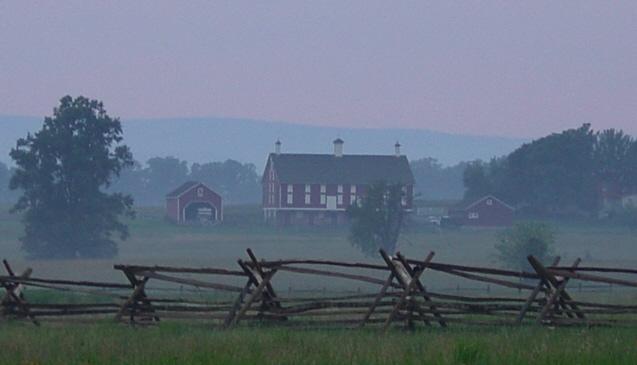
Home #3: The Codori Farm, Gettysburg, a place I know almost as well as I do Arroyo Grande
It’s a tough call, too, to be so open about this. I’ve already told my family, of course, and about twenty friends, most of them AGHS colleagues or local historians. But to put this out into the open is not intended either to frighten people or to solicit pity for me. I don’t want to do either of those. And I remain, thank you very much, forcefully and stubbornly alive.
Good things have come of this. I went to church–to my cradle church, St. Barnabas–Easter Sunday and almost started crying over the words of the liturgy I’d grown up with. Also, I sat next to retired teacher Shirley Houlgate, one of the AVID pioneers and one of the loveliest persons I’ve ever met. Dan Krieger has asked me to contribute some columns for Times Past, and despite the possibility that the copy editors were downing Margaritas and messed part of the piece up, I got in a column about my Dad. The theme, as it turned out, was about reconciliation and that’s a good one for Easter Sunday. I’ll probably contribute three or four more in the coming weeks.
What worries me is having the energy to start new stuff. My kind of writing requires interviewing, traveling, hours and hours at the computer and even more hours and hours taking notes in museums and libraries. The amount of work that goes into even a little 35,000 word book is staggering.
This also meant that I’m going to have to cancel the Adult Ed class I’d planned to teach in the fall, and that was, for me, like canceling Christmas.
For now, getting healthy again involves a lot of inactivity, something I hate. I’m happiest when I’m busy and am most myself (other than when I’m in the classroom, when what you see and hear is the most authentic Jim Gregory there is) when I am utterly and completely lost in research, like tracking down the serial number of a B-17 shot down in October 1944.
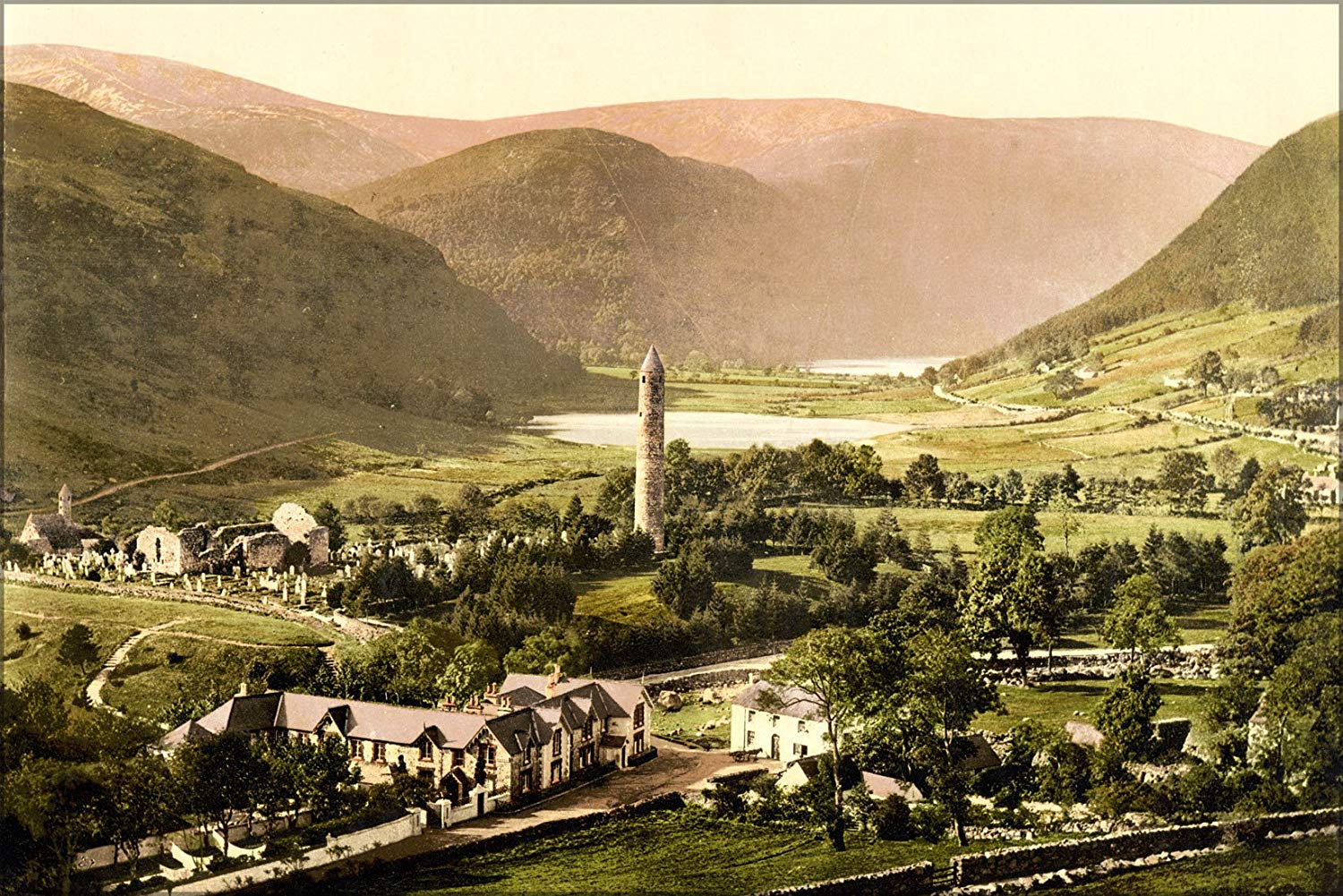
Home #4, yet to be visited: Glenadough, County Wicklow, Ireland.
So I am completely unsure about what the future holds. I am sure, increasingly, of how much I love my family and of how beautiful our dogs are (my standard greeting to Wilson: “Hello, Handsome.”) I think it’s time, too, for me to get outside more and be much less the literary hermit I’ve been the last four years. I think that was me compensating for missing my teenagers.
Most of all, I want to live a long time for them, for those teenagers who are no longer teenagers. My last bunch, from the Class of 2015, is graduating from college and going on to grad school or law school or med school or careers. Some of them have fallen in love and are going to be posting baby pictures in the next few years.
Other kids from my past, no longer kids but admirable young adults, are fighting health problems as serious or even more serious than mine, and they are doing so with such honesty and openness that they humble me in the oddest way: I’m finding out that it’s possible to be humbled and immensely proud at the same time.
That’s not a bad way to live out my life no matter how long it may last. For now, that’s a good long time.
This could be one of my favorite World War II movie clips, from 1990’s “Memphis Belle.” These are B-17Fs, bereft of the forward chin-mount dual machine guns, a later correction, which meant that the boys inside these planes–and some of them were boys, sixteen-year-old liars–were fodder for any Focke-Wulf 190 pilot who attacked from head-on.
That’s how Clair Abbot Tyler, a co-pilot from Morro Bay, died in 1943. An FW-190 cannon round shattered him in his seat. He left a little girl behind him at home.
What the film producers couldn’t have known is the incredble impact our soldiers and fliers had on their surrogate children, who happened to be British, not American. Here is what I found out from researching the little book I wrote:
When B-17s like these took off on their missions, they, and their Hershey bars, and their brashness and unaffected friendliness, had so earned the devotion of British children that dozens of them would line the airfield perimeter to wave goodbye to their Yanks.
I learned this, too: The same fliers were perfectly aware that the German railyards they bombed were flanked by working-class neighborhoods, and so when they missed their aim points, which happened on every mission, they were killing children 25,000 feet below.
It was this realization, and not cowardice, that led many of them to freeze in their chairs at pre-mission briefings to become so rigid that it took three of their comrades to pry them loose and walks them them to the base hospital, to the squadron psychiatrist.
The great poet Randall Jarrell, an Eighth Air Force weatherman who never flew a combat mission, could never let go of those German children. This is what led him to walk very deliberately into the path of a car on a North Carolina highway twenty years after his war had ended.
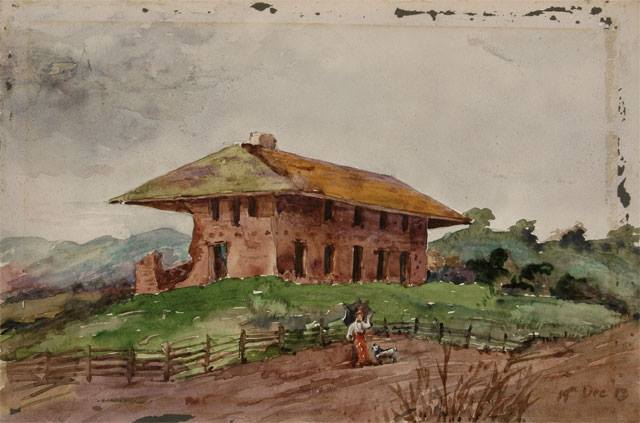
I found this beautiful watercolor online of the Branch Adobe, decaying after the damage done to it by the 1857 Fort Tejon earthquake. It was near the junction of Branch Mill and School Roads in the Upper Arroyo Grande Valley, on a little rise that still commands the valley below. A little lower are palm trees and a clearing that was the foundation of the redwood house Branch’s sons built for their mother, Manuela, after the adobe had finally melted into the ground. Manuela’s home burned to the ground when I was a little boy; we woke and could see the incredible white light of the fire as CDF trucks sped by, too late to save it. A neighbor took me there the next day and all that was left was a burned-out foundation, smoke and ashes.
But what had been there began in 1837, the same year Victoria came to the throne five thousand miles away. That’s when Branch came to the Valley. He was in his mid-thirties, a gentleman now after a career as a Great Lakes boat captain, a mountain man, a trapper, a Santa Barbara businessman. With him was with his twenty-two-year-old wife, Manuela, and their little boy, who would someday build a home that is today the Talley Farms Winery tasting room. The Valley, even for a young woman as strong and loyal as Manuela, was too wild to bear her second child. Eight months pregnant, she rode home on horseback over the San Marcos Pass to Santa Barbara to deliver her baby where her parents would be close by.
What her husband first encountered were monstrous grizzly bears that carried off the seed of his hoped-to-be-fortune, bawling calves, so he began to kill the bears. His neighbor in the Huasna, another mountain man, George Nidever, gave up cattle ranching after he’d killed his one hundredth grizzly. (His successor there, Isaac Sparks, lost an eye to a grizzly.) You have to concede something to both Branch and Nidever: They’d gotten out of the fur trade at just about the same time British machine-made velvet replaced beaver pelts for gentlemen’s hats. But only Branch survived the bears.
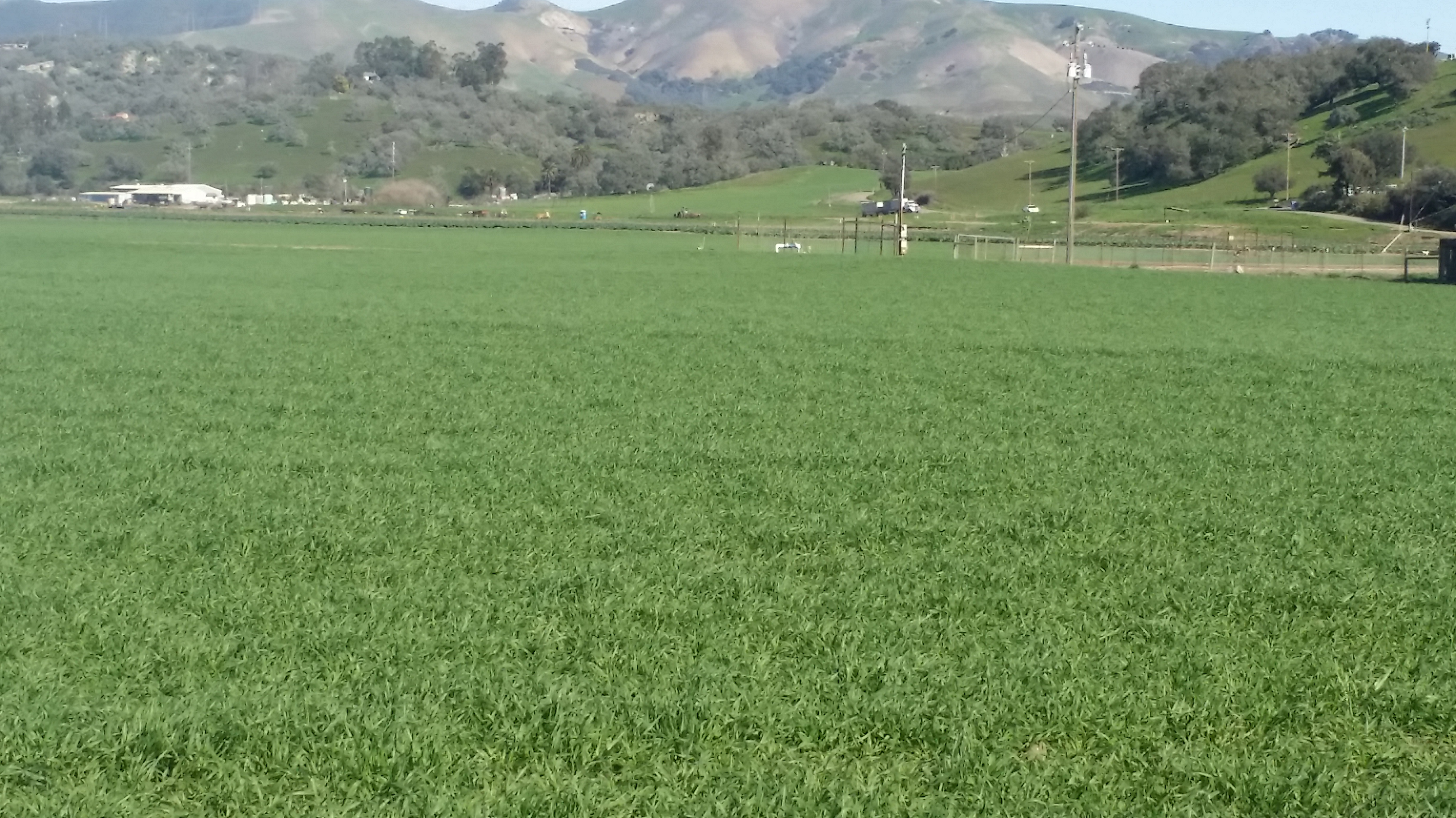
The Upper Arroyo Grande Valley, San Luis Luis Obispo County, today. Branch’s adobe would’ve stood on the hillock at the right-center of this photograph.
Grizzlies weren’t the only obstacle in 1837. The Upper Valley then was dense with willow scrub—the californio word is “monte”—so dense and so punishing that leather chaps were invented to protect vaqueros like Branch’s from having their legs slashed to ribbons when they plunged into it to rescue strays. Branch cleared the monte and planted the crops he knew from his native New York: Wheat and corn, apple and peach trees. An Eastern corn-sheller was his proudest possession, and the base of the grindstone he used to mill the Valley’s flour still sits in Arroyo Grande’s Heritage Square. Both of them were landed at Cave Landing– what is today Pirate’s Cove, near Avila Beach.
His ranch hands—many of them Chumash, others mestizo—worked hardest at roundup in June, when the cattle were slaughtered, not for beef, but for their hides. The hides were stretched on racks and soaked with seawater until they were cured and as stiff as plywood. Then they were hauled, by cart, or careta, to Cave Landing, where they’d be tossed into the surf to be fetched by fearless men, often Hawaiians, who would haul them into longboats to hoisted up into the holds of Yankee brigs bound for Cape Horn and then to Boston Harbor and Boston’s shoe factories.
It was the Gold Rush that transmuted cattle from hides into beef, meat for hungry miners from New York and Sonora and France and Chile. All it took to get the meat to market was your life: Branch and John Price found the bodies of ten people murdered at Mission San Miguel because the innkeeper there had unwisely let drop how much gold dust he’d earned for the mutton he’d sold to the gold fields. Jack Powers and Pio Linares and “Zorro’s” inspiration, Salomon Pico, waylaid cattle brokers in the Cuesta Pass and Gaviota and in Drum Canyon near Los Alamos for the gold dust they carried from beef sold to the gold fields. Pico collected their ears. To fight men like these, Branch became a member of the San Luis Obispo Vigilance Committee, which was different in two respects from San Francisco’s: Our was a little later. We hanged more men.
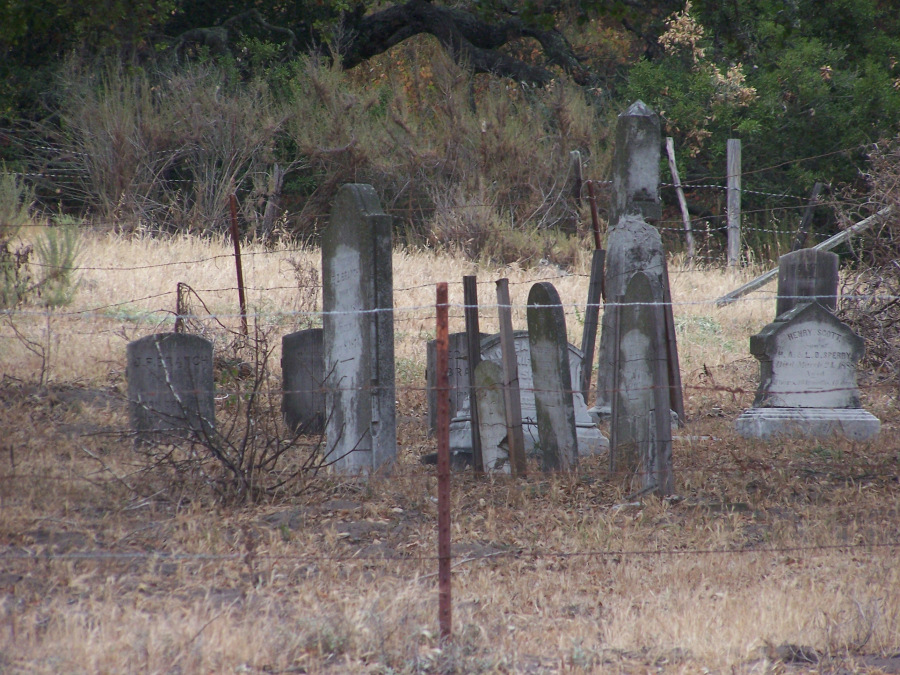
Francis Branch’s tombstone is at left-center; his three daughters’ tombstones are just to its right. The eldest was sixteen.
Branch was in San Francisco in 1862 when he got the message from Manuela. She’d given shelter to a traveler, common to ranch families then, and what he’d given the family in return was smallpox. Branch rode hard to get home again and by the time he did, exhausted and despondent, two of his little girls were dead and a third died soon after.
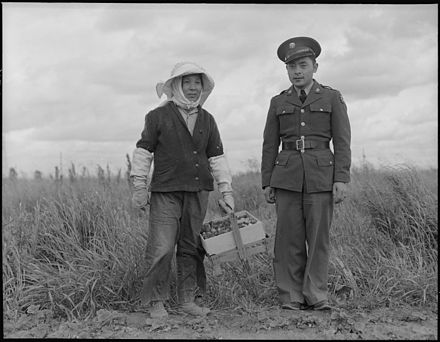
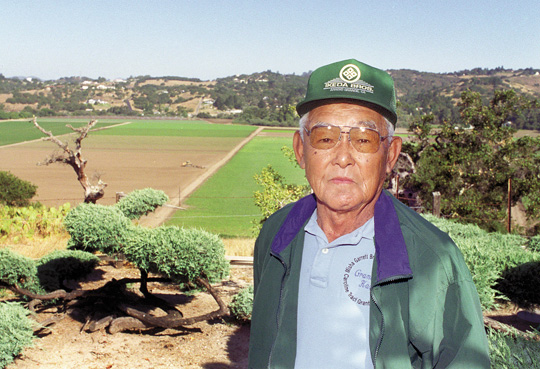
Kazuo Ikeda would come to farm the land behind him in this photograph, once owned by Branch. After Kaz and his family came home from the internment camp at Gila River, they coached Little League and Babe Ruth, inaugurated youth basketball, organized the Rotary Club fish fry, which provides scholarships to local high school students, and restored the Branch family cemetery.
They are buried next to him today, three little tombstones, broken in the years since by cattle scratching itches, next to his big tombstone. Branch died twelve years after, so he would have given instructions to have his little girls close by him. It had to have been the biggest heartbreak of his life.
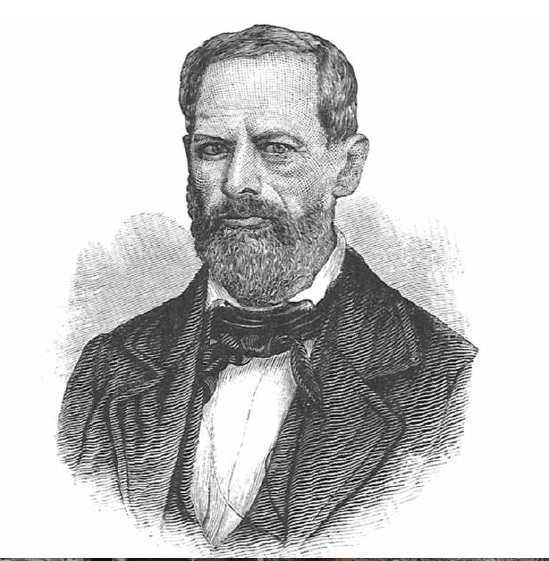
Francis Ziba Branch
Until the drought years of 1862-64. The vast herds of beef cattle he’d tended with such care for twenty-five years died on yellow, stubbled hillsides. Thirst and coyotes and ravenous mountain lions winnowed them down until they were gone. Branch lost the modern equivalent of eight million dollars.
What he hadn’t lost yet was himself, his wife, and his family. He was making the transition to row crops and tree crops and dairy farming and was dividing the Santa Manuela into sub-ranches run by ambitious sons and sons-in-law—men who were founding schools and building roads and raising churches—and then the immense energy this small, wiry, ambitious man had always taken for granted was finally taken from him, by pneumonia, in 1874.
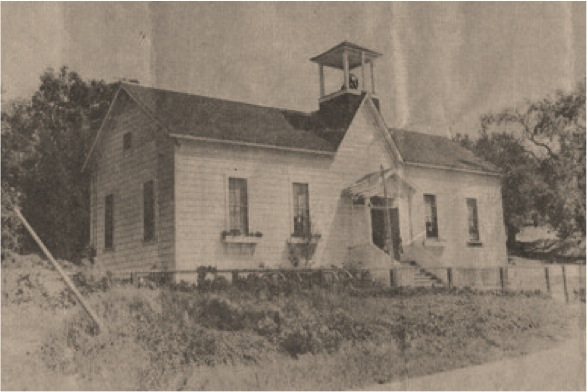
Branch Elementary School, the two-room schoolhouse where my education began in 1958.
So we have a street named for him today.
Yesterday I saw a pickup truck rear-end a sedan at the flashing crosswalk on Branch Street between Rooster Creek Tavern and the Branch Street Deli. Dozens of gawkers gathered to watch the culprit and the policeman and the fire trucks and the ambulance, thankfully, unneeded, as it turned out. Soon the gawkers dissipated and the commotion evaporated.
What was left, once the accident was cleared, was the name of the street. The folks involved, and the gawkers, too, most of them tourists, are to be forgiven, of course, given the situation, for not knowing a thing about the man for whom the street was named. Neither do the customers or the young and attractive waitresses at Rooster Creek Tavern or the sandwich-makers at Branch Street Deli.
But the street where they work is named for the man who once brought grizzly bears down with a Hawken rifle to make his cattle safe enough to the graze the land where he would build the adobe to raise the family, eleven children less three little girls, that would evolve into the beginning of a town—in 1869, one smithy, one general store, one school—that would someday name its main street for him. Yesterday, all that meant was headlight glass shattered in the crosswalk.





 A Work in Progress