Another Christmas.


St.Francis

Francis

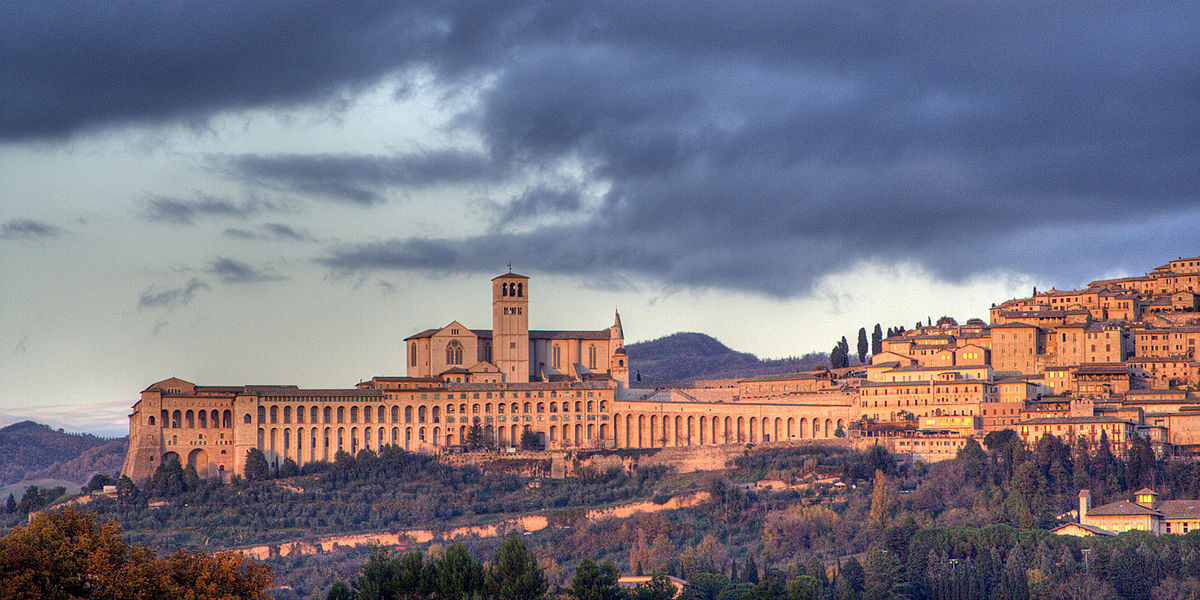
When I was a high school history teacher, I took my students to Italy. We visited Assisi. We sat quietly in front of Francis’s little tomb–fitting, because he was such a little man–and we sat in perfect silence. It was in the silence where I felt the solemnity and the joy of Christ’s spirit washing over me and claiming me again. At the same time, and very appropriately,  little Francis made me feel very small again. He made me, a man in his fifties, a child.

images

Ayn Rand

This woman, the writer Ayn Rand, seems to be our secular saint today. It’s her nihilistic spirit that washes over Congress today, in late 2017, as it gleefully passes a tax bill so regressive that it would make Dickens’s Scrooge blush in shame. I have never seen anything like what they all tax “reform.”

And then I remember, of course I have!

I spent thirty years teaching history: I remember the English traveler Arthur Young’s letters home in 1788, scored with his disbelief in the inequity and illogic of France’s tax burden, which fell most heavily on those who could afford it least. He predicted the inevitability of revolution.

It came only a year later.

I  recognize, too, the disparity in today’s distribution of wealth., and I remember that there has been nothing this illogical in our own history–at least, not since the summer of 1929.

Of course, the politicians must be right: the poor deserve to be poor. They are hungry because they are lazy–or worse, because they are both lazy and less than Caucasian. The wealthy rise to the top because they are genetically and inherently superior–haven’t we heard this somewhere before?  They must be  inherently superior, for example, to my own father, a mere accountant.

And, easily, the most brilliant man I’ve ever known.
1929425_1124498396411_7620943_n

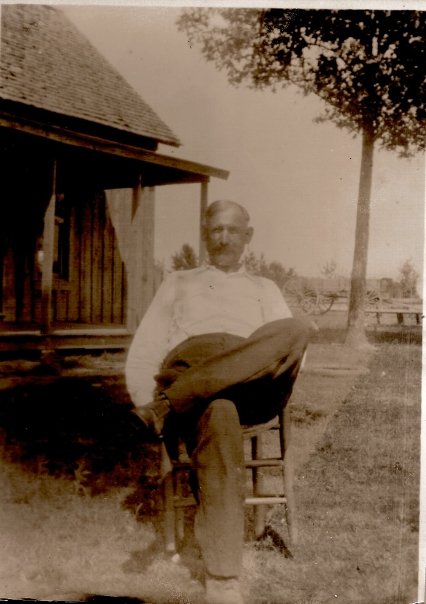
My Grandfather, John Smith Gregory.

My father inherited little from his father, an Ozarks tobacco farmer, except for a little lined notebooks, from the 1920s, kept in a little lined notebook that I still have, that recorded the sales, to his neighbors, of ginseng, of all things, because my Grandfather John ventured a century beyond tobacco and cotton and hogs and landed squarely in the frontier of New Age farmers of the 21st Century. Beyond that, he had a  gift for numbers that was both so imaginative and so precise that he could, as a lumber estimator, calculate a thousand-acre stand of Missouri hardwood to within 100 cubic feet of its eventual yield in a sawmill owned by wealthy men dressed in  double-breasted suits, felt hats and silk ties who lived in an impossible place that was far away, called Kansas City.

It was silk-tied men from Boss Pendergast’s notorious Kansas City machine who left bank-bags full of five-dollar bills on my grandmother’s kitchen table on the weekends before Tuesday elections in the Depression years. She was the local head of the Democratic Central Committee and one of the first women invited to a national political convention–1924, in Madison Square Garden.

A decade later, FDR never would never lose an election in that part of the Ozarks. In return, the Hill People who came down my grandmother’s home town, who came to schoolhouse to vote, never starved.

That was her doing.

Dad inherited that arithmetical gift from my grandfather, that gift for mathematics. Since gifts like that seem to skip generations, I inherited, from Dad, a gift for telling stories and from my grandmother, a love for history and politics.
8fab5fd5d9f8cc24605607a8d48567ea

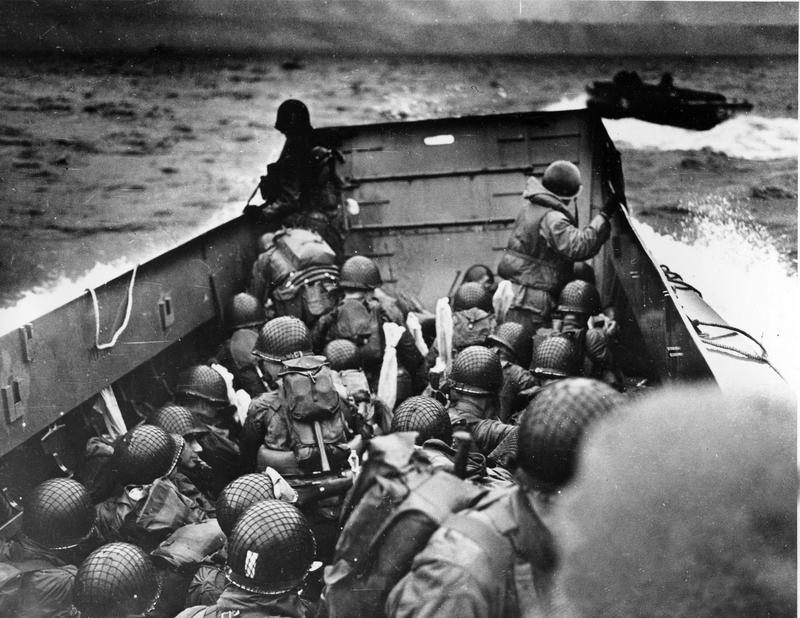
A Higgins Boat headed for Omaha Beach, June 6, 1944.

And then–I am confounded by the irony of this–Dad’s generation, many of then rejected by the Draft for their teeth, rotten after a decade of poverty like that visited on many of the Hill People of Missouri-went to faraway places: New Guinea, Tarawa, Iwo Jima; to North Africa, Normandy, the Ardennes.

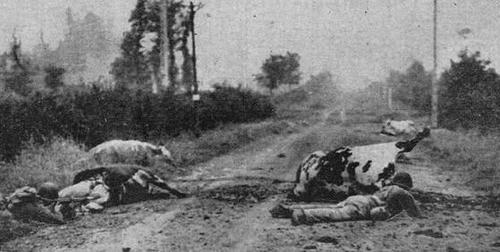
This generation repaid the injustice visited on them in the Depression by dying in hedgerows, their bodies caught within tangles of roots that had been planted in Agincourt’s century. Their only company, lying in the fields the hedgerows enclosed, were the bloated bodies of Norman milk cows killed in the crossfire.
440617 Dead cows

Normandy, Summer 1944

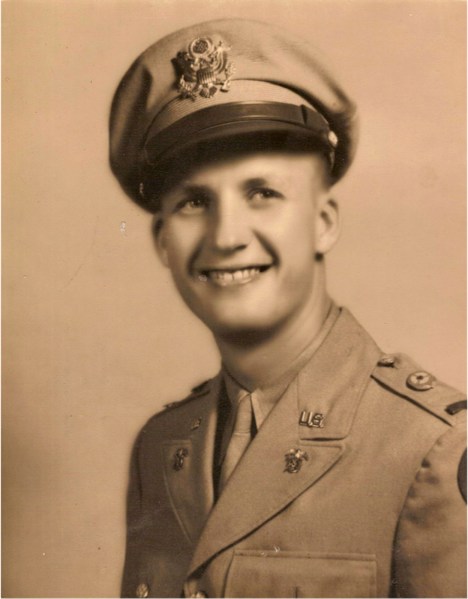
In 1945, my father taught Army Quartermaster burial teams the basics of forensics:  his students were boys who had hoped to become heroes, but were born too late, so they came to a war that had become history.

Instead, their duty was finding dead teenagers, graduates from high schools the year before the teens in Dad’s Quartermaster Corps burial teams had graduated. They disinterred Lettermen and student body officers and what were once called “juvenile delinquents,” but these boys remained only in scraps of viscera and bone, sinew and hair that lay on heads once stroked gently by their mothers, and the young Quartermasters identified them, if they could, for burial.

I inherited, somehow, the memory of those boys, living and dead,  from Dad.
003 (1)

Dad, 1944.

I inherited from Mom the steel she’d kept deep inside to overcome the shame of her own father, a stereotypical Irish drunk and laughingstock of an oil boomtown in the San Joaquin Valley of California.

Yet beneath the steel, she became the kind of woman who would teach her children that there was nothing more important on this earth–there must have been something in her DNA that recalled in her ancestral memories of County Wicklow’s hunger in 1847 Ireland–that there was nothing more important, beyond the arts, than empathy, and generosity, and kindness. Most of all, there  nothing more dignified than Poverty.

1929425_1124481235982_1907209_n

Mom, and big sister Roberta, 1943.

She understood Francis completely. More than that, she accepted him completely. That took steel, too

These are the lessons I’ve drawn from my father’s stories and from my mother’s example. I’ve thought about them, still and quiet before her grave, in my California home town, and before Francis’s grave, in faraway Assisi.
1200px-Assisi-skyline

Assisi.

Here is what I wish for you:

I wish that you get the chance to  gaze, in perfect silence, at the beauty of Umbria below you from Assisi’s hilltop, from that little town of stone and cobblestone. That is where it is so much easier to understand that what Jesus intended for us was love, what Jesus wished for us was love, what Jesus taught us until–and within–the agony of His death by suffocation, was love.

I am just beginning to understand, too, that what Jesus gave us, from His first moments of consciousness, shivering in the arms of his young mother, was His love.




All Dogs go to Heaven

23473253_10155552222998801_1764987599255084952_n

Ashley and Isadora

This lovely young woman is Ashley, who was a student of ours when Elizabeth and I taught at Mission Prep. With her is another lovely girl, Isadora, her Wheaten. My sister, Sally, has a Wheaten named Tillie. They are lovely dogs–eager, frolicky, and more affectionate than your typical terrier, a prickly but adorable lot. Wheatens are charmers and even more charming because they aren’t pretentious about it. Their main business is going about being a dog.

Isadora has a tumor in her lung and so her days are  numbered. When I learned this, there was a deep and profound hurt inside.  I have a hard time with death.

The worst, of course, was Mom’s, who died at only 48. She was and will always be the most formative person in my life, the main reason I get into trouble (when I perceive injustice of any kind, I can’t keep my mouth shut), the main reason, too, for me becoming a teacher, and she instilled in me a belief in God that a lifetime of hurt and anger can’t dent.

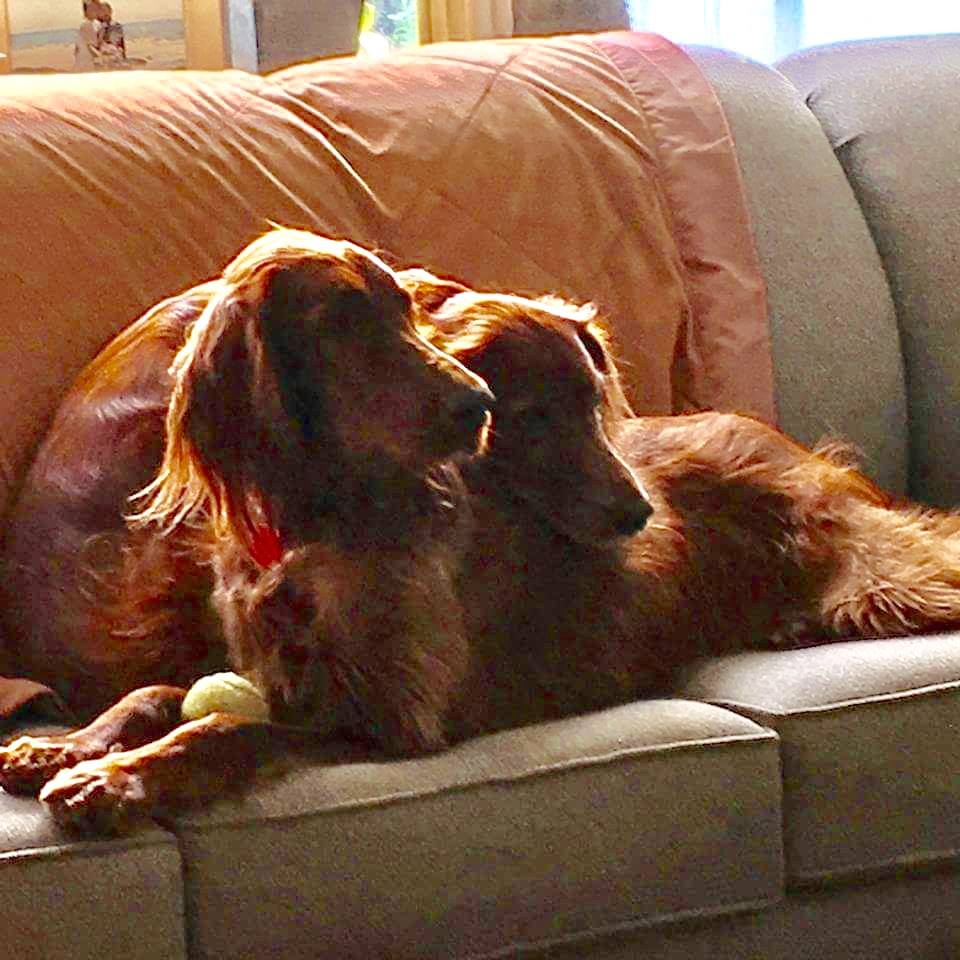
One reason I still believe the way my mother did has nothing to do with Mom. It has everything to do with dogs. I’ve been around them all my life–beginning with a Scottish Terrier and a Cocker Spaniel in my first memories, on Sunset Drive in Arroyo Grande–and the dogs who complete my life today are Mollie and Brigid, our Irish Setters, and Wilson, our Basset.

23319399_10214587525865611_1591498690775319867_n

Mr. Wilson

Mollie will leave us soon. I notice this more because the grizzling of her muzzle and the gradual slowing of her gait, her struggles to climb onto the sofa or our bed, make her aging so obvious.  (At sixty-five, I secretly identify with her, especially when I go to the gym and watch, out of the corner of one eye, twentysomethings doing workouts I could never hope to do. Damn them!)

Every time a dog leaves us, when we hold their heads in our hands and talk softly to them, we aren’t quite sure whether the last moments we spend together are somehow wasted, if the understanding between us and our dog is somehow incomplete. As I get older, I have come to believe these moments aren’t wasted at all. I think the animals somehow know what is happening and understand  the earnestness of our words when we tell them how much we love them. We are part of their passage and they need, as we all will someday, the comfort of company as they cross that fearful space that leads to the other side.

In a lifetime of dogs, I have loved each a little differently and they have loved me with no discrimination whatsoever. They are entirely unselfish in love, if not in food or rawhide treats. We don’t encounter that kind of love very much in life–the “unconditional” kind, to use a trite adjective–and that’s what makes losing an animal one of the most painful moments in any human’s life.

This how much they love us: When I was researching the book Central Coast Aviators in World War II, the historian for the 92nd Bomb Group told me that a dog would grow so close to her human that ground crews noticed that she would get noticeably excited when the B-17s returned to base. Of course, the dogs could hear the bombers long before the ground crewmen. But what they noticed was the dog’s excitement at the sound of her human’s B-17. She had learned to recognize the individual pitch of his airplane’s engines.

23517933_10214626934730808_5781607896525190584_n

Brigid, with her ball, and Mollie

So it’s supposed to hurt because they love us the way God does: without stipulation, without judgment, without reservation, and so when they leave us they leave an immense empty space inside. I spend, and have spent, much of my life criticizing myself, condemning myself, and finding fault with myself. But every morning there is a miracle: Brigid is so transparently happy–and wiggly– to see me again after a night’s sleep that she gives me enough confidence to start another day. There is something in me that she finds invaluable and joyful. I think God must see that something, as well.

I think, too, that God understands that dogs and their humans need to be together. Ashley’s dog, Isadora, has a bond with her that can’t be broken. Heaven, I suspect, is a place for happy mornings where we will see each other once again and forever.

Kids who can breathe.


11021332_10206180776982143_8018641079003443320_o

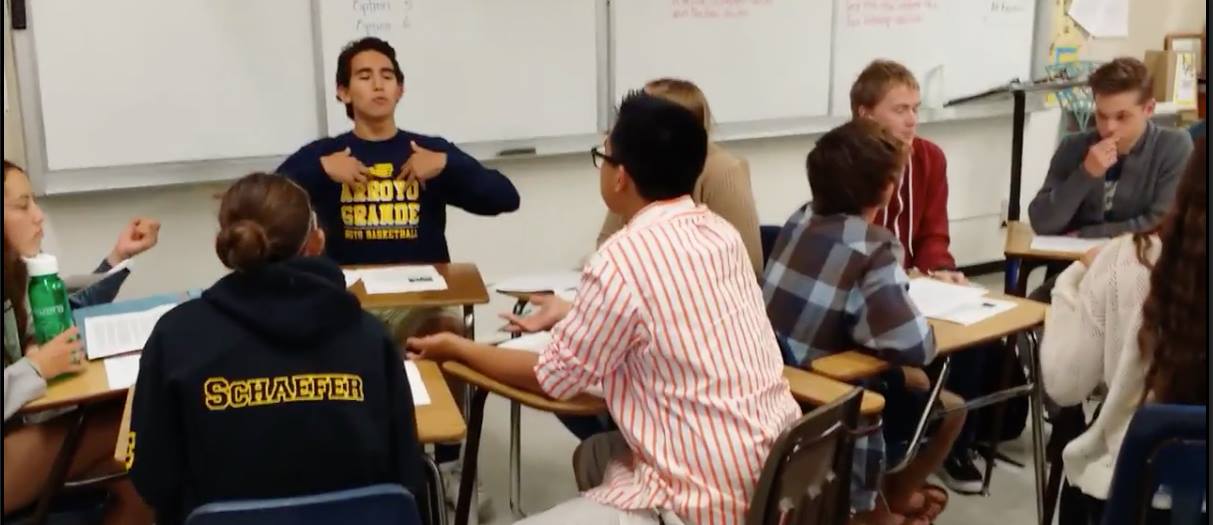
My kids, as JFK’s ExComm, debate what course they should take in the Cuban Missile Crisis. Life is short: Bunn, the young man in the striped shirt, was a delightful person and a gifted student. He was killed this year in an automobile accident.

I found the article below heart-breaking, in part because it was so familiar to my thirty years of teaching high school, in part because it was so alien to my own experience.

What marked my childhood and teens was the relative simplicity of those years. We got three TV channels, on a good day, on Huasna Road. There were land lines and, after school dances, pay phones, not “smart phones.” If I needed to take the pressure off, I would sneak into my Dad’s car, turn on the radio, and listen to Wolfman Jack and the wonderful rock ‘n’ roll that came from somewhere in Mexico via station XERB.

Another blessing was how unstructured our time was. I had endless room to breathe–lost in the pages of books, exploring the hills of the Upper Arroyo Grande Valley, learning Spanish from braceros, trout-fishing in the Arroyo Grande Creek.

I am not suggesting an idyllic childhood. I grew up in an alcoholic, sometimes violent home, but my parents tried hard to be the best parents they could be, and the values I inherited from them made me decide to become a history teacher, and allowed me, in the teaching, to recognize and to love the vitality in the 32 teenaged lives arranged in rows before me every class period of every day for thirty years.

I have my parents to thank for that.

But I saw this anxiety, the kind documented in the Times article, over and over again in the kids I taught every class period of every day for thirty years.

It was as if they had to prove themselves, to prove their worthiness to themselves and to their parents, and there was no reliable inner measure for them to rely on. They had, instead, to do things–club volleyball, student government, six Advanced Placement classes (I would never have allowed my child to take six AP classes, and I taught AP for most of my career), or winning awards. If they didn’t have these extrinsic measures, they would never get into the college of their choice, never have a career that was rewarding, never have the spouse they deserved, never have the kind of validation that, ironically, God never requires nor desires.

Sometimes, when they were taking a test or writing an essay, I would just stare at them, my heart full, at the miracle of their youth and the promise of their future. (It saves me from the despair that is so much a part of our present political life. It is about all that saves me.)

Those were moments every good teacher experiences, and that fullness of heart stays with you all your life.

They never had anything to prove to me. I just wish I had made that clearer.

The most famous sinner in America


51JQ5z85TkL

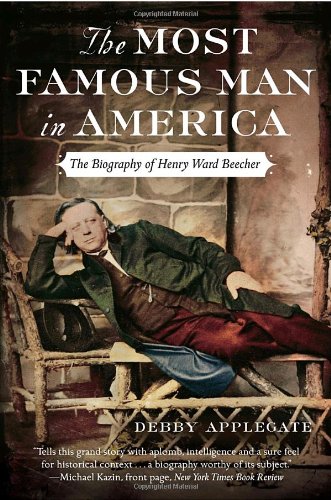
The shamelessness of powerful, predatory men has reminded me of Debby Applegate’s superb biography of the Civil War-era preacher Henry Ward Beecher, “The Most Famous Man in America.”

Beecher, a New England Congregationalist, was progressive,an immensely powerful preacher, a committed abolitionist, and he came from a stellar family (sister Harriet wrote “Uncle Tom’s Cabin” and my AP Euro students may remember sister Catharine as the inventor of the modern kitchen and a formative influence on the Victorian “Cult of Domesticity”)

The family’s patriarch, Lyman, was an unbending man who knew with certainty that Catholics, Unitarians and Methodists were going to hell, postage-paid. Lyman also forbade Catharine’s marriage to a young minister because the elder Beecher was unconvinced of the depth and authenticity of the young man’s conversion. The young preacher then sailed for England, in part to rededicate his commitment to Christ, and drowned in a shipwreck. Catharine never married.

H.W. strayed from his father’s path and instead preached a message that emphasized God’s mercy and love. The younger Beecher was never able to keep his trousers in order, however, was accused of multiple affairs, and was charged with adultery in one of the most sensational trials of its day.

Applegate’s biography won the 2006 Pulitzer Prize. She is an enormously talented writer and a steady, dogged and meticulous historian. It’s one of those books that’s more than a “mere” biography. It’s also a fascinating education on mid-Victorian American religion, politics and sexuality.


1300224636_lyman-beecher

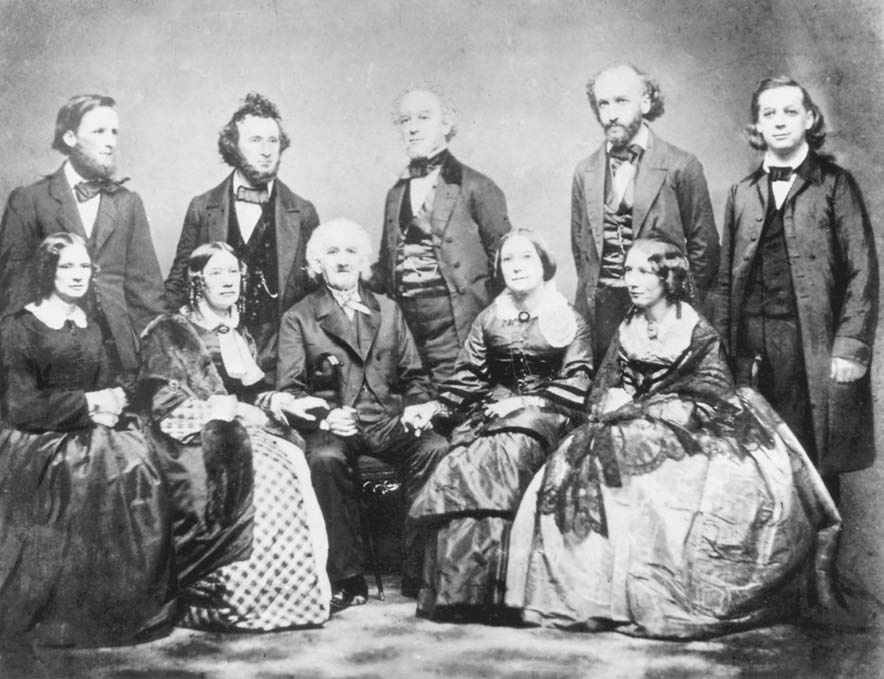
The Beechers. Lyman at center, Catharine on her father’s immediate right, Harriet Beecher Stowe at far right, her brother Henry Ward Beecher standing at far right.

.

Hallowe’en in the Branch District


Branch

Branch School during, probably, the early 1950s. They had taken away both the steeple and the side windows by the time I went there, probably after an episode of Cupcake Mania at Hallowe’en.

We did not trick or treat on Huasna Road in the 1950s and early 1960s. The problem was that the houses were so far apart that children from the Upper Arroyo Grande Valley, during the Great Depression, desperate for caramel corn, had been found wandering in Pozo with their sad, greasy little paper bags empty except for crushed candy wrappers, rusted “Keep Cool with Coolidge” campaign buttons, or  brown, withered apple cores.

The other problem occurred whenever there was a full moon. If you know the Arroyo Grande area at all, then you know that in moonlight the gnarled, twisted oak trees assume human shapes. Some of them have gaping knotholes in their trunks, just big enough to swallow unwary third-graders. Many children, in the 1930s Branch District, went trick or treating and were never found, not even in Pozo.

So, to avoid the alarming loss of Branch School children and the tax dollars they represented, we had, by the 1950s, a relatively safe Hallowe’en Carnival at Branch, at the two-room schoolhouse–the one with the pink asbestos shingles, which has had no discernible effect (pardon me: hack!) on my personal life as a large person.

The thing was, all the fathers would gather cornstalks for a properly decorative motif at school  (I don’t know where they got them. Branch Dads grew Brussels sprouts and cabbage, neither with strong Hallowe’en associations).  Stiff, dead, dry cornstalks, vaguely resembling skeletons, are very nearly as scary as the carnivorous oak trees that lurked at the edges of Branch Mill Road, menacing, silent, sometimes sibilant in the wind, occasionally belching. Moms would put out carved pumpkins, too, relatively harmless until you, at age seven, got around to watching Disney’s “Legend of Sleepy Hollow,” narrated by Bing Crosby, whom you never trusted again.

I actually went to the carnival as “The Headless Horseman” one Hallowe’en. None of my classmates–not one of the seventy-four–spoke to me until Christmas vacation was over.

Damn you, Bing Crosby.

But we would have “fishing booths” at the carnival, where little kids tossed fishing lines –strings attached to willow branches– over the top of a newsprint-paper enclosed booth (Where did our teachers get the energy to do this stuff? They must have been worn out from the corporal punishment that was as indispensable as the Parts of Speech and State Capitals.) and reel in a small toy or bite-sized Tootsie Rolls, which we imagined to be fish doo, but only momentarily, because it was obvious that they were chocolate, which is the third-grade equivalent of catnip or, for the typical college student, grain alcohol mildly diluted by Hawaiian Punch.

The fishing booths were for Minor Leaguers. The climax of the night, after the Costume Parade–which, we all agreed, was pretty lame–was the eighth grade’s Haunted House. The eighth graders were monstrous and mature people to us. They all seemed to be in their mid-thirties and so with enough life experience to reduce the smaller children to gelatinous puddles of terror in their dark, spooky, cavernous Haunted House, also known as a “classroom.” They laid in enough dry ice, for dramatic vapors, to freeze-dry every airman in the Soviet Air Force–a group we feared, in those Cold War years, only a little less than the eighth-graders.

They had discovered, when third-graders are blindfolded, that cold spaghetti is a splendid facsimile for human brains, and that Jello does a passable job of resembling the Digestive System we had just finished memorizing for Mrs. Kaiser. The third-grade girls loved the Haunted House, which allowed them to emit high-pitched decibel-busting screams, which put most of us off girls altogether until the sixth grade, when they were suddenly taller than us and vastly mysterious.

Those who survived the Haunted House–and there were a few–were allowed to partake of the Hallowe’en Climactic Meal, which consisted of tens of dozens of heavenly cupcakes, in every flavor and color imaginable, except for Brussels Sprout or Cabbage, baked by mothers driven by a still-persistent, albeit rural, late Victorian maternal urge: namely, the more cupcakes you baked, the better the harvest would be for your husband’s farm.

So we ate them.

We ate the chocolate ones, of course, most of all.

We did not sleep for three days. We bounced off the walls of our two-room school, with Mrs. Kaiser using a steel-shod yardstick to herd us (sadly, they did not allow cattle prods, not even in the 1950s) back to our wooden desks with the vestigial inkwells, until we were quiet again, studying our spelling lists, our times tables, and our American history dates. And so we learned: Communism was Evil. Chocolate cupcakes were sublime.

I still  know my American history dates, my times tables, and my state capitals. I am a little weak on my measures–how many pecks in a bushel?–but that might have been a lesson that came the day after Hallowe’en.

Sons, Husbands, Fathers

Slide1

Someone found a cat in San Luis Obispo in the fall of 1929, about the time of the Crash. It must have been a slow news week despite that turning point, because the local paper, the Telegram-Tribune, solicited letters from local children for kitty names.

Slide2

B-24 44-40188, after a bombing run over Peleliu, was ferrying wounded to safety on Hollandia. Nicholas Covell is buried in the Golden Gate National Cemetry in San Bruno.

Slide3

Clarence Ballagh fell in love in flight school in Florida, 3,000 miles away from his home town, Arroyo Grande, California.

Slide4

Sixteen months later, Ballagh’s B-17 crashed into the side of Mt. Skiddaw, 5,5000 miles away from Arroyo Grande, in England’s Lake District. His baby girl was named Enid. In 1944, the Methodist Church dedicated a sidewalk, now gone, on Branch Street, in Clarence’s memory. The church asked little Enid to leave her palm prints in the wet concrete.

Slide5

Loren Bubar married in the oldest church, next to the Old Mission, in San Luis Obispo, the beautiful redwood St. Stephen’s.

Slide6

His death was horrific. They misspelled his name in the USAAF records.

Slide7

Jack played the saxophone at Atascadero High School and here, in the Freshman Talent Show at San Luis Obispo Junior College in 1941.

Slide8

His P-38 was set afire by ground fire in what was a virtual suicide mission. Every pilot in the 367th knew it. Jack almost made it, because someone saw a parachute. He has never been found.

Slide9

Clair Tyler married Joanna Renetzky–a Pozo schoolteacher with Dana Family connections–in the oldest church in San Luis Obispo. Note Clair’s best man that day in 1941. Both Clair’s bride and Loren Bubar’s had their bridal showers in the Golden Dragon Restaurant in Chinatown, on Palm Street.

Slide10

Clair’s Dad took him hunting. Clair’s Mom hosted charity events to help feed and clothe Depression-era kids, and she and Clair traveled all over the state together. They lived on Piney Way in Morro Bay. Clair was their only child.

Lost Boys II: World War II aviators from San Luis Obispo County

Unfortunately, I’m starting my research with dead fliers, who are easier to find in the records, so most of what I find early on is going to be immensely sad. The young men who volunteered for air combat–you had to volunteer–tended to me better-educated and gifted in different ways (they were musicians, artists, teachers, architects). Few of them were over 24 years old. Just a few things I learned about them today:

1. The P-38 was much more difficult to fly than the P-51, my Dream Airplane. One engine going out on a P-38 was almost as bad as the ONLY engine going out on a P-51. Jack Langston, Atascadero High ’39, was flying a P-38–it would have looked exactly like the one in the photograph; it was June 22, 1944, so Allied aircraft still had their recognition stripes from D-Day– over Cherbourg when he, along four other members of his air group, was shot down in what all the young pilots realized was a half-baked suicide mission. Jack was married. He was also a gifted musician, a saxophonist.

normandy_6jun1944_invasion_stripes_375

2. SLO native and war hero Elwyn Righetti flew a P-51, On his last mission, as commander of his fighter group (he was shot down and vanished), he ordered two fliers to turn around and go home. It was the last mission required of each man, and he didn’t want them to get killed. The word is “mensch.”

146513263234381242

Lt. Col. Elwyn Righetti’s P-51D, named for his wife.

3. “Mission Belle” was the B-26 co-piloted by Lt. James Pearson of Templeton, shot down over Belgium during the Battle of the Bulge, Dec. 26, 1944.

moen-04

“Mission Belle” with her pilot, Lt. Fox, and two gunners. Fox was killed on that December 26 mission, as well as Lt. Pearson.

4. The cruelest loss of all, in some ways, was an Idaho accident. Sgt. Charles Eddy was a part of the crew that perished in an Idaho B-24 training accident. On the plane’s fourth practice high-altitude bomb run, it suddenly fell, in two minutes, from 20,000 feet to 100 feet, when the pilot and co-pilot finally pulled it out of its dive. Once they had the bomber level, they gained altitude and started to make a gentle right turn to get back to base. The plane nose-dived into the ground.

Maxwell_B-24

A Consolidated B-24 Liberator from Maxwell Field, Alabama, four engine pilot school, glistens in the sun as it makes a turn at high altitude in the clouds.

5. Lt. Clair Abbott Tyler, Morro Bay, was a B-17 co-pilot killed over the Channel in 1943. The best man at his 1941 Mission SLO wedding to Miss Joanna Renetzky was Alex Madonna.

b-17f-vicious-virgin-427th-bs

B-17’s from Lt. Tyler’s 303rd Bomb Group.


July 4, 1910, San Luis Obispo, California

6462488605_833404d9f1_b

About 5 p.m., Monday, July 4. What was then called an “aeroplane” is circling San Luis Obispo.

Gill-Dosh1_zps79c21603

Here is the pilot: Hillery Beachey and his brother, Lincoln, were San Francisco aviators. Hillery was an experienced balloonist; he’d just learned to fly heavier-than-air aircraft that year. This photo was taken in 1910 Los Angeles; the plane is a copy of a Curtiss. Note the pilot’s position; he will, of course, take the full brunt of any crash.

Slide1

A San Luis Obispo newspaper began covering the flight in late June. It was a first. The Beachey flier would take off from the town’s baseball field.

71dddc7b498604253a35d7de9559d589

Preparing for takeoff on the southern edge of town; that looks like Beachey near the engine; note the juxtaposition of cowboy and flying machine at the left edge of the photograph.

Lincoln_Beachey_flying_a_loop

Hillery’s brother, Lincoln, seems to have been the more prominent of the pair. This is an incredible photograph.

LPC-019-016-004A

Both brothers–in this case, it was Lincoln–were injured in serious crashes. Both kept flying.

1aab26

Lincoln boarding a daring design–a Beachey-Eaton monoplane–in 1915.

1aab33

Lincoln waves goodbye on his last flight at the March 1915 Pan-Pacific Exhibition. He attempted a loop over San Francisco Bay, but he didn’t have enough altitude to finish the maneuver. When he tried to level the plane, struts and guywires snapped and the aircraft plunged into the Bay, between two ships. Lincoln, only 28 years old, drowned. His luckier brother died in 1964.

Lost Boys

crew2

More on aviators. I am about halfway through the list of young men we–San Luis Obispo County– lost during World War II in air combat or in accidents.

So, of course, being more or less half-Irish, I had to pull myself up short and ask myself my motives.

What the hell are you doing, Gregory?

There has to be some kind of Cardinal Sin involved in me looking up the names of 106 young men lost fighting fascism and militarism, then paring them down to the aviators, then spending the hours it takes to track down everything from their parents’ names to the airframe numbers of the aircraft that would become their final homes and their coffins.

It’s not morbidity, I decided after a long, long time.

It’s the fact that I have two sons, and most of these young men were younger than my boys.

You see, I had already decided a long time ago that these are my boys, too. So I may have to write a book about them.

You see, I don’t want them to be lost again. Once was enough. That’s what I’m doing, I think. If I’m at all Irish, then we Irish believe there’s nothing quite so close at hand yet so transitory as death.

Whatever my generation has enjoyed, and the two generations I’ve taught history now enjoy and will enjoy, it’s because of these boys. We live because they willed us life, in their deepest hearts, without ever knowing it in the terrible moments when they fell from the sky.

Click the link below to meet some of them, and this is only half. I’ve work to do yet. The table that follows them lists the air accidents that took their comrades in a single day Stateside: March 2, 1944.

The number lost in combat overseas that day is, of course, far larger.

Think on that.

Think about how little, too, the president we have today, who knows almost nothing about our history–or any other nation’s– can register the meaning of lives, like these, given up for us. They represent a generosity and an integrity that he cannot understand.

We deserve better. We owe it to these boys.

Don’t we?

* * *

Here is the link:

https://drive.google.com/open?id=0B05dFICUx2kGV2NmSWF6OEpSaGs

So far to fall…

P-51_katydid_850

Artist’s conception of Lt. Col. Righetti’s P-51, “Katydid,” named for his wife.

By my count, 106 young San Luis Obispo County men were killed during World War II. Twenty-seven of them were airmen, most in the Army Air Corps and a few Navy fliers; there was a Naval aviation training school at Poly during the War.

I’m not sure why it is, but death in the air seems even more capricious and cruel than death in ground combat, and I think that’s because so many of those 27 county residents were killed in stateside accidents. [There were numerous fatalities in local crashes: a P-38 in Oceano, another that plunged into a Santa Maria cafe; a P-39 Aircobra that left a huge crater in Shell Beach.] Combat airplanes don’t forgive a lot, not even a moment’s inattention:

  • Frederick George Gillis was an air cadet who died in Lancaster when his trainer went out of control and flew into a mountain. Both Gillis and his flight instructor bailed out in time. Gillis’s parachute didn’t open.
  • A midair collision of two B-25 medium bombers “on a routine training flight” from Tampa killed Lt. Randoph Donalson over Newberry, South Carolina.
  • When his B-17 pilot tried to make a crash landing in a meadow near Roundup, Montana, Staff Sgt. Charles Valys died when the plane hit the ground, exploded, and broke apart.

All of these men were in their twenties.

The “old man” among our lost fliers was Lt. Col. Elwyn Righetti, from San Luis Obispo, a P-51D pilot shot down near Dresden in the weeks following the notorious fire-bombing there. Righettti, 30, was the winner of the Silver Star with four oak leaf clusters for both his kills and his superb leadership of the 55th Fighter Squadron. Righetti survived his plane’s crash-landing. He radioed his comrades that he was all right, yet he was never found and is still listed as “missing in action.” There is a chance that he was killed by German civilians; another downed American was summarily executed the day before Righetti was shot down.

normandy_6jun1944_invasion_stripes_375

Jack Langston’s P-38 would have looked like this one, with its D-Day markings.

Righetti’s body was never found, and neither  was 2nd Lt. Jack Langston’s. He was shot down by ground fire in his P-38 during a low-level attack on Cherbourg in the weeks after D-Day. Many of these fliers simply disappeared; Langston’s fighter exploded in the air.


b17hit

A doomed B-17.

Sgt. Donal Laird was a ball-turret gunner in a B-17 named “Strictly GI,” shot down over Karlsruhe, a city of scientists once visited by Thomas Jefferson. Flak probably claimed 1st Lt. James Pearson, from Paso Robles, and the crew of his B-26 Marauder over Belgium during the Battle of the Bulge.  An Army Air Corps captain and friend of flight engineer Loren Bubar found his body, later positively identified, a year after Bubar’s B-17 collided with a German ME-109 fighter near Frankfurt.

Loren lies today amid other young Americans in a military cemetery in Luxmebourg, 5,500 miles away from home.


55956588_1416835743

Loren Bubar’s grave.