Transcendence


maxresdefault

The obvious must be stated: Anoushka Shankar is beautiful, and I’m not going to be so dishonest as to claim that doesn’t matter when I watch her play the sitar, the instrument that brought her father so much fame.  Some of her performances are on YouTube videos, like the one linked below. She is, by the way, the sister of the beautiful Nora Jones.

But there are so many kinds of beauty. With Shankar, the self-discipline she has—the mastery of her Self—is as obvious as her physical beauty. Her attention is riveted on the instrument, and she rarely looks elsewhere. I’ve never seen concentration like hers. She seems to regard the instrument, as if it were new to her, but at the same time, there’s steel of great strength in her eyes.

There is a grace about her, a generosity, too. On another video, it’s the closing song of the concert, and she gives each of her backing musicians–violin, percussion, the shehnai, a wind instrument that resembles a clarinet–a chance to solo and to shine, and each is stunning. During their solos, she softly claps her hands in time, her eyes are frequently closed, and she’s smiling just as frequently: it’s a beatific look, even the look of a proud mother (which she is, offstage.) She has given herself over to the other musicians, entered into their performances, and it is the most perfect kind of praise.

In this video, she seems to hit a new gear about two or three minutes into the song, and, except for the percussionist, who’s both skilled enough and empathic enough to follow her, she’s gone.  She is so fast and so nimble and the notes tumble as if they were droplets in a great waterfall.  And, every once in awhile, a little smile crosses her face, and now her eyes begin to close, as if she were listening to a stranger. Something wonderful is happening, I think: athletes refer to it as being “in the zone,” where, for example, every pitch hits the corner for which it’s intended because the pitcher realizes he can release the desire to aim the pitch. Throwing suffices. My hero, Sandy Koufax, had games like that. He was untouchable.

So is Shankar. When you see that smile, she is in a special place where the playing is fluid, effortless and joyful. It’s all right, I think, to live for moments like this, after all the years of rigor and denial and endless, endless practice (her father was a stern teacher, I take it). Those moments, after all, aren’t meant for her alone,  or even for her audience alone. When Shankar smiles, it’s because she’s fully aware that God is listening to her, or, even more important, that God is playing through her.

There’s where the joy is: in the surrendering.

https://youtu.be/O4RZaszNhB0?t=2

Swing Kids

20151222_140005

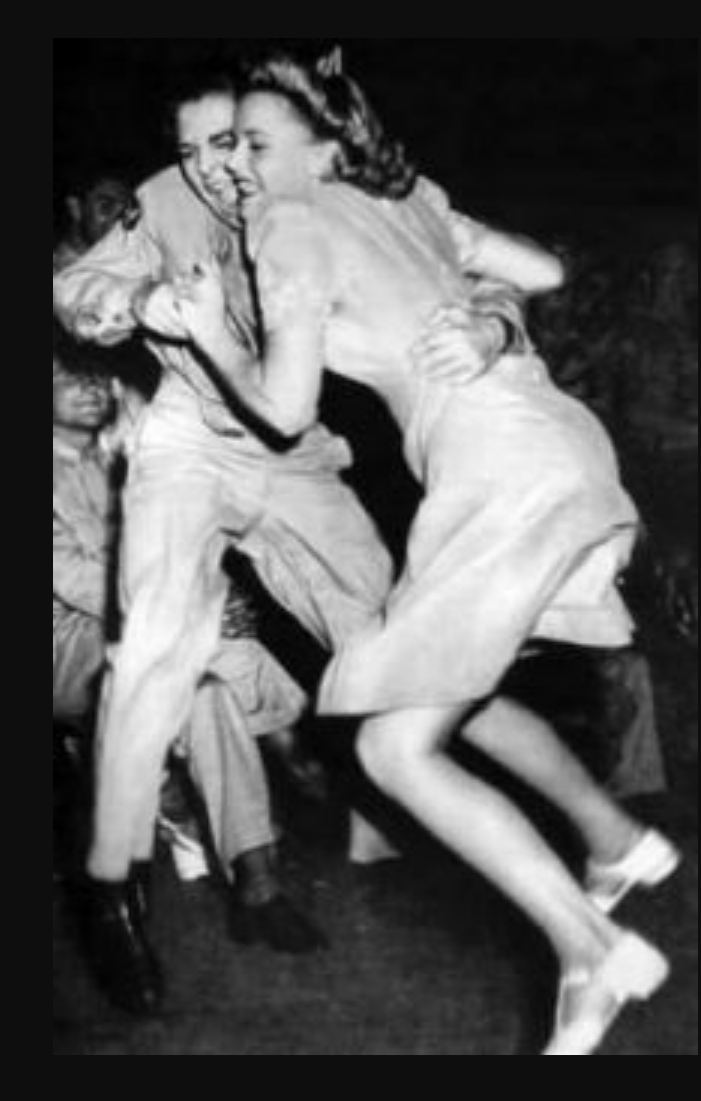
Whatever else I’ve said about the World War II generation–how sad but inevitable, our Sixties falling-out–there’s one more bit of praise: great music, and these young people could dance, a social rite mine left behind.

I put this together, part of a cycle of slide presentations, just in case they’re needed for whenever the book signing will be. Don’t want bored folks.

We open with a smidge of Andrews Sisters, a little silly, and then three Glenn Miller hits: the silky, evocative “Moonlight Serenade,” and then two go-to-war rousers, “St. Louis Blues March” and “American Patrol.” I wonder where Dad was when he first heard these songs? He still remembered “Bluebirds Over (the White Cliffs of Dover”) and, of course, “Der Fuhrer’s Face.” And maybe a French tune or two better left in French.


https://drive.google.com/file/d/0B05dFICUx2kGZWRDZ1BwR1ViaUk/view?usp=docslist_api

What to do on a rainy day in California…

Let’s see. If we leave right now, we’ll get to The City well before the twinkly lights come on along the Bay (Emperor Norton) Bridge…

441369_1280x720


No need to rush, we’ve got the reservations set at the Mark Hopkins. Well, hello, Dennis! Your granddaughter’s started Cal this year, right?

Mark


Good man, Roger. The usual room. Happy Hour at 4:30, Tapas at 5:00? Very good.

hotel-lobby


Always love the view. I’m gonna change into my Mr. Rogers sweater and some slippers. They won’t mind.

intercontinental-mark-hopkins-san-francisco-deluxe


Now, to zippy up to the Top!

img_9893-copy


Perfect! Just getting dark!

Top-of-the-Mark


Can’t decide, either? Okay, one  of each?

vodka


Ah, yes. This will do nicely…

thumb_275


We’re in luck! For a modest tip, the barman, Jean-Claude, is always happy to carry you back to your room…

intercontinental-mark

Nighty-night!


Ode to dead walnuts

I despise walnuts,

Both nut and tree

I don’t mean all nuts–

Just these, right by A.G.

10996561_10205969307775545_8531163215019887538_n

I thought of them because of rain

An errant cloud? All hands on deck!

Grab the tarps! was Mom’s refrain!

Cover ’em up or they’ll mildew to


Heck!

img_2136

I hate ’em, being pointy and hard

At harvest. They fall like longbow arrows

Upon your cranium, they do retard

Your feelings for them. Sorrow, sorrow.

hqdefault

Pick ’em and your hands turn black

Thrown, when green, by Certain Sibs,

And you have to say, hit in the back:

“Walnuts, Doc.” as he tapes your ribs.

dsc_0335

Oh thank you, thank you, husk fly larvae

You may be slimy, but you’re always famished

You killed the walnuts; I think that’s marvy

When in high school, I took Spanish!


Rhagoletis_completa-larvae

Power struggle in the fields

CCP_98107047

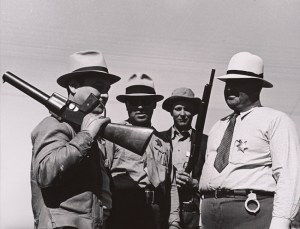
Monterey County Sheriff, right, 1936, and deputies.

This photo reminded me immediately of Rod Steiger’s superbly-acted redneck sheriff in the film In the Heat of the Night. But these are Californians, not Mississippians, and these men, according to the scholarship I’ve been trying to digest so far, were representative of an alliance of reactionary forces that dominated California between 1933 and 1938. Whether they were representative of San Luis Obispo County remains to be seen.

What made up that coalition? To borrow Renault’s quote from Casablanca, they were the usual suspects: Harry Chandler’s L.A. Times, the Hearst newspapers, the L.A. District Attorney and the LAPD, the Chamber of Commerce, Pacific Gas and Electric Co., and Associated Farmers, a powerful anti-labor lobby (they blocked literally hundreds of bills in the state legislature that would have provided laborers with a minimum wage, with decent housing, even a bill that would have required employers to provide drinking cups) that also organized resistance to and suppression of strikes. They had professionals whose specialty was busting strikes. They wore revolvers on their hips, like Henry Sanborn, a national guard officer who organized hundreds of paramilitary “deputies” in the 1936 Salinas lettuce strike, a strike provoked by the growers themselves when they locked workers out of the packing sheds. The growers, in fact, had already built a big stockade, complete with concertina wire, in anticipation of a strike. “Don’t worry,” they told alarmed packing-shed workers before the lockout. “That’s for the Filipinos.”

By the way, the one dissident in the state’s economic power structure, an ardent New Dealer, was A.P. Giannini, founder of the Bank of Italy, by now the Bank of America.
75600162

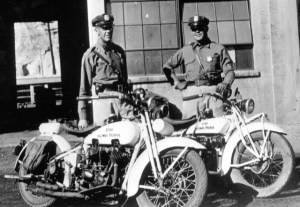
Another disturbing trend was the extent to which this coalition depended on the newly-founded California Highway Patrol. In Salinas and other places, including in a brief mention in an article about Nipomo, the CHP constituted a kind of rapid-repsonse strike suppression force and one, unlike the “deputies” and their baseball bats in Salinas, that was heavily armed.

In the history of American labor disputes, like the 1894 Pullman Strike, this traditionally had been the role of government: to uphold capital and to suppress labor. TR’s intervention in the 1902 Pennsylvania Coal Strike represented a rare departure, because he demanded that both sides come to the bargaining table or he’d use the army to take over the mines. Neither management nor labor were pleased with the president, but the strike was settled. When TR’s cousin became president, capitalists, including California growers, were outraged that the government seemed to side so clearly with workers, what with the Wagner Act (which did not extend to agricultural workers; FDR didn’t want to alienate Southern Democrats and their planter-supporters), with health inspections of labor camps, and with occasional attempts by the federal government to settle strikes (one such attempt had a Labor Department official beaten, stripped, and left in the desert of the Imperial Valley).  The Arroyo Grande Herald-Recorder at this time regularly railed against the excesses of this activist government on its editorial page while its news page primly reported another schedule of AAA subsidy payments.

Frustrated as they were with FDR, growers and their allies obviously took on the strikers, not the federal government.The easiest way to sanction strikers, and to make labor organizers “disappear” (Temporarily. Usually.) was to arrest them for vagrancy, since they clearly weren’t working. That was the pretext used by SLO County Sheriff Haskins, backed by 200 instant deputy sheriffs, in the 1937 pea strike, in April. It worked; that strike, centered in Nipomo, ended pretty quickly. So had another one farther north, in January, in and around Pismo Beach, organized by Filipino laborers against Japanese growers. It was over in thee weeks, with some violence–fights between strikers and scabs–and it ended with a negotiated settlement. The growers didn’t negotiate with the strikers, by the way. They negotiated with the Chamber of Commerce, which dictated the settlement. Curious.

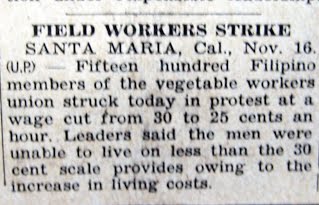
California Filipinos were militant and angry–the late-breaking little story below is from 1934–and probably for good reason. Several sources I’ve read place them at the bottom of a kind of racist continuum with whites at the highest level, followed by Japanese, then Mexicans, and finally Filipinos, who were housed in filthy camps, frequently harassed by police, and seen as sexual predators, with their invariable target, of course, white womanhood.This, too, sounds like 1930s Mississippi as much as 1930s California.
11.16.1934

There was racial tension, as well, between Japanese growers, who had a generational head start, and their Filipino workers. Japanese growers in the Los Angeles area did not have a good reputation for treating their workers well, but LA was, again, a focal point for anti-labor resistance. I’m suspending judgment on local Japanese growers–my friends are from some of those families–until I can learn more. I’ve found no connection so far with between them and Associated Farmers, and, unlike the growers in the Salinas Valley or the San Joaquin Valley, these were small-scale farmers: the Ikeda family, for example, farmed no more than 100 acres, and much of that land was leased. The problem with that analysis is that these growers worked in concert, in what is today POVE, so potentially they might have represented thousands of acres of peas under cultivation. But it’s the Herald-Recorder that really comes off badly–this was before editor Newell Strother’s time–its editorial columns are firmly on the side represented by Associated Farmers, and its news columns, especially in their treatment of Filipinos, are openly racist.

One 1937 story details an Oceano raid on a hall holding taxi dances–Filipino men would buy a ticket and dance with a female, invariably Caucasian, since Filipinas were not allowed to immigrate. The raiders were sheriff’s deputies, including the baseball-bat variety seen in the Salinas lettuce strike. Several, including the girls, were arrested, and the Herald-Recorder reported that one Filipino laborer had bought more than 200 dance tickets from one of the arrested taxi dancers.

I guess this detail in the story was meant to provoke a sharp intake of breath on the part of its white readers. The taxi dancers were white, their patrons weren’t, and the miscegenation laws were still on the books in California.

Tensions began to ease by 1938, partly because the economy was beginning to recover, partly because a reactionary governor, Frank Merriam, was replaced by a more moderate one, Cuthbert Olsen, but also because both state investigations (one young attorney-investigator was Clark Kerr, the future UC President) and a federal one, led by Progressive Sen. Robert LaFollette, embarrassed Associated Farmers with their own conduct: they’d denied their workers basic civil rights, including due process, relied on violence, were indifferent toward inadequate and unhealthy housing conditions, used industrial espionage on a large scale, and frequently cut wages, continuing to claim that they could only pay what the market would bear when, after their 1933 low point, crop prices had begun to recover and would rise steadily into the war years.

If it sounds like I’m taking sides, I’d agree cheerfully. Objectivity demands that historians sometimes take sides, because historians must make informed judgments based on empirical evidence. History does not judge this alliance of big business, big agriculture and state police power well. The powerful brought that judgment, in their seeming victory over the strikes of the mid-1930s, on themselves.

Pep Talk

I have never been shy about writing fan letters, so I wrote one to the UC  Davis prof who’s written a terrific new book, Right Out of California, about political, economic and social conflict in 1930s California.

I also am a shameless little man, so I included the Domingo Martinez piece from the Arroyo Grande book and told her I was looking at writing about the 30s, too.

She emailed back later yesterday:

I’m so glad to hear that my book was relevant to you. I’m also very interested to learn about your own work. The central coast has some great stories from the interwar years to tell; and it seems, from the sample you provided me, that you’re the right person to tell them.

That’s nice. That’s not the clincher, though. My big sister, Roberta, wants me to write it, too.

So I guess I will.

What’s making me dawdle, before I pitch the book idea, is knowing how miserly the pay is. For each $21.99 copy of the World War II book, over a year’s work, I get about $1.50. And I’ve done the research, the writing, located 70+ images from all over the world, some which required me to buy usage rights, and I’ve done a good deal of the marketing.

So I feel like your basic oppressed proletarian.

The other factor: The sheer magnitude of the subject is daunting. World War II, as large-scale as it was, was chronologically compressed and its events already so familiar, so it was much more manageable.

So I think I’ll expand the scope of this book to include the 1920s. That sounds counterintuitive, but I realized that I don’t have the talent or the graduate assistants for a narrative history. What I can do is to generate a thematic overview of the interwar years, to tell good stories well. Themes might include Prohibition and crime; politics, Mr. Hearst, contrasted with the poor; the collapse of farm prices and that impact; daily life, especially of young people; dissidents and dropouts; the New Deal’s impact; the coming of the war.

I’ve got to expand the locale as well, so we’ll include material from Northern Santa Barbara County, even a little from Taft, from San Simeon, of course–but the bulk of the book would come from the area between San Luis Obispo and Nipomo.

[What’s hardest to come by, and what I hunger for, are statistical data that’ll give a snapshot of the Central Coast–everything from foreclosures to crop prices, housing starts to high school dropout rates. Those are hard to find.]

So it would be The Interwar Years on California’s Central Coast or something like that. Or maybe Pete’s Dragon.

Now I’ve got to generate a proposal and go back to my two most important secondary sources and organize the margin notes I’ve taken. I also need to read again David Kennedy’s Freedom from Fear.

Not a good day to feel under the weather.

20151217_084729

The Peas of Wrath

Shipping Peas

I’ve always been interested in social history, including women’s history, and military history. The same goes for a new area I’ve much to learn about but have always found fascinating: agricultural history.

It wasn’t true when I was growing up in the Arroyo Grande Valley, but twenty years before, sweet peas had been the dominant crop in the South County, from the foothills east of Shell Beach to, of course, the Nipomo Mesa, where Dorothea Lange photographed “Migrant Mother” Florence Thompson. Thompson was 33 years old in 1936, struggling to survive in a crude squatters’ camp in the midst of two disastrous annual harvests–blighted by frosts and rains like the one in the closing pages of The Grapes of Wrath–that made the suffering here real. She looks closer to her actual age in this photo, one of six Lange took after passing the camp on her way north to San Francisco.

91soGAHxExL._SX466_

Lange already had boxes and boxes of negatives on the car seat next to her, ready to be processed, her next task, when she saw the sign for the pea pickers’ camp. She kept going. Something stopped her twenty miles up 101; she returned, took the six photographs, and left. Five were published soon after, including this one. The iconic image Lange kept. She must have been stunned with what she’d done when that version of Florence emerged in the lab. It was like a Raphael, an Our Lady of Poverty.

Despite that image, the Depression, I’d thought, couldn’t have been as acute here as it was in the East, where unemployment in Detroit was 50% and, at one point in Toledo, 80%. But then I found these figures from the County Agriculture Department. Statistically, they’re almost as poignant as Lange’s photography:

crop-valuations


They are also appalling. The total valuation of San Luis Obispo County agriculture fell by half between 1929 and 1933, with the collapse of crop prices. Peas were the largest vegetable crop–about 5,000 acres, nearly all in the South County, were planted annually. [Lettuce came in second, at 3,000 acres planted.] Peas were important to the point of absurdity. This World War I-era postcard commemorates Arroyo Grande teen girls, like twentieth-century vestal virgins, “dancing at the Sweet Pea Fair.”

$_57.JPG


The 1929 crop was valued at $2.2 million dollars, but the harvest from roughly the same acreage four years later was valued at only $822,000. This collapse, prior to the arrival of AAA subsidies, contributed to another disaster.

Peas had been so enormously profitable during and after World War I that farmers, according to WPA Writers’ Project accounts, practiced little rotation and intensified cultivation of peas and, quite naturally, even expanded their acreage as prices began to fall after the Crash. This led to a crisis in soil erosion in places like Corbett Canyon–in 1937, the head of the Soil Conservation Service said the erosion in Arroyo Grande was among the worst he’d seen in the United States, and he’d seen Oklahoma. It would take intensive labor by CCC and WPA crews–building check dams, terraces, planting windbreaks–to save today’s Arroyo Grande from looking like today’s North Africa. It was an enormous effort and, I think, one of the most stunning achievements of the CCC, which employed young men 18 to 25 years old and paid them $27 a month, half of which they were expected to send home.

There were other kinds of crises:  bitter strikes in the South County by migrant pea workers–Filipino, some Mexican, and poor white migrants from as far east as Vermont–in 1934 and again in 1937. I have much more to learn, too, about those, but, by 1939, according to a migrant nurse’s report, wages were still low for pea-picking, at one cent a pound, thirty cents a hamper, and they were cut, by mid-season, to twenty-five cents. Growers estimated that they needed to clear 3 1/2 cents a pound to make a living; what struck me wasn’t the miserliness of growers–and that most definitely existed–but the enormity of shipping costs. A hamper of peas that sold for $3.45 on the East Coast cost $1.70 to ship there.  It reminded me of the days of the Populist movement, when it cost a farmer more to ship a bushel of wheat from Kansas to Chicago, by rail, than it did to ship that bushel from Chicago to Liverpool, mostly by ship.

By 1939, good years were beginning to return. A network of county camps, most on farmers’ land, operated either by labor contractors or camp bosses appointed by the contractors, housed 3,000 pea pickers at the height of the season, which ran from March through May. 426 families were “white,” 167 “Mexican” (Mexican labor had begun to return after massive deportations in 1931; many American citizens were deported during the anti-Mexican hysteria of the early Depression). There is no category for “Filipino,” but they were there in large numbers, too, though not as families. Filipinas were not permitted to immigrate: it would require Filipino men dying in combat, fighting for America in volunteer units–the first formed at Camp San Luis Obispo–to “earn” the right to marry, to bring home war brides from the islands, and to begin families, because before and during the war, California miscegenation laws prohibited their marrying outside their race.

download

A Filipino gang working peas near Pismo Beach, photo by Dorothea Lange.


There were children in the camps, too–569, to be exact. Teachers were brought in to give lessons in the Canada camp and in a Nipomo warehouse. The migrant nurse noted that older children looked wistfully every day as the Arroyo Grande Union High School bus passed one camp, slowed, and kept going. This woman had sand. She marched into Principal Clarence Burrell’s office–Burrell was a good man–who took up the issue with the Board of Trustees, which voted to begin picking up the migrant kids to bring them to school. There were only four weeks left in the school year, but you wonder about those kids, both at how enormous it must have been for them have classes in a “real school” and you wonder, too, about how they were treated. I remember how cruel kids can be, remember us calling a poor white family “Okies” when I was in elementary school.  The peas were gone, then, replaced by new Valley crops; bigotry has a long growing season.

download (1)

An Oklahoma father with a hamper of peas in Nipomo. Dorothea Lange photo

From Here to Eternity


montgomery clift & burt lancaster - from here to eternity 1953

Montgomery Clift, as Prewitt, and Burt Lancaster, as Warden, share a bottle in the middle of the road.

From Here to Eternity was on television again last night and I watched it again; in fact, it may be catching up to John Ford’s The Searchers and Milos Forman’s Amadeus as among those films I’ve watched the most.

James Jones’s novel was brilliant and compelling, and Hollywood managed to make a film, an Academy-Award winner, that was just as good. It’s one of the most satisfying films for me to watch, which doesn’t mean it has happy endings: instead, everything that must happen to the major characters eventually happens. You don’t even necessarily root for them because you know full well that they’re all condemned, in some way, by forces too powerful for them to master and too complex for them to articulate, so any cheerleading is futile. But you genuinely admire them: this is my favorite Burt Lancaster film (Elmer Gantry is a close second) and what his Top Sergeant Warden shares with the defiant Montgomery Clift’s Prewitt is an incredible integrity and, in the end, a fierce devotion to The Company that will cost Prewitt his life.


46454859.cached

The kiss: Burt Lancaster and Deborah Kerr.

Of course, the most famous, and most parodied, scene in the film is the kiss in the surf between Warden and Karen Holmes, the frustrated, defeated wife of Capt. Holmes, the company commander so insistent on returning Pvt. Prewitt to the boxing ring. Holmes deserves everything he gets–one of the most enjoyable scenes is watching him get his just reward at the hands of Schofield Barracks’ C.O.–and it is Warden who gives Deborah Kerr’s Karen Holmes, if only briefly, the passion and the hope that you want her to have. She’s not a bad person–she’s made, in her marriage to a weak man, a bad choice. She knows it, which makes her decision at the film’s end noble, heroic, and tragic. She has integrity enough to match Warden’s.

This is the film, of course, that revived Frank Sinatra’s career, and he is terrific as Maggio. He has both a Brooklyn toughness and a kind of lost-puppy vulnerability and–that word again–his foolhardy integrity in standing up to the sadistic stockade sergeant, Fatso Judson, seems to be something that Maggio is compelled to do. It’s his destiny. When he finally does go to the stockade, where he’s beyond Prewitt’s protection, it’s a death sentence, and when he describes how he dies while in Prewitt’s arms, it’s a superb piece of acting.

So is the drunk scene between Lancaster’s Warden and Clift’s Prewitt. It is so arresting because it is so funny–you wonder if the two really were lit when they filmed it–but it’s also so revelatory because nowhere in the film, even with Karen Holmes, is Warden so tender and compassionate as he is with the company troublemaker, Prewitt. It’s this scene, and one shortly after, where bugler Prewitt plays two stanzas of the purest, most evocative version of “Taps” ever recorded, that makes the two protagonists’ devotion to The Company and to The Army so understandable.


Annex - Lancaster, Burt (From Here to Eternity)_05

Warden intercedes to protect Pvt. Maggio (right, Frank Sinatra) from stockade Sgt. “Fatso” Judson (Ernest Borgnine).

The film also has a compelling fight, though tame stuff by the standards of today’s gore, between the hapless Prewitt and a sadistic noncom, Sgt. Galovich, who proceeds to beat Prewitt to a pulp. Prewitt, who refuses to box for The Company, won’t fight back. When he finally does, with a flurry of body blows, you want to cheer, and when the tide begins to turn against Galovich, you don’t want the inept Capt. Holmes to stop it. You want Galovich obliterated. But when Holmes does finally step in, late, it’s the captain who’s the victim, because the fight has been witnessed by two of his superiors at Schofield who decide to investigate Holmes’s feckless command of The Company.

It’s Warden who is the real company commander. As a master of red tape, an almost clairvoyant anticipator of The Company’s crises and needs, contemptuous of weakness in his subordinate noncoms and even more contemptuous of all officers, especially his C.O., Warden is the perfect bureaucrat. Until Pearl Harbor. Then you see the Top Kick rise to the occasion and become the one man in The Company who keeps his head, giving rapid-fire and perfect orders to his men (“Make a pot–no, a barrel!– of coffee!” he snaps to the company cook.), then climbing to a barracks rooftop to bring down an attacking airplane with a .30-caliber machine gun. He becomes a warrior. Part of me doubts that Warden would survive the war, because so many good leaders like him would be weeded out by attrition as we learned to fight in places like Guadalcanal or North Africa, places with unforgiving learning curves. The war would cheat us of our Wardens.


77178-004-F46E8E0B

Lorene, Maggio and Prewitt at the bar of The Congress Club.

The only careless element in a terrific ensemble cast is, to me, Pvt. Prewitt’s love interest: Donna Reed’s character, Lorene, a working girl at The Congress Club, a bar/brothel that Schofield’s GI’s frequent. It’s as if the scriptwriters and director Fred Zinnemann can’t quite decide what to do with her. They’ve got to fly a prostitute under the radar of 1950s film standards, so she winds up coming off as more of an undergrad at a Midwestern university instead of a Honolulu bargirl. Her earnest, intellectual roommate has their house full of books. So she is unconvincing, which I don’t think is Reed’s fault: she’s a victim of the one bit of indecision and timidity in a film that is otherwise so honest.(To be honest, Reed may be a victim of my own Baby Boomage and her housewife/mother role from The Donna Reed Show, but Borgnine’s malevolent Fatso is sublime; he transcends his turn in McHale’s Navy.)

But Reed earns redemption as an actress in the film’s denouement, when she speaks of Prewitt as a war hero and you realize that Lorene, with her fantasy of making enough at The Congress Club to build herself and her mother a little home in Oregon, is and always has been gently unhinged. Nothing good will come of Lorene: she will drift away, like the leis the women toss onto the ocean’s surface from the rail of their steamer bound for the States. Only one character will never drift away and will always have a home, and that’s Top Sergeant Warden.


still-of-burt-lancaster-and-tim-ryan-in-from-here-to-eternity-(1953)-large-picture

Top Kick Warden takes command, December 7.