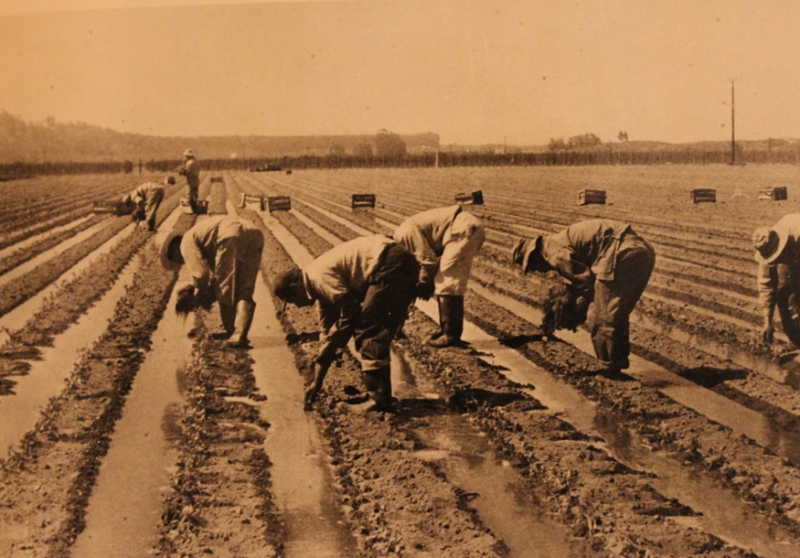
Japanese American farmworkers planting seedlings in the Lower Arroyo Grande Valley. Pismo-Oceano Vegetable Exchange.
It’s just a first draft, and it’s not Hollywood Production Quality. But this presentation draft, to be given in final form next Saturday, is still very close to my heart.
This is a first draft–most of it borrowed from other writing of mine–of remarks I’m to give for the History Center of San Luis Obispo on October 19 at the beautiful octagonal barn just south of town.
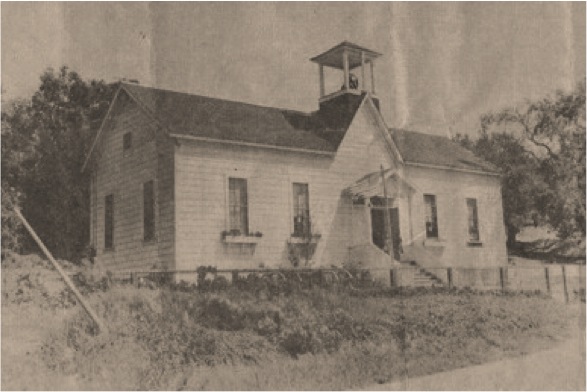
I began my formal education in a two-room schoolhouse in the Upper Arroyo Grande Valley that had been built in 1888. Some of our desks still had inkwells. A two-cubicle outhouse was our restroom. One day a mountain lion came down from the hill above the schoolhouse and sniffed around our baseball field.
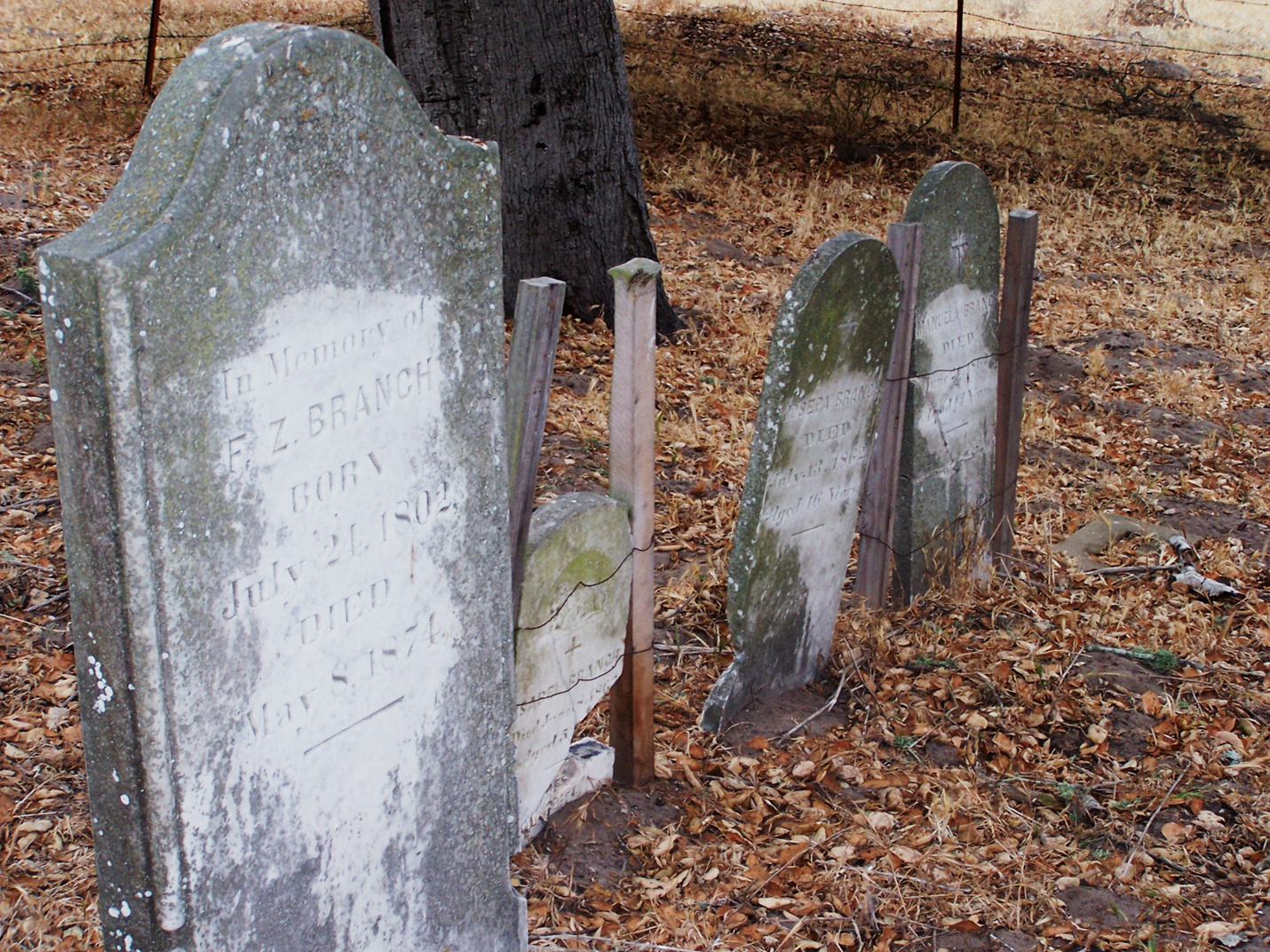
Just over the hill was a little family cemetery that contained the graves of the Branch family, rancheros and founders of Arroyo Grande. Mr. Branch, who died in 1874, is buried beside three daughters, all taken by smallpox in the summer of 1862. And nearby are the graves of a father and son, suspected killers, lynched from a railroad trestle over the creek in 1886.
I had no choice but to become a history teacher. Later, I had the chance to write books about the history—local history—that I love so much.
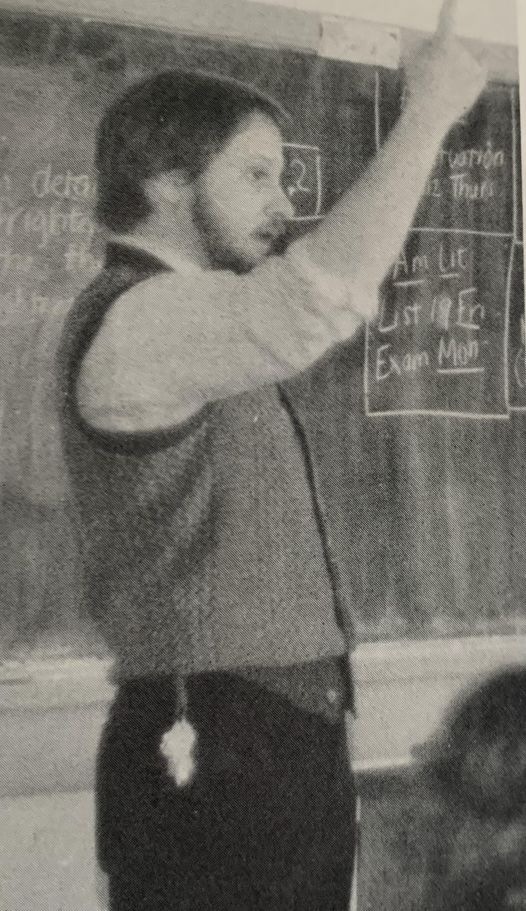
Me, teaching, I guess, at Mission Prep. It’s probably Civil War-era, either Whitman’s poem “Crossing Brooklyn Ferry” or Little Round Top on July 2 at Gettysburg.
The lynch mob’s victims, a father and his fifteen-year-old son, led to a book about San Luis Obispo County outlaws.
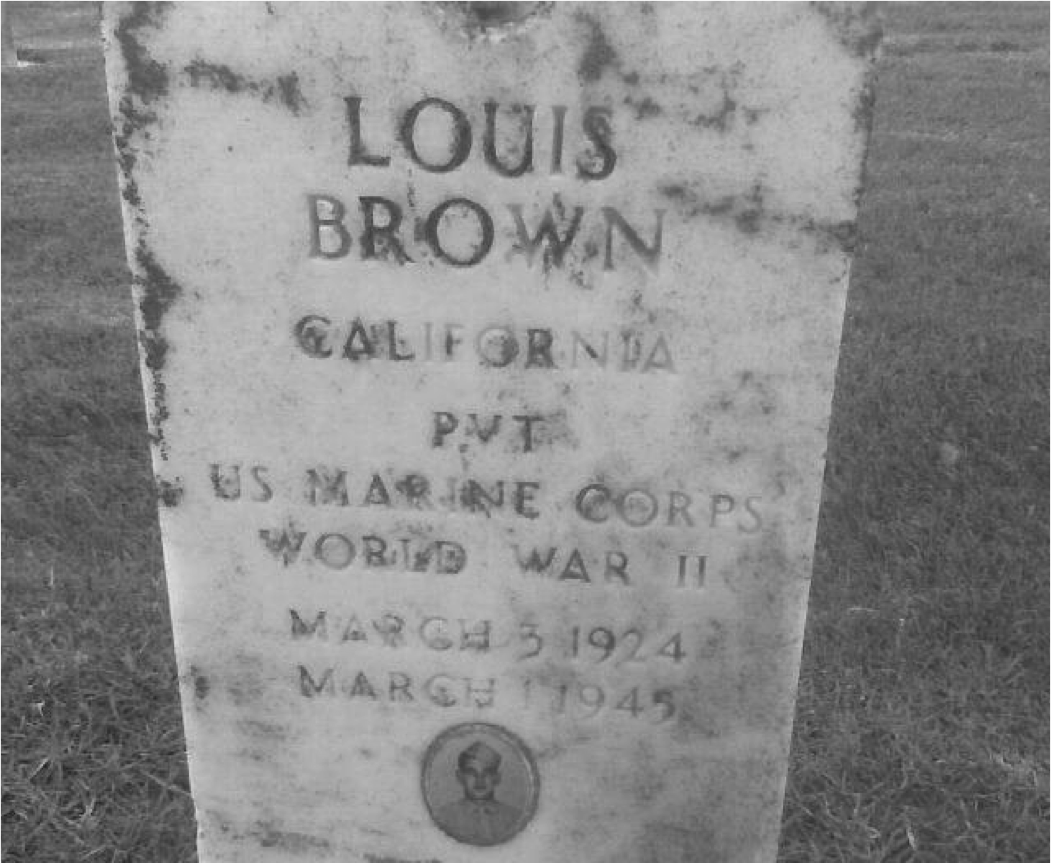
Finding a Marine’s tombstone—he grew up in Corbett Canyon and died on Iwo Jima three days short of his twenty-first birthday—led to a book about World War II.
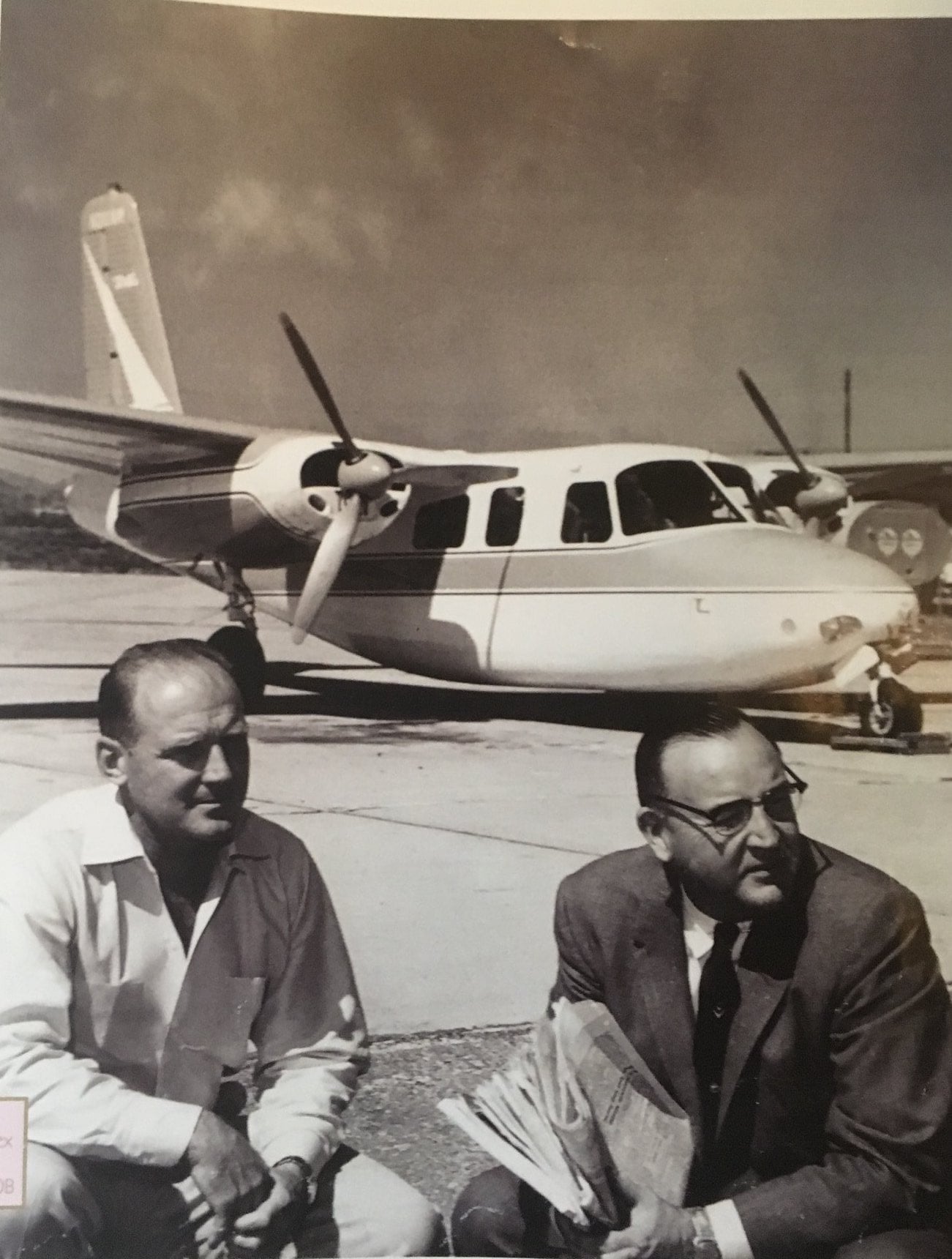
My father was Madonna Construction’s comptroller. He took my brother Bruce and me on an airplane with him once—I was six—while he bid a job in Marysville. The plane was Madonna’s twin-engined Aerocommander; the pilot was Earl Thomson, co- founder of the county airport. I was enthralled by that trip. Sixty years later, it led to a book about Central Coast aviators in World War II.
Alex Madonna, Gov. “Pat” Brown, and the Aerocommander.
My father liked to tell family stories. Dad and Dan Krieger were the best storytellers I have ever known, and that is how I taught history for thirty years.
My name, James Douglass, is from Dad’s family. James comes from my great-great grandfather, an undistinguished Confederate brigadier general. Douglass comes from his son, a young staff officer who had an unfortunate encounter with a Union artillery shell in Arkansas in 1862. Dad’s stories about his family, influding these two, would lead to my writing a book about the Civil War and the sixty veterans buried in Arroyo Grande’s cemetery. To my distinct pleasure, they are all Yankees.
I do not want to cause a political ruckus here, but I am a Lincoln man.
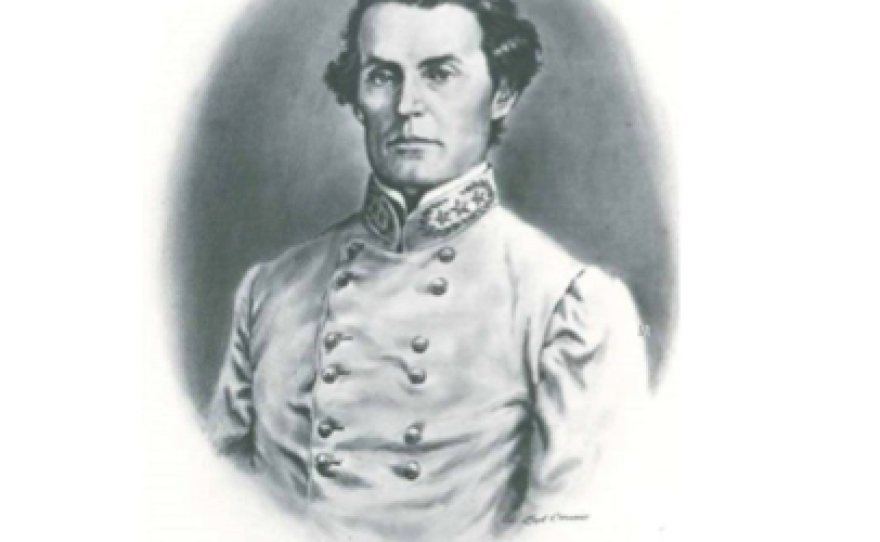
Gen. James H. McBride, for whom I am named.
History can touch us in what seem to be the most casual of ways.
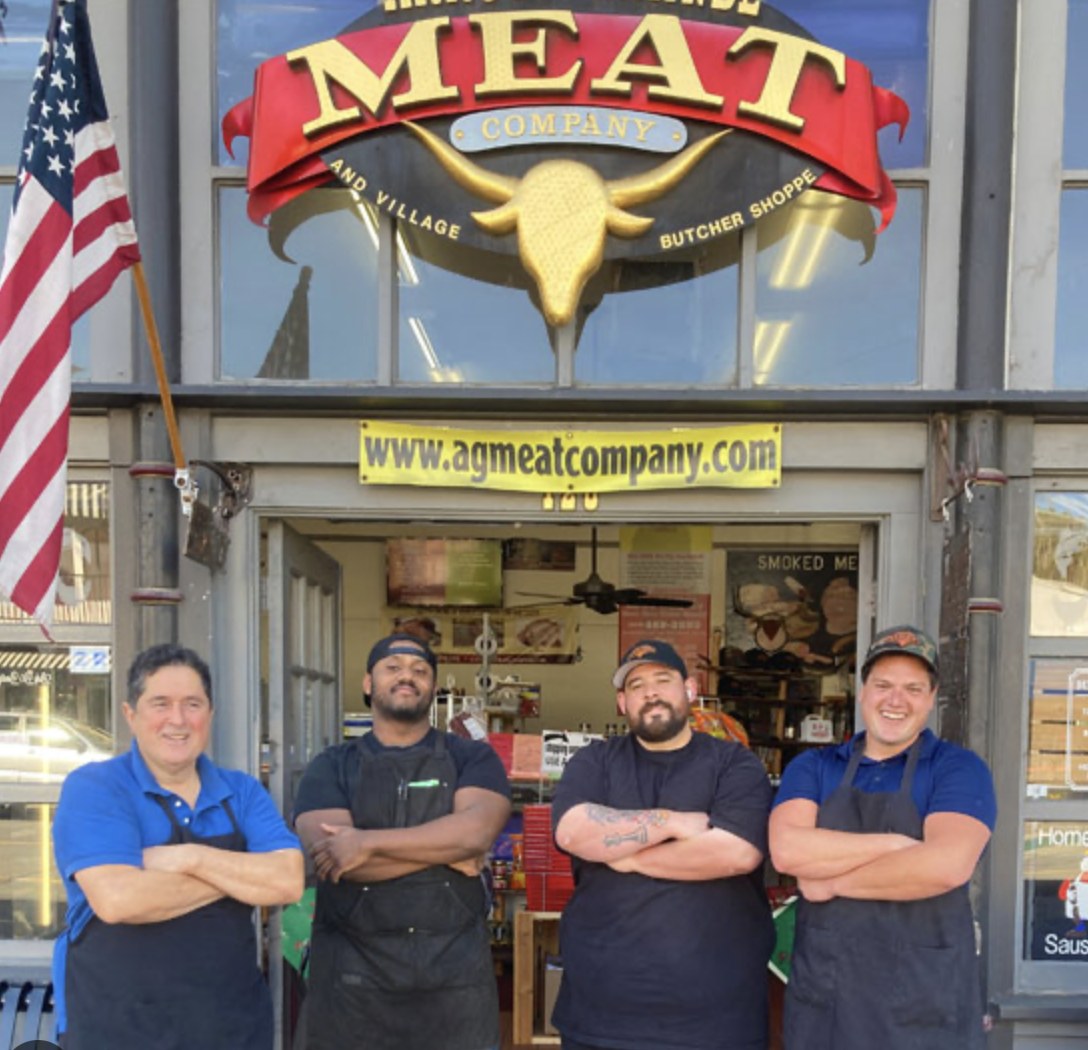
Last week I spent a large sum of cash at the Arroyo Grande Meat Co. on Branch Street, and it was money well spent: Five grass-fed Spencer steaks for my son John’s birthday.
While I waited for the steaks to be wrapped, I remembered that
–This has been a meat market since 1897.
–It, and the storefronts alongside it, were built with brick quarried from Tally Ho Creek clay.
–The brick was fired in a lot owned by Pete Olohan, Saloonist Extraordinaire, and the building named for him includes today’s Klondike Pizza.
–Two of the early meat market partners were E.C. Loomis, he of the feed store, now empty, at the base of Crown Hill, and Mathias Swall, who also built the bank that is now Lightning Joe’s.
–Mr. and Mrs. Swall lived in the home that is now the Murphy Law Firm on Branch Street. They both loved music and played instruments and resolved to teach their children to play instruments, as well. There were twelve little Swalls. Noisiest house in town.
–E.C. Loomis’s sons, including Vard, a onetime Stanford pitcher who coached a local Nisei team, safeguarded the farms and farm equipment of their Japanese American customers during internment, among many local families who did so out of simple admiration for their neighbors, their values and for their devotion to the little town they shared.
–That is how Vard Ikeda got his name, and those families’ friendship is in part why two generations of Ikedas have been so incredibly important to local youth sports.
–Shortly before they were “evacuated” to internment camps in 1942, Japanese farmers came into the meat market to settle their bills. Paul Wilkinson, then the owner, refused to take their money. These were his friends.
“You keep it,” he told them. “You’re going to need it.”
After the war, they paid Mr. Wilkinson back. In full.
I grew up with schoolmates whose grandparents came from Kyushu, the southernmost Japanese home island. Some of my friends’ families came from the Azores and some from Luzon, in the Philippines.
When I was a little boy, the whistling of braceros—baroque and beautiful—woke me up summer mornings as they went down to the fields next to us for work.
I learned my first Spanish from them. Years later, one of my university Spanish professors took me aside to offer me one of the greatest compliments of my life::
“Mr. Gregory, you have a distinct Mexican accent.”
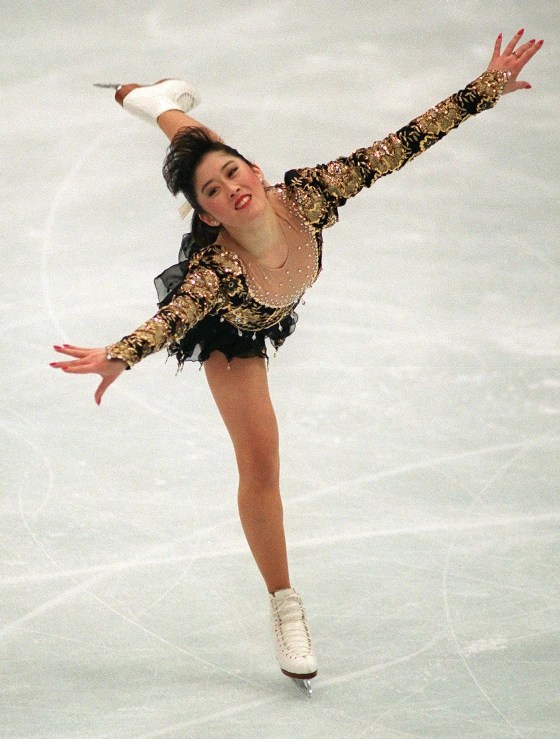
My first sushi was on a special Japanese holiday—I think it was Labor Day—at Ben Dohi’s house. Ben was married to a Yamaguchi sister, and Dr. Jim Yamaguchi came down with his wife and baby girl from the Bay area to visit. I got to hold Jim Yamaguchi’s daughter. Her name was Kristi. She would grow up to be an Olympic gold medalist. I did not drop her.
Kristi Yamaguchi, 1992 Winter Olympics
Mary Gularte took pity on me one cold morning when the schoolbus was late. She took me inside her kitchen and kept an eye out for the bus while setting a dish of sopa—Portuguese stew—on the kitchen table in front of me. I inhaled it. I did not have to eat the rest of the day.
My friends included families with surnames like Pasion and Domingo and sometimes they’d bring back sugarcane from the Philippines and gift me with a stalk to gnaw on. It was wonderful, but I later discovered lumpias, the divine Filipino egg roll, at the Arroyo Grande Harvest Festival. It gave me the greatest pleasure to watch Filipino mothers, most of them, once upon a time, war brides, watch me as I took my first bite of lumpia. My reaction must have been transparent. They beamed.
These were the helping hands that built our county. They helped me in my growing up. These people filled me with their history, by which I mean our history, and they remind me that history is always around us, sometimes just beyond the reach of our understanding. I write about history because I owe the past so much. My writing is the least, and it’s the very least, that I can do for my friends, including those I never had the chance to meet.
My grandfather, Ozark Plateau farmer John Smith Gregory (1862-1933) died eighteen years before I was born. He was the sweetest waltzer in Texas County, Missouri; I wish he’d lived long enough to teach me how to dance.
This is a first draft–most of it borrowed from other writing of mine–of remarks I’m to give for the History Center of San Luis Obispo on October 19 at the beautiful octagonal barn just south of town.
I began my formal education in a two-room schoolhouse in the Upper Arroyo Grande Valley that had been built in 1888. Some of our desks still had inkwells. A two-cubicle outhouse was our restroom. One day a mountain lion came down from the hill above the schoolhouse and sniffed around our baseball field.
Just over the hill was a little family cemetery that contained the graves of the Branch family, rancheros and founders of Arroyo Grande. Mr. Branch, who died in 1874, is buried beside three daughters, all taken by smallpox in the summer of 1862. And nearby are the graves of a father and son, suspected killers, lynched from a railroad trestle over the creek in 1886.
I had no choice but to become a history teacher. Later, I had the chance to write books about the history—local history—that I love so much.
Me, teaching, I guess, at Mission Prep. It’s probably Civil War-era, either Whitman’s poem “Crossing Brooklyn Ferry” or Little Round Top on July 2 at Gettysburg.
The lynch mob’s victims, a father and his fifteen-year-old son, led to a book about San Luis Obispo County outlaws.
Finding a Marine’s tombstone—he grew up in Corbett Canyon and died on Iwo Jima three days short of his twenty-first birthday—led to a book about World War II.
My father was Madonna Construction’s comptroller. He took my brother Bruce and me on an airplane with him once—I was six—while he bid a job in Marysville. The plane was Madonna’s twin-engined Aerocommander; the pilot was Earl Thomson, co- founder of the county airport. I was enthralled by that trip. Sixty years later, it led to a book about Central Coast aviators in World War II.
Alex Madonna, Gov. “Pat” Brown, and the Aerocommander.
My father liked to tell family stories. Dad and Dan Krieger were the best storytellers I have ever known, and that is how I taught history for thirty years.
My name, James Douglass, is from Dad’s family. James comes from my great-great grandfather, an undistinguished Confederate brigadier general. Douglass comes from his son, a young staff officer who had an unfortunate encounter with a Union artillery shell in Arkansas in 1862. Dad’s stories about his family, influding these two, would lead to my writing a book about the Civil War and the sixty veterans buried in Arroyo Grande’s cemetery. To my distinct pleasure, they are all Yankees.
I do not want to cause a political ruckus here, but I am a Lincoln man.
Gen. James H. McBride, for whom I am named.
History can touch us in what seem to be the most casual of ways.
Last week I spent a large sum of cash at the Arroyo Grande Meat Co. on Branch Street, and it was money well spent: Five grass-fed Spencer steaks for my son John’s birthday.
While I waited for the steaks to be wrapped, I remembered that
–This has been a meat market since 1897.
–It, and the storefronts alongside it, were built with brick quarried from Tally Ho Creek clay.
–The brick was fired in a lot owned by Pete Olohan, Saloonist Extraordinaire, and the building named for him includes today’s Klondike Pizza.
–Two of the early meat market partners were E.C. Loomis, he of the feed store, now empty, at the base of Crown Hill, and Mathias Swall, who also built the bank that is now Lightning Joe’s.
–Mr. and Mrs. Swall lived in the home that is now the Murphy Law Firm on Branch Street. They both loved music and played instruments and resolved to teach their children to play instruments, as well. There were twelve little Swalls. Noisiest house in town.
–E.C. Loomis’s sons, including Vard, a onetime Stanford pitcher who coached a local Nisei team, safeguarded the farms and farm equipment of their Japanese American customers during internment, among many local families who did so out of simple admiration for their neighbors, their values and for their devotion to the little town they shared.
–That is how Vard Ikeda got his name, and those families’ friendship is in part why two generations of Ikedas have been so incredibly important to local youth sports.
–Shortly before they were “evacuated” to internment camps in 1942, Japanese farmers came into the meat market to settle their bills. Paul Wilkinson, then the owner, refused to take their money. These were his friends.
“You keep it,” he told them. “You’re going to need it.”
After the war, they paid Mr. Wilkinson back. In full.
I grew up with schoolmates whose grandparents came from Kyushu, the southernmost Japanese home island. Some of my friends’ families came from the Azores and some from Luzon, in the Philippines.
When I was a little boy, the whistling of braceros—baroque and beautiful—woke me up summer mornings as they went down to the fields next to us for work.
I learned my first Spanish from them. Years later, one of my university Spanish professors took me aside to offer me one of the greatest compliments of my life::
“Mr. Gregory, you have a distinct Mexican accent.”
My first sushi was on a special Japanese holiday—I think it was Labor Day—at Ben Dohi’s house. Ben was married to a Yamaguchi sister, and Dr. Jim Yamaguchi came down with his wife and baby girl from the Bay area to visit. I got to hold Jim Yamaguchi’s daughter. Her name was Kristi. She would grow up to be an Olympic gold medalist. I did not drop her.
Kristi Yamaguchi, 1992 Winter Olympics
Mary Gularte took pity on me one cold morning when the schoolbus was late. She took me inside her kitchen and kept an eye out for the bus while setting a dish of sopa—Portuguese stew—on the kitchen table in front of me. I inhaled it. I did not have to eat the rest of the day.
My friends included families with surnames like Pasion and Domingo and sometimes they’d bring back sugarcane from the Philippines and gift me with a stalk to gnaw on. It was wonderful, but I later discovered lumpias, the divine Filipino egg roll, at the Arroyo Grande Harvest Festival. It gave me the greatest pleasure to watch Filipino mothers, most of them, once upon a time, war brides, watch me as I took my first bite of lumpia. My reaction must have been transparent. They beamed.
These were the helping hands that built our county. They helped me in my growing up. These people filled me with their history, by which I mean our history, and they remind me that history is always around us, sometimes just beyond the reach of our understanding. I write about history because I owe the past so much. My writing is the least, and it’s the very least, that I can do for my friends, including those I never had the chance to meet.
My grandfather, Ozark Plateau farmer John Smith Gregory (1862-1933) died eighteen years before I was born. He was the sweetest waltzer in Texas County, Missouri; I wish he’d lived long enough to teach me how to dance.



 A Work in Progress