
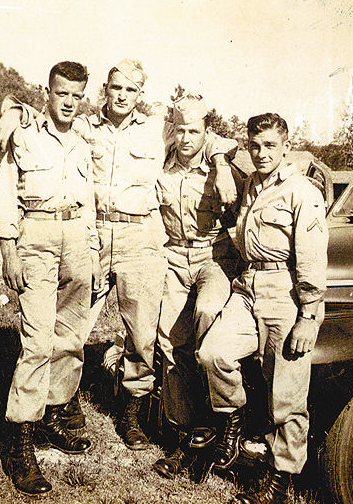
My friend Erik pointed me to a Cal Poly history student who wants to learn and write about SLO County’s role in World War II. Out of guilt—I failed to return an email—I shared a few facts with him tonight and then extended that into this blog post.
Among the South County’s (and Northern Santa Barbara County’s) contributions to World War II:
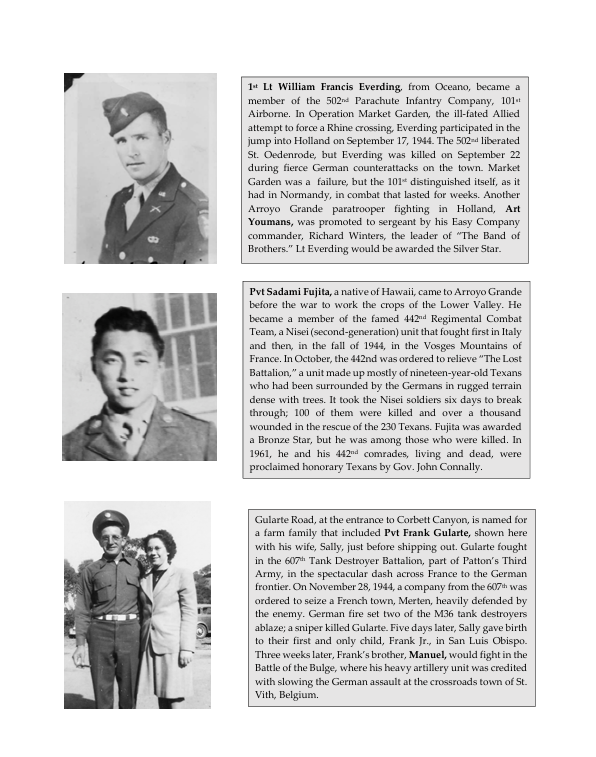
1. Arroyo Grande was home to two Nisei soldiers in the famed 442nd, one KIA in the relief of the “Lost Battalion.”
2. Another, an intelligence officer, who served as a liaison with Mao’s guerillas. Madame Mao danced with him.
3. A third, a young Guadalupe man, a medic KIA on the German frontier, 1944.
4. Two Arroyo Grande sailors, third-grade classmates, killed on “Arizona.”
5. A Pismo Beach dishwasher, a machine gunner on “Nevada,” credited with shooting down the first Japanese plane that morning.
6. Former County Superintendent of Schools Earl Cornwell, a sailor on Ford Island on December.
7. Nipomo sailor Donald Runels, killed on the heavy cruiser “Northampton,” who had a destroyer escort named for him.
8. The best letter home I’ve ever read was from an Arroyo Grande Filipino American. He was killed when his destroyer, “Walke,” was sunk by a Long Lance torpedo. Both “Northampton” and “Walke” went down in Ironbottom Sound, off Guadalcanal.
9. Seven of the Doolittle raiders did their primary flight training at Hancock Field in Santa Maria, including pilot Ted Lawson, who wrote Thirty Seconds Over Tokyo.
10. An Arroyo Grande B-17 copilot was awarded the Silver Star for bringing his ship home safely after it had been set afire over Berlin.
11. An Arroyo Grande High School shop teacher, as a World War II flight engineer, brought his ship home after a midair collision and a flak hit that took out both the No. 1 and No. 2 engines.
12. The P-38 figured prominently in local history, with three fatal crashes from the Santa Maria Army Airfield in January 1945 alone. A P-38 pilot from Shandon, memorialized at the American Cemetery at Normandy, was shot down over Cherbourg in a mission that was stupidly planned. Another, who retired to Orcutt, saw his B-17s “bounced” by Me109’s over the Alps. He went after them, only to find out that the lubricant to his machine guns had frozen. He decided that the Germans didn’t know that, so he made repeated passes at them. They broke contact and disappeared.
13. A Marine from Corbett Canyon was killed on Iwo Jima three days before he turned twenty-one. He was a replacement in the elite 28th Marines, which included the squad that raised the flag on Suribachi. Our Marine was killed on 362A, along with three of the flag raisers and Marine film photographer Bill Genaust, who warned AP still photographer Joe Rosenthal to turn around and get that shot that made him famous. Our Marine, a replacement and therefore resented, was in combat for total of 48 hours before he stepped on a mine. I got a copy of his Marine Corps personnel file and it read, bluntly: “Cause of Death: Burns, entire body.”
14. A Marine from Oceano was killed the instant he stepped off his landing craft at Tarawa. He was buried there, but somehow the Marine graveyard disappeared. His remains finally came home in 2017, and he’s buried his mother.
15. His sister joined the Marines, too. She was a driver at Camp Lejeune, and in December 1944, was FDR’s driver on a tour of the camp.
16. World War II made the Filipino American friends I grew up with possible. Filipinas were not allowed to immigrate before the war. But after Pearl Harbor and the invasion of the Islands, local Filipinos joined the Army in droves, quickly filling the ranks of two infantry regiments. They were superb soldiers and, at war’s end, there was a flurry of proposals and of weddings in the Islands. (One war bride was a little dismayed at arriving in Arroyo Grande: “It’s so muddy,” she said. “And farmy.”)
17. A Nipomo retiree landed on Dog Green Beach with the second wave of the 29th Infantry Division. The killing there resembled the opening sequence of Saving Private Ryan. He never forgot the wounded friend he could not reach without himself getting killed. Meanwhile, a future Lucia Mar Assistant Superintendent, Frank Schimandle, was piloting his B-17 above the beaches that day.
18. After their time with “Pappy” Boyington, the Black Sheep Squadron trained at the Goleta Marine Air Station, on the site of today’s UCSB. Sometimes, the AGUHS softball team played the women Marines at Goleta, and there are photos of Corsairs making low passes over Morro Bay during Army practice landings. When two 800-lb bombs struck the carrier Franklin off Kyushu, the resultant fires wiped out the Black Sheep in their ready room. An Arroyo Grande sailor, maybe the most beloved Grandpa I’ve ever known, Filipino American, somehow survived to bring the carrier home to her birthplace, the Brooklyn Navy Yard.
19. I took my AGHS students to the cemetery in Normandy, at Colleville-sur-Mer, and we found the grave of Pvt. Domingo Martinez, a local farmworker killed in July during the Normandy Campaign.
20. Another Arroyo Grande soldier—before the war, a firefighter at Camp San Luis Obispo, jumped into Normandy with the “Band of Brothers.” Dick Winters promoted him sergeant for his conduct and leadership during Market Garden.
From six years ago, another way of capturing the sacrifice our part of the county endured.
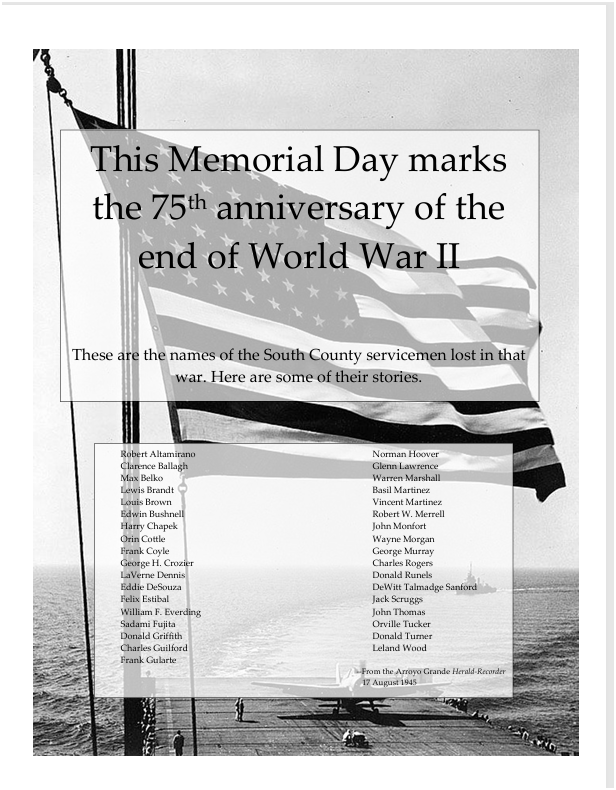
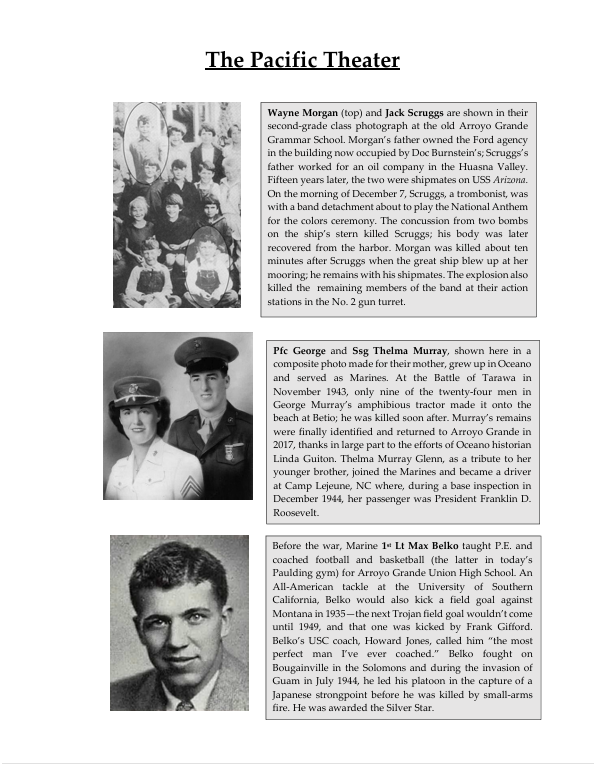
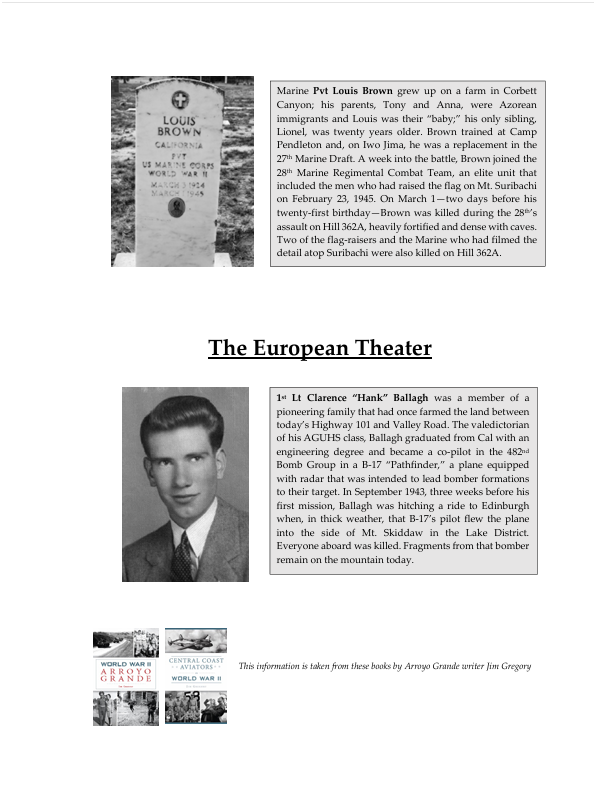
And then there are the videos:
And if these videos aren’t necessarily about World War II servicemen from my part of California, they’re indicative of my feelings for my parents’ generation, which is why I study this war so intently.
 A Work in Progress