
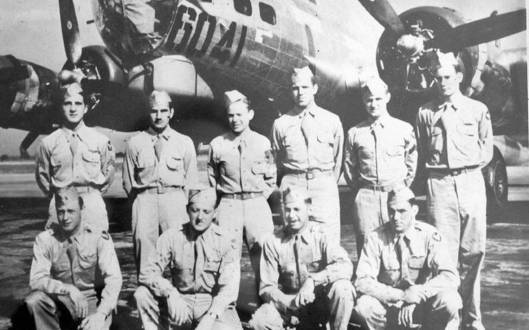
Sgt. Donal Laird, San Luis Obispo, third from left, top row, was a ball-turret gunner killed on his first combat mission in 1944. The wristwatch he wore that day was returned to his family in 2016.
At least eighteen local fliers were killed in World War II, brought down by German fighters, flak, engine malfunctions or by the mistakes they’d made in training.
Here are some of them:
https://drive.google.com/file/d/1TWlbAK0uCcNWUVefk_GZsWy5BJ16qZ1U/view?usp=sharing
But not all the stories that will be told in the book I’ve written, due out in May, are sad ones.
–Nearly 9,000 Army Air Forces cadets went through their Primary flight training at Hancock Field in Santa Maria, now the site of Hancock College. One of them was Louis Zamperini, the subject of Laura Hillenbrand’s book Unbroken. At least two would go on to become four-star Air Force generals after he war. Another 3,000 young men did their Navy pre-flight training at Cal Poly, which mostly abandoned civilian education, except for about eighty students, during the war.
–Lt. Elliott Whitlock of Arroyo Grande won a Silver Star for bringing his crippled B-17 home after a mission over Berlin in 1944. His bomb squadron’s mascot, a Tunisian donkey named Lady Moe, waited quietly each mission alongside the ground crews until Whitlock and all of his comrades who could come home had come home.
–Roy Lee Grover of Santa Maria was such a daring pilot that, after one mission near New Guinea, he dived so low in stafing a Japanese freighter that he brought the ship’s radio antenna home to base, draped around one wing of his B-25 Mitchell bomber.
–The P-38 was, at least in Europe, an inferior fighter to the vaunted P-51. It proved so for Lt. Chester Eckermann of Orcutt when the lubricant to his machine guns froze during a mission over the Alps. But the P-38 was valued for its forward armament, and Eckermann, in escorting his bombers home, found that he could intimidate German fighters by turning and pointing his ship’s nose at them. They immediately broke off contact and flew away.
–Capt. Jess Milo McChesney of Arroyo Grande crash landed twice, on both his first and final missions as a B-24 pilot in Italy, but his ship was so badly shot up that one of his crewmen later side admiringly: “I would fly through the gates of hell with that man.” McChesney later won his fifth Air Medal for flying 100 missions during the Berlin Airlift.
–TSgt Albert Lee Findley Jr., of Los Osos, was shot down twice. The second time was over Germany, and led to him spending the last months of the war as a POW. The first time was far more pleasant: his B-24 Liberator crash-landed near a village in just-liberated France, and the village adopted Findley’s aircrew, feting, feasting, and celebrating them—one villager became pen-pals with Findley’s Mom, back in Oklahoma—until finally, their commanding officer flew low over the village and dropped a canister with a stern message for Findley and his comrades to get back to base. Immediately.
–Harald Bauer, from Paso Robles, was a teenaged Luftwaffe test pilot. When a P-51 shot his jet down, he crash-landed behind American lines. Badly wounded, he was treated by U.S. Army medics. When his captors found out he was half-American, they returned Bauer to his mother’s front door in Germany, in the path of their advance. “Here’s your son, Ma’am,” the GI’s said politely.

