
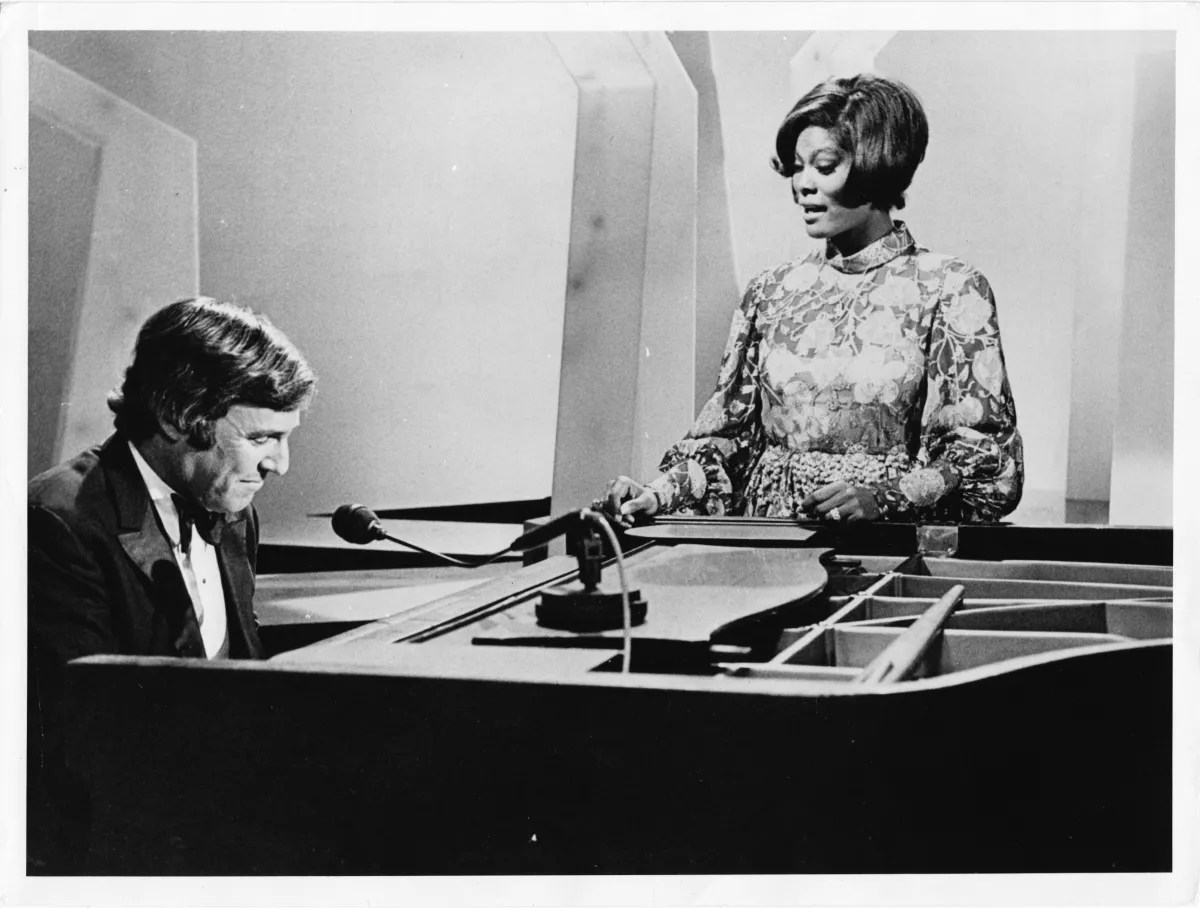
Bacharach and Dionne Warwick, the supreme interpreter of his songs and of Hal David’s lyrics.
PBS was gunning for Baby Boomer cash last night, because their Sunday night pledge drive featured a Bert Bacharach concert, taped when the great man was in his last years, and it was pretty marvelous. We have no cash for them, with pensions and all being what they are and inflation being what it is. But the special made Elizabeth and me pretty happy.
If you are not a Baby Boomer, then may blessings flow over you and your life. I am a Boomer, too, and even though we are not dying nearly quick enough for a couple of younger generations whose time has come, we had a few things going for us. Before the Internet it was AM Radio that gave life to our lives and, like the internet, made our lives shared lives, albeit far less perniciously.
When I was your age. young people—pardon me, my dentures slipped— when I listened to KSLY in the 1960s, you would have a Beatles song, a Supremes song, a Stones Song, a Beach Boys song, a one-hit wonder (“Friday on My Mind,” by the Easybeats, remains one of my favorites; Mason Williams’s guitar-driven “Classical Gas” another. So sue me).
Then there would be a Bacharach/David song, almost always sung by Dionne Warwick, who should be on Mt. Rushmore, scowling at Thomas Jefferson, I think, for the way he treated Sally Hemings.
My parents were part of the Greatest Generation, the inheritors of the Great Depression and the Second World War, but they dropped the ball after all they’d gone through in the 30s and 40s. This is because my parents’ favorite 1960s-1970s musical program was The Lawrence Welk Show, which was dreck. Myron Floren was a featured musician, and he played polkas, grinning happily, on his accordion, which have their place, in Zydeco and Tex-Mex music, for example.
Not in my living room in the 1960s, however.
The Lennon Sisters—no relation to John—were another favorite, and their performances were enough to send the vulnerable into diabetic shock. Here’s what I mean:
Lawrence Welk was dreadful, a kind of musical War Criminal. We Boomers ran screaming from the room when his show came on, and, years later, when I discovered how wonderful my parents’ music really was (Glenn Miller, the Andrews Sisters, Benny Goodman, Tommy Dorsey, Duke Ellington, Frank Sinatra, Ella Fitzgerald), their love for Lawrence Welk bewildered me even more.
So the PBS Bert Bacharach special was a comfort. Whatever else you say about my generation, and we deserve it, our music was wonderful. (I started teaching at Mission Prep in the 1980s, and I thought that generation’s music was, too. I can’t figure out how to insert it here, but I refer you to MTV Unplugged and Aha’s “Take on Me.” Incredible.)
But the program led me to another thought. Bert Bacharach is light-years better than Lawrence Welk. The concert tape was a little unnerving, because he was so very old and obviously so close to leaving us, but he still played a piano, a synthesizer, and sang, which might’ve been a mistake. In general, the younger singers were not a mistake. They were wonderful, except for the Opera Guy, who destroyed his song, and for a lovely British girl in a miniskirt, whose voice was simply too light and delicate for a Bacharach/David song.
I will borrow a phrase from a woman teaching colleague of mine: Even if you’re a female-type Human Being, you have to have Balls the Size of Church Bells to sing a Bacharach/David song. They are complex, the tempo shifts without warning and you have to learn the difference, often in the same song, when the narrative is softer, like the descriptive passage in a novel, and then it’s interrupted by a direct quote, often urgent or triumphant and sometimes even angry.
That is why Dionne Warwick was perfect for these songs. But thinking that led me down another rabbit-hole: Which singers, other than Dionne Warwick, are my favorite interpreters of the great man’s songs?
I still want Dionne on Mt. Rushmore, mind you.
Here is what I mean about Ball the Size of Church Bells. Nobody knows who Cilla Black is today. Not that many Americans knew who she was in 1964, when she was videotaped performing one of my favorite Bacharach songs, “Anybody Who Had a Heart.” She owns this song, which is also one of the most difficult of his songs to sing. (A quick cultural reference: I suspect that the woman lighting up a cigarette in the background near the song’s end is lighting up a Virginia Slim, a 100-mm cigarette aimed specifically at women. Big Tobacco was egalitarian in its intent to kill both genders and anybody in between.)
So it goes.
Anyway, here’s Cilla. That haircut, by the way, was a big deal in 1965. Two of my AGHS classmates, MaryJane Allen and Prisila Dalessi, both stunning young women, had similar haircuts.
I didn’t hear this performance until about six months ago. It made me happy.
So did the second non-Dionne singer I chose for interpreting Bacharach, and that’s Jackie DeShannon (born and raised in Kentucky and Illinois, as was Lincoln) and her interpretation of “What the World Needs Now.” I guess it’s even more relevant today, as obvious as it is for me to say it, than it was in 1965. Bacharach loved horns, too, especially trumpets, and they are lovely in this song. DeShannon always delivered the song this way, with the the Julie Andrew-esque Sound of Music gestures and turns because, I think, she was on a mission.
I think it’s important to remember this song’s context: It was released two years before the Summer of Love in San Francisco—there were no Hippies in 1965—and three years before the Tet Offensive. There were no Peaceniks in 1965, either, except for at Cal, perhaps, and their focus was on nuclear annihilation, which seemed pretty imminent. DeShannon’s gentle interpretation of Hal David’s lyrics is more powerful than it might seem. She’s pulling us back, in her way, from the brink. (Another popular song with a different message that year was “Eve of Destruction,” sung by Barry McGuire, which assured us that we were all going to die, and real darn soon.)
Last one.
Everyone knew the context of “Say A Little Prayer.” It was a Vietnam song, and everyone knew someone over there—In Country—who needed a little prayer to bring them home. Thirty-four young San Luis Obispo County men came home in flag-draped steel caskets, so there’s a deep emotional undercurrent that goes with this song; it’s the freight my generation carries, heavier than a C-130 cargo plane with thirty steel caskets as ballast.
I’ve played this version of Aretha’s song, surrendered to her by Bacharach and David, I am sure, over and over, but just for me.
I played it again with the earplugs in after the PBS special and my eyes welled up with tears. This incredible woman owns this incredible song, just as Cilla owned hers. If Aretha isn’t in Heaven, I ain’t a-goin.’ I’m joking, of course: God made her with His own hands just to remind us, I think, of how much He loves us. That’s what brought the tears.


I hope you’ve seen The Queen’s Gambit starring Anya Taylor-Joy (she who has eyes worthy of another ‘60s product, the Margaret Keane doll). The clothes are to die for; the music is copacetic, baby.
I heard Classical Gas gas during one of the episodes and promptly created my own bitchin’ playlist—the series pretty much has it nailed, though.
Dig for yourself these groovy tunes:
https://www.refinery29.com/en-us/2020/10/10119384/queens-gambit-netflix-soundtrack-60s-songs
LikeLike
No wonder I love you.
LikeLike
And, BTW, “Venus” is one of my Guilty Pleasures.
LikeLike
Wonderful, Jim. Thank you. My wife, Wendy, and I watched the special, too. I enjoyed Bert’s singing, which reminded me of a comment Raymond Chandler made about ACROSS THE RIVER AND INTO THE TREES: “Frankly, it isn’t his best, but he’s like the pitcher beyond his prime. When he can no longer throw the high hard one, he throws his heart.” Again, Jim, thank you.
LikeLike
Thank you, my dear friend and fellow member of the Raymond Chandler Marching and Chowder Society. When I think I need to get out of a writer’s rut, I re-read “Red Wind.”
LikeLike
Jim, MY dear friend, I forgot to say that I missed Herb Alpert’s version of “This Guy’s in Love with You.” On that song, his restrained trumpet is exquisite. I also forgot to say that since I read your superb piece, I’ve been hearing “Raindrops” in my head continually. Thanks again!
LikeLike