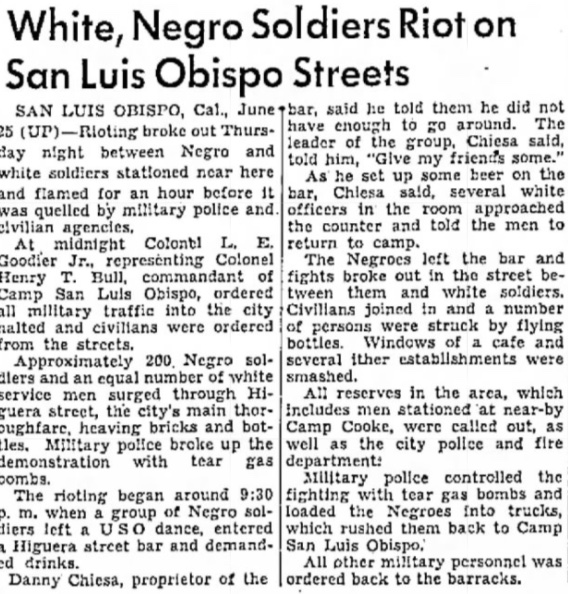
The wire press story recalls a painful part of our past, eighty years ago next week. There were Black Quartermaster units at Camp San Luis Obispo, support troops at the Santa Maria Army Air Force Base, and the 54th Coast Artillery—-a unit designation remindful of a proud part of our nation’s past, the Civil War’s 54th Massachusetts—manned gun positions overlooking Port San Luis and Estero Bay. The fighting the story describes took place on the night of Thursday, June 24, 1943.
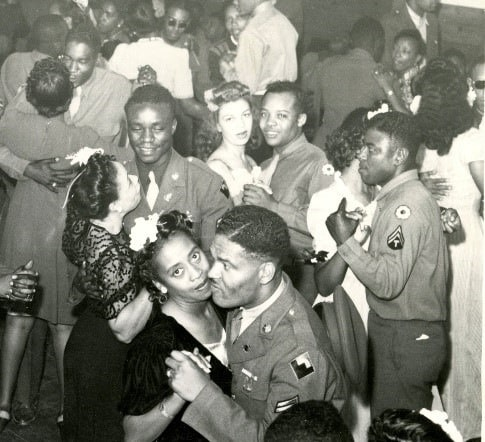
San Luis Obispo, as the nation did, followed the color line. There were, according to extensive research done by military historian Erik Burn, separate USOs. White GI’s frequented what is today’s Ludwick Community Center; the extant USO for Black GI’s is today’s City Utilities Department at 873 Morro, near the Palm Street parking structure.
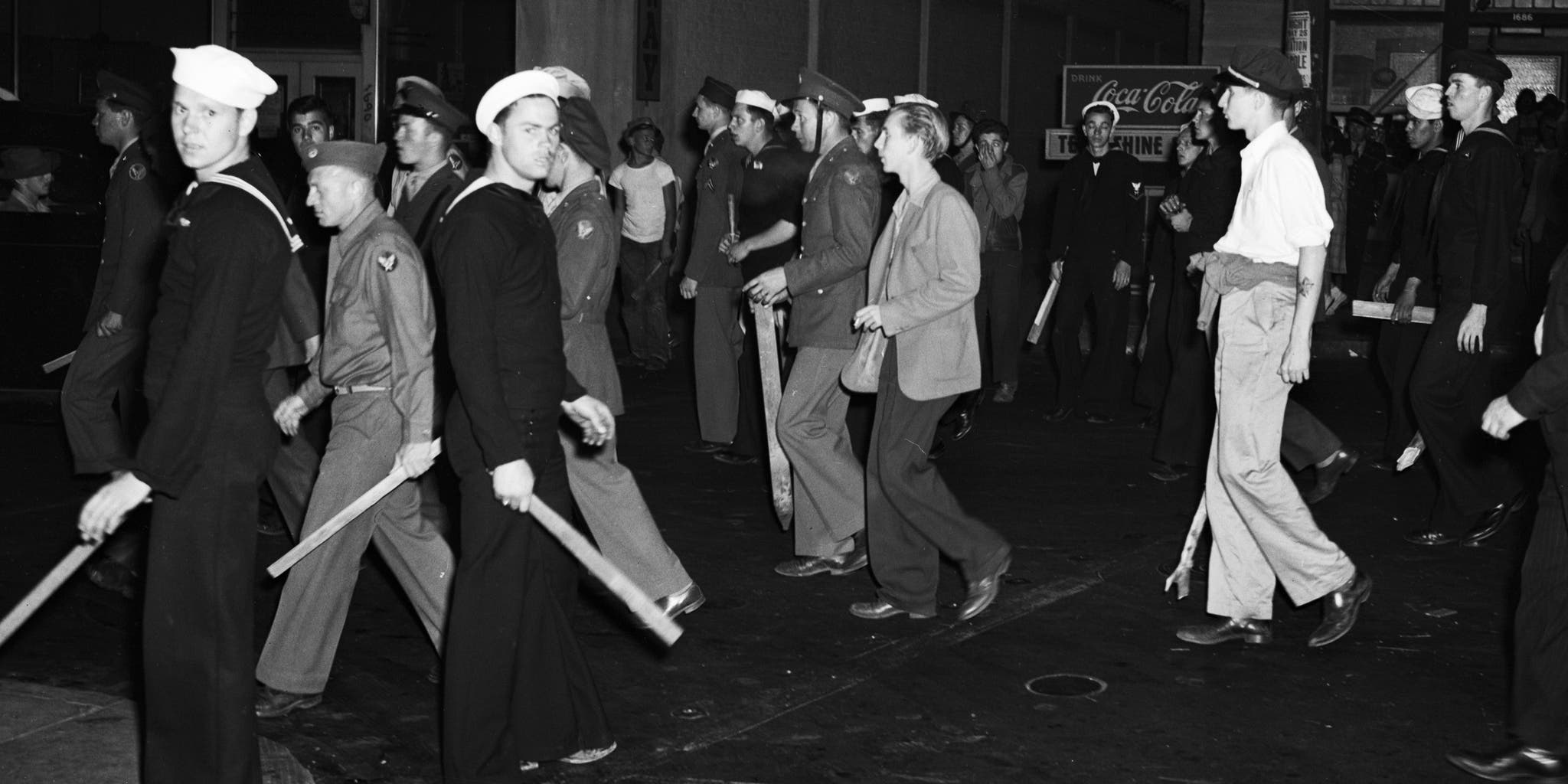
The most famous 1943 incident, of course, belongs to L.A., where Army and Navy enlisted men, many Midwestern or Southern, armed with axe handles, beat and then stripped young Latino “Zoot-Suiters” in fighting that had begun near the Naval Armory in Chavez Ravine and then rolled south to Chinatown and east to Boyle Heights, finally ending at a boundary that is today’s Santa Monica Freeway.
The Latino kids’ sense of style was made manifest in their Zoot Suits. The fashion—considered seditious, I guess, in a time when cloth was rationed, was popular with young Black kids, too. Cab Calloway is blatantly Zootish in the excerpt from 1943’s Stormy Weather, a film, I need to point out, that made the sixteen million men who served in World War II fall in love with Lena Horne. (The song spilled over into literature, too: a passage from Steinbeck’s Sweet Thursday has trumpeter Cacahuete, Joseph and Mary’s nephew, playing “Stormy Weather” into a Cannery Row storm drain for the reverb while the sea-lions accompany him from their rocks on China Point.)
The LAPD had no fondness for minority youth culture in 1943. As was its wont in those days, the Department arrested the Chicano kids, the Zoots, but only after they’d been stripped and beaten. They were easier collars then, when they were bleeding on the sidewalk. And, since they were overwhelmingly the victims of violence, the three days of mayhem were immortalized as the “Zoot Suit Riots.”
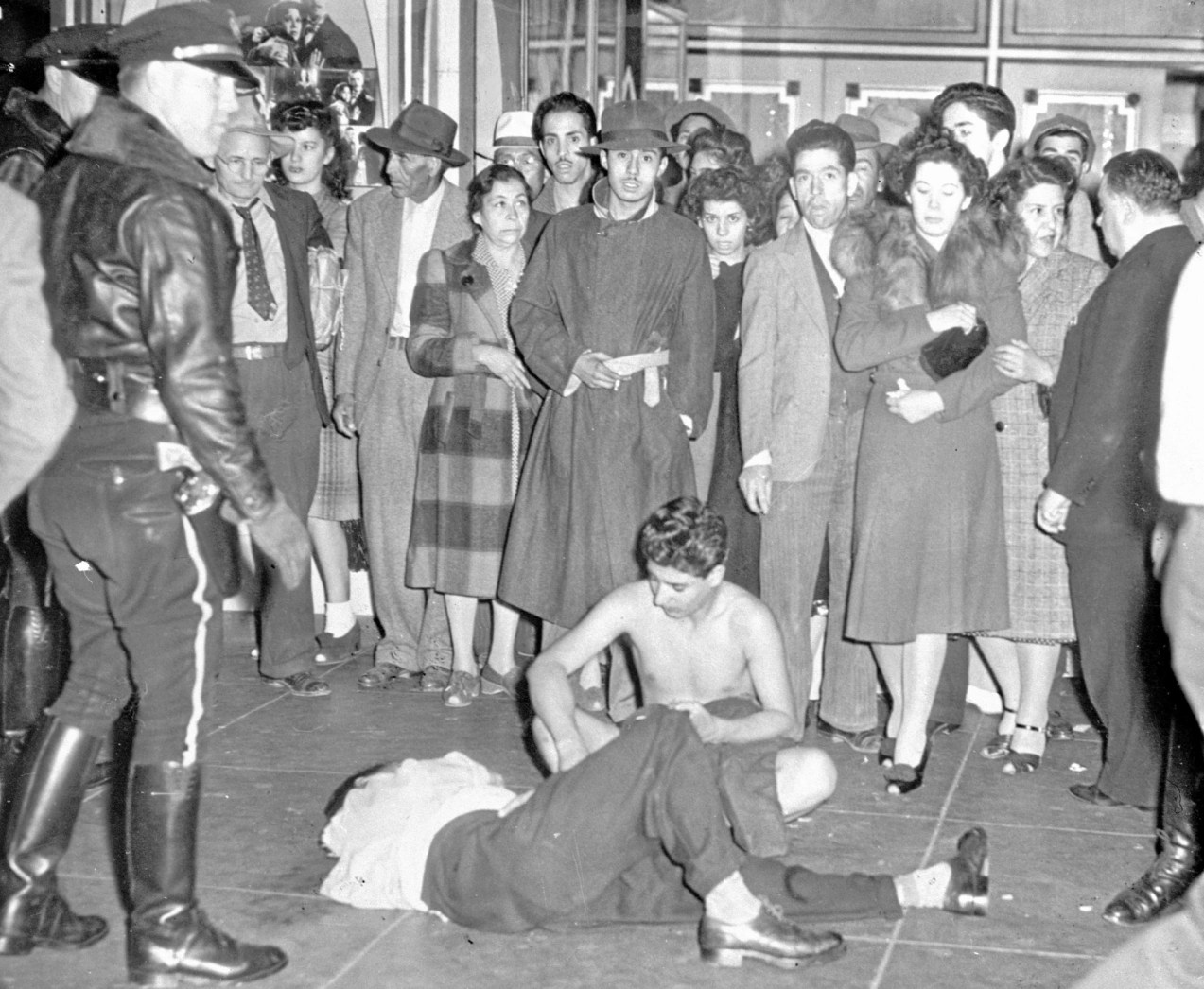
The Zoot Suit riots were a vivid but not exclusive reminder of American racism in 1943. Some of the other incidents:
May 25, 1943: On the same date that George Floyd was murdered in 2020, the promotion of twelve Black workers at a Mobile, Alabama, shipyard that built and maintained U.S. Navy warships led to attacks, by 4,000 Whites, on Black defense workers. Some of those workers jumped into the Mobile River to escape the mob. After at least fifty were injured, National Guard troops put the rioting down.
June 3-8: The Zoot Suit Riots.
June 15-17: Beaumont, Texas, where an influx of both Black and White shipyard workers and crowded housing were factors in three days of rioting that left three dead, two of them Black, one White. A White woman had accused a Black man of rape; when a White crowd gathered around the jail where suspects were held and were denied access, they invaded Beaumont’s Black neighborhoods, torching over 100 homes.
June 20: The Belle Isle Riots in Detroit. 6,000 troops were called out by the president to end violence that resulted in 34 deaths—twenty-five of the victims were Black– fueled by rumors that a White woman had been raped and that a White mob had thrown a Black mother and her child off a Belle Isle bridge. Background tensions included densely packed ghettos and, as was the case in Beaumont, the promotion of Black defense workers. Police stood by as a Black man was beaten to death; a White doctor was murdered as he was making a house call.
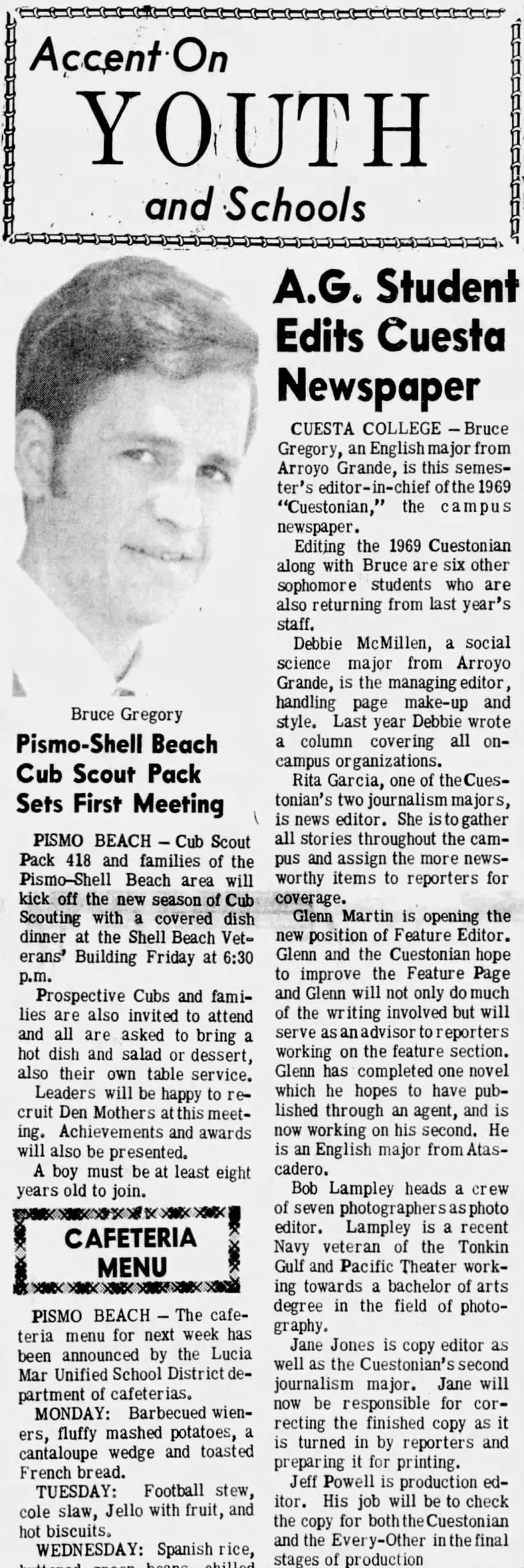
June 24: Fighting between White and Black GI’s in downtown San Luis Obispo. As the article notes, MP’s took the Black GI’s into custody and drove them to Camp San Luis Obispo.
August 1 and 2: As a Black soldier attempted to intervene in the arrest of a young Black woman, an NYPD officer shot him. Rumors that the soldier had been killed led to two days of violence that killed six and caused millions in property damage. Ralph Ellison, in The Invisible Man, and James Baldwin, in Notes of a Native Son, incorporated the riot into American literature.
Racial violence didn’t end at our shores. On April 3’s “Battle of Manners Street” in Wellington, New Zealand, the fighting resulted from American Marines blocking the entrance of Maori soldiers to an all-services social club. In June, one American soldier was killed during interracial violence in Northern England in what became known as the “Battle of Bamber Bridge,” after the town where fighting, including exchanges of gunfire, broke out between Black troops and White MPs. Five American servicemen were shot. In the aftermath, thirty-two, all of them Black, were court-martialed.
The people of Bamber Bridge were sympathetic to the Black soldiers they had begun to befriend. Anthony Burgess, the author of A Clockwork Orange, taught in the little town then, and remembered that when one local innkeeper was ordered to institute a color bar, he put out the following sign:
OUT OF BOUNDS TO WHITE SOLDIERS
* * *
When I taught U.S. History at Arroyo Grande High School, we learned about the L.A. riots every year, using animated maps to follow their progress, reading contemporary news reports and hearing, thanks to PBS, from people who’d lived through the time and scholars who’d studied it. I assume teachers aren’t supposed to teach anything anymore that puts America in a negative light or that might make European-American kids feel guilty.
It’s funny, but my kinds, mostly Anglo, never seemed to feel guilty. They loved the way these teenagers from East L.A. dressed and danced. What they hated was the cruelty visited on them. They would learn about other soldiers and sailors, heroes, as we studied the war itself. But, to use an analogy I’m fond of: I’ve been married for thirty-seven years, and my wife doesn’t love me because I’m perfect. What she feels for me is mature love.
I love my country in the same way, in spite of and in part because of its imperfections.
There was blood on the sidewalks sidewalks along Higuera in 1943. To look away does America and Americans a disservice. In confronting demons from our past, we give our young people the tools they’ll need to form a more perfect union.





 A Work in Progress