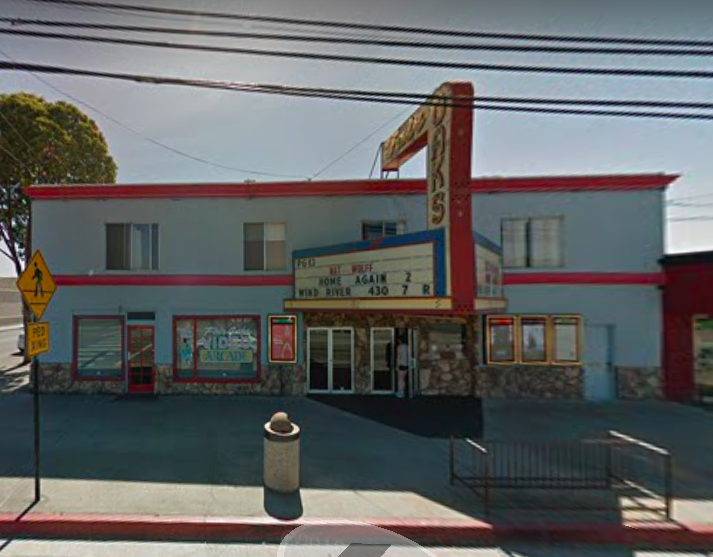
My wife, Elizabeth and I had a post-quarantine movie date to see In the Heights at the Fair Oaks Theater. It was delightful and it was wonderful to see it at the Fair Oaks.
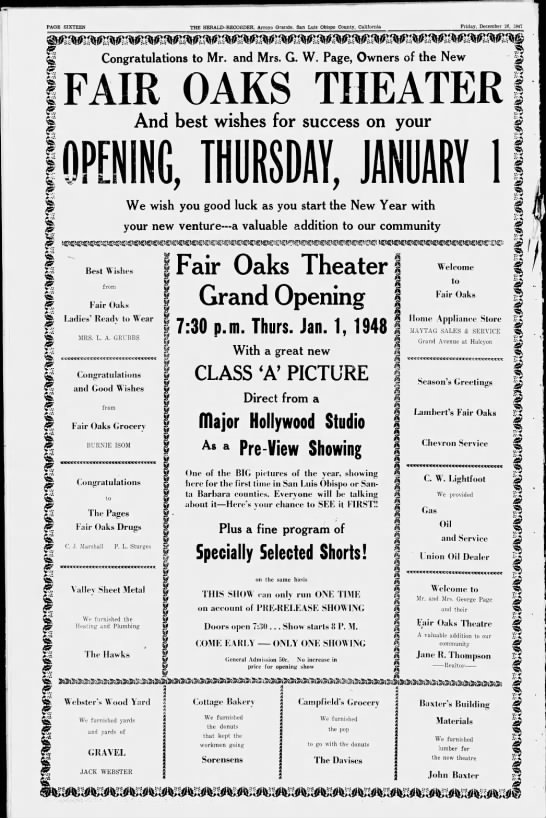
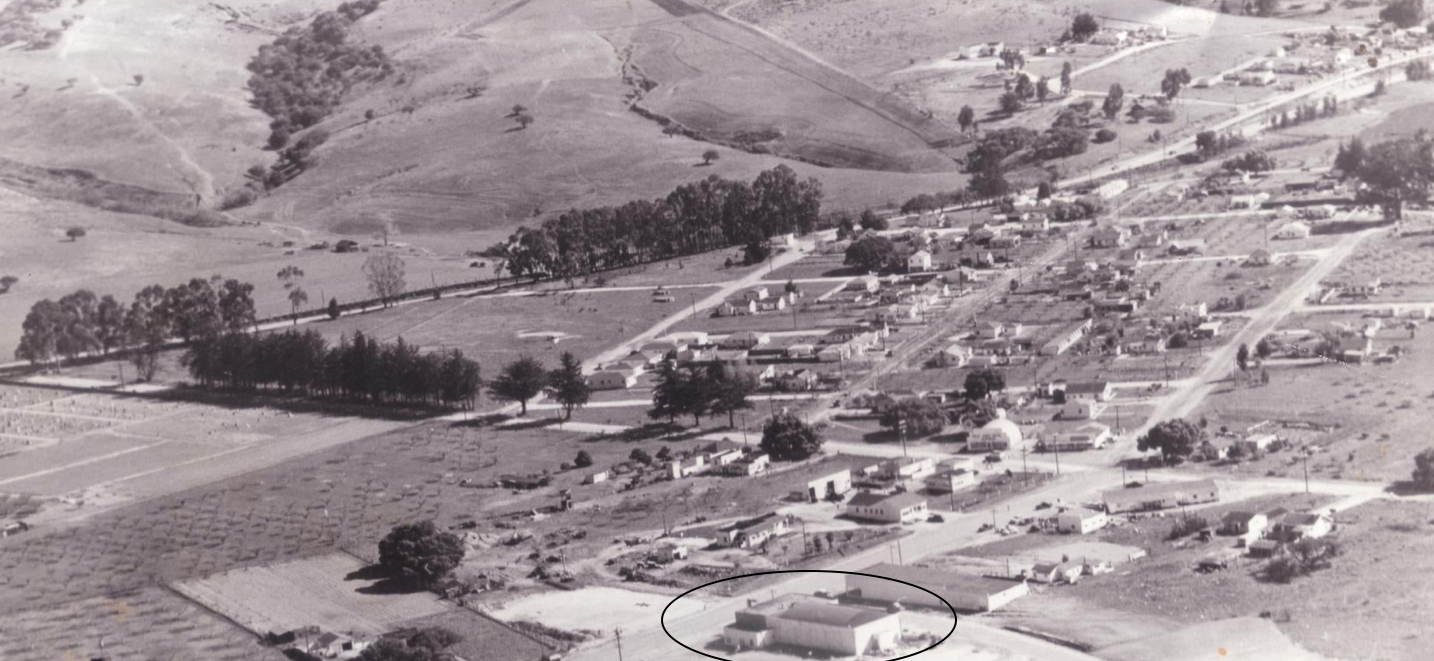
The theater opened in 1948 and by 1955, when my family moved from Taft to Arroyo Grande—the brick barbecue my father built still stands in the back yard of our old Sunset Drive home—it was kind of the center of a community that was growing rapidly.
Fair Oaks already had its own market—the building at the corner of Halcyon and Grand that includes a computer repair shop and a bookstore was the Fair Oaks Grocery, opened in 1939—and would, after the war, add the Fair Oaks Pharmacy, across the street at the other corner of Halcyon and Grand. I remember, vaguely, Mr. Chuck Brooner coming in to fill an after-hours prescription when I was pretty sick.
There was a big hardware store just across Alder from the theater, whose ground floor also included an appliance store. In 1955, Burkhardt’s Shoes, at 951 Grand Avenue, had its grand opening. Mr. Burkhardt was skinny as a whippet and was marked, as was Mr. Brooner, by his kindness: he treated my mother like royalty and was easy with kids who came in for their back-to-school Hush Puppies or Keds.
These places had a growing market because Arroyo Grande’s population more than tripled between 1940 and 1970—from 1,090 to 3,291—and an anecdotal study of new home purchases in the Arroyo Grande Herald-Recorder reveals that many of the new arrivals were, like us, refugees from the San Joaquin Valley.
Dad was a consultant to the founders of Mid-State Bank and got a job as comptroller for Madonna Construction, and, like many others of his generation, bought his home with a V.A. loan and, like many others, wanted a home near a school.
Arroyo Grande obliged with the September 1955 opening of Margaret Harloe Elementary, where my big sister finished her elementary education and my big brother began his. Harloe was one important anchor for Fair Oaks. The theater was the other.
The Grand Opening, 1948
We did not hit it off, the Fair Oaks and I. The first two films I saw there were deMille’s later Ten Commandments—I was distraught when Charlton Heston closed the Red Sea and the Egyptian charioteers’ horses drowned—and John Ford’s The Searchers, in the scene that traumatized me happened in the gathering dusk, when the Texas sodbuster family can hear the Comanche raiding party but can’t see them. It’s since become one of my favorite films, but it wasn’t then, not in 1956.
Forty years before, films were just as important a part of Arroyo Grande life as they were when the Fair Oaks was built. Silent films were screened Saturdays at Tanner’s Dance Hall, on the site where City Hall now stands, and young people were crazy about the movies. I learned this from Jan Scott’s wonderful Readers’ Theater play, “Letters From Home: Keeping Him Close,” which told, through their letters, the story of an Arroyo Grande soldier and his family in the closing months of World War I.
The letters included the impact of the 1918 influenza epidemic and its closure of churches, schools and theaters, and the doughboy’s little sister was desperate to see the movies open again. The high school, maybe not so much.
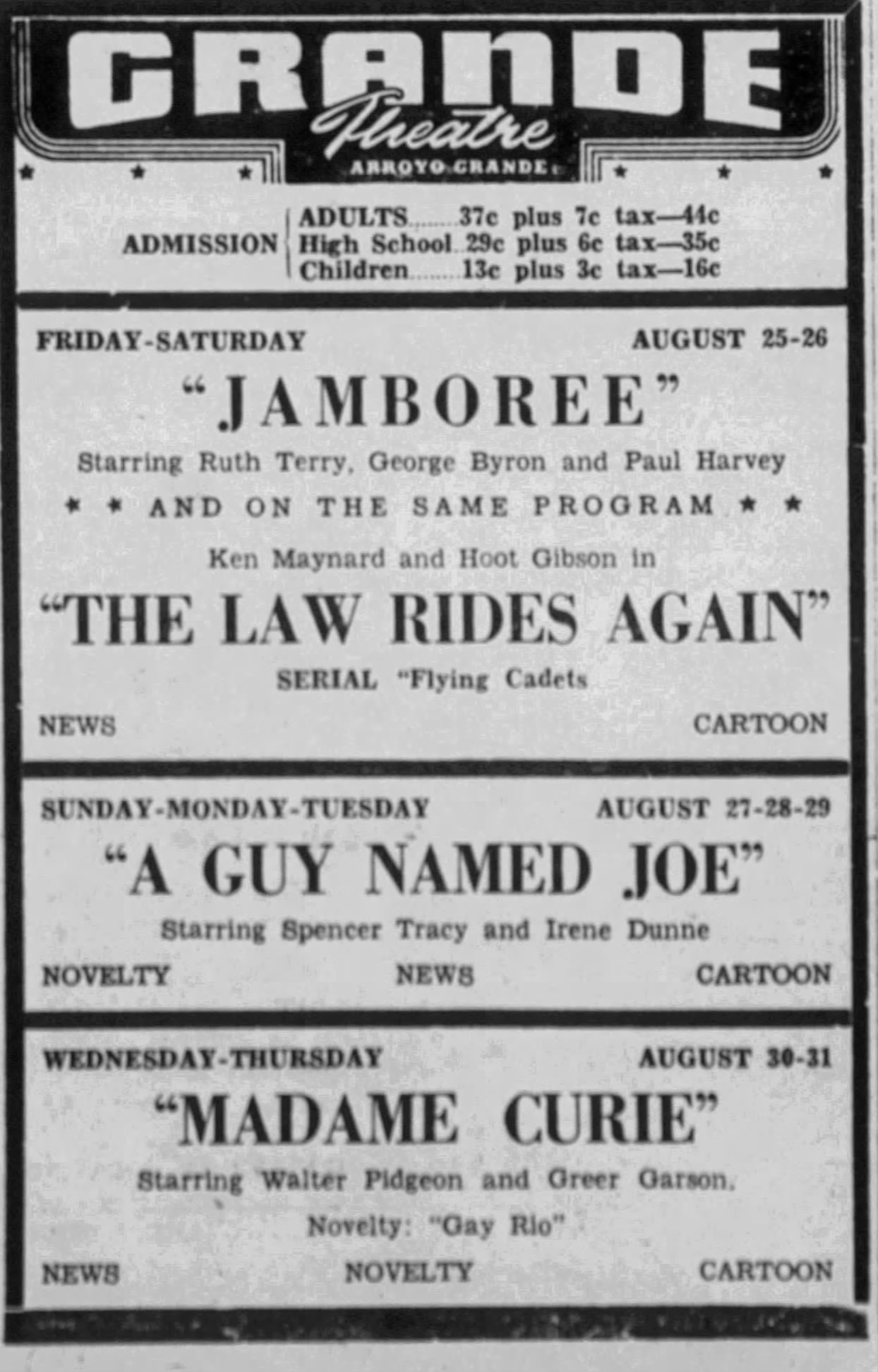
By 1930, the Mission Theater—later the Grande—was boasting talking pictures in its ads. The newer theater—which also sometimes hosted high school commencements (including Stanford-bound Vard Loomis’s), as Tanner’s Hall had once, for the five seniors of the Class of 1898—was housed in the Branch Street commercial building that now includes Posies in the Village.
Jean Wilkinson Frederick’s father owned the meat market on Branch that’s been a meat market since 1897. (Her classmates at the high school, fellow members of the Stamp Collecting Club, included the inseparable Haruo Hayashi, John Loomis, Gordon Bennett and Don Gullickson.)
Jeanne told me a few years ago that she loved the movies at the Grande. Her favorites were the Western serials, and her favorite cowboy was, of course, Gene Autry. It helped that Gene often sang to his horse, Champion, a beautiful sorrel with a blond mane that would’ve been every girl’s dream horse.
August 1944
The Grande was ideal, too, for high school dates, because just down the street, in today’s Village Grill, was the Economy Drug Company, which featured Arroyo Grande’s soda fountain. Soda fountains were vital to Mickey Rooney and Judy Garland and seemingly, to most young couples in the 1930s and 1940s. My mother was a soda jerk in Taft in 1939 when Dad came in for an ice cream sundae. They were married in 1940.
I would survive the first two films I saw with my parents at the Fair Oaks and would see films my Mom loved (Lilies in the Field), films my big sister loved (Tammy and the Bachelor) and films that were more to the taste of my big brother and me (20,000 Leagues Under the Sea and Kirk Douglas’s epic battle with the giant squid.)
Since the mid 1960s, the Rodkey family have run what is truly is a neighborhood theater with all the elements I require in a theater: it’s clean, with comfortable seats and refillable popcorn. My family missed it when it was closed.
It’s like so many other places in Arroyo Grande I’ve found in growing up here: even when you leave your house you can find a place that’s home.
Fair Oaks in 1949. The theater is circled; the corner market is just above and to the right; the Arroyo Grande District Cemetery is to the left.
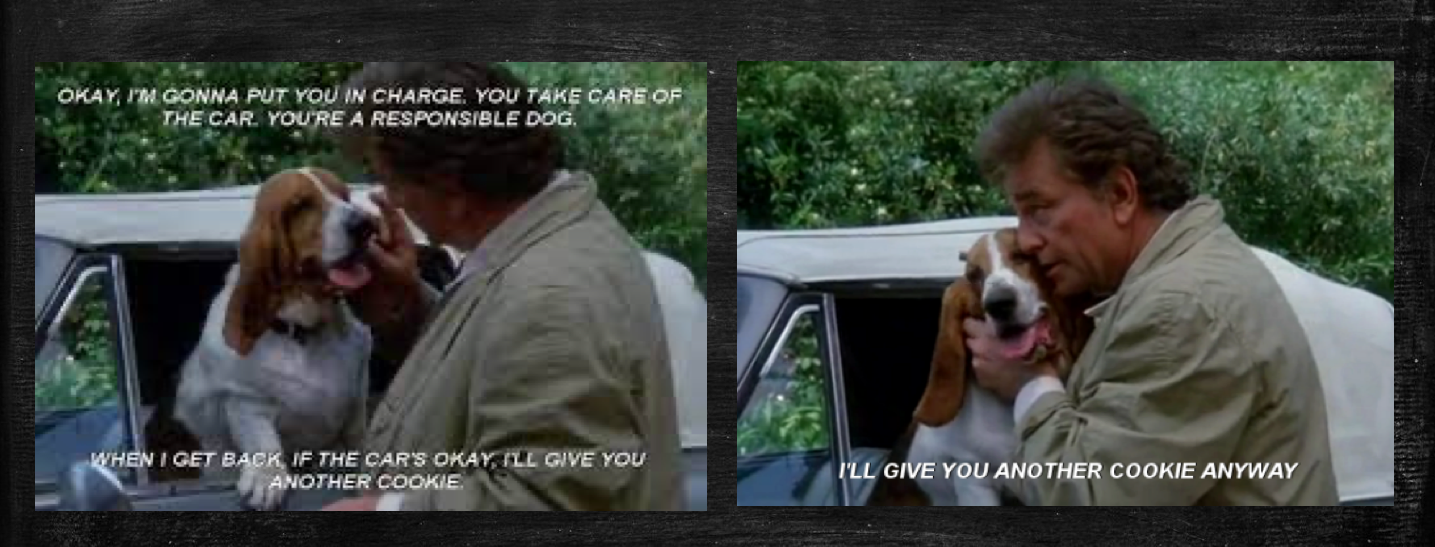
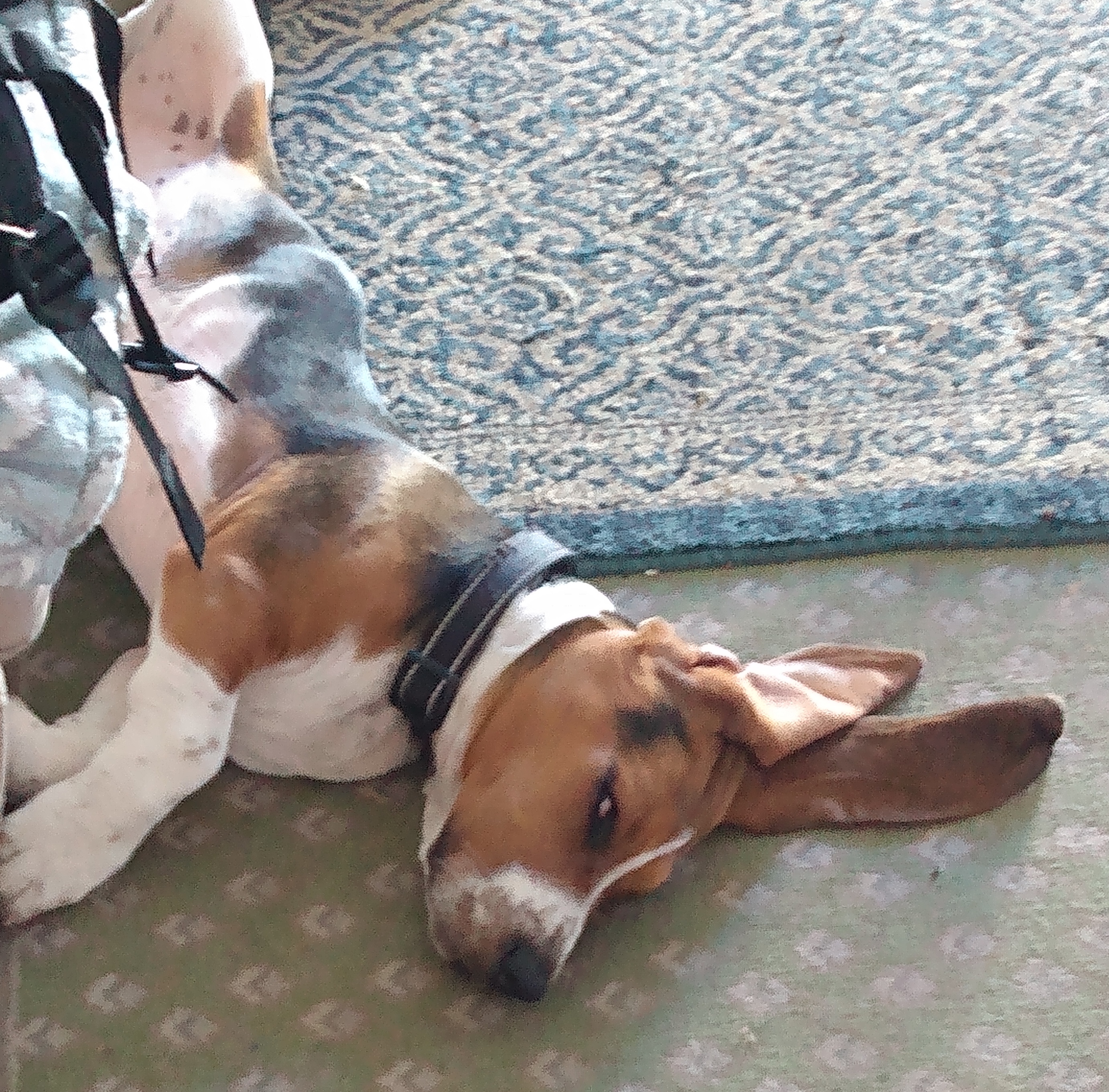
Peter Falk, as Det. Columbo, demonstrates a trait common to Basset hound humans: their liberality with cookies.
I taught European history for many years at Arroyo Grande High School and so wound up leading summer trips for students so they could see some of the places we’d studied. The 2010 trip focused on Western Europe in World War II and during one of the stops we found ourselves in Bastogne, Belgium.
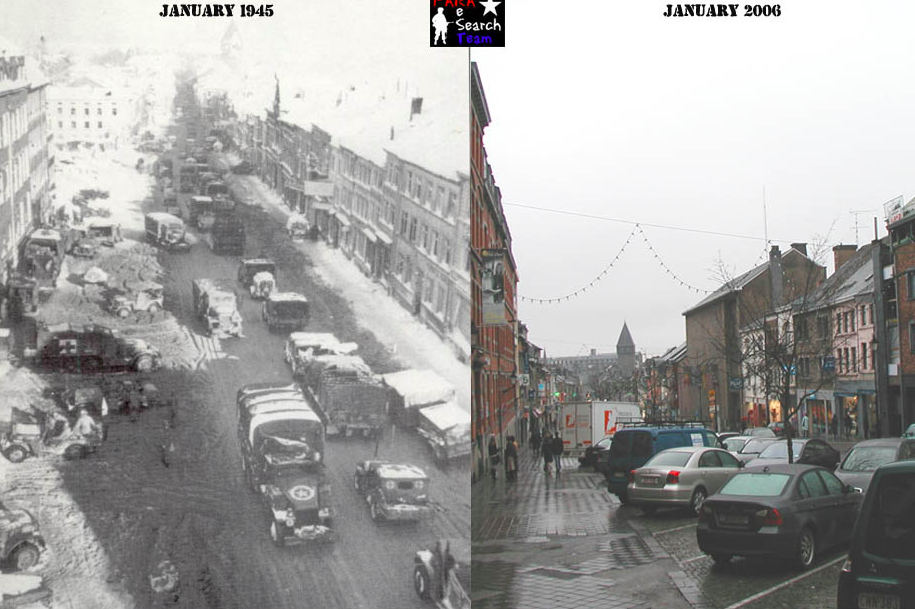
Bastogne, of course, won fame in the winter of 1944-45 when the town and the woods around it were occupied by the American 101st Airborne. Although surrounded completely by the Wehrmacht, the German army, the airborne troops refused to surrender. They were downright rude about it. “Nuts!” the airborne artillery officer in charge, Anthony McAuliffe, told the German delegation that offered humane surrender terms.
What does that mean? The German delegation asked.
It means “go to hell,” they were told.
That’s the sanitized version. I imagine the reply was closer to something the Wehrmacht could do to itself were it not anatomically and militarily impossible.
Bastogne, then and now.
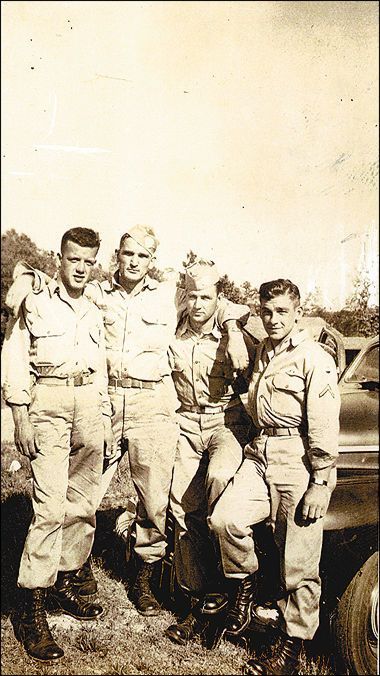
The 101st held on until they were relived–one of them, Art Youman, a member of the 506th Parachute Infantry’s famed Easy Company, was from Arroyo Grande. In holding on, during the coldest winter in Europe in thirty years, the paratroopers ruined the German timetable for their offensive, and the timetable was precious to the offensive’s success. The 101st’s stubbornness helped defeat the Germans, rich in steel but oil-poor, in what came to be called the Battle of the Bulge because they simply ran out of the fuel they needed to drive their panzers— their tanks and trucks and their mobile artillery.
Art Youman, second from left, during jump training in South Carolina. Easy Company occupied Bastogne on his 23rd birthday; by then he’d been promoted to sergeant by Easy Company’s C.O., Richard Winters.
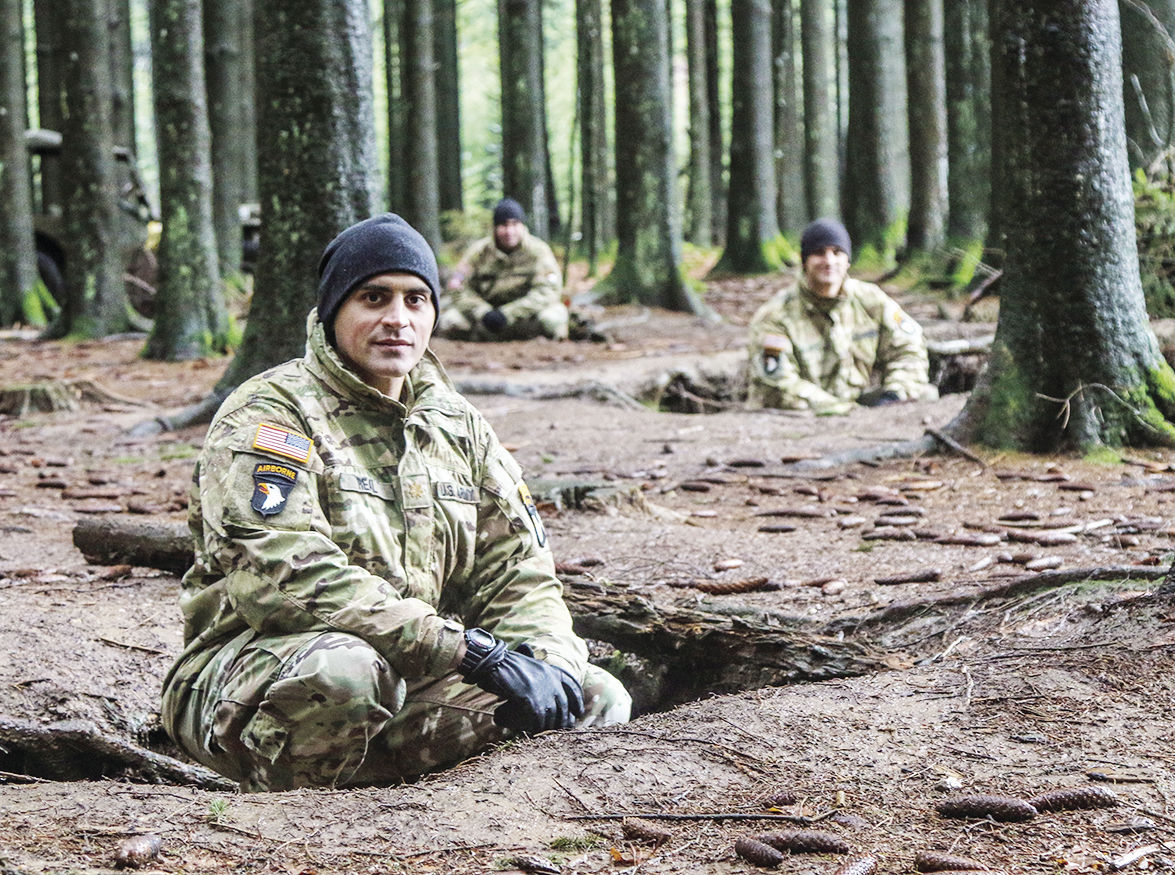
In 2019, 101st Airborne paratroopers posed in these foxholes, near Bastogne, that their comrades had dug in 1944-45.
None of that history mattered to the Bastogne lady giving our tour group the stinky eye in the creperie the day of our visit. All that Belgian-American amity built up during and since the war had dissipated in her eyes. Not only were we Americans–we laughed too loudly, chewed gum, were innocent of all languages other than a strange Southern California variant of Standard English, and we were (horrors!) a bunch of teenagers.
Despite the daggers the lady cast our way, I spotted one redeeming feature: in her lap was a small dog, secured by a chain leash. On my cell phone, I had a photograph of our Basset, Wilson, who passed away at thirteen earlier this year. “Wilson,” our neighbor said, “was a dog for the Ages.” Our neighbor was right.
Our best friend, Wilson.
This is why: I walked over to the lady and showed her the picture of Wilson. She grew so excited that she dropped her small dog.
“COLUMBO!” she shouted with delight. I could hear her dog’s nails askitter on the tile floor.
Her husband just then came out of the restroom. She gestured toward me—her little dog went with her, like laundry fluttering on a clothesline–and my cell phone. The husband looked.
And shouted “COLUMBO!” with delight.
We were all friends after that.
I have been convinced ever since of the singular ability that Basset hounds have to bring harmony to a disordered world. They should be the Official Dog of the United Nations.
Of course, the syndication of old Universal Studios detective shows played a part, as well. Despite your characteristically rumpled appearance, Lieutenant Columbo, I offer you a snappy 101st Airborne salute, sir.
And I offer for your viewing enjoyment another Basset hound photo. That’s Walter. We adopted him in March and drove so far south to meet him—way, way past San Diego—that his vaccination papers were in Spanish.
Wilson, Walter. What was the name of Columbo’s dog? I had to look it up: It was “Dog.” He was a dog for the ages, too.
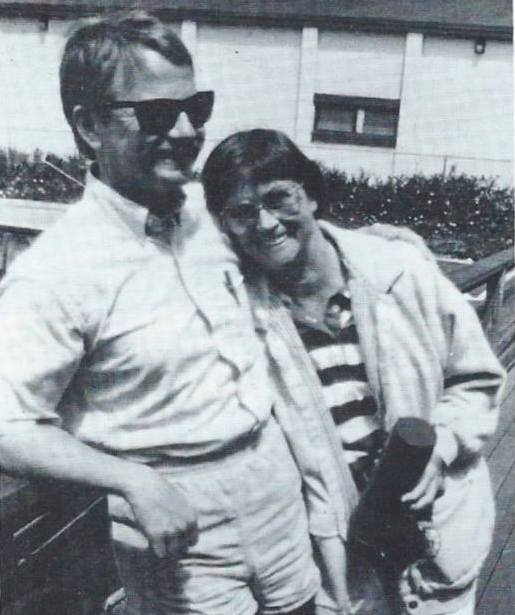
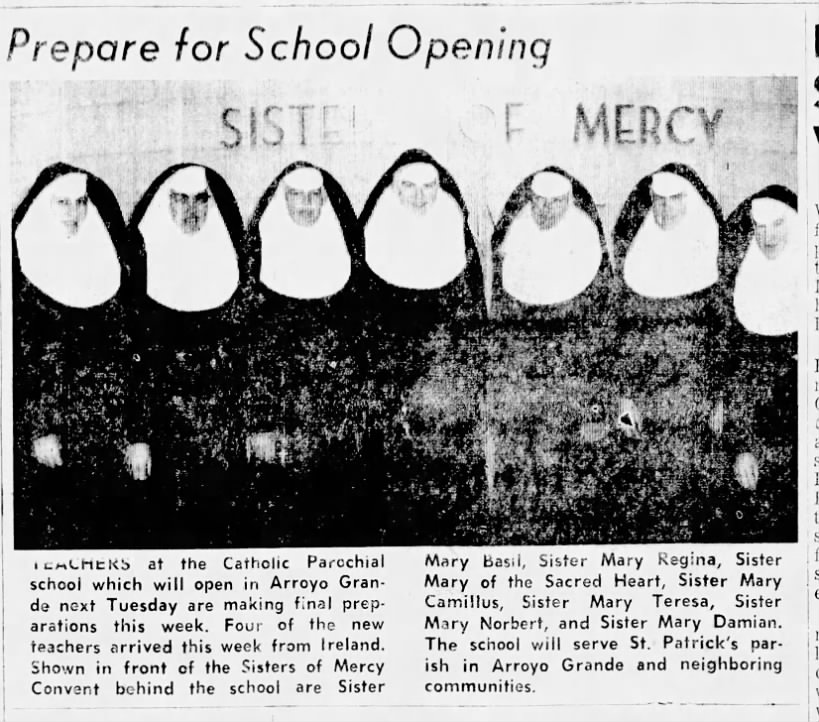
Our dear friend Sister Teresa O’Connell died in May at 90. She taught at St. Patrick’s in Arroyo Grande and Elizabeth and I taught with her at Mission in the 1980s and 1990s. Here’s the two of us back then:
As a member of the Sisters of Mercy, Teresa spent most of her life teaching young people. But when she returned to Ireland, she found a new calling in ministry to the elderly. Hers was such a rich life.
Elizabeth and I “attended” her funeral at the Ennis Cathedral–it was four a.m. our time–thanks to the internet. It was a six-priest funeral Mass with a couple of Monsignors included. Behind the altar, It was like the Irish Catholic equivalent of the 1927 New York Yankees.
It was the least they could do for her.
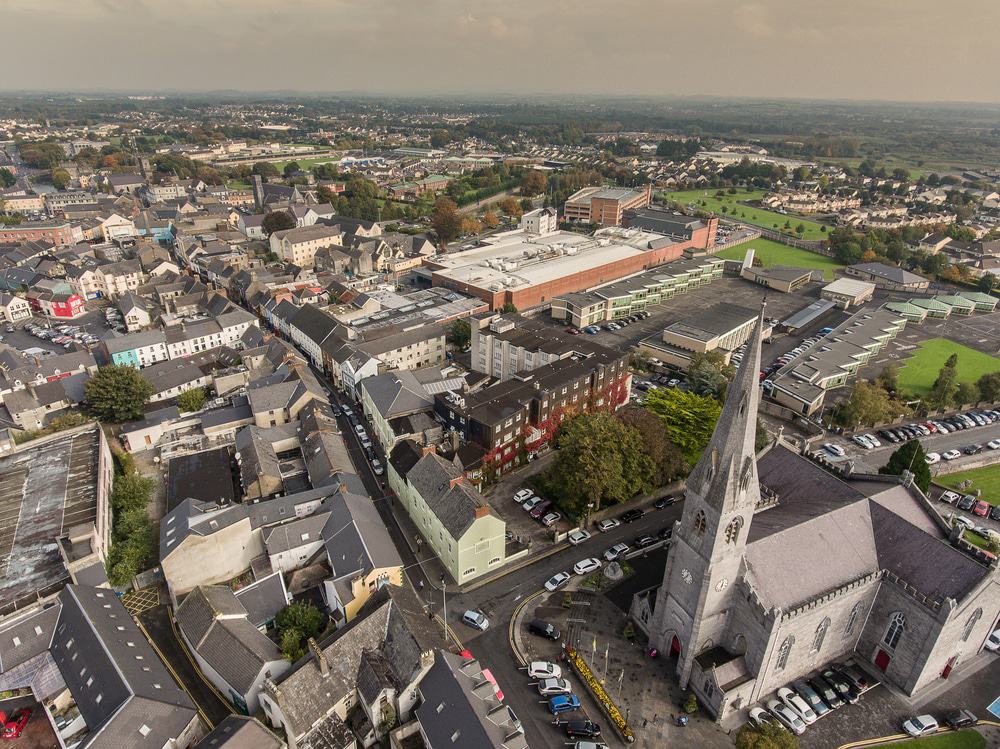
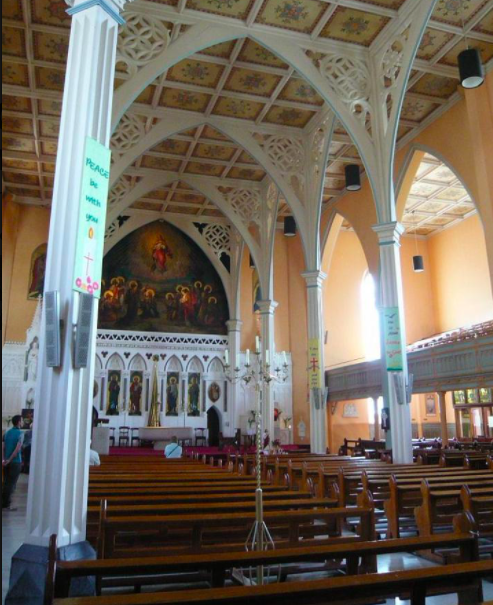
Here are two views of the church.
I made the mistake of starting to do some research on Ennis, because in thinking of Irish history as a road, every few miles you are confronted with a sad detour. The cathedral was built in 1828, which in itself is significant, because the Penal Laws enacted at the end of the 17th Century–that would’ve been when Great Britain, after the insolent Popery of King James II, was once again securely and relentlessly Protestant under William and Mary–forbade the building of new Catholic churches in Irish cities. The ban, then, lasted until the English were long past the Stuarts and running toward the end of their Hanoverians.
I looked up the cemetery where Sister is buried. It’s Drumcliff, Ennis, County Clare. It’s rich in Irish history, too.
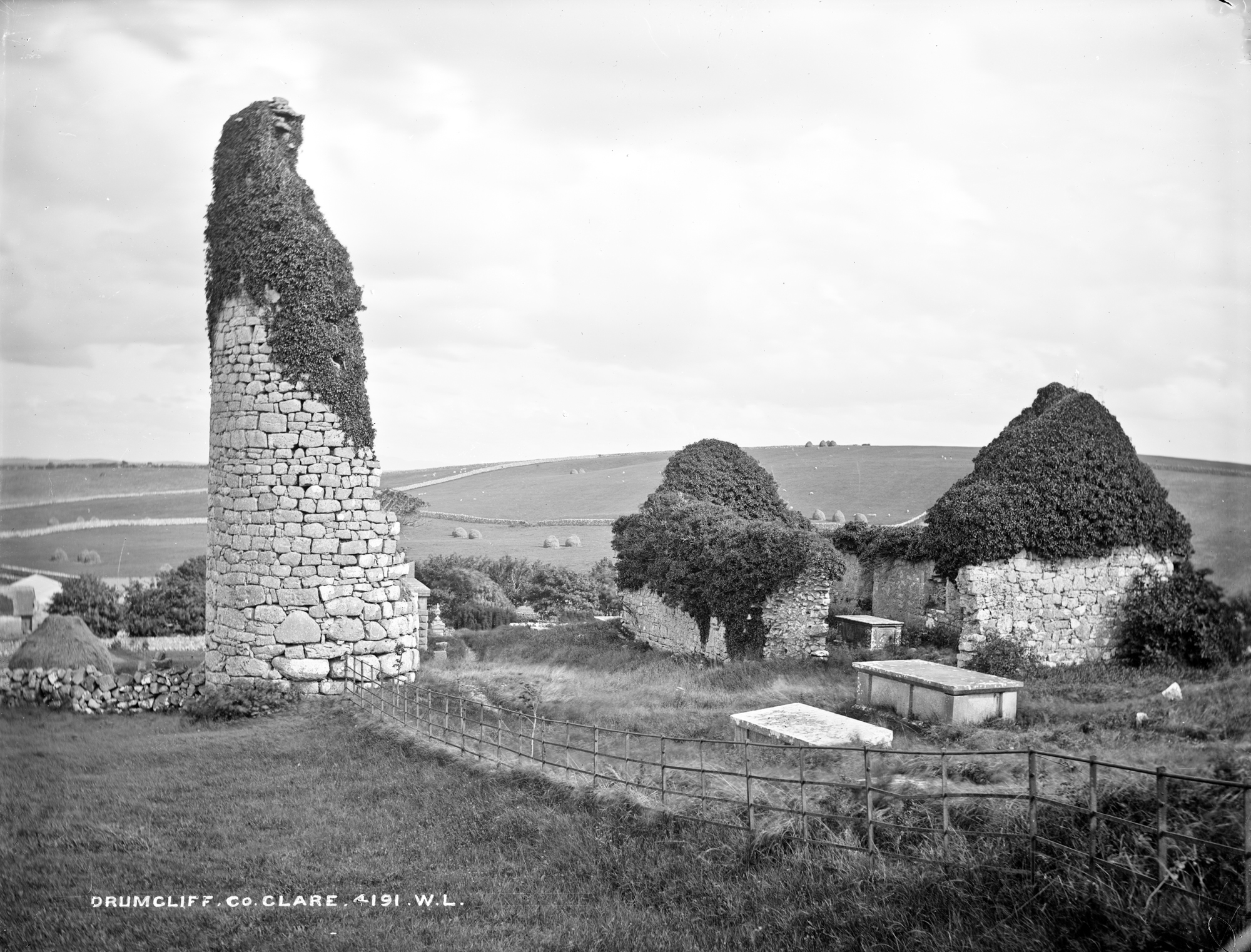
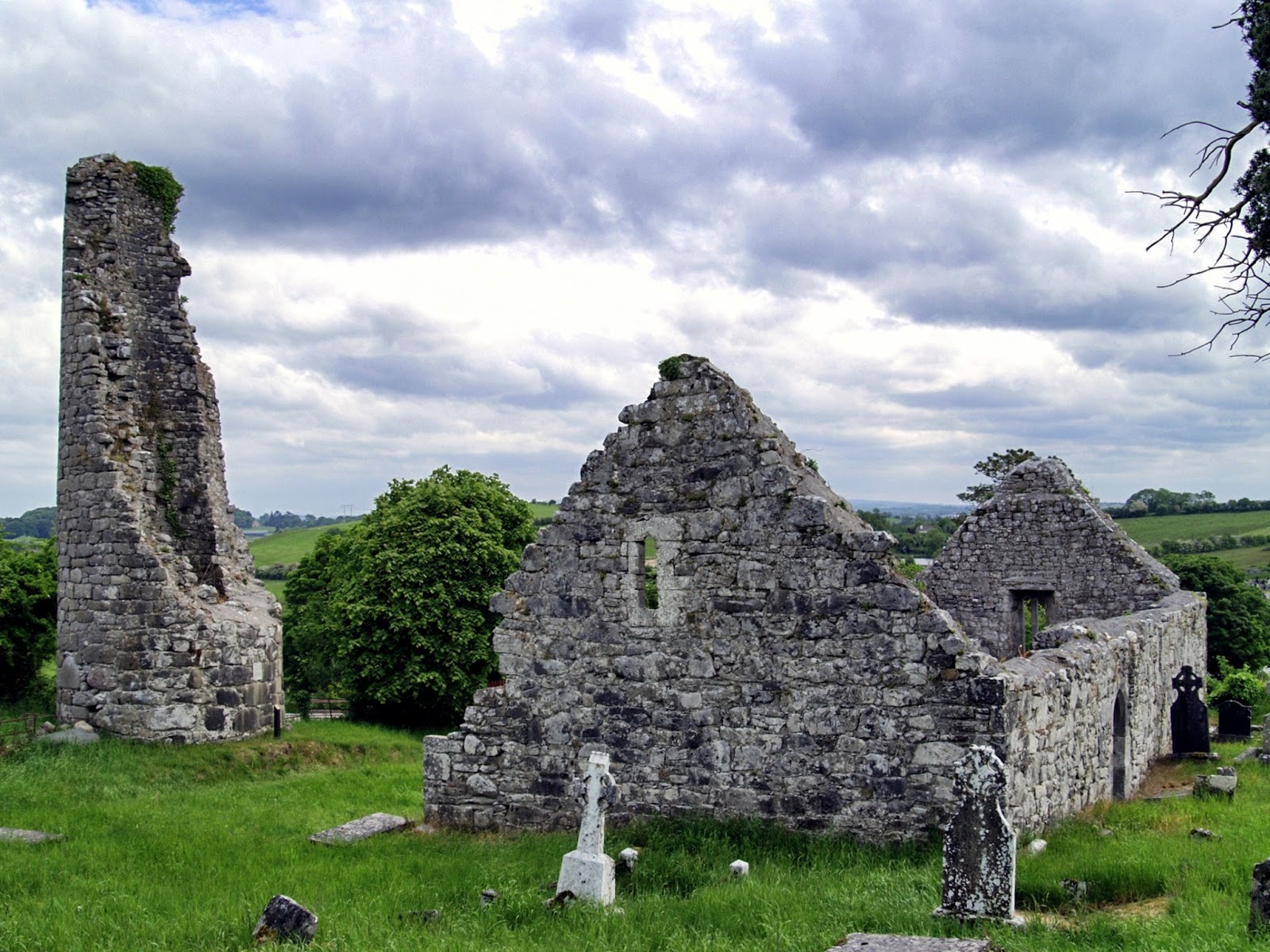
This photo shows the tower and ruined abbey church at Drumcliff. The cemetery adjoins the ruins, on a steep hill that one guide says is windy but strangely serene. Another guide says this: “The existing church ruins are from the 15th century with bits of 10th and 12th century architecture incorporated into it, suggesting it was built on the site of at least one earlier church.”
The earlier church may have been founded by St. Conall. He lived in the 7th century.
When you grow up in a place whose oldest landmark dates to 1772, your history is an eyeblink next to Ireland’s.
The cemetery itself represents one of those sad detours in that history. From a County Clare genealogical website:
Itis impossible even to guess how many persons are buried at Drumcliffe [sic]: so many graves were never marked at all, countless others have no inscriptions, and the multitudes who lie in the cholera grave, the Famine grave pit beside it and the pauper plot closer to the road, will never be identified by the names they bore in life.
Cholera was a terrible killer in the first half of the nineteenth century; it killed Londoners in their thousands, as well as the Irish, until Joseph Bazalgette designed and built a network of intercepting sewers that carried the Thames River’s sewage out to sea.
Ireland, of course, was far behind in engineering projects as grand as this one.
“The Famine grave pit” is mentioned in passing. Perhaps many of those people were on their way out of Ireland. We once saw a massive green in Galway, one of the Famine ports of exit, also in the west, beneath which thousands of destitute Famine victims are buried. They’d almost made it. It’s probable that the people buried in Drumcliff, like those in Galway, died, enfeebled by starvation, of opportunistic diseases like typhus.
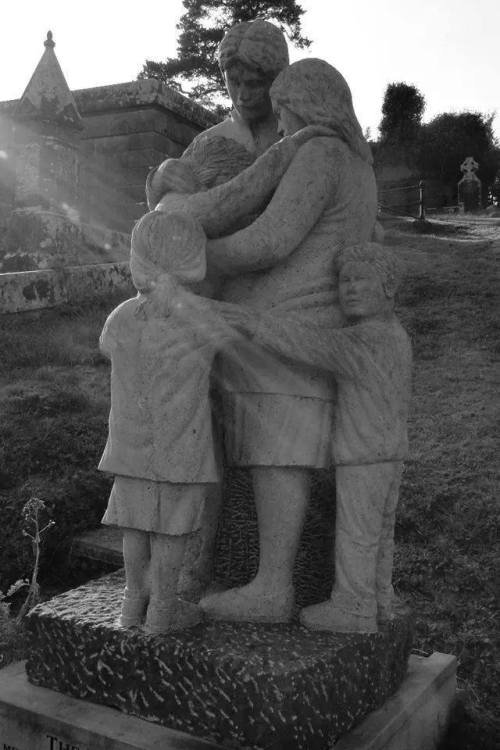
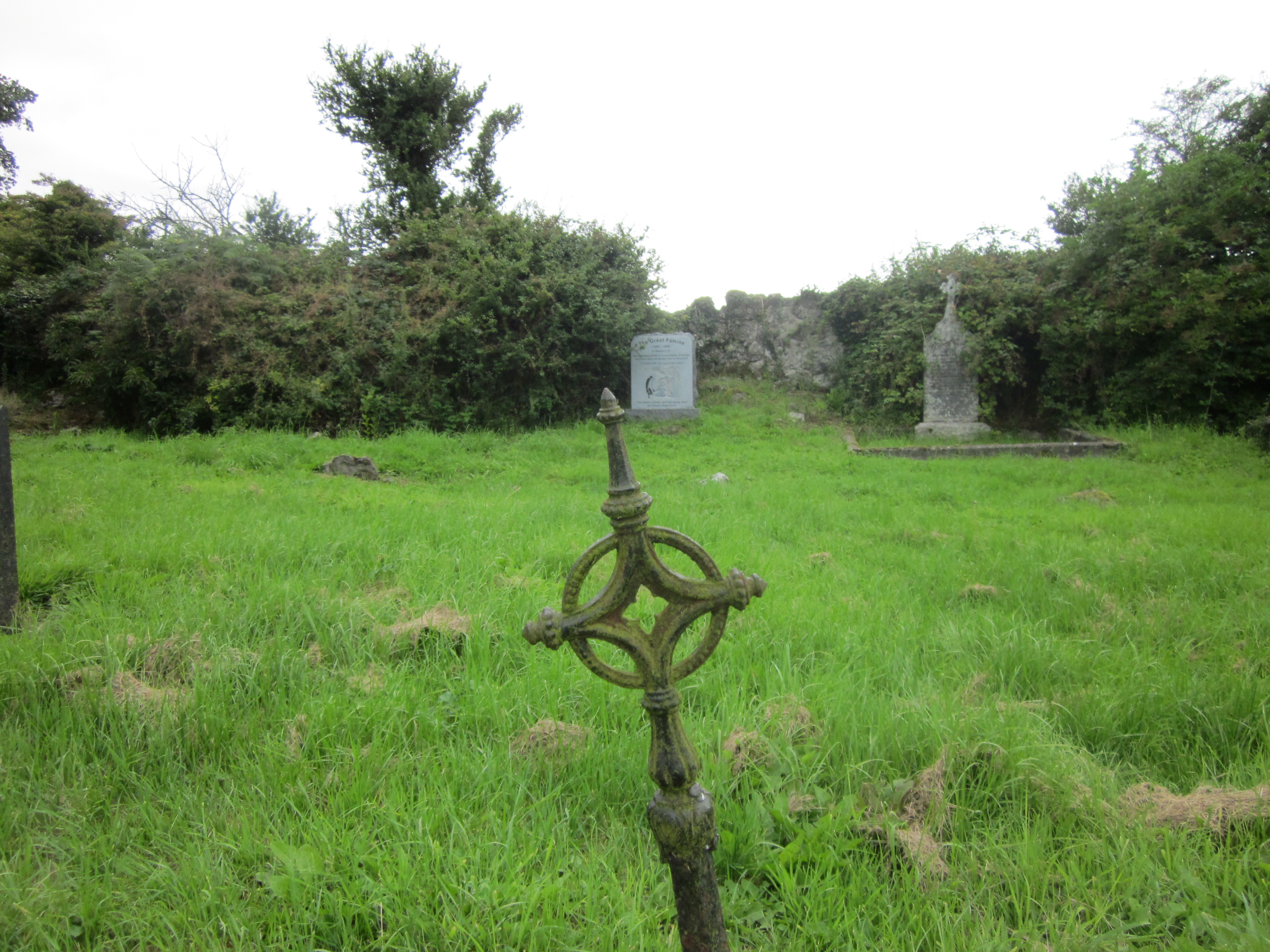
At least the paupers are symbolically remembered. Many of them ended their lives in a nearby workhouse. Here is their monument:
Pauper’s Memorial, Drumcliff
The Famine Grave
It’s a windy but strangely serene place.
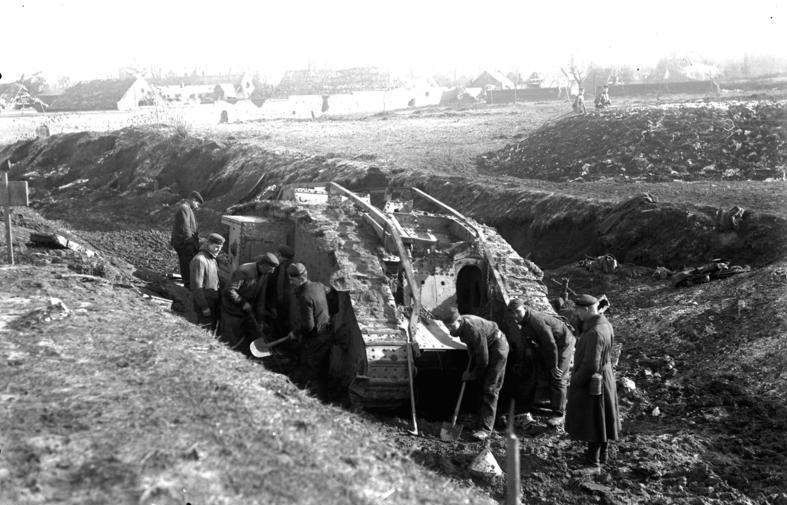
And then you reach the 20th century. There are Great War soldiers buried here: over 200,000 Irishmen fought for the British between 1914 and 1918. Drummer John McMahon served in the King’s Own’s Scottish Borderers, in a battalion that had survived Gallipoli; it’s possible that his death, in July 1917, came in Palestine. Thomas Moody served in the Irish Guards; his death, in November 1917, must’ve been at the Battle of Cambrai, which, like Bazalgette’s intercepting sewers, began as a landmark for modern technology. The British launched a massive attack spearheaded by Mark IV tanks, an innovation in warfare. By the second day of the attack, half the tanks had broken down, and that’s when the Germans responded. Moody probably died in their counterattack, the biggest assault on the British Expeditionary Forces since 1914. It was in that ealier assault–the the First Marne, in September 1914, the battle that stopped the Germans short of Paris, when Parisian taxicabs carried poilus to the front in relays–that claimed artilleryman Michael O’Brien, another soldier buried in Drumcliff.
German soldiers inspect a British tank wrecked at Cambrai.
Of course, the Great War was punctuated by the Easter Rising in Dublin. You can still the gouges British bullets left in the columns of the Neoclassic General Post Office, where the rebels held out for six days during Easter Week 1916. The Dubliners jeered the Irish Republican Army rebels as they were led away, after their surrender, by British forces.
The General Post Office, O’Connell Street, Dublin, after the Easter Rising. Nelson’s Column, to the right, was later blown up by the IRA.
Then the British began executing them, granting one, terribly wounded, the privilege of being shot while seated in a chair. That was a mistake. Now they were martyrs.
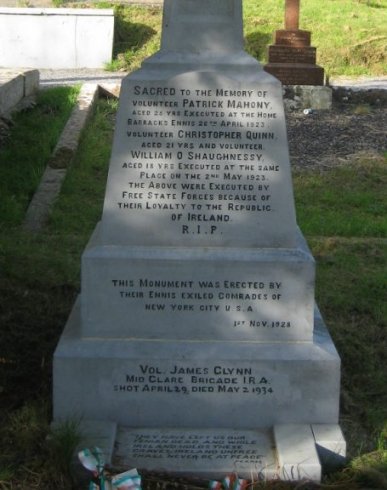
And that leads to one more place in the Drumcliff Cemetery: An IRA Memorial.
Irish rebels memorial
Maybe it’s typical that this memorial was made possible by expatriates, Irish living comfortably and happily distant in New York. What it commemorates might be too painful to remember for the people who live in Ennis today. The four Irish Republican Army men cited on this monument were killed in The Troubles, but not by the English. Three of the four were shot by firing squads made up of fellow Irishmen during the Civil War of 1922. Two were eighteen years old. They were Republicans executed by soldiers of the Irish Free State, the government that shot three times as many Irish revolutionaries in 1922 as the English had during the rising of 1919-1921.
One of the eighteen-year-olds wrote this on the eve of his execution:
Home Barracks, Ennis
Dearest Father,
My last letter to you; I know it is hard, but welcome be the will of God. I am to be executed in the morning, but I hope you will try and bear it. Tell Katie not to be fretting for me as it was all for Ireland; it is rough on my brothers and sisters–poor Jim, John, Joe, Paddy, Michael, Cissie, Mary Margaret–hope you will mind them and try to put them in good positions. Tell them to pray for me. Well father, I am taking it great, as better men than ever I was fell. You have a son that you can be proud of, as I think I have done my part for the land I love. Tell all the neighbours in the Turnpike to pray for me. Tell Nanna, Mary and Jimmy to pray for me, Joe, Sean, Mago, Julia, Mrs. Considine and family, also Joe McCormack, the Browne family, my uncle Jim and the Tipperary people which I knew. I hope you will mind yourself, and do not fret for me. With the help of God I will be happy with my mother in Heaven, and away from all the trouble of this world, so I think I will be happy...
…Dear father, I will now say goodbye – goodbye ‘till we meet in heaven.
I remain, Your loving son, Christie
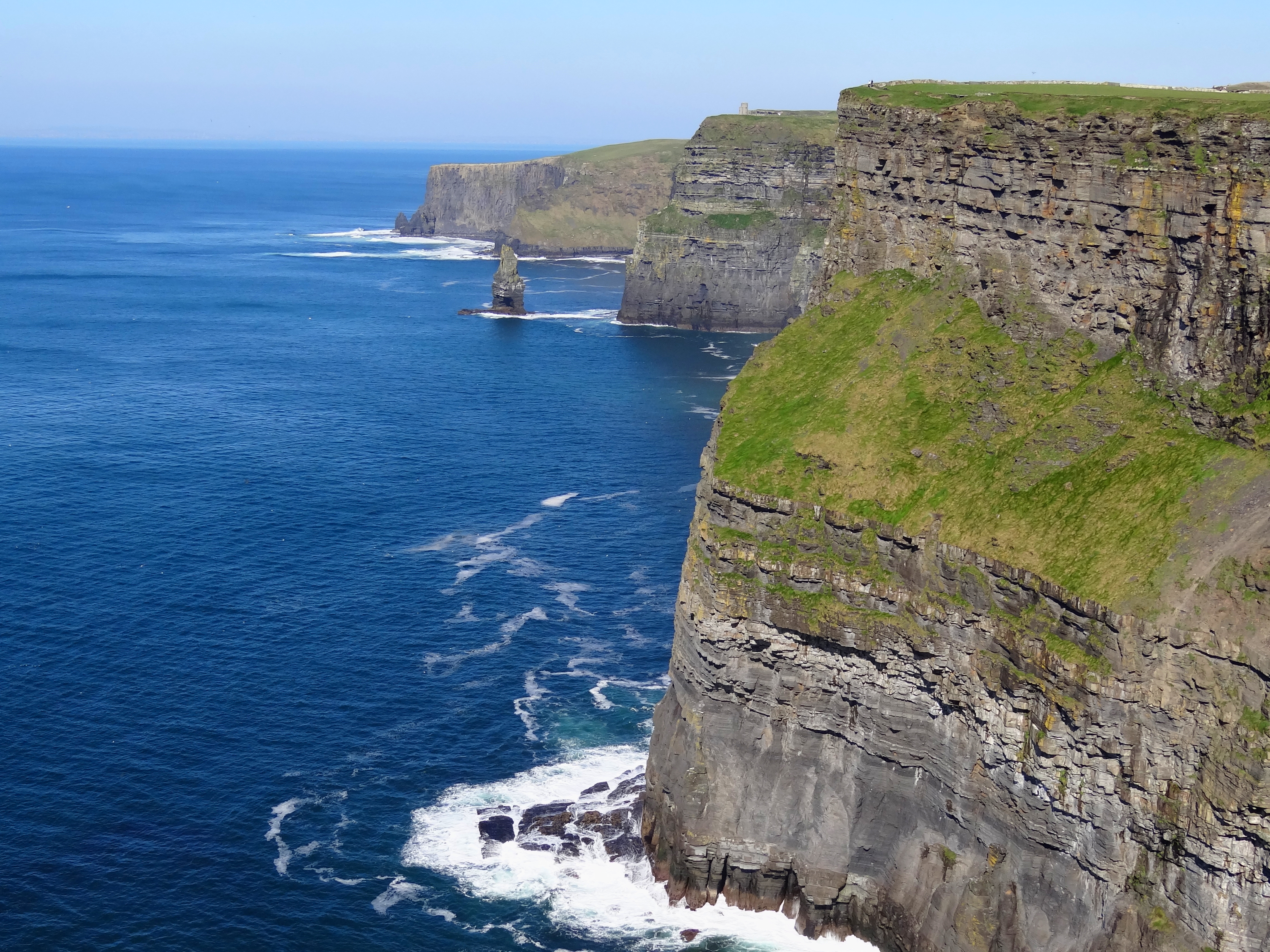
County Clare is famous for goodbyes. The Cliffs of Moher (above) might have been the last many Famine emigrants to America saw of Ireland. A windy and wild place, they are remindful of the title Leon Uris chose for a book he and his wife Jill wrote about Ireland: “A Terrible Beauty.”
Sister Teresa, even in her rest, cannot escape the long road of Irish history that has carried so many travelers—including my own family—on the journeys of their lives. Hers ended in Clare, a place, like the rest of Ireland, so marked by sadness. But sadness is not a dominant Irish trait—the last thing the Irish lost during the Famine, one chronicler noted, was their sense of humor—and it was service to others, not sadness, that dominated Teresa’s life.
I’ve been to Ireland and don’t know that I’ll ever get the chance to go again. If I do, God willing, there’s a place in the Drumcliff Cemetery that needs beautiful flowers and a pinch of California topsoil, perhaps from a field that adjoins St. Patrick’s Church, a parish five thousand miles away from County Clare.
September 1963: Off the airplane and into the classroom. Teresa is third from right.
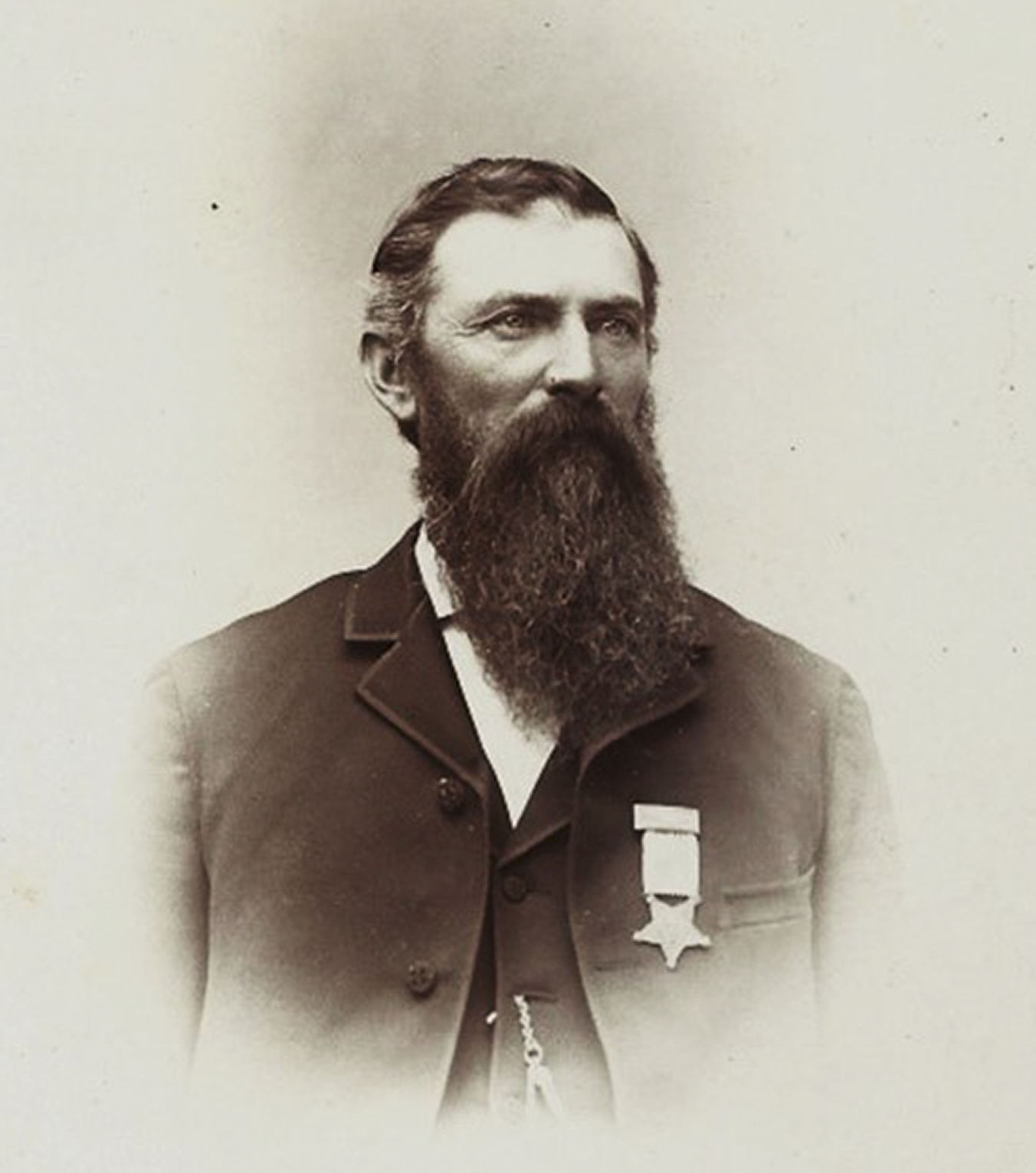
In the 1880s, Erastus Fouch farmed along was is today Lopez Drive. As a sixteen-year-old he’d fought in the Shenandoah Valleywhere he saw his brother killed in action. He later fought at Chancellorsville and Gettysburg. Here he wears his Grand Army of the Republic badge. Jack English photo.
Nearly sixty Civil War veterans are buried in the Arroyo Grande District Cemetery. This excerpt from the book Patriot Graves describes the forces that drove them here.
…A soldier who had endured the third day of Gettysburg and emerged unhurt, and who had then seen his own boys in their counterattack destroy Pickett’s Charge…had already passed the zenith of his life. Nothing like this would ever happen to him again, and what had happened to them brought them, ironically, great joy.
So, for a generation enmeshed in the ethical web spun tightly by mid-Victorian Protestantism—these were Christian soldiers who fought in armies, on both sides, marked by intense waves of wartime revivalism within their camps—the excitement of battle generated a profound moral contradiction. In This Republic of Suffering, a superb account of coming to terms with the scale of death the Civil War generated, Harvard president and historian Drew Gilpin Faust describes the experience of a stunned Confederate who, during a firefight, came to the aid of a shrieking comrade, only to find out that he was “executing a species of war dance,” exulting over the body of the Union soldier he’d just killed. In another battle in 1862, Union soldiers on the firing line called their shots, as if combat were billiards: “Watch me drop that fellow,” one said to his comrades; battle was, indeed, like a game.[1]
The killing didn’t end when the war did. Violent crime rose at three times the rate of population growth in the decades following the war, and perhaps as many as two-thirds of the nation’s convicted felons were veterans.[2] Soldiers understood, on some level, that combat had changed them irrevocably and some worried about it. Society, one Vermont soldier wrote his sister, “will not own the rude soldier when he comes back, but turn a cold shoulder to him, because he has become hardened by scenes of bloodshed and carnage.”[3] He was, in many respects, right: some of the soldiers who came home to Vermont, New Jersey or Iowa brought with them a measure of fear—they had become, in the Civil War novelist Michael Shaara’s term, “Killer Angels.”
Many Union soldiers had demonized themselves and by extension all of their comrades by celebrating their mustering out with epic alcohol binges and episodic violence throughout the demobilization summer of 1865.[4] A Chicago civilian’s insulting comment about William Sherman set off a saloon brawl that cascaded into a riot that police were helpless to put down. Only the fortuitous appearance of the legendarily hard-drinking Gen. Joseph Hooker, who had the credibility to intervene with combat veterans, brought the violence to an end.
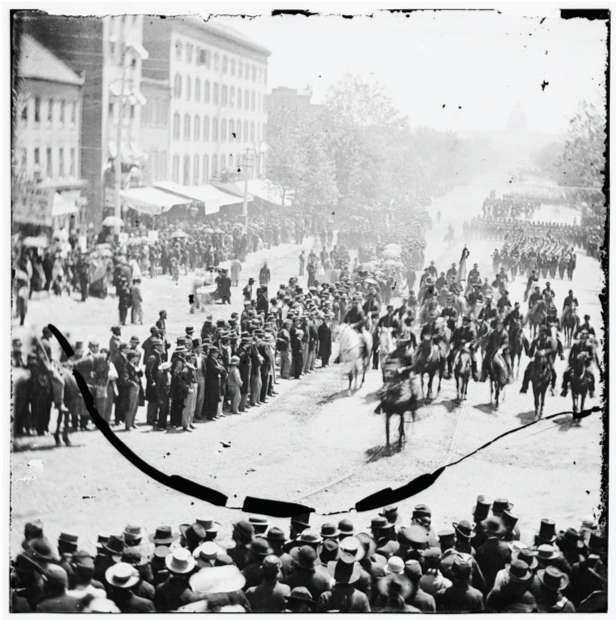
The Grand Review of the Armies at war’s end, Washington D.C., May 1865. Arroyo Grande settler Morris Denham marched with this unit, Francis Blair’s XVII Corps, Sherman’s army.
But for even the most sober of veterans that was precisely the problem with homecoming: it brought them little peace. Professor Jordan describes a sense of what, at its mildest, could be called disorientation. Home wasn’t home anymore. Even little farm towns had changed so much in four years that, for some veterans, they didn’t feel like home at all. Soldiers from the hard-fighting regiments of the Old Northwest, states like Iowa and Minnesota, couldn’t reconcile themselves to the cold winters they’d forgotten while fighting in Mississippi or Georgia. There was a more sinister change to which they couldn’t adjust: Union veterans resembled the little boys who’d survived the 1918 influenza epidemic and were finally let out to play, only to find there was no playmate on their city block left alive. The survivors of “Pals” Battalions who’d joined the Great War’s British Army together went home to neighborhoods empty of the young men with whom they’d grown up. Their pals were gone, swallowed up by the Western Front.
Gone too, in 1865, were whole towns of young men in New York or Vermont or Indiana, dead and buried on Southern farmland that had been poisoned by violence, land still studded with spent bullets. Other young men had vanished without a trace in dark, dense woodlots or fetid swamps. Soldiers came home, then, ostensibly alive and whole and strong but with unseen dead spaces inside where their comrades had once lived. Missing them, or the trauma of seeing them killed, figured in the chronic depression with which so many veterans struggled. Now that the war was done, they still were caught in its aftermath like swimmers in an undertow, struggling to break surface, to find light and cool air, to breathe again.
They recognized, too, that what they had fought for—for the rededication of the democracy Lincoln had described at Gettysburg in November 1863—was fast slipping away. Union veterans remained intensely suspicious of and hostile toward the defeated South; Lincoln’s assassination had been one impetus for their rancor but their anger only intensified when they read the newspaper accounts of the postwar emergence of the old Slave Codes, now called Black Codes. They read, too, of the defiance and the terrorism of the Ku Klux Klan, co-founded by a cavalryman, Nathan Bedford Forrest, who had bedeviled some of them in the Deep South. When Reconstruction ended in 1877, Jim Crow laws revived white supremacy in a way that rivaled the days of slavery. The Union veterans’ hostility was exacerbated because the other side refused to admit—significantly, on a moral level—that they’d lost the war. Typical, in 1894, were the dedicatory remarks that accompanied the unveiling of a Confederate memorial in Richmond, when newspapers noted that the clouds parted and the sun emerged when the speaker, the Rev. R.C. Cave, began an oration that included passages like this:
But brute force cannot settle questions of right and wrong. Thinking men do not judge the merits of a cause by the measure of its success; and I believe
The world shall yet decide
In truth’s clear, far-off light,
that the South was in the right; that her cause was just; that the men who took up arms in her defence were patriots who had even better reason for what they did than had the men who fought at Concord, Lexington, and Bunker Hill; and that her coercion, whatever good may have resulted or may hereafter result from it, was an outrage on liberty.[5]
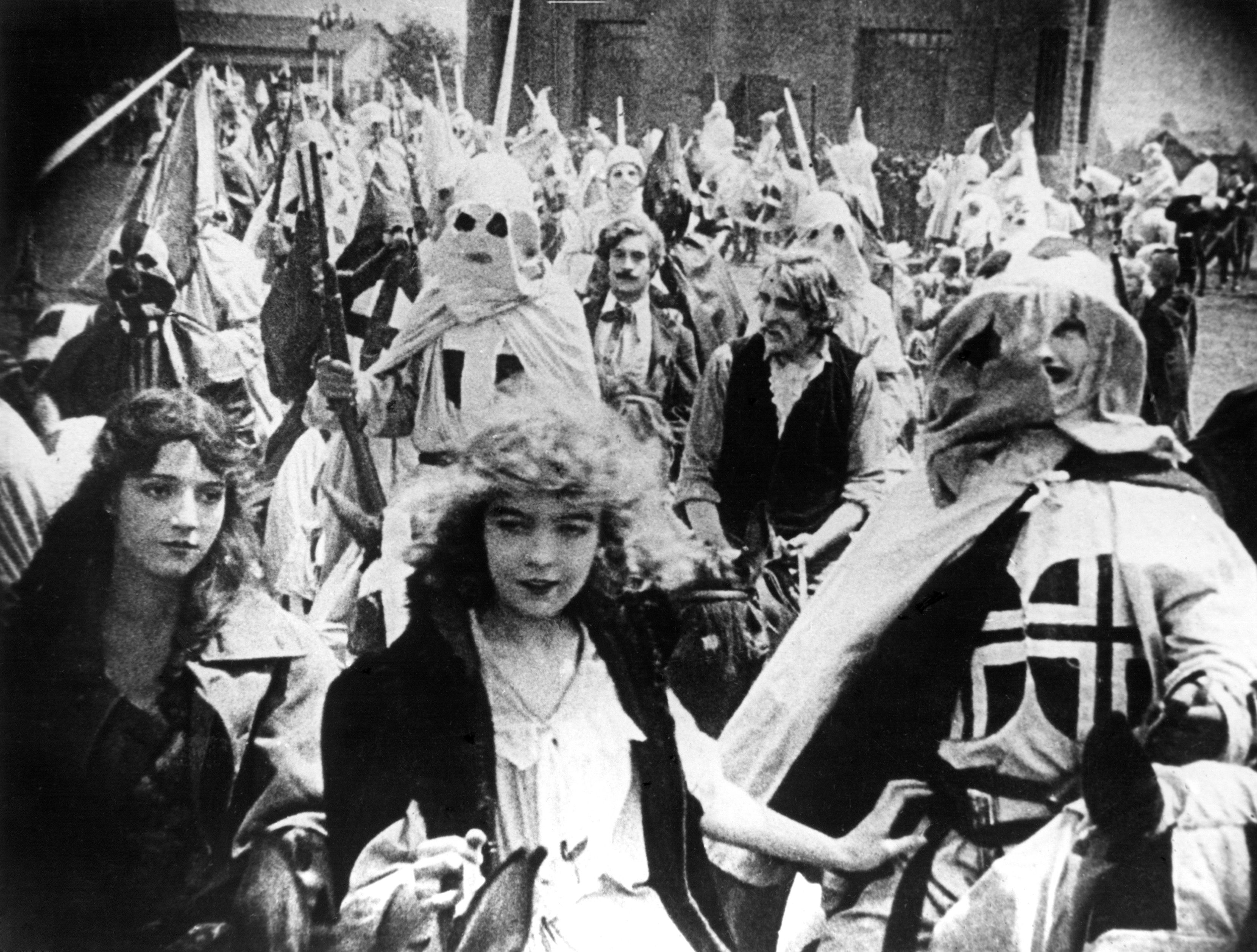
White supremacy triumphant, Birth of a Nation.
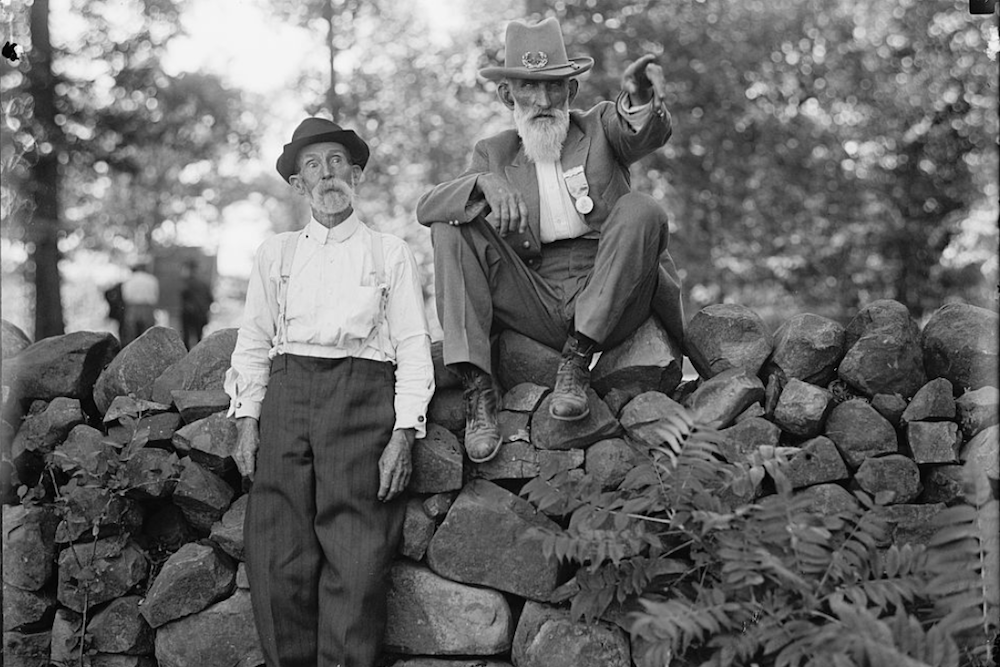
Similar remarks by Southern speakers invited to a Gettysburg reunion in 1913, Professor Jordan notes, rankled the same Union veterans who had protested another unveiling, in 1909, in the Capitol’s Statuary Hall: a sculpture of Robert E. Lee. No matter how chivalrous Lee had been (He never, for example, uttered the word “Yankees,” using instead, in his verbal orders to his subordinates, the term “those people.”), he was a killer, and he had harvested thousands of solders’ lives. The survivors of what they saw as Lee’s war would protest again at the rapturous reception, one that included the Southern-bred President Woodrow Wilson, awarded the 1915 D.W. Griffith film Birth of a Nation, which depicts Klansmen, too, as chivalric heroes who reassert Southern white supremacy over rapacious carpetbaggers and predatory African Americans. “It is like writing history with lightning,” the president said, “and my only regret is that it is all so terribly true.”[6] The most enduring image of the 1913 Gettysburg reunion is that of Confederate survivors of Pickett’s Charge reaching across the stone wall–fifty years before, it had been their objective–to shake the hands of Pennsylvania veterans. What goes unmentioned is the fistfight at the same event that sent seven aged Yankees and Confederates to the hospital.[7]
Two Gettysburg veterans, seemingly reconciled at the 1913 Reunion.
Even as Southern whites reasserted their social and political primacy, American democracy in the North was no tribute to the sacrifice of Civil War veterans, either. The Radical Republican Congress and Andrew Johnson finished what should have been Lincoln’s second term in what resembled the political equivalent of a Western range war. Johnson escaped conviction on impeachment charges by one Senate vote. Grant’s relentlessness and drive had served him well in the struggle against Lee, but another aspect of his personal character—an almost childlike credulity—ate his presidency alive in a series of scandals perpetrated by subordinates who betrayed Grant as surely as Warren G. Harding would be betrayed by his “Ohio Gang” in the 1920s.
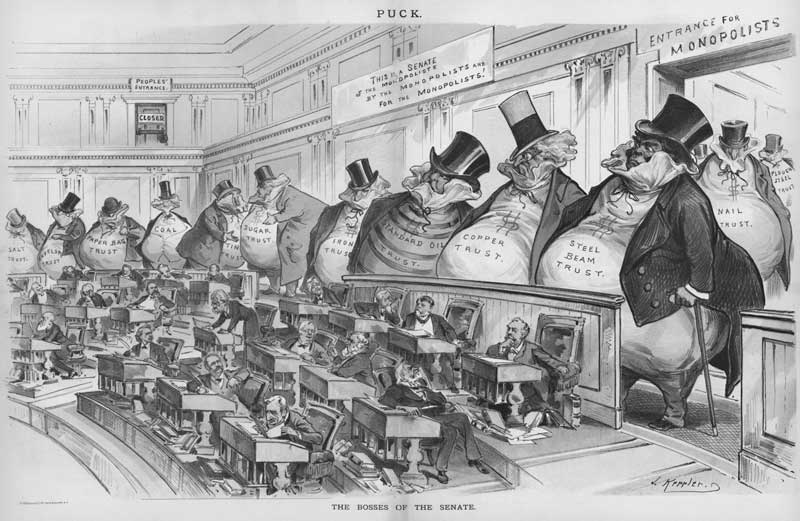
The corruption penetrated to state houses, where the lobbyist for the Santa Fe Railroad kept a slush fund in his office safe for the frequent lubrication of Kansas legislators about to vote on regulatory bills; the monopoly that railroads enjoyed in their American fiefdoms and the freight rates they demanded were so egregious that it cost a farmer more to ship a bushel of wheat from Topeka to Chicago, by rail, than it did to ship that bushel from Chicago to Liverpool, mostly by water. Machine politics dominated cities from New York to San Francisco, where Irish-American voters really did vote early and often, and deceased. In New York, the most famous political machine was Tammany Hall, and it was Tammany Hall’s Boss Tweed who disbursed the equivalent of $4 million to a Tammany-contracted plasterer for two days’ work on City Hall.
The 1889 cartoon “Bosses of the Senate” exemplifies the corruption of Gilded Age America.
In both their disillusionment and in their restlessness, the Civil War generation seems to resemble the generation that came of age during the First World War. After that war, they would become expatriates–Ernest Hemingway, F. Scott Fitzgerald, John Dos Passos among them—young men, many of them veterans, and young women, who no longer recognized or understood the America they’d known as children. They were among the members of Gertrude Stein’s “Lost Generation.”
…[Like}the young people of the 1920s, Civil War veterans were members of a generation on the move. In postwar America, veterans, according to a 2010 study by Seoul University economist Chulhee Lee, were 54% more likely to move to a different state and 36% more likely to move to a different region than non-veterans.[8] Lee posits several reasons for this phenomenon: a central one is the idea that veterans had been exposed to the concept of a wider nation, one beyond their rural farms or row tenements, by campaigns in the South. Westerners, too, fought along the Atlantic seaboard, and some Easterners saw combat or garrison duty during the 1860s Indian Wars on the frontier.
Lee’s point is a key one: Americans had been so isolated and disparate before the war that an outbreak of measles that would make a New York regiment sick would kill soldiers in the Iowa regiment bivouacked alongside, soldiers that, before the war, were so geographically isolated that they lacked the immunity to that particular strain of measles–measles, in fact, killed 11,000 soldiers during the war.[9] The war had begun to break that isolation down, and the troop movements necessary to fighting it had opened young soldiers’ minds to the vastness of their nation and to the possibility of starting over somewhere else.
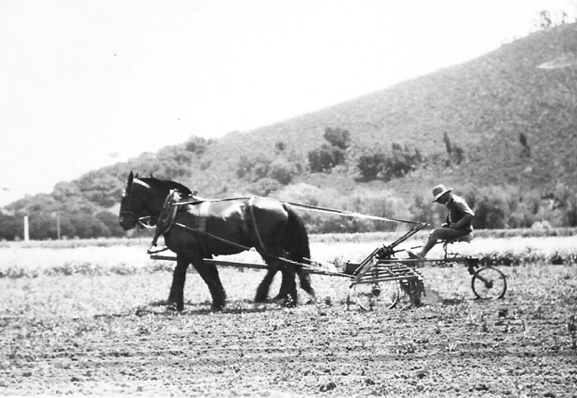
Among the area’s crops were flowers grown for seed. Here, a Waller Farms worker and his team are sowing a field. Photo courtesy Richard Waller
This pattern of increased mobility was a key factor in the lives of Arroyo Grande’s Union veterans. Over fifty would settle the Arroyo Grande Valley and nearby Nipomo. Enough census data exists to follow twenty-three of them, in the course of their lives. After the war, seven of them moved once from the state they’d served as soldiers; seven moved twice. Nine moved three times or more before they came to the Arroyo Grande area. So the men who came here had come as far as they could—like Jody’s grandfather in the Steinbeck novella The Red Pony, they had to stop because they’d arrived at the Pacific: their days of “Westering” were over.
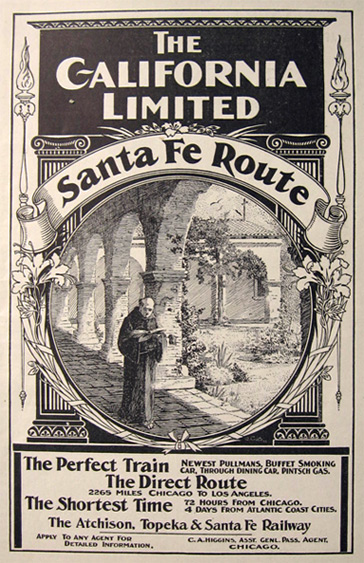
Santa Fe Ad, 1898. The fare from Chicago to Los Angeles was only $25 during the 1880s competition between the Santa Fe and Southern Pacific for California-bound passengers.
[1] Drew Gilpin Faust, This Republic of Suffering: Death and the American Civil War. Vintage Books: New York, 2008, pp. 37-38.
[2] Michael C.C. Adams, Living Hell: The Dark Side of the Civil War, Johns Hopkins University Press, Baltimore: 2014, p. 198.
Elsie Cecchetti. San Luis Obispo Tribune; photo by Vivian Krug
Elsie Cecchetti was our bus driver. In the same way that Louis Tedone was SLO’s baby doctor. Elsie was everybody’s bus driver.
Yes, I go back to the days of Branch School’s yellow pickup with bench seats and the tarp overhead, when we bounced happily over creek crossings.
We waited for her at the Harris Bridge.
I think she had mechanical problems one morning–and it was a cold one–when Mary Gularte took me inside from the bus stop for some sopa. That was a good morning.
Both Mary and Elsie called me “Jimmy.”
We tormented Elsie with “99 Bottles of Beer on the Wall” and then, in 1964, with “She Loves You,” ” I Want to Hold Your Hand” and she always headed us off in “The Name Game” song, before we got to “Chuck.”
And I always looked over the edge of the bus window as she drove confidently up Corralitos Canyon. There were some good drops there, but Elsie knew what she was doing. At the Canyon’s end, past the Dentons, she made a three-point turn that the California Department of Motor Vehicles should have filmed for posterity.
If there was a girl on whom I had a crush–and this was frequent–I looked a long time out the bus window after we’d dropped her off.
I once saw Elsie’s wedding photo, the day she married George, on the steps of Old St. Patrick’s on Branch Street. She was so beautiful that she took my breath away.
But she cleaned up after us at school.
She chewed us out when when we were jerks.
She laughed when we tried to be funny.
She cocked an eyebrow dubiously when we had excuses for being late.
But my most vivid memory is the day she cried. We were on our usual route with most of the stops ahead of us, near what is today Lopez Drive and Cecchetti Road, when she stopped the bus.
The old farmhouse, where she’d made a home and a family, was on fire. And it wasn’t just smoke. It was violent–big, ugly orange flames and billowing, acrid black smoke. Elsie threw the lever that opened the bus doors and stood at the bottom of the steps and she began to sob.
I don’t know–I was only about eight–that any of us, fifteen or so of us, had ever seen an adult in such pain.
And it wasn’t just an “adult.” It was Elsie.
I guess then we heard sirens from the CDF and they knocked the fire down, but it was too late. I don’t remember that part.
What I do remember is walking the rest of the way home in complete silence. We were shocked because we realized, just then, how much we loved Elsie and just how cruel life could be even toward the people we loved the most.
What we began to learn from her, in that terrible moment, was empathy.
Even a school-bus driver can guide you toward wisdom. I finally understand, now that she’s gone, that it was Elsie who always got me home again.
Former and much-beloved Arroyo Grande High School student Victoria, whom I teased for being distantly related, from my college studies, to a moderately reformist Mexican president, listened so intently in my classes and was so unafraid to ask hard questions that she became one of those students you never forget.
When you wanted to see whether your thirty-two kids had “got it,” your eyes always traveled back to Victoria’s because she was so transparently honest. She was your reality check.
She knew as well and all along that teaching history was just my cover story.
When I was teaching material as arcane and fun as social history (using parish registers to discover that many, many Tudor brides were heavily pregnant) or the more conventional stuff, like the stages of the French Revolution— or when we went on our little classroom trips to Paris in the Second Empire or to interwar Berlin–what I was really teaching, I hoped, transcended mere information. I wanted the thirty-three to learn humanity and empathy and hope. In teaching art, I had the chance to inspire them. In teaching war, I had the chance to make them angry.
History’s inert unless it inspires feelings we didn’t know we had that we discover in people we’ll never know.
Victoria got all that. And then she used it.
So now she is a mother and is a mover and shaker for environmental and cultural causes. I am so immensely proud of her.
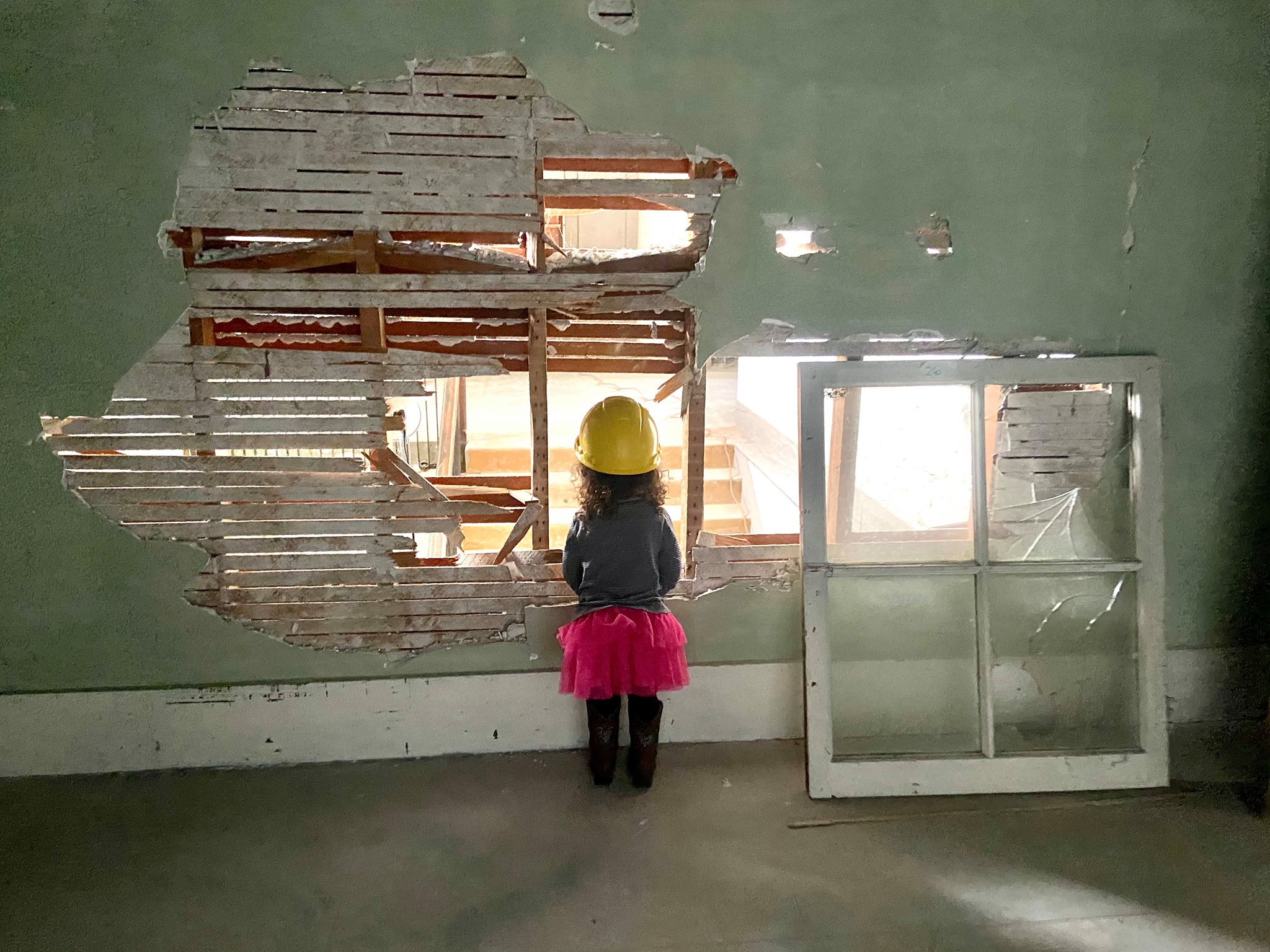
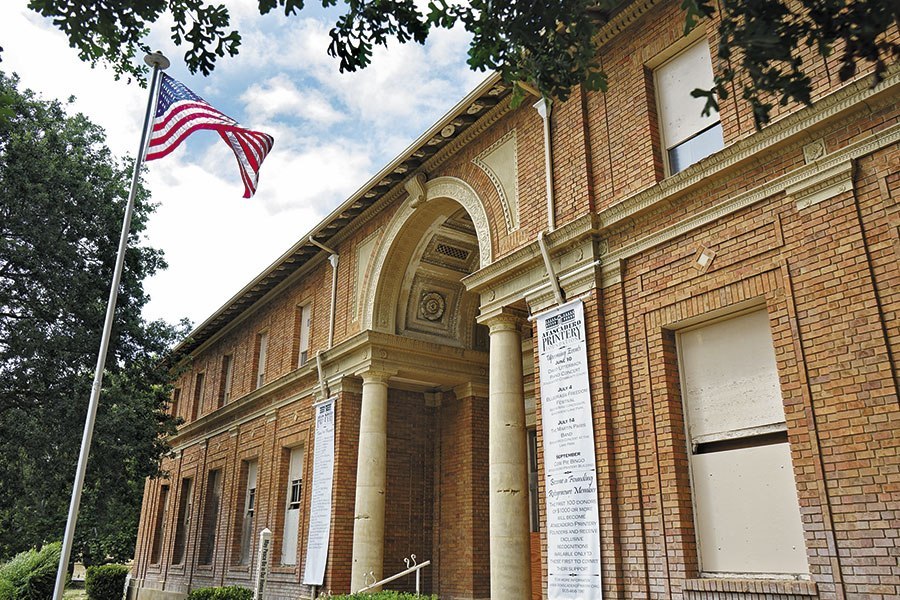
She’s part of Atascadero Printery Foundation–you can find it online, along with some photos of this beautiful building–and so is working toward the restoration of the old Printery to make it a community center for the arts.
This is how Victoria makes history live again.
And the photo above shows her daughter on a tour of the Printery. I haven’t seen an image like this one—not in a long, long time, and not until now, when I need it most—that made me so hopeful for the future.
I have no idea how this is is going to end up, so I might as well begin.
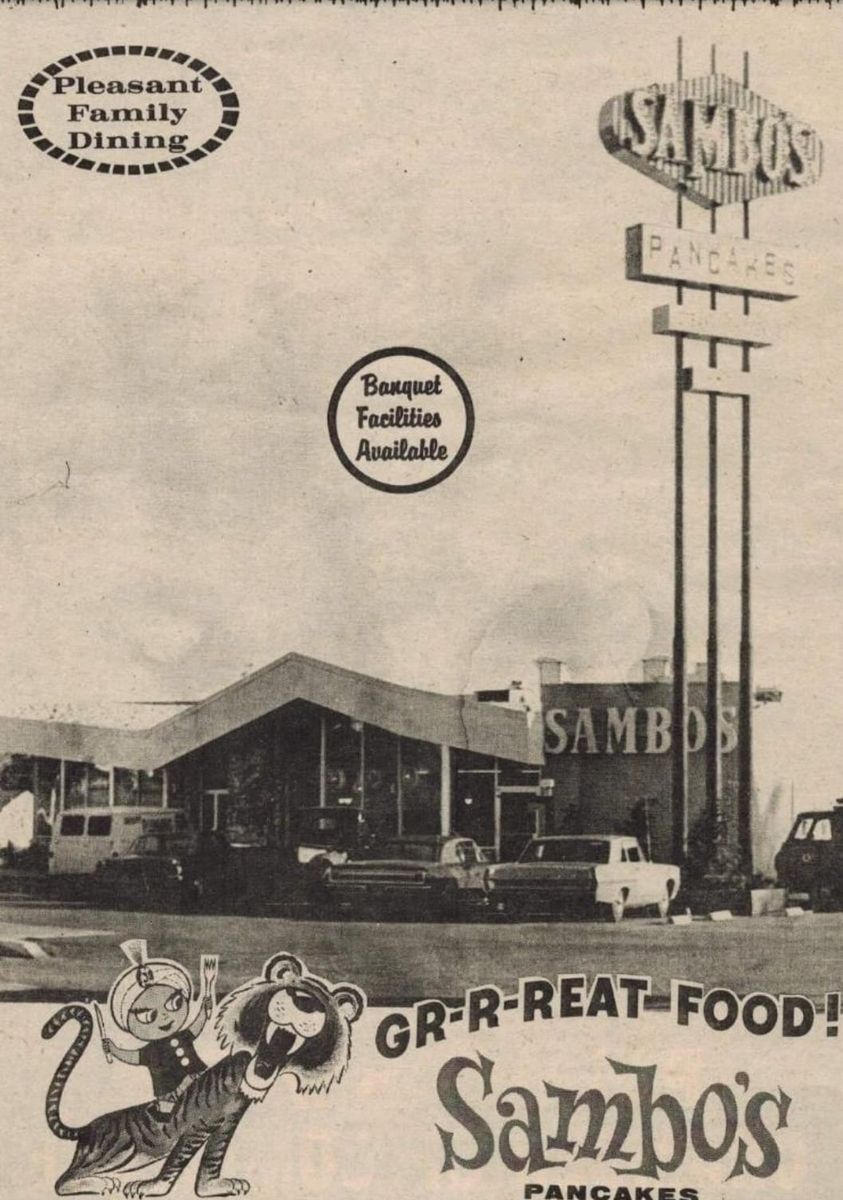
This place became, much later, Francisco’s Country Kitchen, which I came to love both for its biscuits and gravy and for the density of the newspaper racks out front. They will demolish it soon, and that makes me fearful. No so much for losing the building, which is a minor example of a style that considered Moderne sometime between Sputnik and Apollo 13, but because even the most transitory spark lit by the wreckers might ignite fifty years of kitchen grease with the explosive force of a typical B-52 payload.
I’m just glad we live on the far side of Grand Avenue.
But before it was Francisco’s, it was Sambo’s, a story that had always charmed me—imagine tigers spinning themselves into butter, I thought, at four, and imagine how delicious they would be!—but became politically inconvenient many years later after the summit of my time there. That was about 1969.
Ten years after, it was still one of my favorite places. When I was a newspaper reporter for the Telegram-Tribune, I interviewed Leroy Saruwatari there for a feature on the demise of Arroyo Grande’s once-vast walnut orchards. Leroy told me about the perpetrator—husk fly larvae, which are so voracious and pitiless that you wonder why the orchards didn’t collapse, on their own, into sawdust–but he also told me a little about his family, perhaps the first Japanese immigrants to the Arroyo Grande Valley. They came here about 1903. Leroy didn’t know this, but that interview in a booth at Sambo’s so moved me that it would pay off thirty-seven years later when I wrote a little about his family in the book World War II Arroyo Grande.
Sometimes, years after the interview, I would stop in for a coffee or even a breakfast, take a booth to myself if it was during the slack in the morning shift, and furtively stare at the men sitting at the stools along the counter. They were farmers, come in for breakfast and coffee and gossip during a slack time for them, at a midpoint between sunrise and lunch.
Some of them wore green John Deere hats, many more wore the same felt hats typified by Bogart and made unfashionable by JFK, who hated hats. My father’s, with a broad brim and a silk ribbon and bow, lived out its life hidden— neglected except by me, who took it down and tried it on as a child—in the upper reaches of a narrow closet in our home on Huasna Road. Dad’s hat was pristine. The farmers’ hats were dented and stained by the traces of loam that is a compound of Upper Valley soil and irrigation water. Perhaps they’d blown off their heads while they towed a harrow into a field to break it up for a new crop of peppers or cabbage or pole beans.
I was far too shy to sit among them. So I just sat in my booth, waited for my order, and watched them quietly. Had I been a teenaged girl and had it been twenty years earlier, they would have been my Beatles and I would have been screeching. Thank the Good Lord for timing.
I am, after all, the grandson of a farmer from the Ozark Plateau who wore overalls all his adult life, who raised corn and milo and soybeans and—he was considered odd for this—ginseng, who slaughtered hogs in December and who, even into his sixties, was the most graceful waltzer in Texas County, Missouri. The line of teenaged girls waiting their turn to dance with Mr. Gregory did not amuse my grandmother.
And years before I sat quietly watching the farmers at the Sambo’s counter, this was me.
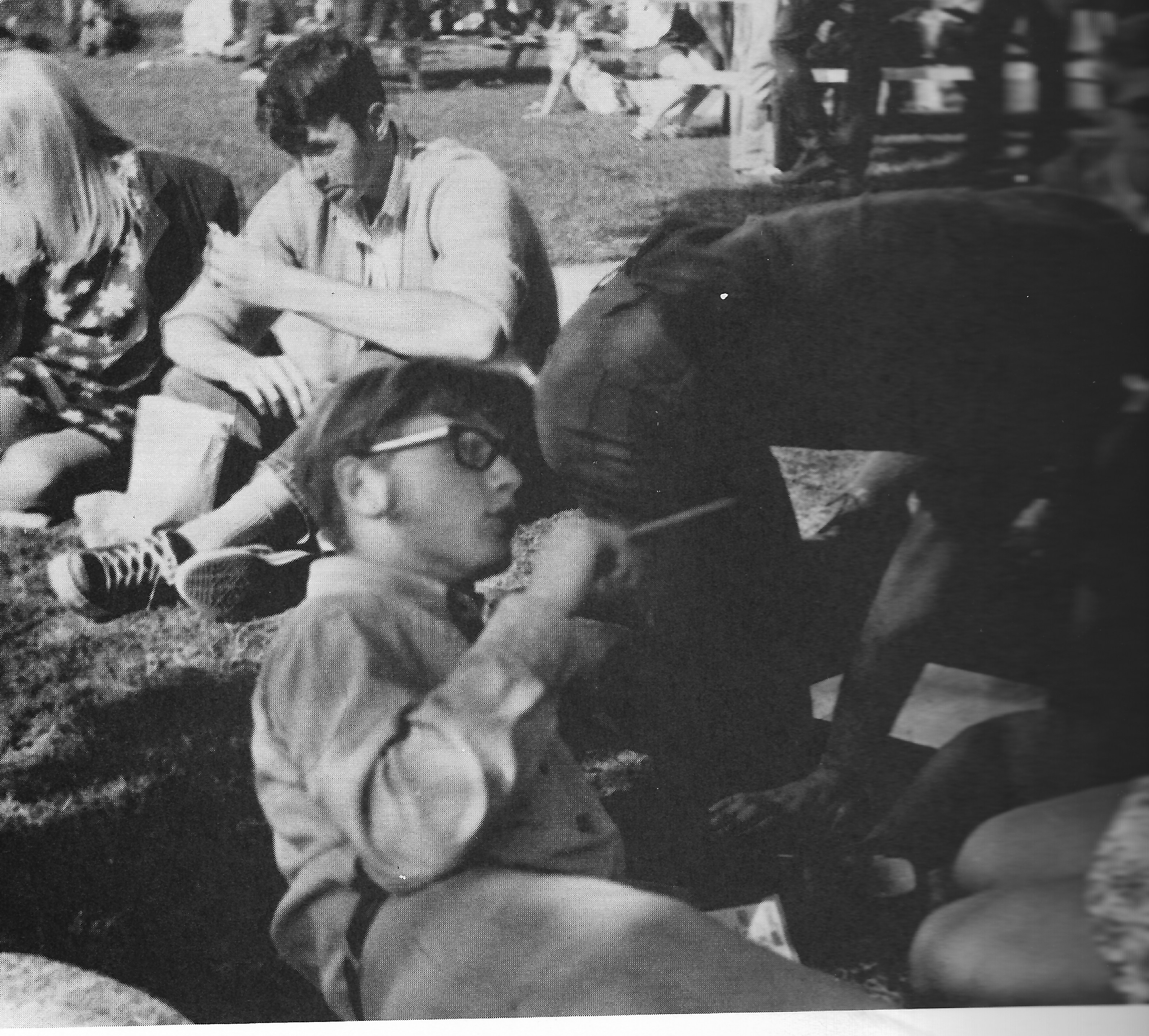
See? I’m being pedantic already. I’m a senior at Arroyo Grande High School, in the Quad, and quite full of myself. Probably I’m at the midpoint of a book–you can see one just beneath my legs—and probably it’s Herman Hesse or Kurt Vonnegut. My victim—you can just see her kneecaps—is my girlfriend, Susan. Susan was—is— extraordinary. She was bright and lovely and, by God, she had tamed a raccoon. She was a horsewoman and she loved my little sister, Sally, so sometimes she’d appear in our driveway and ask to take my seven-year-old sister for a ride. She’d keep one arm around Sally, the other controlled the reins, and they’d ride through Kaz Ikeda’s cabbage fields and talk. My little sister is bright and lovely, too, and I think that a small part of her was formed on those quiet horseback rides.
The rear end belongs to Jack. Just beyond him, with a sandwich, is Clayton, a Canadian transplant whose family settled near the mouth of Lopez Canyon where they raised horses, too. Next to Clayton, the young woman is Lois. Lois was stunning. She had beautiful wide eyes with impossibly long eyelashes and a breathy voice—a little Marilyn Monroe-ish—that devastated every seventeen-year-old male within fifty yards of that tree in the Quad of Arroyo Grande High School.
They chopped the tree down, many years later.
But Lois brings me back to Sambo’s, because her boyfriend was Paul. Paul was my classmate and intellectual soulmate. He may have turned me on to Hesse—“turned me on” was a stock phrase in 1969— and, for a brief time, to psychedelics. Paul was kind of shambly and self-effacing; he sometimes threatened to disappear inside the clothes that seemed just a little too big for him. But he was also brilliant—not just in English but also in mathematics and science and all the other subjects in which I was not at all brilliant.
Lois adored him. So did I.
Paul’s family lived in the blocks of houses bounded by Grand Avenue and the 101. (Another family I loved, the Hirases, lived there, too.) So it was natural, when I visited him, that the meeting adjourned to the nearby counter at Sambo’s, just a short walk away.
We were quiet during our visits there. In 1969, after an AGHS football game, Sambo’s was besieged and had to surrender to hordes of teenagers who ordered enough cheeseburgers and fries to ensure the eventual but inevitable cardiac occlusions, who shouted at each other from three booths away and experimented with how far they could shoot—at each other— a crinkled soda-straw wrapper from the end of its plastic muzzle.
[I didn’t order a cheeseburger. My favorite was a short stack of pancakes with scrambled eggs and blackberry syrup. This might still be one of my favorite meals.]
But we must have been exasperating. I am not sure this is so, but I expect it is: The waitresses’ hair was tied into tight ponytails behind or lacquered beehives above to keep their hairdos out of the food. You could almost see the ponytails come undone or stray strands of beehive, like little blond flags, wander away under the stress of serving teenagers with no more discipline than your typical Capitol Hill mob.
But that was after games.
Paul and I were quiet at our counter seats—the bank opposite from the one where I watched the farmers so many years later—and all we wanted was coffee. I could be wrong, but I believe Sambo’s had a policy then was can be briefly summarized: We are the Marianas Trench of Coffee. For ten cents.
So Paul and I, no matter how different we were—he was far brighter and more worldly; he smoked Winstons and I smoked Camel Filters–would sit there, exploring the depths of Sambo’s Coffee Policy, and we would talk about Hesse and Vonnegut and Steinbeck, about Squares, which included Richard Nixon, about film, about the White Album and about the one passion that we shared above all others: Eric Clapton, Jack Bruce and Ginger Baker, from the supergroup Cream.
“Ya need more cream for your coffee, Hon?” That was the waitress. I can’t remember her name. Since I was seventeen and she was in her mid-forties, she seemed to me a relic from Egypt’s Middle Kingdom. She moved noiselessly on white nurses’ shoes from one bank of the counter seats to the other; she pinned her orders to the cook’s wheel and spun it with great authority, she knew how much to talk and when to shut up.
And she called me “Hon.” [Yes, I know. ALL waitresses call you “Hon.”]
My mother had just died, in 1969, and this waitress was about Mom’s age. Gravity— and doubtless some heartbreak, which is none of my damned business –was beginning to pull the features of her face to the south but their counterpoint was the discipline of her beehive, Peroxide Harlow, which towered defiantly north.
And not only did she put up with us, the pretentious punks that we were, but she never failed to glide back to us for refills, which I always looked forward to. There I was, sitting next to a friend whom I loved and having my cup filled by a woman whom I loved, too. She didn’t know that.
But when she asked quietly “More coffee, Hon?”—I know now this was simply because she had no idea what my name was—for just a moment, Sambo’s restored my mother to me. I wasn’t the only one, either, looking for his Mum that year.
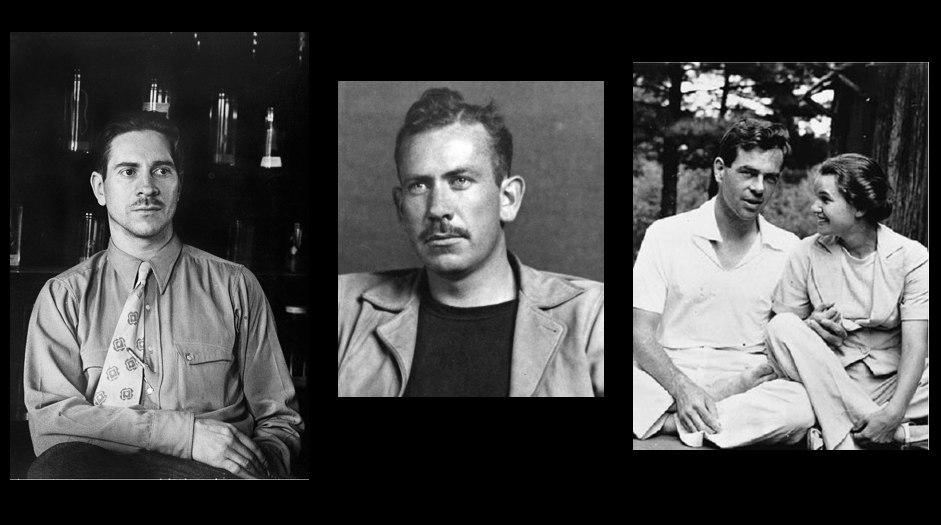
Ricketts, Steinbeck, Campbell and his wife Jean Erdman, a Martha Graham dancer.
If I had a time machine, I’d take it to Cannery Row, Monterey, about 1935.
Ed Ricketts, “Doc,” of Pacific Biological already has steaks and oysters and a loaf of sourdough, the last neatly bisected and all of them bathed in garlic and butter, ready to grill.
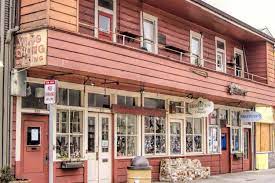
He crosses the street to Wing Chong’s for a gallon of red wine. He crosses back to start preparing dinner.
Wing Chong’s Market, Cannery Row, Monterey.
The guests, who drove in together from Pacific Grove, knock perfunctorily and walk in unencumbered—one of them, with luck, might’ve remembered to bring loaves of hard salami and Jack cheese. Regardless, Ricketts offers them their wine, poured generously into laboratory beakers. Then they barbecue, and one guest, the writer, offers unsolicited opinions—the very worst kind—on the proper way to grill Spencer steaks. They sip.
The steak expert is the the the novelist John Steinbeck. His friend and co-pilot on the perilous journey tomorrow morning back to Pacific Grove is the mythologist Joseph Campbell, who bears a remarkable resemblance to my Grandfather Kelly.
When their time comes, the steak and oysters and sourdough are dispatched promptly, along with a perfunctory iceberg salad with Thousand Islands dressing.
Two-thirds of the wine is left.
I don’t want the wine or the salad or the steak or the oysters–or even the sourdough, dipped in steak juices. I want to be, for just a short time, a fly on the wall, a grass snake under a warm lamp in one of Pacific Biological’s glass terrariums or even a skate breathing noiselessly at the bottom of a tank, just to listen, in my animal disguise, when the talk that won’t end until sunrise begins.
And could they talk. There would have been a lot of laughter, but there would’ve been confrontational moments, too. Ricketts, especially, with the scalpel that is a scientist’s mind, would have sliced his friends’ theories— about sexuality, life after death, about God the Father-Creator vs. God the Prime Mover, about the Great Depression and Italian Fascism— into slices as transparent as sashimi.
I can almost see Steinbeck, from my skate’s tank, slumped disconsolate into his chair once he’s been bested by his friend. In the silence, the only sound might’ve been the waves crashing into the pilings beneath the floor. But writers never shut up. Steinbeck would’ve found his voice again.
When sunrise came, I am sure that they departed wobbly friends.
Ten years away from 1935, the Allies will liberate Dachau and Auschwitz-Birkenau and they will vaporize Hamburg and Hiroshima. Three years later, Doc Ricketts, will be gone, killed on the train tracks above the Row—a little later, The Log from the Sea of Cortez will be his eulogy [Sweet Thursday would have embarrassed Ricketts]— so talks quite like this won’t happen anymore.
That’s a sadness because they told each other such grand stories, made even grander because they were told inside such a homely building.
What they told each other, thought through and distilled and re-worded, was what they’d learned from each other.
They were a biologist whose mind was so profound but whose stock-in-trade was Pacific Coast specimens for high school biology classrooms in Minnesota; a frustrated novelist, who’d written a dismal treatment of the pirate Captain Morgan and an immature and condescending novel about a paisano named Danny from Tortilla Flat and a mythologist who occupied an academic stratosphere to which no living wage could ascend.
What they discovered in each other was an electric attraction—or what Whitman called a “necessary film”— that ties all of us together. Granted, the red wine helped. They talked about our antecedence as clarified by Charles Darwin and William Jennings Bryan, they talked about Celtic and Hindi myth, about human nature’s potential, found in The Buddha, and its tawdriness, found in Huckleberry Finn. They argued about every conceivable topic, from Jungian theory to St. Francis’s wolf.
If they agreed on anything by the time the sun came up over the Gavilan Mountains, it was that this place—this planet—was a living organism, that we were its subordinates and, at the same time, its most murderous and indispensable components. They agreed that we belonged to it, and so to each other.
All of this disparate business, of course, had been hashed out a century before and a continent away from Pacific Biological by the Transcendentalists at Brook Farm. And before that, an ocean away, the same kind of talk happened, but it was in German: the Romantics there called the “necessary film” that ties all of us together weltgeist: World-Spirit.
But they didn’t have barbecue.
The talk on Cannery Row would have disappeared with the Del Monte Express that killed Ed Ricketts, except for Bill Moyers’s marvelous PBS series, The Hero’s Journey: Joseph Campbell and the Power of Myth. This was when we learned, thanks to Campbell, just how miraculous Luke Skywalker’s arrival truly was. Luke became even more miraculous when the mythologist helped us to understand, to our delight, that there was nothing new about Star Wars at all.
And then Campbell, thanks in great part to what he’d learned at Pacific Biological, told Moyers and all of us miraculous stories of his own that, of course, didn’t belong to him at all. He had learned them, too.
Bill Moyers (foreground) and Joseph Campbell, The Power of Myth. PBS.
But that series was a long time ago. But now, against the hard edges of current events, it’s in our soft remembrance of myth where we find the deepest truths, and there we have the chance to find our way back from the desolate place where we find ourselves now.
In the myth that is American film, I look to Frank Capra and Howard Hawks, and, when I can stand him, to John Ford. In writing, I look to Steinbeck and Willa Cather and to Hemingway’s short fiction; from my generation, I look to New Journalists like Tom Wolfe and Gay Talese. I look to the historians Bruce Catton and Barbara Tuchman and Doris Kearns Goodwin, to young historians like Laura Hillenbrand and Lynne Olson and Isabel Wilkerson, to baseball writers Roger Angell and Roger Kahn. I look to documentarian Ken Burns. I rely on the stories they tell me because they are true.
There are some—a harpy in Congress— who hold that our destiny lies in hating each other. That is a monstrous lie.
One way we can counteract this lie is to tell each other the truth: We belong to each other.
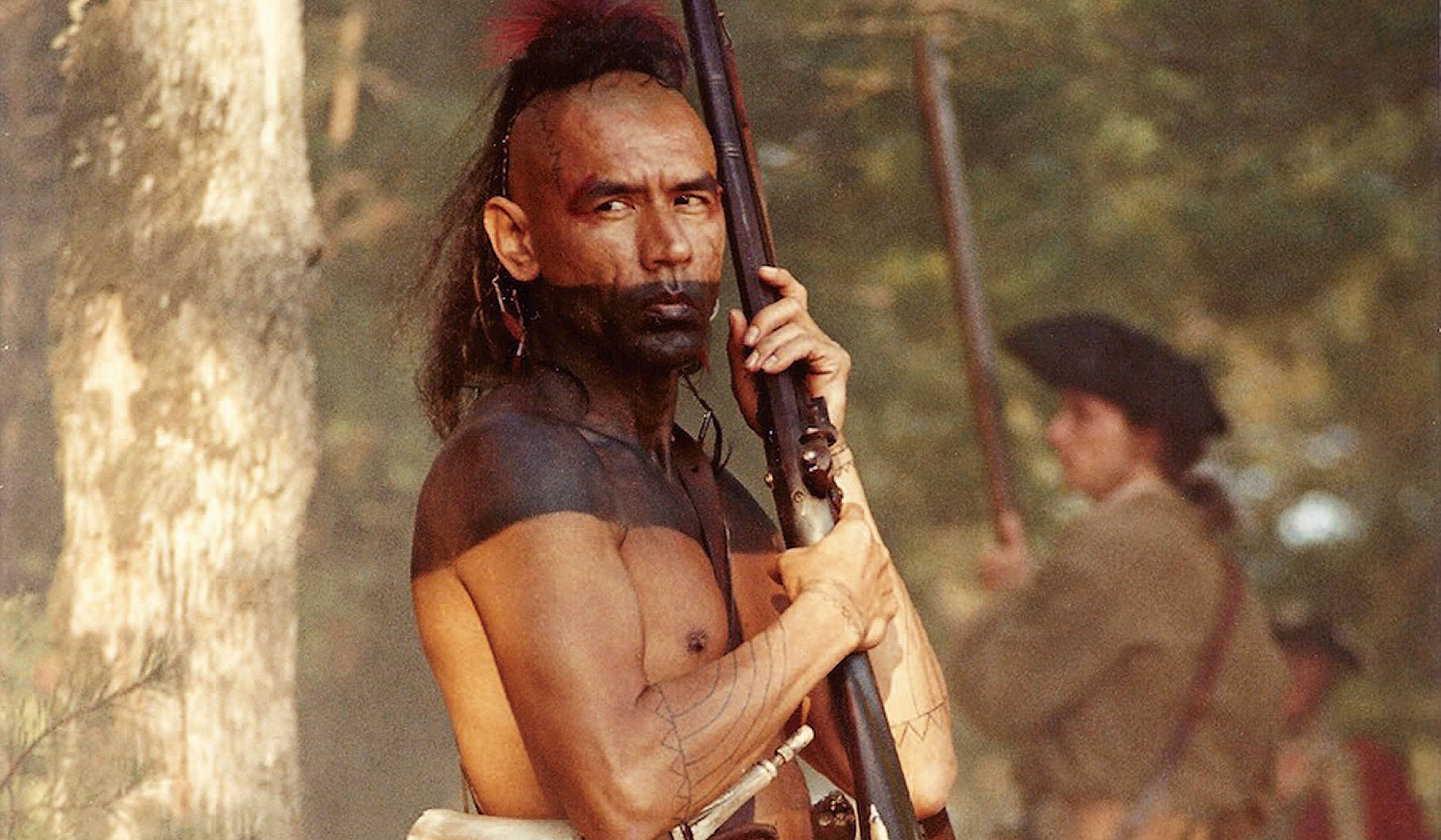
Here is just one example of what connects us: Campbell told Moyers that his research had taught him that there is a version of “Cinderella,” in one form or another, that’s found in nearly every culture in the world. I once watched Wes Studi—so terrifying as Magua in the film Last of the Mohicans—read a Native American version of the story to little children on Reading Rainbow, and he was so open-hearted and read the story so beautifully that the children at his feet, wide-eyed, knew immediately that it was a true story.
So here’s a story that I invented. The fact that it never happened doesn’t make it any less true.
It’s day’s end in Monterey in the summer of 1935. I am shivering a little in the fog despite layers of sweater and jacket. I am sitting on the bottom step of Pacific Biological. It’s cold, but I can smell the promise of warmth: red oak burning on a grill nearby. Then, in my story, I see Ed Ricketts, dressed in indifferent shades of khaki complemented by a surplus olive Army tie. He is closing a worn leather jacket across his chest and against the chill as he crosses the street with a gallon of red wine, which he carries with care, because the bottle’s green glass is thin. Its bottom is lined with sediment.
When he sees me waiting for him, an immense smile transforms his face, always serious, except for now.
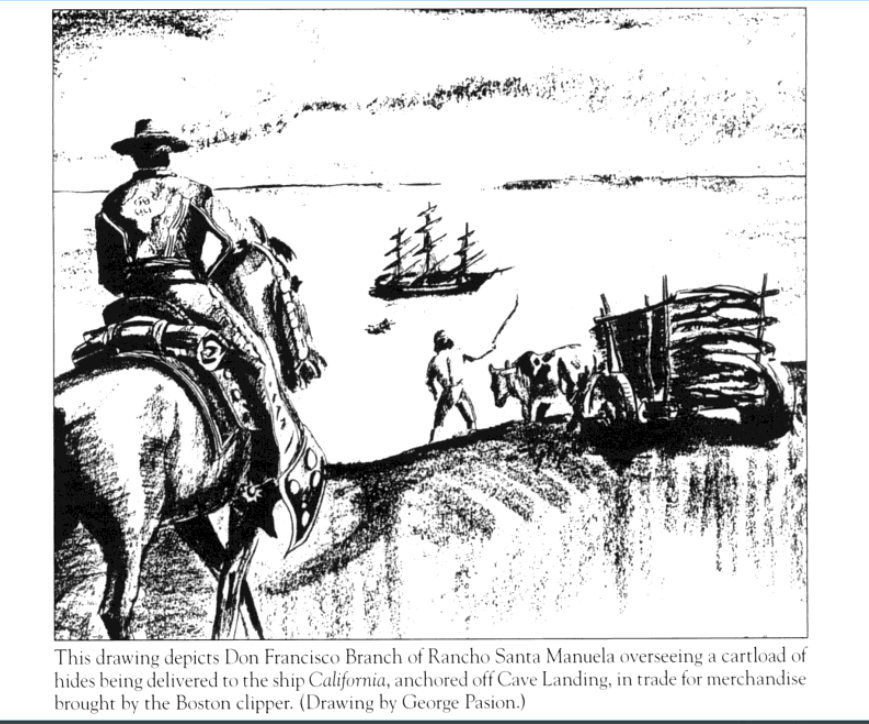
This drawing appears in Jean Hubbard and Gary Hoving’s outstanding book, from Arcadia Publishing, about Arroyo Grande’s history.
It moves me every time I see it. This is why.
The artist was my best friend in first grade at the two-room Branch School. George’s original hangs on a wall of the South County Historical Society’s research library, so every time I go inside I feel an instant of intense pain. George Pasion died two years ago.
George introduced me to empathy. He wore heavy leg braces—the film Forrest Gump replicated them— and running, for him, was awkward and painful. I remember distinctly one day when he could not keep up with the rest of us boys, and his eyes filled with tears. He was frustrated and enraged.
That moment broke my six-year-old heart, which is as good a way as any to begin a friendship.
George’s heart carried immense weight that belied the weakness of his legs. He was strong in ways we couldn’t understand. He was intensely focused but sometimes far, far away; his art, at which we always marveled, took him to places we couldn’t begin to imagine. This piece indicates he found the ability to time-travel while the rest of us were stuck in the Cold War and Mouseketeers.
There was immense wisdom in George, even then, when he was just a second-grade boy.
It was, of course, a wisdom he must’ve inherited from his parents. His father was Filipino, a member of the manong—Elder Brother—generation, bachelor men who came to Arroyo Grande to help support their parents back home. They fought, like tigers, in World War II and, at war’s end, they brought war brides home from the Islands, thanks to newfound liberality on the part of the federal government. Before the war, almost no Filipinas were allowed to immigrate; in California, male immigrants outnumbered them a hundred to one.
This was thanks to some of the most virulent racism, including in Arroyo Grande, that I’ve ever encountered in my research.
So it was World War II, and the families that soldiers started, that made my friend from sixty-two years ago possible. I last saw him fifty years ago. In learning of his passing, and in seeing this drawing, I’m reminded of the Whitman line.
Time avails not, the old fellow wrote in one of my favorite poems, “Crossing Brooklyn Ferry.” Time, according to the poet, doesn’t matter. There are some moments, when we keep them, that can never escape us. And there are some people, like the audacious poet, the old silky-bearded rascal, who inserts himself into his poem, who are looking at us fondly just beyond the reach of our vision.
And so George remains as vivid a presence in my life today as he was in that moment, in 1958, when I saw his eyes fill with tears. That was the moment that made him my first best friend.
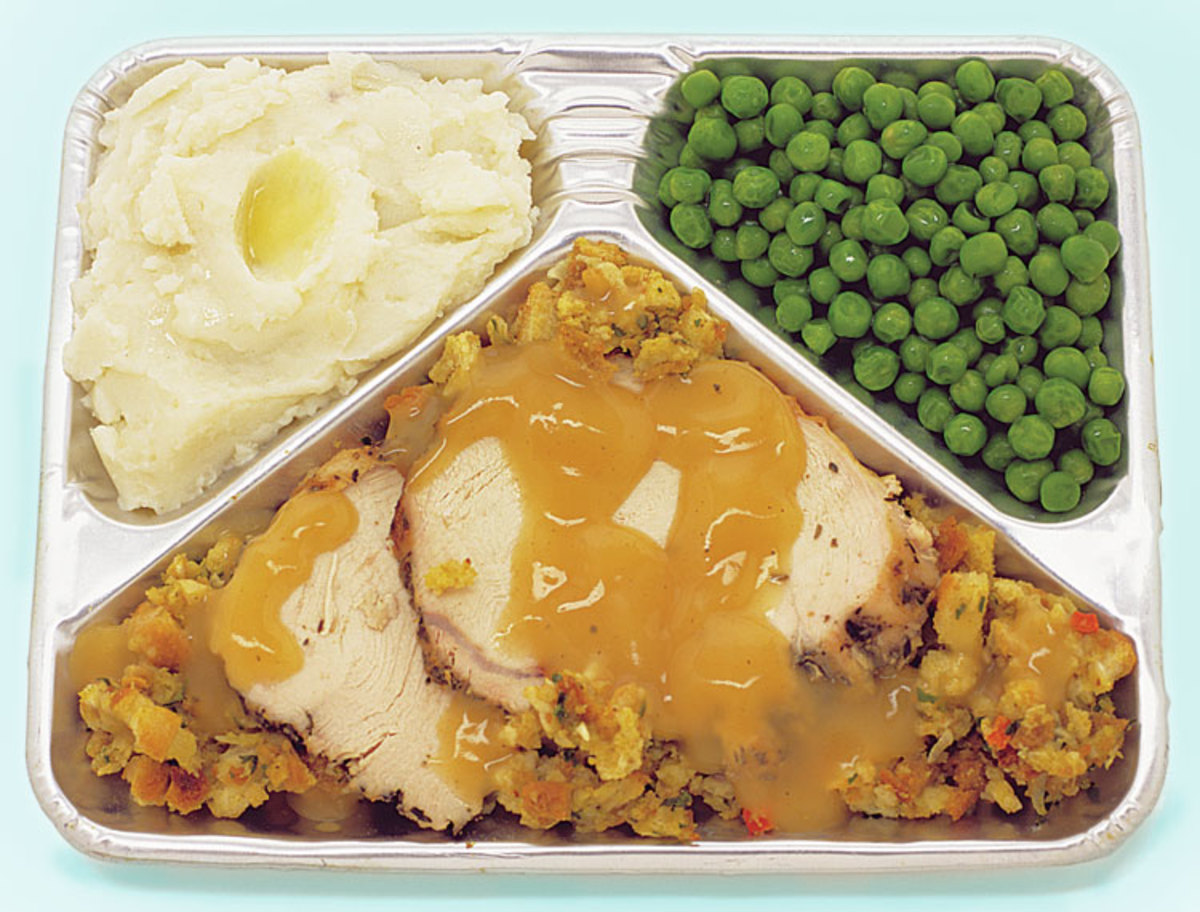
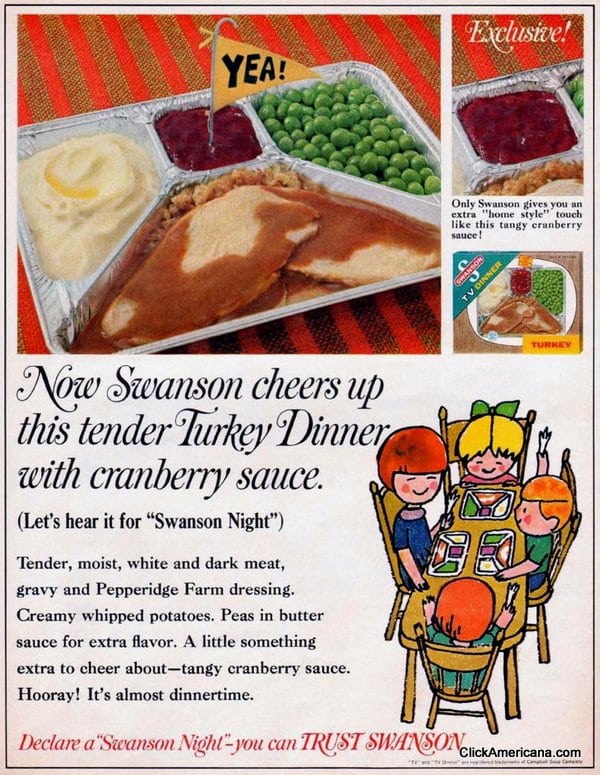
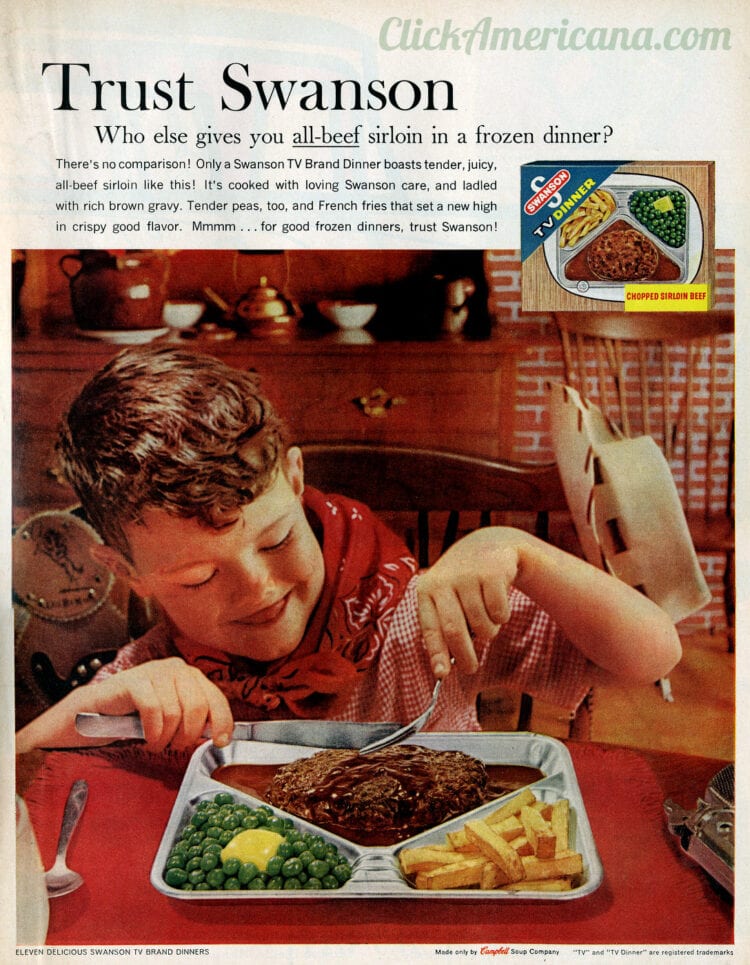
The first TV Dinners began appearing in the mid-1950s, and the Turkey Dinner may have been the first. The turkey had the consistency of papyrus; the mashed potatoes were bland, the dressing turned to goosh, but the peas made outstanding projectiles. We survived the privation younger kids would never know: Cranberry Sauce, added years later, kicked up Swanson’s game a notch. You could dunk the turkey in it to more or less give it some zip.The fried chicken dinners always disappeared from the freezer first. The batter was kidnip (instead of catnip) because it was faintly sweet; the peas this time came with buddies, which made them tolerable, but the mashed potatoes were still disappointing. They tasted like beach sand. The apple/peach combo was a nice notion but they had consistency of banana slugs, whose consistency I do not care to contemplate.I do not understand this cowpoke’s happiness. The one thing you’d think an American TV dinner could do well would be beef. Wrong. This looked like roadsplat and tasted like ketchup, which you could chug anytime out of Mom’s fridge. The fries were an abomination but you ate them first because they were fries. Sort of. The peas were, well, Swanson peas. Boring. Uninspired. Still, they were throwable or, even better, launchable–they traveled at great velocity from your spoon, a kind of dinner-table catapult. Another failed attempt in the World of Beef. The beef tasted like recycled shoe tongues or perhaps the “bully beef” salvaged from the vast British stockpiles left over from the Battle of the Somme (1916). No self-respecting penitentiary would serve a meal this bad. Not even a British one.
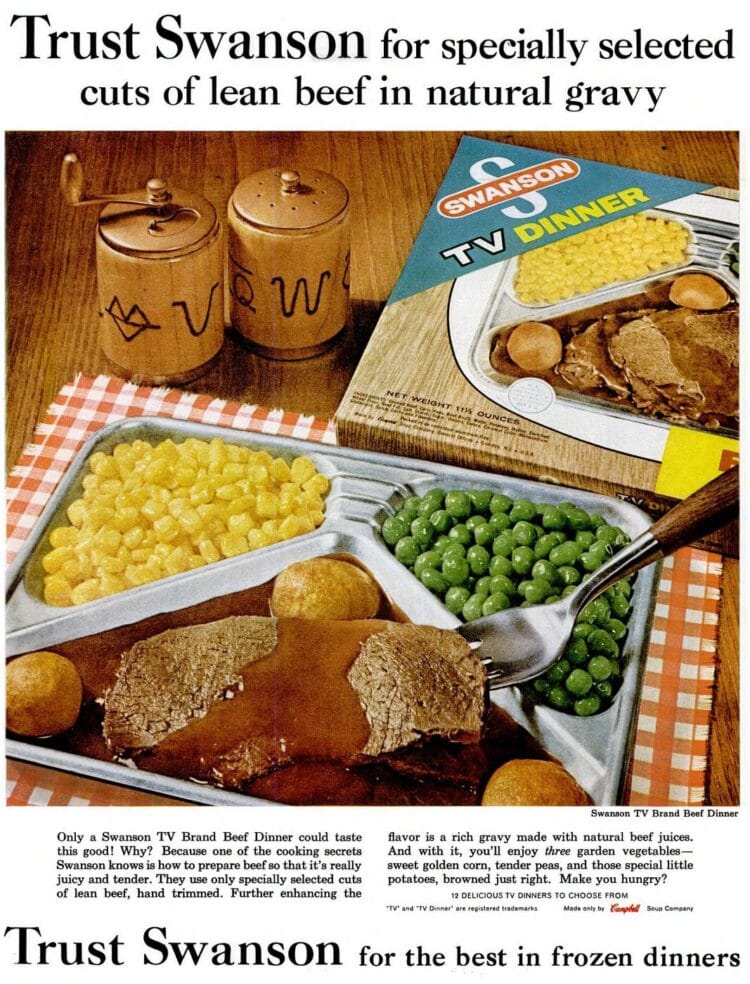
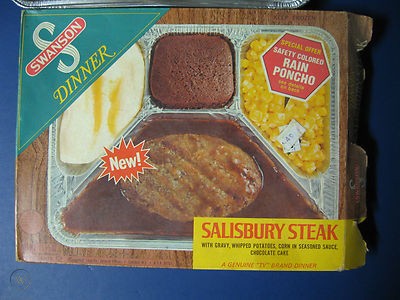
The closest thing to success with beef, due largely to the thin brown gravy, which was actually tasty and the only corrective in the Scientific Literature for the mashed potatoes–finally, if you drowned them, they tasted almost good. The gingerbread brownie? The work of a madman.
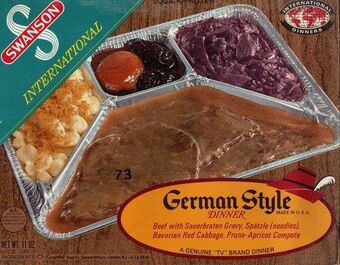
We never had this one, but any meal with pickled red cabbage gets my hearty approval. Sadly, the photographer who took this shot for the TV Dinner carton appears to have dropped his glass eye into the dessert.
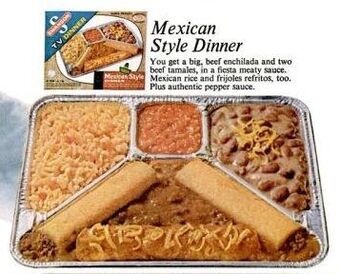
More international genius. The enchilada wasn’t too bad. You could just about stand the refried beans, whose aroma brought to mind molten rubber at the Goodyear Tire Factory, but they improved if you mooshed them together with the rice. Nice chili gravy with Undetermined Meat Objects within. The real disappointments were the two “tamales,” essentially surplus Mexican Navy torpedoes and, as torpedoes sometimes do, they’d settle to the bottom and just stay there. For days.
Took FOREVER to cook, and by the time it was ready, your twelve-year-old self was so famished that its just-out-of-the-oven super-steamed heat burned away the top layers of skin cells on your palate and tongue, which meant that you couldn’t taste anything for several days. But if you had the patience to let it cool a bit, this little gem was Comfort Food Supreme. After a tough day at school, a nice snack to eat during Rocky and Bullwinkle or while watching dreamy girls dance the Frug or the Slauson on a music show called Where the Action Is. The natural order was restored.







 A Work in Progress