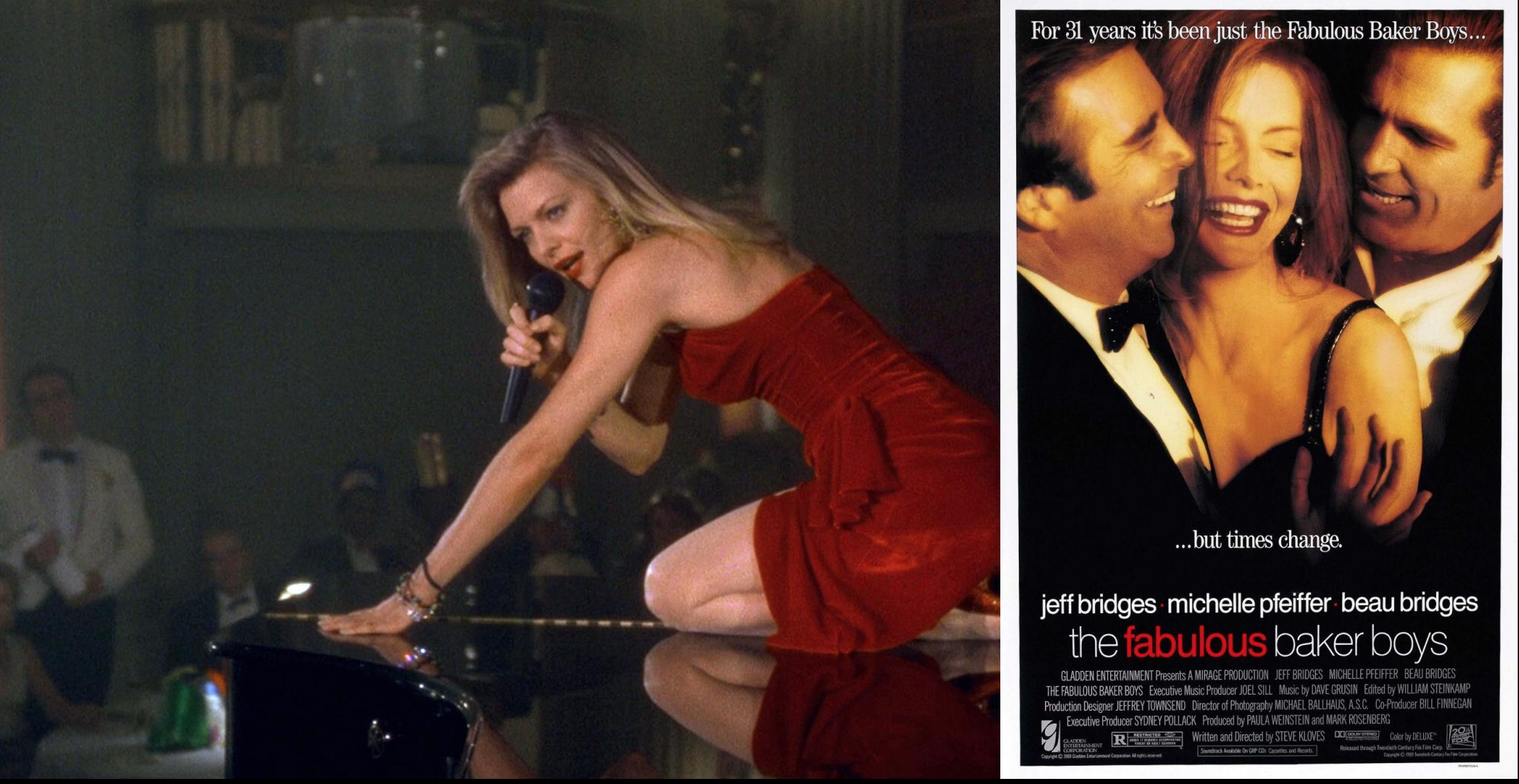
The Fabulous Baker Boys (1989) was on this morning, so I just had to stay in bed, “in recovery” from my Covid and flu shots, and so, being in bed, I just had to watch it.
Michelle Pfeiffer was 31 when she took on the role of the call girl-turned torch singer. The Bridges brothers, the Baker boys, a brother-brother act, are her accompanists. The elder Baker (Beau Bridges, the elder brother in real life) decides they need a female singer to rejuvenate their jaded performances, and her becoming part of their act makes things complicated.
A critic called the film “Romantic Noir” and that’s just about right. It’s an absorbing movie, not a happy one, because the romance doesn’t work itself out to our satisfaction. And the exterior scenes are filmed in a Seattle that looks as it if it could be the Great Depression: weedy vacant lots, boarded-up buildings, walkup apartments just beginning to go to seed, cheap hotels and cheap ballrooms with dirty back offices.
Pfeiffer, then thirty-one, was not sure she could bring this scene off because she didn’t consider herself “sexy.” A choreographer was assigned her and walked her through the song and the moves until, finally, the scene belongs to Pfeiffer.
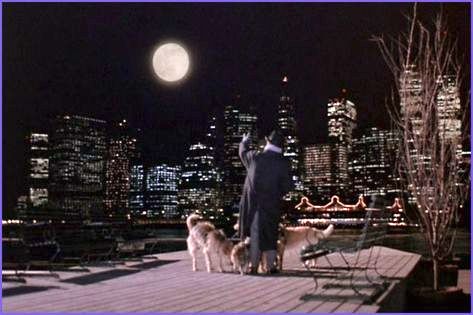
At this point in the plot, that Pfeiffer has decided to declare her intentions to Jeff Bridges, a cynical man who, fortunately, loves his black Lab, Eddie, and the lonely little girl who comes through his apartment window to visit them.
Here’s the song’s opening, and I would submit that the head snap at the end, the direct gaze suggest that it’s all over for you, Mr. Jeff Bridges.
I think that if a movie scene is authentic, it reminds you of something else you’ve seen, even if it’s seemingly irrelevant. Pfeiffer’s head swivel reminded me of Diana Ross and the Supremes. Here they are on the Ed Sullivan Show, and watch for the hip move and then Ross’s head swivel. For us poor dumb men, the littlest things women do fascinate us, if “fascinate” is anywhere close to being the right word.
Speaking of “poor dumb men,” by the time Pfeiffer climbs down from the piano at the end of “Makin’ Whoopee,” you know that Jeff Bridges is doomed. That’s okay. He can take it. Or he thinks he can. The movie will decide how it wants to work this relationship out.
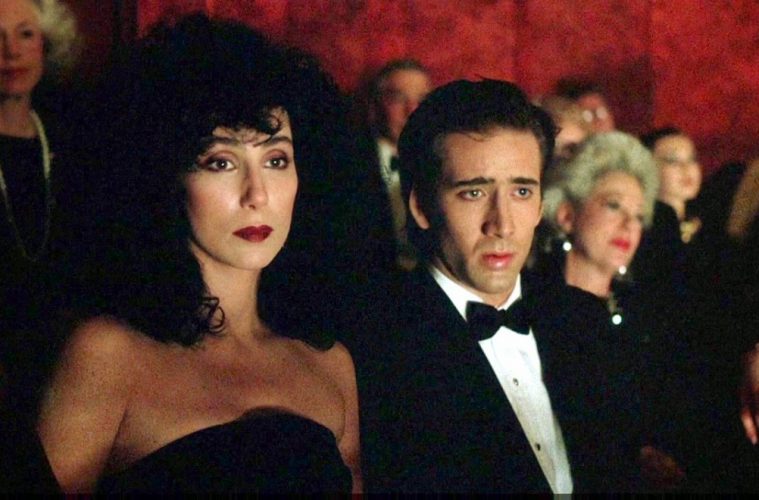
I was surprised that Moonstruck was on this morning. I was not surprised that, while I started watching halfway through—Rose is undergoing her transformation at the hair salon, and then she buys the shoes, “ruby slippers” and that drop-dead dress— I had to watch it to the end and then all the way through Deano’s voice and the credits.
What a marvelously written film. The words made the actors wonderful. So I had to look it up. It had some Nora Ephronesque elements, and, for romantic comedies, she was one of our greatest screenwriters— but she’s not Italian. Nope. But neither is the screenwriter for this Moonstruck. John Patrick Shanley is (obviously) Irish-American. But his early years equipped him to write the Academy Award-winning screenplay script for this film.
So I looked Shanley (above) up on Wikipedia. Here’s why he has the chops for this New York love story:
Shanley was born into an Irish-American family in The Bronx, New York City. His mother worked as a telephone operator, and his father was a meat-packer. The neighborhood Shanley grew up in was considered very rough.
Shanley’s academic career did not begin well, but ultimately he graduated from New York University with honors. In his program bio for the Broadway production of Doubt: A Parable, he mentions that he was “thrown out of St. Helena’s kindergarten, banned from St. Anthony’s hot lunch program and expelled from Cardinal Spellman High School.” He was heavily influenced by one of his first teachers, Sister Margaret McEntee, on whom he based the character of Sister James in his play, Doubt. While at Cardinal Spellman High School, he saw two school productions that influenced him: The Miracle Worker and Cyrano de Bergerac.
After his freshman year at New York University, Shanley was put on academic probation. He then enlisted in the United States Marine Corps, serving in a stateside post during the Vietnam War. Following his military service, he wrote a novel, then burned it, and returned to the university with the help of the G.I. Bill, and by supporting himself with a series of jobs: elevator operator, house painter, furniture mover, locksmith, bartender. He graduated from New York University as valedictorian in 1977,with a degree in Educational Theatre, and is a member of the Ensemble Studio Theatre.
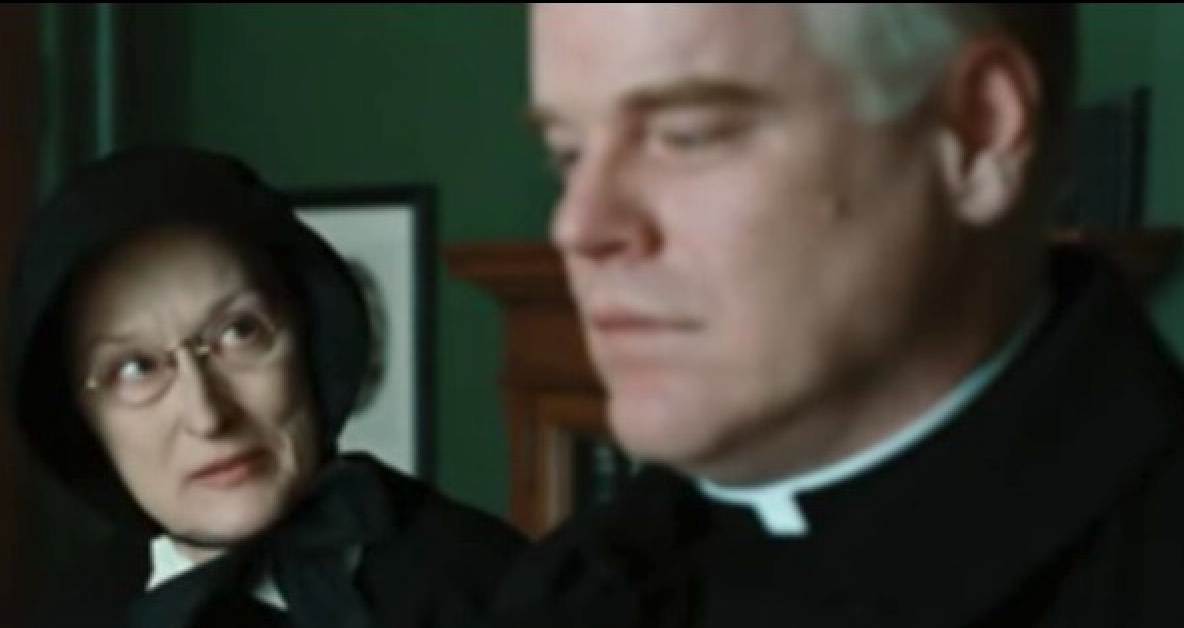
Meryl Streep and Philip Seymour Hoffman in Doubt, which won the Pulitzer Prize for Drama.
What makes this film such a treat for me are both the unexpected turns, like the “love him awful” exchange, and the revealed wisdom that mark Shanley’s dialogue.
Ronny Cammareri: You’re gonna marry my brother? Why you wanna sell your life short? Playing it safe is just about the most dangerous thing a woman like you could do. You waited for the right man the first time, why didn’t you wait for the right man again?
Loretta Castorini: He didn’t come!
Ronny Cammareri: I’m here!
Loretta Castorini: You’re late!
Loretta Castorini: Bless me, Father, for I have sinned. It has been two months since my last confession.
Priest: What sins have you to confess?
Loretta Castorini: Twice I took the name of the Lord in vain, once I slept with the brother of my fiancé, and once I bounced a check at the liquor store, but that was really an accident.
Priest: Then it’s not a sin. But… what was that second thing you said, Loretta?
Rose: Have I been a good wife?
Cosmo Castorini: Yeah.
Rose: I want you to stop seeing her.
[Cosmo rises, slams the table once, and sits down again]
Cosmo Castorini: Okay.
Rose: [pauses] And go to confession.
Rose: No, I think the house is empty. I can’t invite you in because I’m married. Because I know who I am.
Rose: Why do men chase women?
Johnny: Well, there’s a Bible story… God… God took a rib from Adam and made Eve. Now maybe men chase women to get the rib back. When God took the rib, he left a big hole there, where there used to be something. And the women have that. Now maybe, just maybe, a man isn’t complete as a man without a woman.
Rose: [frustrated] But why would a man need more than one woman?
Johnny: I don’t know. Maybe because he fears death.
[Rose looks up, eyes wide, suspicions confirmed]
Rose: That’s it! That’s the reason!
Johnny: I don’t know…
Rose: No! That’s it! Thank you! Thank you for answering my question!
Loretta Castorini: Where are you taking me?
Ronny Cammareri: To the bed.
Loretta Castorini: Oh, God. I don’t care. I don’t care. Take me to the bed.
And then there’s this moment, when, for once, the director tells you all you need to know without being pushy about it. It’s the morning after the opera, and it’s all over for Loretta. She’s in love.
(I’d be remiss if I didn’t mention the heartache of seeing the World Trade Center towers that live on in the shots that establish this as a New York film. I feel the same pang of sadness for two more films I enjoy, Working Girl and Gangs of New York.)
Olympia Dukakis, whom we lost two years ago, won the Academy Award for Best Supporting Actress, and she is somehow both regal and funny, even when the funny bits are a little rueful, as they are in her bittersweet scenes with the late John Mahoney, the university professor who chases his coeds—he reminds Rose that her own husband is being unfaithful—which leads to the eternal questions she asks: “Why do men chase women?”
I guess I’ll have to add this film to the list (Casablanca remains at the top, with John Ford’s The Searchers and the first two Godfathers close behind) of films I could watch a thousand times. I owe its screenwriter at least that many thanks.
I have never had a linear mind. Mine is lateral. I don’t go from A to Z: A reminds me of M and M has a slight connection to E–oh, did you know that E and T are distant cousins?–and, about a half-hour later, I arrive at Z. It just takes longer for me. I love the side-trips, though. I still don’t know, however, how all this stuff gets trapped, historical ants in amber, in what passes for my brain.
Take this song, from Pat Garrett and Billy the Kid. It’s my favorite Bob Dylan song, folks:
The 1973 Sam Peckinpah film starred Kris Kristofferson, James Coburn, Jason Robards, Slim Pickens, Kathy Jurado and, oh yeah, Bob Dylan.
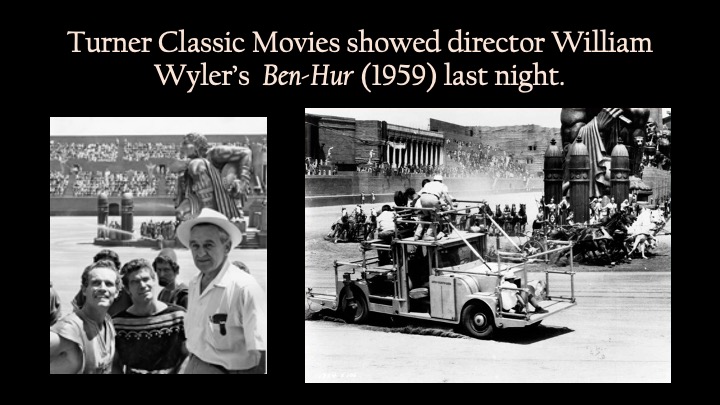
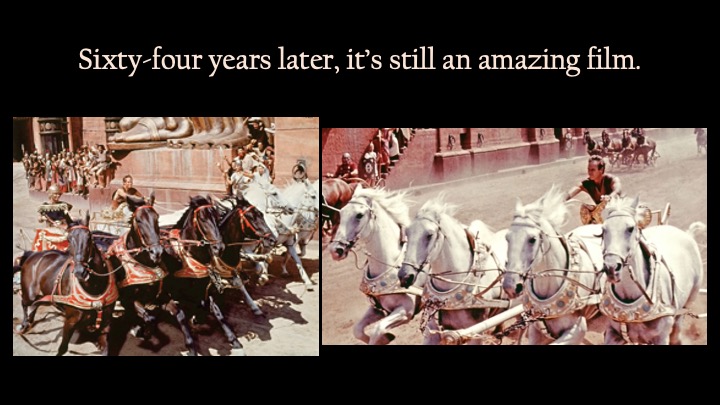
This may or may not make sense. But this is how I got from Ben-Hur to Pat Garrett and Billy the Kid with an Arroyo Grande stop along the way.
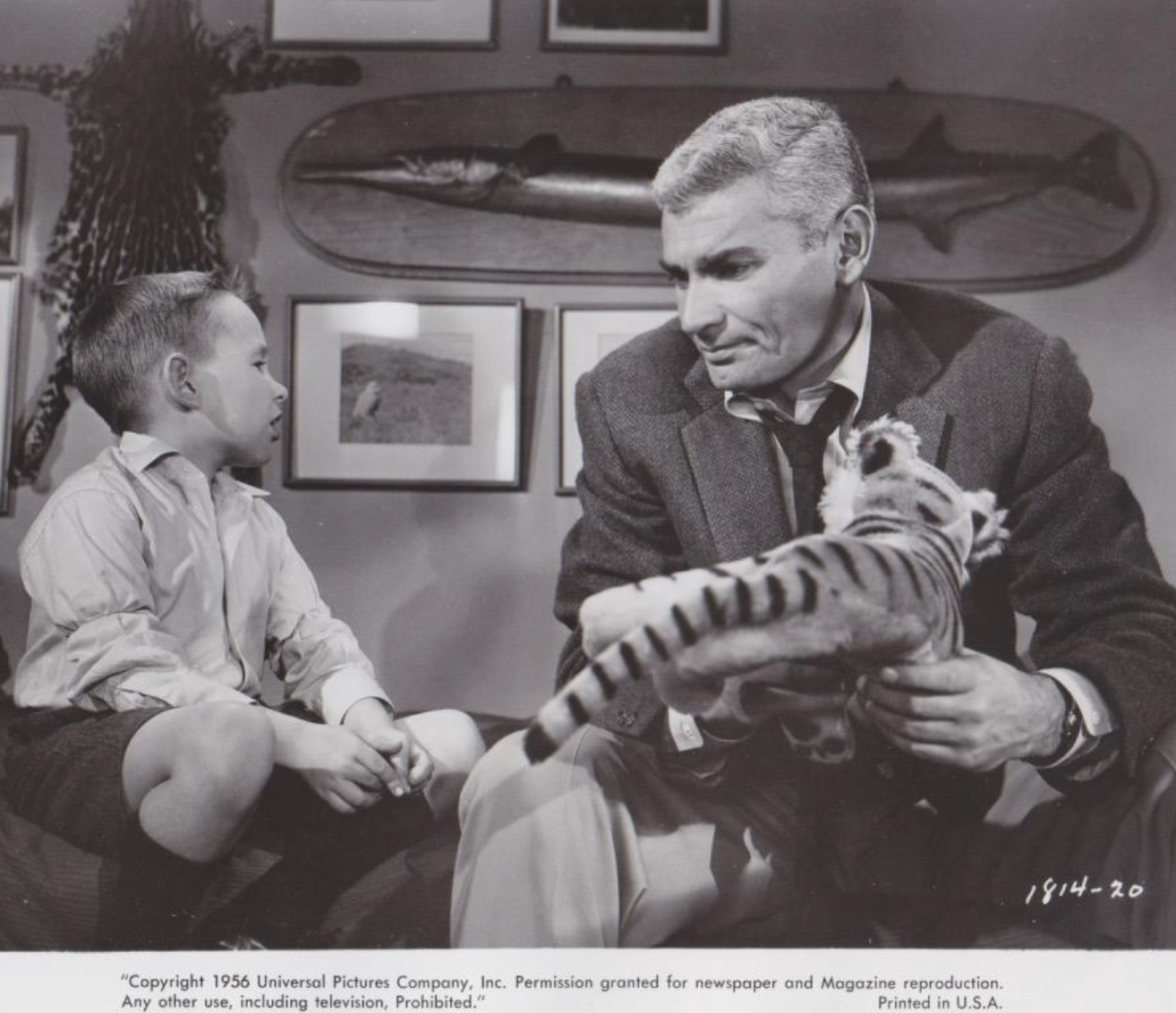
In 1956, Mom took me to the Fair Oaks Theater—just a short walk from where me and my family live today—to see a romantic comedy, Toy Tiger, starring Jeff Chandler.
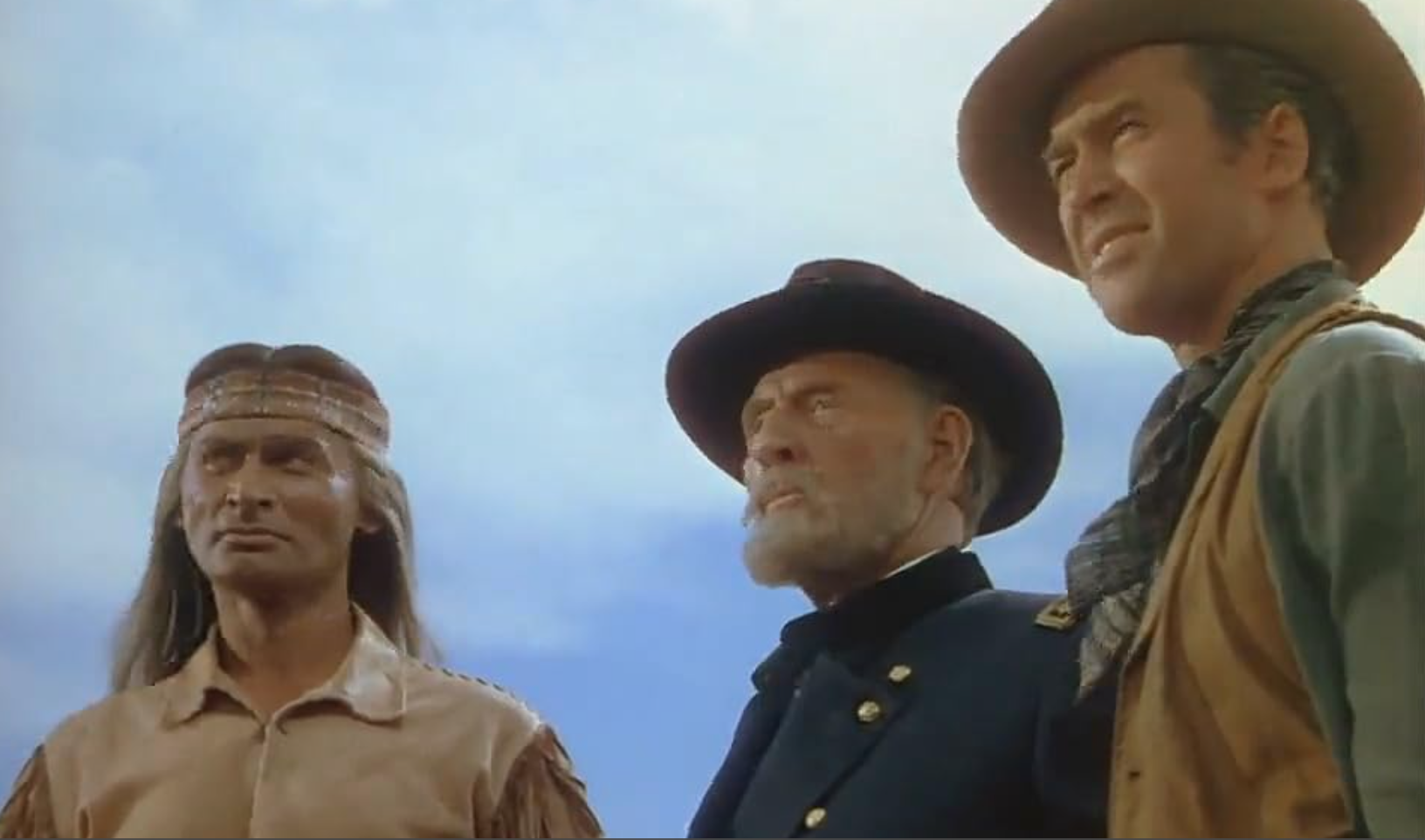
Chandler was not your romantic comedy kind of guy. Usually he was a Marine officer leading his rifle platoon onto a Central Pacific beach, or a lawman protecting a frontier town from evil gunslingers or an Apache chieftain. He was an awesome Apache chieftain.
Jeff Chandler, Basil Somebodyorother and James Stewart in Broken Arrow (1950).
But the Toy Tiger in the film was an early experiment in Hollywood merchandising. I don’t think the Scarlett O’Hara whalebone corsets went over so well. I fell for this one. Hard. I think he came into my life at Christmas.
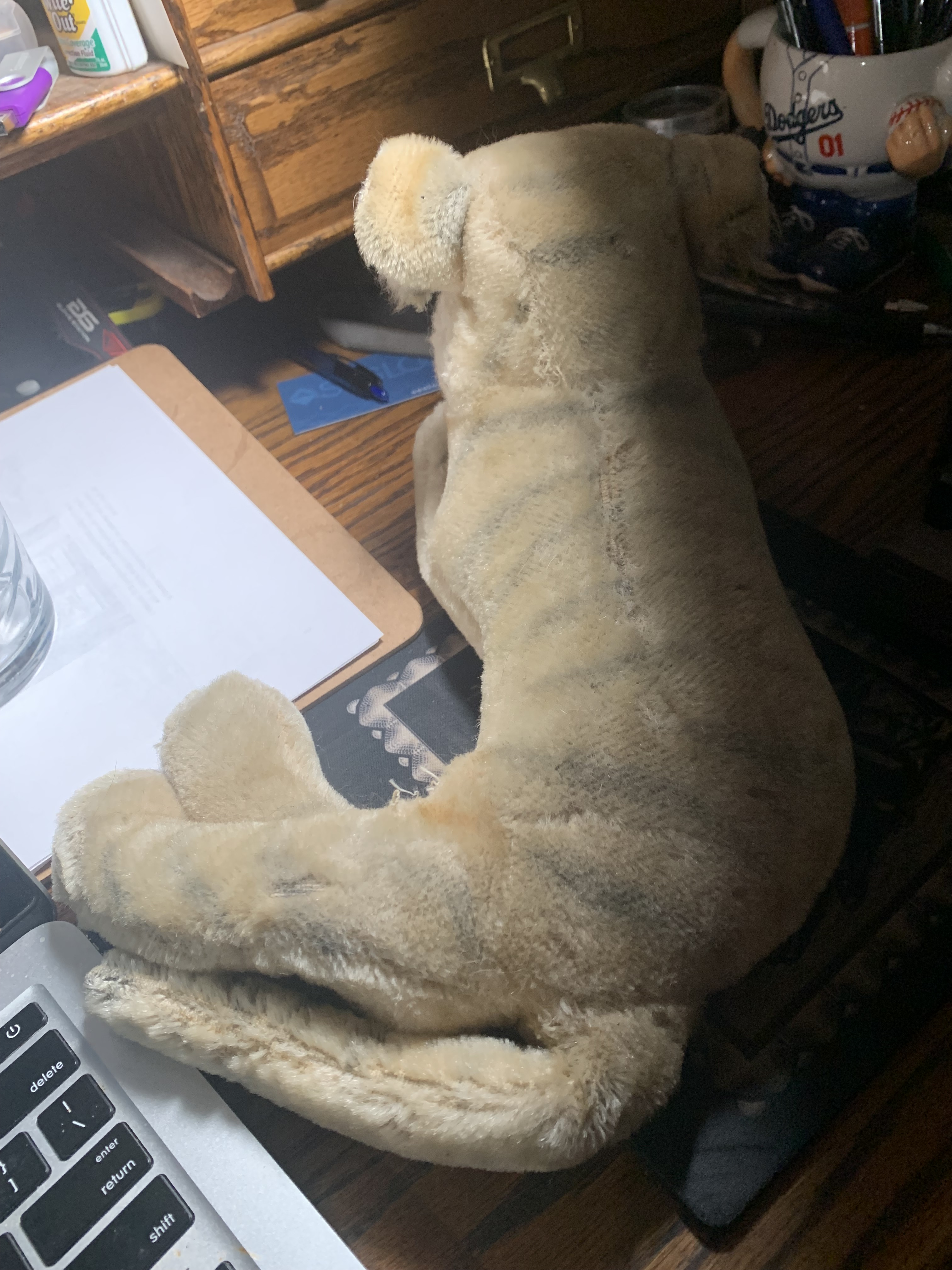
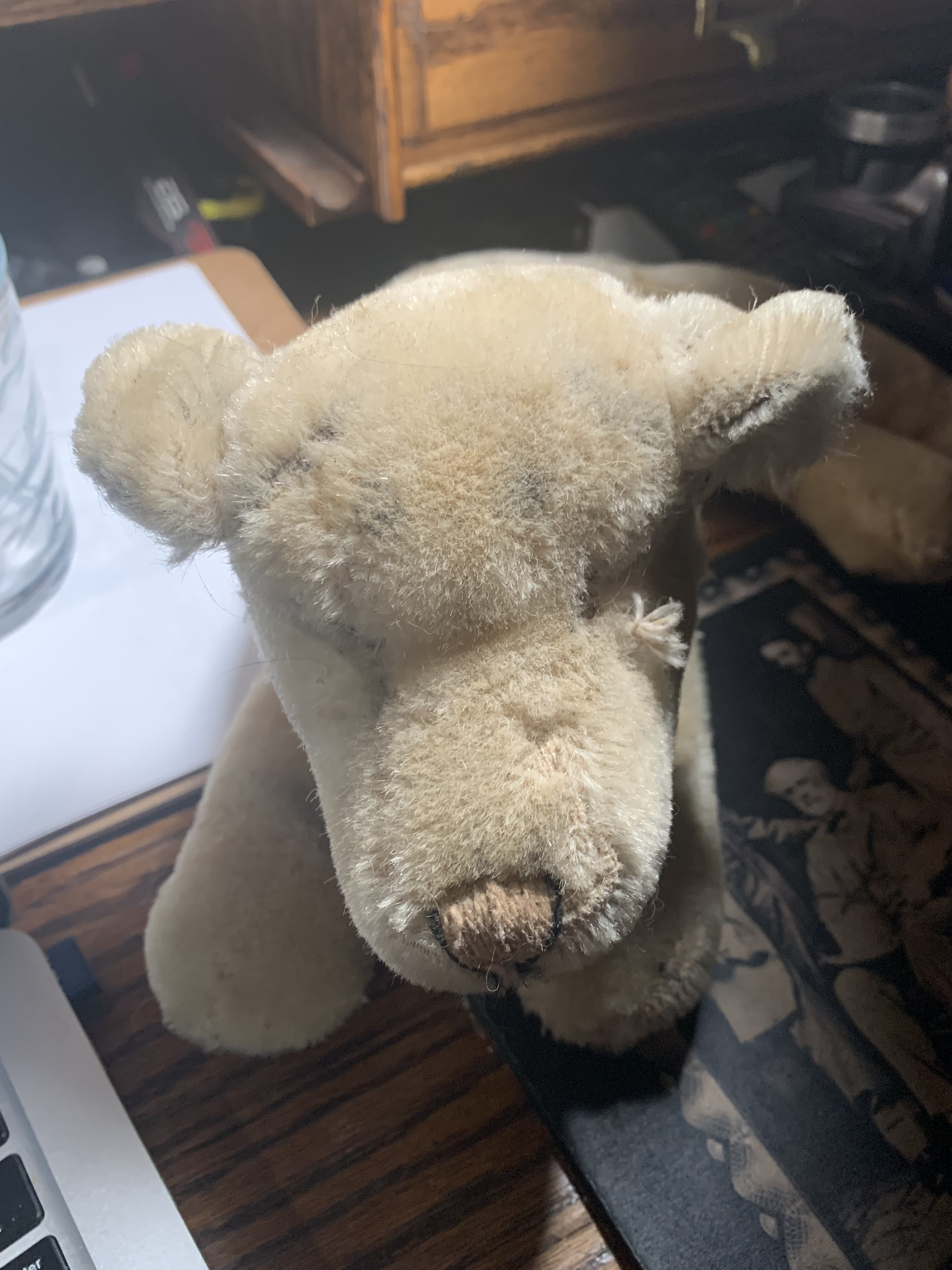
That’s the original Toy Tiger in the film still above and this is mine, sixty-seven years later. He’s blind and faded and some of his stuffing is starting to come out, but he’s always within reach, just above my computer. I needed him when I was four.
Walter fills a similar need today. Sometimes in the middle of the night I will feel a very cold Basset Hound nose pressing into the nape of my neck. It’s Walter sniffing to make sure I’m still there. I’ll turn over and gather him next to me and then we go back to sleep.
Walter doesn’t know this—-wait, maybe he does—but he makes me feel just as safe at seventy-one as Toy Tiger did when I was four.
Jürgen Prochnow (the white cap) as the U-boat captain. It is Christmas and he and his crew are listening intently for the telltale sound of reindeer hooves on the deck above them.
Das Boot
Top of the line–the 1981 version, that is. You got your sturm. You got your drang. You got beards like the Hatfields and McCoys by the film’s end. The grief comes, alas, becaue of the Americans and their air atttacks on the sub pens. You get the thrill of a high-speed run in heavy seas through the Straits of Gibraltar and an impish junior officer with a red beard. AND you have the Nazi “political officer” everyone despises. He doesn’t care for the crew’s taste in music, either. Maybe the best sub film of all time.
20,000 Leagues Under the Sea
Yeah, it’s a Disney movie from 1954, but where ELSE are you going to get to see Kirk Douglas sing to a sea lion? And where else can you see James Mason, a vengeful 19th century version of Elon Musk or Richard Branson, bust up warships AND—the scene that initiated my fondness for calamari–you get Douglas in a fight to the death again a giant squid!
U-571
Any boarding party led by Pulp Fiction’s Harvey Keitel is the boarding party for me, yo-ho! Lots of good male grunting and bonding and killing and stuff, and Matthew McConaghey is the most clean-shaven sub sailor in history. Keitel’s knit cap with the little dingleball on top is a definitive fashion statement, and this depth-charge scene, from the 2000 film, nearly equals Das Boot’s. Nearly.
The Enemy Below (1957)
This is as much a psychological thriller as it is a war movie and, as many critics like to note on Mr. Google, the Germans, led by (too old) captain Kurt Jurgens, are NOT cartoonish. His counterpart is Robert Mitchum as the American destroyer captain and the two ships look for an opening—any opening—so that they can kill the other guy. It’s like a Frazier-Ali 15-rounder, but in the middle of the South Atlantic. And Mitchum? I could watch that man butter his toast and get a kick out of it. I can do without the trailer intro/narration by Dick Powell, he of 1935’s Lullaby of Broadway. Lullabye-bye, Powell.
K-19: The Widowmaker
In this 2002 thriller, Harrison Ford is the Russian commander whose accent periodically disappears; Liam Neeson’s is far more reliable. Since Vikings invaded both Russia and Ireland, good on Neeson, whose accent might come from some Viking who invaded both places, too. Maybe Ford can be forgiven, since he was born in Chicago and very few longships were seen on 9th-Century Lake Michigan. But, there you go. When a reactor begins to melt down, the last 2/3 of the film is tragic, of course . Doom doom doom. Collective society may suck, but the film at least shows Soviet sailors willing to give everything to save their crewmates and their submarine. No one can save Ford’s Russian accent; it evidently fell overboard.
Runners Up
The Hunt for Red October:While I am fond of Sean Connery’s spiky hairpiece, the movie goes downhill after he murders Red October‘s political officer, a moment of sudden violence that’s kind of fun. After that. It’s as if the defecting Soviet sub is plowing through maple syrup. And I detest Tom Clancy’s writing. I remain sad that Sean Connery is dead but content because Clancy is. He won’t inflict anymore of his technobabble on us. Red October has a magnetohydrodynamic “caterpillar drive” ANNNNND she’s
Just a little deuce coupe with a flathead mill But she’ll walk a Thunderbird like she’s standing still She’s ported and relieved, and she’s stroked and bored She’ll do a hundred and forty with the top end floored
The only other compelling character is the American sub commander Scott Glenn, who has Balls the Size of Church Bells, a mystery after the tight Wranglers and mechanical bull rides he endured in Urban Cowboy.
Run Silent, Run Deepis based on a pretty good novel I read when I was about thirteen, but since it revolves around a personality clash between one of my favorite actors, Burt Lancaster, as the exec, and his captain, Clark Gable, I am unimpressed. If I want personality clashes, I’ll watch Matthau and Jack Lemmon in The Odd Couple.
Voyage to the Bottom of the Sea (1961). Just stay there. Cool sub, though, but the ones at Disneyland have windows too and you can see mermaids from them. Barbara Eden’s in this film, but she’s in the sub, alas, and not outside combing her mermaid hair with a golden brush while perched on rock, which I would pay good money to see.
Ice Station Zebra: Ice Station Zero.
Operation Petticoat. What a great idea! Let’s trivialize submariners!
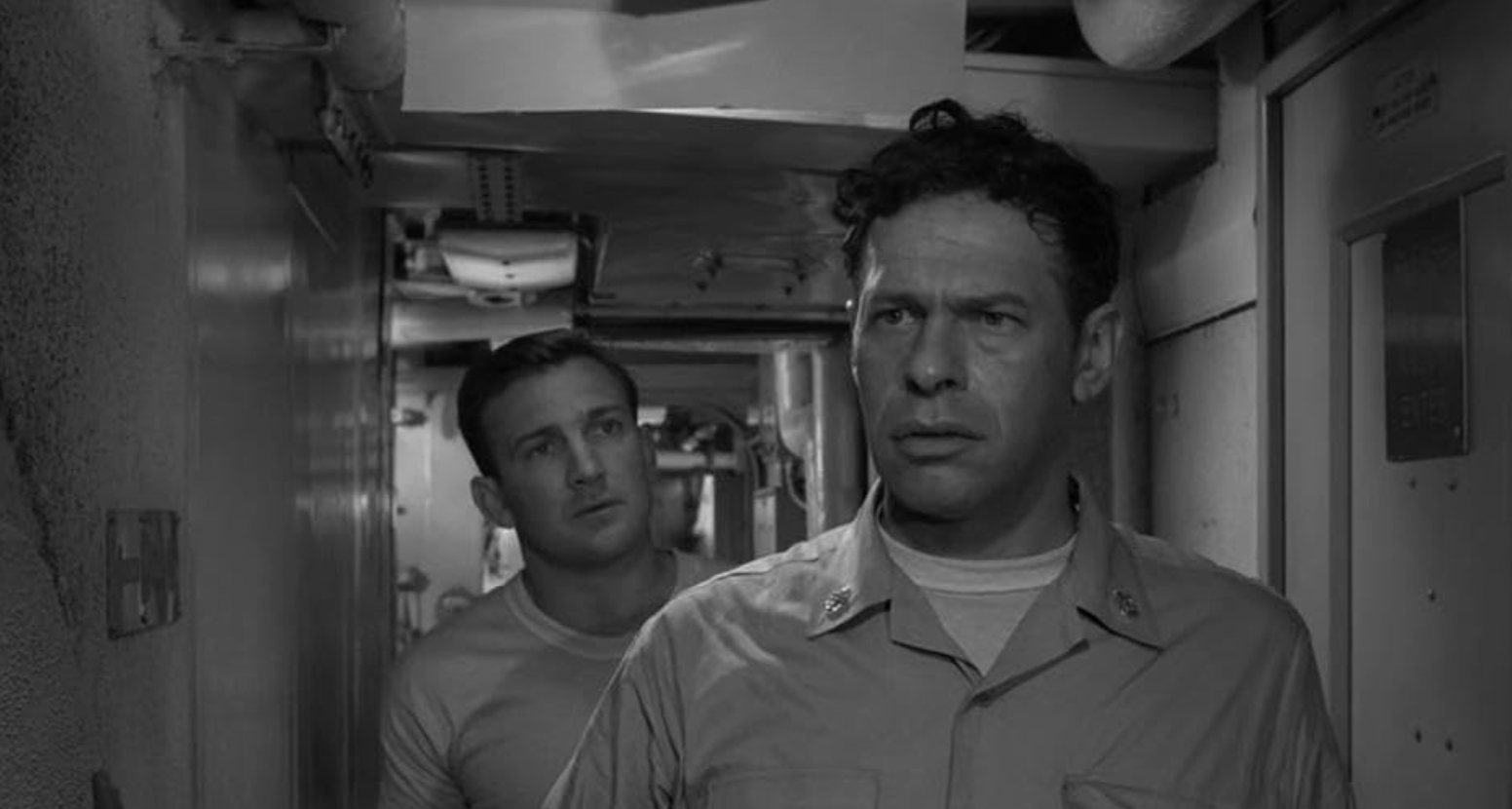
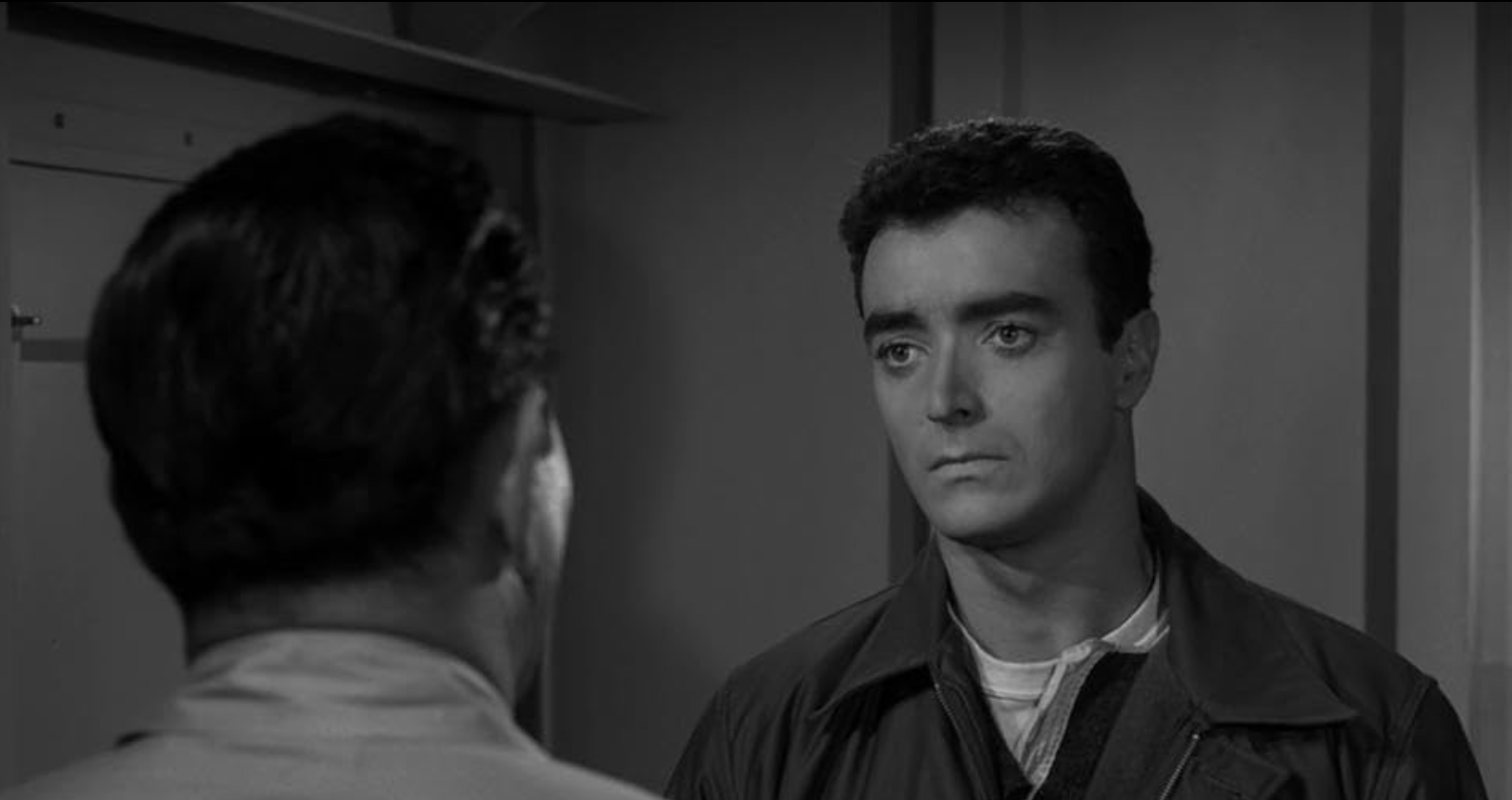
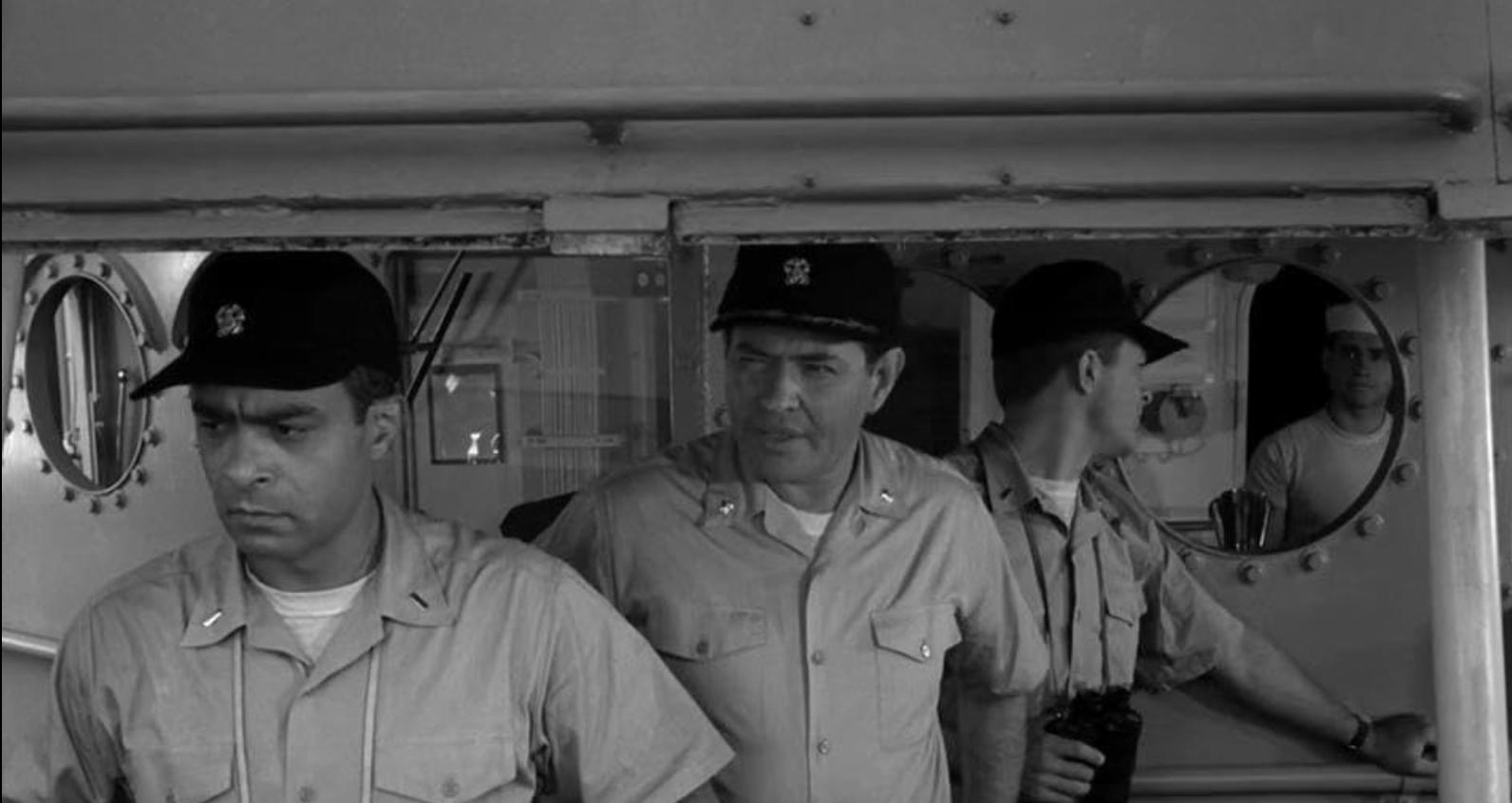
BEST RUNNER-UP:Twilight Zone, “The Thirty-Fathom Grave.” Rod Serling was such a talented writer, but I much prefer his ghostie stuff to his Serious Social Stuff. He wrote the script for this episode. An American destroyer’s sonar, in our time (that would be about 1960 in TV time) picks up what sounds like a hammer pounding against metal beneath the surface. Alas, it’s a sunken submarine, and a destroyer sailor and World War II submarine vet, played by an excellent actor, Mike Kellin, suddenly realizes that that was his sub and the pounding comes from his lost crewmates, calling for him to come join them. The ship’s captain, played by Simon Oakland, is quite good, as is John Considine, who explores the wreck (for you Boomer types, Considine brother, Tim, was in My Three Sons. He left the show to college and never returned. I suspect he was crushed to death while telephone-booth* stuffing, popular among college students before they began occupying adminsitration buildings a few years later.
(*Younger people: Use Google Image Search for the term “telephone booth.”)
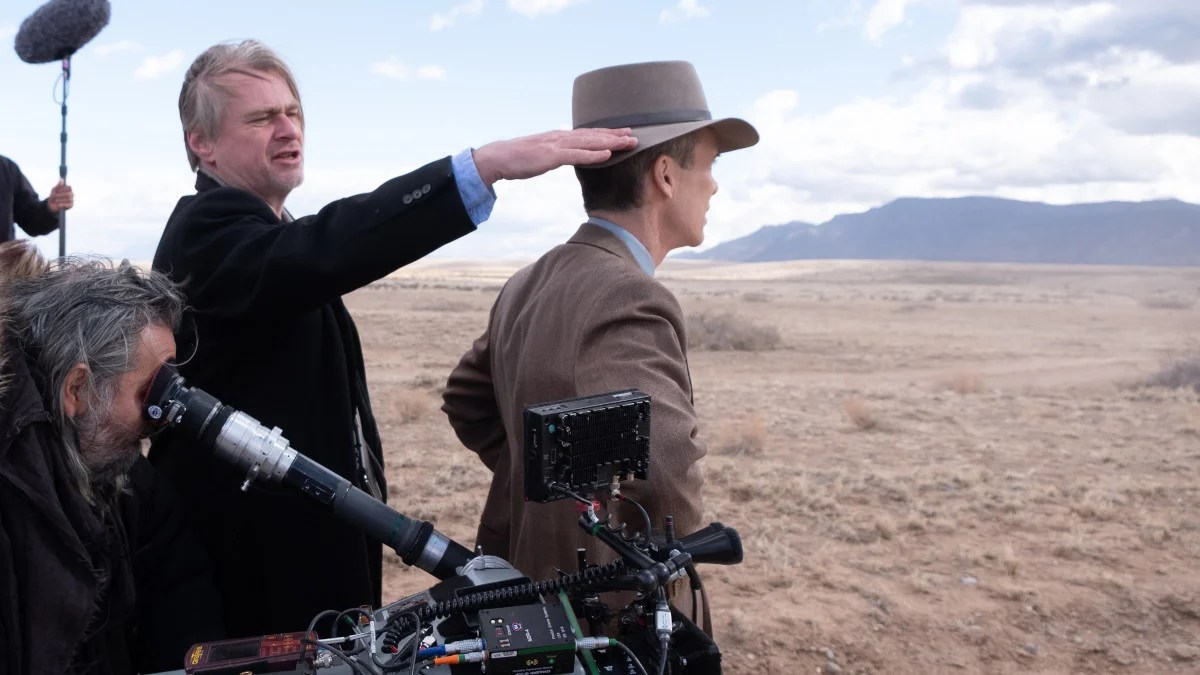
I borrowed four spectacular scenes from two earlier films—the fantasy Inception remains one of the most amazing films I’ve ever seen, and the two air-attack scenes from Dunkirk are terrifying— but the ending of the war film is moving, too. The soldier, evacuated from the beach, is headed home on a train. Grateful Brits have reached through the train window to gift him and his mate with newspapers and then with beers ( Bass ales) and the soldiers read Churchill’s speech aloud from the papers. Here, Nolan is both spectacular and intimate.
He intercuts the train scene with the counterattack from Tom Hardy’s Spitfire. His character, Farrier, has stayed too long over the beach. His job is to protect the soldiers below him, and in doing his duty, he runs out of fuel. Farrier sets his Spit afire and awaits the Germans who will make him a prisoner of war, if he survives, for the next five years. Again, both spectacular and intimate.
David Lean, one of my favorite directors, could do that, could get you close to his characters. The developing relationship between Peter O’Toole and Omar Sharif in Lawrence of Arabia and is one example; William Holden’s coward who becomes a tragic hero in Bridge on the River Kwai is another. It’s one of Holden’s finest performances, and he’s one of my favorite actors.
But Nolan’s characters seem even more real to me than Lean’s.
Now, with Oppenheimer, we have two master history teachers in David Lean and Christopher Nolan.
I wish that Nolan somehow could’ve had a chance at directing Gettysburg, a dreadful film based on a marvelous Michael Shaara novel. But we have, thank the Lord, Glory.
And, thanks to Nolan, we can enjoy once again big movies with heart.
This day means so much to me because Tony Bennett was our American Corrective.
Where there is division, he reached across divides.
Where there is rudeness, he said “thank you” at the end of his duets.
Where some among us live misshapen lives, crushed by the weight of privilege, he was born the son of a grocer and a seamstress from Calabria, in southern Italy.
Where there is mean-spiritedness, he was unfailingly kind.
Where there is crudity, he was class.
Where there is despair, he radiated happiness.
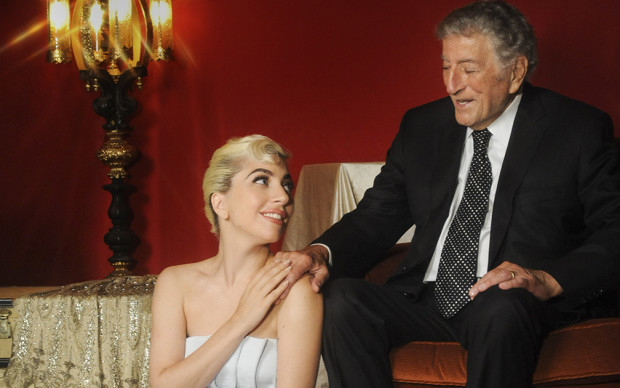
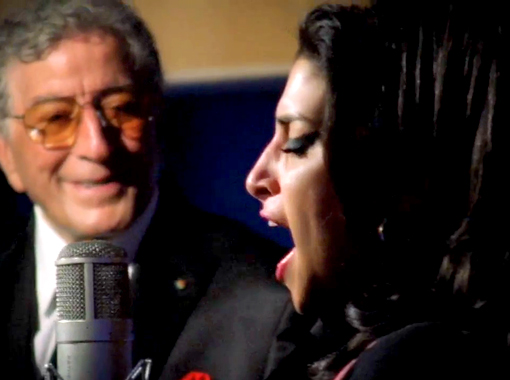
Where there is misogyny, he welcomed women—Lady Gaga, Amy Winehouse, Faith Hill, Aretha Franklin, KD Lang— as his equals. Look at the expression on his face here:
Where there is selfishness and self-absorption, he was generous and open-hearted.
Where there is ugliness, he was Grace.
Where the the notion of “duty” is dismissed, he sang “San Francisco” every time as if it were the first time.
Where there is falsity and deceit, he sang that song with an honesty that would’ve embarrassed performers less sure of themselves and their gifts.
Where there is failure, he failed, too.
He came back from drug addiction to us. He came back FOR us.
It took a 96-year-old man to show us what we’re capable of in our future, if only we’re willing to listen to voices that call us to higher places, where cable cars climb halfway to the stars.
I’m a little obsessed with this song, but I’m not the only one. The Los Angeles Times reported that the original video has reached one billion views on You Tube, and why not? The video was creative, compelling, told a story, and, let’s face it—how fun it would be to be pulled into a fantasy world when you’re idling in a restaurant whose specialty is cold milk?
And the song is charming. It’s been covered by so many bands, but let’s start with the opening of the the original video:
My friend and former student Kristin introduced me to the Mariachi Sound Machine version a few years ago, and I still love it. My favorite part is the trumpeter and his little boy. But I love all of it.
First to Eleven is a band from Erie, Pennsylvania. I love the grunge touch (the drummer is cool); the lead singer, Audra Miller is—let’s face it—kinda sexy. Jeez! Is it okay that I said that? Here’s that version in its entirety:
I always love to find songs I know covered by the high-school-aged School of Rock kids. Look at how happy they are!
But of all the A-Ha variations, there’s none quite like the unplugged MTV performance by Morten Harket (the band was Norwegian), which is elegant. And it’s almost as much fun to watch the women in the audience react to a pop song which still has such power almost forty years later.
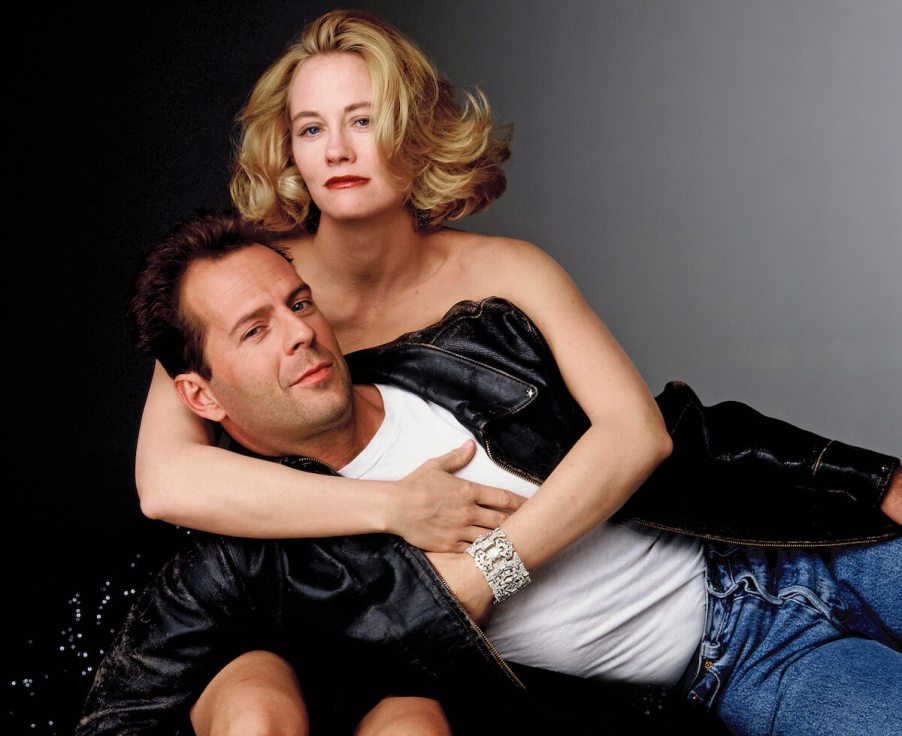
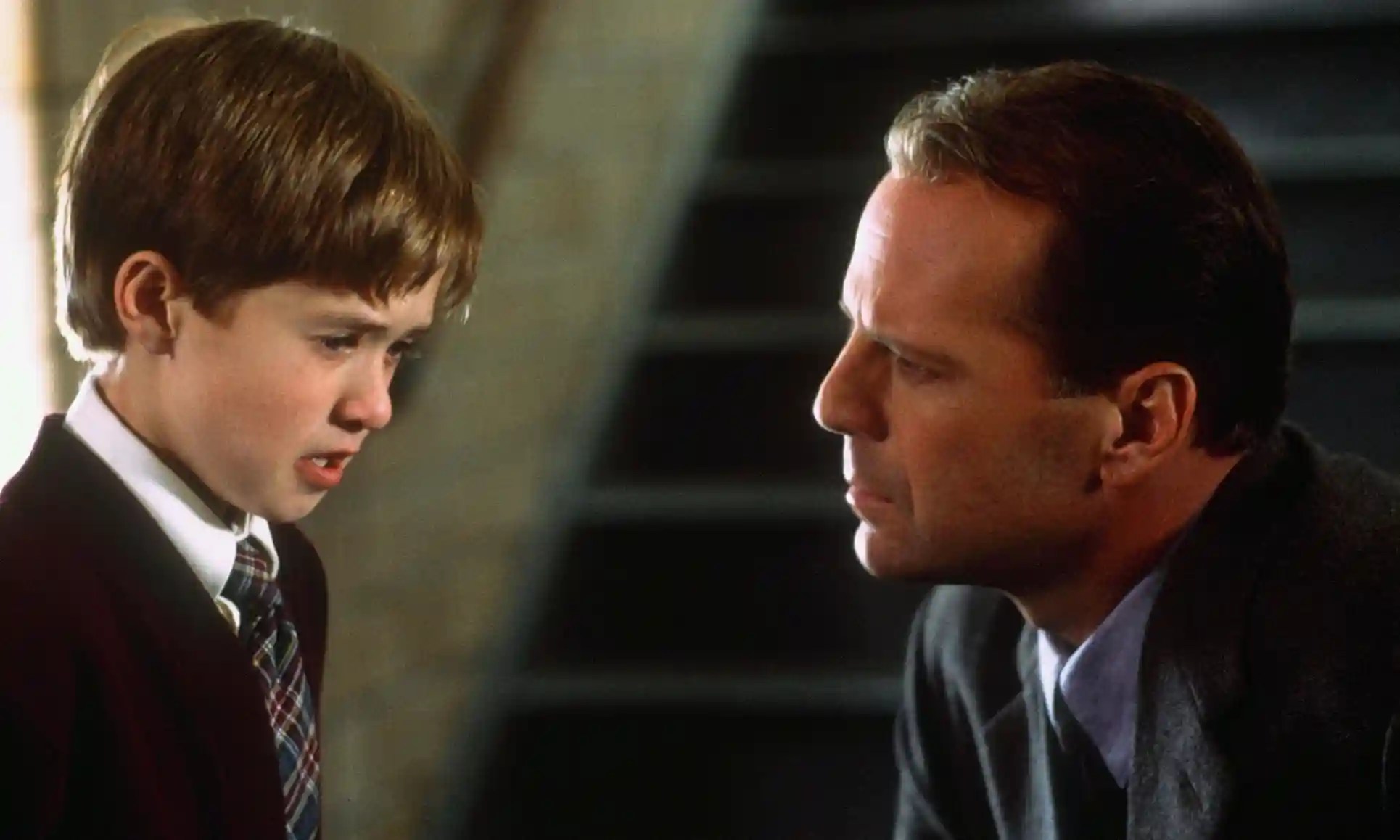
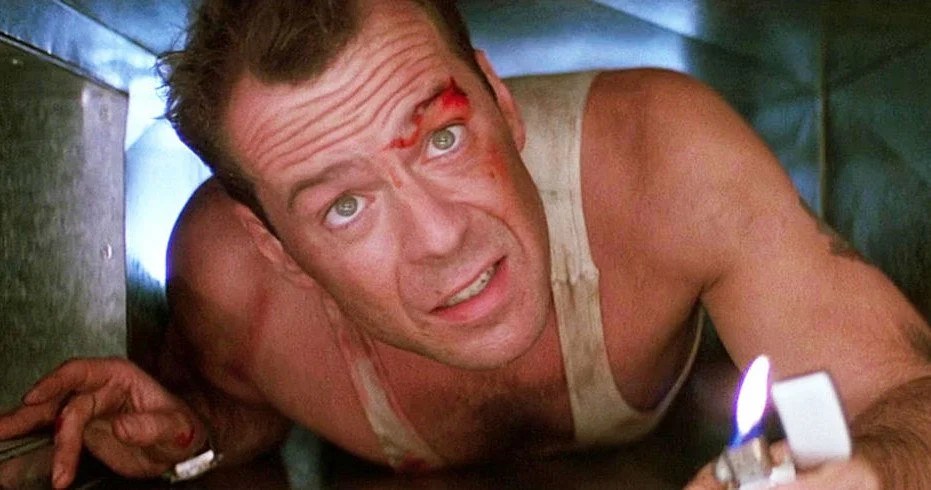
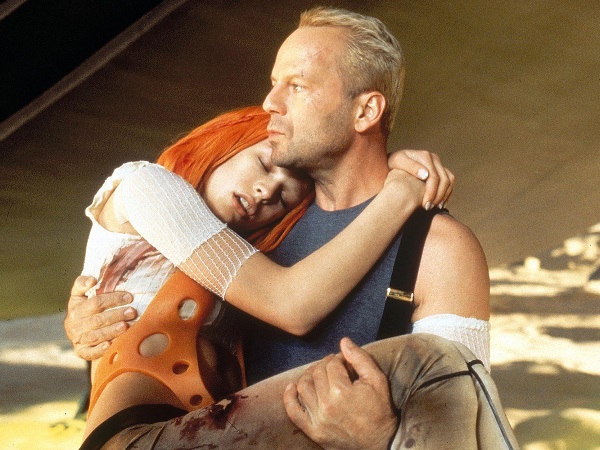
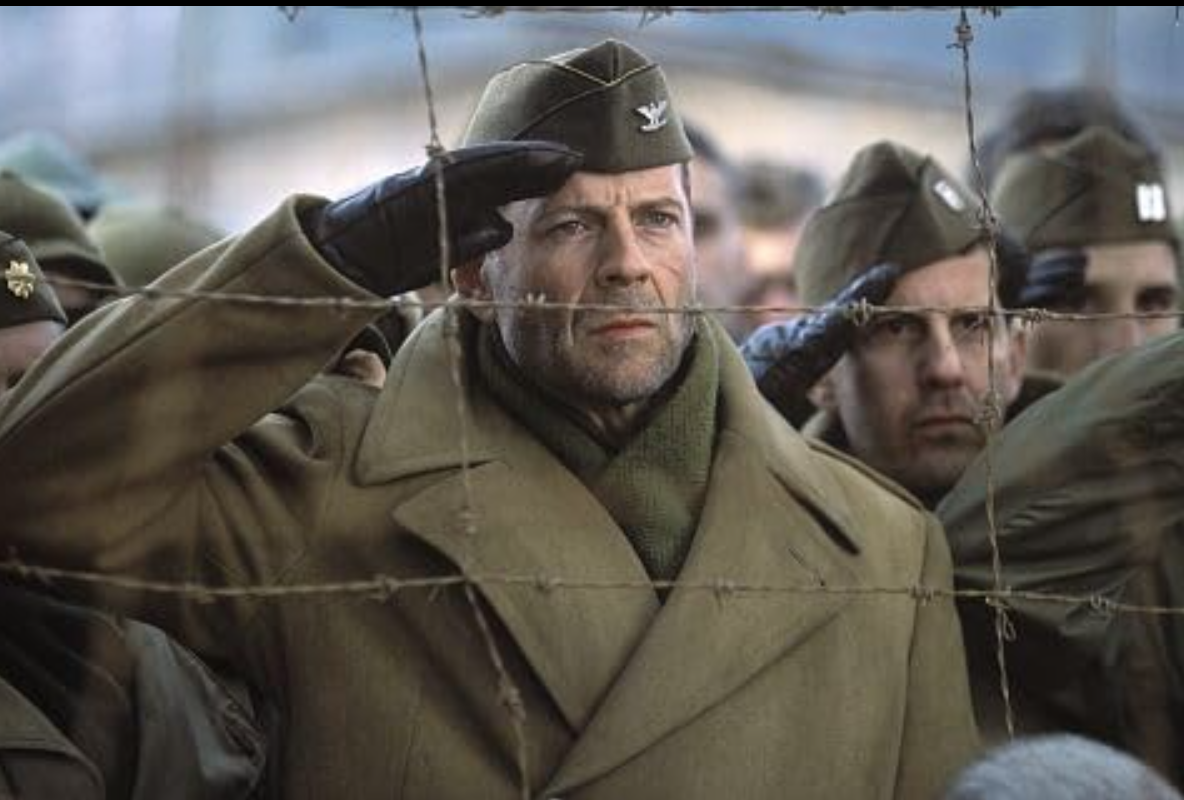
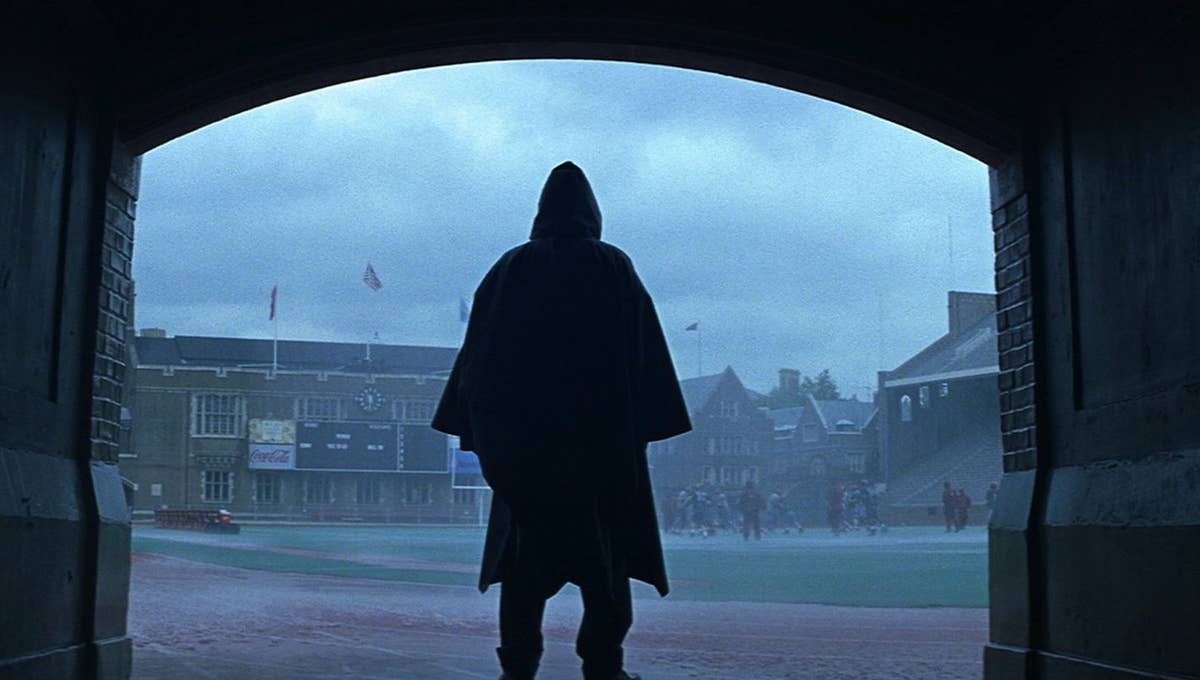
For some reason, for three days now, I’ve been obsessing about the 1985-89 ABC series Moonlighting, with Cybill Shepherd, once “just” a model, and Bruce Willis, who was kind of shiny and new, and with his hairline pretty much intact. I’ve been obsessing about him especially, but the two were brilliant together. Shepherd proved herself a deft comedienne, and I later became a big Willis movie fan. My favorites aren’t the Die Hards but the two films he made with M. Night Shyamalan, The Sixth Sense and Unbreakable, where his performances were nuanced and, to me, deeply moving.
But this show was charming and innovative. Breaking the Fourth Wall in this season opener, for example:
And sometimes it had the audacity to get philosophical:
And it was never afraid to allude to literature. Dr. Seuss, for example:
Or Shakespeare. In “Atomic Shakespeare,” the show took on Taming of the Shrew. Hit it, Bruce:
Shepherd’s Maddie could sing, too. This is lovely:
And sometimes they danced. Willis was surprisingly good. And Shepherd was at least game.
The show lasted four seasons but probably should have ended at two and a half or three. It burned out its stars, who couldn’t sustain the high bar it had set or the toll it had taken on their professional relationship. It burned out its writers, too, who lapsed into cutesiness and destroyed the sexual tension between David and Maddie by having them give into it.
But it was a grand ride; when it was good, Moonlighting was very good.
As was Willis, an actor I enjoy immensely.
What probably brought on this Moonlighting musing is his struggle with aphasia. God has graced him with a supportive and loving family. Willis has graced me with a host of memorable characters—including Moonlighting’s David Addison, Jr.
Many years ago, we went rowing on the Cherwell River, which joins the Thames near Oxford University. Well, Elizabeth rowed. I was attending to our picnic lunch, which needed attending to.
So, for some reason this morning, I was thinking of movies filmed on the Thames, and here they are some that I found.
My favorite remains Henry VIII’s arrival via royal barge in A Man for All Seasons. The music is magnificent, too, and the way the crews raise their oars and glide into shore is elegant. Okay, I like the James Bond boat chase, too.
1. The World Is Not Enough. Bond films are always good for chase scenes, but this one, with a soggy Pierce Brosnan, has to be one of the best.
2. Let’s tone it down a bit. How about Ringo’s disconsolate walk in A Hard Day’s Night?
3. In Harry Potter and the Order of the Phoenix, we get an aerial view.
4. We use the Thames to assassinate model Kate Moss in Absolutely Fabulous: The Movie.
5. And, speaking of assassination, Elizabeth I’s narrow escape in 1998’s Elizabeth:
6. Joseph Fiennes woos again, trying to chase down his muse, Gwyneth Paltrow, in Shakespeare in Love.
7. Alex pulls off a coup among his group of droogs alongside the river in what remains such a disturbing film, Kubrick’s Clockwork Orange (1971).
8. Ah, but here’s the masterpiece: Henry VIII arrives for dinner at Thomas More’s home in Fred Zinneman’s A Man for All Seasons (1966). The music. by Georges Delerue, is glorious, as is the cinematography.