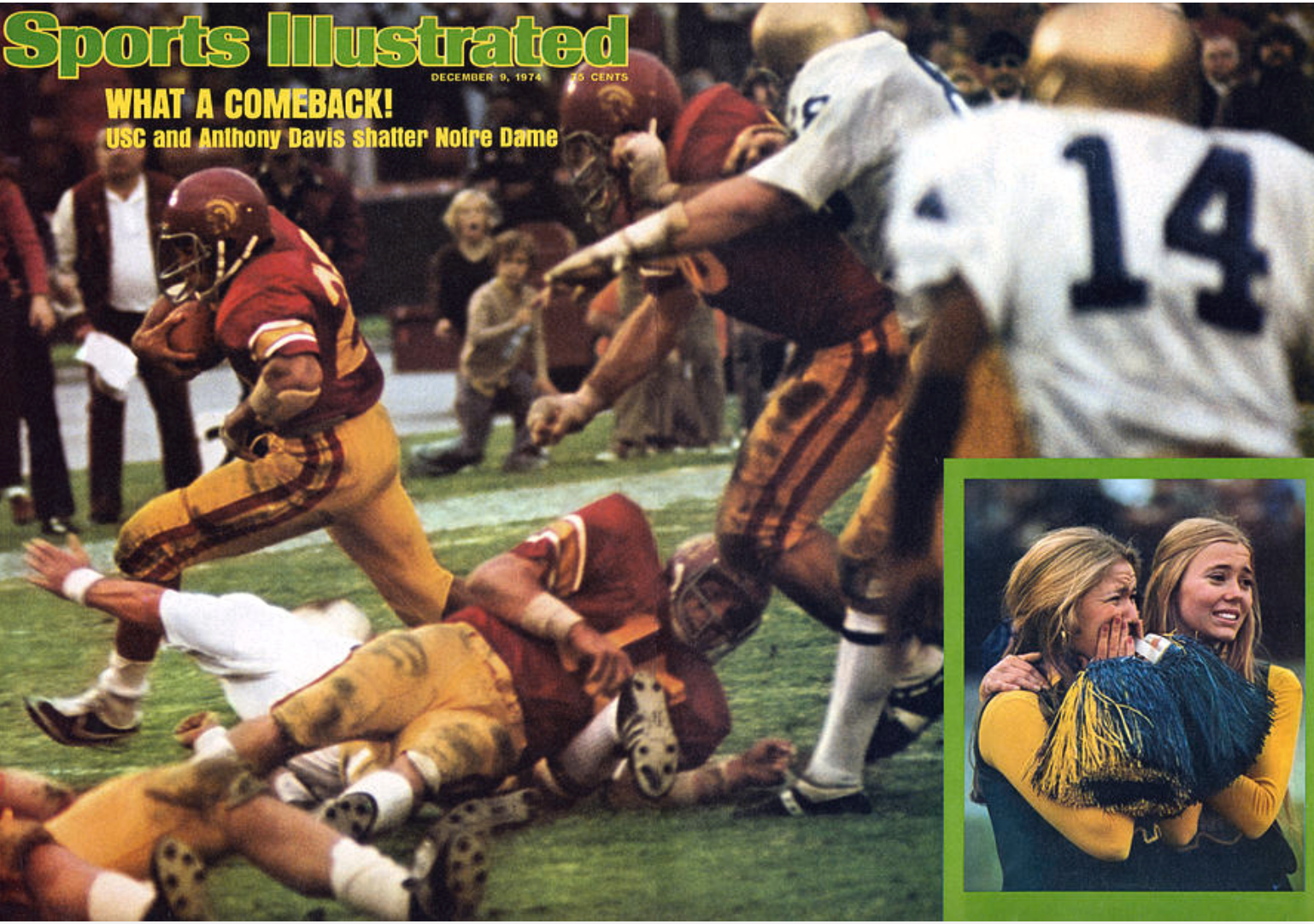
In truth, I could’ve done without the crying Notre Dame cheerleaders.
Well, Washington beat Oregon Friday night in the last Pac 12 Championship. I am sad to see the conference break up. I think that Washington State will play in the same league as Manchester United and Arizona might have the Edmonton Oilers on their schedule next year, I don’t know.
It was the Pac 4 in 1915, when the league was formed: Cal, Washington, Oregon and an agricultural college that is today Oregon State
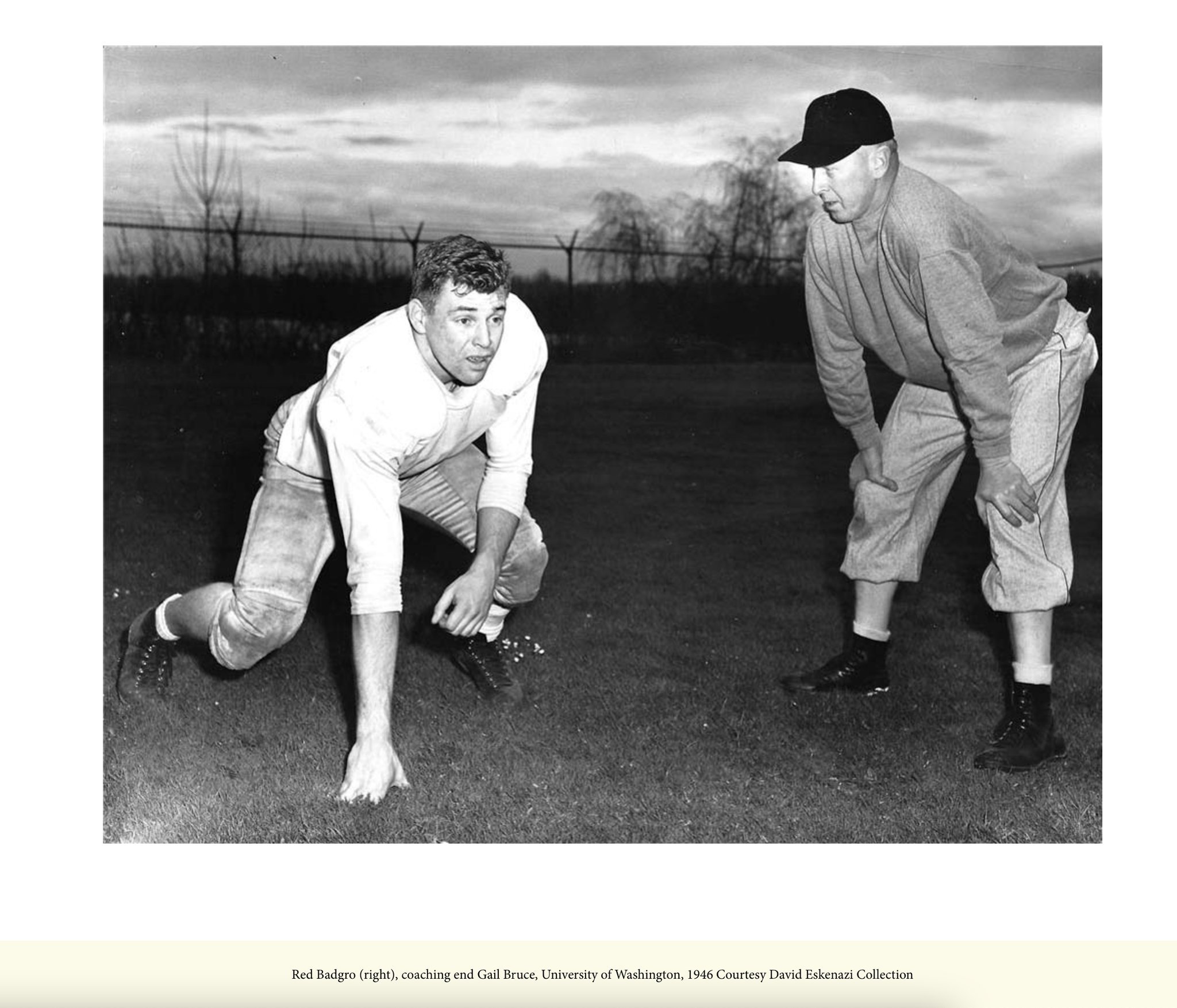
In the late 1940s, Elizabeth’s Dad played end for Washington and he went on to play for the 49ers. Football was his ticket out of poverty.
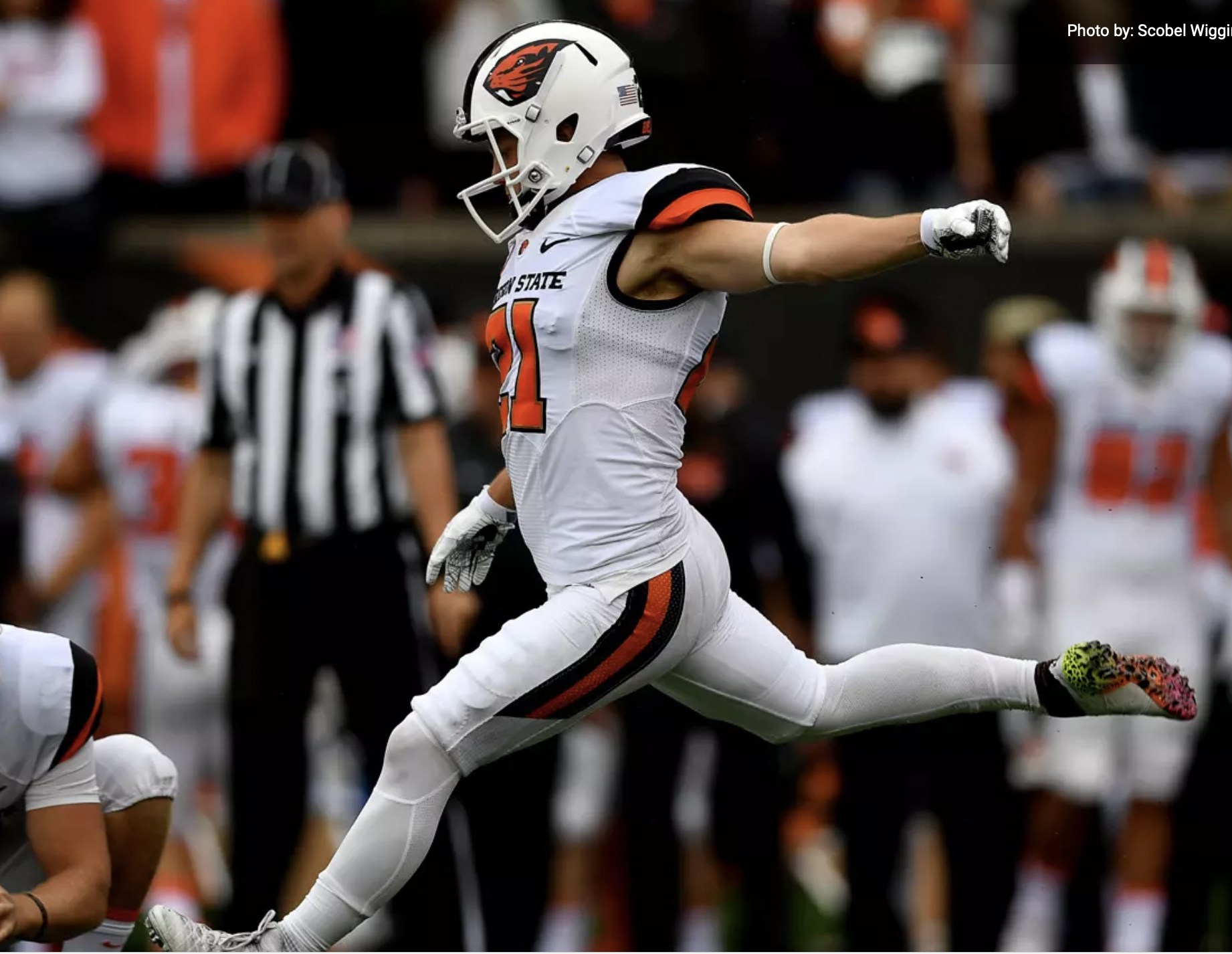
A decade ago, AGHS sent kicker Garret Owens, a fine young man I had the honor to teach, to Oregon State. along with fellow Eagles Brent Vanderveen and Garrett Weinrich.
And one of Elizabeth’s brothers, Kevin, who passed away this year, played in three Rose Bowls under USC coach John McKay. He was a runty linebacker who became the Trojan defensive captain because he was also really smart.
I was in Missouri atop the very famous and beautiful Ozark Plateua in 1974 when, on November 30, SC played Notre Dame. I was watching at my cousin Frances Sally’s house. The Irish were leading 24-6 at the half and my Missouri kin were making fun of Californians. “Them Trojans are playin’ like SISSIES.” (I am exaggerating. But not much.)
Then USC came back, thanks to running back Anthony Davis’s six touchdowns. My close personal friend Anthony Davis. (He met my Dad in Bakersfield one day and then my phone rang. Dad said “There’s somebody I want you to talk to.” Then another voice said “Hi, Jim! It’s Anthony Davis.” I stopped breathing, but only for about an hour.)
Final score that day: USC 55, Notre Dame 24. And this was Ara freakin’ Parsegian’s Notre Dame. He is one of the greatest football coaches in college history.
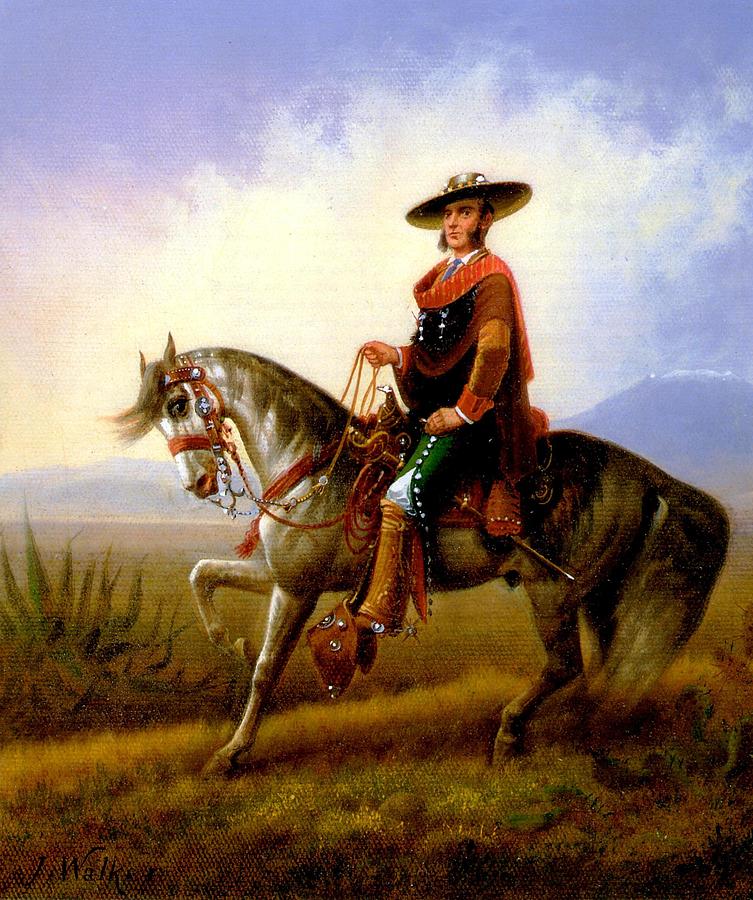
A California ranchero suitably dressed (and tacked) for the holidays.
Since Arroyo Grande founder Francis Branch assumed Mexican citizenship to obtain the 1837 patent on his 17,000-acre Rancho Santa Manuela, his family’s Christmases would’ve had a distinctly Mexican flavor.
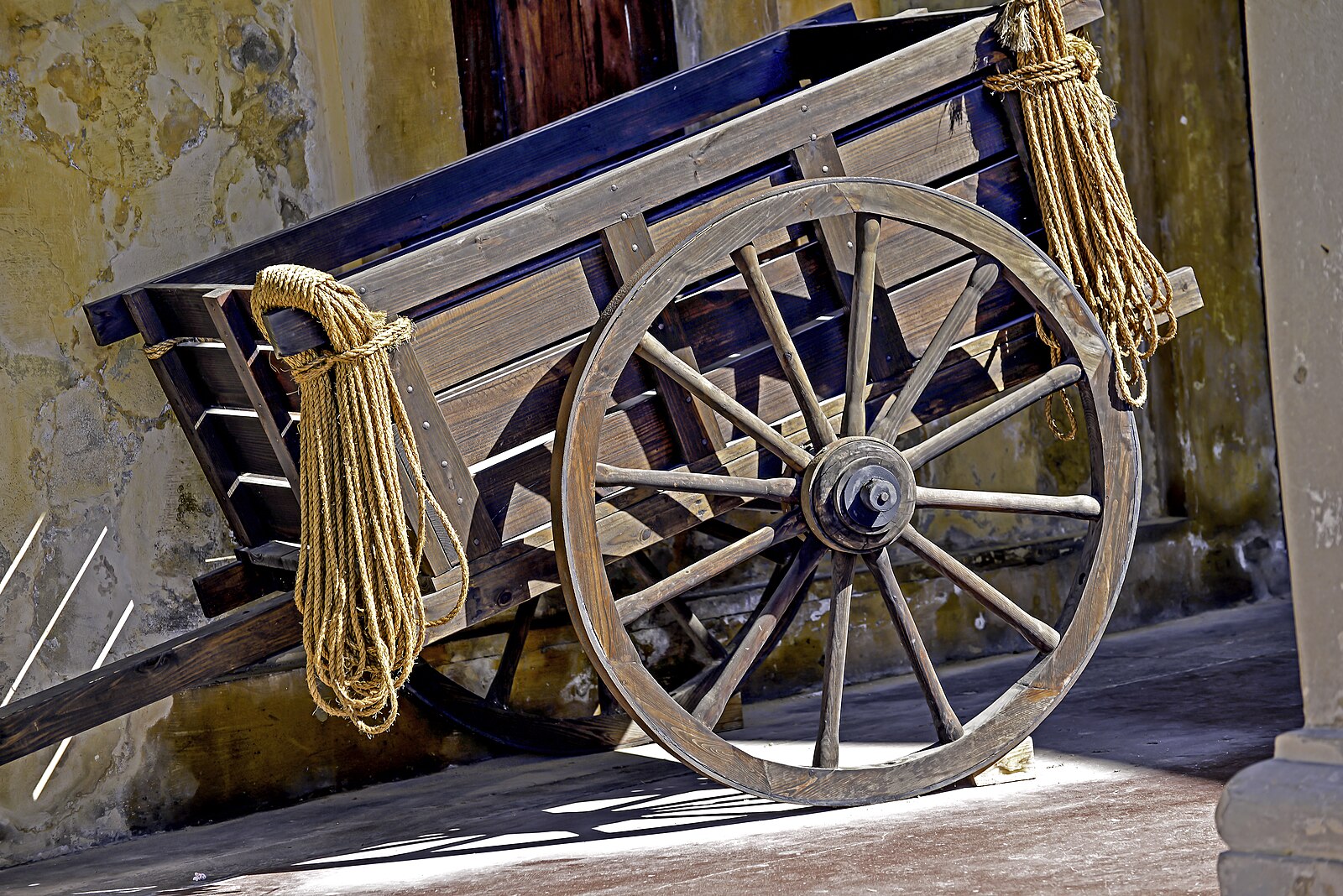
The dean of county historians, Dan Krieger, wrote a 2018 column with his wife Liz about Christmases in the rancho days. Rancheros, Krieger explained would’ve ridden into San Luis Obispo dressed in their finest, including their silver-inlaid saddles. Their families might’ve followed in the two-wheeled carretas, or carts, decorated for the occasion.
A carreta ride from Santa Manuela to the Old Mission couldn’t have been comfortable.
In town, Branch and his wife, Manuela, might’ve attended Christmas Eve mass. That would be followed by a Christmas play that focused on the shepherds’ discovery of the Christ child. And, for children, no holiday celebration would’ve been complete without the piñata, filled with the sweets that would spill out once the successful blow had been delivered.
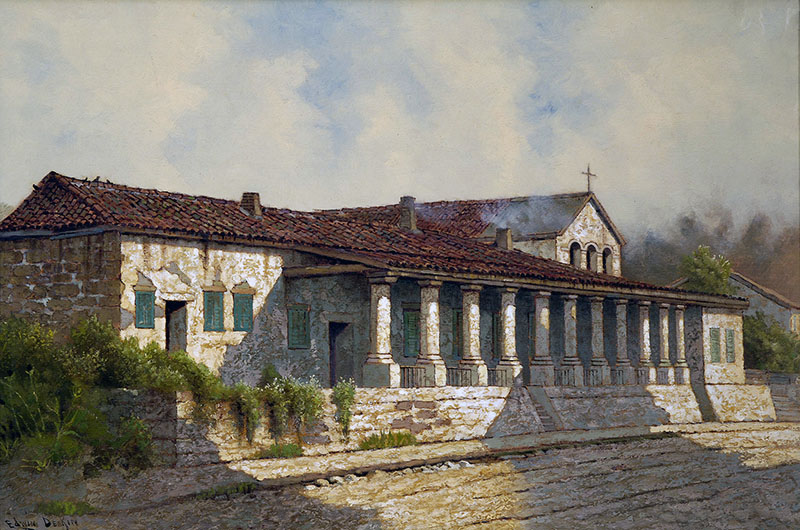
Mission San Luis Obispo.
It was Queen Victoria’s German husband, Albert, who introduced the Christmas tree to the English-speaking world, and by the 1890s, it was central to Arroyo Grande’s celebrations. An 1896 Arroyo Grande Herald notes the big tree sponsored by the Grand Army of the Republic—Civil War veterans—put up outside their hall on Bridge Street, roughly across the street from the IOOF Hall.
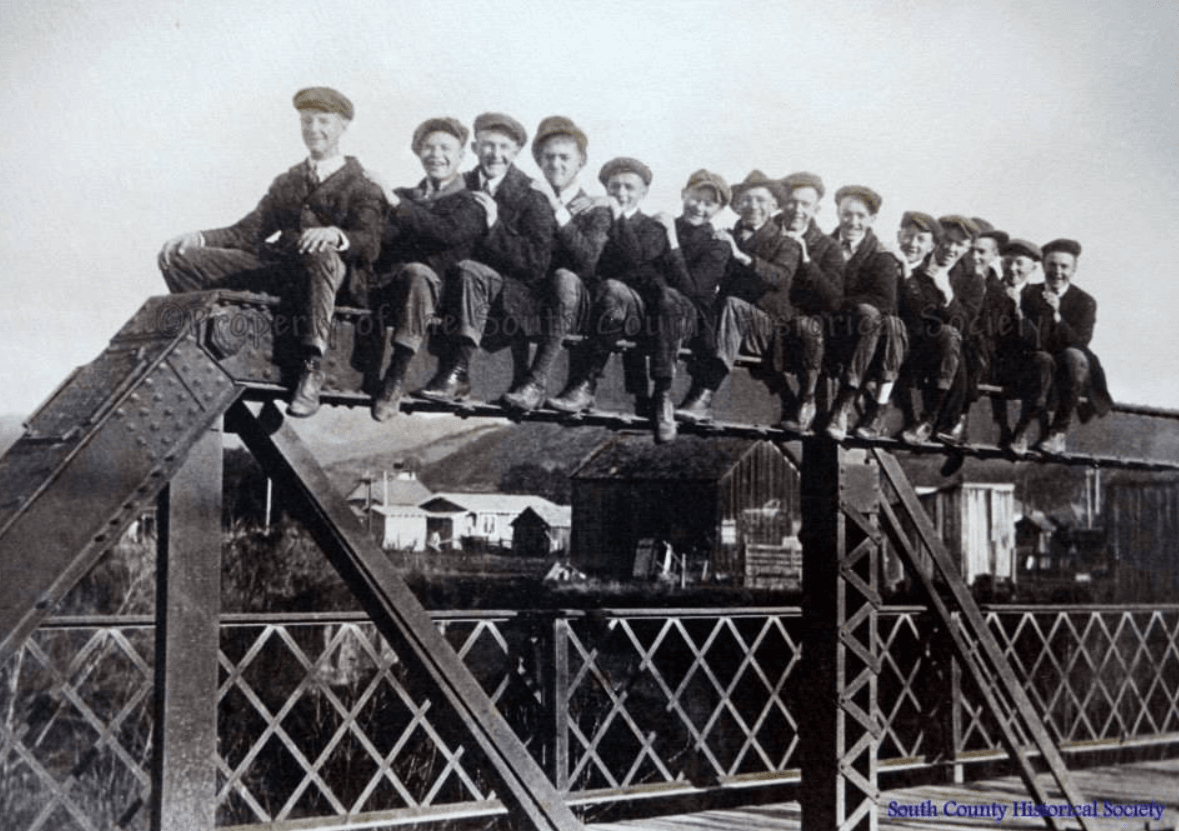
Young lads atop the Bridge Street bridge, built in 1909.
Later, community Christmas trees marked the holidays. The whole town gathered for its lighting in a custom that began in 1898 went into the 1940s. The Christmas trees were tied to the nation’s history: a 1937 Herald-Recorder article—this Christmas was observed during the Great Depression–notes with some alarm that the community Christmas expense fund, whose goal was $100, had not yet been met. Another issue Depression-era paper notes the generous contribution of a man who sent a check for $2.50 toward that year’s Christmas fund.
Sadly, a December 5, 1941 article anticipates the lighting of that year’s tree, an event that never would have happened because of the strict blackout regulations enforced immediately after Pearl Harbor. Arroyo Grande would later learn that two of its own, sailors on USS Arizona, had been killed on December 7.
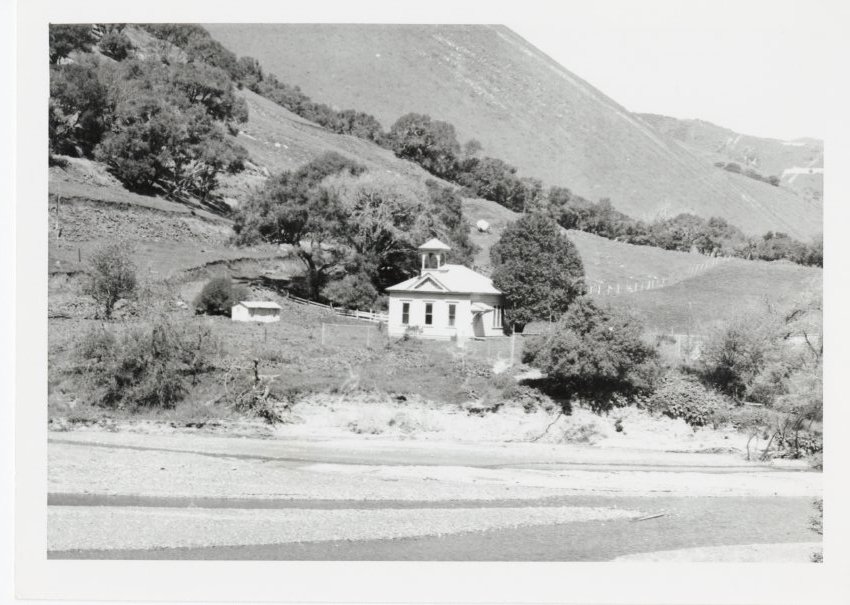
Santa ManuelaBranch Elementary
School pageants were another way to the bring smaller, rural communities that surrounded Arroyo Grande together; little country schools were central to farm life in Arroyo Grande; they served as voting precincts and as meeting places for organizations like the Farmers’ Alliance.
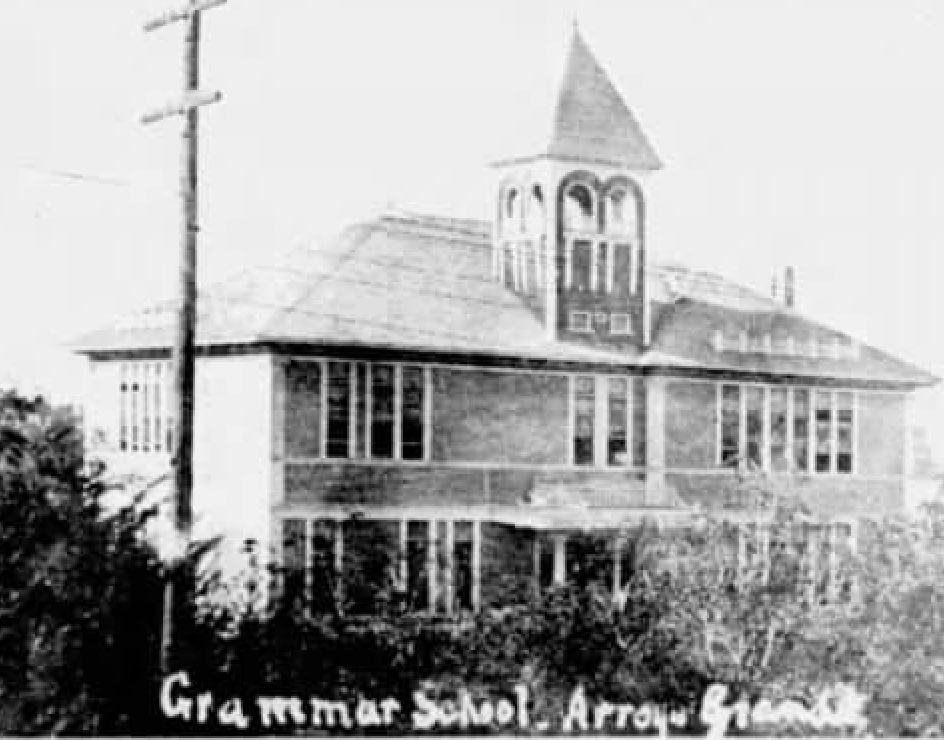
In town, an 1896 Arroyo Grande Grammar school program includes a play entitled “Brownies in Fairyland,” with an extensive cast that includes many pioneer surnames—Clevenger, Phoenix, Ballagh, Parsons, Musick, Whiteley and Silva are among them.
Even the tiny Santa Manuela School had a pageant in 1936, featuring familiar carols like “Hark! The Herald Angels Sing” and less familiar ones, like “Down the Chimney.” The teacher, Adelaide Rohde, would’ve spent countless hours rehearsing her students in addition to teaching her daily lessons, directed to multiple grade levels in a school that probably had no more than twenty or twenty-five students. But Santa Manuela was still prominent enough so that Santa himself made an appearance at the end of the program, handing out bags filled with popcorn and sweets, including to Miss Rohde and the eight audience members.
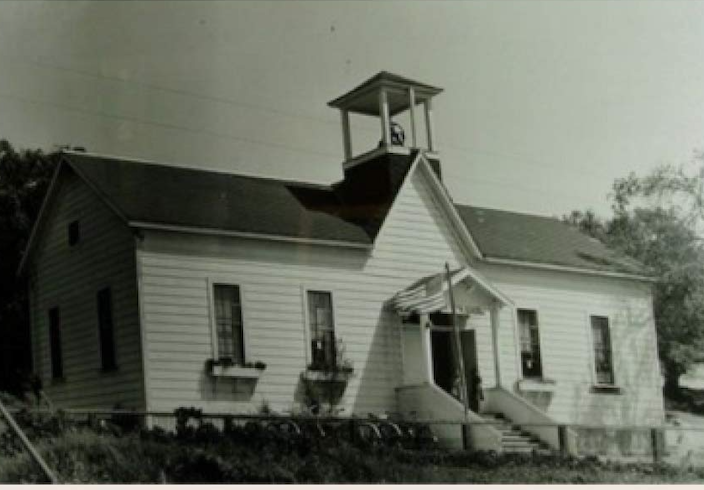
Since Branch School was twice the size of Santa Manuela—two rooms—it attracted an impressive audience of 125 in 1934. Both teachers—Mrs. Bair and Miss Whitlock—were also from prominent families—the Bairs ranched in the Huasna Valley and the Whitlocks owned the Commercial Company, a dry-goods store on Branch Street. The names here, too are familiar, many of them Azorean—Coehlo, Silva, Amaral, Reis—but George Cecchetti Sr., whose father came from Pisa, and four Agawas, two boys and two girls, whose parents came from Japan, also sing and act. The program features two harmonica solos, one by Billy Agawa and another by Francis Fink, who performed “Red River Valley.”
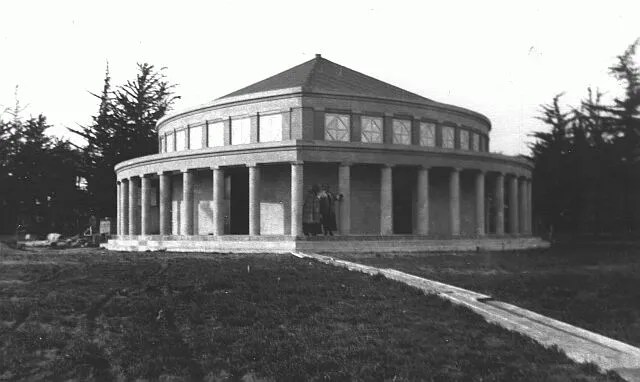
The Temple of the People’s Christmas observation seems to have been organized by Madame Borghild Janson, “the noted teacher of vocal culture.” A 1927 Herald-Recorder notes that the previous year’s program “overfilled” the Hiawatha Lodge, so 1927’s would feature two performances. Madame Janson staged a mystery play, a medieval tradition whose subject was biblical stories or the lives of the saints. In her choice of songs, she stuck to her theme. “Scandinavian Christmas songs from the 12th century” were part of the part of the program as well as more familiar Christmas carols.
The Temple of the People will celebrate its 100th anniversary in 2024.
A common thread in all of the holiday observations is the bringing together of people; Christmas broke down the isolation typical of far-flung rural farms and ranches. Seeing distant friends and neighbors must have been as much a celebration as was Christmas.
Adapted from The Heritage Press, published quarterly by the South County Historical Society. (Membership is $25 annually for individuals and $40 for couples.)
My new favorite way of procrastinating, and my ways of procrastinating are legion, are looking for covers of songs I love. They’re not always better, mind you, but sometimes a new interpretation is so good is that it reminds you of how good the original was. I love, have always loved, Neil Young, so this Dave Mathews cover of “Cortez the Killer” is amazing mostly because of the guitarist’s solo. His name is Warren Haynes.
“Like a Hurricane” is Neil Young another favorite. Bryan Ferry (Roxy Music) covers it in Lyon France. Ferry’s not the main attraction–the keyboardist-turned-saxophonist is ethereal.
The main attraction for me in one of my favorite Rolling Stones songs is the trombonist playing with the Tedeschi-Trucks Band. She is incredible.
Because they’re kids and just learning, the School of Rock people have put a few YouTube videos that are a little painful. I think these two have great merit. The lead singer nails “California Dreamin'” and the boy drummer and the girl bassist are freakin’ adorable.
Is it the same lead singer here? Being so young, has no right to “get” a song like this. She does.
Sometimes the interpreters are themselves exceedingly famous. Miley Cyrus’s cover of the Dolly Parton classic is, I think, stunning, and it preserves the song’s Appalachian-ness, a word I just invented. (I also like her cover of the Doors’ “Roadhouse Blues,” but it’s too racy for me to include today. It’s in another post about her, though.)
Miranda Lambert and The Gurlz do this Elvin Bishop classic justice—I like her jazzy voice. Lambert’s an animal lover, so I think there are one or two Great Danes in the studio.
I think everyone in the Western Hemisphere knows that I have a crush on an Austrian duo, the MonaLisa Twins. This was the first video I saw of them; I love also their sense of humor:
They perform at the Cavern Club in Liverpool, a replica of the club the Beatles played in Hamburg just before they hit the Big Time:
Los Lobos will never escape their cover of the Richie Valens classic. I think we’re all glad about that. I love this band. I love this performance at Watsonville High School in 1989. I’ve seen Los Lobos in concert twice. “La Bamba” got EVERYBODY cheering and dancing at both. Look at all those happy people in the audience:
Foxes and Fossils covers EVERYBODY, but I like this one for the lead singer and for the backing vocals that replicate the harmony and the punctuation (“Now don’t….don’t, don’t, don’t…) He’s right. There isn’t a good way to end this song:
“You’ve got spunk!” Lou Grant said in the first Mary Tyler Moore show. Mary Richards blushed and admitted that maybe she did. “I HATE spunk” Grant’s rejoinder was classic. So’s this song, and the lead singer has spunk.
This has always been one of my favorite Fleetwood Mac songs, and it is apparently eminently cover-able. Big big Super Bowl-esque production values here for the country group Little Big Town, and Keith Urban is showing off, but it’s still mighty darn lively. Oh, look! There’s Nicole Kidman!
Laura Nyro was one of my generation’s most gifted songwriters. Sara Bareilles, who knocked me out as Mary Magdalene in a live TV production of “Jesus Christ Superstar,” makes this song celebratory. Look at the happy people in the orchestra! The occasion? The induction of Nyro into the Rock Hall of Fame.
Hear, hear.
Just one more. In very distinguished company, watch Prince take over “While My Guitar Gently Weeps.” Sublime. He was our Amadeus.
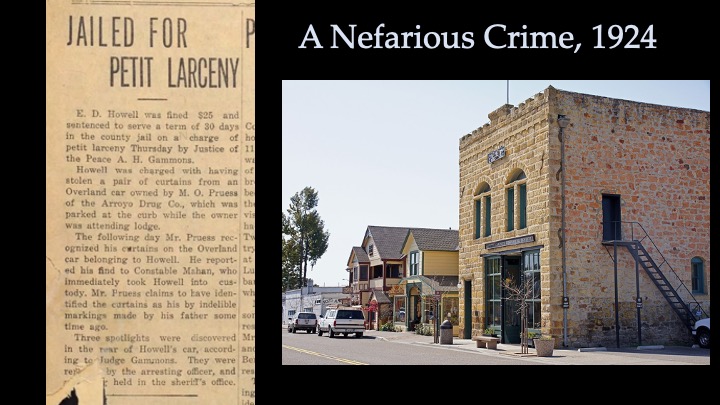
This article from the January 3, 1924 Arroyo Grande Herald-Recorder records a theft on Bridge Street. Mr. Pruess’s automobile curtains were stolen while he was in a lodge meeting. A little research evealed that the town druggist was a steadfast member of the International Order of Odd Fellows (an organization more popular than the Freemasons in the late 1800s) and so it’s likely that the crime took place here, on Bridge Street, outside the IOOF Hall that is now the South County Historical Society’s home.
Several things about this little story amazed me. Judge Gammons threw the book at the malefactor, a $23 fine (over $400 in 2023 dollars) and 30 days in jail. His victim, Mr. Pruess, was enormously popular. His friends included Ole Gullickson, likewise popular, and the two were among a group of local businessmen who went deer-hunting annually somewhere up north. They always bought lubricant–whiskey– first, purchased on the beach from a local bootlegger. Ole’s son Don remembered this because they always took Ole with them. Nobody would suspect and illegal booze purchase with a six-year-old -boy amid the grown men.
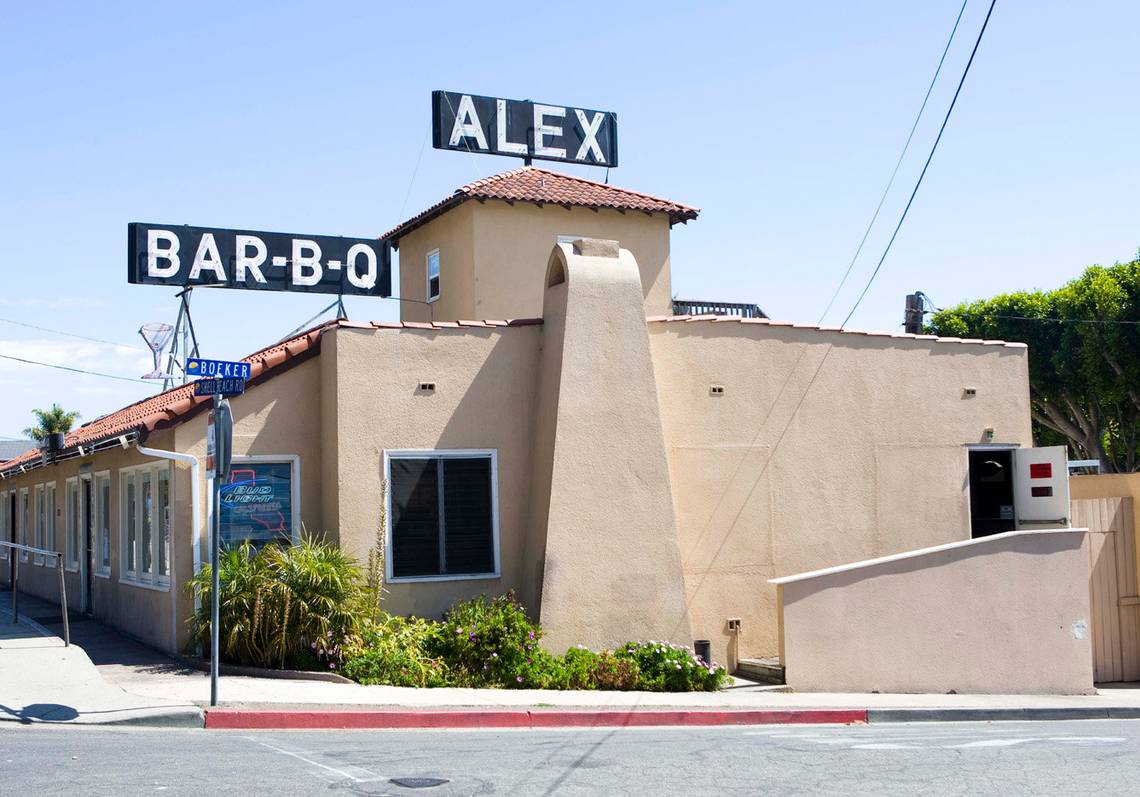
Don, probably in the Top Ten of the nicest people I have ever met, told me this story. He wasn’t 100% sure, but he thinks they bought the whiskey from “some guy named Alex.”
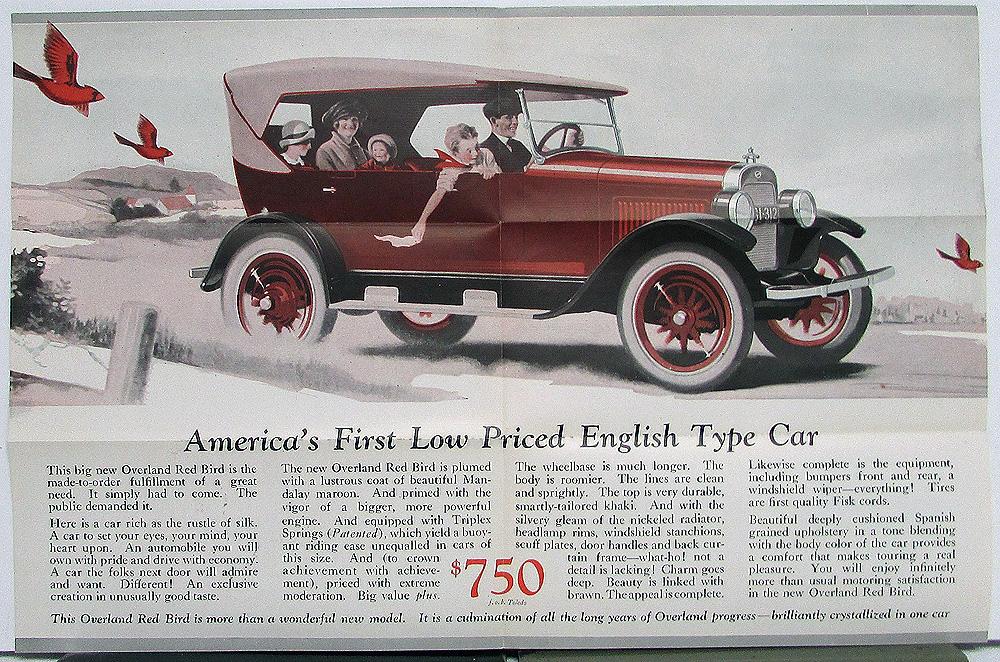
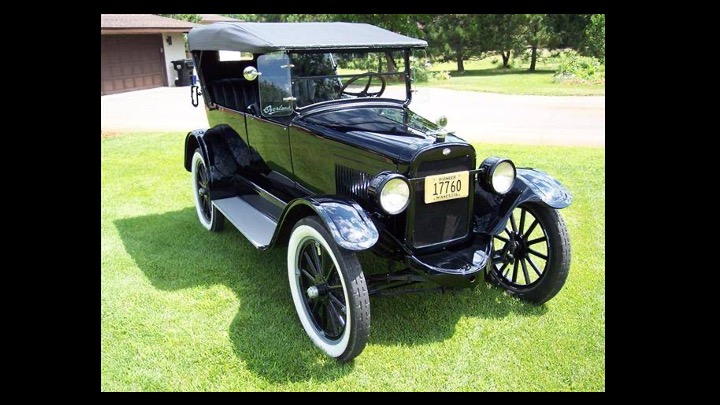
Mr. Pruess’s car was an “Overland,” a brand I’m not familiar with. So I looked it up. The ad above is for a 1923 model. The arrest came about because Mr. Pruess recognized his curtains the very next day.They were inside another Overland.It must’ve been a popular make then, even though it’s not around today.
Unlike Alex’s, almost not around.
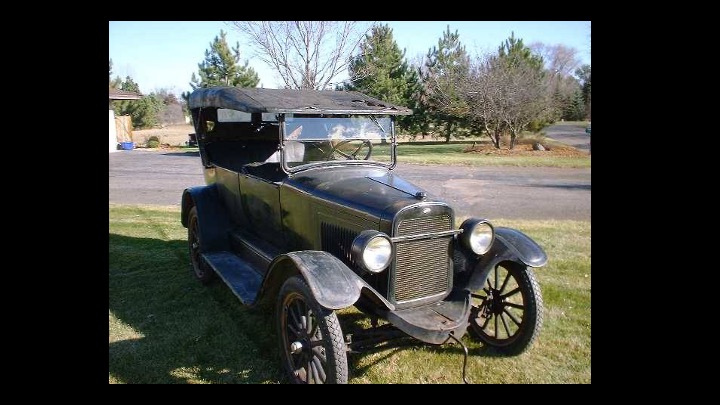
Look at the job one man did in restoring this 1924 Overland, at one point in pieces in his garage. It took three years. It’s a beautiful car, I think, even though when you look closely at the front bumper, you realize that folks needed one of those arm-breaking cranks to start the engine.
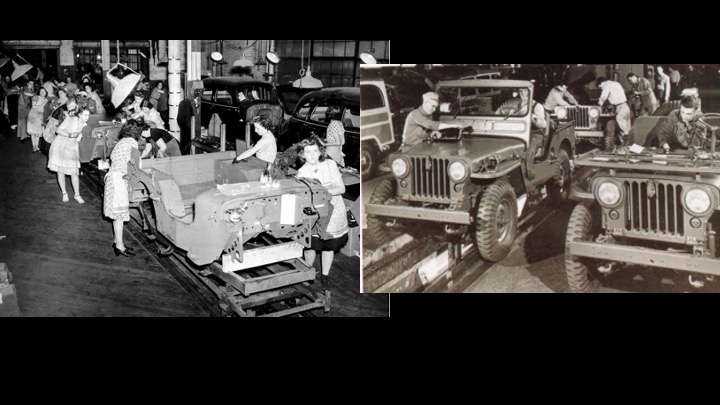
I had one more little search to do. Who made “Overlands?” It turned out that the man was one John Willys, whose name will be connected forever to a little four-cylinder car that went to war after Pearl Harbor. Here are some of them being made at the Overland-Willys plant in Toledo, Ohio. John Willys was the father of the Jeep.
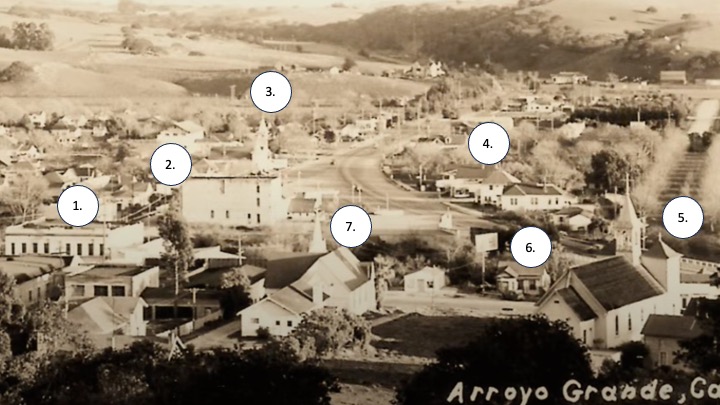
One more thing: I love photos of Old Arroyo (we do not use the term “The Village” in my house. It’s pretentious.), so here’s one that includes the IOOF Hall, built in 1902.
The Olohan Building, home to Klondike Pizza. (I think, but I’m not sure, that the Mosher building is across the street, at the left lower edge of the photo. It’s Posies in the Village today; in the 1920s, it was the Mission Theater, busy showing silents and then talkies.)
The IOOF Hall.
The Presbyterian Church. Some Lucia Mar offices are there today.
The doctor’s office–a beautiful building. It was Dr. Cookson’s office when I was little and today it’s a pediatrician’s office.
St. Patrick’s Church, which had to be demolished because of termite damage.
Mr. Giacomini’s house. He carved his own tombstone–it’s in the cemetery today, but he didn’t quite yet need it, it so he kept it in his front yard.
The Methodist Church, today the Harvest Church.
I’m a little unsure as to the picture’s date. The lettering suggests it’s from the very early 1900s, but I don’t see the very large and imposing grammar school, which stood on the site of today’s Ford agency. Its successor, the Orchard Street School, was a PWA New Deal project, so maybe this photo’s actually from the 1930s.
I hope, by then, that Curtain Thief E.D. Howell had taken up the Straight and Narrow Path in life.
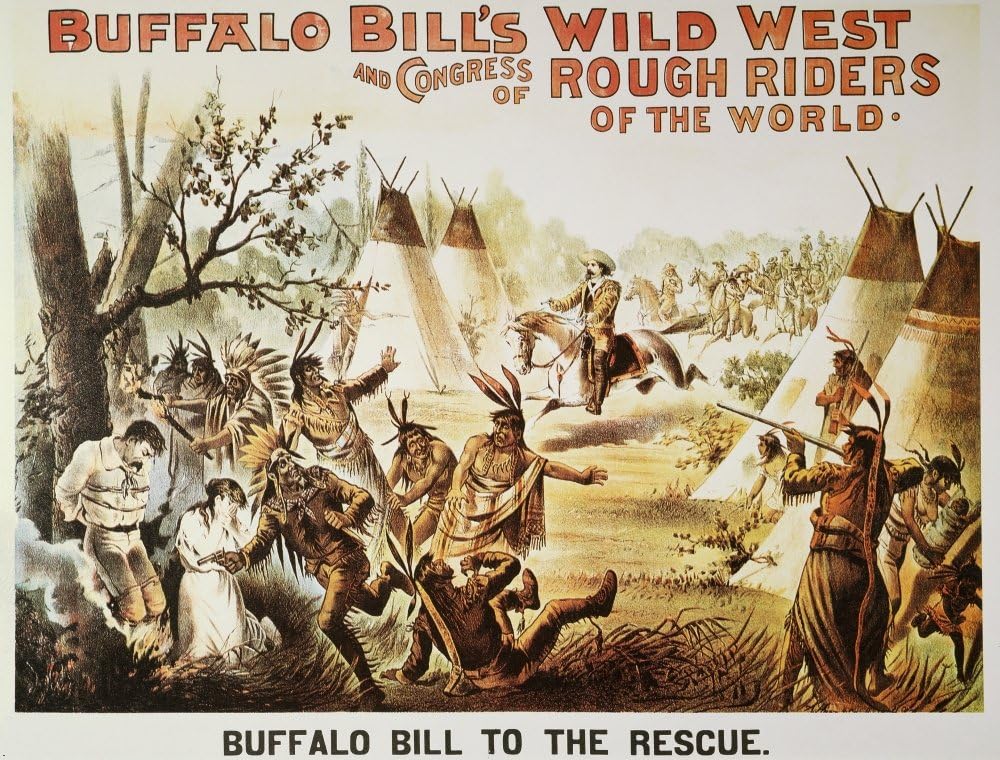
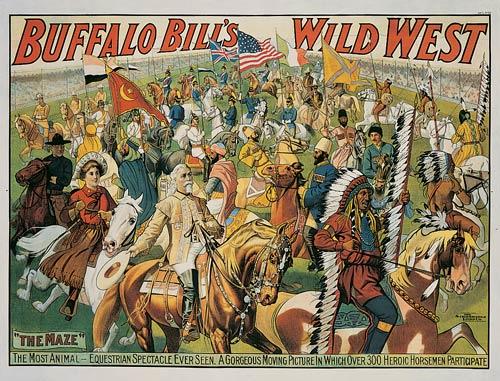
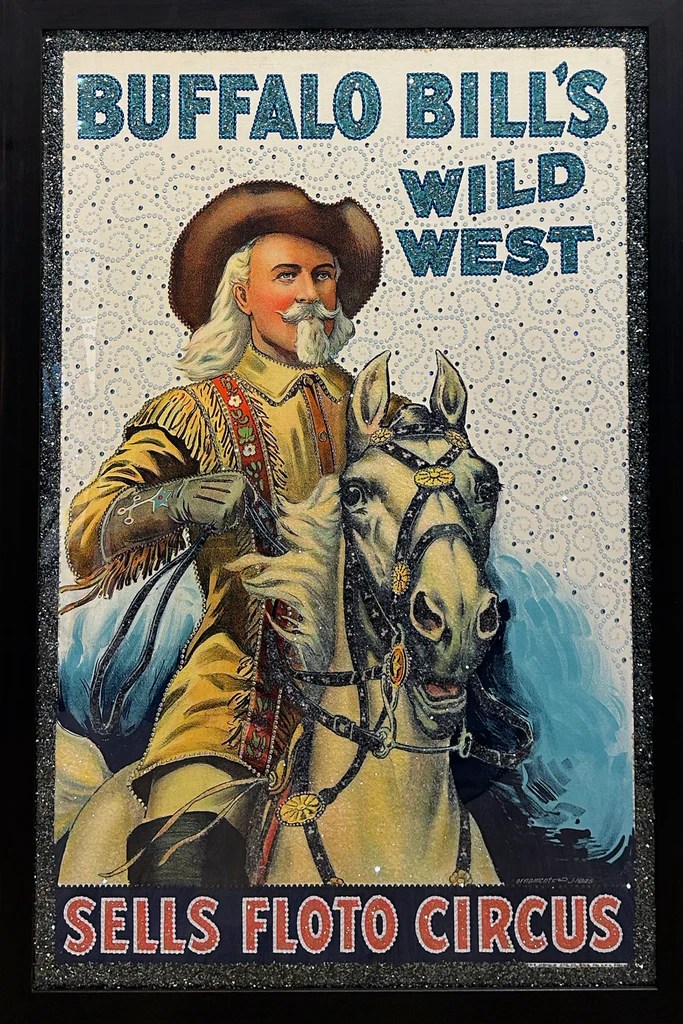
Long before there were the television Westerns I grew up with, and long before there was television, there was Buffalo Bill’s Wild West Show, which played all over the world, including for Queen Victoria and a panoply of royal princesses. What I did not know is that before impresario Bill Cody died in 1917, his Wild West show visited San Luis Obispo twice, once in 1908 and once more in 1914.
The advance the 1908 show got—notices in the Tribune for weeks beforehand–rivals the publicity for the first airplane flight over San Luis Obispo two years later. Here’s the poster locals would’ve seen in 1908:
And here’s the 1914 version, when Cody’s show, maybe fading a little by then, was traveling alongside the Sells-Floto circus:
San Luis was tiny, so where are you going to put all those elephants and lions and Bill’s buffalo? For the 1918 show, he City and the showmen finally agreed on Mitchell Park, which remains a park today, near the corner of Osos and Pismo.
San Luis Obispo Tribune, October 13, 1908
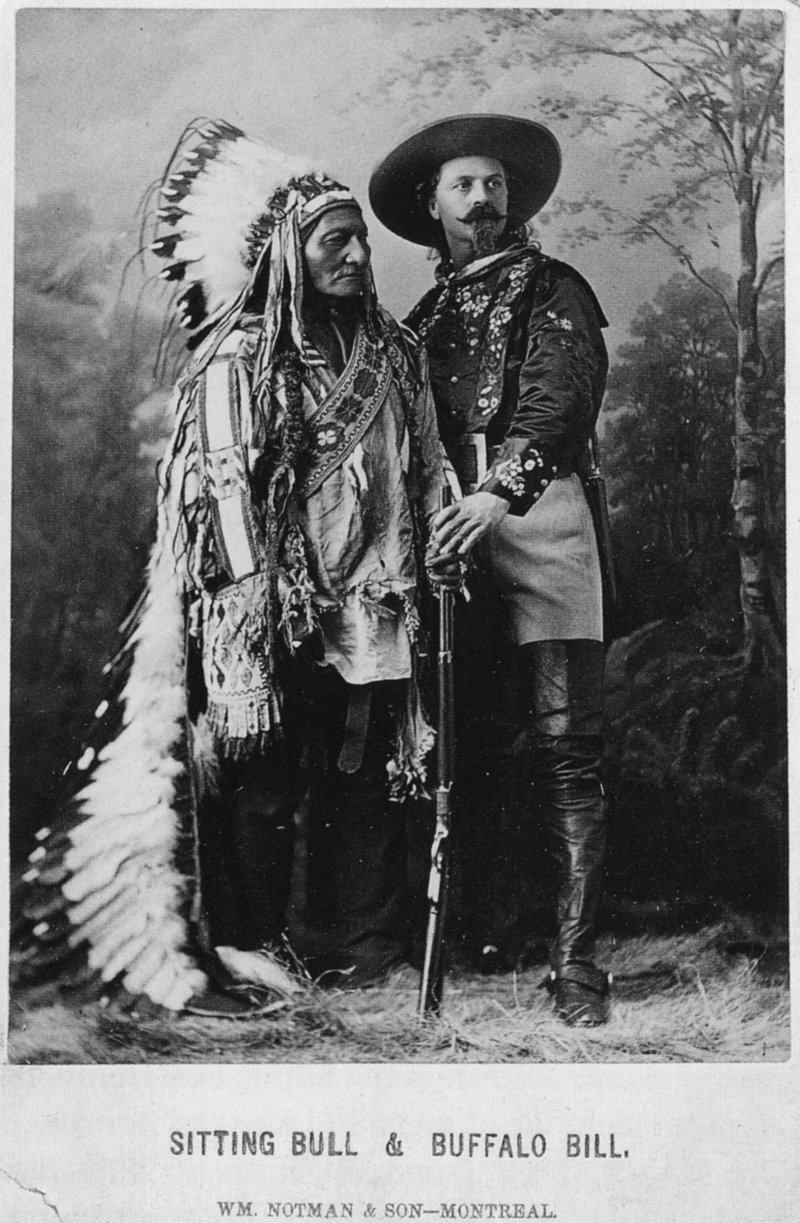
By 1908, a onetime main attraction was eighteen years dead. Sitting Bull, the Lakota Chief, appeared with the show in the 1880s, near the close of his life. He was shot dead by Indian police at the Standing Rock Agency on December 15, 1890 at the climax of the Ghost Dance movement .
(That was just two weeks before the Seventh Cavalry’s revenge at Wounded Knee. Nineteen troopers received the Medal of Honor for their hard day’s work in killing 300 Lakota. The troopers had to ride two miles to gun down two women running in the snow.)
Back at Standing Rock on December 15, one of Sitting Bull’s horses had been a souvenir from the Wild West Show, trained to rear and prance at the sound of gunfire. The horse did just that when the shooting broke out.
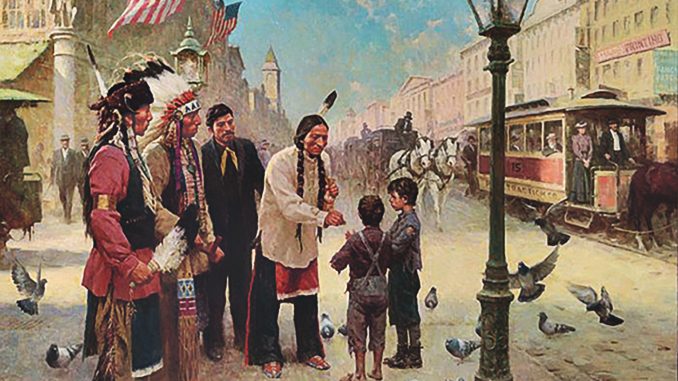
In 1884, one of the show’s stops was Philadelphia. In addition to his stipend for appearing with Cody, Sitting Bull sold autographs. Then, as was typical with him, he gave all the money away.
It was in Philadelphia where was appalled by the sight of ragged children in the street, so that was where his Philadelphia tip money went. Likewise, Sitting Bull’s contemporary, Crazy Horse—two Arroyo Grande settlers, soldiers in 1865, saw him perform a “dare ride” across their front—was the same. He was among the finest hunters in his band, and, on the return to camp, he made sure that widows and orphans were fed first.
The Lakota loved children. Another thing that shocked Sitting Bull in 1884 was that so many urban children worked, from shining shoes to factory machine-tending, which killed them sometimes. Children, he believed, should be free, and they should be free to play.
So the sight of ragged children, many of them immigrants, moved Sitting Bull. “The White Man knows how to make everything,” he remarked to his companions. “He does not know how to distribute it.”
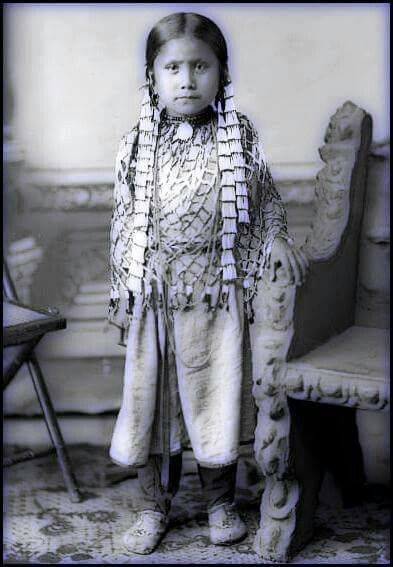
This is White Dove, one of his daughters:
Crazy Horse had a daughter, too. Her death had hurt him deeply. In the late spring of 1876, he visited his little girl on her funeral scaffold. He stayed for a few days, praying, fasting, talking to his daughter and listening for her answer. He got it. When he left, she had given him the calm he needed for the upcoming fight. All the Lakota knew it was coming. Sitting Bull had a vision of it happening. The fight was the one that would break out in the Valley of the Greasy Grass, what the waischus–White people—called “Little Bighorn.”
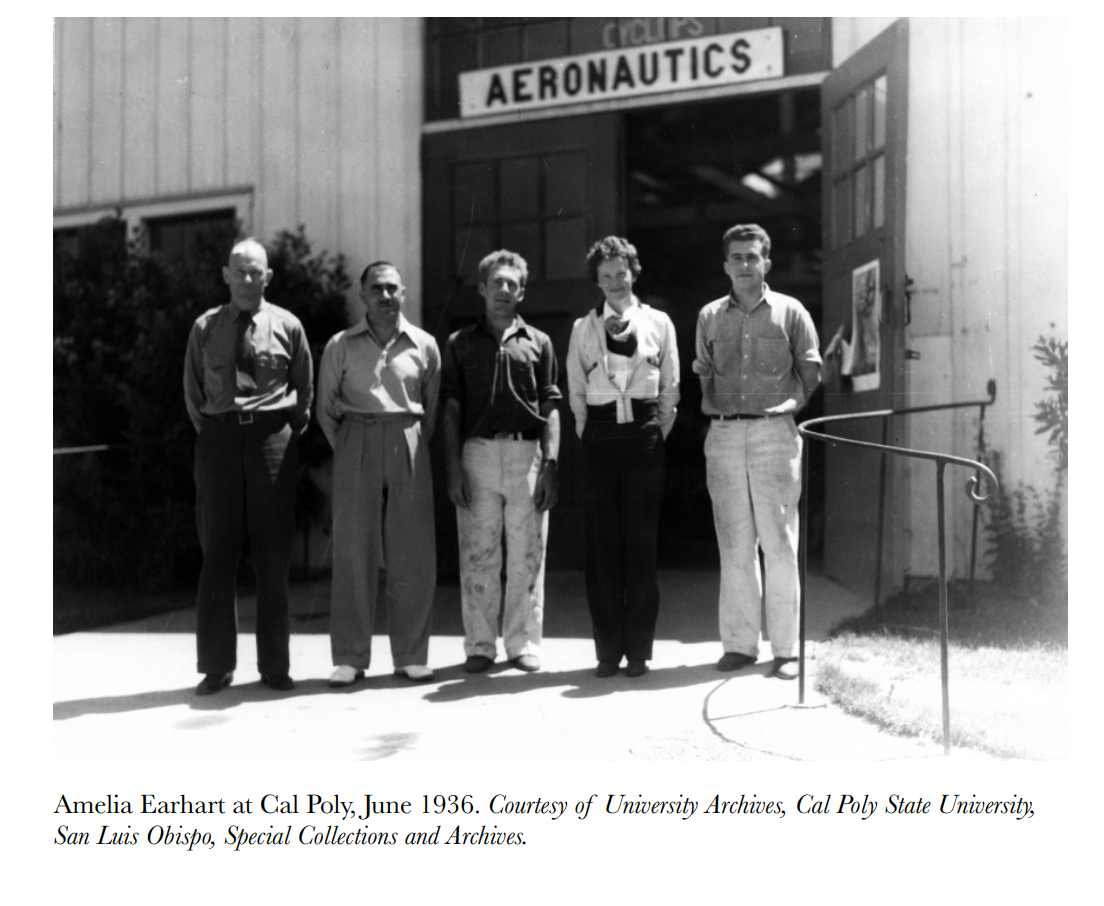
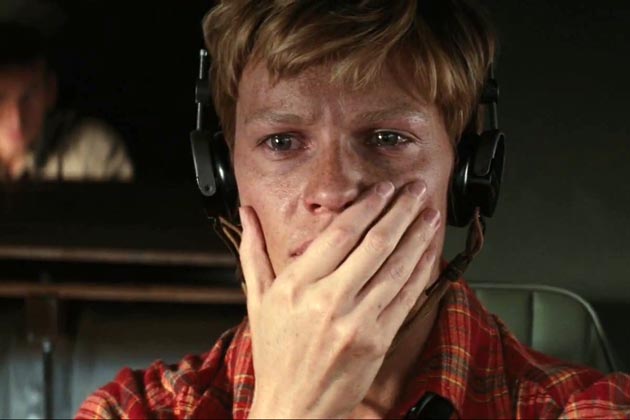
My AGHS teaching partner and dear friend Amber Derbidge (we both love airplanes) once loaned me her DVD of Amelia, the movie bio of the aviator’s life, and it just happened to be on the TV again yesterday and I got all misty-eyed again and damn if she and Fred Noonan didn’t disappear again. It happens every time. What’s haunting are the stories that seem authentic, about people who reported hearing Amelia’s voice over their short-wave radios for weeks after the Coast Guard lost contact with her.
In the movie, Hilary Swank’s Amelia knows she’s done for, and she gets misty-eyed, too, as the enormity of her situation sinks in. It’s heart-breaking.
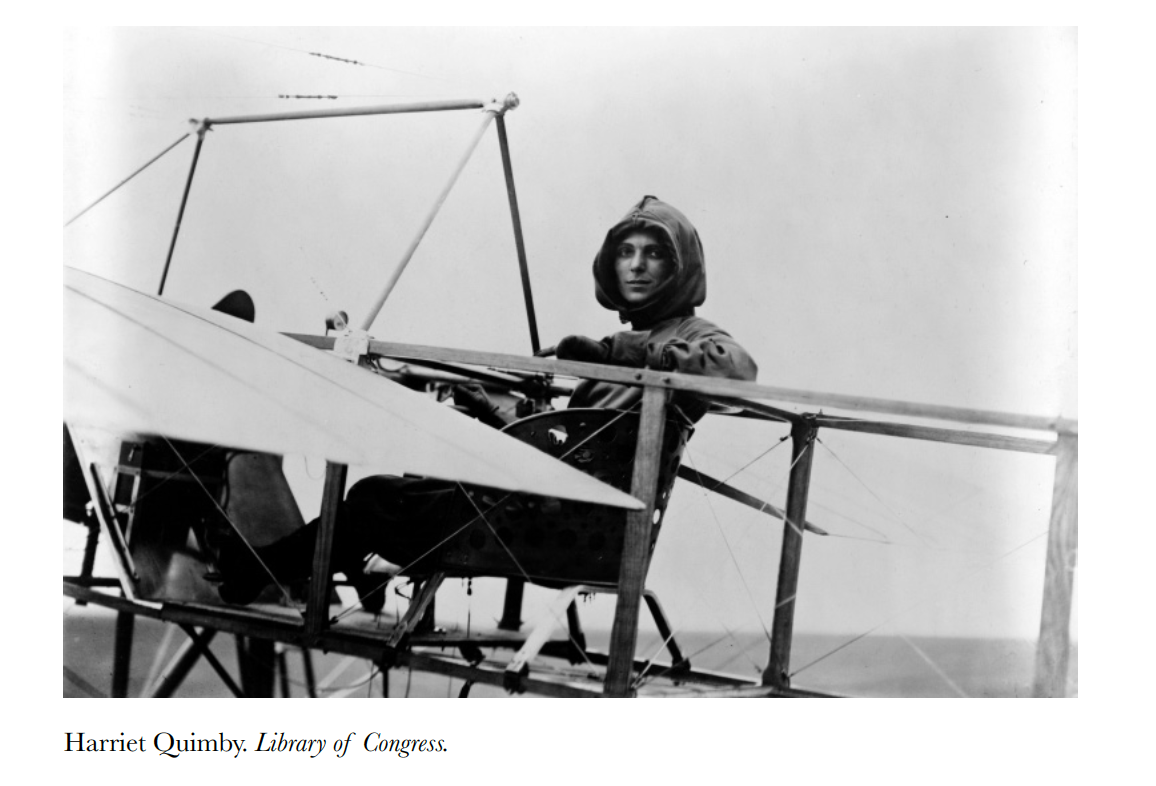
It’s obvious to say that early aviation was dangerous. Harriet Quimby, who claimed Arroyo Grande as her hometown, became the first woman in American to earn a pilot’s license. She was the first to fly across the English Channel in April 1912. In July, she was dead, killed when her Bleriot monoplane flipped and dumped her and a passenger into the ocean near Boston.
Harriet and Amelia and then I learned about Dorothy, who became yet another pilot-hero. She was a WASP. Here’s the story:
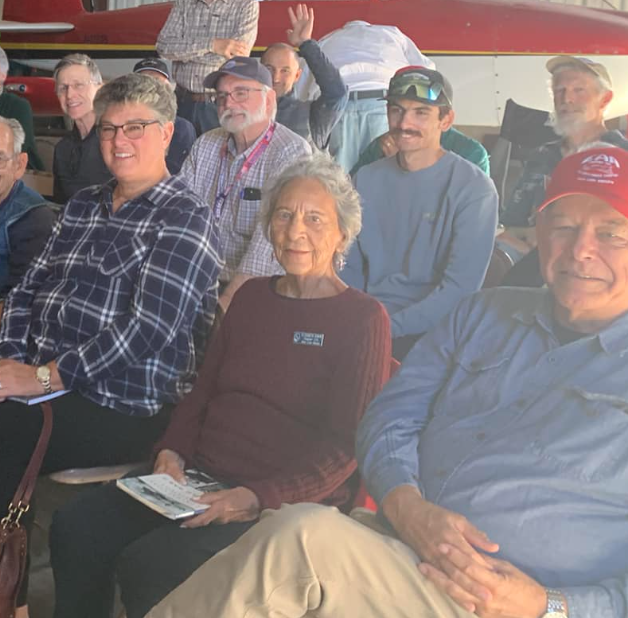
Dorothy Rooney died a few years ago at 102. But on Sunday, when I gave a talk on aviation history at the SLO Airport, I met Dorothy’s flight instructor, Elizabeth, once again. No, not her World War II flight instructor, but almost that good. I will try to approximate Elizabeth’s story. (Elizabeth wears little P-40 Thunderbolt earrings, which endears her to me).
My friend Elizabeth Dinan, center.
“Are there any female flight instructors here?” an older woman asked Elizabeth one day at McChesney Field.
“Well, I’m one.”
“Can you give a lesson?”
“Sure. When would like to go up?”
“Now. I flew a little during World War II and I just wanted to see if the magic was still there.”
So they went up. After fifteen minutes or so, Elizabeth asked her student, who was, of course, Dorothy May Moulton Rooney, if she’d like to take the wheel.
“Naw.”
A moment passed.
“OKAY!”
For the next forty-five minutes, Elizabeth’s student took the Cessna through its paces, kind of lazy-like.
“Why’s the rudder so sticky?” Dorothy asked.
Elizabeth realized that Dorothy had been used to flying military trainers and warplanes, and the Cessna’s controls must’ve seemed primitive. But she brought the plane in for a landing. It was a bouncy one.
For Dorothy, the magic was still there.
“Can we do this again?” she asked Elizabeth. Elizabeth nodded. That began decades of friendship.
But it took awhile to work out Dorothy’s landings. Again, it was because of the warplanes she’d flown–the approach in a powerful plane is much steeper and more abrupt as the pilot brings it home. After awhile, Dorothy learned to make her approaches shallow enough so that the landings were almost as smooth as the happy moments the two spent in the air.
Here’s a wonderful SLO Tribune story about the group, the 99s, that Elizabeth’s part of—you’ll recognize her by those earrings— and what makes this old geezer (me) happy is to see how many young women are becoming pilots.
…The Bills have a player named Rousseau and the Broncos have a player named Locke. Voltaire is on Injured Reserve…
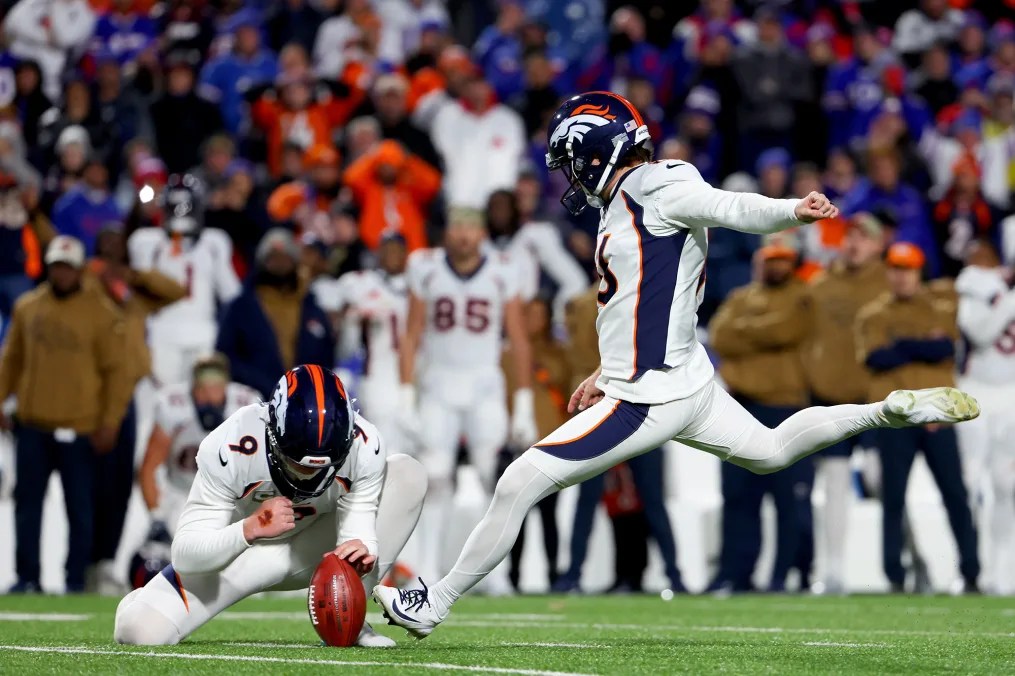
A desultory (I get to use that word once a year) first half–15-8, which is a softball score–turned into a thriller second half in Monday Night Football:
Near game’s end: Bills 22, Broncos 21. The Broncos seemingly go 4 and out on an incomplete pass…
WAIT!
Pass interference on the Bills! First down and within field goal range. The Broncos rush their field goal team onto the field with seven seconds left. The hurried kick is wide right. Game’s pretty much over…
WAIT!
The Bills had twelve men on the field! The second field goal attempt is good: Broncos 24, Bills 22. THE KICKER, WIL LUTZ, IS A FOOTBALL HERO!
* * *
…Poor Bills. Poor QB Josh Allen, who is great hiding in the cornfield in that TV commercial. He had a dreadful night: a fumble and two interceptions…
* * *
…The Bills have a player named Rousseau and the Broncos have a player named Locke. Voltaire is on Injured Reserve…
* * *
…I like the Bills, but just a little bit, because Buffalo’s near Ontario, where my Irish great-grandparents once lived…
* * *
…I am still boycotting the PGA, thanks to Crown Prince Mohammed ibn (“Just use a surgical saw!”) Salman al Saud of Saudi Arabia and The Kingdom’s heavily moneyed role in professional golf…
* * *
…They used to tell me that the sound of thunder was angels bowling in heaven. Now you can tell your grandkids that it’s Bobby Knight throwing chairs…
* * *
…Was there a World Series this year? I don’t CARE. Oh, nuts: Congrats to Bruce Bochy, who has the biggest hat size in baseball and is an excellent manager…
* * *
…In College Ball, there are actually TWO Pac-17 (or whatever the number is. Doesn’t matter. They’ll all be in the SEC within two years.) teams in the Top Ten: Oregon and the Husky Puppies.
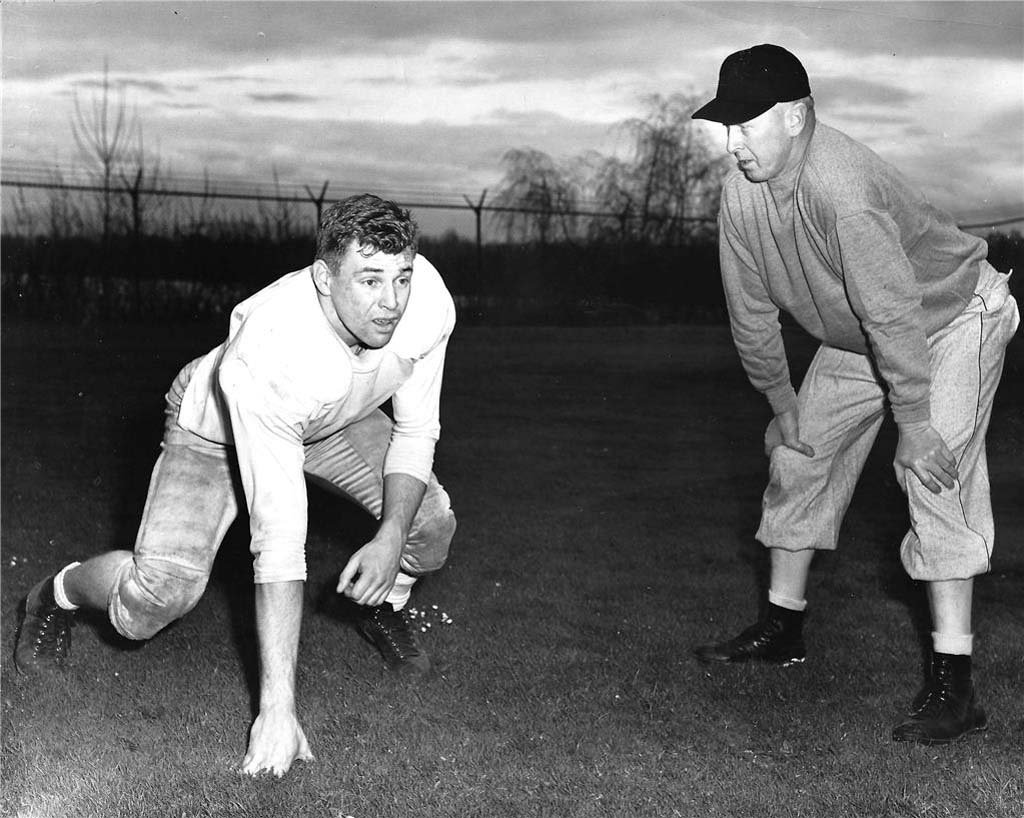
My father-in-law Gail was a University of Washington Husky Puppy–that’s him in the photo with Coach Howard Udell in the late 1940s…
* * *
…My Alma Mater, Mizzou, will be invited to a Bowl slightly more prestigious that the Mucinex/Dow Chemical/Colace Poopin’ a Pineapple Bowl after a convincing win over Tennessee…
* * *
…I am ready for some Women’s NCAA Basketball because they pass and have plays and strategery and stuff…
* * *
…The last time the Summer Olympics were in Paris was in 1924, when Hemingway was there as a correspondent for the Toronto Daily Star and writing short stories in clean well-lighted place.
That’s Hem, with Shakespeare and Co. bookstore owner Sylvia Beach (he was recovering from a skiing accident) out in front of the bookstore, which faces Notre Dame. The cathedral, not the football team.
There’s a cafe next door, Les Deux Magots, where you can get a latte the size of a soup bowl and gaze thoughtfully at the cathedral, just like Hemingway did. Except he was drinking a Pernod.
Sorry. Back to sports…
* * *
…Megan Rapinoe was injured in her last professional game. That stinks. Roland Messier is NOT a soccer player. He is a pastry chef. I looked it up…
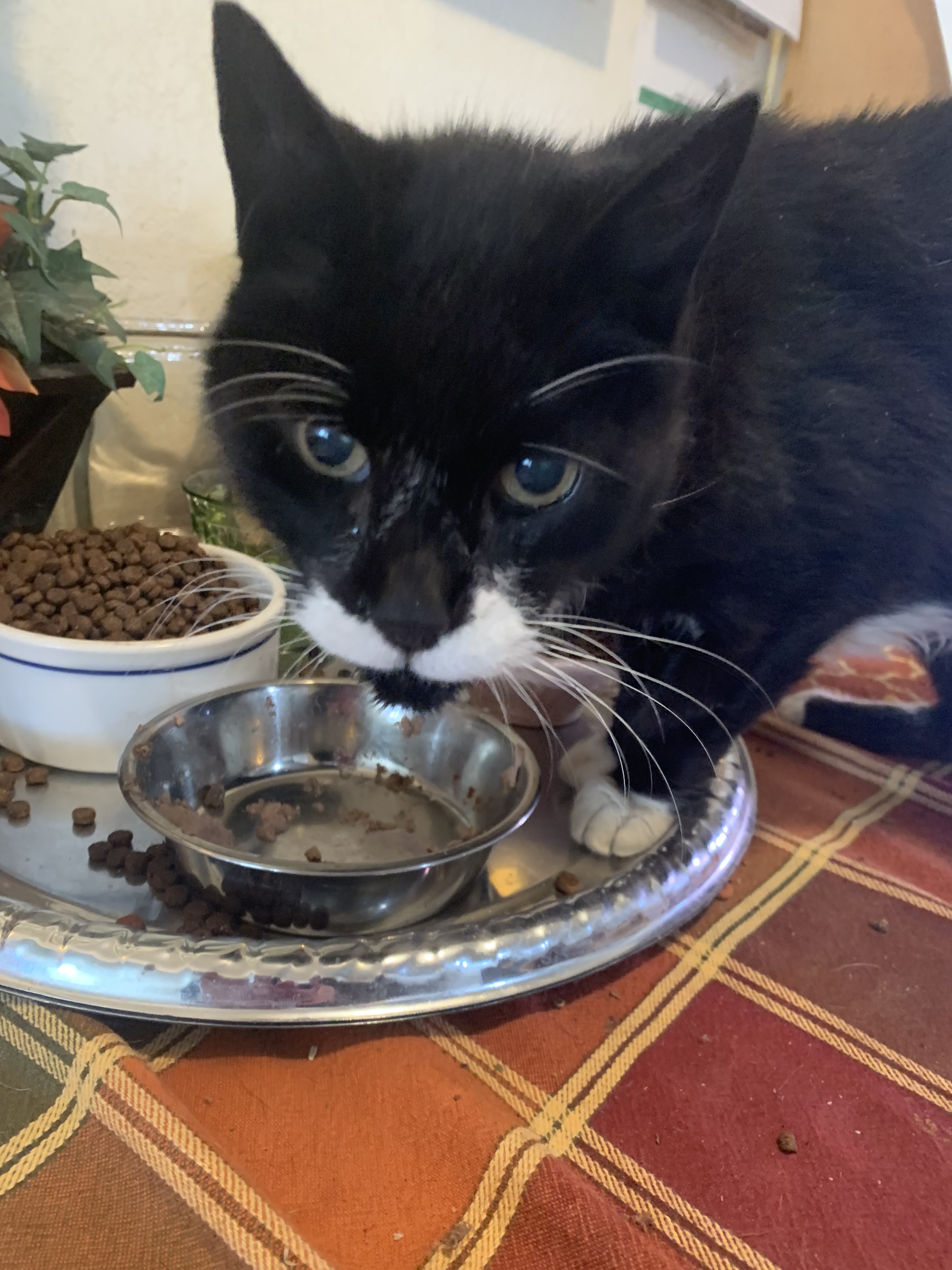
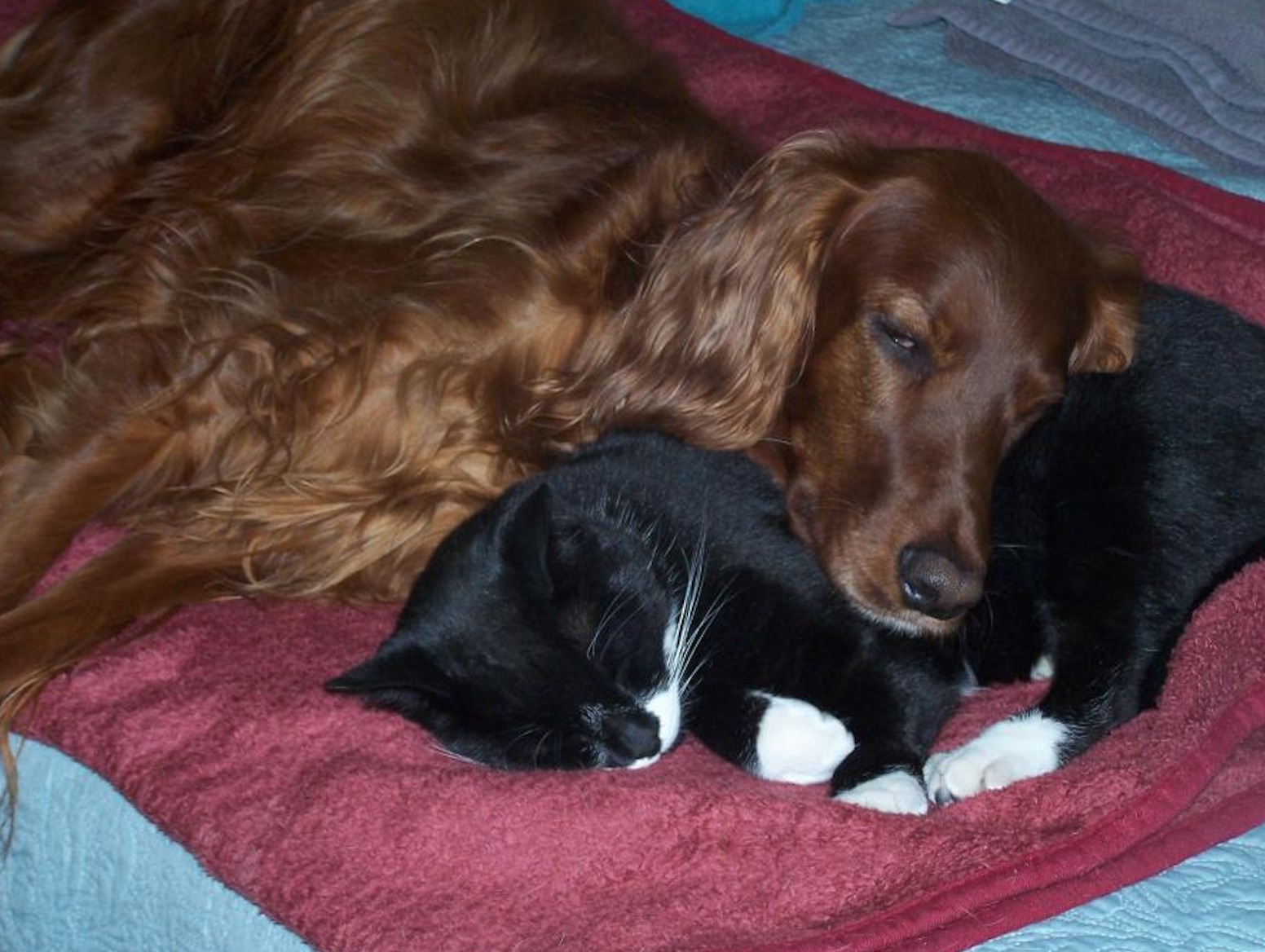
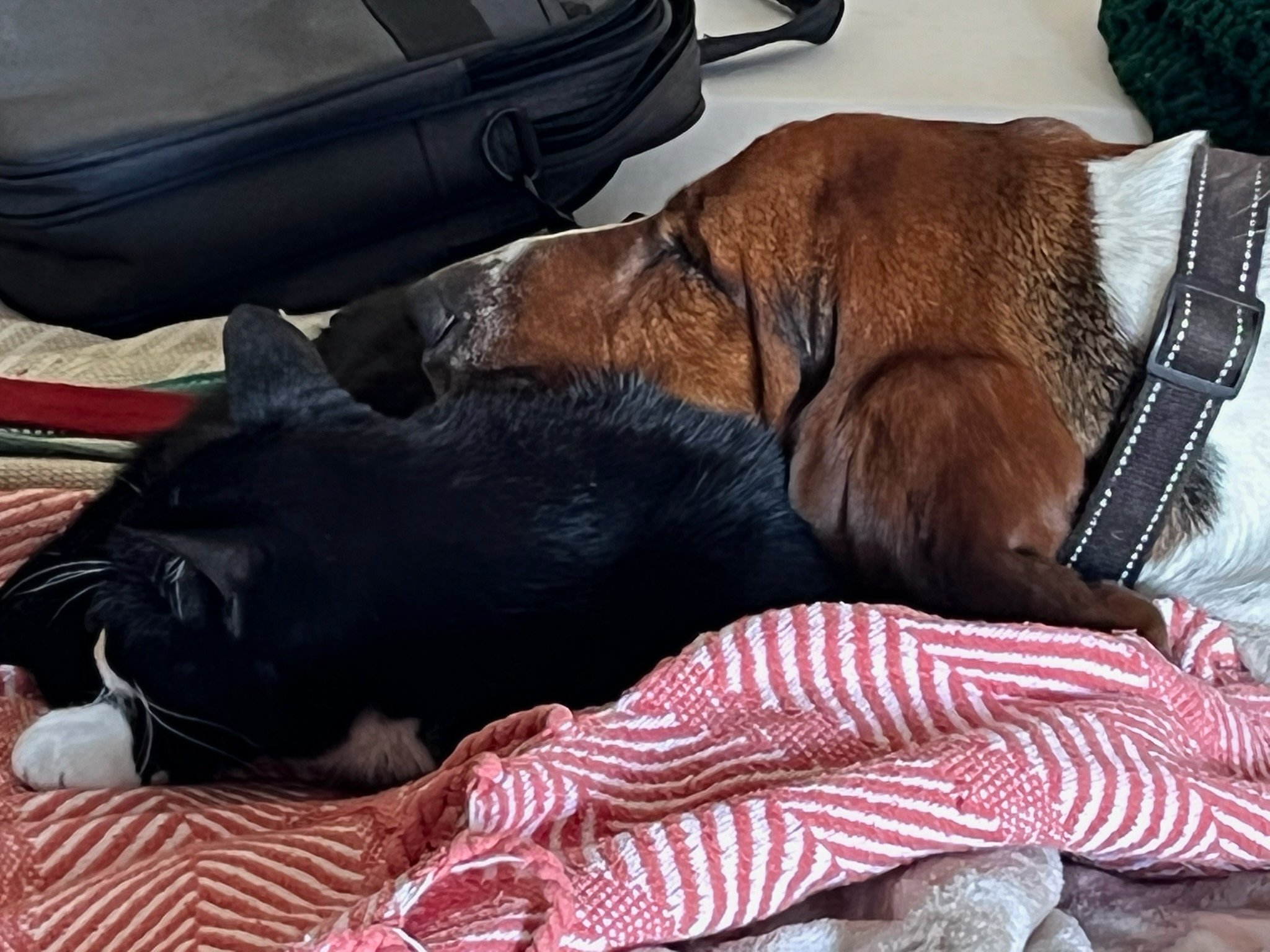
He was, of course, my fault. Every animal we’ve ever had, except for Honey the pit/lab and Winston the tabby kitten, has been my fault. I am a sucker, I guess. Mittens is our beautiful Tuxedo kitty, and he’s not doing well. He’s seventeen and has a respiratory problem we can’t seem to shake or ameliorate, and now his fur is in disarray, a sure sign that he’s not feeling well. He’s not necessarily the favorite cat in my life—he’s a bit standoffish, now, not feeling well, he turns to me for pets—but he’s one of the most beautiful.
We decided, seventeen years ago, to go look at the Humane Society of Santa Maria’s kitten adoption day. It was a moment of sheer abandon, of course. We went into the pet store and found the stack of metal cages in which the hopeful kittens were waiting. It was Mittens who immediately rushed to the front of the cage and began poking his nose out the grill and purring. The gray tabby in the same cage stayed in the shadows, in the rear. So it was Mittens who won us over.
Then the Humane Society volunteer casually (maybe not) informed us that the gray tabby was the tuxedo’s brother.
I shrugged. (“Oh, what the heck,” I was thinking.) So we brought them both home and they became Mittens and Pickles. Mr. “Pick me!” turned out to have an independent streak while his gray brother was very affectionate. We lost Pickles a few years ago to cancer and that was a hard experience, nearly as hard as losing my first Basset Hound, Wilson.
And now Mittens has gone out to scout the territory ahead where I will someday live. I’m not being maudlin here—just realistic—and I hope that I can be as dignified as he is and, like him, unafraid to reach out for comfort.
Thank you, Mittens, my friend.
* * *
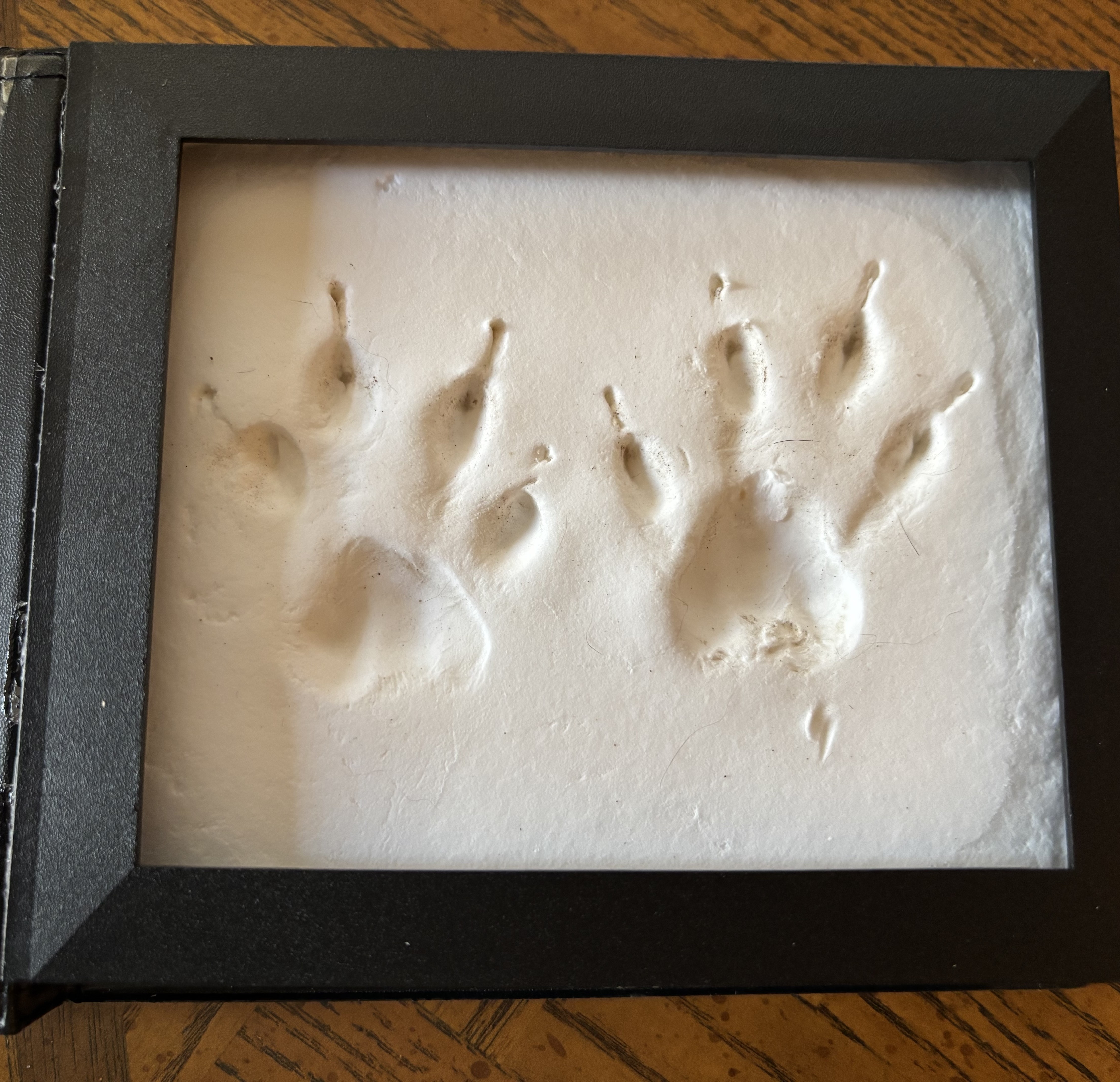
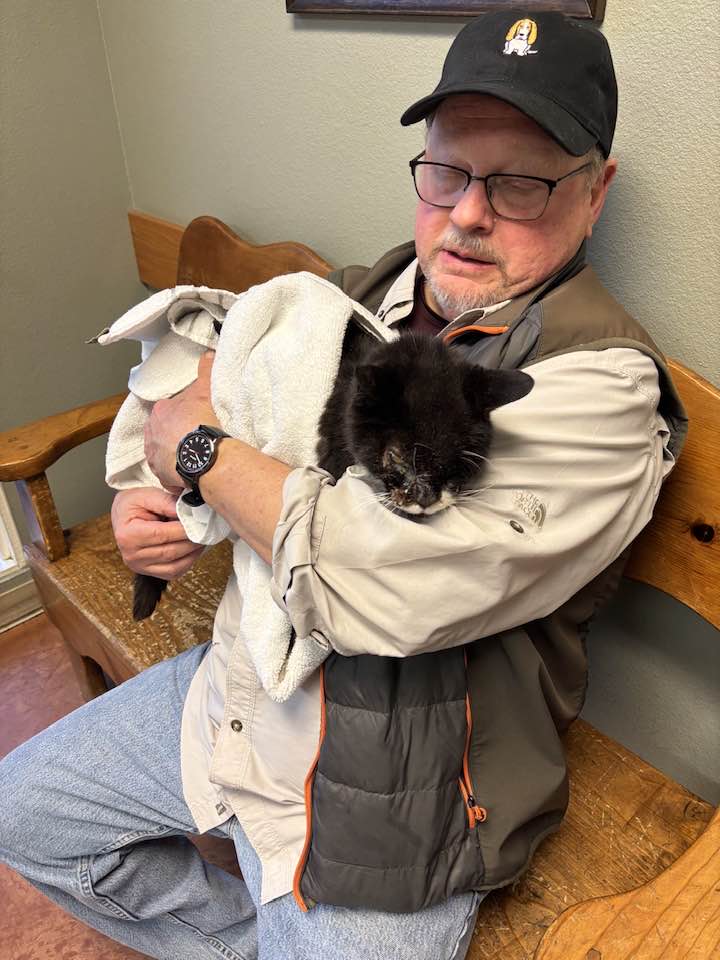
Mittens crossed over the Rainbow Bridge on December 2, 2024.
Mittens, getting sleepy, in our last few minutes together. The vet, who was magnificent, granted us this time.
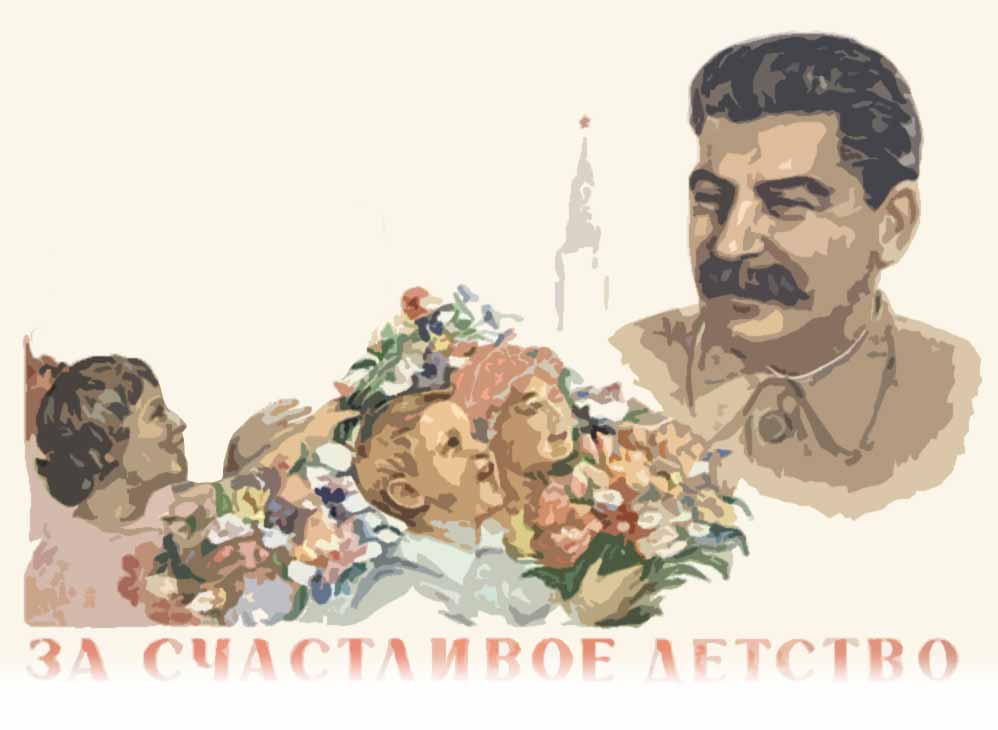
Stalin expels Leon Trotsky from the Soviet Union; Trotsky eventually will be assassinated in Mexico. What followed in the USSR was the assassination of the truth, unfortunately, a recurring theme in history—including today.
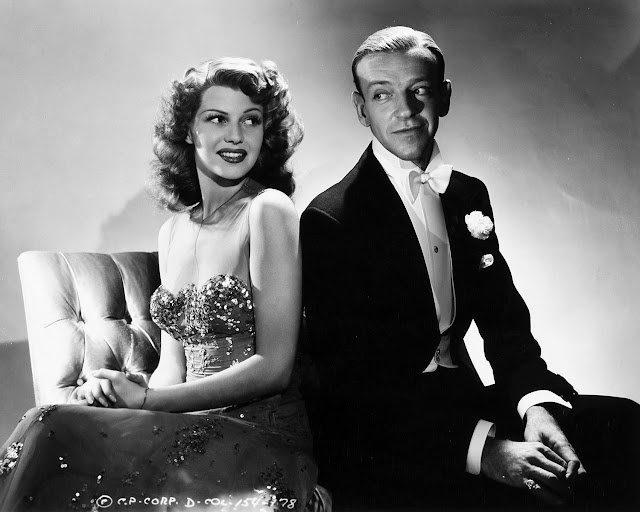
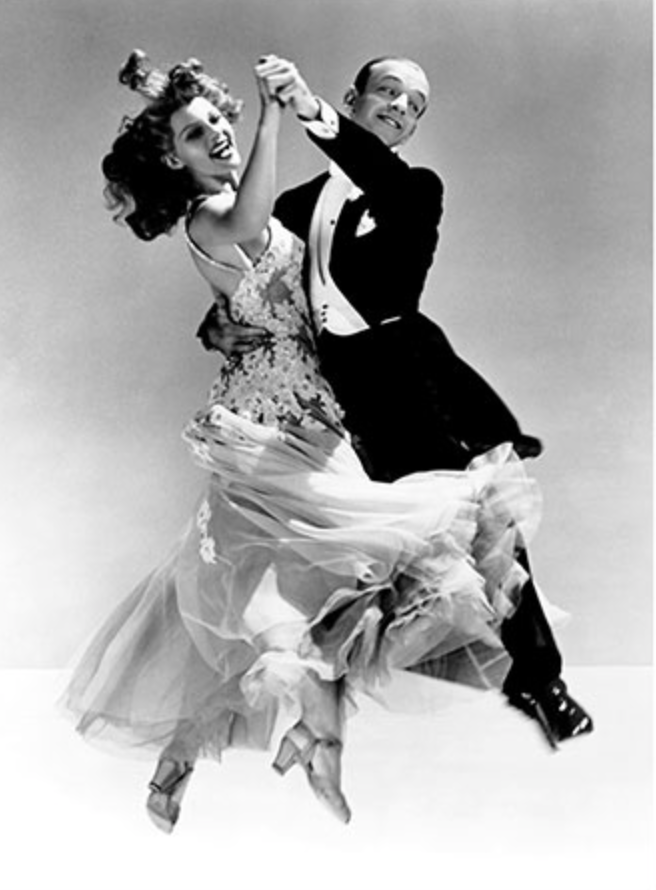
My Facebook friends already know that I have desperate crushes on classic movie stars—Lauren Bacall, Grace Kelly, Audrey Hepburn, Hedy Lamarr, Ingrid Bergman, Ginger Rogers and Vivien Leigh, to name a few. I have no idea why I missed Rita Hayworth, so let’s make it official. She was both beautiful and charistmatic, and the woman could dance, as Fred Astaire discovered in rehearsing for You’ll Never Get Rich (1941). She was a natural:
Fred Astaire’s seemingly inexperienced costar was anything but intimidated. “She learned steps faster than anyone I’d ever known,” he noted. “I’d show her a routine before lunch. She’d be back right after lunch and have it down to perfection. She apparently figured it out in her mind while she was eating. (Grunge.com)
And don’t tell Ginger, but…
Shortly before his death in 1987, Fred Astaire told interviewers that Rita Hayworth was categorically his favorite dance partner.
Wow.
Some YouTuber with way too much time on his hands decided to create a video with scenes from You’ll Never Get Rich to the music of…wait for it…Led Zeppelin’s “Rock and Roll.” I think that was actually time well spent.