Posted by ag1970 | Filed under American History, California history, World War II

23 Saturday Aug 2014
08 Friday Aug 2014
Posted in American History, California history, World War II
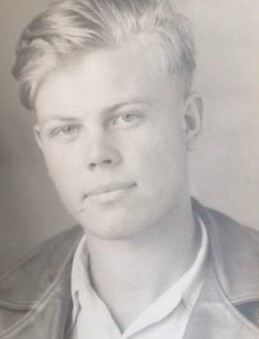
Will Tarwater as a young Arroyo Grandean
What happened the morning of December 7 reached Arroyo Grande at 11:30 a.m., when, for many townspeople, it was a quiet time: they might have been listening to classical music, interrupted by the news bulletin, while they read a Sunday paper from San Francisco or Los Angeles, and waiting for the big lunch that, for many American families, was as traditional as Sunday church services
For Juzo Ikeda’s children, that would have meant services at the Arroyo Grande First United Methodist Church where, three years earlier, in a foreshadowing of the suffering that was to come, Japanese-American members of the church had donated a painting of Christ in Gethsemane, struggling with the fear he felt as the Temple Guard was on its way to arrest him.
It is said that many Americans had to find an atlas to locate Hawaii; even the announcer in one of the initial broadcasts pronounced the island where Arizona burned, Oklahoma had capsized, and where 160 warplanes were destroyed on the ground as “Owahoo.”
Will Tarwater, whose family ranched in the Huasna Valley and who spent a career as a Border Patrol agent—a career that you learn, once you get to know him, has deepened in him an innate sense of justice and compassion—remembers being in town with his father and being “completely shocked. It was beyond our understanding. Bewildered! We went home and turned on the radio to hear more. Still could not make any sense of it.”
A little more than an hour after the first radio broadcast, San Luis Obispo Tribune photographer and archivist David Middlecamp writes, the fire siren in the county seat to the north of Arroyo Grande—affectionately called “Ferdinand”—began to wail. This was the summons for 40th Division soldiers, in training at Camp San Luis Obispo, to return immediately to base. County Sheriff Murray Hathaway dispatched extra deputies to Union oil storage facilities on the other side of town and the company itself provided extra security for Avila Beach and Estero (Morro) Bay. The newspaper rushed a Sunday edition to print—the first, Middlecamp notes, in decades—when it became apparent that the Philippines were under attack, as well. Tarwater remembered both that Sunday edition and the size of its headlines seven decades later.
The next day, he and his classmates at Arroyo Grande Union High School gathered in their new gymnasium—a New Deal WPA work project that still serves as the Paulding Middle School gym today—to listen to Franklin Roosevelt’s brief but dramatic address asking Congress for a declaration of war. By December 8, the initial disbelief that news of the attack generated had been replaced by growing fear.
FBI agents descended on the Valley that day. They began to collect the heads of the farm families. Shigechika Kobara was an important target because of his leadership in the Japanese-American community: he would spend the following days in the county jail, then in Army custody, before being reunited with his family in the Arizona desert. Juzo Ikeda would have faced the same fate, but he’d broken his neck in a farm accident and was helpless, watched over by his son, Kaz, who would be allowed to stay behind while the rest of the Ikeda family was sent to the Central Valley. The agents somehow missed another prominent man, Yeiji Hayashi, which was a relief to his 15-year-old son, Haruo, because it would be his father’s stoic strength that would keep the family together in the months to come.
This is when the rumors began–rumors that Will Tarwater refused to believe, since one of his closest friends was classmate Ben Dohi, in a high school where 25 of the 69 members of the class of 1942 were Americans of Japanese descent.
After Pearl Harbor, rumor mills had a heyday about it. All kinds of wild rumors about everything: a large farmhouse off Halcyon near the highway had a basement full of guns! Another house had a secret room full of short-wave radios and they were in constant contact with Tokyo…on and on. It seemed like someone was trying to turn us against our neighbors. Most of us couldn’t buy it. We had grown up with them.
Haruo Hayashi, a sophomore at the high school, had grown up with three friends who meant a lot to him: John Loomis, Gordon Bennett and Don Gullickson. The three would stand by him when he returned to school–he’d listened to the news of Pearl Harbor on the radio while recuperating from an appendectomy, and had to wait another week not knowing how he’d be received by his classmates. His three friends–two would go on to fight the Japanese at Pelelieu and Okinawa, would write letttters to Haruo in his internment not the name of a tough Italian-American kid who told Haruo “I will personally at the shit out of any kid who calls you a ‘Jap.”” would be the friends who continued to write letters to Haruo in his internment Their friendship was not uiversal: some classmates called Haruo a “Jap.” He has forgotten their
But beyond the little high school on Crown Hill, the fear hardened two weeks after the attack. The war arrived offshore. One story I heard growing up, though I’ve never been able to confirm it, has a housewife in the lovely seaside community of Shell Beach, about five minutes north of Arroyo Grande, looking out her picture window for a picture-postcard view of the Pacific, then freezing in horror when a the shaft of a submarine’s periscope appeared where she might have preferred the spout of an migrating grey whale instead.
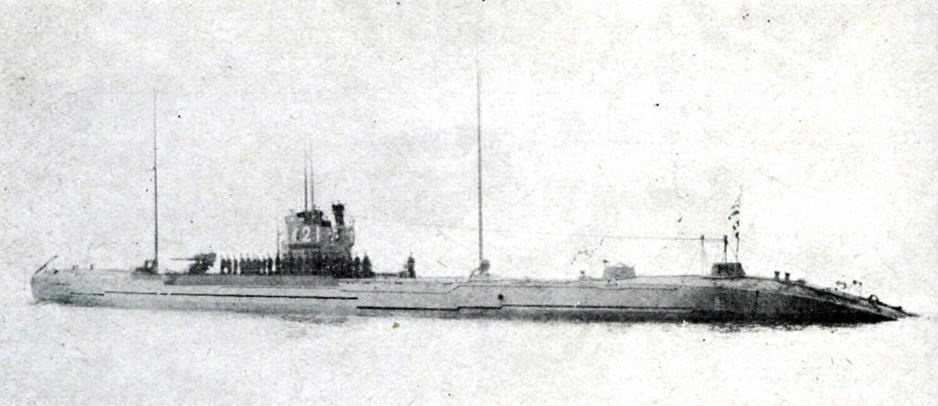
I-21
It is a plausible story: The Imperial Japanese navy had positioned nine submarines, or I-boats, all along the West Coast. One of them, I-21 had, on the morning of December 22, fired a torpedo that missed its target, an oil tanker, off Point Arguello, about 45 miles south of Arroyo Grande, and her captain, Kenji Matsumura, headed north in search of targets of opportunity. He would have passed Shell Beach on his way to another frustrating encounter, when his boat failed to sink the tanker Larry Doheny off the north coast of the county, despite an attack in which he fired another torpedo and opened fire with I-21’s deck gun.
Matsumura found a third target in the little tanker Montebello off another coastal town, Cambria, farther north, but this time, the result was more satisfying for him: at 5:45 a.m. on December 23, he fired two torpedoes and this time one hit; I-21 surfaced and opened fire with her gun—its report could be heard inland by residents of Atascadero, 26 miles away—and although her crew escaped, Montebello went under 45 minutes after the attack had begun.
Within weeks, I-21 was patrolling the coast of Australia, would later shell Sydney Harbor, and would be lost with all hands near Tarawa in 1943: Matsumura and his crew are ample demonstration of why this is called a “world” war.
Three days later, the Arroyo Grande Herald-Recorder reported that a 22-year-old sailor, Wayne Morgan, had been killed at Pearl Harbor. Arroyo Grande residents would find out much later that Morgan, who went to grammar school and graduated from the high school here, had died, like Jack Scruggs, on the U.S.S. Arizona.
So he surreal shock of Pearl Harbor, followed by the I-21’s attacks just off the coast, generated the kind of fear seen at its most extreme in “The Battle of Los Angeles” the following February, where anti-aircraft batteries, aided by an array of searchlights, opened fire on an air attack that never existed.
Californians’ fears far outweighed reason: in 1942, Japanese I-boats would sink four ships off the West Coast, while German U-boats sank 70 ships off North Carolina’s Outer Banks alone, when Americans from Fire Island to Miami Beach could watch as doomed American merchantmen—and their crews– burned offshore.
It was time, some began to say, to get the Japanese out—away, at least, from the coast, where they were suspected of Fifth Column activities like those in the wild rumors Will Tarwater had sense enough to doubt. When a Mutual Broadcasting commentator named John B. Hughes advocated the removal of the Japanese in a January 1942 broadcast, he was flooded with letters of support.
One came from a woman in Guadalupe, a little town just south of Arroyo Grande:
Today’s (broadcast) really came close to home.We live near this small town where nearly one half are Japs. They farm all the best land and pay outrageous prices per acre, such as $45 or $50, and live in a shack to do it. Besides [they] own the theatre, half the garages and just about run this town…really, this is no country for such people.
A woman from San Luis Obispo, north of Arroyo Grande, agrees.
…We want to congratulate you on the stand you are taking towards the Japs. We wish there were more like you. We have lived in and around San Luis Obispo all our lives and have seen enough of the Japs to know that our races can never mix.
A local businessman:
I have talked to many people around the Arroyo Grande Valley…and the Japs farm two thirds of the best valley land and own 10% of it now, and every one of them are of the same opinion that now is the time to put the screws to the Japs before it is too late.
None of the letters, brimming with envy, cited the Japanese as a threat to national defense. But it would not be long until, indeed, the screws were put to them.
They would be applied by the President of the United States on February 19, 1942. Even before Pearl Harbor, as the superb historian Lynne Olson notes in her book about the president’s struggle with isolationists, Those Angry Days, the fall o2f France, Britain’s struggle under the Blitz, the efforts of lobbyists for Britain and, finally, the wiretaps he had authorized J. Edgar Hoover to place had all had a cumulative effect: on the President’s personality. He no longer saw shades of gray.
Committed to defending the country, wounded by the devastation of his beloved Navy’s Pacific Fleet, and bolstered by public opinion that seemed to support those who wrote letters to John B. Hughes, he overrode his own Justice Department, which disputed Executive Order 9066’s constitutionality, and ordered the Western Defense Command and General John deWitt to begin removing “persons of Japanese ancestry” from their homes near the Pacific and into distant internment camps.
FDR and his Secretary of War, Henry Stimson, had picked the right man. DeWitt accepted his assignment—although any general might have preferred a combat command—with a sense of mission, and this is how he justified it:
In the war in which we are now engaged racial affinities are not severed by migration. The Japanese race is an enemy race and while many second and third generation Japanese born on United State soil, possessed of United States citizenship, have become “Americanized,” the racial strains are undiluted.
DeWitt now took control of the lives of 120,000 Pacific Coast residents–the Issei, first-generation immigrants who were not allowed to become citizens under the Naturalization Act of 1790, and reaffirmed by the Supreme Court in 1922, which restricted that privilege to whites, and 70,000 Nisei, the second generation, by birth American citizens.
When the evacuation order came to San Luis Obispo County, the Defense Command gave San Luis Obispo County residents, according to Pat Nagano, a resident of the county’s north coast, ten days to put their affairs in order, dispose of their property—Nagano describes what we would call “yard sales” today—it was a buyer’s market: he remembers desperate families parting, for pennies, with the belongings symbolic of a lifetime of hard work, and each teapot, dinner table or easy chair taken away by triumphant buyers—they were like carrion birds—meant the memories attached to them were taken away, as well.
They tried to find homes for their pets, to say goodbye to those friends who were willing to talk to them, and some of Nagano’s one-time friends were not, and, finally, pack what remaining belongings the evacuation orders allowed.
The buses came for them in the high school parking lot on Crown Hill in Arroyo Grande, and there was a poignant moment when the local Women’s Club brought box lunches for their neighbors as they waited to board. Will Tarwater remembered, too, a long line of farmer’s trucks that followed the buses inland; they must have looked almost exactly like the trucks that had brought farmers stricken by the Dust Bowl to California. So Tarwater lost his friend, Ben Dohi–a man whose family still farms the Lower Arroyo Grande Valley–on a day important to every local boy: it was the day before trout season opened.
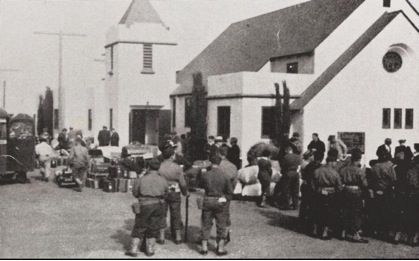
Evacuees in Santa Maria, south of Arroyo Grande, prepare to board the buses that will take them to Tulare on April 30, 1942.
Not all Californians would be as charitable as the Arroyo Grande Women’s Club: some would soon begin to loot now-vacant farms and farmhouses, and sometimes, in little farm towns throughout California, they would burn the houses, tractor sheds and barns after they had taken everything of the remotest value.
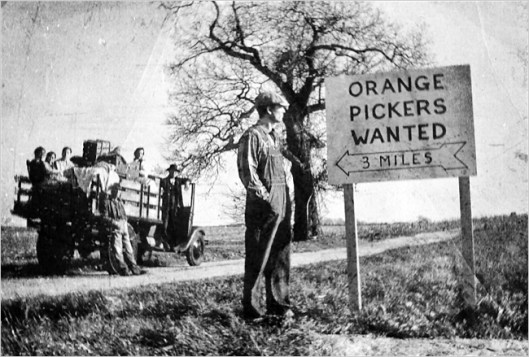
The parents of one young Nisei, George Nakamura, would be among the families who would lose their farms, and, like the others, the Nakamuras would lose also almost everything else they owned. Now, in April 1942, the remains of their lives were packed in the suitcase stowed in the belly of the bus or under tarpaulins in the trucks that followed the buses. On their suitcases the families had painted their names–‘S KOBARA 14440″– in white letters that remind you of the abandoned luggage on display at Auschwitz.
Some two hundred residents boarded the buses for the long ride away from the coast and the land some of them had been farming for forty years. The convoy of buses pulled out of the Arroyo Grande Union High School parking lot and took them to Tulare, California.
Tulare was among several temporary camps throughout California. One of the most notorious was at the Santa Anita racetrack, where the people who were now essentially refugees slept in horse stalls. One memorable photograph at the Santa Anita center shows a young Nisei woman posing, cheerfully and almost defiantly, beside the statue of the champion of underdogs like herself, Seabiscuit.
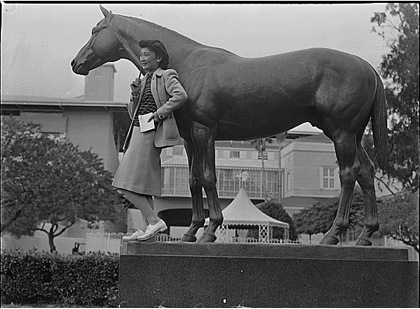
The Nakamuras and their neighbors would endure a long, dispiriting bus ride over the hills of the Coast Range and into the vast, flat, and sometimes colorless interior of California where, they would be among the first arrivals as the camp opened on April 27—at its largest, 5,000 internees lived here—on a site that had been used for the county fair before the war.
What happened there in the space of five months is extraordinary The Tulare camp produced a newspaper that buzzes with news from the schools established there, features advice columns and an extended sports section, including many stories written by George Nakamura, who had been a reporter on his Arroyo Grande high school paper, the Hi-Chatter, about men’s baseball and women’s softball leagues (Arroyo Grande’s teams were in first place in both), played in the oppressive summer heat typical of the Valley—complete with box scores and league standings.
The farewell edition of the remarkable Tulare News—32 issues were published between May and August of 1942—includes a heartfelt letter of thanks from the Tulare Center’s director, Nils Aanonsen, who is remembered as a compassionate man who defied the army and tried to turn over management of the camp to leaders elected by the internees. It paints an optimistic picture, thanks to an article from a travel magazine, about their ultimate destination.
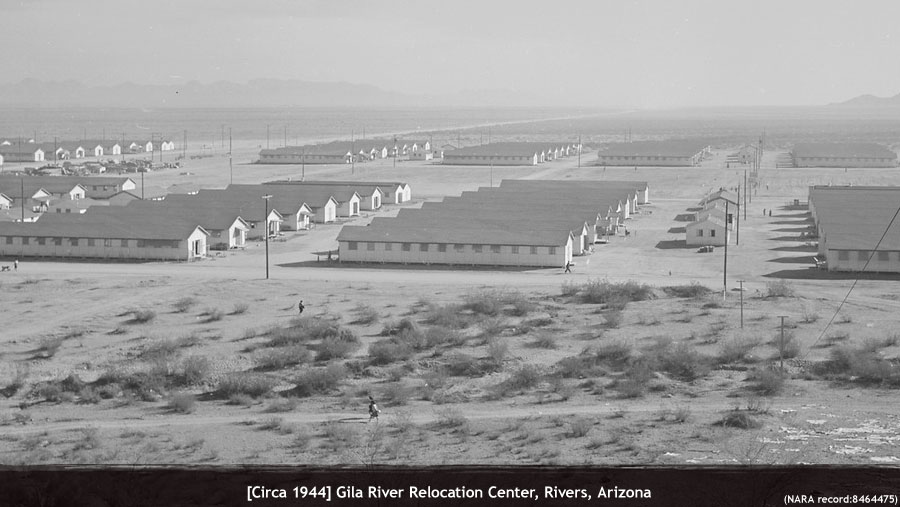
That was a camp on reservation land at Gila River, Arizona. When Nakumura and his family arrived and he saw what a desolate place it was, the first thing he did was to get the hell out. He was in a group of 32 young men were the first to leave Gila River for the comparative comfort of the United States Army. By the war’s end, 22 young men from the Gila River camp would be killed in action. while their families endured overcrowding—until additional barracks were added, some had to sleep in mess halls and even latrines—dust storms, rattlesnakes, and more: an internee learned to rap her shoe on the barracks floor in the morning before putting it on, to induce the scorpion inside to leave.
George Nakumura’s Army aptitude tests immediately impressed the Brass. He was brilliant and
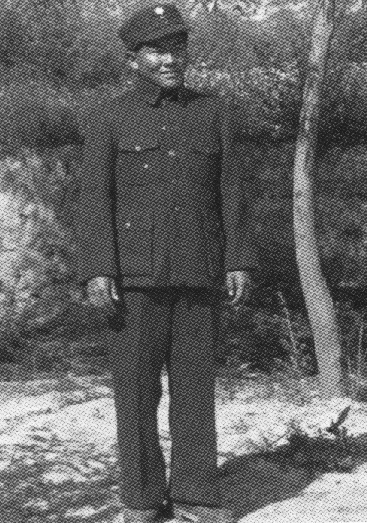
Nakamura in China, 1944 or 1945.
he was fluent in Japanese, so he became an Army Intelligence officer. He was assigned, as its youngest member, to what the Army called “The Dixie Mission:” Nakamura was one of a group of officers who, in 1944, were inserted into the hills of Yenan, where they would assist the Chinese in intelligence gathering as they resisted the Imperial Japanese Army and their brutal counterintelligence arm, the military police, the Kempeitai.
From his base with a group of Chinese resistance fighters, Nakumura and his fellow Americans
joined on intelligence-gathering missions: Nakamura would act as translator in the interrogation of Japanese soldiers captured on some of them, but on one mission, he went alone. He would win the Bronze Star for the daring rescue of a downed American pilot.
His Chinese hosts in their remote camp grew to like this Arroyo Grande soldier so much that, on his 21st birthday, they threw him a party. There were toasts and even a little dancing.
At the Chinese soldier-leader’s insistence, his young wife, named Jiang, took a turn dancing with Nakamura: they tried, perhaps, a fox-trot. She had been an actress before the War, and so was a woman of culture.
The young American officer would, after the war, get his Master’s Degree in International Relations from Columbia University, which suggests he might not have been such a bad dance partner for the boss’s wife
She would be reviled someday—in fact, in the many twists and turns that twentieth-century Chinese history took. the last two decades turned against Jiang. In 1981, the Communist government would put her on trial for her life, a trial where she was repeatedly mocked and insulted. In the peculiar Chinese dialect that is the language of the Party, she became “The White-Boned Demon.”
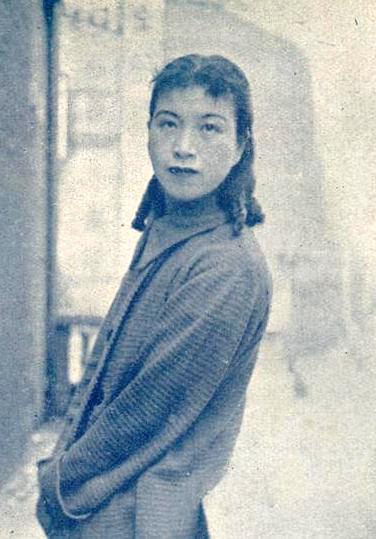
Young Jiang Qing
Jiang, in return, was defiant and supremely contemptuous of her accusers. She was fully aware that she was the star of a televised version of what was essentially a Stalinist show trial, and she was determined to do a star turn.
Her fiery defense was irrelevant, of course, and so Jiang was sentenced to be executed but, because of her husband’s influence, still potent even after his death, she would not be shot. The court instead handed down a life sentence for her membership in the “Gang of Four,” those accused of helping to conceive and carry out the disastrous 1968 Cultural Revolution. She would commit suicide in prison in 1991.
For almost forty years before that ignominious end to her long life, Jiang would become known universally by what was essentially her stage name in a role she relished more than any, for it was easily the role of a lifetime:
George Nakamura’s dance partner on his 21st birthday was Madame Mao.
Nakamura would live a long life, too, but his would be a happier one. He would finish his army career in Japan, where he served, after the war, as an interpreter for MacArthur’s occupation—some call it the vainglorious general’s shogunate, after the 300-year military dictatorship of the Tokugawa clan, ended in 1867 by the restoration of the Meiji Emperor. It would be the Meiji government that would dispatch American labor contractors to hard-pressed farmers in Kyushu, and it was those contractors and their persuasive powers that would bring families like Nakamura’s to the Arroyo Grande Valley.
The course of Nakamura’s life would, ironically, take him in the opposite direction. After finishing Columbia, he would return to Japan, where he lived for thirty years in Tokyo as the East Asian manager of a large American electronics firm and as the head of a management consulting company. He and his wife retired to Hawaii, then moved to Texas to be closer to their grandchildren
He died there at 90, in early 2014, and his obituary justifiably praises him—in his last years, President Barack Obama would sign a bill that would add the Presidential Medal of Freedom to the many honors George Nakamura earned in a long, productive and cosmopolitan lifetime. After it had ended, Gary Nakamura would visit the Arroyo Grande cemetery with his father’s ashes. It was in April, the same month when, in 1942, the buses had stood waiting in the high school parking lot, and now his Dad had come home.
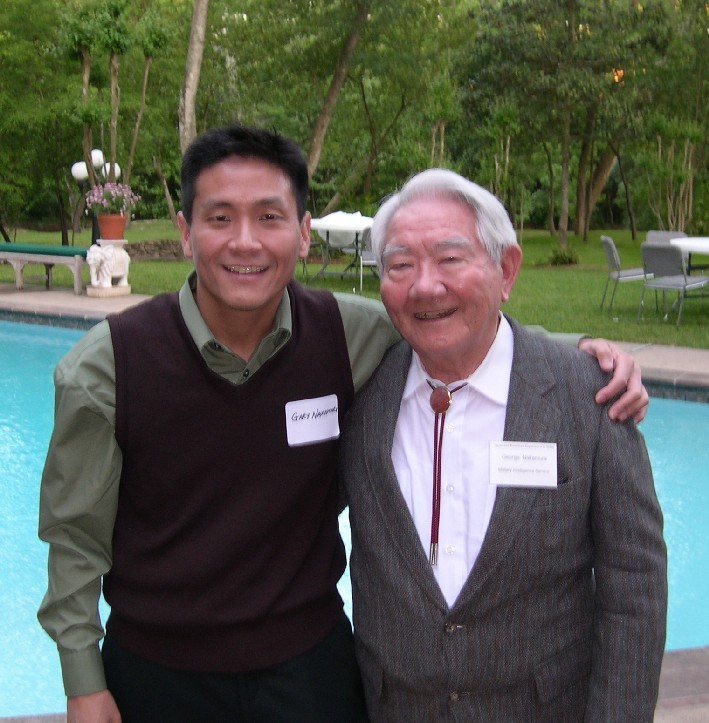
George I. Nakamura and his son, Gary, in 2005.
Posted in American History, California history, World War II
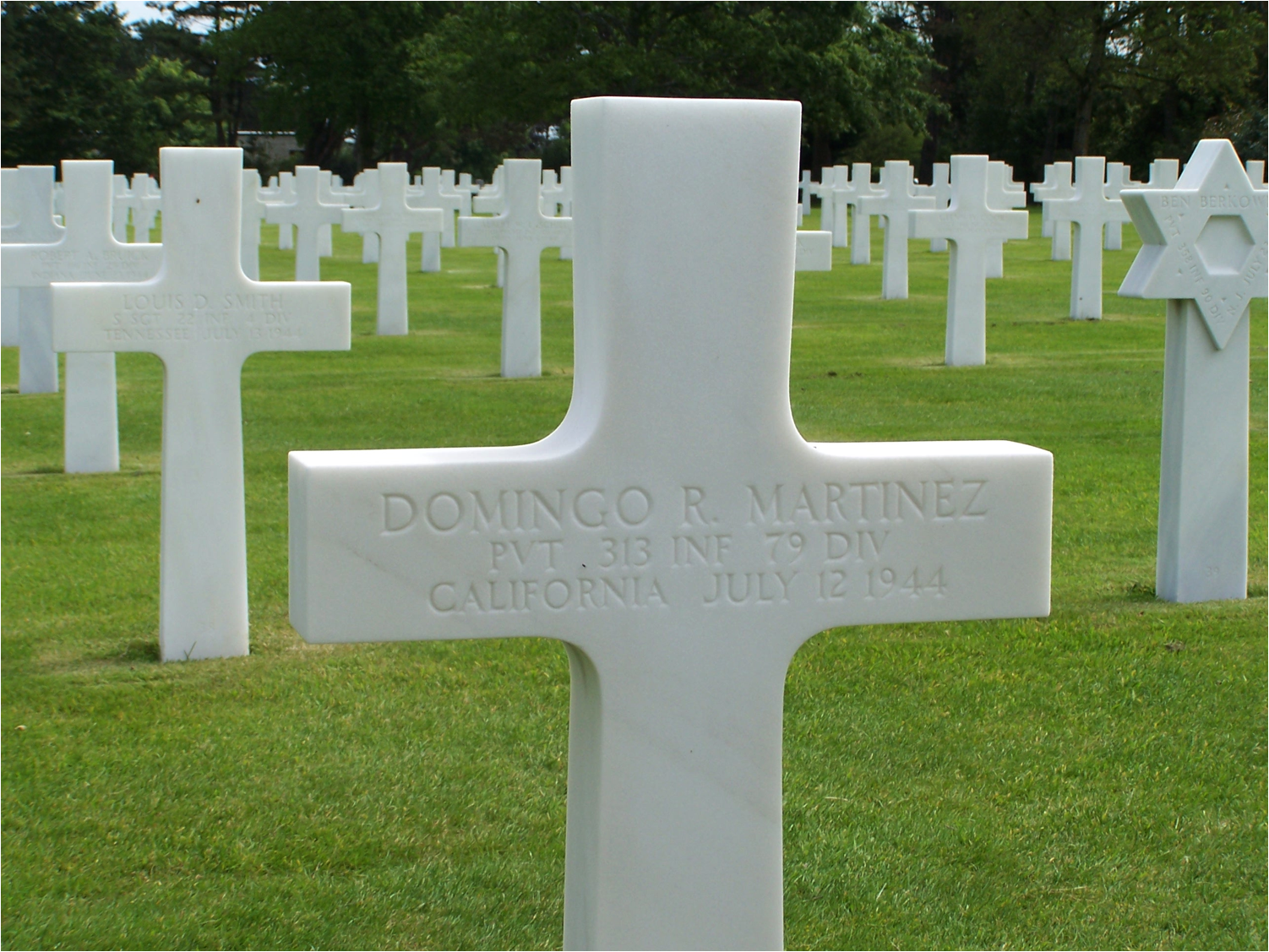
It is difficult to imagine Normandy in 1944; it is a beautiful place today, as are its people: a simple bonjour earns an American tourist a smile of appreciation, and the little villages are lovely, separated by pastures and farm fields, each with its distinctive little parish church. During the Middle Ages, as the skilled writer and Francophile Graham Robb notes, few villagers ever went beyond the sound of their parish church’s bells. The world beyond was like the ends of the earth.
It is not the ends of the earth, but the D-Day beaches are 5,500 miles away from the Arroyo Grande Valley. Three local men, killed in the campaign to capture and then and break free from Normandy, are buried at the American Cemetery at Colleville-sur-Mer, an almost impossibly beautiful place above Omaha Beach.
Below the cemetery, just offshore, a visitor today can see young men as they should be—exuberant and free– as they race tiny sailboats, their sails bright oranges and reds, just beyond the surf line, where on June 6, young men floated like dead leaves on the water’s surface. The invasion of Hitler’s Europe nearly failed here. It didn’t, but only because of an American generation that includes those who still hold the high ground at Colleville-sur-Mer.
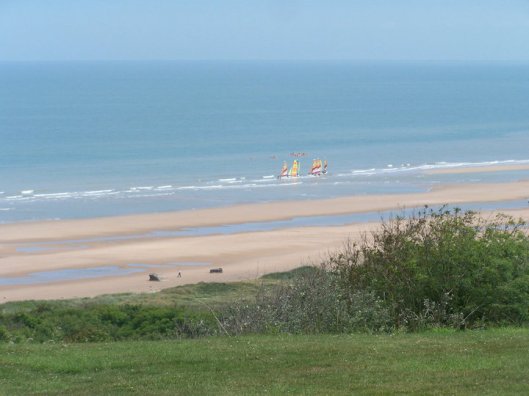
Omaha Beach today.
Up there, on the immaculate cemetery grounds, and not far from a famous American—the ebullient and popular Gen. Theodore Roosevelt Jr., felled by a massive heart attack soon after the invasion– lies a soldier as far removed from the Roosevelts’ patrician (if rambunctious) Oyster Bay home as a human being can be, in terms of both distance and social class.
He was a farm worker, Pvt. Domingo Martinez: Plot C, Row 13, Grave 38. Martinez is the soldier who more than likely knew the bean-stakes and the smell of sweet peas of prewar Arroyo Grande. The best that can be said is “more than likely:” the Arroyo Grande Valley is where a farm worker, as he’s listed in his 1943 Army enlistment records, would have found a job, or a series of jobs, following different harvests, and migrant farm workers are elusive for both historians and for census-takers.
Domingo may even have been double-counted in the 1940 Census; there are two “Domingo R. Martinez” entries, both from New Mexico; one is living in San Miguel County, hit hard and recovering from the Dust Bowl; he is living with his father, Fulgencio; his mother is deceased. But a second Domingo R. Martinez, also originally from New Mexico, is counted in the same census, and in California. He is living in Redlands, picking oranges, with a man named Thomas listed as his father, and Thomas is married to Aliga Martinez.
They must be different men. But “Aliga” Martinez is listed as “Aleja” in a postwar Redlands City Directory, and it is Aleja who will file the 1946 request for the marble cross that marks Domingo’s grave at Colleville-sur-Mer. The form lists Redlands as her hometown.
It is the measure of a poor man’s life: researchers can’t be certain of where he lived when the war broke out. They know exactly where he died.
Two more soldiers, city boys compared to Martinez, are honored here at the American Cemetery, both from the county seat just to the north, An artillery officer. 2nd Lt. Claude Newlin, from San Luis Obispo, is buried here. Ironically, Newlin’s battalion, attached to the 35th Infantry Division, had spent a year training at the camp just north of his home town. Newlin had survived some of the costliest fighting of the campaign, near St. Lo, only to die hours before the 35th broke out of Normandy to join George Patton’s breath-taking race across France to Metz and the German frontier.
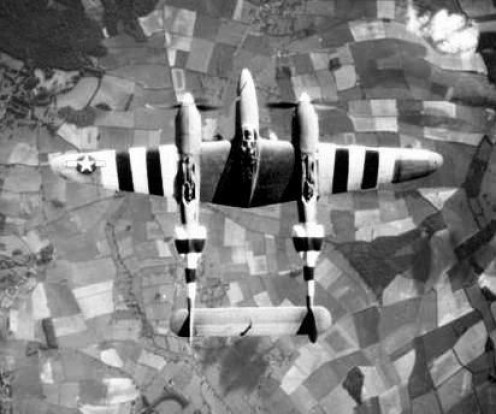
Lt. Jack Langston’s fighter would have looked like this P-38, with is distinctive D-Day identification stripes.
For another San Luis Obispo soldier, an airman, there is a memorial, but no grave. On June 22, 2nd Lt. Jack Langston was flying his P-38 in a low-level attack on Cherbourg with his 367th Fighter Squadron when that city demonstrated the folly of ordering low-level attacks. Langston died that day with four other 367th pilots. His body was never found.
The farm worker, Pvt. Martinez, 26 years old, born and raised in New Mexico, now a Californian, found himself in the streets of Cherbourg in June 1944, far below the speeding fighter planes. Martinez was fighting with the 313th Regiment of the 79th Infantry Division, the “Cross of Lorraine Division”–their unit symbol had been St. Joan’s–and the 79th had seen hard fighting in France before, in 1918.
They were sent into action near Cherbourg soon after landing on Utah Beach, and they fought their way into the heart of the port city–a port the Allies would need, because a capricious Channel storm destroyed the “Mulberry,” the artificial harbor built off Omaha. The Allied armies in France therefore faced an enormous supply problem. They needed a port to help feed, arm, and fuel the growing numbers of Allied solders in France. For the Allied command, SHAEF, Cherbourg was critical.
It was also difficult to take. Its bristling anti-aircraft defenses would claim Jack Langston. Massive coastal batteries could keep naval support for the Americans at bay, and the city’s Wehrmacht defenders, though not elite troops (20% of them were non-German conscripts) were securely dug in and they had nowhere to go, for they were backed into a corner of France, and so isolated that the only alternative to fighting was to leap into the sea.
Once they’d gotten inside Cherbourg, G.I.’s learned to hate street fighting almost instantly. Death came instantly from illusory shadows that a fallen G.I.’s comrades never saw, and from gunfire they sometimes never heard. In peacetime, a French city block can be melodious with the sounds of cafe music or the singing of children at play. In combat, the same block, seemingly empty, can muffle the report of a sniper’s rifle or generate echoes that make soldiers look anxiously in every direction at once.
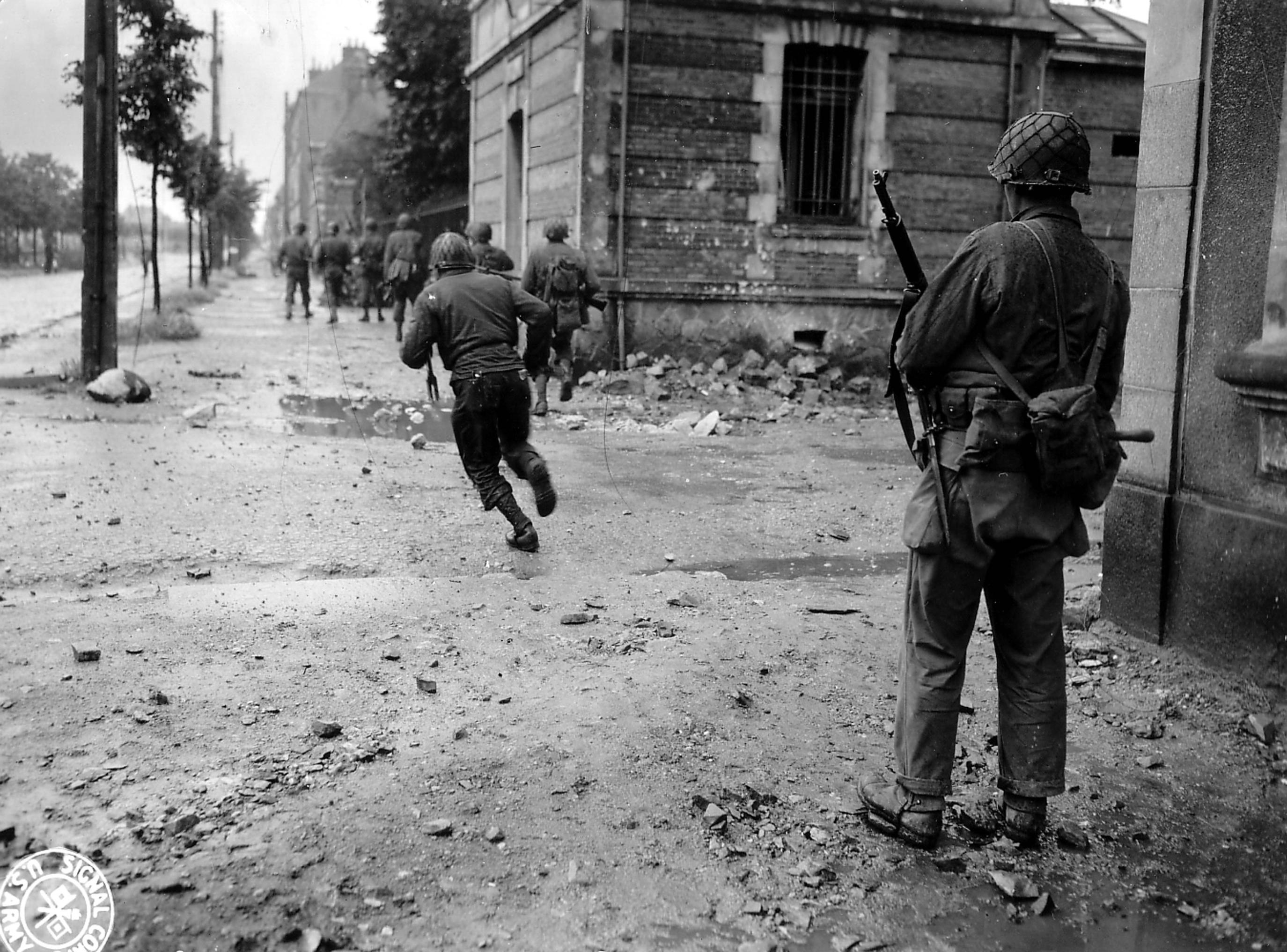
Street fighting, Cherbourg. These G.I.’s are from Martinez’s 79th Division.
It would be the 79th that would capture the fortress that dominated the city on June 26. Its commander surrendered three days later. Military historian John C . McManus notes that the men of the 79th that day were filthy, exhausted, and bearded, “like burlesque tramps,’ as one soldier said. They got little rest. The division quickly shifted from urban combat to a drive through the farms and villages of the Cotentin Peninsula.
Now, American ground forces in Normandy faced a new, even more difficult challenge. Three weeks after D-Day, they had fallen far short of the objectives set for them by Allied planners and the staff officers working furiously over maps in Gen. Omar Bradley’s custom command trailer. The offensive in the Cotentin stalled in great part because the Germans had the advantage of fighting defensively, in the bocage, the Norman hedgerows, and they winnowed units like the 79th down.
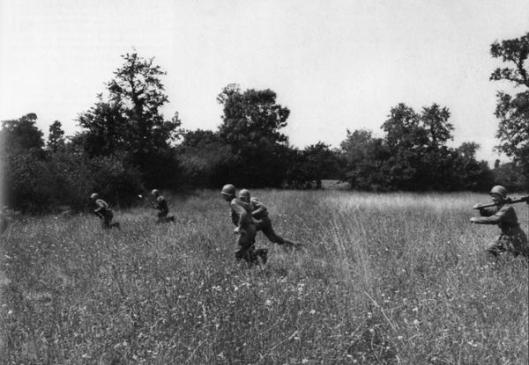
79th Division GIs sprint across a field bound by hedgerows.
The hedgerows enclosed fields plowed since Agincourt, or pasturage for fat Norman cows, and were a hopscotch of natural fortresses—roots and compacted earth had formed defensible walls. The G.I.’s had to assault them, one by one, to try to root the defenders out.
When G.I.’s broke through a hedge and entered a field, the superb German machine gun, the MG42, hidden in the next hedge beyond, or positioned on the Americans’ flanks, annihilated entire rifle squads. It fired so rapidly that a burst sounded like canvas ripping. Army films had incorporated the sound to try to desensitize trainees.
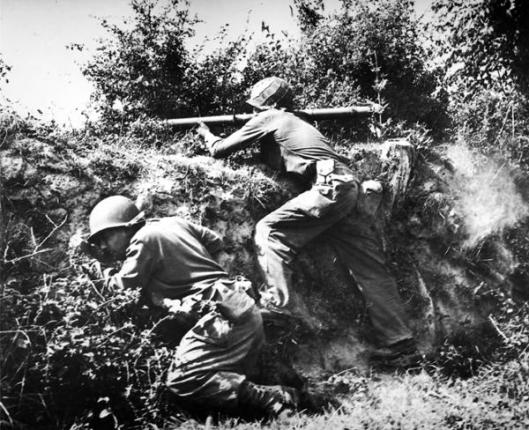
Fighting in the bocage: A 79th infantryman fires a bazooka.
So the Americans could hear, but never see, in the tangle of the hedges, who was killing them so efficiently. The bocage quickly transformed G.I.s, with supreme indifference, into either hardened veterans or into statistics.
American soldiers, adaptive and imaginative, eventually would develop the tactics to overcome the kind of war the Germans fought in the bocage. For the 79th, in early July, what was beyond the hedgerows may have been worse. The Germans would not wait for them this time. They would attack. This came soon after the 79th, along with the 82nd Airborne and the 90th Infantry Divisions, seized, at great cost, several hills around a key crossroads, Le Haye du Puits.
This should have compelled the enemy to abandon the town. They didn’t. They attacked instead, on July 7, intent on destroying the 79th in their positions on a ridge above the town. The German soldiers, including SS-Panzer units, attacked with great ferocity and with great courage. These were not garrison troops, but hardened and determined professionals. In a day of fighting that ended only at nightfall, the 79th stopped them. This was the turning point. On the next day, another day of street fighting, the Americans would capture Le Haye du Puits.
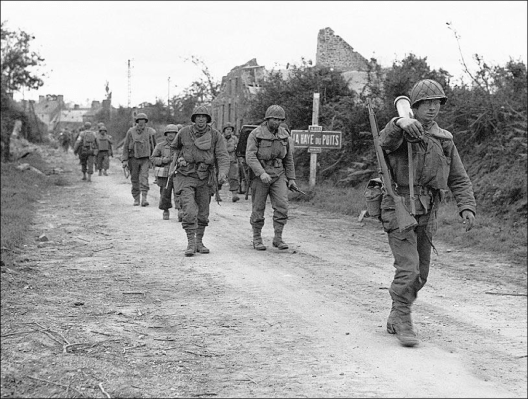
Le Haye du Puits is secured. The lead 79th division GI his carrying a mortar tube; one soldier behind him is carrying the mortar’s baseplate on his back.
Afterward, Signal Corps photographers attached to the 79th captured the images of some soldiers, like patrons arrived for their dinner reservation, enjoying a bottle of wine, sitting around a restaurant table set up on the street outside a partly-destroyed building; other photos reveal the faces of men as blank as those of sleepwalkers. They are utterly worn out, used up, by a month of ceaseless combat.

Le Haye du Puits, July 1944
Ironically, Domingo Martinez survived all this and was killed days later, after the division, including his 313th Regiment, had taken up defensive positions to regather itself. He died on July 12, near a village named Bolleville, and so would not experience the energy and the jubilation of the breakout from the bocage.
With the breakout at month’s end, the Americans would inexorably roll up the Germans, uncover Paris, and liberate the city in August, standing aside to let Free French units and their prickly commander, Gen. Leclerc, enter first. Leclerc would have been furious to learn that Ernest Hemingway and some of his camp followers had preceded him and they were, with great offensive spirit, but also with deteriorating unit cohesion, busy liberating the bar at the Ritz Hotel.
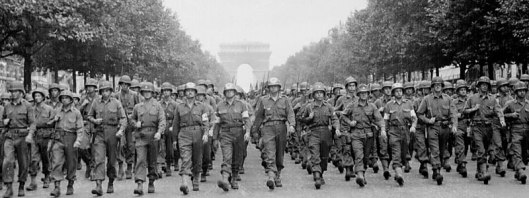
GI’s on parade, Paris, August 1944. These soldiers, from the 28th Infantry Division, marched directly out of Paris and back into combat.
It’s hard not to wish that Pvt. Martinez had been granted at least time enough to celebrate, as well. And maybe, for a migrant farm worker and Dust Bowl refugee, even more time than that.
It is hard not to wish Domingo Martinez the time for a quiet talk with a little granddaughter. She is wearing a crisp white dress–it might be her First Communion– and wide-eyed and attentive, she is looking up at him while they are sitting, nestled together–she is feeling the wonderful safety that a grandfather’s love can provide– on the sofa. They are waiting together for the Sunday lunch his daughters are preparing after Mass, and he is telling the little girl about the five-day leave granted him that summer of 1944.
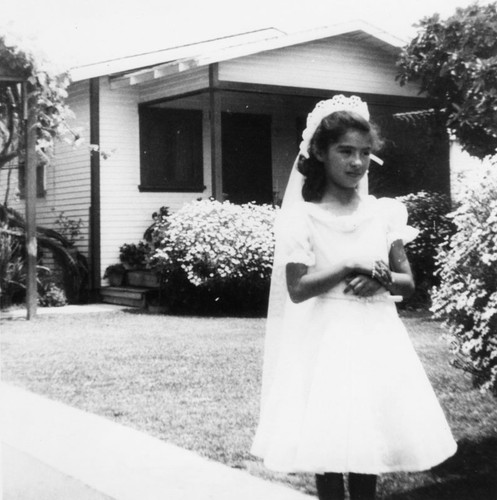
He decided to visit Notre Dame. Once he’d entered the great church, he took his garrison cap off, crossed himself with holy water, and walked slowly down the nave, the silence pressing on his ears, past the clutter of the pews. There, delighted, he stopped and stood on a spot near the transept where he was suddenly bathed in brilliant, colored sunlight. This is the Rose Window’s gift to men and women of good faith.

24 Thursday Jul 2014
Posted in American History, California history, Uncategorized, World War II
https://www.youtube.com/watch?v=ZLFCYQjziw8&feature=youtu.be
In which Mr. Gregory, with the help of the Andrews Sisters–especially Maxine, my favorite, who’s so funny–proves this really was a “World War .”
18 Friday Jul 2014
Posted in American History, California history, World War II
15 Tuesday Jul 2014
Posted in American History, California history, World War II
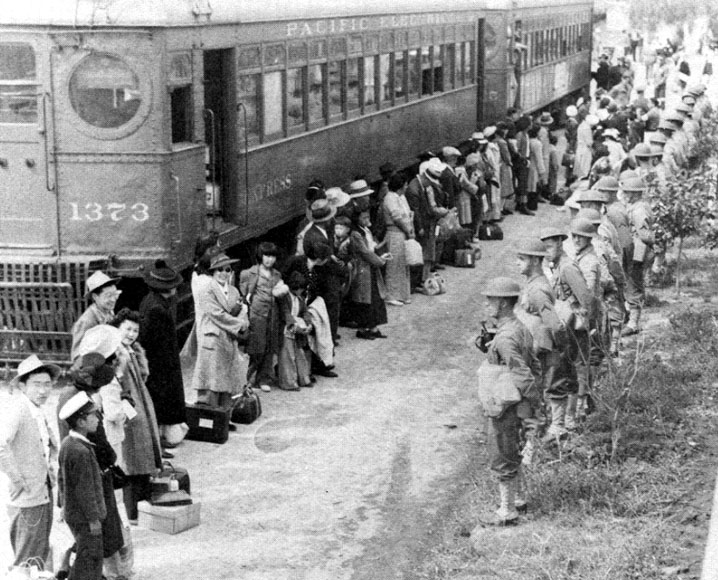
Japanese-Americans await transport at the Santa Anita Racetrack. They slept in the stables.
From a letter to a University of Oregon alumni magazine that ran an article on the internment of World War II:
“In 1942, U.S. Marines were battling the Japanese in the Guadalcanal jungles. American aircraft carriers were sunk by Japanese warplanes. So many ships were sunk in the Solomon Islands ‘slot’ that it was nicknamed Iron Bottom Sound. The fighting was a match of equals that could have gone either way. The American public was frightened of a West Coast invasion. We cannot condemn 1942 policy using our 2013 mores and sensibilities. The prospect of a ready made collaborationist population, following a Japanese invasion, impelled the internments of Japanese Americans.”
This, of course, excuses the irrational. Consider the other coast of the United States:
–In 1941, German U-boats were already attacking American warships: the destroyers Greer and Kearny came under fire before a torpedo took the Reuben James and 115 of her 159-man crew in October, five weeks before Pearl Harbor. Even before then, with the fall of France in June 1940, war hysteria in America had been intense. With FDR’s blessing, J. Edgar Hoover would compile voluminous lists, aided by wiretaps, of suspected German Fifth Columnists living in the United States; the agency included more lists of any American who subscribed to periodicals written in German or Italian, and until FDR ordered the registration and monitoring of all aliens, there were isolated but frightening cases of Germans or German-Americans who were attacked–one was murdered–by wrongheaded “Patriots,” deprived of our 2013 mores and sensibilities.
–By 1942, American troops were fighting Rommel’s Afrika Korps—and getting routed, at Kasserine Pass. In general, the war was going against the Allies on both the Western Front—the disastrous Dieppe Raid is a notable example–and Eastern Front, with Gen. von Paulus’s Sixth Army, which would eventually surrender at Stalingrad, defeating Soviet forces in combat around Kharkov.
In the Pacific war, we had lost the Philippines, just as the War Department knew we would, and our Pacific possessions, but we’d taken the war to Japan with the Doolittle Raid in April and achieved a much more substantive victory–the first American turning point–at Midway in June with destruction of four of the six carriers that had begun the war against us at Pearl Harbor, along with the cadre of the Japanese naval air forces.
–German U-boats sank 82 American ships in all waters in December 1941 alone; In 1942, they sank 121 American ships off the East Coast and 42 along the Gulf Coast out of a total of 500 American merchant marine ships sunk by German submarines that year. Americans on holiday, from Coney Island to Miami, could see our ships glowing at night as they burned,, with their crews. A U-boat also delivered a team of Abwehr saboteurs onshore near Jacksonville, Florida. We were bleeding ships and English children were beginning to go hungry: they were allowed one small egg every four weeks.
During the same period, Japanese submarines sank a total of four ships off the West Coast.
–120,000 Japanese-Americans were interned under Executive Order 9066. Fewer than 3,000 Italian-Americans or Italian aliens and 11,000 German-Americans or German aliens were interned.
14 Monday Jul 2014
Posted in American History, California history, World War II
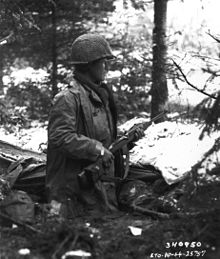 I recently found a local man who fought, like this soldier, with the 442nd Regimental Combat Team. Pfc Sadami Fujita was killed in action and awarded the Bronze Star and Purple Heart during the relief of the “Lost Battalion” in the Vosges Mountains in October 1944.
Sadami was born and raised in Hawaii. Here he is, as an eight-year-old, in the 1920 census. You can click on the images to make them larger.

But in 1939, he left Hawaii for California on the President Pierce, evidently with a younger brother, Jimmy. Here’s the “alien” passenger list and; below, Pierce passes one of the Bay Bridge’s towers, probably in 1935, the year before the bridge opened.
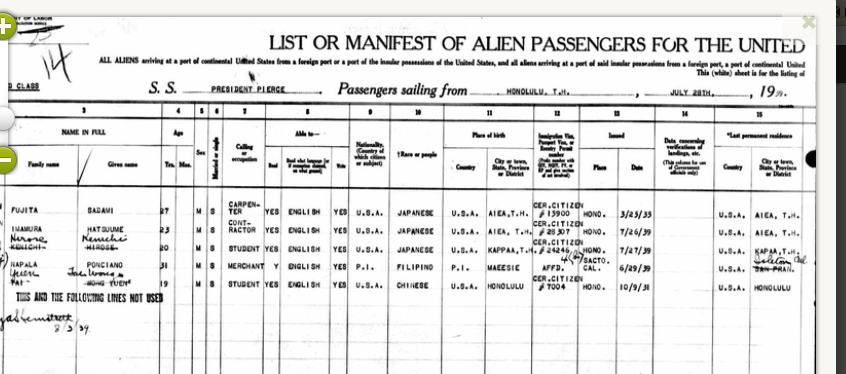
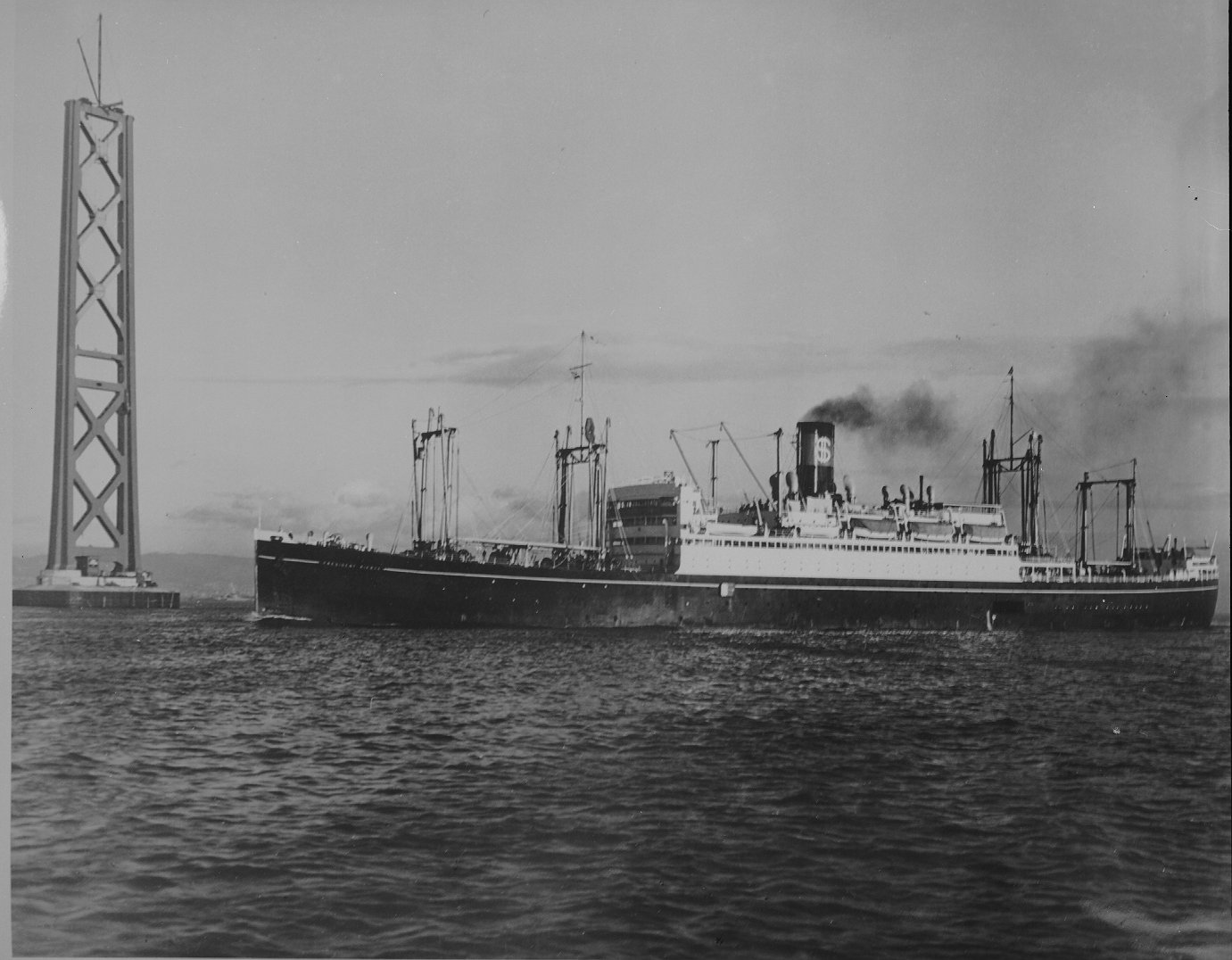 This ship was intimately tied to the career of Amelia Earhart. She was one of the dozens of ships, both military and civil, which searched fruitlessly for the lost flier in 1937. But in 1934, Pierce had saved Earhart’s life on her Hawaii-to-California flight, in her beloved Lockheed Vega. From a website on that flight:
In the final hours of the journey Earhart found herself surrounded by a thick blanket of fog. Glancing down through a hole in the fog, she suddenly caught sight of a ship. She dove down through the hole, she wrote later, “faster than I ever flew before from 8,000 feet to 200!” The ship was the President Pierce, outward bound from San Francisco. Earhart lined her plane up with the wake of the ship and headed for California—now only 300 miles away!
In the 1940 Census, Sadami, too, has found a home in California: he is living with two brothers, Jimmy, who will go to the Poston internment camp, and Dick, in Arroyo Grande. The page from that year’s census is like a Who’s Who–it includes the Ikedas, the Hayashis, the Fukuharas, and Javier Pantaleon, the foreman at the Waller Seed Co. to whom doomed sailor Felix Estibal wrote one of his last letters before being killed in action off Guadalcanal in November 1942. 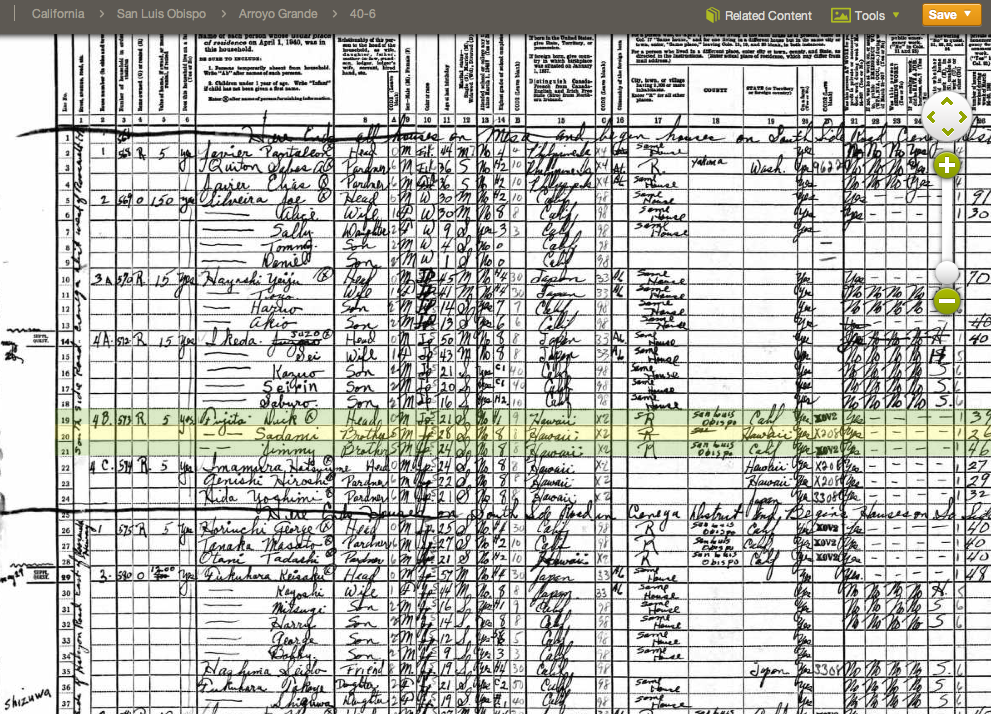
Five months after FDR re-instated the draft, the United States Army tapped Sadami on the shoulder–and, not unusual in the Army–they spelled his name wrong, though not as egregiously as the case of Marine Private Louis Brown, from Corbett Canyon. Killed on Iwo Jima, the twenty-year-old’s name was spelled “Louise” in the Navy casualty records.
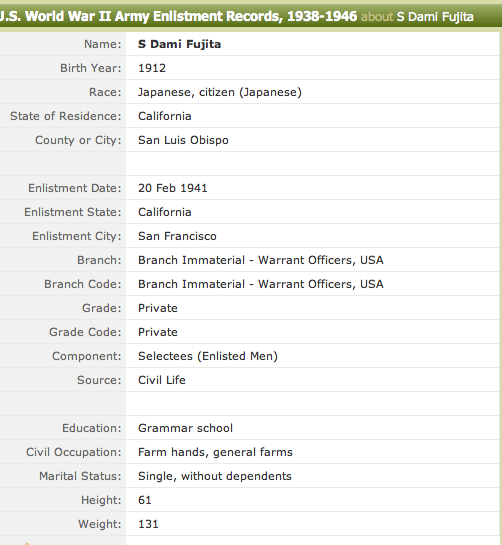 He would be assigned to the 100th Infantry Battalion, a tough outfit made up of Hawaiian Japanese-Americans. The 100th would later be merged with the famous 442nd Regimental Combat Team as that unit’s First Battalion. The 442nd included Nisei soldiers from all 48 states. The unit would do most of its fighting in Italy, but was transferred to France in the fall of 1944.
Sadami, a PFC in “B” Company of the 100th Battalion, was killed on October 28 in the relief of the “Lost Battalion,” a unit made up largely of Texans that had been surrounded by German troops in the Vosges Mountains.
This is what it was like that day, from a website on the 442nd: (http://www.the442.org/battlehistory/vosges.html)
The following day [October 28th], both battalions continued the drive forward in the teeth of stubborn resistance and heavy artillery and mortar fire. Casualties went up and up, caused largely by tree bursts, from which there was no escape. Our own artillery was active, and the Cannon Company and 4.2 mortars performed yeoman service, but the Germans were below ground, while our troops were up and moving forwards. At the end of the day, the regiment was 1,500 yards nearer to the “lost battalion,” but only at [a] terrible cost in men and material. During the night, biting cold and rain kept the men from resting.
So it’s probable that it was artillery fire that killed Fujita–the Germans fired .88 shells into the treetops and, as was the case in the Hurtgen Forest, a ferocious battle being fought at the same time in in Germany, just over the Belgian border, many GI’s were killed by flying shrapnel and splinters. This is what the combat zone looked like then, and today: 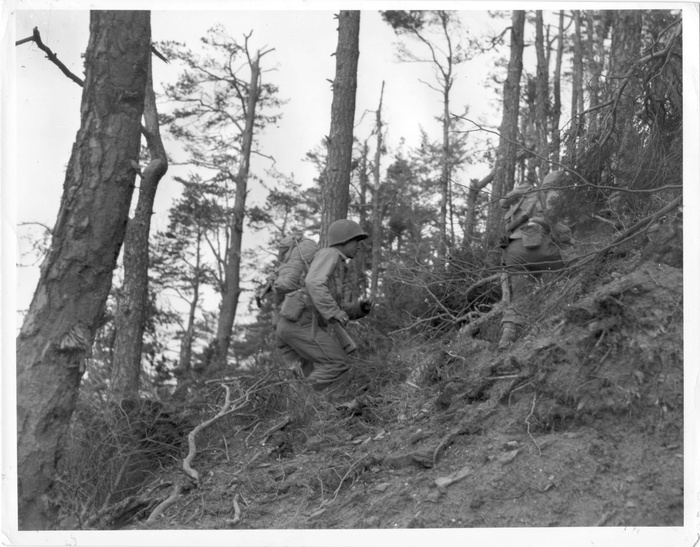
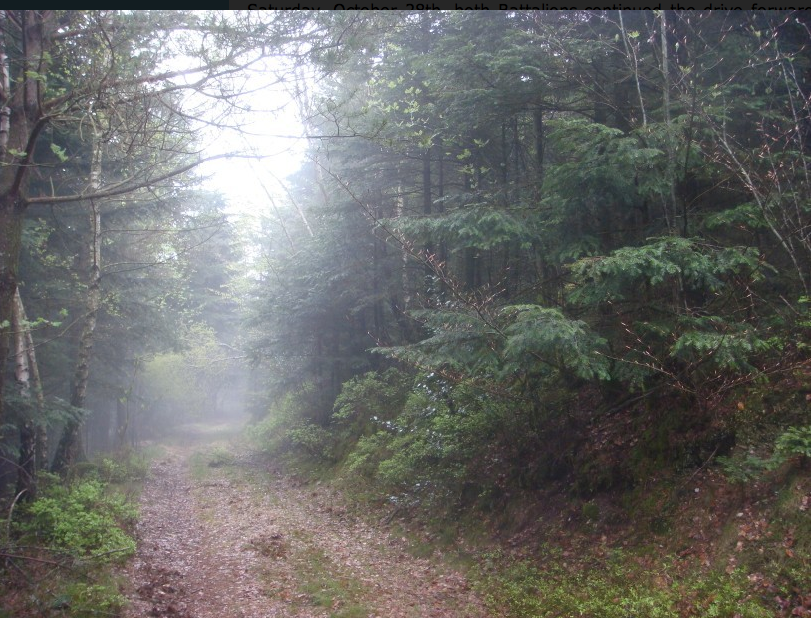 The 442nd broke through two days later. 800 Nisei soldiers were killed or wounded to rescue the 230 Texans.
Several Nisei soldiers, like Masami Hamakado, in Fujita’s “B” Company, kept extensive photographic records of their service years and of their comrades. Two of Hamakado’s photographs show paired soldiers, but each is labeled only with last names. In both photos one of the names is “Fujita.”
This is what drives historians nuts. No first names. Here’s the first photograph, labeled “Ono and Fujita at Parade Rest.” 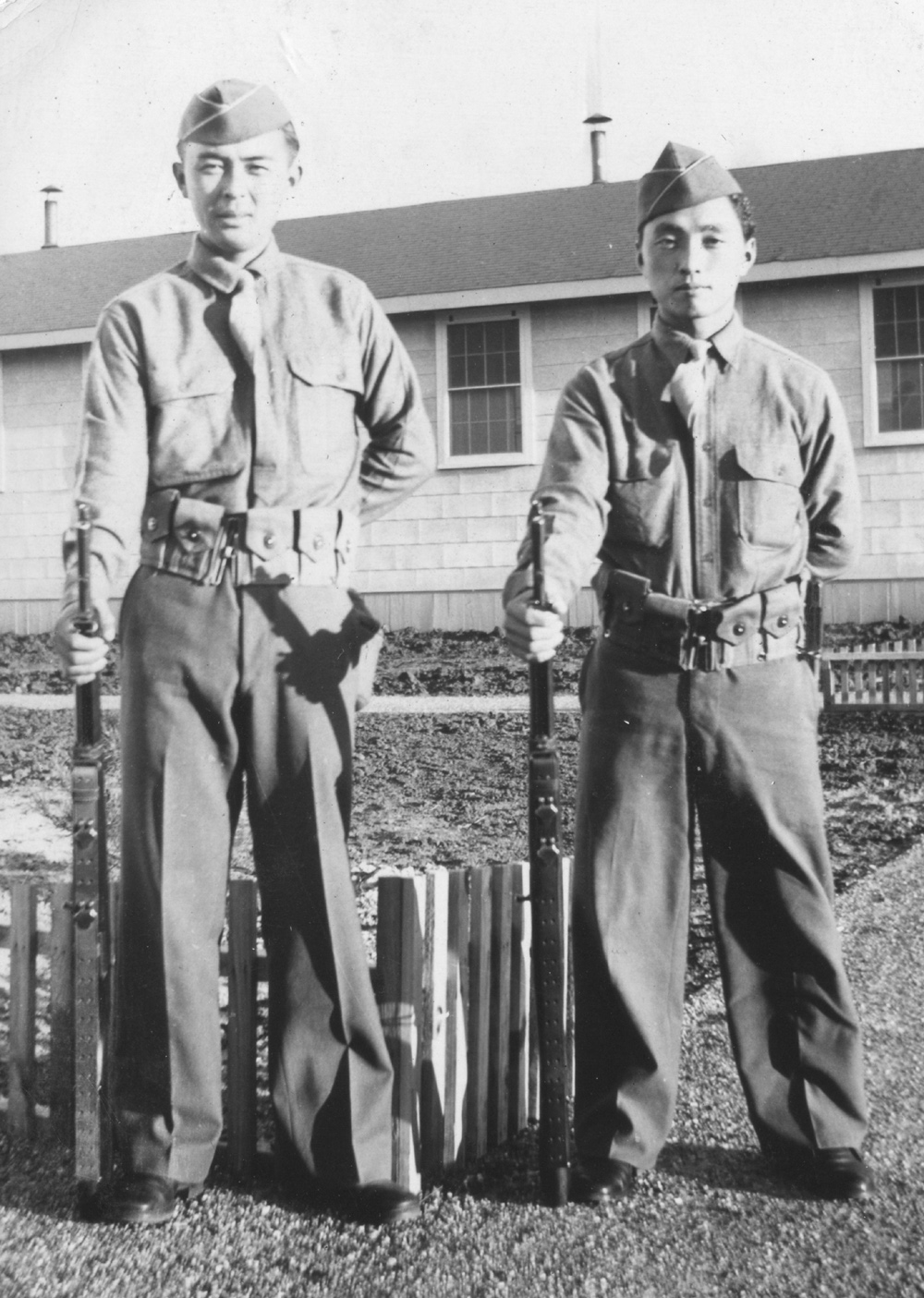
Here’s the second, “Fujita and Umihara.” 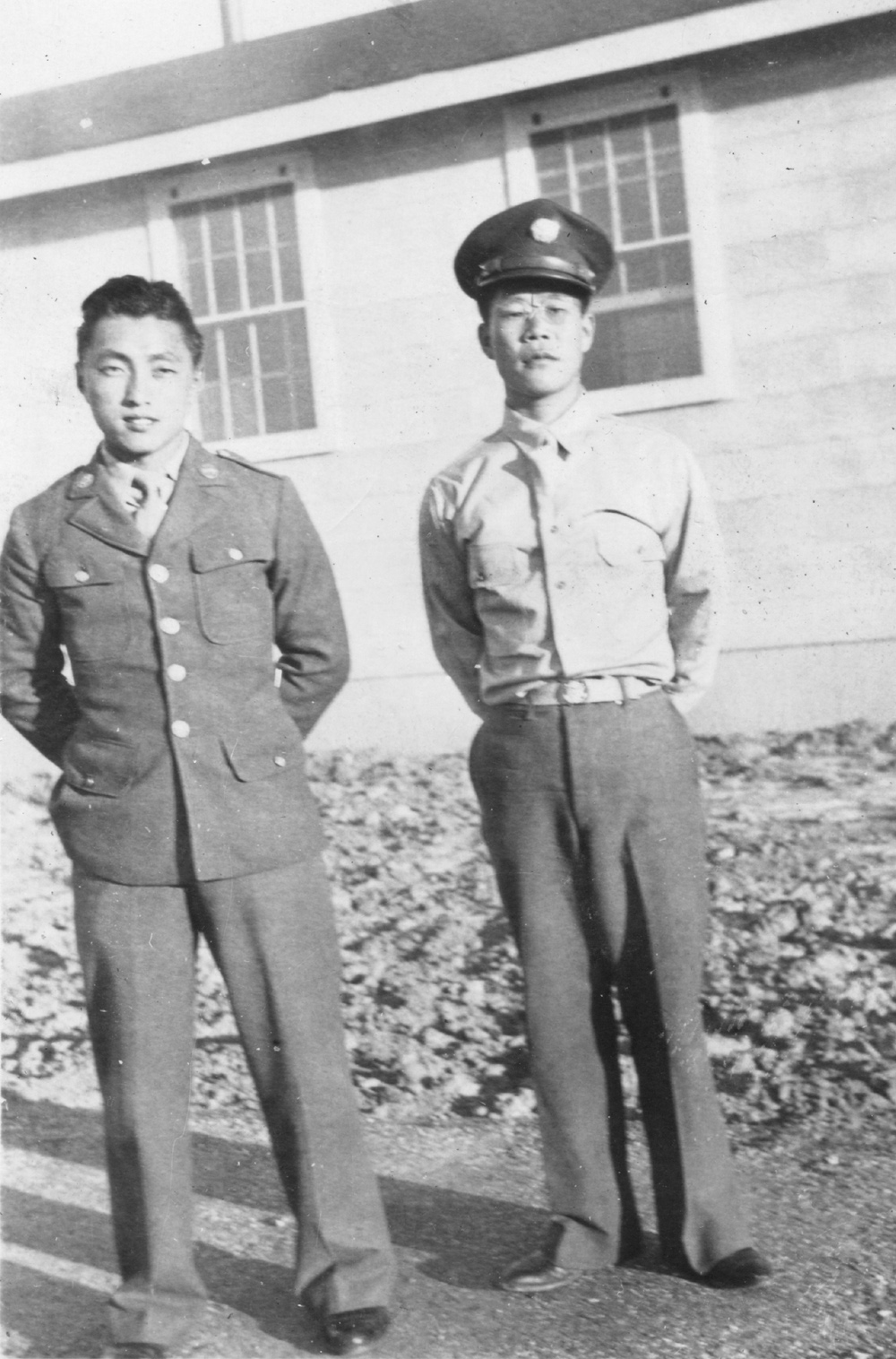 One of these men has to be the Arroyo Grande Fujita. A hint: Sadami was only 5′ 1″, so he’s likely to be the shorter man in either photograph. I looked up the enlistment record of the other “B” Company Fujita., whose first name was Hasami.
He was 5′ 2″. Great.
I’m reasonably sure–but will never be certain– that the lower photo is of “our” soldier, because Sadami Fujita outweighed Hasami Fujita by 22 lbs., so the smaller soldier in the lower photograph is a more likely choice.
He’s a nice-looking young man.
My next step is to hope to get a return email from the Fujita family still living in Hawaii–maybe the will know more about Sadami and maybe they’ll have photographs.
Sadami Fujita would go home to his family. His grave is in the Punch Bowl, an incredibly beautiful place; I visited in 1996. I owe it to him to find out more. 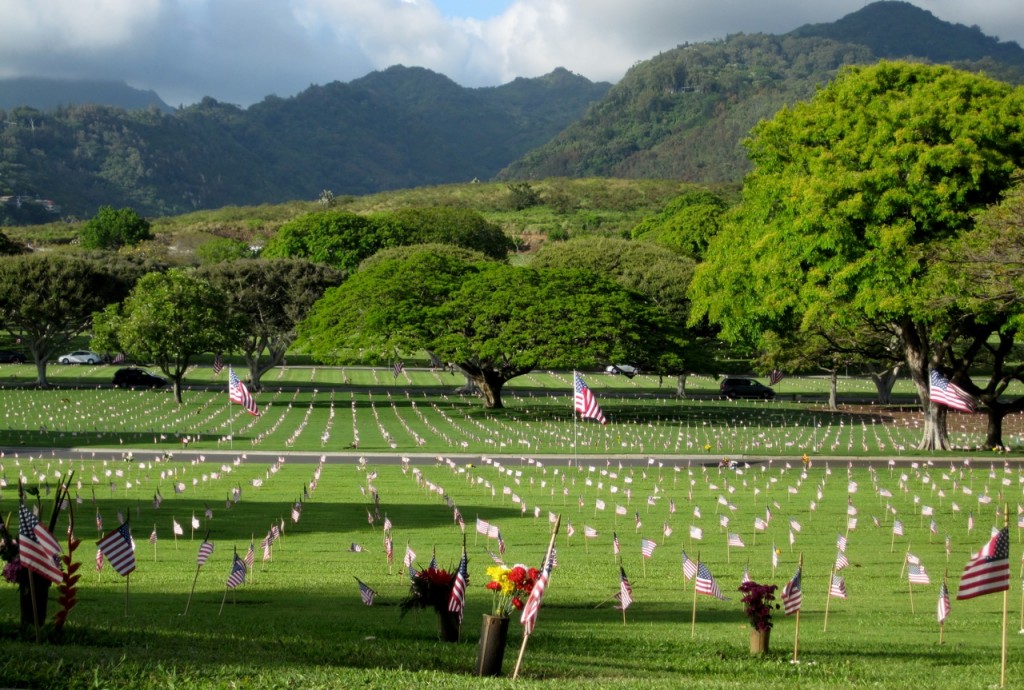
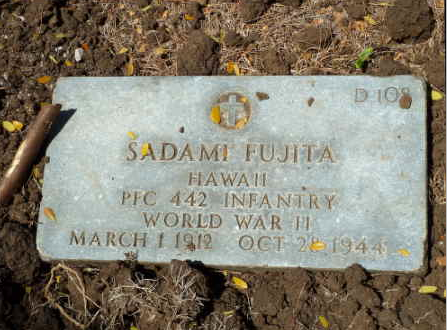 I owe to these young men, too. These are the 442nd Regimental Combat Team soldiers who gave their lives for the country:
MEMBERS OF THE 100th INFANTRY BATTALION AND 442nd REGIMENTAL COMBAT TEAM KILLED IN ACTION IN WORLD WAR II
Chester K. Abe / Matsuei Ajitomi / Tokio Ajitomi / Frank Chujiro Akabane / John Akimoto / Victor Akimoto / Hideo Akiyama / Zentaro G. Akiyama / Eugene T. Amabe / Nobuo Amakawa / James H. Anzai / Yoshiharu N. Aoyama / Harold J. Arakawa / James Y Arakawa / Masashi Araki / Frank N. Arikawa / Hiroaki Arita / Shiro Asahina / Ralph Y. Asai / Shotaro H. Asato / Kenneth L. Asaumi / Shigeo Ashikawa / Daniel D. Betsui / James Boodry / Howard Vernon Burt / Joseph Lawrence Byrne / Henry Chibana / Guchi Chinen / Onso Chinen / Jenhatsu Chinen / Danny K. Chorike / Cloudy Gary Connor Jr. / Walter Maurice Crone / Haruo Doi / Kenneth E. Eaton / Tetsu Ebata / George Eki / Hachi Endo / Hiroo H. Endo / Masaharu Endo / Robert T. Endo Kaname Enomoto / Kiyozo Enomoto / Ralph Burnell Ensminger / Harold C. Ethridge / Charles Oliver Farnum Jr. / Fred H. Fritzmeier / Abe M. Fuji / Paul Fuji / Masao Fuji / Richard T. Fujii / Samuel A. Fujii / Yutaka Fuji / Jitsuro Fujikawa / Masaki Fujikawa / Hideo Fujiki / Toshiaki Fujimoto / Noboru Fujinaka / Russell Takeo Fujino / Yasuo R. Fujino / Yoshimi Fujino / Teruo Fujioka / Wendell S. Fujioka / Sadami Fujita / Ross K. Fujitani / Peter Fujiwara / Takeo Fujiyama / Akira W. Fukeda / Shigeo F. Fukuba /Masami Fukugawa / Barbara Fukuhara /Herbert M. Fukuhara / Kakutaro Fukuhara / Edward Fukui / Roy S. Fukumoto / Ichiji Fukumura / Chester T. Fukunaga / Arthur M. Fukuoka / Katsumi Fukushima / Kaoru Fukuyama / Stanley K. Funai / Satoshi Furukawa /Tatsumi Furukawa / Tsuyoshi Furukawa / Kenneth K. Furukido / Henry T. Furushiro / Mitsuo Furuuchi /George M. Futamata / Shigeto Fuyumuro / Roland Joseph Gagnon / Seikichi Ganeko / Hiroshi Goda /Kazuo Goya /Yeiko Goya / George Gushiken / Frank T. Hachiya / Victor Hada / Hatsuji Hadano / Eichi F. Haita / Tom S. Haji / Tetsuo Hamada / Kenichi Hamaguchi / Katsuyoshi Hamamoto / Seuchi Hamamoto / Fred Y. Hamanaka / Clifford H. Hana / Richard S. Hanaumi / Tamotsu Hanida /Ben Hara / Charles K Harada /John Y Harano / Kiyoshi Hasegawa / Mikio Hasemoto / Denis M. Hashimoto / Hisao Hashizume /Masao Hatanaka / Kunio Hattori / Harry M. Hayakawa / Makoto Hayama / Stanley Hayami / Donald S. Hayashi / Eugene Hayashi / Joe Hayashi / Robert N. Hayashi /Tadao Hayashi / Torao Hayashi / Henry Hayashida / Henry Y. Hayashida / Hideyuki Hayashida / Robert Hempstead / Eiji Hidaka / Charles Higa / Eddie K. Higa / Katsumori Higa / Masao Higa / Takei Higa / Toshio Higa / Wilson E. Higa / Yeiko Higa / Bert K. Higashi / Harold T. Higashi / James T. Higashi / Harry N. Hikichi / Aranari Hiraga / Tomosu Hirahara / Mitsuo Hiraki / Kazuo L. Hiramatsu / Hiroyuki Hiramoto / Frederick M. Hirano / John Hirano / Robert R. Hirano / Genichi Hiraoka / Satoru Hiraoka / Gerome M. Hirata / Louis M. Hirata / Himeo Hiratani / Yasuo Hirayama / Yutaka Hirayama / Masao Hisano / Gary T. Hisaoka / Yeichi Hiyama / Richard M. Honda / Tomio Honda / Kay I. Horiba / James J. Horinouchi / Paul F. Horiuchi / Robert S. Hoshino / Earl Hosoda / Max M. Hosoda Jr. / Kihachi Hotta / Teruo Hozaki / Toshio Hozaki / Kenichi Ichimura / Edward Y. Ide / Shigeo Igarashi / Kiyoshi Iguchi / Masao Iha / Kazuo Ihara / Martin M. Iida / George Ikeda / Isamu Ikeda / Masao Ikeda / Roy Y. Ikeda / William Y Ikeda / Yoshio Ikeda / Lloyd Ikefuji / Henry S. Ikehara / Kikuichiro D. Ikehara / Haruyuki Ikemoto / James S. Ikeno / Tomio lmai / William I. Imamoto / Larry M. Imamura / Shunichi Imoto / Thomas T. Inada / Ben M. Inakazu / Masami Inatsu / Minoru Inoue / Henry Inouye / Masato Inouye / Takeshi Inouye / Masaji Irie / Tadayoshi Iriguchi /Mitsuo M. Iseri / Haruo Ishida Hidemaro Ishida / Minoru Ishida / George F Ishii / Richard H. Ishii / Stanley T. Ishiki / Walter S. Ishiki / Kiyoshi lshimizu / Kusaku Isobe / Hachiro Ito / Roy Ito / Takashi Ito / Tetsuo Ito / Robert K. Iwahiro / Hisashi lwai / Yoshio Iwamasa / Lawrence T. Iwamoto / Henry S. Izumizaki Thomas M. Jichaku / Katsui Jinnohara / John A. Johnson / Chitoshi Kadooka / Joe Y. Kadoyama / Yasuo Kagawa James J. Kagihara / Tsugito Kajikawa / Nobuo Kajiwara / Fred Y. Kameda / Bob T. Kameoka / Shinobu Kametani / Mitsuo Kami / Shizuto Kamikawa / James J. Kanada / Walter E. Kanaya / John S. Kanazawa / Frank Kanda / Takezo Kanda / Takeo Kaneichi / Katsuhiro Kanemitsu / Seichi Kaneshiro / Yasuo Kaneshiro / Isamu Kanetani / Jero Kanetomi / Akira Kanzaki / James S. Karatsu / Haruo Karimoto /Kenneth G. Kashiwaeda /Yoshitaka Kataoka /Noritada Katayama /John S. Kato /John J. Kato /Joseph Kato /Kenji Kato /Yoshio Kato /Masaichi Katsuda /John R. Kawaguchi /Richard H. Kawahara /Tetsuro Kawakami Kazuo Kawakita /Haruo Kawamoto /Sadao Kawamoto /Toshio Kawamoto /Yutaka Kawamoto /Kikumatsu F Kawanishi /Cike C. Kawano /George Kawano /Tetsuo Kawano /Yasuo Kawano /Albert G. Kawata /Satoshi Kaya /Stephen M. Kaya /Yasuo Kenmotsu /Lewis A. Key /Tadashi Kijima /Leo T. Kikuchi /John S. Kimura /Matsuichi Kimura /Paul Kimura Jr. /Tsuguo Kimura /Shomatsu E. Kina /Francis T. Kinoshita /Mamoru Kinoshita /Richard K. Kinoshita /Toshio Kirito /Robert T. Kishi /Roy J. Kitagawa /Paul T. Kitsuse /Ronald S. Kiyabu /Edward Y. Kiyota / Kiichi Koda /Sadaichi Kohara /Sadamu Koito /Hayato Koizumi /Yutaka Koizumi /Shaw Kojaku /Tadashi Kojima /Nobuo Kokame /Jimmie T. Kokubu /James K. Komatsu /Katsuto Komatsu /Fred H. Komeda /Nobuo Komoto /Harry M. Kondo /Harushi Kondo /Herbert Y. Kondo /Howard N. Kondow /Seichi Kotsubo /Shigeo Kuba /George M. Kubo /Tadashi Kubo /James Kubokawa /Mitsuharu Kuboyama /Thomas T. Kuge /Isamu Kunimatsu /Tetsuo Kunitomi /Katsuji K. Kuranishi /Jerry S. Kuraoka /Minoru Kurata /James S. Kuratsu /Ichiji H. Kuroda /Robert T. Kuroda /Satoshi Ben Kurokawa /Shigetoshi Kusuda / Shosei Kutaka /Masaji Kutara /Shozo Kuwahara /Sunao Kuwahara /John Kyono /Clarence E. Lang /Leonard H. Luna /Harry F. Madokoro /Saburo Maehara /Richard K. Magarifuji /Matsutada Makishi /Harry Makita /Seiso J. Mana /Ben Masaoka /Kay K. Masaoka /Masa Mashita /Dick Z. Masuda /Eso Masuda /Kazuo Masuda /Yoshito Masuda /George A. Matsumoto /Noriyuki Masumoto /Lawrence K. Masumura /Kiyoshi Masunaga /Peter S. Masuoka /Carl G. Matsuda /Masao Matsui /Hiroshi Matsukawa /Isamie Matsukawa / Dick Y. Matsumoto / Goro Matsumoto / Kiyuichi Matsumoto / Sadao Matsumoto / Tommy T. Matsumoto / Renkichi Matsumura / Kaname Matsunaga / Satoshi Matsuoka / Shizuo Matsushida / Kazuo Matsushima / George M. Mayeda / Jimmy Mayemura / Thomas T. Mekata / Torae Migita / Katsuaki Miho / Yoshio Minami / lsamu Minatodani / Kiyoshi Mine / Nobue Mine / Tom T Misumi / Kazuo Mitani / Kazuo Mito / Larry N. Miura / Toshio Miura / Charles M. Miyabe / Masayoshi Miyagi / Masayuki Miyaguchi / Tetsuo Miyake / James H. Miyamoto / Thomas T. Miyamoto / Yasuo Miyamoto / George S. Miyaoka / Isami Miyasato / Tamotsu Miyata / Tokio Miyazono / Tsuyoshi Miyoga / Mitsuru E. Miyoko / Noburo Miyoko / Timothy Mizokami / William S. Mizukami / Hideo Mizuki / Morio Mizumoto / Yukitaka Mizutari / Henry T. Mochizuki / Edward V. Moran / Kiyoto Mori / Shigeru Mori / Haruto Moriguchi / Rokuro Moriguchi / Arthur A. Morihara / Roy T. Morihiro / Haruto Morikawa / Hiromu Morikawa / Toshiaki Morimoto / Harold Morisaki / Joseph Morishige / Takeo Morishita / Iwao Morita / George K. Moriwaki / David Leander Moseley / Hiroshi Motoishi / Susumu Motoyama / Hachiro Mukai / Sadao S. Munemori / Isamu Murakami / Kiyoshi Murakami / Sakae Murakami / Tadataka Murakami / Tokiwo Murakami / Toshio T. Murakami / Kiyoshi K Muranaga / Richard K Murashige / Robert S. Murata / Mitsugi Muronaka / Roy L Naemura / Grover K Nagaji / Hiroshi Nagami / Hiroshi Nagano / Setsuo Nagano / Martin M. Naganuma / Goichi Nagao Hitoshi Nagaoka / Hideo Nagata / Jim Nagata / Taichi Nagata /Fumitake Nagato /Yoshiiwa Nagato /Kaoru Naito /Hitoshi Najita /Masaru Nakagaki /Hirao Nakagawa /Usho Nakagawa /Hitoshi Nakai /Masao Nakama /Shigenori Nakama /Shinyei Nakamine /Joe K Nakamoto /Seichi Nakamoto /Edward E. Nakamura /George S. Nakamura /Henry Y. Nakamura /John M. Nakamura /Kosei Nakamura /Masaki Nakamura /Ned T. Nakamura /Tadao Nakamura /Wataru Nakamura /William K Nakamura /Yoshimitsu Nakamura /Masao Nakanishi /Tsutomu Nakano /Robert K. Nakasaki /Dick S. Nakashima /Raito R. Nakashima /Wataru Nakashima /Frank K. Nakauchi /Donald T. Nakauye /Kiyoshi C. Nakaya /Minoru Nakayama /Saburo Nakazato /John T. Narimatsu /Tetsuo Nezu /Yutaka Nezu /Willie S. Nieda /Shigeto Niide /Edward Joseph Nilges /Minoru Nimura /Ban Ninomiya /Takao T. Ninomiya /Chikao Nishi /Takanori A. Nishi /Kazuo Nishihara /Takaki Nishihara /Akio Nishikawa /Tohoru Nishikawa /Joe M. Nishimoto /Tom T. Nishimoto /Shigeki Nishimura /Wilfred K. Nishimura /Charles J. Nishishita /Chieto Nishitani /Taro Nishitani /Sueo Noda /Yoshito Noritake /Al Y. Nozaki /Tadashi Nozaki /Alfred S. Nozawa /Toshio Numa /Masayoshi Oba /Sanichi Oba /Stanley T. Oba /Tadashi Obana /Larry M. Ochiai /Benjamin F. Ogata /Fred S. Ogata /Masaru Ogata /Masayoshi Ogata /Tsugio Ogata /Edward Ogawa /John N. Ogawa /Sadao Ogawa /Yoshio W. Ogomori /Abraham G. Ohama /Arnold Ohki /Muneo Ohye /Shigeo Oikawa /Teiji T. Oishi /Akira Oiji /John T Okada /Donald M. Okamoto /James S. Okamoto /James T. Okamoto /Ralph S. Okamoto /Tomiso Okamoto /Togo Okamura /Isao Okazaki /Takaaki Okazaki /Katsu Okida /Richard M. Okimoto /Seiei Okuma /Toyokazu Okumura /Susumu Okura /George Omokawa /Ken Omura /Takeyasu T. Onaga /Satoru Onodera /Lloyd M. Onoye /Choyei Oshiro /Edward Oshiro /Kenneth Oshiro /Sam Y. Oshiro /Seikichi Oshiro /Wallace H. Oshiro /Yeishin Oshiro /Daniel C. Ota /Randall M. Ota /Roy Ota /Tadashi Otaguro /Masanao Otake /Douglas K. Otani /Kazuo Otani /Bill M. Otomo /Akira Otsubo /Jiro Otsuka /Harumatsu Oyabu /Francis K. Oyakawa /Robert Y. Ozaki /George Y. Ozawa /Francis J. Rerras /Roy T. Reterson /Neill M. Ray /Masatsugu Riyu /Ben W Rogers Jr. /Herbert K. Sadayasu /Yohei Sagami /Thomas T. Sagimori /Atsuo Sahara /Masami Saiki /Hoichi Saipan /Calvin K. Saito /Chuji Saito /George S. Saito /Kinji Saito /Masuto Sakada /Masaaki Sakaguchi /Richard M. Sakai /Yoshinori Sakai /Atsushi Sakamoto /Louis K. Sakamoto /Masa Sakamoto /Noburo Sakamoto / Robert /. Sakamoto / William Samonji / Minoru Sasaki / Yoshio Sasaki / Toshio Sasano / Itsumu Sasaoka / Andrew Y. Sase / Michael Sato / Saburo Sato / Shin Sato / Shukichi Sato / Tadao Sato / Yukio Sato / George K. Sawada / Kurt E. Schemel / Toll Seike / Koichi K Sekimura / Hihumi Seshiki / Hiroshi Shibao / Kenneth K. Shibata / Mitsuru Shibata / Tetsuo Shigaya / Masao F. Shigemura / Hideo Shigeta / Masao Shigezane / Takeshi Shigihara / George M. Shikata / Ted T. Shikiya / Roy K. Shimabuku / Hideo Shimabukuro / Tomoaki Shimabukuro / George M. Shimada / Akira R. Shimatsu / Jimmy T. Shimizu / Takeo Shimizu / Robert Shinde / Takeo Shintani / Nathaniel A. Shiotani / Joe A. Shiomichi/ Roy R. Shiozawa / Shigeomi Shiraishi / Kiyoshi J. Shiramizu / Kizo Shirokane / Henry M. Shiyama / Toshiaki Shoji / David I. Suda / Sadami R. Sueoka / Theodore T. Sueoka / Shinichi Sugahara / Kenji Sugawara / Hiroshi Sugiyama / ltsuo Sugiyama /Togo S. Sugiyama / Michiru Sumida / Albert M.Sunada / Nobuyuki Suwa / George W. Suyama / Jiro Suzawa / Kenny R. Suzuki / Takashi Suzuki / YonezoSuzuki / Edward H. Sweitzer / Teruo Tabata / Shigeo Tabuchi / Sadao Tachibana /Yoshio Tagami / Hitoshi B. Taguchi / Cooper T. Tahara / Masaru Taira / Seitoku Taira / Boon E. Takagi / David Kiyoshi Takahashi / ltsuo Takahashi / lwao A. Takahashi / Mon Takahashi / Toru T. Takai / Thomas T. Takao / Ronald K. Takara / Gordon K. Takasaki / Katsumi L. Takasugi / Shigeo J. Takata / Jo Takayama / Yoshito Takayama / Masaharu Takeba / Jimmy Takeda / Shoichi J. Takehara / Yosh Takei /Haruo Takemoto /lwao Takemoto /Tami Takemoto /Tooru Takenaka /Robert M. Takeo /Jimmy Y. Taketa /Peter Taketa /Shigeto Taketa /William H. Taketa /Ichiro S. Takeuchi /Tadashi Takeuchi /Thomas Takizawa /Kenji Takubo /Douglas Tamanaha /Kuneo Tamanaha /Masao H. Tamanaha /Thomas T. Tamashiro /Masaru Tamura /Osamu Tamura /Toyoshi Tamura /Kei Tanahashi /Harley Tanaka /Jack M. Tanaka /James J. Tanaka /Jiro Tanaka /John Y. Tanaka Keichi Tanaka /Ko Tanaka /Matsusaburo Tanaka /Saburo Tanamachi /Larry T. Tanimoto /Teruto Tanimoto /Yukio Tanimoto /Mitsuo Tanji / Katsushi Tanouye /Ted T. Tanouye /Yukio Tanouye /Masaru Tashima /Michio Tachima /Haruyoshi H.Tateyama /George Tatsumi /Masaru Tengan /Yoshio Tengwan /Henry M.Terada /Ted A. Teramae /Lloyd M. Teramoto /Shizuo Teramoto /Henry Terazawa /Herman T. Teruya /Kenkichi K. Teruya /Michio Teshima /Theodore T. Tezuka /Shiro Togo /Clifford T. Tokunaga /Hidetoshi Tokusato /Harry H. Tokushima /Patrick M. Tokushima /Minoru Tokuyama /Takaya Uragami /Moriichi Uyeda /Theodore T. Uyeno /Daniel M. Wada /Kenneth Y. Wasada /Shigeo Wasano /Hiroshi Watanabe /Kiyotoshi Watanabe /Kozo Watanabe /Theodore H. Watanabe /James D. Wheatley Jr. /Earl White Jr. /Steve S. Yagi /Hideo Yamada /Raymond T. Yamada /George T Yamaguchi /Fred M. Yamamoto /George I. Yamamoto /John T. Yamamoto /Masaru Yamamoto /Takeo Yamamoto /Tsuyoshi Yamamoto /Thomas I. Yamanaga /Tsutomu Yamaoka /Harry S. Yamasaki /Gordon K. Yamashiro / Lei S.Yamashiro /Joichi Yamashita /Kazuo Yamashita /Setsuro Yamashita /Chioyoaki J. Yamauchi /GoroYamaura /Thomas T. Yamazaki /Fred S. Yasuda /Joe R. Yasuda /Arata Yasuhira /Hideo Yasui /Yoji Yasui /Mitsuru Yeto /Masuichi Yogi /Hideo Yonamine /Satoshi Yonekura /Hitoshi Yonemura / Kenjiro Yoshida /Yoshiharu E. Yoshida /Mitsuichi Yoshigai /Makoto Yoshihara /Toraichi Yoshihara /Minoru Yoshimura /Saburo Yoshimura /Akira Yoshinaga /Hajime Yoshino /Isami Yoshioka /S. Yoshioka / Tatsuo Yoshizaki /Don Yumori /Shiyoji Yunoku .

