Sons, Husbands, Fathers

Slide1

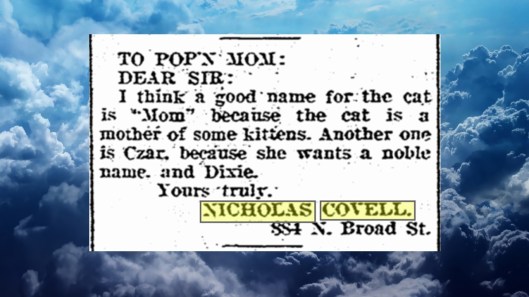
Someone found a cat in San Luis Obispo in the fall of 1929, about the time of the Crash. It must have been a slow news week despite that turning point, because the local paper, the Telegram-Tribune, solicited letters from local children for kitty names.
Slide2

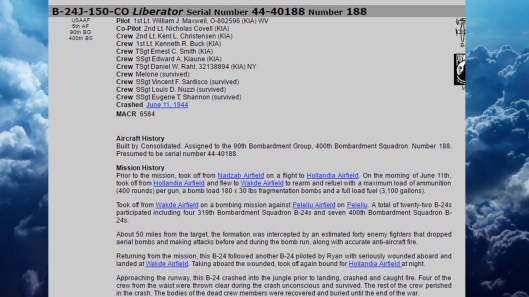
B-24 44-40188, after a bombing run over Peleliu, was ferrying wounded to safety on Hollandia. Nicholas Covell is buried in the Golden Gate National Cemetry in San Bruno.
Slide3

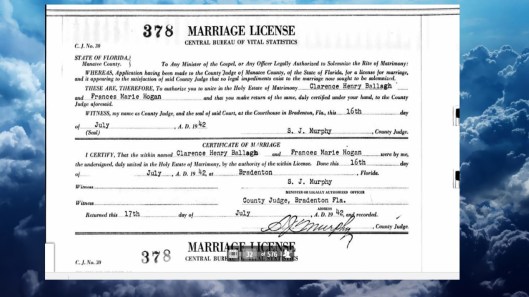
Clarence Ballagh fell in love in flight school in Florida, 3,000 miles away from his home town, Arroyo Grande, California.
Slide4

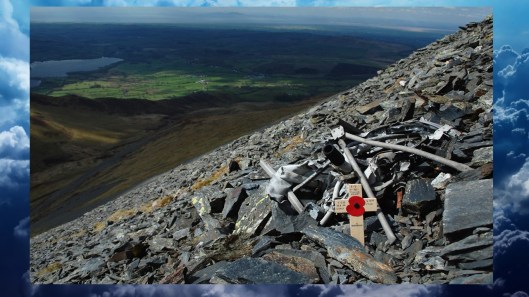
Sixteen months later, Ballagh’s B-17 crashed into the side of Mt. Skiddaw, 5,5000 miles away from Arroyo Grande, in England’s Lake District. His baby girl was named Enid. In 1944, the Methodist Church dedicated a sidewalk, now gone, on Branch Street, in Clarence’s memory. The church asked little Enid to leave her palm prints in the wet concrete.
Slide5

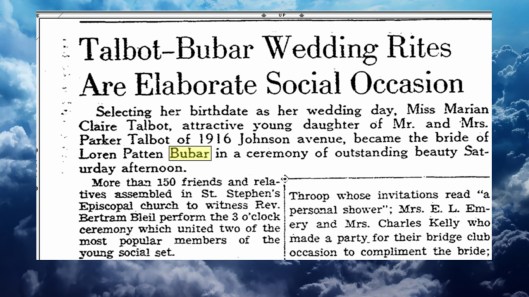
Loren Bubar married in the oldest church, next to the Old Mission, in San Luis Obispo, the beautiful redwood St. Stephen’s.
Slide6

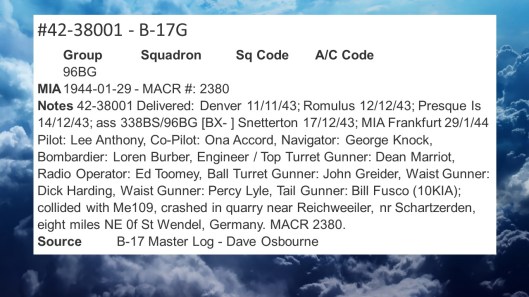
His death was horrific. They misspelled his name in the USAAF records.
Slide7

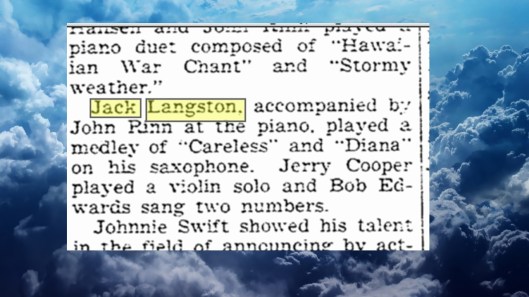
Jack played the saxophone at Atascadero High School and here, in the Freshman Talent Show at San Luis Obispo Junior College in 1941.

Slide8

His P-38 was set afire by ground fire in what was a virtual suicide mission. Every pilot in the 367th knew it. Jack almost made it, because someone saw a parachute. He has never been found.
Slide9

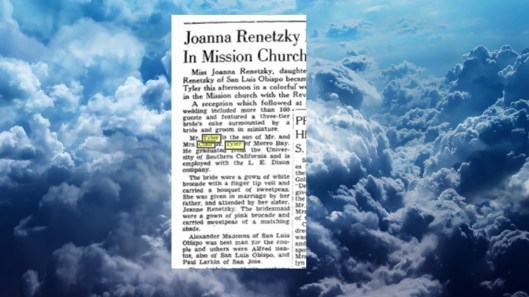
Clair Tyler married Joanna Renetzky–a Pozo schoolteacher with Dana Family connections–in the oldest church in San Luis Obispo. Note Clair’s best man that day in 1941. Both Clair’s bride and Loren Bubar’s had their bridal showers in the Golden Dragon Restaurant in Chinatown, on Palm Street.
Slide10

Clair’s Dad took him hunting. Clair’s Mom hosted charity events to help feed and clothe Depression-era kids, and she and Clair traveled all over the state together. They lived on Piney Way in Morro Bay. Clair was their only child.
Lost Boys II: World War II aviators from San Luis Obispo County

Unfortunately, I’m starting my research with dead fliers, who are easier to find in the records, so most of what I find early on is going to be immensely sad. The young men who volunteered for air combat–you had to volunteer–tended to me better-educated and gifted in different ways (they were musicians, artists, teachers, architects). Few of them were over 24 years old. Just a few things I learned about them today:

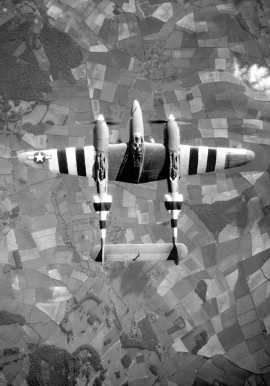
1. The P-38 was much more difficult to fly than the P-51, my Dream Airplane. One engine going out on a P-38 was almost as bad as the ONLY engine going out on a P-51. Jack Langston, Atascadero High ’39, was flying a P-38–it would have looked exactly like the one in the photograph; it was June 22, 1944, so Allied aircraft still had their recognition stripes from D-Day– over Cherbourg when he, along four other members of his air group, was shot down in what all the young pilots realized was a half-baked suicide mission. Jack was married. He was also a gifted musician, a saxophonist.

normandy_6jun1944_invasion_stripes_375

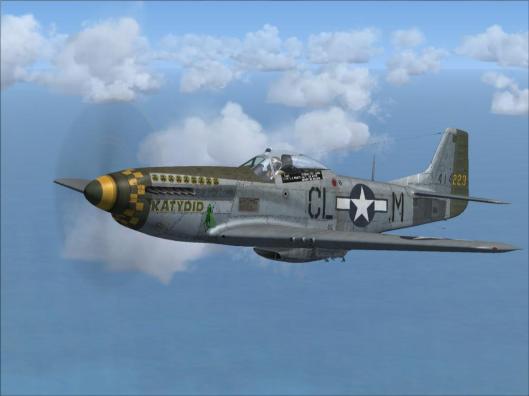
2. SLO native and war hero Elwyn Righetti flew a P-51, On his last mission, as commander of his fighter group (he was shot down and vanished), he ordered two fliers to turn around and go home. It was the last mission required of each man, and he didn’t want them to get killed. The word is “mensch.”

146513263234381242

Lt. Col. Elwyn Righetti’s P-51D, named for his wife.

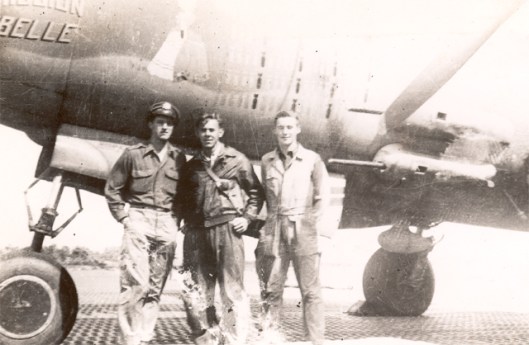
3. “Mission Belle” was the B-26 co-piloted by Lt. James Pearson of Templeton, shot down over Belgium during the Battle of the Bulge, Dec. 26, 1944.

moen-04

“Mission Belle” with her pilot, Lt. Fox, and two gunners. Fox was killed on that December 26 mission, as well as Lt. Pearson.

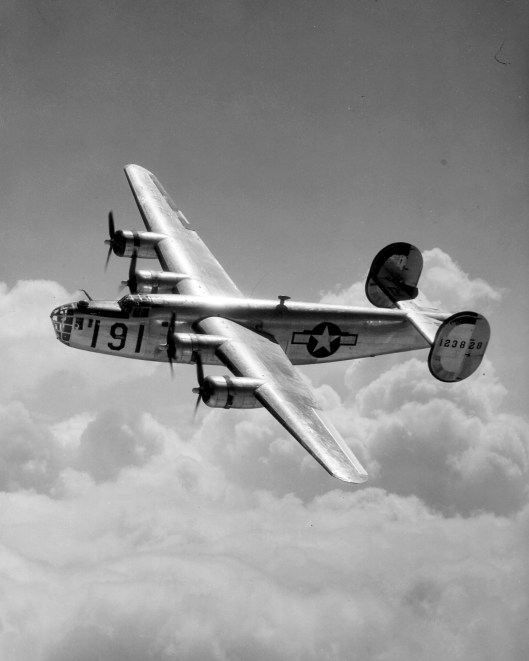
4. The cruelest loss of all, in some ways, was an Idaho accident. Sgt. Charles Eddy was a part of the crew that perished in an Idaho B-24 training accident. On the plane’s fourth practice high-altitude bomb run, it suddenly fell, in two minutes, from 20,000 feet to 100 feet, when the pilot and co-pilot finally pulled it out of its dive. Once they had the bomber level, they gained altitude and started to make a gentle right turn to get back to base. The plane nose-dived into the ground.

Maxwell_B-24

A Consolidated B-24 Liberator from Maxwell Field, Alabama, four engine pilot school, glistens in the sun as it makes a turn at high altitude in the clouds.

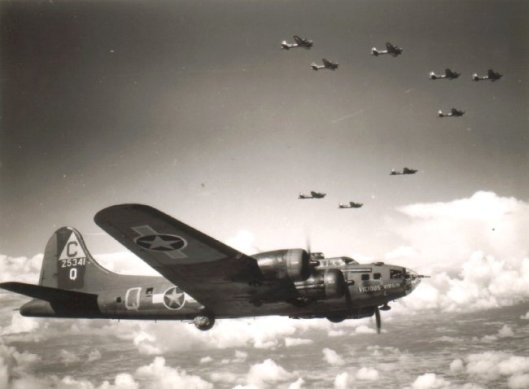
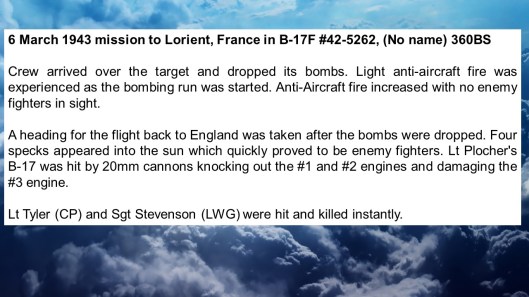
5. Lt. Clair Abbott Tyler, Morro Bay, was a B-17 co-pilot killed over the Channel in 1943. The best man at his 1941 Mission SLO wedding to Miss Joanna Renetzky was Alex Madonna.

b-17f-vicious-virgin-427th-bs

B-17’s from Lt. Tyler’s 303rd Bomb Group.


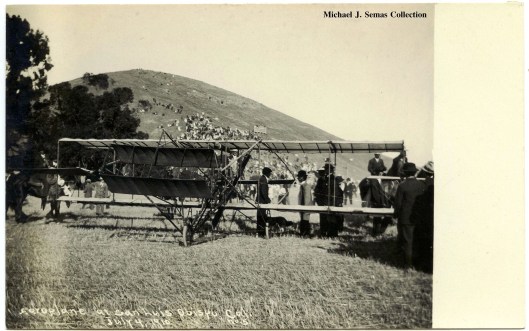
July 4, 1910, San Luis Obispo, California

6462488605_833404d9f1_b

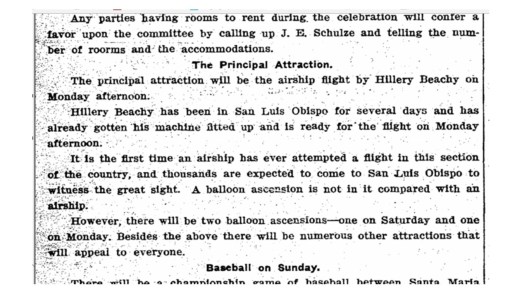
About 5 p.m., Monday, July 4. What was then called an “aeroplane” is circling San Luis Obispo.

Gill-Dosh1_zps79c21603

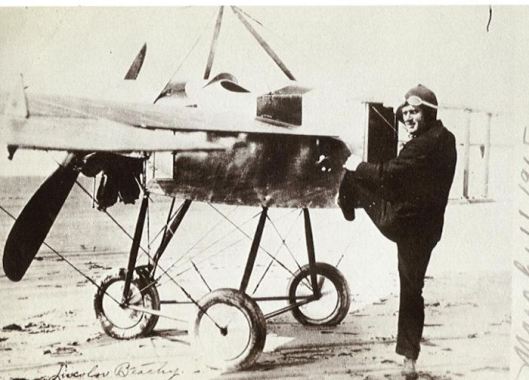
Here is the pilot: Hillery Beachey and his brother, Lincoln, were San Francisco aviators. Hillery was an experienced balloonist; he’d just learned to fly heavier-than-air aircraft that year. This photo was taken in 1910 Los Angeles; the plane is a copy of a Curtiss. Note the pilot’s position; he will, of course, take the full brunt of any crash.

Slide1

A San Luis Obispo newspaper began covering the flight in late June. It was a first. The Beachey flier would take off from the town’s baseball field.

71dddc7b498604253a35d7de9559d589

Preparing for takeoff on the southern edge of town; that looks like Beachey near the engine; note the juxtaposition of cowboy and flying machine at the left edge of the photograph.

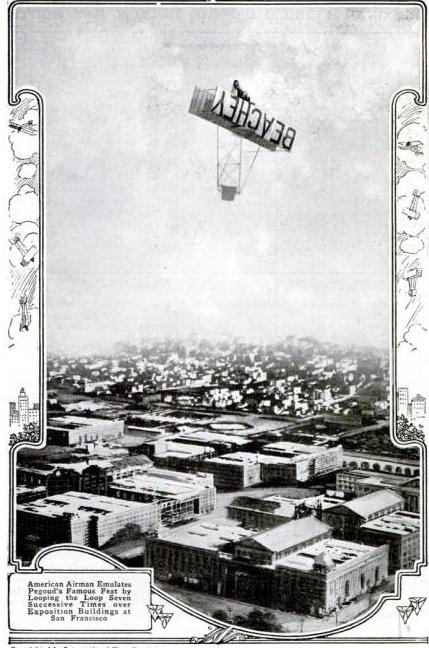
Lincoln_Beachey_flying_a_loop

Hillery’s brother, Lincoln, seems to have been the more prominent of the pair. This is an incredible photograph.

LPC-019-016-004A

Both brothers–in this case, it was Lincoln–were injured in serious crashes. Both kept flying.

1aab26

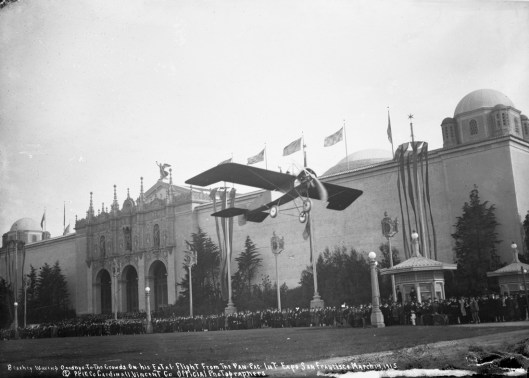
Lincoln boarding a daring design–a Beachey-Eaton monoplane–in 1915.

1aab33

Lincoln waves goodbye on his last flight at the March 1915 Pan-Pacific Exhibition. He attempted a loop over San Francisco Bay, but he didn’t have enough altitude to finish the maneuver. When he tried to level the plane, struts and guywires snapped and the aircraft plunged into the Bay, between two ships. Lincoln, only 28 years old, drowned. His luckier brother died in 1964.

Lost Boys

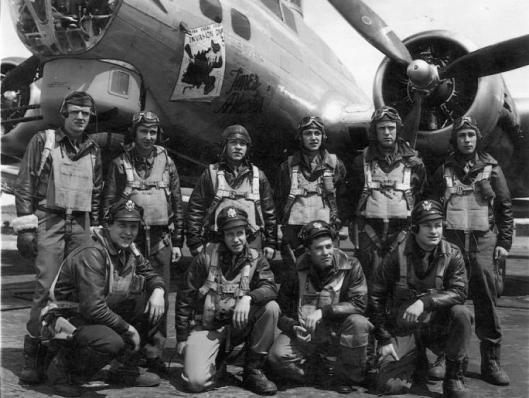
crew2

More on aviators. I am about halfway through the list of young men we–San Luis Obispo County– lost during World War II in air combat or in accidents.

So, of course, being more or less half-Irish, I had to pull myself up short and ask myself my motives.

What the hell are you doing, Gregory?

There has to be some kind of Cardinal Sin involved in me looking up the names of 106 young men lost fighting fascism and militarism, then paring them down to the aviators, then spending the hours it takes to track down everything from their parents’ names to the airframe numbers of the aircraft that would become their final homes and their coffins.

It’s not morbidity, I decided after a long, long time.

It’s the fact that I have two sons, and most of these young men were younger than my boys.

You see, I had already decided a long time ago that these are my boys, too. So I may have to write a book about them.

You see, I don’t want them to be lost again. Once was enough. That’s what I’m doing, I think. If I’m at all Irish, then we Irish believe there’s nothing quite so close at hand yet so transitory as death.

Whatever my generation has enjoyed, and the two generations I’ve taught history now enjoy and will enjoy, it’s because of these boys. We live because they willed us life, in their deepest hearts, without ever knowing it in the terrible moments when they fell from the sky.

Click the link below to meet some of them, and this is only half. I’ve work to do yet. The table that follows them lists the air accidents that took their comrades in a single day Stateside: March 2, 1944.

The number lost in combat overseas that day is, of course, far larger.

Think on that.

Think about how little, too, the president we have today, who knows almost nothing about our history–or any other nation’s– can register the meaning of lives, like these, given up for us. They represent a generosity and an integrity that he cannot understand.

We deserve better. We owe it to these boys.

Don’t we?

* * *

Here is the link:

https://drive.google.com/open?id=0B05dFICUx2kGV2NmSWF6OEpSaGs

So far to fall…

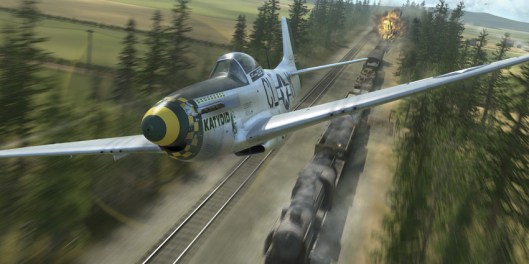
P-51_katydid_850

Artist’s conception of Lt. Col. Righetti’s P-51, “Katydid,” named for his wife.

By my count, 106 young San Luis Obispo County men were killed during World War II. Twenty-seven of them were airmen, most in the Army Air Corps and a few Navy fliers; there was a Naval aviation training school at Poly during the War.

I’m not sure why it is, but death in the air seems even more capricious and cruel than death in ground combat, and I think that’s because so many of those 27 county residents were killed in stateside accidents. [There were numerous fatalities in local crashes: a P-38 in Oceano, another that plunged into a Santa Maria cafe; a P-39 Aircobra that left a huge crater in Shell Beach.] Combat airplanes don’t forgive a lot, not even a moment’s inattention:

  • Frederick George Gillis was an air cadet who died in Lancaster when his trainer went out of control and flew into a mountain. Both Gillis and his flight instructor bailed out in time. Gillis’s parachute didn’t open.
  • A midair collision of two B-25 medium bombers “on a routine training flight” from Tampa killed Lt. Randoph Donalson over Newberry, South Carolina.
  • When his B-17 pilot tried to make a crash landing in a meadow near Roundup, Montana, Staff Sgt. Charles Valys died when the plane hit the ground, exploded, and broke apart.

All of these men were in their twenties.

The “old man” among our lost fliers was Lt. Col. Elwyn Righetti, from San Luis Obispo, a P-51D pilot shot down near Dresden in the weeks following the notorious fire-bombing there. Righettti, 30, was the winner of the Silver Star with four oak leaf clusters for both his kills and his superb leadership of the 55th Fighter Squadron. Righetti survived his plane’s crash-landing. He radioed his comrades that he was all right, yet he was never found and is still listed as “missing in action.” There is a chance that he was killed by German civilians; another downed American was summarily executed the day before Righetti was shot down.

normandy_6jun1944_invasion_stripes_375

Jack Langston’s P-38 would have looked like this one, with its D-Day markings.

Righetti’s body was never found, and neither  was 2nd Lt. Jack Langston’s. He was shot down by ground fire in his P-38 during a low-level attack on Cherbourg in the weeks after D-Day. Many of these fliers simply disappeared; Langston’s fighter exploded in the air.


b17hit

A doomed B-17.

Sgt. Donal Laird was a ball-turret gunner in a B-17 named “Strictly GI,” shot down over Karlsruhe, a city of scientists once visited by Thomas Jefferson. Flak probably claimed 1st Lt. James Pearson, from Paso Robles, and the crew of his B-26 Marauder over Belgium during the Battle of the Bulge.  An Army Air Corps captain and friend of flight engineer Loren Bubar found his body, later positively identified, a year after Bubar’s B-17 collided with a German ME-109 fighter near Frankfurt.

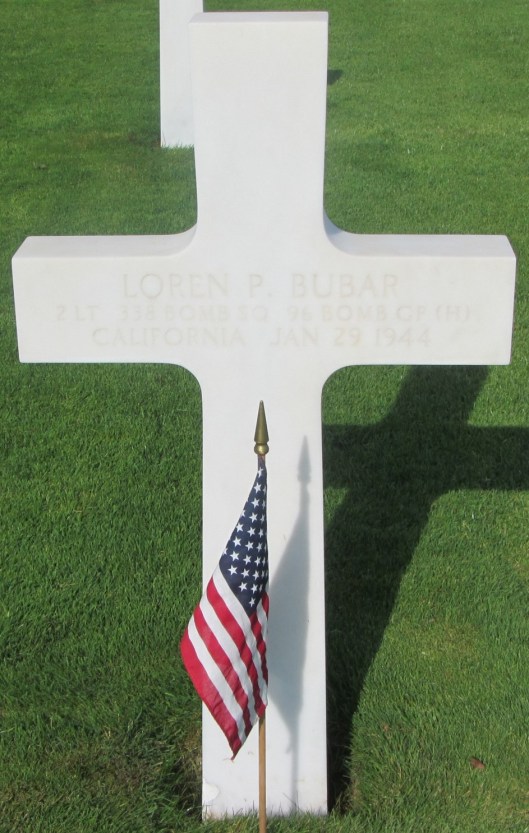
Loren lies today amid other young Americans in a military cemetery in Luxmebourg, 5,500 miles away from home.


55956588_1416835743

Loren Bubar’s grave.

One life

the-martian

I watched Matt Damon in The Martian for the first time a couple of days ago, and like both the protagonist’s Robinson Crusoe determination and even more the film’s large message: even one human life is worth saving. I was so happy that they saved astronaut Mark Watney’s.

gty-syria-chemical-child-ps-170404_4x3_992

But sooner or later, sadly, you have to turn away from the make-believe of movies and turn to real lives. This precious angel is Syrian, and she was one of the victims of a gas attack both Assad and Putin vigorously deny is their responsibility.

This is the time I’d push my Trump Button. If there is any way to make those two men pay for what they have done to this child, I would do it, and make it hurt.

But, in doing some research on local military aviation, I found that 106 county men died in World War II–27 of them, an estimate, were airmen. Some of them died long before they reached the European or Pacific Fronts: a B-17 crash in Pocatello, Idaho; a midair collision between B-25s over Newberry, South Carolina; a parachute that failed to open for a flight cadet over Lancaster.

b17hit

And, of course, there were many more who died “somewhere in the South Pacific,” or “in the skies over Germany.” If they were lucky, their ship exploded. If they were not, they fell six miles to their deaths. Twenty-seven local airmen died either mercifully or in the kind of prolonged fear that surpasses all understanding, and which no human being deserves–except, possibly, for those who would kill children deliberately and impassively.

Some of these young men killed children, invisible and indiscriminate, in the miles below their bombers. Despite that barbarism, committed in the name of fighting barbarism, I grow attached to them. I miss them, I wish them their lives and their youth back. I have not worked out that contradiction in my thinking; I doubt I ever will.

And, of course, that is useless. I can help the lost fliers of World War II no more than I can help the little Syrian girl. Rage and compassion have practical limits; to contemplate war means we must acknowledge the deaths of young men and, now, women, in the most terrible ways.

It’s exhausting to shake your fist by the side of history’s road. Perhaps the best we can do it to hold close another traveler when he or she pauses to rest. May it please God that somehow this is gesture enough to fill that little girl’s lungs with air that is cool and fresh and life-sustaining.

Why I am going to catch hell


0a16329c6418f0ba376a7c00f5492dc4

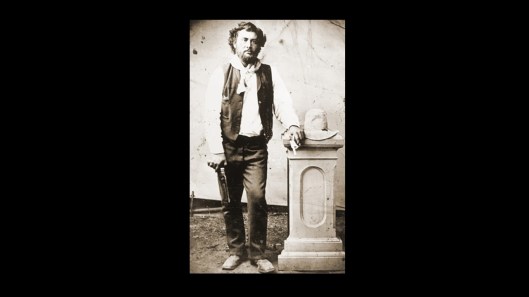
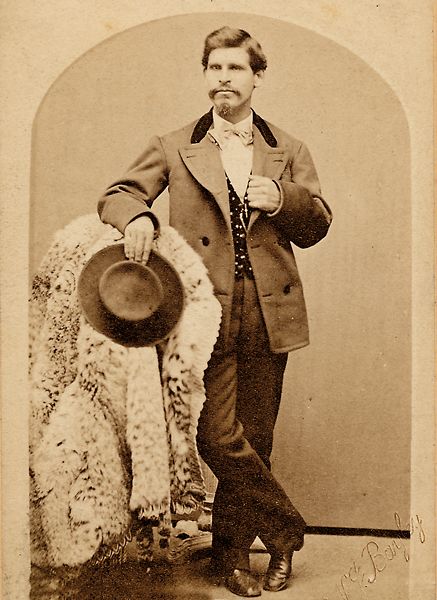
Californio outlaw Tiburcio Vasquez was hanged in 1875 San Jose.

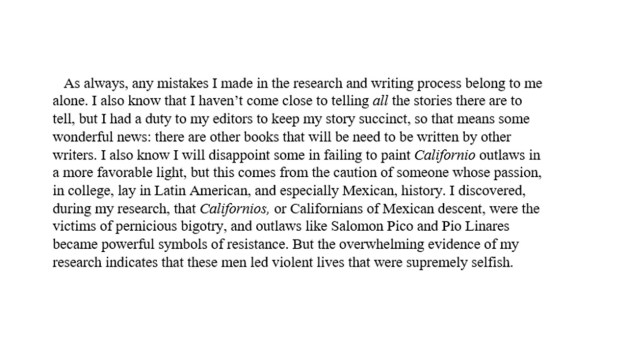
The passage below is from the acknowledgements to the new book, on outlaws. I am already receiving messages from folks urging me to reconsider the scholarship and portray California outlaws like Vasquez, Salomon Pico, and Pio Linares as patriots, as social outlaws, or what the Marxist historian Hobsbawm called “primitive rebels.” They are going to be unhappy:

Slide1

Forty years ago, I found Hobsbawm’s thesis thrilling, because his was one of those books that forced you to look at history in a totally different way. I even took a college course in social outlawry–in Missouri, not far from towns that Jesse James once haunted–and wrote my paper on Vasquez.

I took the class because I inherited my Irish-American mother’s instinctive distrust of the powerful and her faith in the poor and working people who, like her ancestors, suffered so much under men like the oligarchs who are such a potent presence in our government today. If anything, the wealthy are as powerful or even more powerful now than they were in Jesse James’s lifetime, and they are the most clear and present danger to American representative democracy. I can think of no decision since Plessy  v. Ferguson that has been more injurious than Citizens United.

But I am forty years older from the time I read my Hobsbawm. Some Marxists age well–Eugene Genovese, now a rabid conservative, wrote Roll, Jordan, Roll, an incandescent history of slavery, when he was younger and more sensible, and it is still brilliant–but my Hobsbawm-inspired treatment of Tiburcio Vasqeuz is trite and shallow.

In the course of researching the outlaws book, I found overwhelming evidence to explain the satisfaction Latino Californians took in the actions of  the men, like Vasquez, whom they identified as social outlaws, because these people were driven out of the gold fields, politically marginalized, and their land was seized. But I finally decided that what makes a social outlaw is not what he does, but how he dies. Outlaws like Vasquez die  at a young age and  their deaths are invariably violent. What’s left behind is what I used to call “the James Dean effect:” the suddenness of their deaths is a powerful catalyst for creating myths they really don’t deserve.


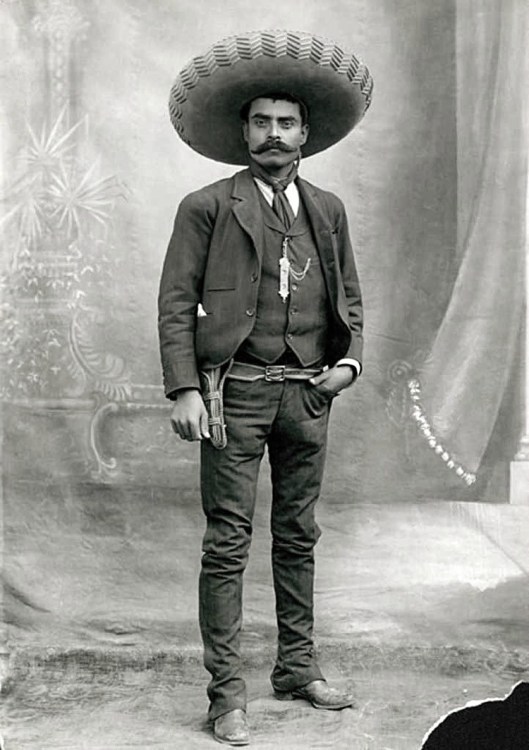
750full-emiliano-zapata

Emiliano Zapata, killed in 1919.

In life, they are neither heroic (Joaquin Murieta shot unarmed Chinese miners) nor consciously and deliberately acting to make a political statement. Vasquez pleaded that he was, but he was in jail facing the possibility of hanging, and his pleas were intended to generate sympathy, which they did.

There is, then, a vast difference between a Californio bandit like Salomon Pico and a Mexican revolutionary like Emiliano Zapata. Both men were killers. Pico killed to satisfy Pico. Zapata killed because the wealthy sugar planters of Morelos had a monopoly on farmland that starved peasant families to death. There are men, like the Morelos sugar planters, whose lives are improved immensely by killing. While he fought them, Zapata promulgated the Plan de Ayala, a cogent statement of revolutionary justice. The outlaws I met in researching the book had to rely on the writers of pulp fiction to give their lives a sense of justice. These are the lives that their admirers truly deserved. They exist only in fiction and in our dreams.

Horsewomen


FullSizeRender (2)

I was so happy to find this book, Horses of the West, by the superb photographer Jeanne Thwaites, from 1971, because it’s out of print AND because that’s my big sister, Roberta Gregory, on her Morgan mare, in the center of this photo, between two noted local horsewomen, Sid Spencer and Anne Westerman.

Sid and Anne were sisters. Anne raised her Welsh ponies off of Carpenter Canyon Road and the little fellows were unintimidated by Sid’s Herefords, some of them as big as the ponies, at roundup time. [Welsh ponies used to haul carloads of coal out of mines, so they’re tough little beasties.] Anne taught locally for many years, including a stint at the one-room Santa Manuela School, now in Arroyo Grande’s Heritage Square. P.J. Hemmi, lynched at fifteen in 1886 from the Arroyo Grande PCRR trestle, also attended a previous version of that school, which burned. Lumber from that school was salvaged to build “our” 1901 schoolhouse. That was a long, long, long time, of course, before Anne’s tenure there.

Sid was a widow who raised cattle and her Morgans in Lopez Canyon. At roundup time, it was an all-woman occasion: Anne, Sid, Sheila Varian and her foundation stud, Bay-Abi, who was both beautiful and beautifully trained at working with cattle, and a host of young women, including Roberta. They were, I think, undogmatic and unaware feminists, because they had absolutely nothing to prove to any man, didn’t give a damn what men thought of them, and didn’t need them or their advice. They roped, branded, nutted, fell off and got knocked silly, survived rollovers, broke horses, and, more often, broke bones. Mature horsepeople are about as arthritic as NFL veterans.

They were wonderful.

By the way, Dad and some friends once went dove hunting on Alex Madonna’s land, adjacent to Sid’s, and they wandered onto her property. They were dismayed when she threw down on them with a 30-30 carbine and suggested that everybody just relax until the sheriff got there. Everybody relaxed. Sort of. Sid was quiet, soft-spoken, but very direct. She was a force of nature.