Kindness in a time of war

B-17s_Taxiing

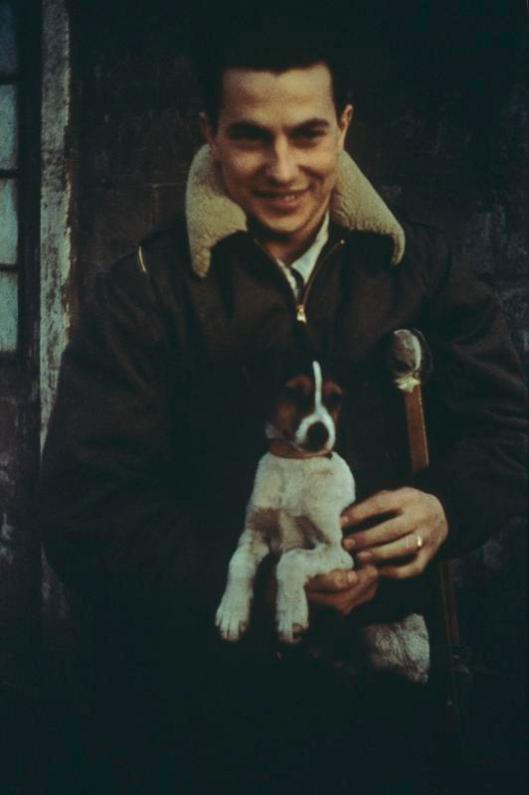
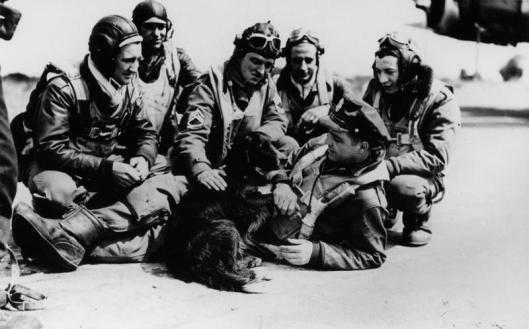
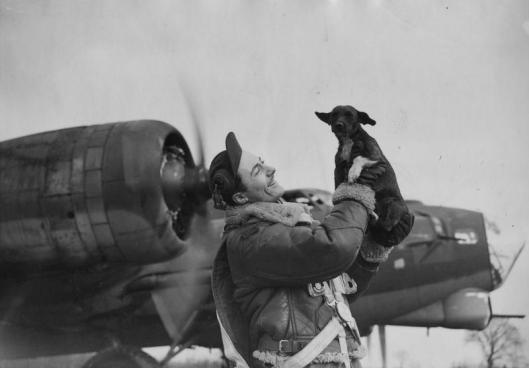
Two photos about the Eighth Air Force’s war in England: 398th Bomb Group B-17G’s taxi on the runway of their base in Hertfordshire, 1944; a young American airman with an even younger British friend.


_77967304_fre_000266


British schoolchildren adored the Yanks, and, of course, their Hershey bars. At the start of any combat mission, the perimeter fence around any American airfield in East Anglia would be lined with children, waving goodbye as the big bombers took off.

Many of their Yank friends wouldn’t come back, of course. For every American infantry soldier killed in World War II, three were wounded. For every American airman wounded in World War II, three were killed.

My father was no flier–he was a Quartermaster officer, stationed in London for much of the war. But he, too, found that link–that “Special Relationship”–with the English, who treated him with great kindness.

At the war’s end, he found something remarkably similar–a great kindness– in Germany. The photograph of4d4c75c4e316c73e6489a3894d6e9ea2 the other little girl, the shy little charmer, validates, in its way, my father’s fondness for the Germans he came to know. Her photo was taken by a GI in occupied Berlin in 1945.

Mr. Kamin, our German teacher, was leading a student trip there when he was approached by a matronly woman who had once been a little girl like the one in the photograph.

“You’re Americans, aren’t you?” she asked.

Mr. Kamin confessed it.

Her eyes welled with tears. “I just want to thank you for the kindness your soldiers showed me after the war.” She shook Mark’s hand, the German teacher born long after her GI’s had gone home.

I enjoy military history, obviously, and it is both tempting and dangerous to romanticize war. But I found, over and over again, in writing the book, incidents of kindness—there’s that word again—on the part of luftwaffe soldiers toward the American fliers they’d captured.

In several instances, they actually saved the lives of airmen who were about to be lynched by outraged civilians. That’s because these people had seen German schoolchildren reduced to ash by incendiaries or buried alive beneath tenement rows, collapsed in unrecognizable heaps by high explosives. The Americans were terrorfliegers, terror fliers, and cold-blooded killers.  The only thing that saved the Yanks from German civilians was the intercession of German soldiers.

One 88-mm crew among them offered a local co-pilot, a man who lived in Morro Bay after the war, a bowl of potato soup for lunch after they’d shot his B-17 down one afternoon. Another one, a luftwaffe sergeant, while taking an airman by train to the interrogation center near Frankfurt, popped open the latches on his briefcase, reached inside, and brought out a thick slice of sausage on black bread that he handed wordlessly to his prisoner.

I don’t know how, and never will know how, to reconcile those Germans with the the SS guards in the camp photo albums who ate bowls of blueberries with their pretty secretaries or sang folk songs in manly choruses just beyond the smell of the children reduced to smoke in the crematoria chimneys of Auschwitz-Birkenau.

Those moments when I despair in history–and they are so frequent, and so barbaric– are never balanced completely by moments of decency. So I savor decency where I can find it.

War can reveal, in the briefest of moments, in gentle accidents, our decency, our deepest humanity. That’s when we find, as my father did, our best intentions and most generous impulses returned to us, even from people we were taught to hate.


GI

Berlin, 1 May 1945

Making Friends, Living and Dead


3f56f9934d0dd46b32995cf4646e1be9

B-17s from Clair Abbott Tyler’s 303rd Bomb Group.

I wish I could write fiction. I have neither the talent nor the patience: I would put protagonists, antagonists and all those minor characters and plot-advancers in front of a firing squad before I got to Chapter Five.

End of book.

This is not a bad thing. A well-trained firing squad would save both me and my potential readers substantial agony and would be no loss to the Literary Canon.

The good news—I think— is that I was a history major, and that devotion to a college major with such a dismal financial future stuck through thirty years of teaching the teenagers that I still miss three years after my retirement. What being a history major meant, additionally, is that I am hopelessly addicted to historical research. That’s a pursuit, for writers of  both history nonfiction and fiction, that is as infuriating and tedious as it is rewarding and fascinating.

For the book Central Coast Aviators in World War II, that meant four hours of research inside a World War II database of every American military aircraft built during World War II, in this case to match a B-17’s serial number with the name of the B-17. Was it “Flaming Mayme?” or “Flaming Maybe?” I decided on the latter. That particular B-17 collided with Mr. Skiddaw in the Lake District in September 1943, killing every airman aboard.

One of the passengers on “Maybe,” who was just hitching a ride for a weekend pass to Edinburgh—my father’s favorite city during his World War II stint in Great Britain—was from my home town, Arroyo Grande.

His name was Hank Ballagh. He was the Class Valedictorian, 1938, of the high school I attended and where I later taught. He graduated from Cal with an engineering degree, did his training as a B-17 co-pilot in Florida, fell in love and married Frances Marie Hogan there, in Broward County, and the two would become the parents of a little girl who was just beginning to walk when “Flaming Maybe” ran into dirty weather with a pilot, new to flying on instruments, who flew the bomber into the face of Mr. Skiddaw.

This happened three weeks before Hank’s first combat mission. He would almost have certainly been killed on one of those. His B-17 was a “Pathfinder,” with a radar bulb in place of the ball turret underneath, designated to pinpoint the aim point for the bombers following. As the first in over the target, the Pathfinders were usually the first planes downed. But Hank didn’t die taking the war to the enemy. He died in a terrible accident.

His wedding band—Hank-Fran 7-17-42, the inscription inside read—was returned to Frances Marie Hogan Ballagh, who lived on Cornwall Avenue in Arroyo Grande, in 1949. (The wristwatch of San Luis Obispo ball-turret gunner Donal Laird, killed on his very first B-17 mission in 1945, was returned to his family in 2016.) Hank and Frances’s little girl, Enid, pressed her small handprints into the fresh concrete of a sidewalk, dedicated to her father’s memory, just outside of her Dad’s Methodist church on Branch Street in Arroyo Grande.


8751483360_6a9fbcd46c_o

Fragments from “Flaming Maybe” remain on  Mt. Skiddaw today.

The sidewalk is gone now. My job is to make sure, in some small way, that Hank Ballagh’s memory isn’t. The problem is, even for a research nerd for me, is how attached the writer becomes to characters who lie wholly and thankfully outside his invention.

Second Lt. Clarence Abbott Tyler of Morro Bay had a little girl, too. He married a local girl, a Renetzky, who was descended from an old-time ranchero family, the Danas. Alex Madonna, he of  the Inn, was the best man at their wedding. Two years later, cannon rounds from a Focke-Wulf 190 obliterated him in his co-pilot’s seat and so from his toddler’s memory on a B-17 mission over Lorient in March 1943.

Nick Covell’s fifth-grade class toured the local newspaper offices of the San Luis Obispo Telegram-Tribune and plugged their ears in the din of the press room; he attended Patsy Berkemeyer’s birthday party, and the Berkemeyers were bakers, so the cake must’ve been terrific. He went to Cal Poly and the steer he exhibited at the Los Angeles County Fair won a ribbon. The B-29 he piloted was on fire when it went down over the Kawasaki District of Tokyo in the spring of 1945.

In researching an earlier book, I met Mess Steward Felix Estibal, essentially a U.S. Navy servant–his was a rating reserved for Filipino- and African-Americans—who provided me with a touching and hilarious letter home (the boatswain’s mate was “the leather-lunged whistle-blower”), written from his destroyer in the South Pacific, which I found published in an early 1943 edition of the local weekly.

Three hours later, I found the article that listed him as “Missing in Action” after a Japanese Long Lance torpedo had blown the bow off his little fighting ship, USS Walke. Some of Walke’s sailors survived the sinking, I found out later, only to be killed by the concussion of the ship’s depth charges as they exploded while tumbling to the seabed of Ironbottom Sound off Guadalcanal. Felix Estibal’s body was never recovered. Reading the bare-bones little 1943 newspaper article about Felix’s death so soon after reading such a warm and life-affirming letter did what it should have done. It broke my heart.

So that’s the problem with writing historical nonfiction. You make friends or you adopt surrogate sons—ironically, mine are from my father’s generation—and sometimes you lose them.


ban_416walke_02

August 1942: After a refit at Mare Island Navy Yard, USS Walke (DD416) leaves San Francisco for the last time.

For the book Aviators, I made friends that I will never forget. Lucy May Maxwell, young enough to be my daughter—or, I fear, my granddaughter—is a British researcher with the Imperial War Museums and its Duxford branch, the American Air Museum in Britain, which has more information on the American air war in Europe than any three comparable American organizations. Lucy was invaluable to me in tracking down photographs, identifying planes and fliers, and she reminded me, no matter how strained it becomes, of that “special relationship” the United States and Britain share.

The sources for Aviators included MACRs (Missing Aircrew Reports), the aforementioned and endless lists of aircraft serial numbers, mission reports from websites dedicated to bomb groups in England, Italy and South Pacific—some included strike photos, aircrew lists, and even formation diagrams for bomb squadron missions–four local museums and their staffs, The New England Journal of Medicine (for the tropical diseases Pacific fliers had to endure), aviation archaeology groups who locate and memorialize crash sites around the United Kingdom and Hawaii, training and personnel manuals from the 303rd Bomb Group, part of the Eighth Air Force, genealogical websites like ancestry.com and genealogybank.com (the latter is invaluable for its newspapers), video interviews of local fliers that are now part of a Library of Congress collection, and, best of all, interviews with two new friends, two 94-year-old Army Air Forces veterans.


Findley

23319262_10214584284464578_1260845643530065578_n

Al Findley Jr. as a German POW; Al and me, 2017


Al Findley Jr.,  a B-24 radioman, was shot down twice. The first time was over a newly-liberated French town, Epernay, whose residents were so delighted with their crash-landed American guests (they put them up in warm straw or even feather-beds and the wine, as the saying goes, flowed) that one became pen-pals with Al’s mother, in Oklahoma. Al’s  squadron commander finally had to buzz Epernay to drop a canister that contained the sad order for the aircrew to get their sorry rear ends back to base. There was a war on.

The second time Findley was shot down was over Germany, and that was less pleasant, made even less pleasanter by getting strafed, twice, by American P-51 Mustangs. Thankfully, Findley not only survived but became a lifelong Air Force sergeant—a Command Master Sergeant—who opened a little antique shop, in England, with his wife after his retirement. He moved to Los Osos. Seventy years after his wartime service, Sgt. Findley drives to a retirement home outside Morro Bay every Sunday and takes his World War II friends out to breakfast.

The other nonagenarian (that’s the only chance I’ll ever get to use that word!) is John Stuart Sim, a longtime Cal Poly architecture professor and, in the war, a P-47 Thunderbolt pilot who flew out of his Ie Shima base on August 9, 1945, to witness the blood-red flash and then the mushroom cloud of the Nagasaki bomb.

A year before that mission, John was a flight instructor with his two closest friends at an Army Air Forces base in Pierre, South Dakota, when he met a young woman named Mary at the Hopscotch Inn (The Hopscotch Inn was in another time zone, which meant an extra hour of beers for Stuart and his two friends, a kind of Army Air Forces version of the Three Musketeers). John and Mary met at the Hopscotch every night for the next week. They decided it made no sense to wait to get married, so they didn’t.

A few months later, at a party on an isolated little base in Texas, one of John’s flight-instructor friends, one of the musketeers, told Mary quietly and earnestly that he was certain her new husband would survive the war. He wasn’t as sure about the others–and he was one of them. He was right, of course. John made it. The other two—one, after an engine failure over the East China Sea, the other in a fiery crash at the edge of Hickam Field on Oahu—didn’t.

Stuart

Lt. John Sim Stuart and the P-47 Thunderbolt he named for Mary.

But seventy-three years after that first meeting at the Hopscotch Inn, John and Mary Stuart are still married.

The deaths stay with you. The lives do even more.

Elvis: The Searcher

FQICFMYBOVD2NDDBVBSVEAZ6I4

The two-part HBO documentary on Elvis, The Searcher, was absorbing. Tom Petty–sigh!– and Bruce Springsteen were among the commentators. It was also, of course, heart-breaking, because Elvis never exactly found what he was searching for.

You wonder, of course, about the dead twin, the early poverty, the almost Jesuitical sense of mission he felt to overcome his family’s seeming failure and to heal their heartbreak. And you wonder about his mother. It wasn’t that he was a mother’s boy, according to the documentary: it was instead that the son and the mother were extensions of each other. They were, in some ways, the same person. He never recovered from her death.

She died just before he went into the Army, which was a pivotal and in many ways tragic break in his career. He lost his mother and he lost contact with that first vital wave of rock ‘n’ roll, which died while he was overseas. He also, in Germany, discovered the uppers that would keep him awake on overnight duty and which would help to kill him seventeen years later.

He really wanted to be a movie star, but he hated the stupid movies, too, three a year, each with meaningless “Elvis” soundtracks. [Significantly, the one possible exception to stupid Elvis musicals was King Creole, when so many of the supporting musicians were African-Americans. His delight in performing the music for this film is transparent.]

Later, he did Vegas and the insane, exhausting tours because he was compelled to do so. For five years, he was on the road for a hundred-fifty concert dates a year. I think they, combined with that damnable sense of duty, with Colonel Tom Parker and with the prescription drugs, were more than enough to kill him. They were more than enough to kill anybody.

But Part One of the documentary portrays a young man alive to every sound coming from every black blues club on Beale Street in Memphis, alive to every stylish walk he saw there (“A’hm gonna USE that!” he told a friend. I don’t know about the Forrest Gump bit.), alive, most of all, to Gospel, but understanding also of the Scots-Irish ethic that permeates Southern culture, and so understanding of the Country-Western tradition kept carefully and jealously at the Grand Old Opry. (He horrified the Opry; it was the Louisiana Hayride that spread the Gospel of Elvis instead.)

When he first went into Sun Records he took everything he’d absorbed growing up and created, in a studio no bigger than a custodian’s closet, Elvis. Sam Phillips knew instantly that he had found someone like no one else in music history–and then was generous enough to let him go to RCA Records because Sun just wasn’t big enough for Elvis’s talent.

Elvis knew that he was like no one else, either. He was both self-aware of this and shocked by it. Springsteen spoke movingly about the early recording sessions, about how the epiphany that visited both of them: both realized just how powerful their talents were. And in those moments and in those sessions, both young men (and later, the Beatles, with George Martin) recorded music with such purity that it will move us all always.

Addendum November 2022: I finally got around to watching Baz Lurhmann’s version of Elvis. I have a complex relationship with the director, and this film disappointed me: it was perhaps too accurate in its portrayal of Elvis’s later life, which is unremittingly depressing. The first half remain inspirational to me, especially in this shorthand sequence on the influence of Black culture on Elvis. This is Lurhmann at his best.


Lessons from Coach Sab’s Generation

Sat

Saburo Ikeda’s Arroyo Grande Valley Little League Team, about 1965.

I had the great good fortune to speak to Mrs. Ainsworth’s class at St. Patrick’s Elementary today about the 1942 evacuation and internment, in the Arizona desert, of our Japanese neighbors.

This gave me one more chance to talk about a wonderful family, the Loomises.  Sadly, it gave me one more chance to miss my  friend, Joseph Ira Loomis, who left us five years ago. I don’t think I will ever get over missing Joe. I don’t think I’m supposed to.

But it was also a wonderful chance to talk to young people about important things like honor and character, courage and loyalty, and, most of all, friendship, all of these the qualities that the Loomises and so many others–the Taylors, the Phelans, the Silveiras, the Bennetts, to name just a few—so exemplified then. They seem in short supply today. But in the World War II years, these were the businessmen and the farm families who shepherded, throughout the desert years, their Japanese neighbors’ fields and homes, their sheds and the expensive irrigation pipe stacked inside, their trucks and their heavy equipment.

Other, more personal, property–love seats and dining-room sets, rocking chairs and bedsteads, maple dressers and black-lacquered hutches imported from Japan decades before Pearl Harbor–all of these disappeared, stolen or broken up by cowards armed with hatchets.

But others in the Valley outnumbered the cowards. Mr. Wilkinson at his meat market and grocery on Branch Street refused to accept payment when his Issei customers came into his store to settle accounts in April 1942 (“You keep your money. You’re going to need it.”) just before they were shipped to the temporary relocation center at the Tulare County Fairgrounds, where they slept in livestock stalls that stank of manure.

y5

Children’s parade, Gila River, Harvest Festival 1942.

In August, they went to the Gila River camp, where the temperature was at or above 109◦ for a month, where the winds came up to kill off a generation of grandparents born in Kagoshima or Hiroshima-ken with the spores that carried Valley Fever, where they lived in barracks with cardboard-thin walls that carried them, unwilling, into the deepest secrets of the families on the other side of the wall, where you shook your shoes in the morning for scorpions and let fly balls to left field drop because of the rattlesnakes waiting for you there.

fujita

Arroyo Grande farmworker Sadami Fujita (left), 442nd Regimental Combat Team, was killed by intense German small-arms fire in the Vosges Mountains in October 1944. Fujita had volunteered  to bring up more ammunition for his his rifle company

Young people, of course, hated the camps. By 1944, an entire generation was missing from Gila River. The young women got out for jobs or college in Denver or Chicago or St. Louis. The young men got out to college, as well, got out to top sugar beets in Utah or they got out to die in distant Italian mountains or in the forests of the Vosges Mountains in France, where the Germans had learned to fire their superb 88-mm cannon into the treetops to impale the Nisei GIs below with jagged splinters.

In late 1944, the first of our neighbors began to come home.

Ultimately, fewer than half of them would, but a few of those who never lived here again asked their children to bring their ashes home to Arroyo Grande–and this was many, many years after the war–so they could be with their neighbors and their families once more, and forever.

That is what this Valley does to a person. This is home.

In 1945, Mr. Wilkinson, in his meat market and grocery on Branch Street, was just as shameless as he’d been in 1942, and just as generous, in extending credit to the people coming home from the desert alive and hoping for new lives.

The town blacksmith, Mr. Schnyder, repaired the Kobara family’s water pump on Christmas Day 1945 because there are no holidays with crops in the ground. He understood that and he understood, too, the kind of people the Kobaras were—and are.

In the years after the war, the Japanese families who returned to this Valley demonstrated the same qualities that their neighbors had in the days after Pearl Harbor, in gentle but immensely powerful ways.

Sab Ikeda’s 1965 Little League kids were so well-coached that they knew always to take out the lead runner, knew how to lay down a bunt, knew how to grip a curveball. His kids, now in their sixties, still remember all those lessons from Coach. What they remember even more was the constant smile on Coach’s face as he taught them.

Poly

Poly baseball, 1939.

When Sab’s brother, Kaz Ikeda, died in 2013—he was a gifted catcher for Vard Loomis’s Arroyo Grande Growers and for Cal Poly (he always said that another brother– I think it was Sei–was the better player), the mourners gathered at the Arroyo Grande Cemetery sang the valedictory hymn: “Take Me out to the Ball Game.” It was, of course, the perfect choice.

When I interviewed Haruo Hayashi, I admired his humor but also his very understated outrage. I was surprised that what upset him wasn’t the internment. I suddenly realized what he was telling me in a very soft voice: He trained with the 442nd Regimental Combat Team at Camp Shelby, Mississippi, and he never got over the black GIs standing outside the camp gym for USO shows that the white and Nisei GI’s watched inside. He couldn’t understand something so shameful.

Haruo

442nd Regimental Combat Team veteran Haruo Hayashi and his granddaughter, Ally. Note the name on Mr. Hayashi’s cap.

So the families, including the Hayashis, who did come home from the desert not only picked up their lives where they’d left them, but they began, from the moment they came home (despite some of them being denied hotel stays in Santa Maria, some being denied service in local grocery stores), to give their lives to the community that had been stolen from them for three very painful years.

How painful were they? The people who were taken to Gila River refused to talk about the desert with their children, who wanted desperately to hear the stories of what their parents and grandparents had endured. But the Nisei never talked about the desert. Never.

In their public lives, their generosity was open and seemingly effortless. They never stopped giving to their neighbors—in youth sports, in service clubs, in countless volunteer hours, in the Methodist Church, in homes where their refrigerators were always open to a generation of ravenous teenaged boys.

But Gila River remained, both submerged and sharply painful, until they began to approach the ends of their lives.

This is when they began, hesitantly, to open up to historians and to young history students. They began to tell the stories of their lives. Despite the wounds of this terrible war–which included both German shellfire and striking coronary disease rates among those who’d lived in the camps–they decided, in those stories, to give us the most precious gifts of all. In the telling, they gave us honor and character, courage and loyalty, and, most of all, they gave us friendship.

51206b3bd169e.image

Stan, Mitzi and Vard Ikeda at Kaz’s funeral, 2013. Santa Maria Times.

The Vietnam War–and San Luis Obispo County–by the numbers

Sometimes, as arid as they may seem, statistics can reveal history in a poignant way.  This isn’t Cliometrics, which is a much more sophisticated discipline that uses statistical analysis to understand history. It’s based, instead, on a small but very precious sampling: These are the young men—their names are recorded on The Wall—who we lost in Vietnam.

draft-web

Draftees board a bus at the San Luis Obispo Greyhound Station, 1966. Despite the popular belief, volunteers outnumbered draftees in the Vietnam War.  Photo from David Middlecamp’s Photos from the Vault.

34 total dead, San Luis Obispo County, Vietnam War (1965-1972)

National average, Vietnam war dead,  per 100,000 population:  28.5

California average per 100,000 population: 27.9

San Luis Obispo County average per 100,000 population: 32*

Deaths by municipality:

San Luis Obispo: 9

Arroyo Grande: 4

Atascadero: 8

Grover City (Beach): 4

Morro Bay: 2**

Oceano: 2

Paso Robles: 4

Pismo Beach: 1


Deaths by year:

1965           1 

1966           1

1967           6

1968           11

1969           9

1970            3

1971           2

1972           1

Average Age at Death:  22.4

Average Age, Vietnam soldier: 22

21 most frequent age for SLO County servicemen killed [Two were 18, one was 19; the oldest was 31]

46573_SEGUNDO_PETE_S_DOB_1946

Sgt. Pete Sprule Segundo of Oceano, U.S. Marine Corps dog handler, killed by “friendly fire,” 1969. To know Segundo, say his friends from AGHS, was to love him. Pete is buried near my parents in the Arroyo Grande District Cemetery.

Service Branch

Army 24

Marine Corps 8

Air Force  1

Navy  1

[Three officers; 31 enlisted men]

Cause of death:

Explosive device  3

Helicopter crash 4

Aircraft Crash 1

Accident “other” 3

Accident, friendly fire 1

Grenade 8***

Artillery/mortar/rocket  6

Unknown 3

Small arms fire 3

Illness/infectious disease 2

*County Population, 1970 Census: 106,403. Our average is higher than either the state or national averages. One supposition is that military service, in rural America during the 1960s, was seen as a way to serve America and a way to advance in life. This was still very much a rural county in 1965, when the war began to accelerate and long before it became so divisive.

**The two Morro Bay soldiers were killed within four days of each other in April 1968, when Tet was still convulsing South Vietnam; the impact on such a small town had to be devastating.

***This statistic is shocking. It meant that those casualties, even if some were inflicted by RPG’s, were the result of extremely close combat.

Sink the Bismarck!


Bismarck-firing-on-Hood1

Bismarck fires a salvo at HMS Hood, 24 May 1941

I’m following a thread of fellow naval enthusiasts about the still-excellent 1960 film Sink the Bismarck!, a classic study of British stiff upper-lipness and, at the same time, a taut thriller.

A dark moment in that film, and in history, came on May 24, 1941, when the battlecruiser Hood and the battleship Prince of Wales confronted Bismarck in the Denmark Strait during her escape into the North Atlantic. The battle began at about 5:52 a.m. Ten minutes later, a shell from Bismarck detonated a powder magazine inside Hood and the ship blew up. There were, in a crew of over 1400 men, only three survivors.


lastpictureofHood

HMS Hood, in a photo taken two days before her destruction.


signalart1

An eyewitness on Bismarck made this sketch of Hood blowing up.

Prince of Wales hit Bismarck at three times, but when a German shell killed the entire bridge crew except for Captain J.C. Leach, she broke off action and the battle was over. Bismarck would eventually be hunted down and destroyed—or scuttled—three days later.

Prince_of_wales

Prince of Wales, with her “dazzle” paint scheme.

Prince of Wales would be the site for the August 1941 meeting of FDR and Churchill, when the two drafted the Atlantic Charter. Three days after Pearl Harbor, a Japanese air attack sank Prince of Wales off Malaya, and Captain Leach was among the casualties.

Esmond Knight as Captain Leach

Captain Leach, played by actor Esmond Knight in Sink the Bismarck!

What I did not know is that the actor who played Captain Leach in the film was himself a young lieutenant, a gunnery officer, on Prince of Wales when she took on Bismarck. Esmond Knight, hit by shell fragments, was blinded and would remain that way for two years until a specialist restored sight in one eye. Knight would go on to a long and stellar stage career, acting with contemporaries like Laurence Olivier and John Gielgud, and would appear in dozens of films in both Britain and America.

He died in 1987. The last of the three survivors of Hood, a dear man named Ted Briggs, died in 2008.

So it goes.

12093800_1691178731113987_68241045_n

Ted Briggs

Teachers and Humility

10462813_10204064704081643_4755616275869953070_n

It must’ve been Friday. I’m wearing jeans.

It just occurred to me that one of the great joys in teaching high school for over thirty years was in finding students who were far brighter than I am.  They were always polite about it, because I had the armaments of age and study to wield as cudgels if they ever got too saucy with me. Once a very bright student disputed evolution with me, and I used the Gulf Current and the tropical orchids that grow in the Ireland’s west country to bring his argument gently to earth–but those weapons were things I deployed warily, because I didn’t trust myself with them.

The best alternative to cudgels that I had to offer students who were that bright was the perspective that comes from learning, and communicating, empathy for people neither they nor I would ever meet: Scots women condemned as witches; the terror of German Catholics dying brutal deaths in the 17th-century Sack of Magdeburg;  the defiance of Parisians who stood as straight as soldiers in the face of the artillery fire that destroyed their barricades; the barbarity of spousal abuse, revealed in the deaths of working-class London women grimly recorded in the archives of the Old Bailey’s criminal courts;  the outrage of poilus in mutiny in 1917 France, demanding, and claiming, the citizenship that had rightly belonged to them since 1789; the joy of Berliners in 1947, waving scarves and handkerchiefs at C-47’s when those planes, bearing food and fuel, flew so low that their their wheel-carriages brushed tenement rooftops.

You don’t teach brilliant kids: You show them the course, as if they were Winter Olympics bobsled teams, and you gently nudge them when they run too close to the banks at the course’s edge. You coach them, point the path ahead for them, and then you let them run as fast as they can.

If all you see of them, in the school year when they are yours, is the blur of their passing, it is a sight that remains with you the rest of your life.


At the Retirement Home

308323568

GI’s and their dates at a Tokyo jazz club, 1945.


“You are from Atascadero?”

“No, ma’am. Arroyo Grande.”

“Oh. I am from Paso Robles. My husband built us a house there. Now I live here. But I still have that house.”

She was Japanese, and before I could show off my fancy-pants history knowledge, wondering if she had come from Kyushu, like the ancestors of so many of my childhood friends, I realized: She was Japanese.

She was a war bride.

“You are from Atascadero?”

“No, ma’am. Arroyo Grande.”

“This is my husband. He built us a house in Paso Robles. Now I live here. But I still have that house.”

She fished inside her purse and brought out two photos. The one that caught my eye was black and white, frayed at the edges from so much handling, and the image was that of a handsome young serviceman.

“Air Force?” I asked.

“Yes!” she brightened. “Air Force!  He built our house.”

In Paso Robles.

Stop yourself. Don’t pity her.

“You are from Atascadero?”

I let her take a book with her because she promised to pay me when I came back to visit in June. That was twenty dollars well lost.

You could tell, easily, that she had been a beauty sixty-six years ago, the year I was born, when her husband had built that house. She is still beautiful.

You could tell just as easily that there was more than a little steel in her personality.

There had to be.

She had made the leap from postwar Japan—they must have met during the Korean War– to the United States when this nation was at full tide, in the boom of the 1950s and 1960s, and she’d left everything she’d known behind to take up a new life in a strange place with a Byzantine language that she had mastered nearly completely except for the conjugation of verbs.

But she stayed.

She must have loved him dearly.

But sixty-six years later, she is the only Asian in the retirement home. Was she lonely because of that? [You remember Filipino soldiers in 1943, many from our county, on short passes into Marysville, where the first place they hit wasn’t a bar. It was a Chinese restaurant. They were desperate for rice. They were, of course, refused service, because they were Asians.]

She must have made him rice. Maybe, in the years after the war, he got odd looks from his co-workers when he opened up his lunch box and munched contentedly on the rice balls she’d made for him that morning, flavored with nori paste.

Kimi Kobara had made a similar cultural leap when she came to the Arroyo Grande Valley, twenty years before the war, as a picture bride. She’d wept every morning for weeks, every morning as soon as her husband, Shig, was out of the house and into the fields, where it it was just light, with his horses and their plow, or their cultivator, or their harvester.

Kimi, a middle-class girl from Kyushu, had no idea that life could be so hard in California.

But she must have loved Shig dearly, because she persevered, and she raised a beautiful family. Kimi had steel, too.

This woman—I am so sorry that I don’t remember her name, but I have never been good with names—elicited in me a wave of pity at first.

Stop yourself.

It wasn’t hard to let the pity wilt in the face of her dignity.

She had been a great beauty with great courage, and her husband had built her a house and she kept his photographs from as far back as his service days, their courting days, and you hope (and you know) that they will meet again, perhaps in a Kyoto park, like the one that enchants and haunts Scarlett Johannson’s character in Lost in Translation, she, elegant, in a pale yellow kimono, he in his Air Force dress blues, and when they embrace this time, they will never have to let go.


maxresdefault

A wedding in a Kyoto garden, from Lost in Translation.

Air War in the time of Trump

4d4c75c4e316c73e6489a3894d6e9ea2

A little girl in Berlin, 1945.

I am especially fond of the passage below in the next book, Central Coast Aviators of World War II, in part because, despite my half-Irishness, the half-English in me is so passionate about England.

The passage reminds me, too, of the cheapness of current events when compared to the selflessness, the courage, and the occasional nobility of our past. These young American airmen-some of them, sixteen and bald-faced liars to their enlistment sergeants–made a bond with the English so powerful that modern tourists can find stained-glass windows in little Anglican churches where American fliers from World War II, forever young, look heavenward toward Christ, forever Risen.

But I need to remind myself, an American, of the terrible evil we’ve done. Wounded Knee comes to mind immediately, and slavery, of course. Another vivid memory is that of the slave mother I learned about in college. She used Master’s hatchet to chop her own foot off to queer the sale that would have separated her from her children.

Multiply her agony and you arrive at 1944-45, when Army Air Forces commander Tooey Spaatz ordered the powdering, from the air, of German rail-yards. Adjacent to them were dense rows of working-class tenements, and so we powdered, too, whole families, whole blocks of German children–in Dresden, they stacked them in the streets, still smoking, as best they could without breaking them–and 25,000 feet above, the young Americans knew what they were doing.

And they hated it.

[On the ground, meanwhile, the young men of Easy Company, 101st Airborne, would eventually discover that the Europeans they loved most of all were German.]

Some of the airmen hated their missions so much, late in the war, that, like the poet Randall Jarrell, who walked in front of a car years afterward, they never completely recovered. They hated what was happening below them because they were Americans, and because they were Americans, they appreciated the humanity in the children they were burning. They could feel the heat, sweating in their electric suits, despite the subzero cold just beyond the thin protection of their steel-and-aluminum airframes, built in Seattle to inflict pain on Berlin.

So I write books for many reasons, but the most important reason is to remind myself of how much I love my country, and how hard it is to look away from its cruelties, yet how necessary it is to look squarely at them. And, too, I am reminded of how much I admire the decency and the idealism that redeems us–sometimes when those qualities are least apparent to us.


Chapter 4. This Seat of Mars

This royal throne of kings, this sceptred isle, 
This earth of majesty, this seat of Mars
…This precious stone set in the silver sea
…This blessed plot, this earth, this realm, this England.

Shakespeare, King Richard II.

P-38s

P-38s over Normandy, 1944. Library of Congress.

If there was a military historian with a gift close to Shakespeare’s, it was another Englishman named John Keegan. Keegan was a little boy in the English countryside, in Somerset, when the Americans began to arrive in their numbers in late 1943 and into the spring of 1944. Little English boys had lived for years with the deepest of privations—thanks, in large part, to the U-boat campaign that had nearly starved Shakespeare’s “sceptred isle” to death—and then the Americans came. They were, as Keegan later said in narrating a television history of the Great War in the pivotal spring of 1918, when he for once arrived at a loss for words, “…well, they were Americans.” By which he meant they were boisterous, cocky, well-fed, well-clothed, and, thank God, they were friendly, with an innocence and immediacy that was distinctly American. Their World War II counterparts taught English boys baseball and flirted with their big sisters, and married some of them, but most of them not, which meant that little boys Keegan’s age would inherit littler half-Yank nieces and nephews. Most of all, they were generous. There seemed to be no end to their Hershey bars (there wouldn’t be after the war, either, when, during the Berlin Airlift, one of bomber pilot Jess Milo McChesney’s comrades, Gail Halverson, air-dropped Hershey bars, floating on little parachutes, to the hungry children of blockaded Berlin) and no end to the rough affection for children that came with these big, loud men from across the sea.


GI's baseball

American GI’s teach British war orphans the finer points of baseball. Imperial War Museum.

And then they were gone. Keegan has vividly described the early-morning dark when that happened, when the chinaware and modest family crystal on every shelf in the Keegan home began protesting, rattling an alarm so loud that it woke the family up, if the motion beneath their beds hadn’t already made them sit bolt upright. The anxiety of Keegan’s family, and their neighbors, and of other families all across East Anglia, was relieved only when they went outside. Then anxiety gave way to wonder. They could feel in their breastbones the vibrations—“the grinding forced you to the ground,” Keegan remembered– of the engines of thousands of airplanes, but could they could see only the dim red warning lights of C-47s headed slowly east. Some of the Americans Keegan had grown to love so quickly, his heroes, were on those airplanes, and tens of thousands more, his heroes, were riding deathly pale on landing craft corkscrewing in foul Channel waters, and they were all headed for Normandy.[1]

It was D-Day.

For the two years before D-Day, the Americans in England who had been carrying the brunt of the fight to Nazi Germany were the airmen of the Eighth Air Force. They made up 49 bomb groups and 22 fighter groups and their bases were 71 airfields concentrated in East Anglia, from Norfolk south to Essex, in places that must have sounded quaintly medieval  to American ears:  Bury St. Edmunds, Knettishall, Little Staughton, Matching Green, Molesworth, Snailsworth, Snetterton Heath, and Thorpe Abbots.

Dickson

Robert Abbey Dickson of Morro Bay. Courtesy the Dickson family.

Shaw’s  charming line about “two peoples separated by a common language” must have rung true, then, for young men, newcomers to England who’d ferried their bombers from Labrador (or for the luckier men, like Robert Abbey Dickson who’d shipped out on Queen Mary, or future Cal Poly professor Richard Vane Jones, who’d made his trip on Queen Elizabeth.) Dickson’s luck held: when he first arrived in England, he was sent to the 381st Bomb Group, where he flew two orientation missions as a co-pilot. The 381st’s base was American-built, at Ridgewell, Essex, which meant that it had been built quickly in prefabricated stages by hard-working soldiers, black men, in army construction units. Bases like Ridgewell were marked by Quonset-hut barracks, each with a single, feeble, coal-burning stove, muddy streets, and mercilessly cold showers. But Dickson was quickly transferred to the 91st Bomb Group, based at RAF Bassingbourn, and the “RAF”—Royal Air Force—prefix made all the difference. An Eighth Air Force Base with the “RAF” designation had originally been built by the British, and, given Britons’ stubborn reluctance to give up their island, such bases had been built to last. Bassingbourn had paved streets and central heating. Dickson was delighted. It was, he remembered, almost like a country club compared to the 381st’s home base.

Army food wasn’t country club fare. American soldiers would never recognize this, but they were, comparated to their British Commonwealth allies, well-fed. Bill Mauldin, the great cartoonist who created the imaginary Willie and Joe, his comrades in the Italian campaign, once remarked, without malice, that his mother was the worst cook in the world. Then he encountered army food, which was infinitely worse.[2] At least airman understood that they were fed better than men like Mauldin, dogfaces, who commonly used G.I. powdered lemonade to wash their socks. Still, even in the Army Air Forces, the green-hued powdered eggs, along with the ubiquitous Spam, were breakfast standards, and creamed chipped beef on toast—referred to as “shit on a shingle”– followed airmen across the Atlantic from the air bases stateside where they’d first encountered what seemed to be, to the military, a perverse culinary masterpiece. Radioman/gunner Albert Lee Findley Jr. found little relief off-base. “English food took some getting used to,” he admittted tactfully. One vegetable, Brussels sprouts, was as common to English fare as Spam was to American mess halls, and, at war’s end, many English-based G.I.’s swore they would never eat them again.

There were other features of English culture that the Americans found more to their liking. Airmen almost immediately found pubs near their bases, and the attraction was powerful. Historian Donald Miller writes of the 1943 arrival of an AAF engineer battalion, charged with laying out an airstrip outside the village of Debach, near the North Sea. Their discovery of what English called “the local,” this one called The Dog, resulted in the Yanks buying so many rounds “for the house”—the last round, just before closing time, was for forty-seven drinks—that the next day, a doleful little sign was posted outside The Dog: “No beer.” It was, Miller notes, the first time the pub had been closed in 450  years.[3] The Americans, of course, also found young English women to their liking, as well. The War Department discouraged what were called “special relationships,” and made it nearly impossible, thanks to a bureaucratic maze, for the best-intentioned American soldier to marry, but, of course, the War Department failed. “Special relationships” were as common as visits to the local pub. Al Spierling of Arroyo Grande, a B-17 flight engineer, lost a little of  his youthful idealism—Spierling was a thoughful young man who made a special trip to York to explore the setting for Brönte’s Wuthering Heights– when he learned that a gunner he knew, a married man, had taken up with an English girl. He was a little shocked. “For a twenty-year-old,” he said, “I learned a lot.”[4]


couple

A young British woman and her airman–she’s wearing his wings on her lapel–watch American bomber return to base. American Air Museum in Britain.


There was the other special relationship, the one historian Keegan remembered, and that was with English children. Airmen seemed to have great affection, just as other G.I.s did,  for their smallest neighbors, and the affection was reciprocated. A typical sight at the beginning of any combat mission would be the childen gathered at an airbase’s perimeter fence. They were there to wave goodbye to the crews as their big airplanes took off to reach their assembly points high above the English countryside.


[1] Elizabeth Grice, “War Memories: John Keegan’s Life and Times,” The Telegraph, September 17, 2009. http://www.telegraph.co.uk/culture/books/6203052/War-memories-John-Keegans-life-and-times.html. Accessed July 2, 2017.

[2] Foot Soldiers, “The Allies.” The History Channel, 1998.

[3] Donald L. Miller, Masters of the Air, Simon and Schuster Paperbacks, New York: 2006, pp. 137-38.

[4] “Albert Spierling,” oral history interview.


The Amazing McChesneys, from Corbett Canyon

10666295_123155394868

Jess Milo McChesney, B-24 pilot, top right.

The reason I write books is to disabuse us of the notion that, because we’re from a rural California county, we’re not all that important to American history.  This is not so.

The McChesney family of Corbett Canyon–I was taught by a relative, Eva Fahey, at Branch School, went to Arroyo Grande High with another, Leroy McChesney III, and finally, taught a third, Kathryn, who is quietly but incandescently brilliant–is a perfect example of what I’m talking about.

They ran a dairy out there (the McChesney children would lay out milk cans on a trestle for the Pacific Coast Railway and, magically, have it return to them as ice cream from the Golden State Creamery in San Luis Obispo), but dairy cows were far from their chief interest.

Leroy McChensey Jr., tall and rangy, would take breaks from the milk barn to, in borrowing Whitman’s phrase, “stare in perfect wonder” at the vultures drifting effortlessly overhead. He caught the flying bug early.

leroy_jr_300-L

Leroy McChesney Jr.

The urge to fly got worse when a wrong-way biplane from Santa Maria landed in a pasture alongside the McChesney farm, which the pilot, in 1922, had mistaken for his landing strip in Santa Maria, most likely another pasture just a tad bit farther south.


crash landing ranch

The wrong-way airplane, with passengers who don’t seem too upset, Corbett Canyon, 1922.

The proof that Leroy had been bitten badly by flying came long after he’d earned a pilot’s license, once he’d married and started a family. He began building a full-scale glider, for whatever reason, in the living room. It grew. The kids had to dodge the fuselage to make their way to the kitchen for Golden State ice cream in the freezer. I think eventually Leroy’s project migrated outside, but his love for flying remained such a constant in the family that, years later, after he’d suffered a heart attack, his wife, Grace, took up flying. She reasoned that she’d have to land the damned plane. Truth be told, she, a member of the “99’s,” a women’s flying group, may have been the better pilot.

But, unlike Leroy, she didn’t get the country airport, McChesney Field, named for her. It was Leroy’s boundless energy as an advocate for fellow fliers and as a member of several state and national aviation boards that got that well-deserved honor.

His little brother, Jess, caught the bug, too. And he was a war hero, like the more famous son of another dairy family, the Edna Valley Righettis, who gave us P-51 pilot Elwyn, an enormously gifted flier and leader, lost in 1945.

Jess flew his thirty-five B-24 combat missions, in the Fifteenth Air Force, out of Italy, a pilot whose career was book-ended by crash landings on both his first and final bomb missions, which wended their way over the Alps and into Austria, Germany, and Hungary, where civilians lynched downed aircrews. On both those book-end missions, the latter a belly-flop on a British airfield, the big bomber he piloted had been shot to pieces.

One of his gunners tried to contact the family many, many years later, and learned, over the phone, that Jess had died. He was devastated.

“I would fly to the gates of hell with that man,” he said simply over the long-distance connection.

Jess’s career did not end with the end of World War II. He would win his fifth Air Medal in “Operation Vittles,” which we know better as the 1948-49 Berlin Airlift, when Stalin, determined to starve the western Allies out of Berlin, deep inside East Germany, closed the borders to ground traffic.

Of course, it wasn’t Allies who were going to starve. It was German children. So in one 310px-C-54landingattemplehofof, I think, the most heroic episodes in our history, veteran World War II pilots who had been shot to pieces by German 88-mm flak or by German fighters, FW-190s, turned instead to airlifting fuel and food and medicine to Berliners, and especially to children. That’s when Jess Milo McChesney was activated from the Reserves and flew the 100 missions that would add a fifth Air Medal to his DFC.

We tend to downplay the Berlin Airlift in favor of the “Memphis Belles” of World War II but, truth be told, what Jess did in 1948-49 was nearly as dangerous. The relief flights were so relentless and so constant–one of the biggest cities in the world had to be supplied completely by air–that exhausted pilots made mistakes that killed them and their aircrews, or exhausted airframes failed and plunged, in pieces, into Berlin suburbs. These were enormously courageous and compassionate young men.

4d4c75c4e316c73e6489a3894d6e9ea2

An American GI in Berlin’s occupation force recorded this image of a little girl in 1945.

Of course, the most famous of Jess’s comrades was Gail Halverson, “Der Schockoladen Flieger,” who tied handkerchiefs to Hershey Bars and dropped them, in their little parachutes, to the children of Berlin on his approach to the airfield at Templehof.

Halverson did this because he loved children. I watched a story, on CBS news on, I think, the fiftieth anniversary of Halverson’s chocolate campaign. When he landed in Berlin, he was immediately buried by a mass of adoring and middle-aged German hausfraus, who had never and would never surrender their love for Americans.

And Jess Milo McChesney, far less famous than Halverson but just as brave and just as bound by duty and by compassion, is just as important to American history. There is a powerful connection between Berlin and Corbett Canyon, California.


jess