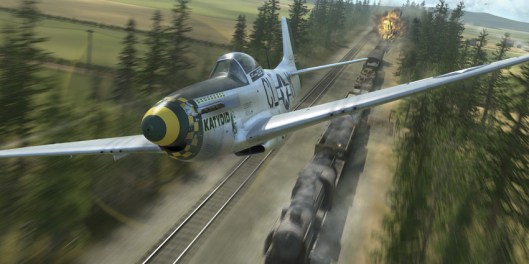
Lt. Col. Elwyn Righetti’s P-51, “Katydid,” on a strafing run. Righetti disappeared after being shot down over Germany in 1945. He was raised in San Luis Obispo.
I get asked sometimes how I do my research for my books. They are small books, but I was asked again yesterday and decided, just to be able to answer future questions semi-coherently, to set down how I researched the next book, Central Coast Aviators in World War II, coming out in May. Okay (deep breath), here goes:
- I started by looking up the names of the county war dead on the Atascadero Veterans’ Memorial. From there, I identified eighteen young men—all Army Air Forces, the branch in which nearly all local men served (and the vast majority in Europe)—killed in action or in training accidents.
- I used three websites—newspapers.com, genealogy bank and ancestry.com—to locate the obituaries and circumstances of death for each airman. In some cases (Lt. Clair Tyler of Morro Bay, for example, a B-17 co-pilot killed over Brittany; Capt. Jack Nilsson of San Luis Obispo, a B-29 Pathfinder pilot, killed over Japan) I was able trace these young men through virtually every stage of their lives, which was both fascinating and heart-breaking to write: Tyler’s best man was Alex Madonna; Nilsson, as an eight-year-old, went to a birthday party for a little Berkemeyer daughter. Since her family owned the local bakery, the cake must’ve been awesome!
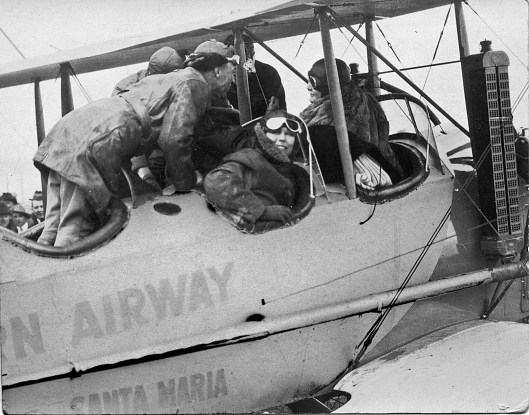
- Those websites were also invaluable in tracing the history of aviation in our county, including the first airplane flight over San Luis Obispo, in 1910 (other sources, primarily San Francisco newspapers, taught me about the lives of the Beachey brothers–Hillery, who’d flown that airplane, and Lincoln, who drowned when his monoplane plunged into San Francisco Bay–and were the West Coast equivalent of the Wright Brothers), Amelia Earhart’s visit to Cal Poly and the history of San Luis Obispo Airport.
- Another incredible source, as usual, was Cal Poly’s Special Collections and Archives, which helped me to pin down the history of the Aeronautical Engineering Program—Poly students built the first student-constructed airplane in American history, in 1928, “Glen-Mont”—and rare photographs. Michael Semas was generous in allowing me to use photos from 1910 and the Camp Merriam (now Camp San Luis Obispo) airfield during the 1930s.
- As always, California military historian Sgt. Major Dan Sebby and his California Military History website were incredibly helpful in both the history of Hancock Field and in helping me find information on the aviation program at Camp Merriam.
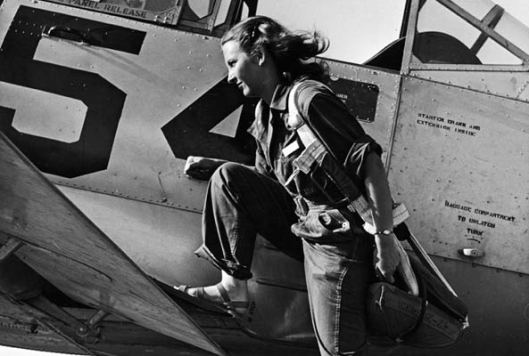
- For the living fliers, including WASP pilot Dorothy Rooney, the SLO Veterans’ Museum has compiled about 200 oral history interviews. (The lioness’s share of this remarkable effort has fallen on two interviewers, Joanne Cargill and Joy Becker, and all of us owe them a terrific debt.) I narrowed that list down to World War II aviators, about thirty, and then attempted to contact each one or their survivors for permission to use the material, now on a Library of Congress website. I was successful in about twenty cases. These interviews were the single most important resource for this book, and when I get hammered, as I will be, for leaving fliers out, it would have been helpful if they’d set their memories down as these fliers did!
- Another wonderful source for the WASPs was Texas Women’s University, where I learned more about Dorothy Rooney and about two Santa Barbara County WASPs, one killed in a training accident and another, raised in Solvang, who became a lifelong flier after the war. I found her children interviewed one son on the phone and got permission to quote from the marvelous obituary they’d written for her.
- The Santa Maria Museum of Flight was another excellent resource; I spent a day with the curator there and got his permission to use several photos of Primary Training at Hancock Field (today’s Hancock College) and material from one yearbook: a class from 1941 yielded seven participants in the Doolittle Raid, five Air Aces, two future four-star Air Force generals, and one cadet who didn’t make it as a pilot but became a B-24 bombardier in the Pacific: Louis Zamperini, the subject of Laura Hillenbrand’s excellent book Unbroken. About 8,000 cadets went through Primary Flight Training at Hancock Field.
- For Cal Poly’s Naval Aviation Cadet pre-flight program (about 3,000 cadets went through Poly), I found first-hand material in a memoir written by former Poly President Robert Kennedy, two online autobiographies written by pilots who’d gone through Poly’s program, and back issues of Mustang Roundup, the wartime magazine that replaced the El Rodeo yearbook during the war years.
- Particularly useful as a local source: David Middlecamp’s always-revelatory column, “Photos from the Vault” and Dan Krieger’s “Times Past,” particularly on the life and death of perhaps our best-known local hero, P-51 pilot Elwyn Righetti (I also corresponded with Righetti’s biographer, Jay Stout, who was very helpful.)
- Foreign sources were just as helpful, particularly the Imperial War Museum and its sister institution, the American Air Museum in Britain. These sources yielded wonderful wartime photographs of aircrew, air bases and aircraft. The also corroborated the fate of lost airmen and were a starting point for determining the fates of lost aircraft. Other websites, in Holland and France, were also useful in helping to find both bombers and fighters in which local fliers had been lost.
- In the European Theater, the Air Museum provided the name, if applicable, and serial numbers of both American bombers and fighters. The are websites with MACR (Missing Aircrew Reports) listed by date and the plane’s serial number, and I used those websites to verify the identities and losses of aircraft. In a few cases, the Air Museum provides, in some cases, Deceased Personnel Files; in two cases, I was able to discover the fate of a local flier by using the file belonging to another crewman on his aircraft. Both sources were also helpful in determining the fates of lost airmen and aircraft in the Pacific Theater.
- Army Air Forces accident reports are also available online and provide some detail on both stateside and overseas plane crashes. I was amazed to discover, for example, that there were nine P-38 crashes among fighters based at the Santa Maria Army Airfield in January 1945 alone, claiming the lives of three pilots and two civilians (in a cafe on Broadway in Santa Maria) on the ground.
- Although most of the World War II generation is gone, I was able to conduct interviews with Albert Lee Findley Jr of Los Osos, shot down twice as a B-24 crewman, and John Sim Stuart, a retired Cal Poly professor and P-47 fighter pilot who witnessed the flash of the Nagasaki bomb. The McChesney family, both in person and on a family website, was wonderful in revealing the history of local aviation—the County Airport is McChesney Field.
- Hometown Heroes Radio and the Estrella Warbirds Museum in Paso Robles were key in providing information on Hal Bauer, an Atascadero resident who was a Luftwaffe test pilot (he flew the wooden jet, the He-162) with an incredible story. As an American citizen, Lt. Commander Hal Bauer flew intelligence missions along the Chinese and Soviet borders during the Korean War.
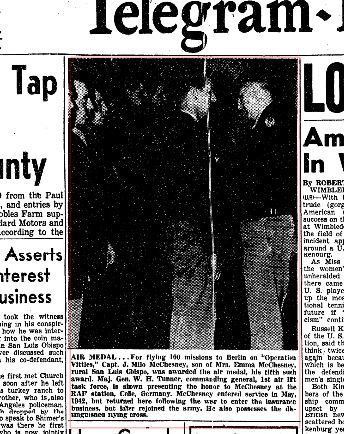
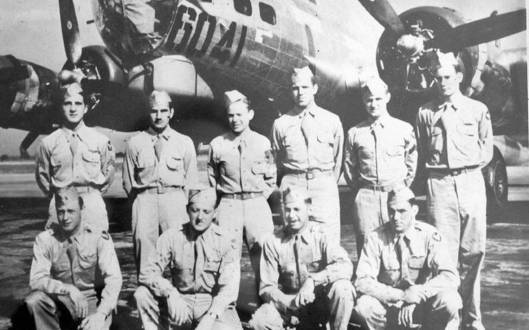
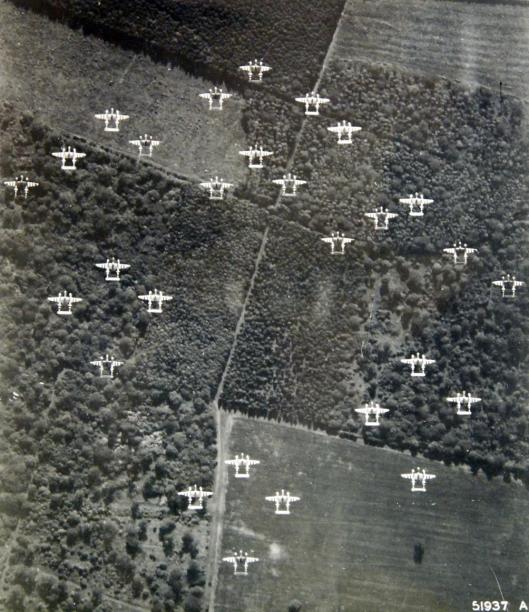
- Several units maintain online histories that include Mission Reports. I was able, for example, to locate and identify aircrew, target, mission duration and losses for virtually every mission that Flight Engineer Sgt Al Spierling ever flew, including his thirteenth, in B-17 “Georgia Peach,” which survived a near-collision over the target–Berlin–and a flak hit that took out two engines. (Spierling later taught Auto Shop at Arroyo Grande High School.) Roy Lee Grover’s 405th Bomb Squadron, based in Australia and then New Guinea, has an incredible website, heavily illustrated. Arroyo Grandean Jess Milo McChesney’s 376th Bomb Group has another superb website that fills in a lot of gaps on the neglected Fifteenth Air Force, based in North Africa and then in Italy. One source—on lost flier Clair Tyler’s 303rd Bomb Group—even provided an illustrated diagram of each B-17’s position in his bomb squadron on the day he was killed on a mission over Lorient.
- One wonderful find was the 303rd Bomb Group’s “Duties and Responsibilities of the B-17 Crewmen,” a wartime manual for each of the ten men who flew the heavy bomber and the 303rd’s “Aerial Bombs,” a detailed description of bomber ordnance. Just one more: Maj. James J. Carroll, “Physiological Problems of Bomber Crews in the Eighth Air Force during World War II,” a paper prepared for the Air Command and Staff College, which detailed just how uncomfortable, including the difficulty of taking a pee, flying a combat mission was, “uncomfortable” being an understatement. Another paper, on tropical diseases in World War II, revealed how life for Pacific fliers was even more “uncomfortable.”
- Other websites provided both visual and written information on POW’s, even including artwork and cartoons, which were delightful, of camp life. The oral history interviews from local fliers also provided incredible detail on the meagerness of diet, on the menace of German civilians (there were lynchings of downed Americans by enraged Germans, Hungarians and others), and the frequent and unexpected kindness of German soldiers toward their captives.
- Family members, and correspondence with them, were incredibly helpful. Particularly helpful were the daughters of B-17 co-pilot Robert Abbey Dickson of Morro Bay, the daughter of P-38 and P-51 pilot William K. Pope of Paso Robles , the descendants of B-17 pilot Harold Schuchardt of Los Osos, the sister of B-26 pilot Richard Vane Jones, a Cal Poly education professor, and Bruce Gibson, the son of a B-29 crewman taken prisoner by the Japanese.
- Beyond the primary sources and interviews, there were several books, secondary sources, that were very important. By far the most important was John McManus’s book, Deadly Sky. I think he is one of our finest World War II writers.
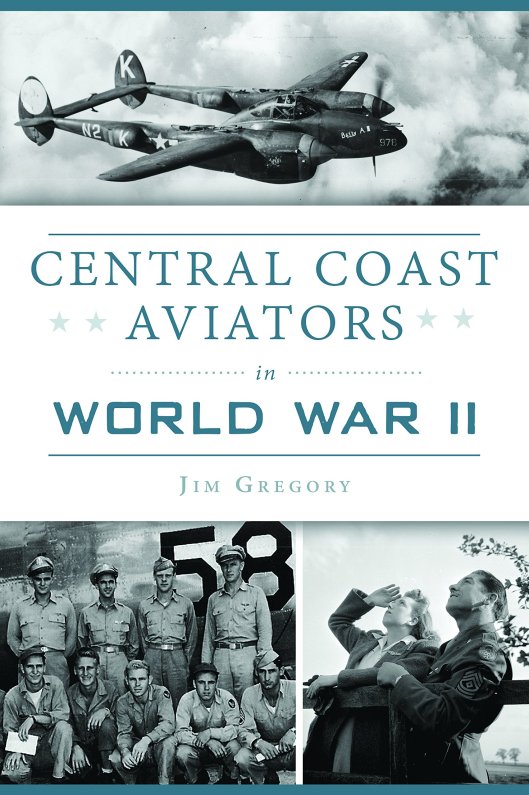
Just for grins, here are the book’s notes, one of the parts of any history book that I always take time to read:
Notes
1 “303rd BG(H) Combat Mission No. 20, 6 March 1943,” http://www.303rdbg.com/missionreports/020.pdf
2 Eddie Deerfield, editor, Hell’s Angels Newsletter. “The Terrifying Last Mission of the Mart in Plocher Crew,” May 1999. http://www.303rdbg.com/missionreports/020.pdf.
3 The information on 2nd Lt. Tyler is taken from several articles in the San Luis Obispo Telegram-Tribune, beginning November 24, 1931 and ending August 27, 1943.
4 “100 Years Ago: July 5, 1898-July 12, 1898,” Wilmar N. Tognazzini, compiler, http://wntog.weebly.com/1898.html.
5 Carly Courtney, “Lincoln J. Beachey: The Tragic Rise and Fall of the Master Birdman,” Disciples of Flight, October 31, 2016, https://disciplesofflight.com/aviation-pioneer-lincoln-j-beachey/.
6 “Official Program for Celebration that Began This Afternoon,” San Luis Obispo Daily Telegram, July 2, 1910, p. 3.
7 Frank Marrero, “Lincoln Beachey: The Forgotten Father of Aerobatics,” Flight Journal Magazine, April 1999, http://www.frankmarrero.com/Beachey/The_Forgotten_Father_of_Aerobatics.html.
8 David Middlecamp, “Aerial Pioneer Harriet Quimby,” from the blog Photos from the Vault, San Luis Obispo Tribune, July 14, 2010, http://sloblogs.thetribunenews.com/slovault/2010/07/aerial-pioneer-harriet-quimby/
9 “Harriet Quimby,” National Aviation Hall of Fame, http://www.nationalaviation.org/our-enshrinees/quimby-harriet/ Accessed June 17, 2017.
10 Earl Miller, “Famous Flier Inspects Poly Aerial Building,” San Luis Obispo Daily Telegram, June 25, 1936, p. 1.
11 Interview with Leroy McChesney III, Arroyo Grande, California, May 9, 2017.
12 “Airplane Lands at Arroyo Grande by Mistake,” San Luis Obispo Tribune, March 22, 1922.
13 Barnes McCormick, Conrad Newberry, Eric Jumper, eds. Aerospace Engineering during the First Century of Flight, American Institute of Aeronautics and Astronautics, Reston, Virginia, 2004. Pp. 861-62.
14 “Matriarch of music in SLO dies at 98,” San Luis Obispo Tribune, Dec. 7, 2010, http://www.sanluisobispo.com/news/local/article39139020.html.
15 “Guardsman Praises Airport,” San Luis Obispo Daily Telegram, Feb. 17, 1939, p. 1.
16 “Learn to Fly!” San Luis Obispo Telegram-Tribune, Sept. 6, 1940, p. 20.
17 Jay A. Stout, Vanished Hero. Casemate Publishers, Havertown, PA, 2016, p.18.
18 Stout, p. 53-54.
19 Read D. Tuddenham, “Soldier Intelligence in World Wars I and II,” http://www.iapsych.com/iqmr/fe/LinkedDocuments/tuddenham1948.pdfb.
20 Elena Sullivan, “Cal Poly Women: Roles and Depictions during World War II,” Research Paper, History 303-01, California Polytechnic University-San Luis Obispo, March 2016. http://digitalcommons.calpoly.edu/cgi/viewcontent.cgi?article=1022&context=cphistory.
21 Robert E. Kennedy, Learn by Doing Memoirs of a University President, Monograph, Robert E. Kennedy, California Polytechnic University-San Luis Obispo, 2001, p. 83.
22 Eldon N. Price, Senior Birdman: The Guy Who Just Had to Fly, iUniverse Inc. Publishing, 2006, pp. 21-22.
23 Wendell Bell, Memories of the Future, Transaction Publishers: New Brunswick, New Jersey, 2012, pp. 42-43.
24 “Boeing / Stearman PT-17 ‘Kaydet,’” http://www.warbirdalley.com/pt17.htm. Accessed June 21, 2017.
25 The accounts of San Luis Obispo County airmen lost to training accidents comes from various issues of the San Luis Obispo Telegram-Tribune, 1943-45.
26 Marilyn R. Pierce, Earning Their Wings: Accidents and Fatalities in the United States Army Air Forces During Flight Training in World War Two. PhD Dissertation, Kansas State University, Manhattan, Kansas: 2013.
27 “Capt. G. Allan Hancock,” http://www.hancockcollege.edu/public_affairs/capt-hancock.php. Accessed June 22, 2017.
28 Justin Rughe, “Historic California Posts, Camps, Stations and Airfields: Hancock Field,” http://www.militarymuseum.org/HancockField.html. Accessed June 22, 2017.
29 Interview with Santa Maria Museum of Flight CEO Mike Geddry Sr., May 4, 2017
30 Eugene Fletcher, Mister: The Training of an Aviation Cadet in World War II. The University of Washington Press, 1992: pp 61-62.
31 John C. McManus, Deadly Sky: The American Combat Airman in World War II, New American Library, New York: 2000, p. 23.
32 Stout, Vanished Hero, p.23.
92
33 “Lt. Hagerman, Paso Robles, Killed in Air Crash,” San Luis Obispo Telegram-Tribune, February 14, 1944, p. 1.
34 “Dorothy May Moulton Rooney,” oral history interview by Joanne Cargill, January 27, 2010. Dorothy May Moulton Rooney Collection(AFC/2001/001/71857), Veterans History Project, American Folklife Center, Library of Congress.
35 “Betty Pauline Stine,” https://airforce.togetherweserved.com/usaf/servlet/tws.webapp.WebApp?cmd=ShadowBoxProfile&type=PersonAssociationExt&ID=22008. Accessed June 23, 2017.
36 “Above and Beyond: Gertrude “Tommy” Tompkins-Silver,” http://www.wingsacrossamerica.org/above—beyond.html. Accessed June 23, 2017.
37 Susan Stambeg, “Female WWII Pilots: The Original Fly Girls,” NPR transcript for Morning Edition, March 9, 2010, http://www.npr.org/2010/03/09/123773525/female-wwii-pilots-the-original-fly-girls. Accessed June 23, 2017.
38 Katherine Sharp Landdeck, “A Woman Pilot Receives the Military Funeral the Army Denied Her,” The Atlantic, September 8, 2016, https://www.theatlantic.com/politics/archive/2016/09/wasp-elaine-harmon-arlington-national-cemetery/499112/. Accessed June 23, 2017.
39 “WASP Final Flight: Sylvia Barter, 43-W-7,” http://waspfinalflight.blogspot.com/2009_02_01_archive.html. Accessed June 23, 2017.
40 “Albert Lee Findley Jr,” oral history interview by Joy Becker, September 26, 2013, Albert Lee Findley, Jr. Collection (AFC/2001/001/93273), Veterans History Project, American Folklife Center, Library of Congress.
41 “Consolidated B-24J Liberator,” http://www.joebaugher.com/usaf_bombers/b24_18.html. Accessed July 7, 2017.
42 “Robert Abbey Dickson,” oral history interview by Joanne Cargill, September 19, 2007, Robert Abbey Dickson Collection (AFC/2001/001/56287), Veterans History Project, American Folklife Center, Library of Congress.
43 Jay A. Stout, Hell’s Angels: The True Story of the 303rd Bomb Group in World War II, Berkley Caliber Books, New York: 2015, pp. 96-98.
44 Don Moore, “He Flew with Jimmy Stewart in WW II,” https://donmooreswartales.com/2010/05/05/jim-myers/. Accessed June 24, 2017.
45 Sam McGowan, “The Boeing B-17 Flying Fortress vs. the Consolidated B-24 Liberator,” February 21, 2017, http://warfarehistorynetwork.com/daily/wwii/the-boeing-b-17-flying-fortress-vs-the-consolidated-b-24-liberator/
Accessed June 24, 2017.
46 “Harold Edgar Schuchardt,” oral history interview by Joanne Cargill, May 10, 2007, Harold Edgar Schuchardt Collection (AFC/2001/001/51597), Veterans History Project, American Folklife Center, Library of Congress.
47 “Duties and Responsibilities of the B-17 Crewmen,” 303rd Bomb Group (H), http://www.303rdbg.com/crew-duties.html. Accessed June 23, 2017.
48 “Aerial Bombs,” 303rd Bomb Group (H), http://www.303rdbg.com/bombs.html. Accessed June 27, 1942.
49 John T. Correll, “Daylight Precision Bombing,” Air Force Magazine, October 2008. http://www.airforcemag.com/MagazineArchive/Pages/2008/October%202008/1008daylight.aspx. Accessed June 27, 2017.
50 Sandra MacGregor, “Richard Cowles, World War II Tailgunner,” SLO Journal Plus, August 2015: pp. 28-29.
51 McManus, Deadly Sky, pp. 37-42.
52 “Albert Spierling,” oral history interview by Joanne Cargill, Nov. 21, 2003, Albert A. Spierling Collection (AFC/2001/001/10402), Veterans History Project, American Folklife Center, Library of Congress.
53 Maj. James J. Carroll, “Physiological Problems of Bomber Crews in the Eighth Air Force during World War II,” paper prepared for the Air Command and Staff College, March 1997. http://www.dtic.mil/cgi-bin/GetTRDoc?AD=ADA398044. Accessed June 27, 2017.
54 “Richard Vane Jones,” oral history interview by Joy Becker, May 7, 2009. Richard V. Jones Collection (AFC/2001/001/71933), Veterans History Project, American Folklife Center, Library of Congress.
55 “Henry Joe Hall,” oral history interview by Joy Becker, May 21, 2009. Henry J. Hall Collection (AFC/2001/001/71890), Veterans History Project, American Folklife Center, Library of Congress.
56 Elizabeth Grice, “War Memories: John Keegan’s Life and Times,” The Telegraph, September 17, 2009. http://www.telegraph.co.uk/culture/books/6203052/War-memories-John-Keegans-life-and-times.html. Accessed July 2, 2017.
57 Foot Soldiers, “The Allies.” The History Channel, 1998.
58 Donald L. Miller, Masters of the Air, Simon and Schuster Paperbacks, New York: 2006, pp. 137-38.
59 “Albert Spierling,” oral history interview.
60 Jerome O’Connor, “U Boat Sanctuary—Inside the Indestructible U Boat Bases in Brittany,” January 1, 2008,
http://historyarticles.com/gray-wolves-den/ Accessed July 2, 2017.
93
61 “The Bombing of Germany 1940 – 1945: Allied air-strikes and civil mood in Germany,” University of Exeter, http://humanities.exeter.ac.uk/history/research/centres/warstateandsociety/projects/bombing/germany/. Accessed July 2, 2017.
62 “Individual Deceased Personnel File: 1st Lt. Clarence H. Ballagh,” 1949. American Air Museum in Britain. https://www.americanairmuseum.com/person/32316. Accessed June 2, 2017.
63 “Sidewalk dedication, 1944, Arroyo Grande, California.” https://www.ancestry.com/media/viewer/viewer/c22332c1-e9fc-40d8-8b55-cbc5d6b3488b/7516801/-1076227646. Accessed June 2, 2017.
64 “File 164. 1944-02-21/21 B-17 42-30280 Holcombe IJsselmeer Zeewolde,” http://www.zzairwar.nl/dossiers/164.html. Accessed July 2, 2017
65 J. David Rogers, PhD, University of Missouri-Rolla, “Doolittle, Black Monday, and Innovation,” https://web.mst.edu/~rogersda/american&military_history/Doolittle-Black%20Monday-Need%20for%20Innovation-1944.pdf. Accessed July 4, 2017.
66 Telephone communication with 91st Bomb Group historian Jody Kelly, July 9, 2017.
67 “Marshall Stelzriede’s Wartime Story: The Experiences of a B-17 Navigator During World War II,” http://www.stelzriede.com/ms/html/marshwcp.htm. Accessed June 17, 2017.
68 Roy Lee Grover, Incidents in the Life of a B-25 Pilot, AuthorHouse, Bloomington, IN: 2006, pp. 40-41.
69 “John Sim Stuart,” oral history interview by Joy Becker, November 17, 2009. John Sim Stuart Collection (AFC/2001/001/71863), Veterans History Project, American Folklife Center, Library of Congress
70 McManus, Deadly Sky, p. 110.
71 Capt. James J. Sapero, USN, “Tropical Diseases in Veterans of World War II.” New England Journal of Medicine, December 1946, Vol 235, No.24, p. 843.
72 Grover, Incidents, pp. 40-41.
73 Grover, pp. 37-38.
74 Allen D. Boyer, “Legendary WWII pilot Pappy Gunn gets his due in new biography,” The Oregonian, November 27, 2016. http://www.oregonlive.com/books/index.ssf/2016/11/indestructible_pappy_gunn_john.html. Accessed July 7, 2017.
75 “Roy Lee Grover, 2014 Veterans’ Day Honoree,” University of Utah. http://veteransday.utah.edu/?p=2543. Accessed July 8, 2017.
76 Joseph Rogers, “Arthur Rogers: The Jolly Rogers,” https://prezi.com/5syuymfh9obl/arthur-henry-rogers-the-jolly-rogers/. Accessed July 7, 2017.
77 Pacific Wrecks, “B-24J-150-CO Liberator Serial Number 44-40188,” https://www.pacificwrecks.com/aircraft/b-24/44-40188.html. Accessed June 20, 2017.
78 “County Men in the Fight: Purple Heart Award,” San Luis Obispo Telegram-Tribune, February 27, 1945, p. 1.
79 “Historical Snapshot: B-29 Superfortress,” Boeing Corporation, http://www.boeing.com/history/products/b-29-superfortress.page. Accessed July 8, 2017.
80 “John Sanderson Gibson,” oral history interview by Margie Shafer and Maxine Fischer, July 14, 2003. John Sanderson Gibson Collection (AFC/2001/001/07842), Veterans History Project, American Folklife Center, Library of Congress.
81 “Aviation History Online: Boeing B-29 Superfortress,” http://www.aviation-history.com/boeing/b29.html. Accessed July 9, 2017.
82 Jack Nilsson’s biographical information comes from several stories from the San Luis Obispo Telegram-Tribune, 1931-1940.
83 Joe Baugher, “B-29 Attacks on Japan from the Marianas,” March 15, 2002, http://www.joebaugher.com/usaf_bombers/b29_10.html. Accessed July 9, 2017.
84 Herman S. Wolk, “The Twentieth Against Japan,” Air Force Magazine, April 2004, pp. 68-73. http://www.airforcemag.com/MagazineArchive/Documents/2004/April%202004/0404japan.pdf. Accessed July 7, 2017
85 “B-29 Combat Mission Logs, 1945, of William C. Atkinson, Radar Navigator,” http://www.atkinsopht.com/atk/saipan.htm. Accessed July 6, 2017
86 Spierling, oral history interview.
87 The information on targets comes from Bob Brown’s missions list, courtesy of the Central Coast Veterans’ Museum, and from the missions list kept by SSgt. John Ward, who flew with McChesney, courtesy of Michael McChesney.
88 “D-Day Leaders: Spaatz,” Military.com. http://www.military.com/Content/MoreContent1/?file=dday_leaders7. Accessed July 10, 2017.
94
89 Spierling, oral history interview.
90 Interview with Albert Lee Findley, Jr., Central Coast Veterans’ Museum, July 7, 2017.
91 “County Men in the Fight: Jess M. McChesney,” San Luis Obispo Telegram-Tribune, May 17, 1945, p. 1.
92 Interview with Leroy McChesney III, Arroyo Grande, California, May 9, 2017.
93 David Middlecamp, “Arroyo Grande veteran survived three plane crashes in World War II,” Photos from the Vault. San Luis Obispo Tribune, May 27, 2016. http://www.sanluisobispo.com/news/local/news-columns-blogs/photos-from-the-vault/article80444052.html. Accessed July 11, 2017.
94 McManus, Deadly Sky, p. 269.
95 Victor Gregg, “I survived the bombing of Dresden and continue to believe it was a war crime,” The Guardian, February 15, 2013, https://www.theguardian.com/commentisfree/2013/feb/15/bombing-dresden-war-crime. Accessed July 11, 2017.
96 Miller, Masters of the Air, pp. 305-306.
97 Jeffrey Meyers, “The Death of Randall Jarrell,” VQR: A National Journal of Literature and Discussion, Summer 1982, http://www.vqronline.org/essay/death-randall-jarrell. Accessed July 11, 2017.
98 Miller, pp. 387-388.
99 “Stalag XIII-D,” http://wwii-pow-camps.mooseroots.com/l/264/Stalag-13D-Oflag-73. Accessed July 17, 2017.
100 Gibson, interview, American Folklife Center, Library of Congress.
101 “Messerschmitt Bf 110 (Me-F110),” Acepilots.com, 2011. http://acepilots.com/german/bf110.html. Accessed July 18, 2017.
102 McManus, Deadly Sky, p. 51.
103 Jim Gregory, World War II Arroyo Grande, The History Press, Charleston, SC: 2016, p. 102.
104 David Middlecamp, “Photos from the Vault: P-38 training crash in Santa Maria, World War II week by week,” San Luis Obispo Tribune, http://www.sanluisobispo.com/news/local/news-columns-blogs/photos-from-the-vault/article39511437.html. Accessed July 18, 2017.
105 “Chester Eckermann,” oral history interview by Joanne Cargill, Central Coast Veterans’ Museum, April 26, 2007. Chester Earl Eckermann Collection (AFC/2001/001/49482), Veterans History Project, American Folklife Center, Library of Congress.
106Stout, Vanished Hero, xvi.
107 Dr. Henry Goodall, “Joe Griffin : Memoirs of summer 1944 : 367th USAF Fighter Group,” Friends of the New Forest Airfields, March 21, 2016, https://fonfasite.wordpress.com/2016/03/21/joe-griffin-memoirs-of-summer-1944-367-fg/. Accessed July 18, 2017.
108 “France—Crashes 39-45: Crash du P-38 Lightning type J-15-LO s/n 42-104212,” http://francecrashes39-45.net/page_fiche_av.php?id=6175. Accessed July 18, 2017.
109 “Quesada, Elwood Richard, Aviation Pioneer,” National Aviation Hall of Fame, http://www.nationalaviation.org/our-enshrinees/quesada-elwood-richard/. Accessed July 19, 2017.
110 Michael D. Hull, “Embattled Skies: Air Power at the Battle of the Bulge,” Warfare History Network, January 7, 2016, http://warfarehistorynetwork.com/daily/wwii/embattled-skies-air-power-at-the-battle-of-the-bulge/. Accessed July 19, 2017.
111 “Heinkel He 162 Jet Fighter Test Pilot,” PeninsulaSrVideos, December 28, 2012. https://www.youtube.com/watch?v=xmJqjx9VVKM. Accessed July 19, 2017.
112 “William K. Pope,” oral history interview by Joanne Cargill, Central Coast Veterans’ Museum, December 3, 2009. William Pope Collection (AFC/2001/001/71853), Veterans History Project, American Folklife Center, Library of Congress.
113 Stout, Vanished Hero, p. 83.
114 “Statistical Record, 55th Fighter Group,” http://www.55th.org/. Accessed July 19, 2017.
115 Stout, Vanished Hero, xi-xiii.
116 David Middlecamp, “Remembering Elwyn Righetti on Memorial Day,” Photos from the Vault, San Luis Obispo Tribune, May 21, 2015, http://www.sanluisobispo.com/news/local/news-columns-blogs/photos-from-the-vault/article39533085.html. Accessed July 17, 2017.
117Personal communication with former Cal Poly architecture student David D. Floyd, July 10,
2017.
118 Stuart, oral history interview.
119 Record of KIA status for Lt. Raymond Ranger, National Archives, https://www.fold3.com/image/29032675. Accessed July 20, 2017.
120 Incident report, Hickam Field, 21 April 1945. https://www.fold3.com/image/295871536. Accessed July 20, 2017.


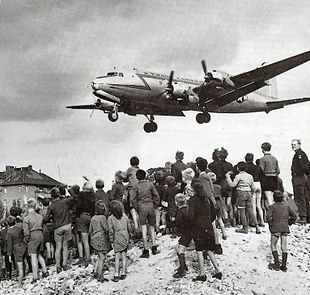 of, I think, the most heroic episodes in our history, veteran World War II pilots who had been shot to pieces by German 88-mm flak or by German fighters, FW-190s, turned instead to airlifting fuel and food and medicine to Berliners, and especially to children. That’s when Jess Milo McChesney was activated from the Reserves and flew the 100 missions that would add a fifth Air Medal to his DFC.