Joseph Vard Loomis – A Silent Hero

A story worth sharing–over and over again.

wendelboek's avatar

Warning: This is a long post. But if you read through it. It is definitely worth it.

“Vard was really friendly,…not only to the Japanese. When he talked to …farmers, ..he sat and talked for a half-hour or an hour. He really cared about people, ” said Kazuo “Kaz”, a prominent Arroyo Grande farmer.

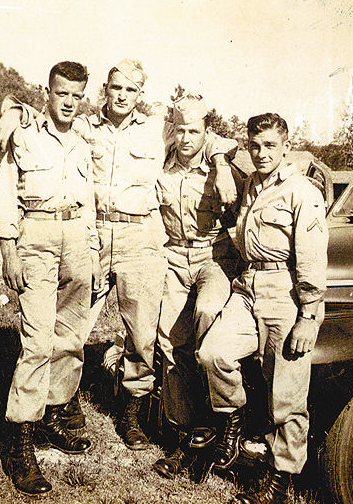
Captures Vard in the middle with the first Arroyo Grande Japanese-American baseball team that he coached. (Photo courtesy of Lilian Sakarai and the South County Historical Society, Heritage Press, Volume II number 6, August 2007)

Joseph Vard Loomis, better known as “Vard” is one of those people that is hard to forget. He was described as friendly, personable and loyal by those who knew him. However, what he is likely remembered most for, is his love and kindness to the Japanese-American citizens of Arroyo Grande.

According to The Heritage Press, “The most prominent supporters of Japanese Americans…

View original post 1,880 more words

Memorial Day Remarks, Arroyo Grande District Cemetery, May 25, 2015


The American Cemetery

Not far away from us is the grave of Marine Sgt. Pete Segundo, killed in action in Vietnam in 1969. Pete was once President of the Arroyo Grande High Letterman’s Club, and his yearbook photo is typical: his broken arm is in a sling, and a bright, contagious smile crosses his face. To know Pete was to love him.

Twelve feet from Pete’s grave are two people I love. My parents are buried here. My father was a captain in the U.S. Army. I am writing a book about Arroyo Grande in World War II—my father’s war–and because it is the 70th anniversary of that war’s end, I am thinking of another grave in a cemetery 5,500 miles from here.

It is the American Cemetery at Colleville-sur-Mer, above Omaha Beach in Normandy.

That beach is the exclusive property of the men and women of my parents’ generation. We honor the fallen of all American wars today, but I would like to direct my remarks to the World War II generation and, by extension, to their families.

Omaha Beach today.

Omaha Beach today.

9,000 young men who will always be young men are buried at that impossibly beautiful cemetery in Normandy. Three came from our county.

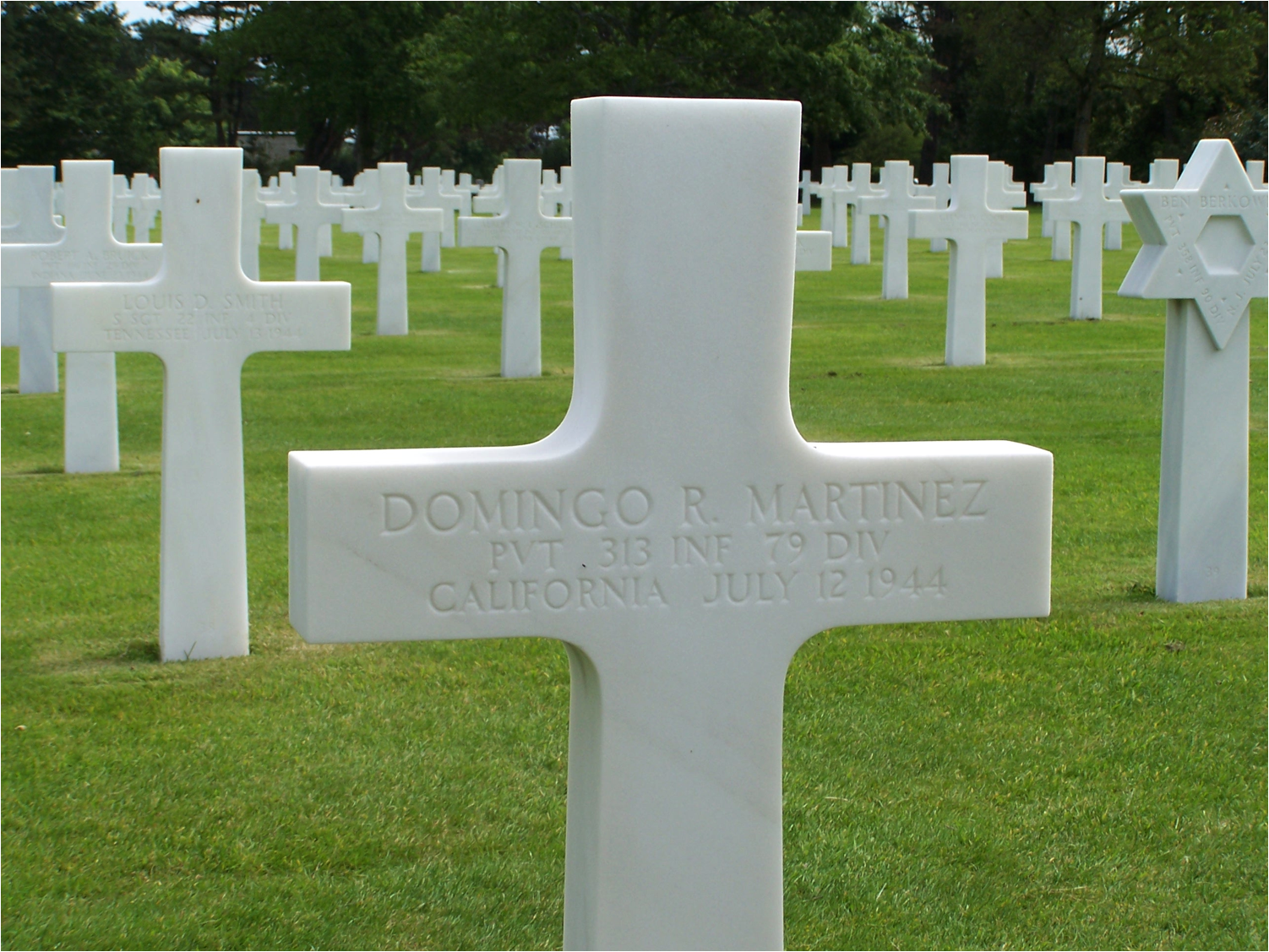
One of them was Pvt. Domingo Martinez. He is buried at Colleville-sur-Mer in Plot C, Row 13, Grave 38. Martinez knew the hard work of driving bean-stakes into the soil and he knew the smell of sweet peas of the prewar Arroyo Grande Valley. He was a farmworker, a refugee from Dust Bowl New Mexico.

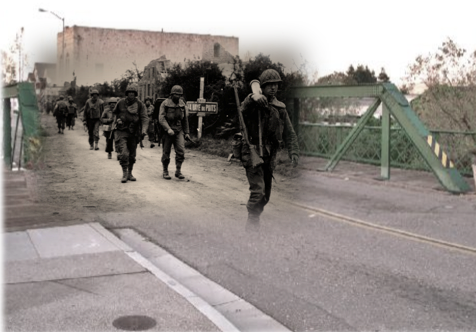
But in late June 1944, Martinez was a rifleman, fighting in the streets of Cherbourg with the 79th Infantry Division.

Cherbourg was vital to securing the Allied supply line after D-Day.

It was also difficult to take. Its bristling anti-aircraft defenses would kill a San Luis Obispo fighter pilot named Jack Langston. Massive coastal batteries kept naval support for the Americans at bay, and the city’s defenders, although garrison troops, were securely dug in.

79th Infantry Division GIs, Cherbourg.

79th Infantry Division GIs, Cherbourg.

They had nowhere to go, for they were backed into a corner of France, and so isolated that the only alternative to fighting was to leap into the sea.

Once they’d entered Cherbourg, 79th Division G.I.’s learned to hate street fighting almost instantly. Death came instantly from illusory shadows that a fallen soldier’s comrades never saw, and from gunfire they sometimes never heard.

In peacetime, a French city block can be noisy with the cheers of a cafe crowd during the World Cup or the comical horns of tiny cars or the singing of children at play.

In combat, that same block, seemingly empty, can muffle the report of a sniper’s rifle or generate echoes that make soldiers look anxiously in every direction at once.

So the 79th fought house by house and street by street and eventually they captured the fortress that dominated the city, on June 26. Military historian John C .McManus notes that the men of the 79th that day were filthy, exhausted, and bearded, “like burlesque tramps,’ as one G.I. said.

They got little rest. The division quickly shifted from urban combat to a drive through the farms and villages of the Cotentin Peninsula.

American soldiers in Normandy now faced a new, even more difficult challenge. By the third week after D-Day, they were falling far short of the objectives set for them by Allied staff officers in crisp uniforms working over crisp maps that lacked one crucial detail.

The offensive in the Cotentin stalled because the Germans had the advantage of fighting defensively, in the bocage, the Norman hedgerows, and they winnowed units like the 79th Division down.

The bocage, Normandy.

The bocage, Normandy.

The hedgerows the maps never showed enclosed fields plowed since Agincourt, or pasturage for fat Norman cows, and were a hopscotch of natural fortresses.

This meant that the G.I.’s had to assault them, one by one, to try to extract defenders who gave ground and their own lives stubbornly.

When G.I.’s broke through a hedge and entered a field, the superb German machine gun, the MG42, hidden in the next hedge beyond, or positioned on the Americans’ flanks, annihilated entire rifle squads. It fired so rapidly that a burst sounded like canvas ripping.

The MG 42 machine gun.

The MG 42 machine gun.

So the Americans could hear, but never see, in the tangle of the hedges, who was killing them so efficiently. The bocage quickly transformed G.I.s, with supreme indifference, into either hardened veterans or into casualties.

American soldiers, adaptive and imaginative, eventually would develop the tactics to overcome the kind of war the Germans fought in the bocage. 

But for Martinez’s 79th Division, what lay beyond the hedgerows in early July may have been worse, because the Germans would not wait for them this time: this time they would attack.

The 79th, fighting in echelon with the 82nd Airborne and the 90th Infantry Divisions, seized a ridge and several hills around a key crossroads at a village called Le Haye du Puits.

79th Division GIs, Le Haye du Puits

79th Division GIs taking fire, Le Haye du Puits. The GI at the right carries a Browning Automatic Rifle.

This should have compelled the enemy to abandon the town. They didn’t. They attacked instead, on July 7, intent on destroying the 79th in their positions on the ridge above the town.

The German soldiers, including SS-Panzer units, attacked with great ferocity and with great courage. These were not garrison troops, but hardened and determined professionals. They attacked in surges all day and only at nightfall did it become clear that the 79th had stopped them.

This was the turning point. On the next day, in another day of street fighting, the Americans would capture Le Haye du Puits.

Afterward, Signal Corps photographers attached to the 79th captured the images of some soldiers, their faces as blank as those of sleepwalkers.  They are utterly worn out, used up, by a month of ceaseless combat.

9vmfcsuzi9eu6jo8agvrm1so5zmfptsweoc_p_6vvdk-1

By the time Le Haye de Puits was secured, Domingo Martinez was gone. He was killed during a furious series of assaults on a little village called Le Bot, just to the south, and so would not experience the energy and the jubilation of the breakout from Normandy, which came soon after.

For the next three weeks, the Americans would roll up the Germans, then uncover Paris and liberate the city, standing aside to let Free French units enter first.

The Graves Registration record of Martinez's death. He was most likely killed by German artillery--his regiment came under intense fire from 88mm guns.

The Graves Registration record of Martinez’s death. He was most likely killed by German artillery–his regiment came under intense fire from 88mm guns.

You cannot help but wish that Pvt. Martinez had been granted enough time enough to follow the French into Paris, and maybe, even better, a week’s furlough for a farmworker, now a soldier, to explore the incredible city.

Domingo would decide to visit Notre Dame. Once he had entered the great church, he would remove his garrison cap, dip his fingers in the holy water font, then cross himself.

He would turn, blinking a little, to take in the vastness of the place, and then he would walk up the nave—the silence pressing on his ears–slowly past the clutter of pews. There, at the transept crossing, he would stop suddenly to stand, smiling with delight, as he was bathed in brilliant, colored sunlight.

This is the gift of the Rose Window to men and women of good faith.

It is your good faith, and your faith in your country, that has marked the World War II generation. Your faith sustained America during the war, and it made my life as a free American possible afterward.

I can’t thank you adequately enough today. But five years ago, I found your brother, Domingo Martinez, in the American Cemetery at Normandy. I gently touched the cold marble of his soldier’s cross and so did eight of my Arroyo Grande High School students. We spoke to him without the encumbrance of words.

That was one way of saying thanks. Now this young soldier belongs to a new generation of Americans.

wpid-martinez-cross.png.png

Family Secrets

Emma Martha Kircher Keefe
My grandmother and mother, about the time of the story in the Bakersfield Californian.

The Breed Act forbade borrowing another California’s driver’s vehicle without permission, but neglected to assess a penalty for its violation. This old article points out the folly of such a law by spinning this story:

The Bakersfield Californian

April 10, 1925  

Keefe Arrested Now comes Ed Keefe of Taft into the story. Not so long ago Keefe. a young man, became intoxicated In Taft, borrowed a car without leave of the owner and in a wild-eyed attempt to emulate the harrowing speed of the wilder-eyed Darlo Resta, wrecked the machine, authorities allege. With dispatch, officers of the Taft constabulary incarcerated the young man and the new charge made one of its maiden appearances opposite the name of Keefe, who Is no relation to the ball player.

The charge was “driving an automobile without the owner’s consent.” Keefe pleaded guilty to the felony and asked for probation. The court considered that It was his first offense; that he had a young wife and baby to support and granted the plea for leniency.  

Shortly after probation was allowed Keefe was arrested again by the Taft police who accused him of doing everything except making an attempt to roll the streets of the oil town. Again Ed Keefe appeared before Judge Mahon last week. Keefe denied before the court that he had attempted to apply the crimson brush to the portals of the West Side city, explaining that he had merely gone home to “sleep it off” in a genteel manner. After a severe reprimand and an order to behave, Keefe was given his freedom. He promised faithfully to accept the mandate of the court.  

Third Time

Today, Keefe appeared In court for the third time. Taft officers had pounced on the young hopeful again. They argued that he had attempted to mitigate the woes weighing upon his weary shoulders by a prolonged absorption of paint remover, often labelled synthetic gin or Scotch, according to the whims of the labeller.

The Taft officers informed the district attorney’s office that Keefe after “getting likkered up” had gone home where he endeavored to “beat up” his wife until the majesty of the law crimped his style. Judge Mahon made the young man the subject of a third excoriating reprimand, regretting that he was unable to imprison Keefe. The court reviewed his leniency granted In the hope that the defendant would “behave himself” and then predicted that Keefe would soon appear In court again with the label of some bona fide charge with a penalty attached.  

Given Freedom

To the neglect of the framers of the Breed Act, young Keefe owes his freedom. His wife wants to give him even more freedom for she has filed a complaint for divorce…

The writer is heavy-handed, too arch for his own ability, but young Keefe is too rich and too pathetic a target to pass up. He deserves every lash of this bush-league Mencken’s whip.

The problem is, Ed Keefe is my grandfather.

He was Irish–his father was born in the Famine years—and Ed would be the tenth of eleven children born on a Minnesota homestead, would become the love of my grandmother’s life, and, when he had disappeared by 1927, he left an emptiness in my mother’s heart that would never be filled.

She spent the rest of her life wondering about him.  My parents even hired a detective to try to find him, and I’ve spent years searching for him on the internet–uncovering instead a cache of respectable, middle class, well-educated and pious Keefes, including an unexpected nun. I found their ancestral village, Coolboy, in Wicklow, then traced where nearly every one of them, in a trail that leads from Ontario to Minnesota to Kern County, was married and buried, and Edmund is not even a whisper.  Not even a footnote.

 Update, May 2025. That wasn’t that Ed “borrowed” a car. The first two articles are from July and August 1924; the third, when he’d gone missing, was from an October 1925 Oakland Tribune.

Last night I accidentally googled this story. I reflexively wanted to punch out the man who would strike my grandmother–my Grandma Kelly, when she married another, more reliable, Irishman, a Taft police constable–and who would have so terrified my mother, four years old at the time of this news story, with all the violence it implies, buried or lost in her memory, a good thing. She never found him, which she thought a bad thing.

Ed Keefe didn’t to deserve to play the ghost that haunted my mother’s memories– he hadn’t enough character or weight or importance. But he was her father. And he’s not important enough, either, for me to hate.  But he was my grandfather. Actions like these–impulsive, thoughtless, outrageous–suggest to me that he was already a lost cause at 28, and that his alcoholism almost certainly had deeper roots, possibly in bipolar disorder or in the depression that has stalked both lines of my family and has followed me in my own life from the day that it took my mother’s.

My step-grandfather, the police officer, George Kelly—my Gramps–was the grandfather any boy would want. Once, long before I was born, in a story that made me shiver when my Dad told it, three oilfield roughnecks jumped him in an alley while another officer, Pops Waggoner, was enjoying a Coke-and-something-else in the Prohibition-era Taft Elks Lodge. Pops heard the scuffle and stumped, with his wooden leg, down the stairs to the alley and was too late. He found three unconscious men and one intact and upright Irish cop, in need of a new uniform. That was the same Gramps who played catch with my two-year-old son two decades ago with a little rubber ball and played so gently and talked such soft and silly nonsense—the language of very small children– that my son, John, fell a little in love with him. As I had.

Gramps. I imagine that it was a beard-growing competition for some Taft civic celebration.

So I am no more comfortable about feeling sorry for myself over the accidents of biology and genetics that have flawed the lives of my mother and me than I am with punching a dead man. In fact, the story about Ed Keefe only made me love my mother more. She never had the inclination, or the self-regard, to understand that no victory she won in her life was too small. I am fascinated by this page from her senior yearbook, the 1939 Taft Union High School Derrick.

Screen Shot 2015-04-14 at 10.13.10 PM
My mother, in the third row from the top, third from the left.

Her natural curls are shaped in a way that’s suggestive of Shirley Temple’s moppet locks or Gone with the Wind’s Butterfly McQueen–1939 was the year that film premiered–and in her pose, she’s looking backward, over her shoulder. What’s pursuing her might have destroyed anyone else far earlier:  Her father was a drunk, a kind of charming and feckless village idiot, the butt of the Bakersfield Californian, with all the literary majesty that this newspaper possesses, and so she would have grown up with that inheritance and with all the cruelties children can inflict on each other, in bloodless wounds that never heal.

But.

She is in CSF, GAA, she is class secretary, class vice president, and there is nothing in that face that hints at defeat or humiliation or isolation. With a father as absurd as hers it is not absurd at all to draw an inference from a source as trite as a yearbook page and its little clutters of honoraria, from such a distant time and place.

So this is what I have learned in the last two days about my mother:

She would never stop glancing back over her shoulder. But, at 17, at Taft Union High School and Junior College, at the end of an era that had wounded and humiliated an entire nation and on the cusp of one that would make our power nearly unlimited, a lonely little girl had found her identity. She was a year away from marriage and four from motherhood, which would become her greatest and most enduring gift. She would strike sparks in my life:  a love for learning, a fierce sense of social justice and a hunger for God’s presence–the last, a lifelong irritant that I cannot get rid of, no matter how hard I try.

I cannot tell you how much I admire her.

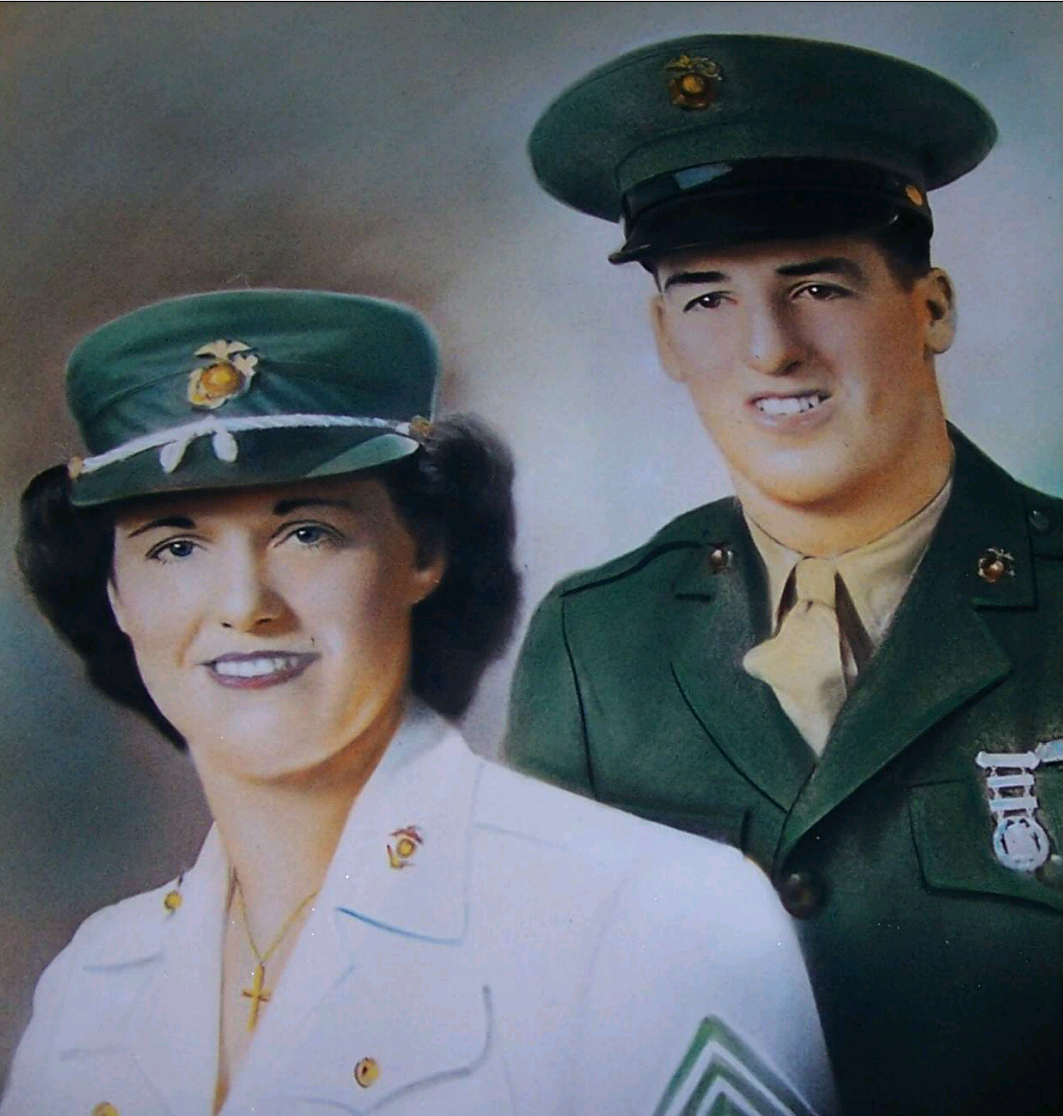
Patricia Margaret Keefe Gregory and her eldest child, Roberta, a wartime portrait.

Ozark Death Wish

0

My Grandfather’s farmhouse and the Blue River in Texas County, Missouri. It is beautiful there, but this is where a gunman killed six and then shot himself last week.

St._Francis_River_at_Silver_Mines_Recreation_Area_2

There was a very disturbing article in The Daily Beast: Texas County today is marked by the suffocation of Pentecostal and fundamentalist churches who keep vigilant watch over the ugodly, which probably includes a smattering of Episcopalians and Catholics. They’ve bought up nearly all the local liquor licenses to keep the area dry, in an Ozark variation on Sharia Law.

Life there is also marked by chronic and deep-rooted joblessness, by a thriving trade in meth and by meth addiction, and by violence. Sometimes folks just vanish.

It sounds like a scary, hopeless place, and it was once a place of pretty little farms, pasturage grazed by horses that were a family’s pride, forests full of game, and neighbors who looked out for each other.

During the Great Depression, the New Deal and electricity–and hope–came to Texas County, because we agreed that we all have an obligation to look out for each other. Today, all Congress can do is bicker, delay, posture and sulk. These are good people. What is to be done?

Be quiet, already.

I feel that I must apologize in some way for hammering away at Lucia Mar with my very small hammer on Facebook. It’s not that I’m important. I just have a big mouth. I will return to my usual cheerful self, one way or another, soon.

Since I am retiring, I really don’t have much of a dog in this fight: retirement is determined by averaging the last three years of a teacher’s salary, and I would have to make more than Leo DeCaprio this year to make any substantive difference.

But I do not like to see good people get pushed around. I do not like to see them patronized. I do believe that loyalty should always go both ways. I do believe that the teachers in my District are dedicated, compassionate and skilled and I believe most of all that they love children.

I do believe that the District, too, will find a way to get even with me and with others who have called them out. Lucia Mar has a long and well-deserved reputation for vindictiveness, so there’s a good chance that someday soon, a meteor will fall and squash me flatter than a copper penny on a rail. That is the way life works.

From Bolt’s “A Man for All Seasons:”

If we lived in a State where virtue was profitable, common sense would make us good, and greed would make us saintly. And we’d live like animals or angels in the happy land that needs no heroes. But since in fact we see that avarice, anger, envy, pride, sloth, lust and stupidity commonly profit far beyond humility, chastity, fortitude, justice and thought, and have to choose, to be human at all… why then perhaps we must stand fast a little –even at the risk of being heroes.

No heroes live here. I am a small and fearful man whose fear is tempered by an Irish temper. People like me, and people far braver than me, must be squashed. We call that Progress.

Before I get too awfully flat, I’ll throw in a photo of me where I have always been at my happiest: in the classroom, with the teens who are your children–and mine, too.

I will now be quiet until I can talk about better things and remind myself that I must not be taken too seriously, no more than the man who rows the Thames taxi carrying More back to his beloved daughter, Meg.me

Sargasso Sea

Another hard morning. Elizabeth is dusting,  vacuuming and moving furniture to sweep underneath. I have gotten up twice and gone back to bed twice.

This adrenal fatigue ( not medically official)  stuff is insidious. It can leave you breathless. Sitting up makes you dizzy. Getting out of bed feels like attempting  a reversal , in wrestling, against an opponent three weight classes above yours. I’ve had times, working at the computer, when my head droops, my chin hits my chest, and I go to sleep. At school, lunchtime and passing periods are the worst, because you have to fight off the urge to lie down, or, worse, the urge to feel sorry for yourself, and you have to summon the energy for the next class of kids.

At the end of the day and on weekends, there’s no energy left to summon. This is not remotely like depression–been there, done that. This is like living in a body, heavy, stiff,  leaden,  that refuses to do what you want it to do. It’s infuriating , or would be, if you had the strength to be angry. Now, I want to sleep and I want to resist sleeping, and there’s no victor in a fight like that.

Sushi and Sisters

InariMmmmm. Inari sushi. Haven’t had it for years. Used to have it when I was young at Ben Dohi’s house–a great man– but only on special Japanese holidays like Christmas, the Fourth of July and Labor Day. (And Thanksgiving, of course.)

On one visit, I had the honor of holding Ben’s baby niece, who still has not forked over the royalties I am sure she owes me for not dropping her. Her name was Kristi Yamaguchi, and I liked to think I had a small part in making her athletic career possible.

The sushi was wonderful, but even better were Kristi’s aunts, the Yamaguchi sisters–Ben’s wife, Ty, was a Yamaguchi– preparing it in the kitchen. They were very, very funny. (Witty, because they were also very intelligent. They made the air kind of crackle.). They liked to needle each other and, even more, the men in the living room watching football or baseball on TV in various semi-horizontal positions. I think they were out there for protection, kind of like when they circled the wagons in Westerns.

I love sports, but I used to hang out in the kitchen because the women were far more entertaining, and they had the same kind of giggle that sisters can have, and that was a happy and endearing sound, but there was something else, and it was just a little magical. For just an instant, they were teenagers again, pleated skirts and bobby sox and saddle shoes, and you had the distinct sense that for Mr. Yamaguchi, these three daughters were a handful. If it’s not already obvious, I loved the Yamaguchi sisters very much.

The Valentine

1606216_10205982028693560_3876837376207520435_o

.

Last week, a student left a Valentine on my teacher’s desk at Arroyo Grande High School.

It read: “Thank you for believing in me.”

She was born in Guerrero, a Mexican state I know from my college studies of the revolutionary Emiliano Zapata, who was from nearby Morelos, south of Mexico City.

Zapata’s life, ended by assassination in 1919, empowered peasants who wanted a little land to farm. He fought rapacious sugar planters who both monopolized the land and guarded it with Maxim guns. The planters, in fact, wanted to expand their holdings, threatening to plant cane even in the naves of little churches in Guerrero.

My life is ordinary. I’m no Zapata. I am a bespectacled and aging teacher who has been inspired in watching this girl empower herself.

Her family’s first language is Spanish, but she is mastering the arcane details of Advanced Placement European History, with its Hapsburgs and Bourbons, Calvinists and Anabaptists, Girondins and Jacobins, Bolsheviks and Spartacists.

She is getting an “A” in one of the most difficult classes we offer, and she has just turned sixteen. I want to see her in a UC when her time with us is done in the Lucia Mar Unified School District.

My mother would’ve had the same hope. I wrote about her in an essay called “To the Girl on the Lawn at Cal,” which was purely imaginary. She was trapped in poverty, abandoned by her Irish father, a man who liked his liquor and had a penchant for borrowing cars without notifying their owners, in 1920s Taft.

Like this student, she loved to learn. My mother’s mind was forever hungry, just as she’d been, in the physcial sense of the word, as a little girl. The laundry room of our home on Huasna Road faced a pantry with cupboards filled with canned food that we would never eat because there were times when she never ate.

In the essay, I imagine my mother, about nineteen, in a sweater, pleated skirt, bobby socks and saddle shoes, on the lawn outside the Bancroft Libary. Her notebooks, dense with her precise handwriting, were at her feet. She was, I think, studying for her final in Cultural Anthropology (a course I later, and very happily, got to teach to my high school students), and she was devouring information as quickly as a hungry girl can devour bread.

Twenty-five years later, she shared the education I’d wished for her, in my imagination, with me.

My mother taught me how to read, how to appreciate music, art, justice and faith.  Fifty years after her death, I took my sons to Gettysburg and was able to describe where we were, in tracing the landmarks of the three-day battle, and what had happened there. The words came out without me willing them, in brigade-strength paragraphs, the story-telling gift that was my father’s.  I was summoning ghosts. 

But the meaning of what I was telling my sons was my Mom’s doing. As a mother, she felt the pain of Gettysburg.  It was her spirit moving inside me and it was her voice speaking, lovingly but bluntly, to the grandsons she never got the chance to meet. 

The two of us—her voice entwined with mine—left my sons visibly shaken, a little grief-stricken and, I am now sure, better human beings.

They weren’t the only young people my mother cared for. Everything she’d taught me was was meant for students exactly like my Valentine, the teenager from Guerrero, a girl who might have been hungry, too, once upon a time.

My mother knew this girl, and she loved her just as much as she’d loved me.

My mother, 1936, Taft Union High School, at the same age as the AGHS student who left me the Valentine.

Why I Love “Lost in Translation”

Tags

,

lost-in-translation-3

Goodbye.

I think we have lost the feel a great writer has for knowing what to leave out of a story. I don’t want to know if Rick slept with Ilse that night. Not seeing the Great White in “Jaws” or the Comanches early on in “The Searchers” made both films terrifying.

And Sofia Coppola knew what to leave out in “Translation, ” including the ending we knew, if we were honest with ourselves, that was the ending we really wanted.

Coppola has too much integrity for that, and it’s integrity that makes Murray and his character admirable. It is his integrity that makes it so plausible that a young woman might fall in love with him—his Ichabod Crane-like arms and legs an insult to Japanese  interior design— and especially a young woman so intensely aware that she is lost.

Steinbeck wrote about opening a book and letting the stories crawl in by themselves, and Coppola knows how to do that,  too. The episodic and seemingly inchoate structure of the film reflect the reality of traveling in a strange land and of traveling through a life so foreign to the dreams either Murray or Johansson might once have dreamed.

maxresdefault

And Japan is a strange land. It is frenetic and crass and as fake as karaoke and it is also impossibly beautiful and the Japanese themselves impossibly graceful. My favorite moments are some of the briefest–Murray’s tee shot with Fuji anchoring but not dominating the beauty of the scene, of a man alone, and then we see Johansson, alone, the serenity and sensory delight of her walk in a Kyoto park shattered by an interruption: a traditional wedding party flanks a youthful couple who are committed to each other and to— -and also because of—tradition.

lost-in-translation-wedding-2-lg

Johansson is so beautiful, but is the only beautiful thing alive in that park without roots, and she knows it.  She is ready to commit herself and to dedicate her life,  but there are no roots and there is no soil. Her ache for them is heartbreaking.

Scar-Jo-Window-Scene

Murray’s life might seem barren, too, when long-distance conversations about floor covering seem to take on the weight of the Versailles Peace Conference. He is not in love,  but he is dedicated to his marriage and he is committed to his family,  and duty may be a poor substitute for love,  but it is profound bravery, and there is no substitute for that. The film is so bittersweet because you know, in the very last moments of his life, Murray will return to that final embrace on the Tokyo street. This time he will not let go. And then, of course, because it is the end of his life, he will let go of it all, let go of her, give her, once again, the freedom to find her way as she was always meant to do.

lost_in_translation-murray-1