Sopa, Sushi and Lumpias: Oh my!


tomato soup bowlThere was a time that is gone forever when mothers would look at me accusingly. I would think I had done something wrong. I hadn’t. “You’re too skinny.” I miss those words. Mary Gularte lived a .22 long rifle away from us. I know this because her boys were out back shooting one day and I was walking across the Harris Bridge over Arroyo Grande Creek, and heard what Churchill called the “charming” sound of bullets overhead. Mary gave them no quarter when she found out. She sat me down at her kitchen table once, on a cold morning, in a tiny house where she raised her brood of Gularte boys and girls, and made me eat a big bowl of sopa, or Portuguese stew, aromatic and dense, and I was never so happy to follow orders as I was that day with Mary. I didn’t have to eat the rest of the day.


tuna_roll1Another food stands out: the sushi I had, long before it was fashionable, at Ben Dohi’s house, across from the high school—tuna and sticky rice wrapped in nori, strips of seaweed, a huge task for his wife and her Yamaguchi sisters to prepare, so it was reserved for special Japanese holidays only, like the Fourth of July and Labor Day. It was sweet and savory, chewy and delicate, and sometimes while Ben and the men watched sports in the living room, I would stay with the Yamaguchi sisters in the kitchen, both because they were hilarious and because I was closer to the food.


lumpia2Lumpias were the final treat, and I am reasonably sure that I could eat them until it reached the point that I would need transport to the Emergency Room. These are Filipino egg rolls, crunchy and filled with vegetables and pork, and an association of Filipino women sold them during the annual Arroyo Grande Harvest Festival, the big community celebration, and it was a courtesy, after a bit of cooling when you bought them, to eat the first one in front of their booth. It gave them a chance to watch your face, to watch the way your eyes closed and then the smile began as you took that first bite of lumpia. It made them happy because they were mothers, too.

Arroyo Grande is a microcosm of the American melting pot, but three immigrant groups have played formative roles in the shaping of the twentieth century town—in the 21st, we are seeing increasing numbers of immigrants from Egypt and South Asia, and their children are a joy to teach—but the 20th century belongs to the waves of people who came from Portugal, especially the Azores, from Japan, and from the Philippines.

For a people who traveled so far, I remember our Portuguese neighbors best when they came to a complete stop. In a phenomenon I’ve seen in eastern Colorado, the Texas Panhandle, and southern Missouri, two farmers, like Manuel and Johnny Silva, who just had breakfast together two hours before, would stop in the middle of the road, pickup-cab to pickup-cab, to talk while sprinklers described vast arcs in their fields alongside the road. I did not know what they talked about—if you had come up behind one of the trucks, the men inside wearing straw cowboy hats, you would have gotten a big smile and a wave and the truck would instantly pull off to the side to let you by. Two hundred yards later, if you looked in your rear-view mirror, the trucks would be together again and the conversation would have resumed. Those moments demonstrated to me that the secret to the success of Portuguese immigrants to the Arroyo Grande Valley–many of them refugees from natural disaster in the Azores–was their devotion to each other.

Mrs. Paulding’s Bike Ride

The Hemmi lynching was an anomaly in the history of Arroyo Grande. The time between the drought years and the First World War would be marked by progress and by a happy confluence of remarkable families who replaced the ranchero generation of Branch, Price and Dana. Agriculture would provide them with a living and they would build a town of brickwork and ornate wooden facades two miles west of Branch’s ranch house.

He had donated the land along the Arroyo Grande Creek for the town, his gift to posterity; but he was a realist, as well. As drought decimated his cattle, Branch began to sell small pieces of the Santa Manuela to hopeful farmers.

So a new generation settled Arroyo Grande:  Easterners like Branch, some from England–which accounts for the road cheerily named “Tally Ho” by the immigrant Vachells, sometime polo players–or Moravia or, like Joseph Jatta, from Canada. For those who acquired a piece of Branch’s Santa Manuela, the bargain was simple: So long as they occupied the land, cleared the monte and planted both crops and family roots, Branch offered them easy mortgages.

The townsite he donated, the one whose main street bears his name, began to emerge in the 1880s and would incorporate just before the Great War. A smithy, little shops, and soon the PCRR and its attendant warehouses and platforms were built; the little track ran along the foot of Crown Hill, which dominated the eastern end of the town of Arroyo Grande, on its way north to San Luis Obispo.

Two inevitable and competing institutions would also be built—churches and saloons. Civilization was still incomplete: A town constable was shot to death when he tried to disarm a man at a local saloon early in the new century. Local historian Jean Hubbard has written a superb history of the Arroyo Grande Methodist Church: in 1892, when Pastor Ogborn’s sermon was interrupted by a befuddled drunk who wandered into the church; the pastor stopped, grabbed the trespasser by the collar, dragged him outside, and after the noise of “a brief scuffle,” nonchalantly re-entered and finished that Sunday’s lesson.

Clara Edwards Paulding two years before her marriage, 1881.

Clara Edwards Paulding two years before her marriage, to the man who would become the town doctor, in 1881. Clara is about to begin a teaching stint in Hawaii.

My childhood church was St. Barnabas Episcopal, where the Sunday nine o’clock featured a regular whose attendance was interrupted only by her death in 1983. She was Miss Ruth Paulding, a longtime teacher at the high school and a link to the earliest days of the town—she was born in 1892 in a large home partly hidden by an oak that pre-dates the Declaration of Independence, by vegetable gardens, and sometimes by sunflowers, on Crown Hill, and she only had to walk across the street to her work.

When I knew her, her wheelchair was always parked alongside the front pew. I can’t remember whether she was first or last, but the priest would leave the sanctuary to administer communion to her; it was a small but meaningful homage. I do remember the pleasure of getting a little smile from her if our eyes met while I returned to my pew from the altar rail. She was so fragile, so elegant, and so admired that a smile from Miss Ruth was as good as, or even better than, a blessing from a priest. She was ‘a gallant lady,’ the title of the little biography she wrote about her mother, Clara.

I did not know my own ties to Clara until later, but from what I knew about Ruth’s mother, I was an admirer.  She returned to college with Ruth, who’d been promised an extra $100 a year, if she took additional coursework, when the Second World War began to revive the economy. The pair decided to take summer courses at Clara’s alma mater, Mills College. Ruth took classes for the extra money; Clara, over eighty years old, took hers for pleasure, a course in “History of the United States to 1865” because, she said, she remembered the rest.

One of Clara’s assignments during more than thirty years in the classroom was at the school I attended, Branch Elementary. There is a photo of her in front of the school. Behind Clara and her bicycle in 1898 are the same steps I would climb on my first day of formal education sixty years later.

Arroyo Grande’s population, at the time of the photograph, was approaching 1,000. Beyond the town, to the east in the Upper Valley, and to the west, bounded by the sand dunes at the edge of the Pacific, in the Lower Valley, there were patchworks of farms worked by ambitious pragmatists:  Arroyo Grande men and their teams of heavily-muscled draft horses, their necks arched in effort, turned some of the richest soil in the world to prepare it for planting. They might have been plowing for sowing pumpkins or carrots, onions or beans, or one of the most important products in the many cycles of agriculture the Valley has seen: flowers, cultivated for their seeds.

What must have delighted Clara Paulding on her two-mile bicycle commute to her sixty students every morning would have been the sight of brilliant fields of flowers and, planted in others, she would have smelled the delicate fragrance of sweet peas.

It’s not hard to imagine her, given her personality, waving cheerily to the men working those fields, their faces hidden by broad-brimmed straw hats, or to imagine them waving back, wide smiles creasing their upturned faces. ecause even as field workers they had never had this much hope, and even in the Upper Valley, hemmed in closely by the oak-studded Santa Lucia foothills, they had never had this much room.

Clara’s spirit was expansive. She may look severe in her photograph, but she adored, without disguising it, young people, and the youngest the most, a feeling they reciprocated.  Her wave on school mornings would have touched these men, younger sons from a very crowded place, and not particularly welcome in this new place.

The men in the fields whom she greeted were from Japan, and some of them from a prefecture known as Hiroshima-ken.

Clara Edwards Paulding, 1898, Branch School.  She would later be a founder of Arroyo Grande Union High School and, beginning in 1920, would serve on its Board of Trustees.

Clara Edwards Paulding, 1898, Branch School. She would later be a founder of Arroyo Grande Union High School and, beginning in 1920, would serve on its Board of Trustees.


The Lynching

The Pacific Coast Railway Bridge

The civilizing and the Americanizing of the once-wild Arroyo Grande Valley begun in 1837 by pioneer ranchero Francis Ziba Branch and his wife, Manuela, should have accelerated with the 1881 arrival of the railroad, the narrow-gauge Pacific Coast Railway. It did achieve this, to a large, extent, tying the Valley to the Pacific Ocean, where there was a commercial wharf at Port Harford, to the Lompoc Valley to the south and to markets in the county seat, San Luis Obispo, to the north.

The railroad’s efficacy as a tool of civilization was dampened when the citizens of Arroyo Grande, in 1886, hanged a fifteen-year-old boy from the PCRR Bridge that forded the Arroyo Grande Creek in the heart of town. The lynch mob strung up the boy’s father, too, and the bodies were found by little boys on their way to school. They gawked at the corpses for a long time, from the soles of their feet to their stricken, clay-colored faces, and once they got to school, tardy, they were punished for telling the story of what they’d seen.

It was the morning of April Fool’s Day, after all.

Although a local pastor would praise the ad hoc Committee of Vigilance for its work that day, it didn’t sit well with all the participants. One of them, in great, great old age, talked to my brother’s class at our two-room school, Branch Elementary, in the late 1950s. The victims of the vigilantes were a father named Peter Hemmi and  his son, Julius. or P.J. The elderly man who told the story must have been about P.J.’s age when this happened.

Mrs. Hemmi was sitting in the anteroom of what passed for a jail, and when the crowd –some of them may have had their faces covered–burst he said, the look on her face revealed that she knew exactly what was about to happen. The old man had never forgotten that face at that moment; it haunted him like Marley’s Ghost, but Mrs. Hemmi was with him always, not just at Christmas.

They wanted to lynch a third man, Peter’s nephew, but the elder Hemmi defended him.  The mob let the nephew go, and he ran for his life with a noose still around his neck.  Peter could not save his son.  P.J. was, one longtime local historian, Madge Ditmas, once wrote, a boy of “cruel disposition,” and he had ended a long-running boundary dispute over property near the source of Arroyo Grande Creek with a rifle.  In a confrontation between the Hemmis and their neighbor, Eugene Walker, P.J. began shooting: Walker died in his garden amid his vegetables. P.J. then shot Walker’s dog and, finally, shot Mrs. Walker twice.  She would live— until November—but now, only hours after he’d started firing, no amount of pleading could save the terrified boy. This was justice.

It was justice carried out by mob violence that was not at all coincidental. Five weeks before the lynchings, a similar mob had appeared in Arroyo Grande’s nascent Chinatown and ordered the residents to leave within two weeks or there would be “justice.”  Three days after the Hemmis died, a similar group, mounted, their faces covered, descended on a Chinese road gang working on an extension of the railroad to Nipomo and they were similarly ordered to leave. Or die.  (Meanwhile, in San Luis Obispo, the county seat, someone attempted to dynamite a Chinese laundry owned by Sam Yee; at about the same time, a rival business opened called, without equivocation, “The Caucasian Steam Laundry.”)

Hemmi was not Chinese, but he was an immigrant; possibly his English was heavily accented, and that wouldn’t have helped him.

Even fifty years later, Madge Ditmas  (to Madge, Evil Incarnate resided in Filipino immigrants and in the New Deal) refused to call Peter Hemmi by name in her history columns in the local weekly, the Arroyo Grande Herald-Recorder, referring to the Swiss-born Hemmi as “The Frenchman.”

There was not the slightest chance that the two would be allowed burial on sanctified ground, amid their neighbors. The 71-year-old Manuela Branch had their bodies brought to her family’s graveyard, and the two were buried a few feet away from her husband, whose reputation was indestructible.

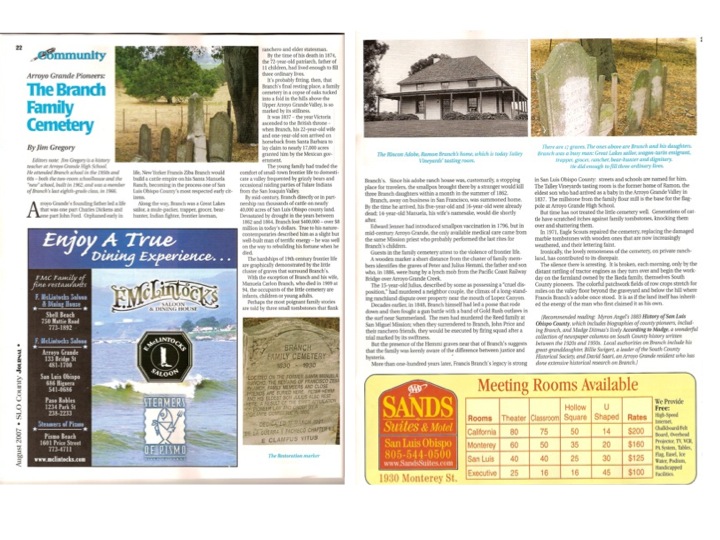
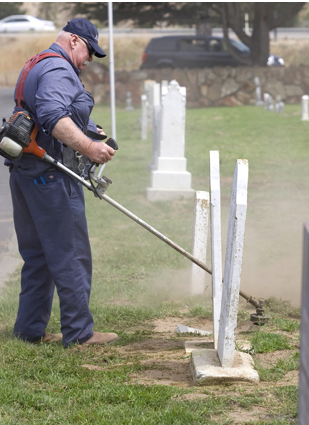
The little burial ground, by the early 1960s, had reverted to pastureland, and generations of cattle with itches to scratch had knocked down, one by one, the elegant Victorian obelisks and tablets that had marked the graves of the pioneer family. But at some point, someone had built a heavy-gauge steel pipe fence around the graves of Julius and P.J., so their tombstones stood upright and unrepentant.

Francis Branch's tombstone is the largest, at center; since the 1960s, the Hemmis' tombstones were damaged and an Eagle Scout replaced them with a single wooden marker, at far right.

Francis Branch’s tombstone is the largest, at left-center; the Hemmis’ tombstones were damaged at some time during the mid- to late 1960s, and an Eagle Scout replaced them with a single wooden marker, at far right.

JFK

75362bcf56ecbcf18f8d12643a1ce139November 2013.  I’ve been thinking about the assassination of President Kennedy a lot the last two weeks. I will be the first to admit that I am an emotional person; paradoxically, I cry about twice a decade. I’ve cried twice the last week.

But I’m also an academic and I know every detail down to the commas of the seamy stuff, the predatory and amoral father who lobotomized one of his daughters and, when one of the others would have a 16-year-old classmate spend the night, he would lift the covers and climb into bed with her; the mother, so distant, whose response to the one fidelity of her husband—his devotion to his self-indulgence–was to use her faith to draw curtains around herself and live in a world made safe by priests and lit by stained glass. I know their anointed son, the first Irish Catholic American President, who blew himself up to steal the glory back from his younger brother, was an arrogant bully.  I know what a mean-spirited little bastard Bobby was, which is exactly why he became my favorite, because when Jack’s death burned his own arrogance away he discovered his bedrock, his greatest strength, was compassion. I have not allowed the decades to erase the name of the young woman—it was Mary Jo–who drowned in Teddy’s car.

I know all that. I know how doom stalked this family, and it did so largely because they deserved it. I know all of that.

But I know one more thing: I still miss President Kennedy.

I miss him because his short time with us was so transformative. One example: among young people, there was a Renaissance of our folk music that coincided with his presidency. It was as if we had rediscovered in music our national identity, and one that we’d somehow forgotten was so joyful yet also so impatient—patience has never suited Americans—with injustice. Our history was living again.

It wasn’t a coincidence that so may Americans not much older (and some, like President Carter’s mother, were much, much older) than I was had joined the Peace Corps or were volunteering–and giving their lives, like three young men buried in shallow graves in an earthen dam in Neshoba County, Mississippi–to register African-American voters.

It wasn’t a coincidence that the White House introduced every American then alive to cellist Pablo Casals. While pundits justifiably mocked the President’s enthusiasm for James Bond novels, Kennedy’s passion for Byron was far more enduring and it was Robert Frost who became the co-star at the Inaugural.

Had Kennedy not been reading Barbara Tuchman’s superb account of the summer Europe collapsed into the First World War—The Guns of August—there is a good chance none of us would be alive today. Kennedy had picked up the book in the fall of the Cuban Missile Crisis.

And it was fact that most Latin Americans and, even larger numbers of Europeans, liked us, that the President of France had a crush on Mrs. Kennedy, who spoke near-effortless French, as transparent as eighth-grade boy’s, and that the President’s triumphant visit to what was then still one of the poorest nations in Europe—Ireland—finally secured the bond made by the Irish Brigade, scythed in neat rows in the Wheatfield  at Gettysburg.

My job in Kennedy’s presidency was more prosaic: It was my obligation, I decided, to shuffle out to the living room at 4 a.m. in my pajamas, wrapped in a blanket, no matter how cold the night before had been, every time a Mercury astronaut was to begin his mission. (Half the time the launches would be scrubbed and so I would fall asleep in class that day.) When it appeared the heat shield on Friendship 7 had become dislodged and there was a real chance that John Glenn’s re-entry would incinerate him, I prayed as hard as a little boy can pray and I was deeply touched by God’s reply: The parachutes above the little capsule, swinging gently like a bell in its descent, on the flickery television screen.

Let me be clear about this: I am not coming anywhere close to claiming the Kennedy was popular with all Americans. Many hated him. Some of that came from the memory of his father’s bizarre stint as our ambassador to England, when Joe Sr. had unwisely pronounced England finished and urged détente with Nazi Germany.

But a more visceral and widespread hatred was directed toward Kennedy’s Catholicism, the same bigotry, so deeply rooted in the Old Confederacy and the Mountain West, that had poisoned Al Smith’s run for the presidency only a year after jubilant French Catholics had mobbed Lindbergh at Le Bourget to make him one of their own. That kind of hatred is not only poisonous, it’s indestructible, and so it survived Dallas and lives today.

I am not forgetting how palpable the fear of the time was, either, when, during the 1962 Cuban Missile Crisis, my father came home empty-handed from Williams Brothers’ Market on Grand Avenue because the shelves had been stripped bare by our terrified neighbors.

But there is another side of Kennedy’s time that scholars are wary of because there’s nothing that historians hate quite so much as sentimentality. Sentimentality kills the reputation of any historian as dead as an easy rifle shot.

The shot that killed Kennedy before his time, of course, was immortalized in a few grainy frames of the Zapruder film that have become the pornography of the assassination. I will try my best to never watch that film again.

But I saw some film images last week that reminded me of the wellsprings of strength in John Kennedy. He was, for most of his life, a semi-invalid, a resemblance that connects his life to Franklin Roosevelt’s. In both men, physical frailty was their greatest gift, because it spared them their assigned destinies as spoiled rich boys who would lead lives of little consequence.

FDR mastered his polio by imprisoning his withered legs in steel braces and building a massive upper body that he learned to throw forward in order to force his legs to follow. The moment when the president approached the podium to ask for a declaration of war was terrifying, for his balance was never secure, but he refused to fall, and that refusal might also have been the hallmark of both his presidency and the nation itself in the years of Depression and war

Kennedy fought illnesses in waves—Addison’s’ Disease,  or the back that radiated the kind of pain Inquisitors dream of. An accumulation of infirmities dogged him all his life. He was sometimes so sick that one brother mused that if a mosquito ever bit Jack, the mosquito would die.

Kennedy masked his vulnerability with lies and with a skillfully managed diet of images that projected vitality—touch football, golf (sparingly, because he didn’t want to Americans to connect him with Ike’s golf addiction), and the beauty of his wife and of his children.

Far more important, he also developed what FDR didn’t have:  a first-rate intellect and with it, a sense of intellectual detachment and the ability to compartmentalize his emotions. The last trait would poison his marriage, but, in 1962, together these became the very strengths that would save civilization from nuclear destruction.

Just a little over a year later, Texans came out in enormous numbers to see the President and Mrs. Kennedy on Thursday and Friday, and, until last week, when I saw the footage of his last 48 hours, assembled by National Geographic producers, I had never realized how enthusiastic those crowds were. There was a warmth and a kind of celebratory communion in them that stunned the Kennedy advance people and the Secret Service detail.

Friday had begun with rain in Forth Worth. By the time Air Force One touched down at Love Field in Dallas, it was Kennedy Weather: bright, crisp, autumnal sunshine. The beauty of that day was quickly obscured by blurred images, snatches of rumor, the eloquent pause that registered the grief not even newscaster Walter Cronkite could master. It seems, sometimes, like Dallas was the last bright day we have ever had, and our time and our nation have ever since been stalked by shadows.

I don’t remember those shadows before Dallas, but I was so very young. What I’m beginning to believe now is that most important and salient point of November 22, 1963, wasn’t that we loved the Kennedys, though, in my house, we truly did.

What was far more important was that we loved being Americans, and it was that self-regard and self-confidence that seemed to die, too, with such explosive violence, in Dealey Plaza.

I think it’s been that healthy self-regard that has made us such a positive force in the world. And I am not talking about a pernicious doctrine, American Exceptionalism, which emerged again in the last election as a kind of litmus test for holding office.

I don’t think John Kennedy’s generation, which included my Dad, born a year after the President, went to war to prove that our nation was better than everyone else’s.  National Socialism already held that copyright.

So what we lost, in Dallas wasn’t the kind of jingoism that comes so easily to 21st Century politicians; it wasn’t arrogance. It was our faith in ourselves—the faith that Lincoln had articulated so well with his “few brief remarks” at Gettysburg, almost exactly 100 years before Kennedy’s death. I think we lost it, but that doesn’t mean it’s gone. It’s ironic, but I’ve seen flickers of that faith most in my travels abroad.

I will never forget the sunburst over Derrynane Bay in a stop for lunch on the Ring of Kerry and inside the little restaurant was a little sign, carefully lettered, that read “Happy Fourth of July to our American friends.”

We were visiting Reims Cathedral with our students when a Frenchwoman insisted on giving us a personal tour because precisely because we were Americans, and it was American money, from the Rockefeller Foundation, that was painstakingly restoring shell damage to the Cathedral from 1916.

Once a Bavarian woman approached Mr. Kamin, our German teacher, and his students near Munich and thanked him, and them, for the kindness World War II GI’s had shown her when she was a little girl. There were tears in her eyes. Of course, many of those young soldiers had died long before Mr. Kamin’s students had been born.

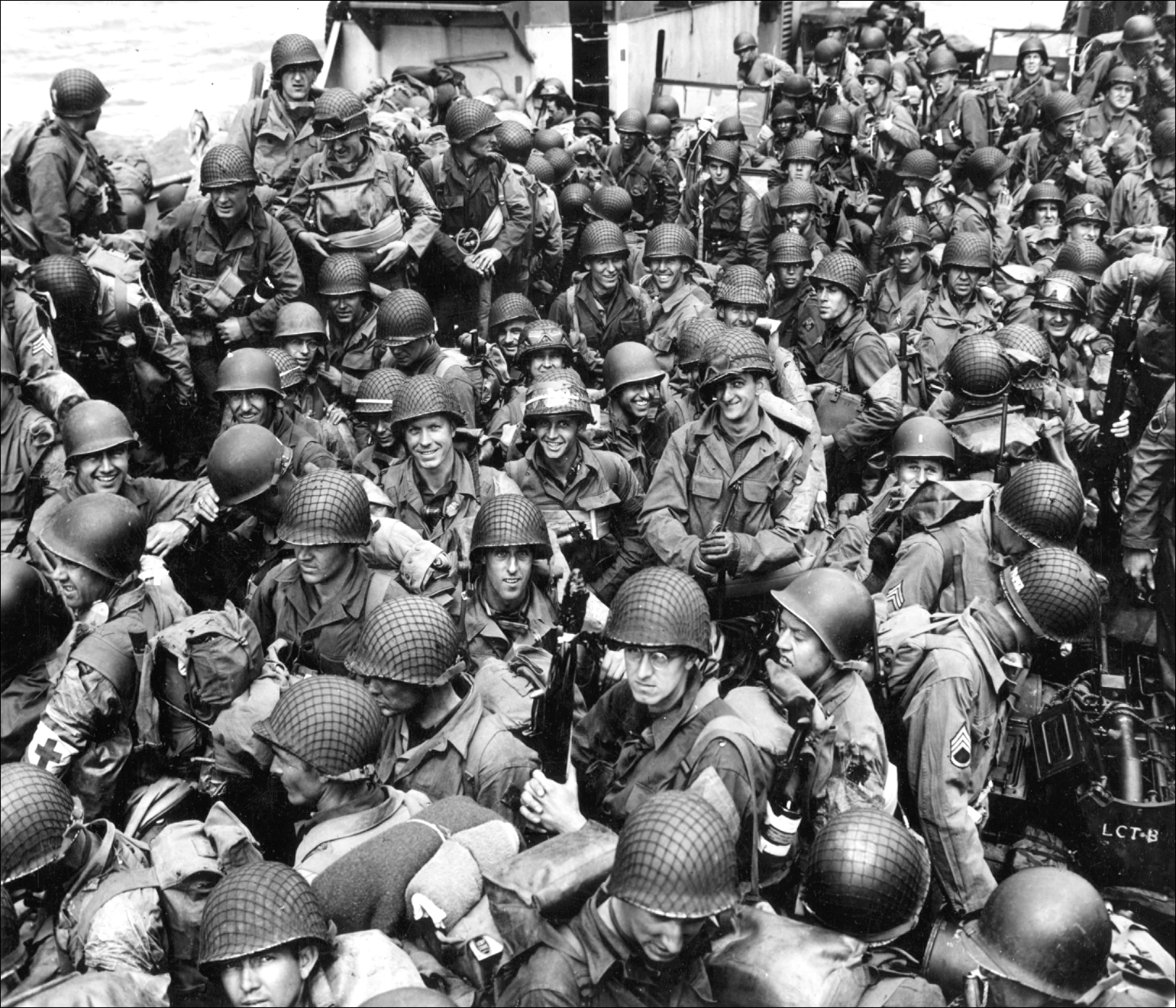
Young Americans, including young men like those soldiers, may be the best evidence we have that the faith we have in ourselves has such enduring power. In my experience, there are few images more evocative of the faith we keep than those that confront you silently in the fields of the dead.

My trips to the American cemeteries in the Ardennes, at Colleville-sur-Mer above Omaha Beach and to the Punch Bowl on Oahu never, ever made me want to wave flags or blow trumpets.

I always think instead of men who were once wavering toddlers, who took their first steps to a little smattering of applause from their parents. They waited expectantly and sleeplessly on Christmas Eves stalked by the Great Depression. When they did sleep, they would sleep with their arms around the best friend they would ever have, and one as mongrelized as Hitler said all of us Americans truly were: a dog. I think of boys whose hands shook when they tried to pin that damned corsage on the dress of their Prom date. And then they aren’t boys anymore: they’re young men fresh out of Basic whose last moments here, maybe a few free moments in San Diego or Philly, were marked by ribald laughter and 3.2 beer or poker—any distraction that would somehow increase the distance between themselves and the troopships waiting to take them to their deaths.

So I never think of patriotism at places like Colleville-sur-Mer. I think of baby shoes, and I think of mothers.

Or I think of somehow pulling off a temporal fraud so preposterous that I hope it really happens to me someday.

My fantasy is that I would get a chance to teach those boys the history of their country in my classroom, a history that some of them would not survive, and somehow I could help them understand what they would never have the time to understand:  In their lives, no matter how short, there was a light so powerful that it would destroy the greatest darkness the world had ever known.

And maybe, somehow, I would get the chance, in my re-working of history, to put my arms around them at graduation, to hold them tight for just a moment until I would have release them to give them the chance they deserved to fulfill their destinies.

The young men I would like hold close to me have been dead a long, long time, and so has the president who emerged from that incredible generation. But I am so grateful that I am old enough to have recognized their light—our light–last week when I watched the news and saw an aircraft carrier group and a Navy hospital ship headed at flank speed for the Philippines, so devastated by a massive typhoon.

Kennedy understood that the most fundamental American value is generosity, and so the ships in that television image reminded me of the president whose life and whose call to service so illuminated my own. It reminded me that I live in a country I love so much that my love is greatest in the anger I feel when it is clearly in the wrong, warmest when my fingers touch cold marble in Normandy, brightest in the flame that marks the grave where my childhood, too, is buried.

Most Inspirational. Ever.

jim-hayes-fb2Jim Hayes taught me journalism at Cal Poly and was on the copy desk when I was a Tribune reporter.  He is now in hospice care with a brain tumor,and his Facebook page has exploded–page after page after page–with tributes from former students.  Here are some of mine.

*   *   *

This is Missie Pires, at the “Mustang Daily” in the early 1970s. I was 21, and Jim made me

her writing coach. She would go into broadcast journalism, anchor at KSBY, and NOT because of me, but because she was bright, hard-working, and so incredibly positive; she actually could light up a room—newsroom or otherwise. I was heartbroken when she died so young, but our time together so many years before was the first hint I’d ever had that I loved teaching and that I might have a gift for it.

Jim knew that before I did.

Years later, my first student teaching assignment was at Morro Bay High, and I met another student I grew to love as I’d loved Missie. It was Josh, Jim’s son.

There are Roman Catholics and then there is the denomination I belong to—Lousy Catholics—but I fundamentally believe that God lights our way with people like Jim and Missie, and, through them, She takes enormously good care of people like me, well-intentioned and good-hearted characters, but with a wee tendency to run off the tracks if we’re not watched carefully.

I’m on a fine road nowadays–after 29 years in the classroom, I still look up at them when they’re taking a test or writing an essay, and they are so beautiful, so full of promise, that my eyes fill with tears. Thanks, Jim.


January 2014.  Jim died in June.

* * *


What makes Hollywood fun: murder, duplicity, and blondes

Double-Indemnity-2

The L.A. Times food critic Jonathan Gold wrote an excellent summer piece this year on great Los Angeles hamburgers, and it made me think about my strange affection for a city I largely dislike unless it’s about 1946 outside and the Red Cars are running. I’m a San Francisco kind of guy, with the exception of the Dodgers, and that has more to do with Vin Scully than with any loyalty to the Southland. But there is no noir like Los Angeles Noir–-I watched Double Indemnity one more time recently on late-night television-–and the list of good films of the genre is kind of amazing. Here are just a few favorites:

  1. Chinatown. Not only a good hard-boiled detective film, in the Raymond Chandler tradition, the novelist who created private eye Philip Marlowe, but it deftly sketches the water wars that made L.A. and its orange groves–the attraction that lured my mother’s family from the Minnesota prairie–possible in the first place. J.J. Geddes, I think, is one of the most memorable characters in American film, and John Huston’s cameo, both jovial and sinister, is stunning.
  2. Double Indemnity. The murder plot flows seamlessly to the point where, after dumping the body of Barbara Stanwyck’s husband on the railroad tracks, she and Fred MacMurray can’t get her car to start so they can leave the murder scene. Then the seams start to unravel, and it’s a lovely thing to watch. Doom can be interesting. In a perverse way, it’s even kind of fun, especially in the implicit comedy of the Stanwyck-MacMurray plot-hatching in the aisles of the local grocery store: the two are interrupted by little ladies asking the lanky MacMurray’s help in reaching the canned goods.
  3. True Confessions. John Gregory Dunne’s screenplay about two brothers–-one, Robert Duvall, an L.A. homicide detective, and the other, Robert DeNiro, a politically ambitious monsignor–is deeply moving. Duvall must solve the mystery of a priest found dead in a prostitute’s bed, and he’s got to tear down the wall DeNiro’s character has constructed to protect his church and his career. This is a wonderful story about redemption, and how redemptive personal destruction can be.
  4. The Big Sleep. Bogart and Bacall in a plot so arcane that even the scriptwriters couldn’t figure it out. Bogie’s Marlowe builds on the fast-talking Sam Spade we’d first seen in San Francisco, in The Maltese Falcon, and his ability to shift character, posing, for example, as a dirty-minded bookworm in one scene, foreshadows James Garner’s television detective, the delightful Jim Rockford. Bacall is smoky, alluring, mysterious, dangerous, and Bacall.
  5. L.A. Confidential. A superb ensemble cast–Kevin Spacey, Guy Pearce, Russell Crowe, Kim Basinger as a kind of Bacall archetype, although her call-girl character has been molded to look like Veronica Lake. You’ve got your fast-talkers, con men, like Spacey, but you’ve also got your straight arrows, like Pearce and the wounded Crowe, and all three, it will turn out, are decent men at their core in a department so corrupt that even they, in own casual infidelities to the law, must finally take a stand. Again, a wonderfully redemptive story crowned by a harrowing shootout scene.
  6. The Big Lebowski. I’m a little dense, but by the third or fourth time I realized that this was a wonderful tribute to and parody of the Chandleresque formula, with Jeff Bridges as a soft-boiled stoner and the incomparable John Goodman as Walter, his manic, explosive and completely inept partner. Includes femmes fatale, slipped Mickeys (in Lebowski’s White Russian), a couple of Falcon-like talismans (a finger, Lebowski’s rug), and a brace of Nihilists.

What makes these films even more compelling is, of course, real tragedy. Human wreckage has always surrounded the film industry and examples include Elizabeth Short’s grisly 1947 murder (she worked for awhile at what would become Vandenberg Air Force Base), when she became immortalized as “The Black Dahlia;” the implosion of film comedian Fatty Arbuckle’s career when he was charged with the 1921 murder of aspiring actress Virginia Rappe; the mysterious 1924 death of producer Thomas Ince, “father of the Western,” after a visit to William Randolph Hearst’s yacht, Oneida, where Hearst mistress Marion Davies, as she did at San Simeon, served as the Chief’s hostess. What ended Ince’s life? Was it a heart attack or a bullet intended for Charlie Chaplin, Davies’ putative lover?

It’s film, finally and ironically, that best illuminates dark places like these. All of these films entangle us in L.A.’s tawdry Day of the Locust glamour, in its ambition and deception, because this is a place where nobody is who you think they are, a place where, as Chandler wrote, the Red Wind-–the Santa Anas-–can lead even the most dutiful Valley housewife to contemplate her husband’s back while absently squeezing the butcher knife’s handle in her free hand, the one without the potholder.

Glory Days

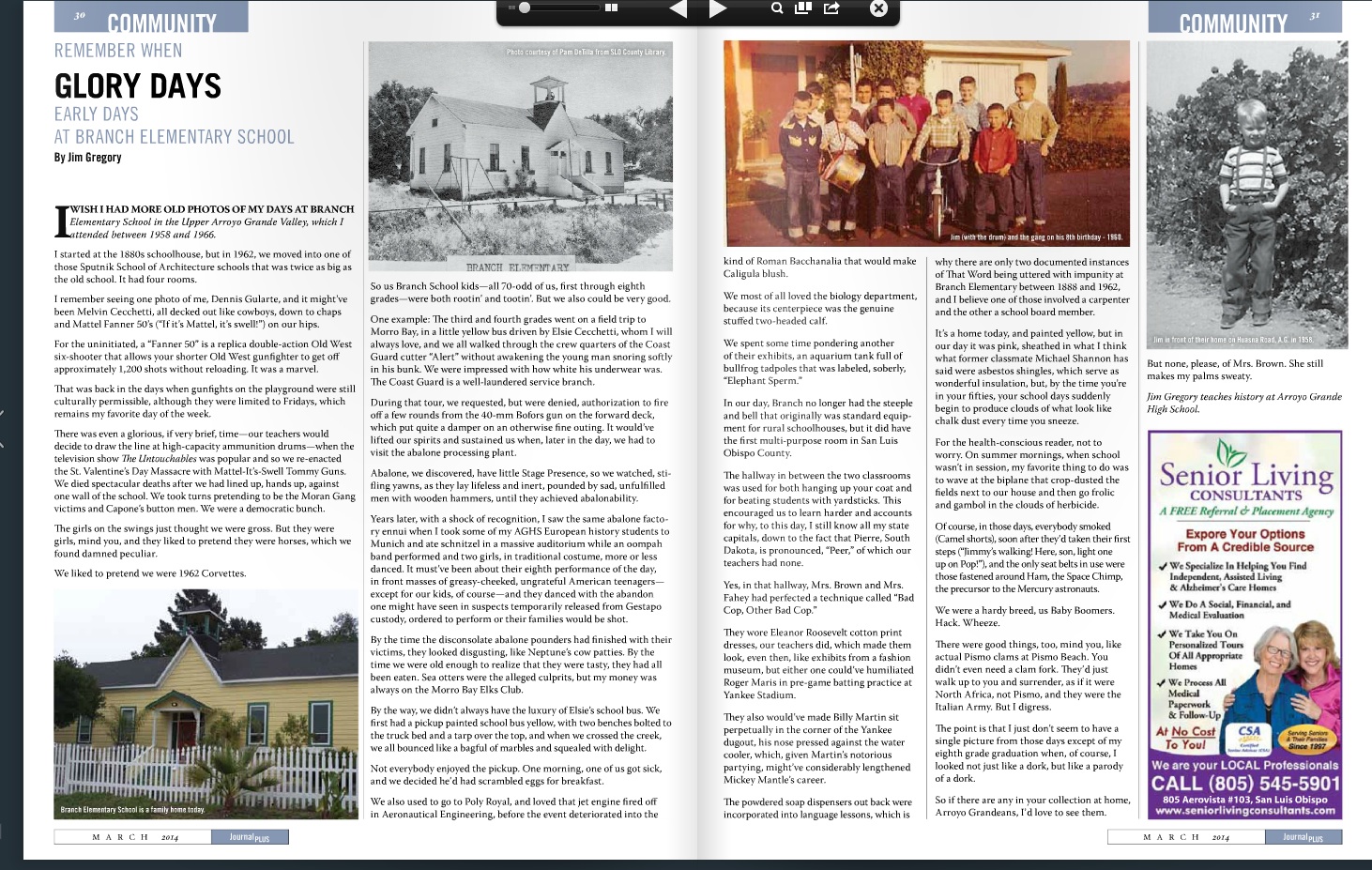
Screen shot 2014-07-22 at 4.18.51 PMI wish I had more old photos of my days at Branch Elementary School in the Upper Arroyo Grande Valley, which I attended between 1958 and 1966.

I started at the 1880s schoolhouse, but in 1962, we moved into one of those Sputnik School of Architecture schools that was twice as big as the old school.  It had four rooms.

I remember seeing one photo of me, Dennis Gularte, and it might’ve been Melvin Cecchetti, all decked out like cowboys, down to chaps and Mattel Fanner ’50s (“If it’s Mattel, it’s swell!”) on our hips.

For the uninitiated, a “Fanner ’50″ is a replica double-action Old West six-shooter that allows your shorter Old West gunfighter to get off approximately 1,200 shots without reloading. It was a marvel.

That was back in the days when gunfights on the playground were still culturally permissible, although they were limited to Fridays, which remains my favorite day of the week.

There was even a glorious, if very brief, time–our teachers would decide to draw the line at high-capacity ammunition drums–when the television show The Untouchables was popular and so we re-enacted the St. Valentine’s Day Massacre with Mattel-It’s-Swell Tommy Guns.  We died spectacular deaths after we had lined up, hands up, against one wall of the school. We took turns pretending to be the Moran Gang victims and Capone’s button men. We were a democratic bunch.

The girls on the swings just thought we were gross.   But they were girls, mind you, and they liked to pretend they were horses, which we found damned peculiar.

We liked to pretend we were ’62 Corvettes.

So us Branch School kids–all 70-odd of us, first through eighth grades– were both rootin’ and tootin’. But we also could be very good.

The entire third and fourth grades went on a field trip to Morro Bay, in a little yellow bus driven by Elsie Cecchetti, whom I will always love, and we all walked through the crew quarters of the Coast Guard cutter Alert without awakening the young man busy contradicting the cutter’s name, snoring softly in his bunk. We were impressed with how white his underwear was.  The Coast Guard is a well-laundered service branch.

During that tour, we requested, but were denied, authorization to fire off a few rounds from the 40-mm Bofors gun on the forward deck, which put quite a damper on an otherwise fine outing. It would’ve lifted or spirits and sustained us when, later in the day, we had to visit the abalone processing plant.

Abalone, we discovered, have little Stage Presence, so we watched, stifling yawns, as they lay lifeless and inert, pounded with wooden hammers, by sad, unfulfilled men, until they achieved abalonability.

Years later, with a shock of recognition, I saw the same abalone factory ennui when I took some of my AGHS European history students to Munich and ate schnitzel in a massive auditorium while an oompah band performed and two girls, in traditional costume, more or less danced.  It must’ve been about their eighth performance of the day, in front of masses of greasy-cheeked, ungrateful American teenagers–except for our kids, of course– and dancing with gleeful abandon was just not in their repertoire.

By the time the disconsolate abalone pounders had finished with their victims, they looked disgusting, like Neptune’s cow patties. By the time we were old enough to realize that they were tasty, they had all been eaten. Sea otters were the alleged culprits, but my money was always on the Morro Bay Elks Club.

[Clams are no more stimulating than abalone, by the way. The second-best show-and-tell ever, other than Tookie Cechetti’s fingertip in a vial of alcohol, lost in a saber-saw accident, was the Pismo clam Dennis Gularte and Melvin Cecchetti attempted to keep alive in the classroom sink in the new school. Clams have all the entitlement and ingratitude of the Kardashian sisters and are only marginally smarter. Our clam said little during the school day, showed little interest when we tried to push a length of kelp, which we know had to be yummy, through its shell’s opening, and then did nothing at all for about another day. Dennis ate it.]

By the way, we didn’t always have the luxury of Elsie’s school bus. We first had a pickup painted school bus yellow, with two benches bolted to the truck bed and a tarp over the top, and when we crossed the creek, we all bounced like a bagful of marbles and squealed with delight.

Not everybody enjoyed the pickup. One morning, one of us got sick, and we decided he’d had scrambled eggs for breakfast.

We also used to go to Poly Royal, the local college’s open house, and loved that jet engine fired off in Aeronautical Engineering, before the event deteriorated into the kind of Roman Bacchanalia that would make Caligula blush.

We most of all loved the biology department, because its centerpiece was the genuine stuffed two-headed calf.

We spent some time pondering another of their exhibits, an aquarium tank full of bullfrog tadpoles that was labeled, soberly, “Elephant Sperm.”

In our day, Branch no longer had the steeple and bell that originally was standard equipment for rural schoolhouses, but it did have the first multi-purpose room in San Luis Obispo County.

The hallway in between the two classrooms was used for both hanging up your coat and for beating students with yardsticks. This encouraged us to learn harder and accounts for why, to this day, I still know all my state capitals, down to the fact that Pierre, South Dakota, is pronounced, “Peer,” of which our teachers had none.

Yes, in that hallway, Mrs. Brown and Mrs. Fahey had perfected a technique called “Bad Cop, Other Bad Cop.”

They wore Eleanor Roosevelt cotton print dresses, our teachers did, which made them look, even then, like exhibits from a fashion museum, but either one could’ve humiliated Roger Maris in pre-game batting practice at Yankee Stadium.

They also would’ve made Billy Martin sit perpetually in the corner of the Yankee dugout, his nose pressed against the water cooler, which, given Martin’s notorious partying, might’ve considerably lengthened Mickey Mantle’s career.

The powdered soap dispensers out back were incorporated into language lessons, which is why there are only two documented instances of That Word being uttered with impunity at Branch Elementary between 1888 and 1962, and I believe one of those involved a carpenter and the other a school board member.

It’s a home today, and painted yellow, but in our day it was pink, sheathed in what I think what former classmate Michael Shannon has said were asbestos shingles, which serve as wonderful insulation, but, by the time you’re in your fifties, your school days suddenly begin to produce clouds of what look like chalk dust every time you sneeze.

For the health-conscious reader, not to worry. On summer mornings, when school wasn’t in session, my favorite thing to do was to wave at the biplane that crop-dusted the fields next to our house and then go frolic and gambol in the clouds of herbicide.

Of course, in those days, everybody smoked (Camel shorts), soon after they’d taken their first steps (“JIMMY’S WALKING! Here, son, light one up on Pop!”), and the only seat belts in use were those fastened around Ham, the Space Chimp, the precursor to the Mercury astronauts.

We were a hardy breed, us Baby Boomers. Hack. Wheeze.

There were good things, too, mind you, like actual Pismo clams–all from the extended family of our classroom clam–at Pismo Beach. You didn’t even need a clam fork. They’d just walk up to you and surrender, as if it were North Africa, not Pismo, and they were the Italian Army. But I digress.

The point is that I just don’t have to seem a single picture from those days except of my eighth grade graduation when, of course, I looked not just like a dork, but like a PARODY of a dork. So if there are any in your collection at home, Arroyo Grandeans, I’d love to see them.

But none, please, of Mrs. Brown.  She still makes my palms sweaty.

Redheads Again


-portrait-of-mademoiselle-irene-cahen-danvers-pierre-auguste-renoirThis Renoir, the exquisite 1880 portrait of 8-year-old Irene Caher d’Anvers, was part of today’s lesson.   Irene would live to be 91.  Born in horse-and-buggy Paris, she would die with humans hurtling through space at unimaginable speeds.

Irene reminded me of a something I’d mentioned in class a few days before. In 29 years of teaching, I told them, I have never taught so many red-haired girls, in particular, and hair in so many shades of red–from strawberry blonde to deep copper. Having this many redheads is extraordinary.

This anomaly led to intense meditation and at least one extended monologue in front of 31 slightly befuddled sophomores, on redheads–all of this was me processing information–and it led to one logical, unavoidable conclusion about them:  They are beautiful.

My mother, by the way, had deep auburn hair. That’s her, with my big sister, Roberta, in 1943. She was twenty-two, with ancestors from County Wicklow, on Ireland’s east coast.

One of the dearest friends of my life, Joe Loomis, died last fall. Joe was the kind of guy–you hear stories about this in him over and over again–who would drop anything and everything to help a friend.

Here’s an example. My Mom, the single most informative influence of my life, died when I was 17.  She took her own life, a pattern that runs in my family the way cancer does in others. Nobody knew how to handle my tragedy. Joe did. He simply drove up to our front door in a jeep, invited me to jump in, and drove me—rapidly–up the Huasna to his family’s Tar Springs Ranch.  The Loomises gave me a place, their home, where I could feel safe again.

Years later, Joe and I had lost touch, but it didn’t matter because I knew this great friend would be around nearby and we would have the luxury of time to renew our friendship.

And now he isn’t, and now we don’t.

I made a color copy of a photograph of Joe– it radiates his kindness and good humor–and put it on the corner of my classroom desk.  This is his year. I will be the best teacher I can be, and it’s for him.

After school today, Kaylee and Maggie, two basketball players, were studying in my room–I work late, and I hate working alone, so having kids do their homework with me is a blessing.

We were talking, I think, about Irene again–-Irene with the red hair, because Maggie has red hair, too.  I was talking to Maggie and suddenly I thought of Joe.

“One of my best friends died this year,” I started.

The girls’ faces fell.  They started to stammer their “sorries.” These are good kids.

“No, you don’t understand.  Maggie, go look at the photo of my friend on the corner of my desk.”

She did.  The girls thought he looked nice.  I asked Maggie what color hair Joe had.  Red, she said.

I don’t think they completely got the point because I didn’t completely make it, and coherence is in short supply when you need it most.  They had to go to their game, and I think they believed they’d said or done something wrong, when in fact they’d given me a wonderful gift.  It took me a few hours to unwrap it.

The reason–and when you’re in your sixties, you begin to understand that life isn’t as accidental and random as you think it is–the reason I have more redheads this year than I’ve ever had in 29 years of teaching— is that Joe hasn’t left me at all.

My little brace of red-haired girls light me up inside every day they’re in my classroom, because they are themselves beautiful and, I now understand, because they connect me to the friend of a lifetime.  It’s no wonder I loved Joe—excuse me, love him–so very much.

February 2014


Joe Loomis.  1952-2013

Joe Loomis. 1952-2013