
I’ve been washing my car at this place since 1969, when “my car” was a yellow 1965 Mustang and this place had all of two stalls. It cost about a dollar, or four quarters, so washing your car was a judicious decision, usually arrived at when I had a high school date.
Now I am old (er), so I sometimes use the full-serve bay, $10, plus the $5 tip I leave for “the guys” who wash my little Mazda.
ICE arrested the guys on Thursday. Three of them. Threw them to the ground and them bundled them into an SUV. The masked men “were very rough,” the carwash manager said.
Rough. Not tough.
“Tough” means the carwash guys who work while your privileged gabacho ass remains seated. They kind of swarm around your car–the windows are up so you don’t hear them grunting as they wipe the car down–then they move you on with a wave, and there’s almost always a car just behind yours; the swarm renews. Sometimes there’s enough of an interruption so that they can manage a bite or two of a chorizo-and-egg burrito between jobs. Sometimes, when it’s hot, you can see steam rising from their soaked clothing. Undressing at the end of a workday like theirs must be glorious.
And then they start all over the next day.
I knew their grandfathers. I used to watch them cultivating row crops with the short hoe–el cortito–a tool so brutal in what it did to backs and knees and even internal organs that it has been banned in California.
If you think they’re taking our jobs, you can have these jobs.
If you think they’re murderers and rapists, look at the actual crime statistics that compare native Americans with immigrants.
If you think they’re sapping our economy, then do a little research on what they contribute in sales taxes. Or stand in line at Aldi or the Dollar Tree.
If you think they’re voting illegally, you are delusional.
If you think they’re ducking responsibility, then why have 34 soldiers and over 200 of their dependents been deported this year?
If you think they’re sponging thanks to Welfare, immigrants consume 24% fewer benefits than American citizens. And, if you define “Welfare” for what it is–aid to dependent children–and still oppose welfare benefits, congratulations. You must hate children.
If you’re proud that your ancestors came here “the right way,” then look at a map of America in 1880, at the beginning of the “tidal wave” of immigration to America. We had a continent to fill and so were begging for immigrants of the correct color to supplant the people who occupied the empty space.
Today, we have a similar empty space, not in land but in a generational blankness made up of Americans who won’t do the kinds of jobs the migrants will do willingly— and with a work ethic that would’ve made them ideal pioneers in 1880.
You think I want to be an American? I LOVE BEING A MEXICAN! I love my country!
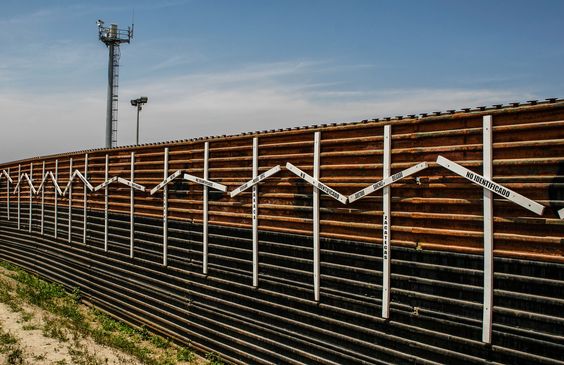
My family and I were on a mission trip to Tijuana when this man, a little drunk, called out to us as we walked along the border fence, punctuated by crosses, each cross commemorating an “illegal” who crossed the border but died in the desert.
The drunken man–in vino veritas–may have been unknowingly echoing the Mexican poet Octavio Paz: “Poor Mexico: So far from God, so close to the United States!” The relationship between the two nations has always been so tightly interwoven as to erase the border violated so often–by American generals Zachary Scott and John J. Pershing, by the revolutionary Pancho Villa. The first victim of Villa’s revolution, which claimed a million lives, was an American woman hanging out her laundry in El Paso. Bullets don’t respect borders, either.
Neither do men with families to feed, nor whole families within hearing range of automatic rifle fire.
Periodically, the United States will dump corn on the world market and, in so doing, render thousands of peasant farmers—corn is a Mexican staple— bankrupt. “Low-value” exports, like corn, are now less vulnerable than Mexican manufactures, and President Trump’s tariff policy is devastating a nascent Mexican industrial economy. American consumption of illicit drugs generates mass murders or war in the streets in Tijuana or Guadalajara. The willful inattention to global climate change means that the flow of refugees from below the border, their crops destroyed, will surge far more than it ever has.
But these people love being Mexicans. But when you have a family to feed, or you are a young woman fleeing the murders associated with female workers at GM plants in Mexico, your choices are narrow and obvious. You find a coyote and you head north.
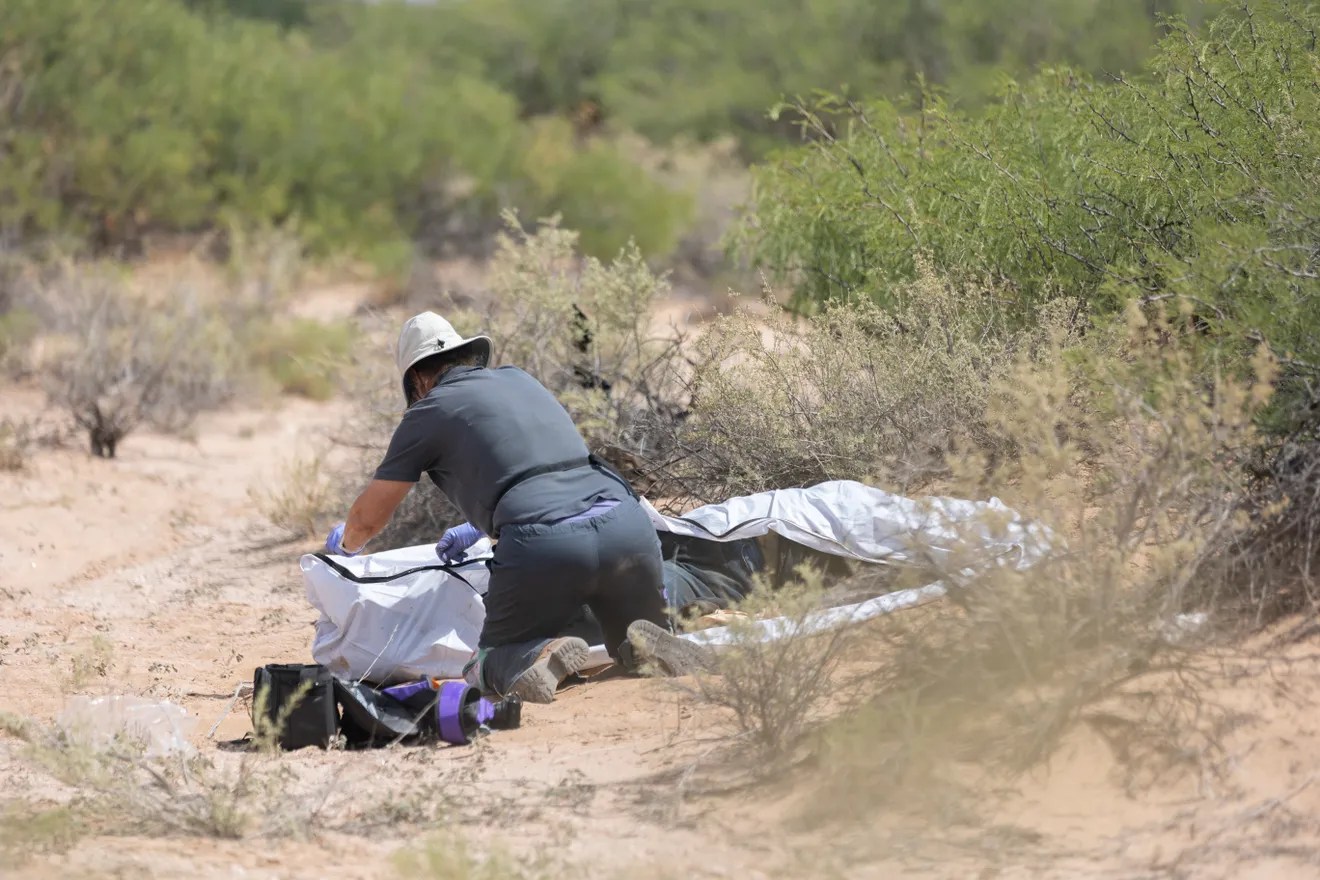
There will be a cross for you on the border fence. La Migra, ranchers and activists find human remains frequently in the desert, leather-like scraps of skin and bone intermixed with faded shirts, paper-thin jeans and comparatively well-preserved Nikes. They are brought to forensic labs in Arizona or New Mexico or Texas and there, pathologists, with immense tenderness, labor over the scraps, looking for any clue that might identify the human beings.
Sometimes they are lucky–a fourteen-year-old boy’s remains might match the missing fourteen-year-old from a village in Coahuila, last seen wearing a pair of Nike Air Jordans.
They will then zip the remains inside a body bag, place it into a wood coffin for shipment home.
If the coffin comes home at night, it will be guided by candlelight. Men will carry it and place it carefully in front of the family home. Then the pallbearers, the family and their neighbors will lower themselves to their knees and begin a Rosary for the boy in the box.