• About
  • The Germans

A Work in Progress

A Work in Progress

Category Archives: Arroyo Grande

The big guns above Shell Beach, 1942-1944

13 Monday Sep 2021

Posted by ag1970 in Arroyo Grande, Uncategorized, World War II

≈ 3 Comments


A World War I-vintage 155-mm artillery piece could hurl a 95-pound shell 20,000 yards.

If you’d been driving north to San Luis Obispo on the old two-lane 101, there was a a battery of these beasts on the hillside to your right as the road begins to curve inland, headed for true north.

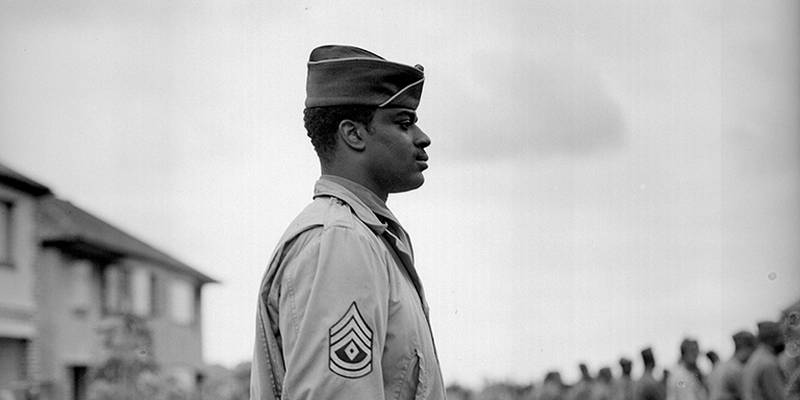
They were there to guard San Luis Bay and they were manned by G.I.’s from the 54th Coast Artillery, an African-American unit that had trained at Fort Fisher, North Carolina–taken from the Confederacy by the Union Army in January 1865–before some of them wound up serving in our county between 1942 and 1944.

I learned this today over lunch, a treat from military historian Erik Brun, who is researching the 54th during the unit’s stay here.

Erik told me that White North Carolinians were not at all fond of having Black G.I.’s close by–even though these soldiers were learning to handle guns that theoretically could inflict considerable discouragement on the U-boats hunting their quarry just offshore.

Those people had forgotten World War I, when 10 merchant ships were torpedoed off the Outer Banks.

In World War II, the U-boats claimed 80 ships. North Carolinians could easily see the glow of burning tankers in the shipping lanes off their coast.

They couldn’t see the crews thrown into the burning water.

So they didn’t want the 54th Coast Artillery anywhere near.

Detachments from the 54th would come to us instead, charged with defending Estero Bay as well as San Luis Bay. And so, for a brief time, Black G.I.’s were part of daily life here.

Some of the 54th’s soldiers played baseball against Arroyo Grande Union High School. A 54th officer–officers were White– married Lorna Folkerts of Arroyo Grande in a candlelit ceremony in a Camp San Luis Obispo chapel. And in 1943, an octet from the 54th sang for South Countians in a holiday concert at the Pismo Beach Army Recreation Camp. The barracks at the Rec Camp had once stood on the site of today’s Arroyo Grande Woman’s Club, where they were built in 1934 to house 230 Civilian Conservation Corps workers from Delaware, New Jersey and New York City.

But the history of Black GIs in San Luis Obispo remains fraught. In June 1943, rioting broke out in San Luis Obispo and it made newspapers throughout America. This is from the June 25, 1943 Salt Lake City Tribune:
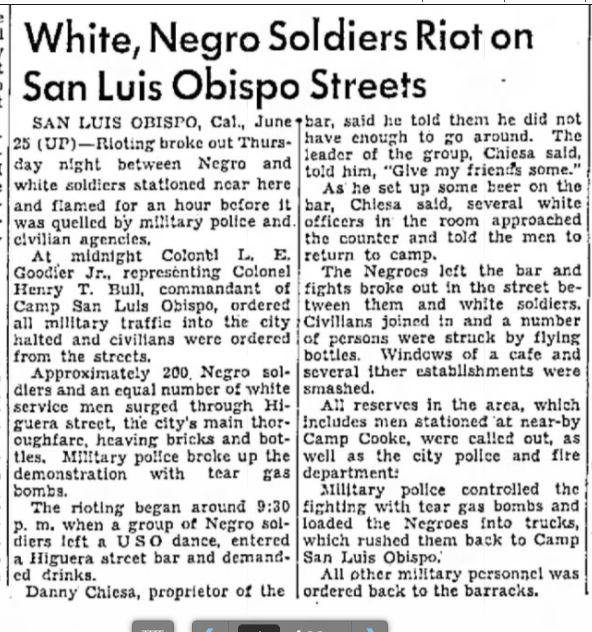
I have been trying to wrap my head around this. In an email to my friend Erik, I tried to explain it to myself.

* * *

It just occurred to me to look up the summer of 1943—what happened in SLO seems part of a national trend. There were race riots in —Mobile, Alabama (May 25) —Los Angeles (The Zoot Suit Riots, June 5-8) —Beaumont, Texas (June 15-17) —Detroit (June 20-22; 34 killed) —San Luis Obispo (June 24) —Harlem, NY (August 1-2)

It strikes me that racial tensions would’ve been intense here and across the nation.

The movement of Black Americans into defense jobs during the war was a factor in Mobile and Beaumont, where Black and White shipyard workers worked. The population influx, resulting housing shortages and competition between Black and White defense workers generated increasing tensions as the shipyards reached full production.

The same was true in Detroit, which created thousands of defense jobs—the city was a focal point for the Great Migration, where you could once find entire city blocks settled by families from the same county in Mississippi —but where housing shortages were (and are) notorious in the Black community and casual but cruel racism was, in 1943, a constant.

A similar influx, but of soldiers, happened here, in a little town not fully equipped to deal with thousands of GIs, including a shortage of places to entertain them. Blacks and Whites coming together (and the latter in such large numbers) and in seeming competition might’ve led to the kind of hostility seen in the shipyards.

It strikes me, too, that racism, including the stereotyping of Black Americans, might’ve typified a town like San Luis Obispo, which had little experience in interacting with them, including the soldiers of the 54th.

There’s a faint similarity, then, to the background of the Zoot Suit riots. Los Angeles was growing in the late 1930s and the war (e.g. the aircraft industry) accelerated it; the city did not plan well and the kind of housing problems that marked Detroit—as well as racism and job discrimination—were common to the Mexican-American community, which included Chavez Ravine.

But it was the decision to place a Naval installation there that resulted in fraught relations between sailors—outsiders, many from the Midwest or the South, who had little understanding of the Mexican-American community— and local residents. The two groups were strangers to each other, as was White San Luis Obispo to the 54th. So the Ravine in L.A. and Danny’s Bar on Higuera became flash-points for two of the 1943 riots.

* * *

I guess because I took a year of the History of the American South in college, at the University of Missouri, I’ve always been fascinated by this part of our history, by which I mean Black History, by which I mean American History.

My Dad, a quartermaster officer who grew up in Texas County, Missouri, was a small part of that history.
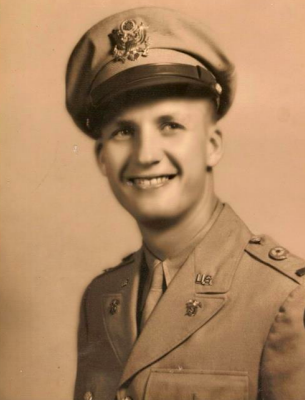
Lt. Robert W. Gregory, 1944


On the troopship to England, Dad was issued a .45 sidearm. It wasn’t for Germans. It was for Black soldiers, truckers, suffering belowdecks in the North Atlantic crossing. I wrote about this:

These were the men who would drive the deuce-and-a-half trucks on the  Red Ball Express. It was my father’s job the organize and send some of  these truckers, in gasoline supply companies, to the 1944 beachhead in  Normandy, where details from George Patton’s Third Army would arrive  regularly to kidnap them so that the great general would be the first to the  Rhine, the natural border between France and Germany. 

In this, Patton would succeed, but it was the Red Ball express that made his  moment, captured by wire service photographers, possible.  

Along the way, the black truckers died under artillery fire, died from worn out brakes and frayed tires and died from the irresistible urge to fall asleep  on darkened roads that led irrevocably east, from the Seine Valley to the  Ardennes. 

To stay alive, they learned to drive at night without headlights. If a driver  felt that sleep was too powerful to resist, he learned to switch seats with his  passenger and comrade while the truck was moving. When the trucks  didn’t move fast enough for the Red Ball drivers, they modified the  governors on their trucks’ carburetors. When the trucks broke down, they  resurrected them.  

On a typical day, 900 trucks were on the road, spaced at sixty-yard  intervals, to keep Third Army fed and its trucks and tanks fueled. 

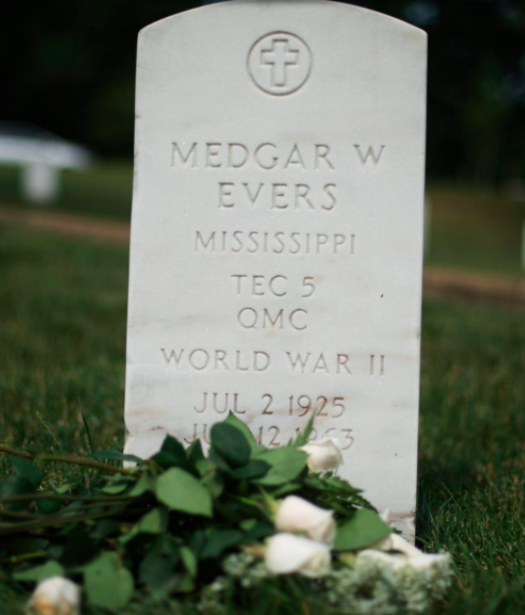
One of the Red Ball veterans was named Medgar Evers. After the war, he  became a civil rights activist. A sniper took his life near Jackson,  Mississippi, in 1963, with a Lee-Enfield rifle, the infantry weapon issued  the British soldiers who became my father’s wartime friends. 

Medgar Evers was thirty-seven years old. His wife, Myrlie, who would  become a formidable activist in her own right, and his three children were  at his graveside when he was buried at Arlington. 

Medgar’s killer was convicted. It took thirty-one years.


The 1916 Battle of Verdun was one of the ghastliest in twentieth-century history, claiming over 300,000 French and German lives and vaporizing seven French villages. But the French have honored their military truck drivers who were part of that terrible battle: The road to Verdun is called La Voie Sacree—The Sacred Way— and, as you approach the battlefield, which my students and I visited in 2010, markers commemorate French soldiers, the poilus, who drove the trucks.
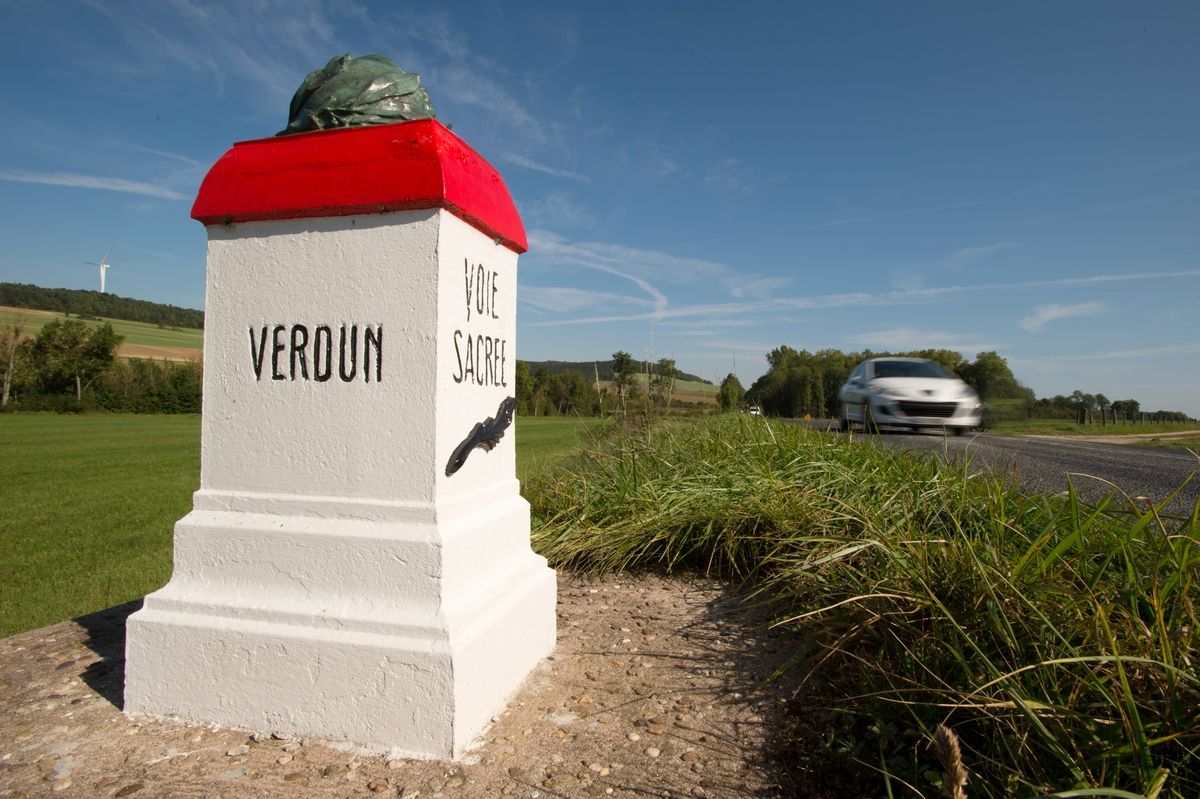

So the French remember. What Arroyo Grande farmer Haruo Hayashi remembers during his time training with the 442nd Regimental Combat Team in Mississippi was the rigidity of Jim Crow. He couldn’t understand why Black soldiers weren’t allowed to watch USO shows inside the Camp Shelby (named after a Confederate cavalry officer) gymnasium. It bewildered him.

Haruo’s family was behind barbed wire at the Gila River internment camp.

So my time with Erik today gave me a lot to think about

This video shows a crew working the same kind of gun the 54th knew so well.



Baby Boomage at the A & W

06 Monday Sep 2021

Posted by ag1970 in American History, Arroyo Grande, Personal memoirs, Uncategorized

≈ Leave a comment

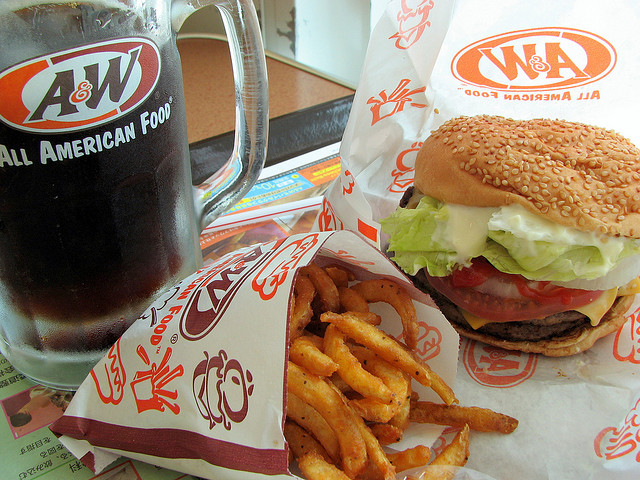
An authentic A & W restaurant.

There used to be an A & W Root Beer restaurant on Grand Avenue. It isn’t there anymore. It was right across Grand from Young’s Giant Food, which isn’t there anymore, either.

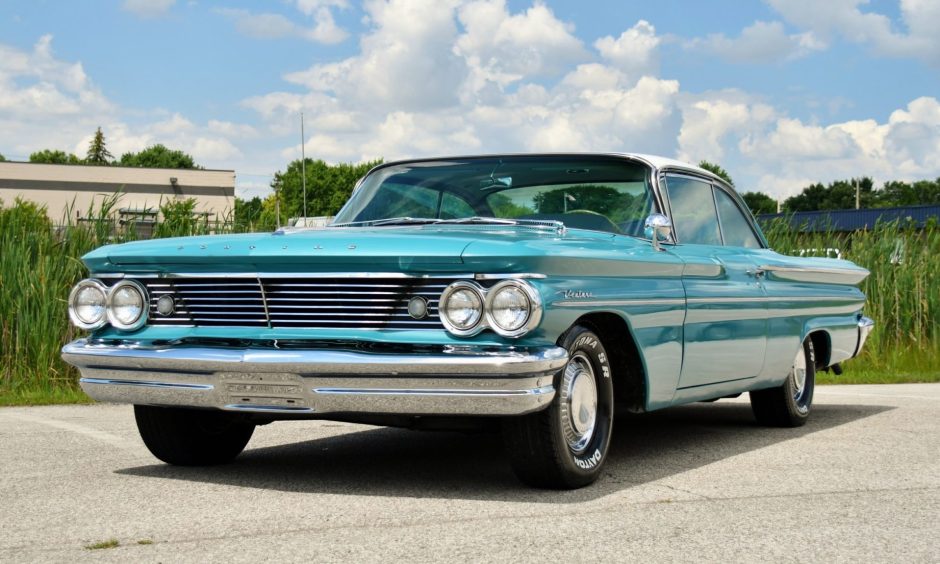
A Pontiac Ventura. My sister’s was red over white.

But when I was little, this was high living: My sister, Roberta, would take Mom and me and later little sister Sally to the A & W in her 1961 Pontiac Ventura.

I believe that it was dangerous to drive a 1961 Pontiac Ventura in the San Diego area. Fighter jets from the Naval Air Station might mistake it for an aircraft carrier and try to land.

But a car that size was made for drive-in meals.

They had car hops, teenaged girls, at this A & W, and I believe, if I’m not mistaken, that they were on roller skates. They’d glide out to take your order and then glide back to place it. They’d hook a tray to the driver’s side door and, with great dignity, roll out again to lay the feast thereupon. It was Roberta, since she was driving, who distributed the goodies.

The smell, of burger and bacon and fries was unendurable. Roberta was never fast enough for me. Many years later, I saw the film Reefer Madness. At one point, one of the hopelessly addicted 1940s teenagers blurts “I NEED SOME REEFERS!” I was like that, but it was with hamburgers.

A nostalgic view. They’re all so white.

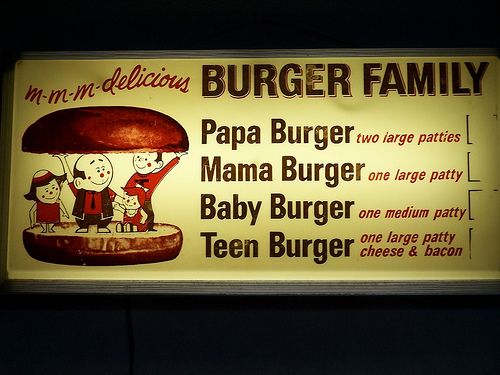
My invariable order: A root beer freeze, a Teen Burger (bacon and cheese, then a novel innovation) and fries. It was a substantial meal and required a nap afterward.

Alas, my cardiologist would whip me with a stethoscope if I ate a meal like that today.

Mom always got the Mama Burger and Sally the Baby Burger. Of course.

But it was a different America then. We had big cars like Pontiacs–eleven miles per gallon, thank you very much–so immense that they were mobile dining rooms, and we had vast and limitless cattle ranches devoted solely to Teen Burger production. There would always be plenty of gasoline, we believed, and you could always eat plenty of hamburgers.

Then they shot the president and the whole shebang started to unravel.

In the words of Kurt Vonnegut Jr.: So it goes.

Harvest Festivals past. And other things.

26 Thursday Aug 2021

Posted by ag1970 in Arroyo Grande, Uncategorized

≈ Leave a comment

It’s sad–but no recriminations on my part–that the Harvest Festival was canceled this year. (There were cancellations during World War II, as well; the first Harvest Festival was in 1937). The Harvest Festival was an especially big deal when I was little, when my parents dropped me off and turned me loose for the day. The parade was the best part. My sisters, in matching mint-green outfits, appeared in at least one, in the pony cart with Obispo Telstar, one of Anne Westerman’s Welsh ponies, doing the work.


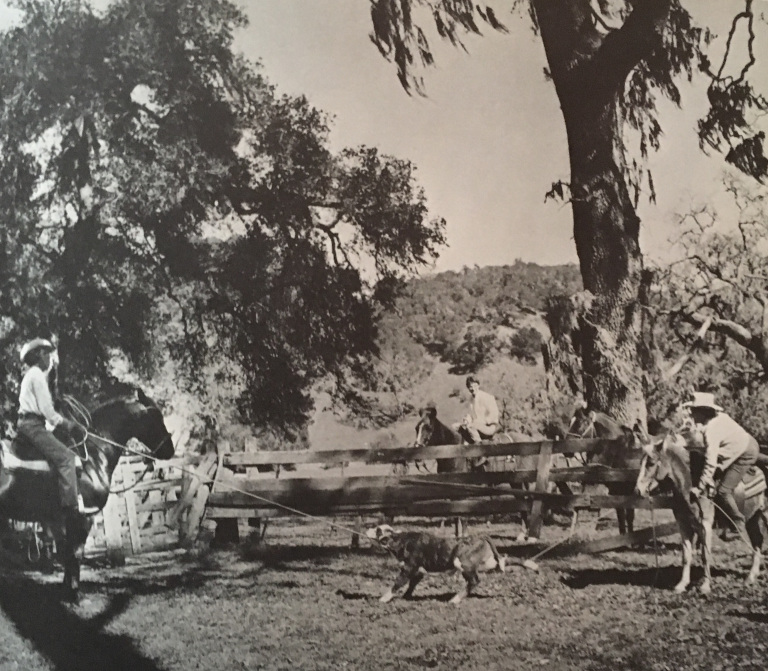
That’s my big sister in the center of the Jeanne Thwaites photograph, taken at Sid Spencer’s cattle ranch, now underneath Lopez Lake. Sid, on her Morgan–Roberta’s riding a Spencer Morgan mare–is on the left and her sister, Anne, on her pony, is on the right.


It was Sid Spencer who taught Sheila Varian how to work cattle. She was a good teacher. Sheila won the National Cow Horse Championship at the Cow Palace in 1961. She was the only woman competitor and her mare, Ronteza, was the only Arabian in a field of Quarter horses.Ronteza’s sire, Witez II, was a champion Polish Arab who plays a central role in a superb book, “The Perfect Horse,” about the American rescue of the Spanish Riding School’s Lipizzaner near the end of World War II.


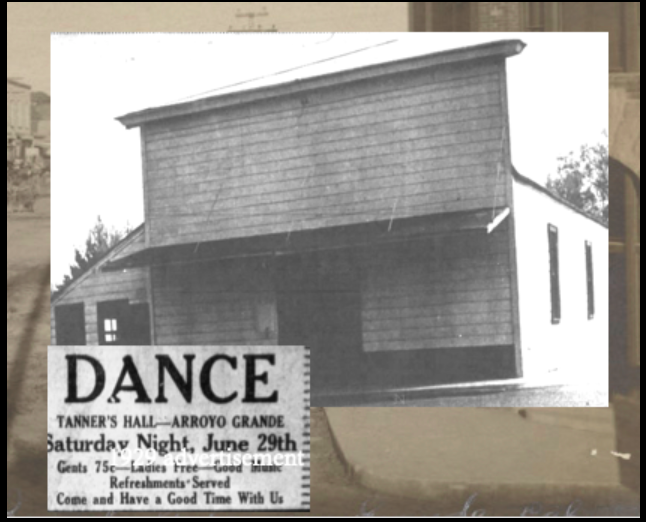
My favorite Harvest Festival equestrian unit was the one that veered off the parade route and entered Ralph and Duane’s. The horses were thirsty.My most vivid memory was the Harvest Festival of 1966, I think. I was a ninth-grader at the big old Paulding campus, having just graduated from Branch in a class of ten boys and three girls. I went to a dance in Tanner Hall, where City Hall now stands.Tanner Hall had been a dance hall since it was built by Beder Wood in 1894.


But in 1966, at that particular Harvest Festival Dance, I saw the second-most epic girl fight of my life. It was terrifying when you come from a graduating class of ten boys and three girls.

These city girls are lethal, I thought.

The most-epic Young Woman fight–note the change in word choice, reflective of the times– I ever saw was one I broke up as a student teacher at Righetti. I barely survived. Boy fights end when they get tired. If I hadn’t intervened at Righetti, those two Young Women would STILL be fighting.I was lucky to survive.

Tanner, or Tanner’s, Hall was also where locals went to watch silent movies, enormously popular by 1912, when the ad appeared in the Herald-Recorder. And Young Women in 1918–we know this from contemporary teenager letters– couldn’t wait for the flu pandemic to end because they missed the movies. High school, not so much.

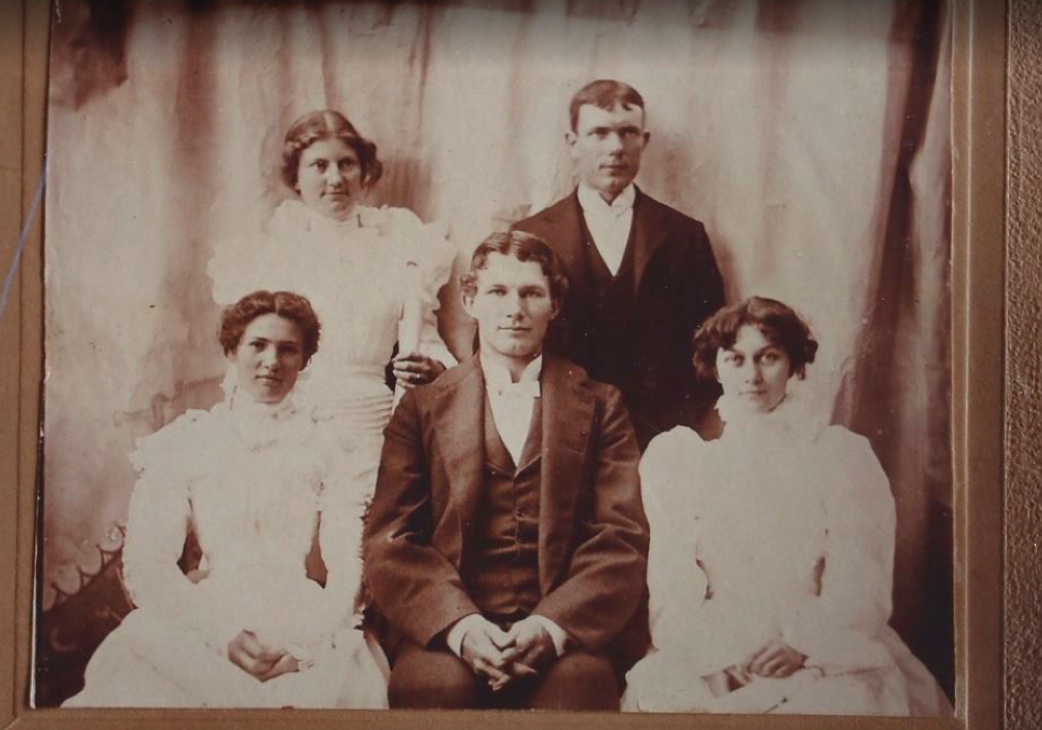
The Hall was also used for high-school graduations. The Hall, according to the Arroyo Grande Herald, “was filled to the point of suffocation” for the graduating class of 1898.All five of them. That’s the Class of ’98 in the photo.

Young Women wore white dresses to their graduations in those days. Fifty years after her graduation from Arroyo Grande Union High School, Ruth Paulding STILL fit into hers.

At the 1898 commencement, graduate Albert Ore delivered what the newspaper characterized as a stirring speech, “Spain and America!” about the then-current war still being played out in Cuba and the Philippines.

Ore gave that speech on June 30, 1898.The next day, Theodore Roosevelt’s Rough Riders, one of them from San Luis Obispo, followed the Buffalo Soldiers in to take the Spanish trenches atop Kettleman Hill in Cuba–misnamed “San Juan Hill.”

Albert Ore must have been thrilled. Look at what his speech did.

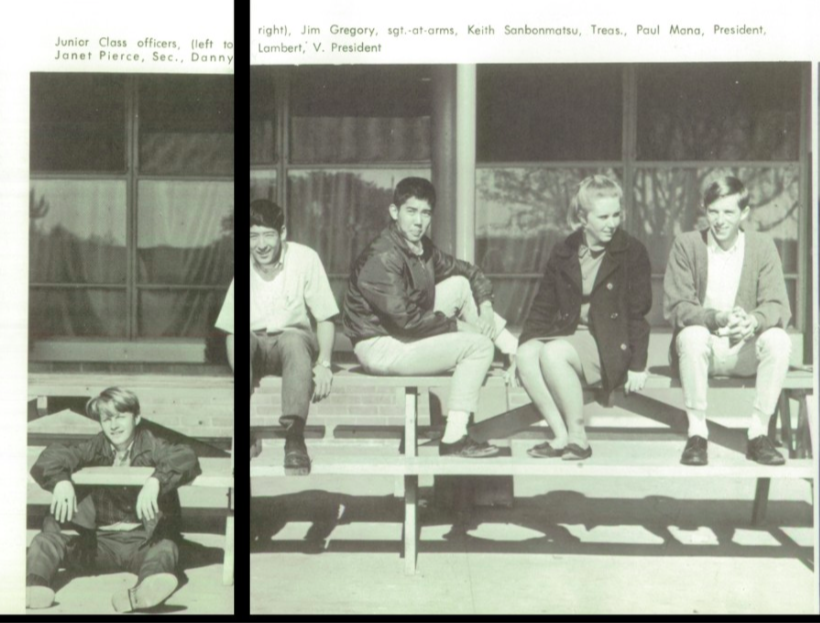
My friend Keith Sanbonmatsu

29 Thursday Jul 2021

Posted by ag1970 in Arroyo Grande, Uncategorized

≈ Leave a comment

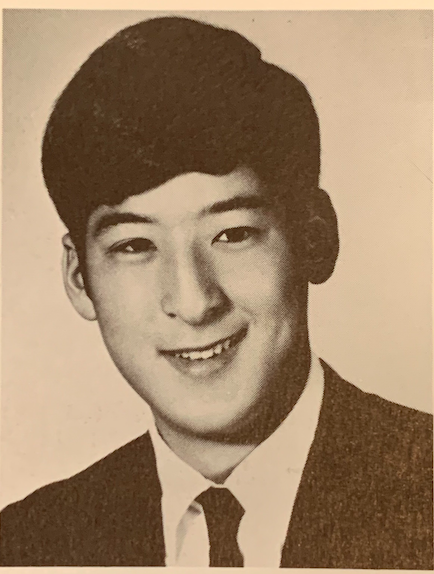
Senior photo, 1970

I didn’t learn until last night that my friend and AGHS classmate Keith Sanbonmatsu, AGHS ’70, has died after a motorcycle accident in  Simi Valley.

I knew it couldn’t have been ‘natural causes.’ Keith was, throughout his life, an incredible athlete—a swimmer in high school, a relentless walker even as he approached seventy.

He was bright, unfailingly positive, with a sense of humor that flew like an arrow toward anything that was absurd or nonsensical.

He also had an integrity that was bedrock to his personality. I think it was Keith and Vard Ikeda we once saw as referees at a third-grade Biddy Basketball game, when one of the kids’ coaches was doing a terrible-tempered Coach Bobby Knight routine, stopping just short of throwing the folding chairs.

The refs called a time-out and had a very, very quiet talk–we couldn’t hear a word–with the offending coach.  He was very, very quiet for the rest of the game.

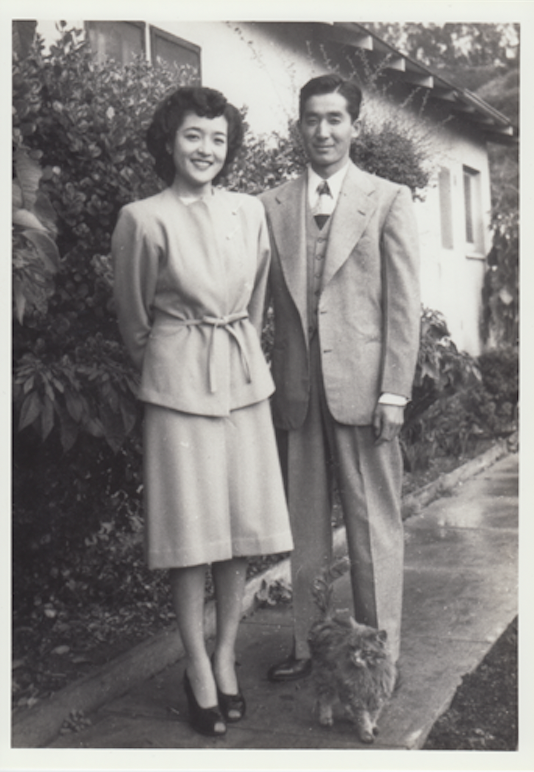
I love this photo. Keith’s parents, Nami Kobara Sanbonmatsu and Mitsuo Sanbonmatsu– and kitty. Mitsuo was a farmer and an artist, a painter.Keith Sanbonmatsu Collection, Cal Poly Re/Collecting Project

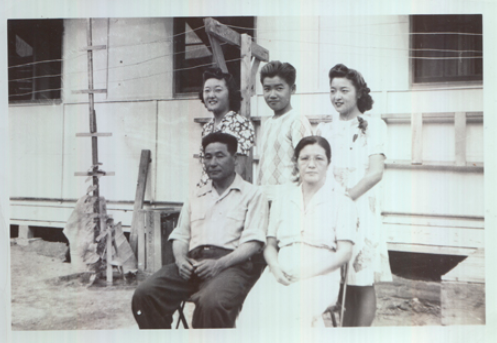
I know that one source of Keith’s integrity and strength of character came from his maternal grandparents, Shig and Kimi Kobara. Like our other Japanese-American neighbors, they were interned, at the Gila River Camp, during World War II. But Shig was such a successful  farmer, and such a natural leader, that the FBI picked him up and took him away only days after Pearl Harbor.

The Kobara family at Gila River…
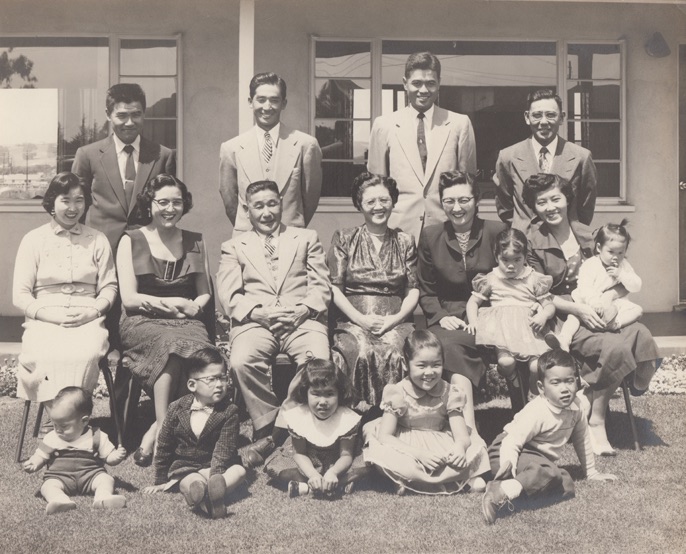
…and in a remarkable contrast–an image that celebrates a marvelous moral victory– The Kobara family a decade later.

Top row (left to right): Ken Kobara, Mitsuo Sanbonmatsu, Towru Kobara, Hilo Fuchiwaki. Middle (left to right): Mari Kobara, Nami Kobara Sanbonmatsu, Shigechika Kobara, Kimi Kobara, Iso Kobara Fuchiwaki, Lori Fuchiwaki, Fumi Kobara, Joan Kobara. Bottom row (left to right): Gary Kobara, Keith Sanbonmatsu, Dona Fuchiwaki, Susan Fuchiwaki, Steve Kobara. Lori Fuchiwaki Collection, Cal Poly Re/Collecting Project

That’s also why the War Relocation Authority, at the end of the war, made sure the Kobaras were the first to come home from Gila River. They had to sleep for several weeks in the interior hall of their home in the Lower Valley. They could hear gunshots in the night. As the other families began to come home, it was Shig and Kimi who gave them shelter until they could re-establish their own homes and farms. This proved to be a necessity because local hotels refused the Japanese-Americans shelter.

But in a story that was repeated over and over again in Arroyo Grande, farmer Joe Silveira looked after the Kobara family’s land and equipment during the war; I think it was Cyril Phelan who stayed from time to time in their home and let it be generally known that he was accompanied by a 30.06 rifle. That discouraged potential vandals.

Keith and his cousin, Dona Fuchiwaki, both related to Shig and Kimi, were an immense help to me in writing the World War II book. And it was Kimi, through an oral history interview, who provided me with this charming story, included in World War II Arroyo Grande, about what was truly a frontier couple:

…Arroyo Grande’s Ella Honeycutt, a longtime conservationist and a gifted agricultural historian, notes that by 1913, when Congress passed the first Alien Land Law, it was too late. Many local immigrant families had already acquired farms.  They tended to concentrate in the Lower Arroyo Grande Valley, where they grew vegetables, especially bush peas and pole peas, and when the latter were hit by disease in the mid 1920s, they began to grow newer crops like celery, lettuce and Chinese cabbage.The newcomers had hunted for legal loopholes and found them: they formed corporations and bought land through them, or through friendly white intermediaries, or they bought land in the names of their American-born children, whose citizenship would be inviolable until Executive Order 9066 proved otherwise. The birth of that new generation of Japanese-Americans—the Nisei—was proof incarnate that the people from Kyushu intended to stay in the Valley and make it their home. This trend was made possible by a single premeditated and humane opening in the anti-Japanese laws. They allowed those men already in American to settle here with their wives, to send home for them, or to send, as if they came from the Sears Catalogue, for “picture brides.”

     This is how Shigechika Kobara, one of the early immigrants to the Valley, and his wife Kimi began their lives together. Their fathers were neighbors in Kagoshima, and after a short negotiation and a longer courtship-by-letter, the match was made. Shigechika took a train north and was waiting on a Seattle dock, looking for his bride among the passengers on her ship as it began to berth. She was looking back.  “I remembered his brother, a naval officer,” Kimi recalled, “and I found a man who resembled him. I thought that this was the man I was about to marry. From the deck I fixed my eyes on him, even though I had never met him. That is why it is called a ‘picture bride.’”

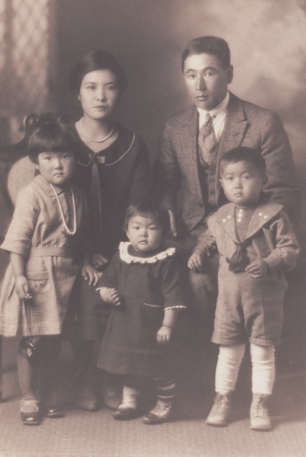
The young Kobara family, about 1930. Keith Sanbonmatsu Collection.

Learning the story of this family has been a grace to my life. I’ve been graced, too, in knowing their grandchildren, my friends and classmates, and in teaching their great-grandchildren in my history classroom. There’s some comfort to be found there when you’ve lost a friend who can’t be replaced.

A Treasure from Arroyo Grande’s past: On the eve of war

28 Wednesday Jul 2021

Posted by ag1970 in Arroyo Grande, Uncategorized

≈ Leave a comment

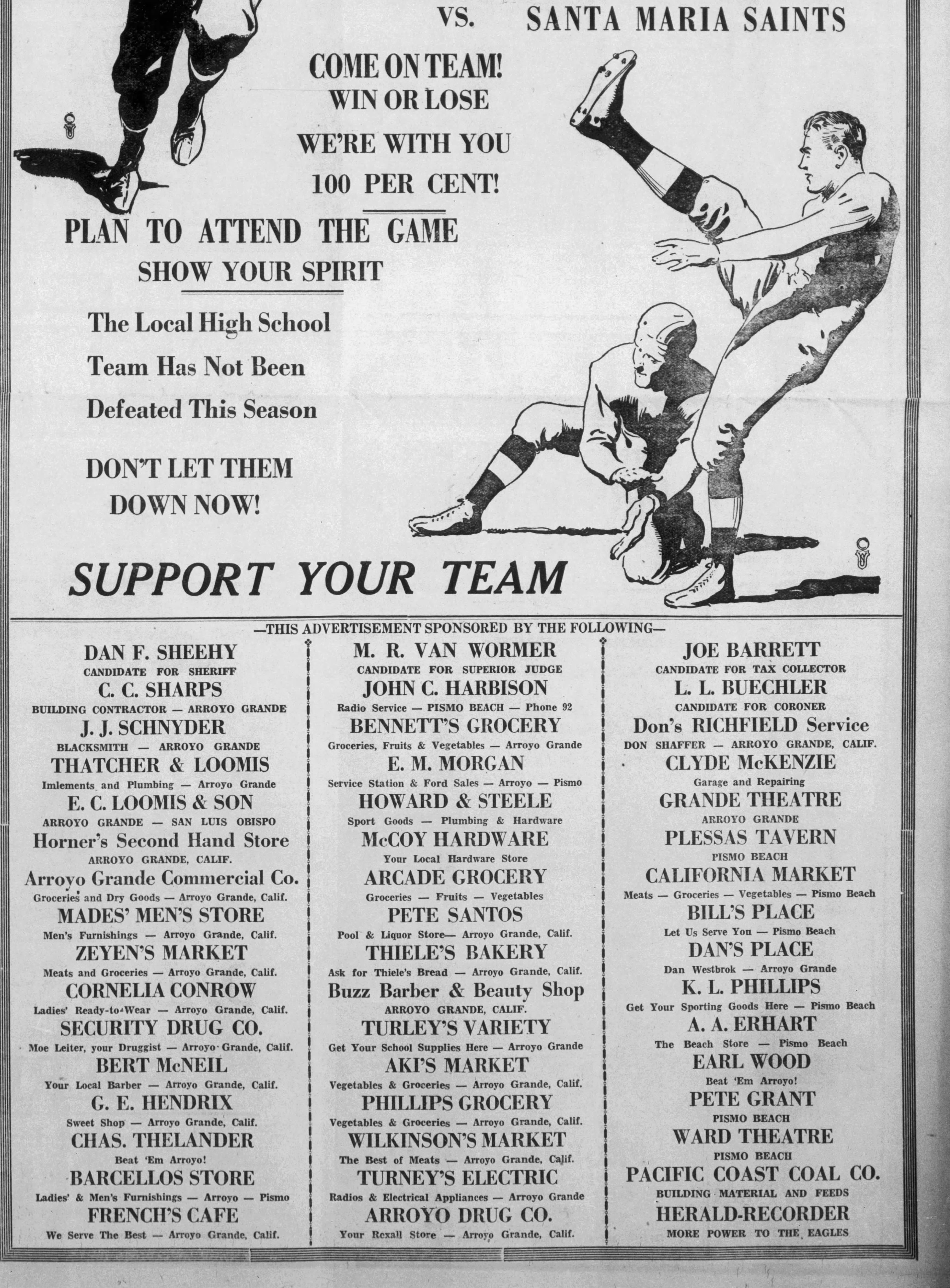
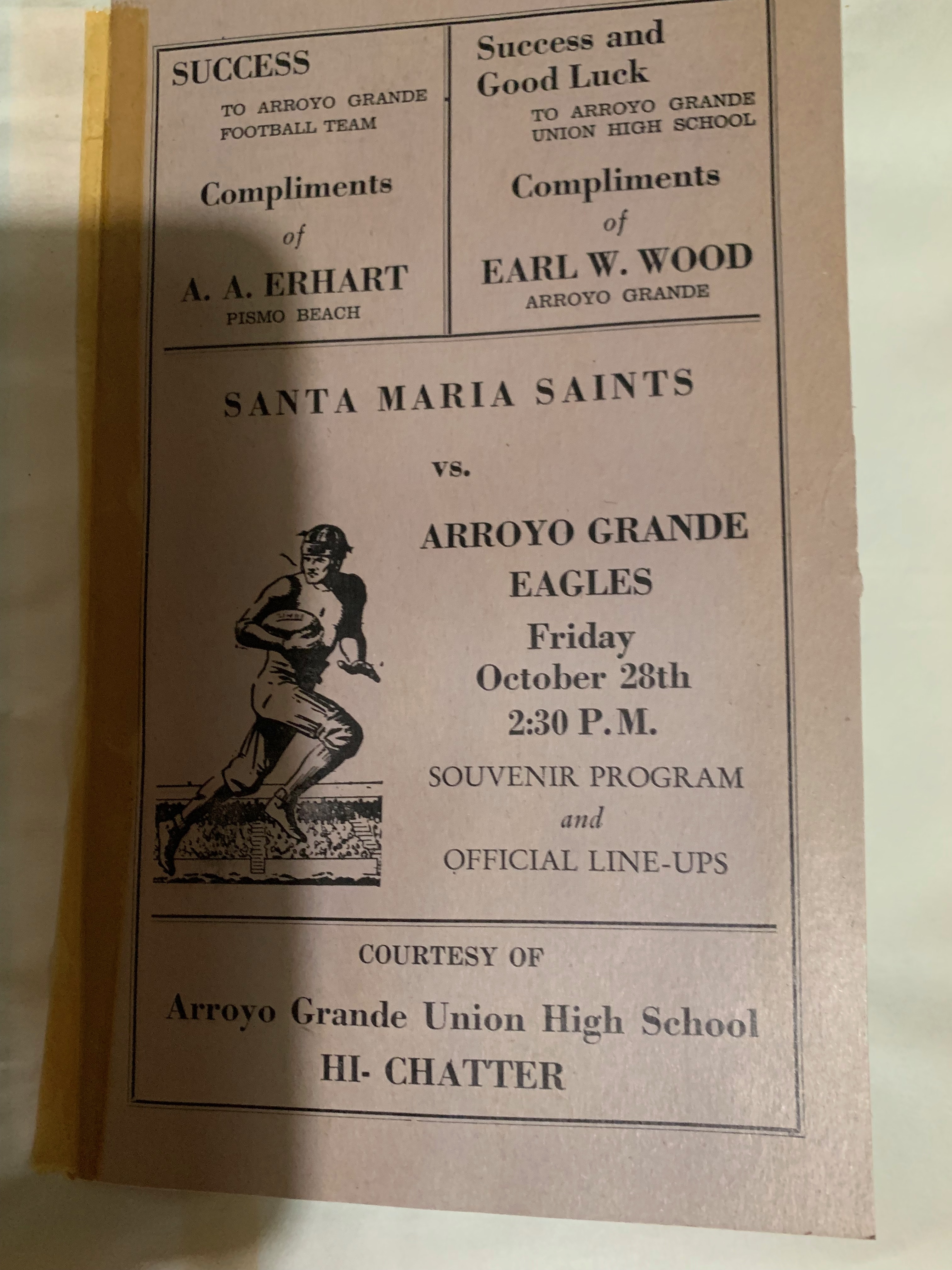
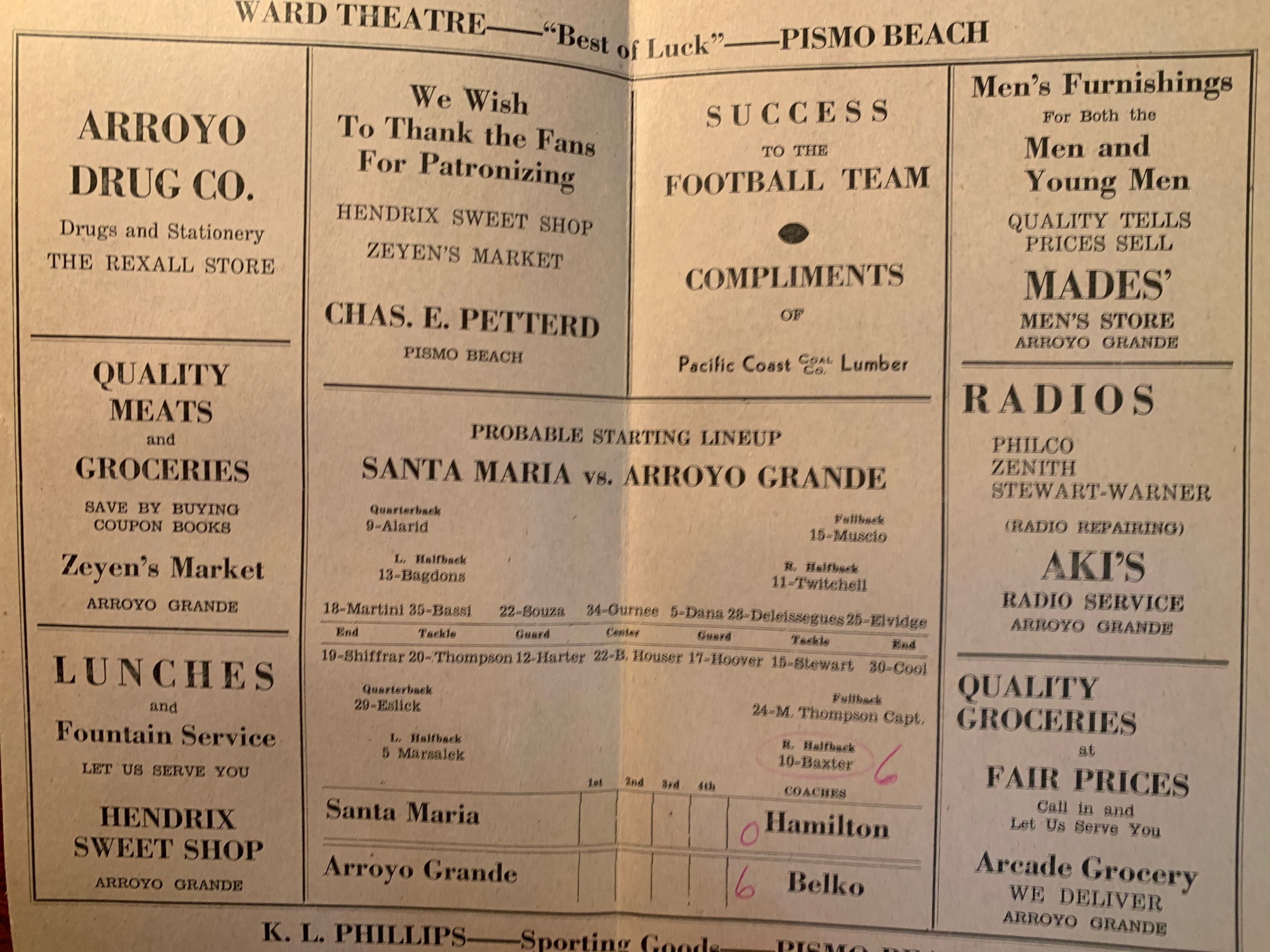
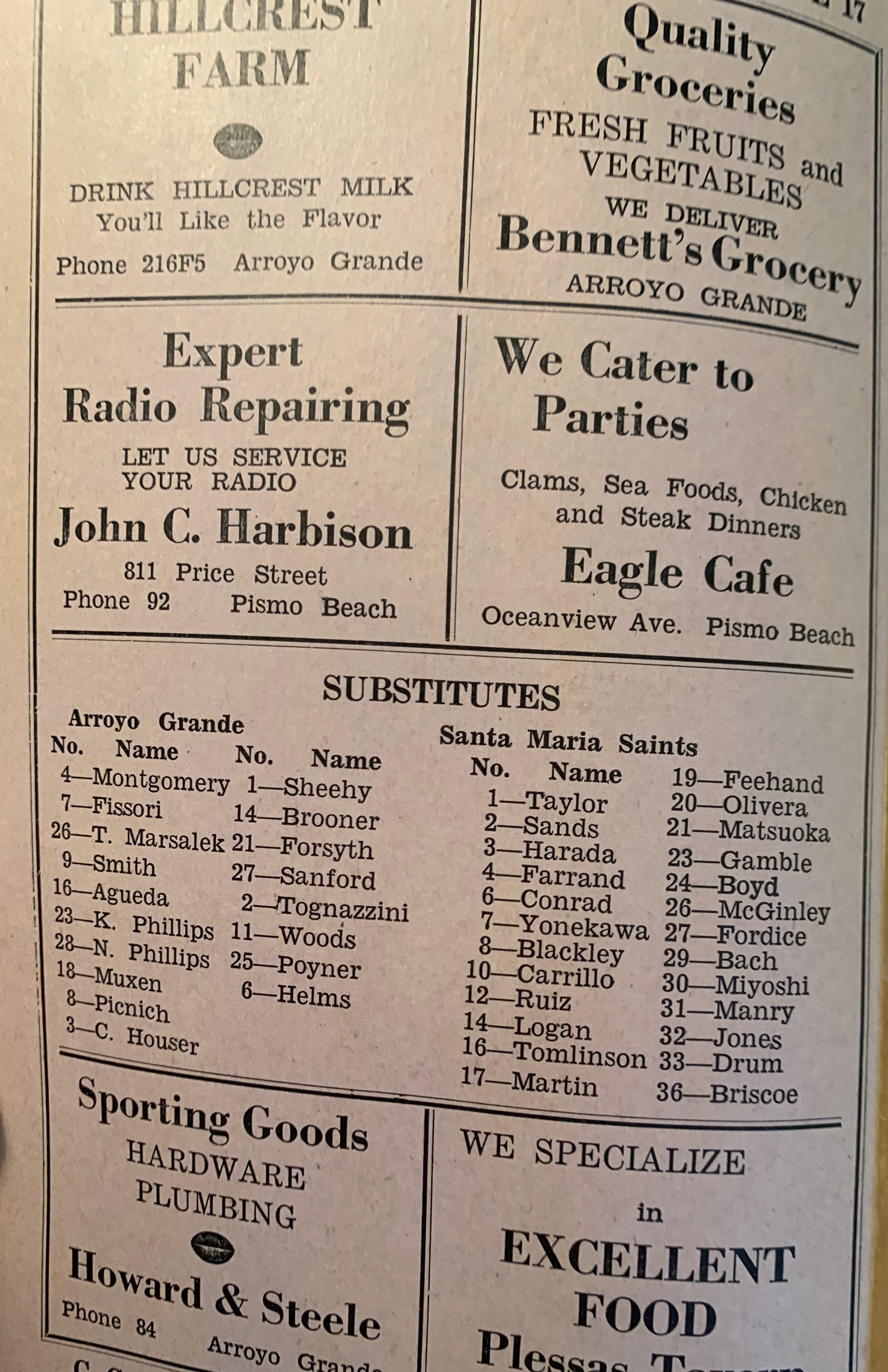
From 1938: A display ad from the Arroyo Grande Valley Herald-Recorder; below, the program for the game:

This is like a Rosetta Stone for local historians. To put this in context, 1938 was the year of the first Harvest Festival, indicative that the area was beginning to recover from the hit it had taken during the Great Depression, when San Luis Obispo County crop prices were halved between 1929 and 1933. And it’s in a kind of place of innocence, three years away from World War II, which will sweep up the little town, population 1,090 in the 1940 census.

A few examples among the advertisers in the newspaper ad, and this is just scratching the surface:

“J.J. Schnyder” was the kindly blacksmith who’d interrupt almost any paying job to fix a kid’s soapbox racer; he was responsible for funding the first swimming pool at Arroyo Grande High School because he wanted kids to have a place to play. When the Kobara family’s irrigation pump broke down in 1945, after their return from internment, Schyder insisted on fixing it immediately. It was Christmas Day.

“E.C. Loomis and Son:” The family would safeguard the land and equipment of their Japanese-American neighbors during the war; one son, Vard, had coached the Nisei Arroyo Grande Growers, a powerhouse baseball team, before the war. His catcher was Kaz Ikeda, whose image is included in the mural on the Mason Bar wall, and Kaz named one son “Vard.” E.C.’s grandson, John, was a Marine who fought at Pelileu and Okinawa who maintained a lifelong friendship with the other three of a kind of “Four Musketeers:” Don Gullickson, Gordon Bennett, and Haruo Hayashi.

“Horner’s Second Hand Store:” Ed Horner, an Eighth Air Force officer, had his B-17 shot down in 1944 and would be a POW until war’s end.

“Commercial Company:” This general-goods store stood on the site of today’s Mason Bar; it was later a grocery in the same building Mason Bar occupies. One of the owner’s sons, Elliott Whitlock, AGUHS ’40, won a Distinguished Flying Cross for bringing his B-17 safely home after it’d been set afire by flak over Berlin in March 1944.

“French’s Cafe:” On April 30, 1942, French’s prepared over 200 box lunches for local Japanese-Americans on the day buses took them to the Tulare Assembly Center. Only about half of our prewar neighbors would come back after the war.

“Bennett’s Grocery” (today, the Chic Salon): Two of Rusty and Muriel Bennett’s sons would serve–Jerry in the Army Air Forces, Gordon in the Navy.

“E.M. Morgan:” His Ford agency occupied today’s Doc Burnstein’s. Morgan’s son, Wayne, was killed December 7 on USS Arizona, along with his second-grade classmate, Navy bandsman Jack Scruggs.

“Aki’s Market,” next to the meat market, was owned by Akira Saruwatari, a member of perhaps the first Japanese immigrant family to settle in the Arroyo Grande Valley; they farmed land across from the Halcyon Store. He was interned at Gila River and would live his postwar life in Santa Barbara.

“Wilkinson’s Market:” Today’s meat market. When his Japanese customers came in to pay their bills just before internment, Leo Wilkinson would’t take their money. “You keep it; you’re going to need it,” he told them. This act of generosity was repaid, in full, after the war.

“Grande Theater,” in the building that today houses Posies in the Village, would’ve been where many local people, through newsreels, kept up with the war news. (A short distance up Branch was the Security Drug Company, today’s Village Grill, where moviegoers could order a milkshake or ice cream sundae after the movies.)

Earl Wood was the funeral director who would supervise the homecomings of many South County servicemen killed in Europe or the Pacific in the years after the war had ended; Louis Brown, for example, killed on Iwo Jima, came home in 1948.

In the program, the Arroyo Grande coach, Max Belko, was once a USC All-American. He kicked a field goal against Montana in 1935, a feat that wouldn’t be repeated for fifteen years, when Frank Gifford kicked the next Southern Cal field goal. Belko, a Marine lieutenant, was killed on Guam in 1944, but we still have a connection to him: He was Haruo Hayashi’s P.E. teacher. (There are many familiar surnames in the football program, but two, both Navy men during the war, offer a glimpse into postwar Arroyo Grande: Tony Marsalek was our longtime fire chief; Chuck Brooner was the pharmacist/owner of the Fair Oaka Pharmacy.)

The sports editor of the high school newspaper, the “Hi-Chatter,” was George Nakamura. As a twenty-year-old intelligence officer in China, he was awarded a Bronze Star for going behind Japanese lines to rescue a downed American flier and, after the war, a Congressional Gold Medal in recognition for his efforts, as an international businessman, to nurture the relationship between Japan and the United States.


Going to the Movies

24 Saturday Jul 2021

Posted by ag1970 in Arroyo Grande, Film and Popular Culture, Uncategorized

≈ Leave a comment

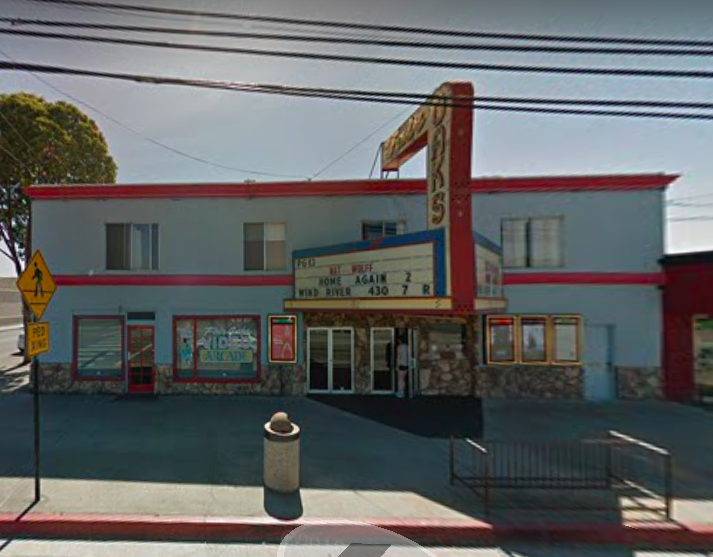
The Fair Oaks Theater, Grand Ave., Arroyo Grande

My wife, Elizabeth and I had a post-quarantine movie date to see In the Heights at the Fair Oaks Theater. It was delightful and it was wonderful to see it at the Fair Oaks.

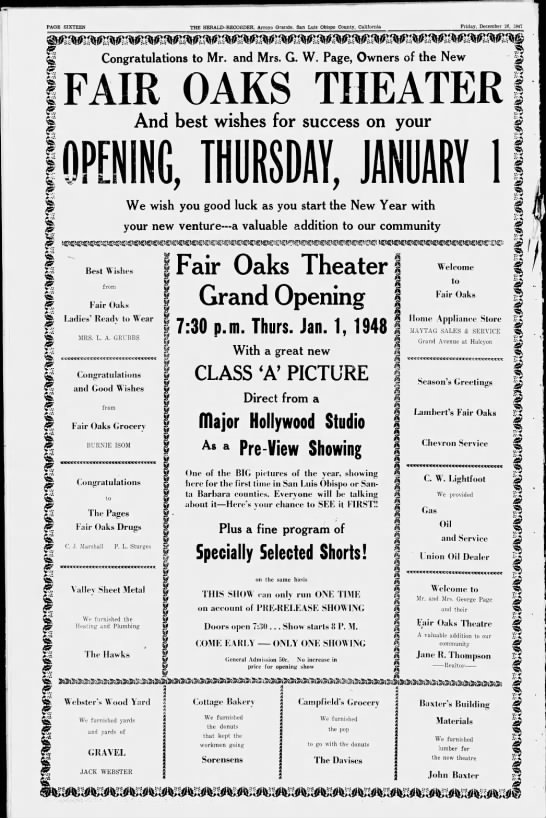
The theater opened in 1948 and by 1955, when my family moved from Taft to Arroyo Grande—the brick barbecue my father built still stands in the back yard of our old Sunset Drive home—it was kind of the center of a community that was growing rapidly.

Fair Oaks already had its own market—the building at the corner of Halcyon and Grand that includes a computer repair shop and a bookstore was the Fair Oaks Grocery, opened in 1939—and would, after the war,  add the Fair Oaks Pharmacy, across the street at the other corner of Halcyon and Grand. I remember, vaguely, Mr. Chuck Brooner coming in to fill an after-hours prescription when I was pretty sick.

There was a big hardware store just across Alder from the theater, whose ground floor also included an appliance store.  In 1955, Burkhardt’s Shoes, at 951 Grand Avenue, had its grand opening. Mr. Burkhardt was skinny as a whippet and was marked, as was Mr. Brooner, by his kindness: he treated my mother like royalty and was easy with kids who came in for their back-to-school Hush Puppies or Keds.

These places had a growing market because Arroyo Grande’s population more than tripled between 1940 and 1970—from 1,090 to 3,291—and an anecdotal study of new home purchases in the Arroyo Grande Herald-Recorder reveals that many of the new arrivals were, like us, refugees from the San Joaquin Valley.

Dad was a consultant to the founders of Mid-State Bank and got a job as comptroller for Madonna Construction, and, like many others of his generation, bought his home with a V.A. loan and, like many others, wanted a home near a school.

Arroyo Grande obliged with the September 1955 opening of Margaret Harloe Elementary, where my big sister finished her elementary education and my big brother began his. Harloe was one important anchor for Fair Oaks. The theater was the other.

The Grand Opening, 1948


We did not hit it off, the Fair Oaks and I. The first two films I saw there were deMille’s later Ten Commandments—I was distraught when Charlton Heston closed the Red Sea and the Egyptian charioteers’ horses drowned—and John Ford’s The Searchers, in the scene that traumatized me happened in the gathering dusk, when the Texas sodbuster family can hear the Comanche raiding party but can’t see them. It’s since become one of my favorite films, but it wasn’t then, not in 1956.

Forty years before, films were just as important a part of Arroyo Grande life as they were when the Fair Oaks was built. Silent films were screened Saturdays at Tanner’s Dance Hall, on the site where City Hall now stands, and young people were crazy about the movies.  I learned this from Jan Scott’s wonderful Readers’ Theater play, “Letters From Home: Keeping Him Close,” which told, through their letters, the story of an Arroyo Grande soldier and his family in the closing months of World War I.

The letters included the impact of the 1918 influenza epidemic and its closure of churches, schools and theaters, and the doughboy’s little sister was desperate to see the movies open again. The high school, maybe not so much.

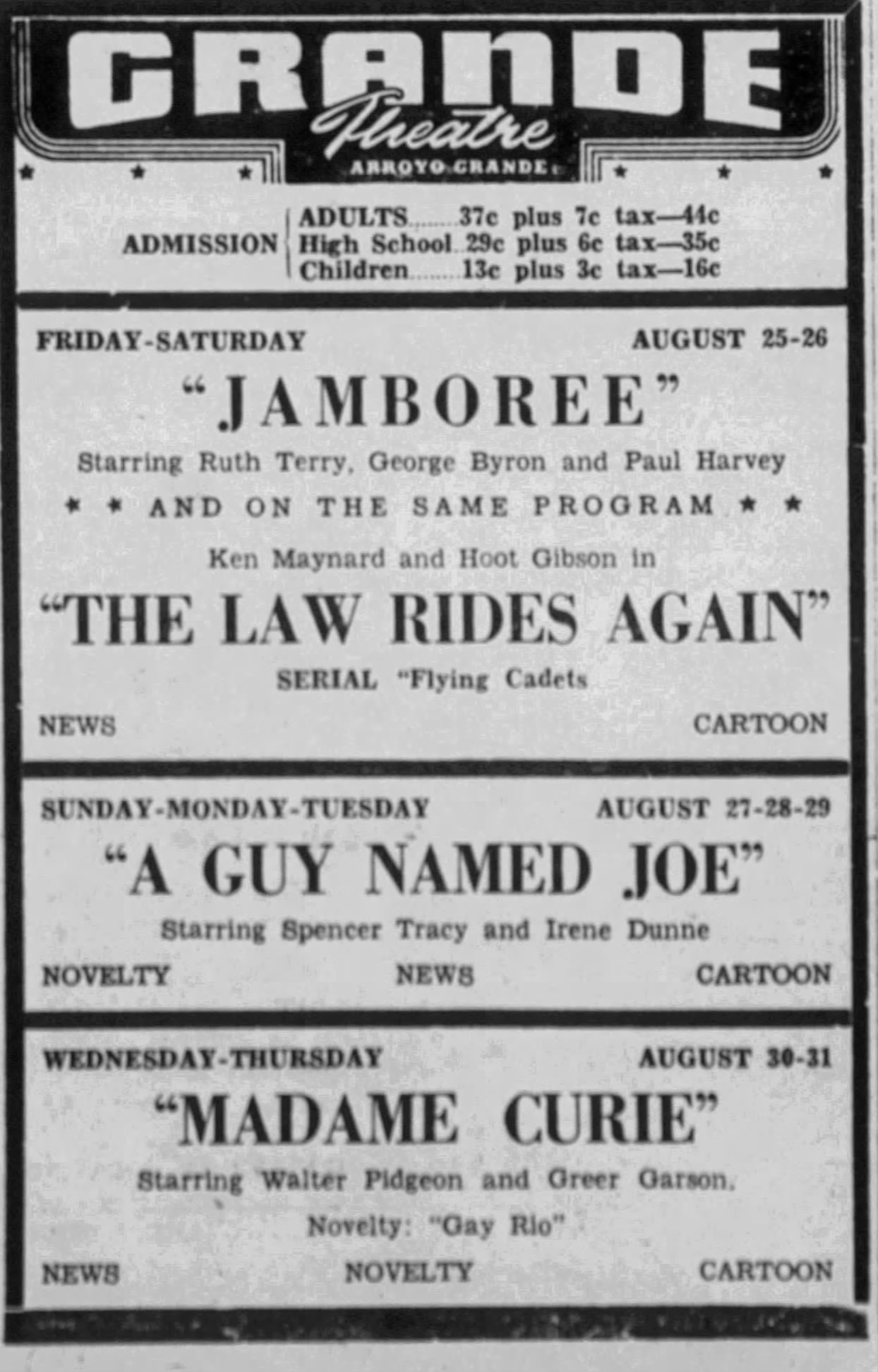
By 1930, the Mission Theater—later the Grande—was boasting talking pictures in its ads. The newer theater—which also sometimes hosted high school commencements (including Stanford-bound Vard Loomis’s),  as Tanner’s Hall had once, for the five seniors of the Class of 1898—was housed in the Branch Street commercial building that now includes Posies in the Village.

Jean Wilkinson Frederick’s father owned the meat market on Branch that’s been a meat market since 1897. (Her classmates at the high school, fellow members of the Stamp Collecting Club, included the inseparable Haruo Hayashi, John Loomis, Gordon Bennett and Don Gullickson.)

Jeanne told me a  few  years ago that she loved the movies at the Grande. Her favorites were the Western serials, and her favorite cowboy was, of course, Gene Autry. It helped that Gene often sang to his horse, Champion, a beautiful sorrel with a blond mane that would’ve been every girl’s dream horse.

August 1944


The Grande was ideal, too, for high school dates, because just down the street, in today’s Village Grill, was the Economy Drug Company, which featured Arroyo Grande’s soda fountain. Soda fountains were vital to Mickey Rooney and Judy Garland and seemingly, to most young couples in the 1930s and 1940s. My mother was a soda jerk in Taft in 1939 when Dad came in for an ice cream sundae. They were married in 1940.

I would survive the first two films I saw with my parents at the Fair Oaks and would see films my Mom loved (Lilies in the Field), films my big sister loved (Tammy and the Bachelor) and films that were more to the taste of my big brother and me (20,000 Leagues Under the Sea and Kirk Douglas’s epic battle with the giant squid.)

Since the mid 1960s, the Rodkey family have run what is truly is a neighborhood theater with all the elements I require in a theater: it’s clean, with comfortable seats and refillable popcorn. My family missed it when it was closed.

It’s like so many other places in Arroyo Grande I’ve found in growing up here: even when you leave your house you can find a place that’s home.

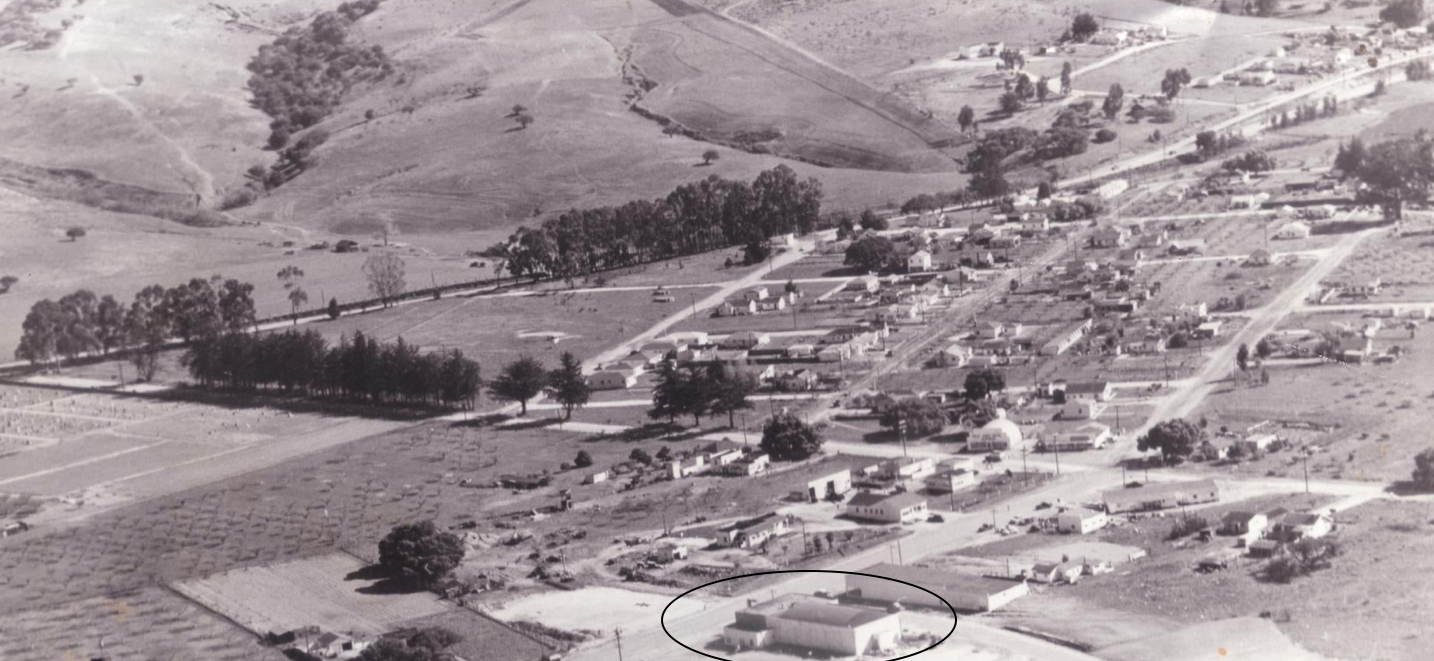
Fair Oaks in 1949. The theater is circled; the corner market is just above and to the right; the Arroyo Grande District Cemetery is to the left.


Basset hounds and world peace

08 Thursday Jul 2021

Posted by ag1970 in Arroyo Grande, Uncategorized

≈ Leave a comment

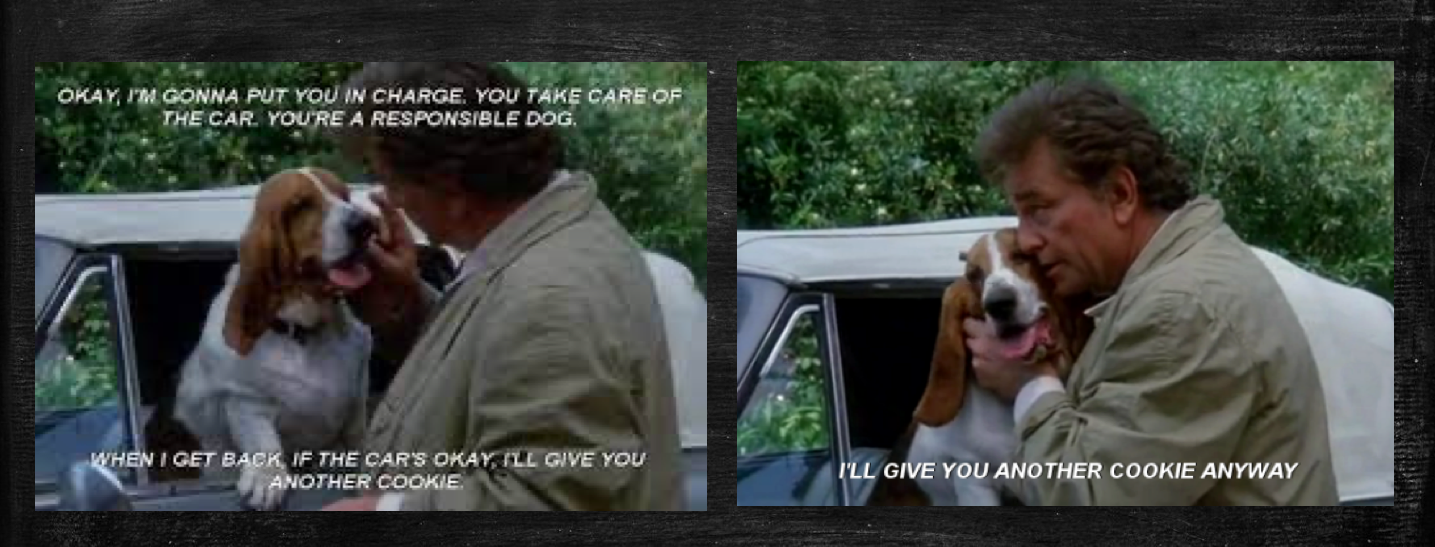
Peter Falk, as Det. Columbo, demonstrates a trait common to Basset hound humans: their liberality with cookies.

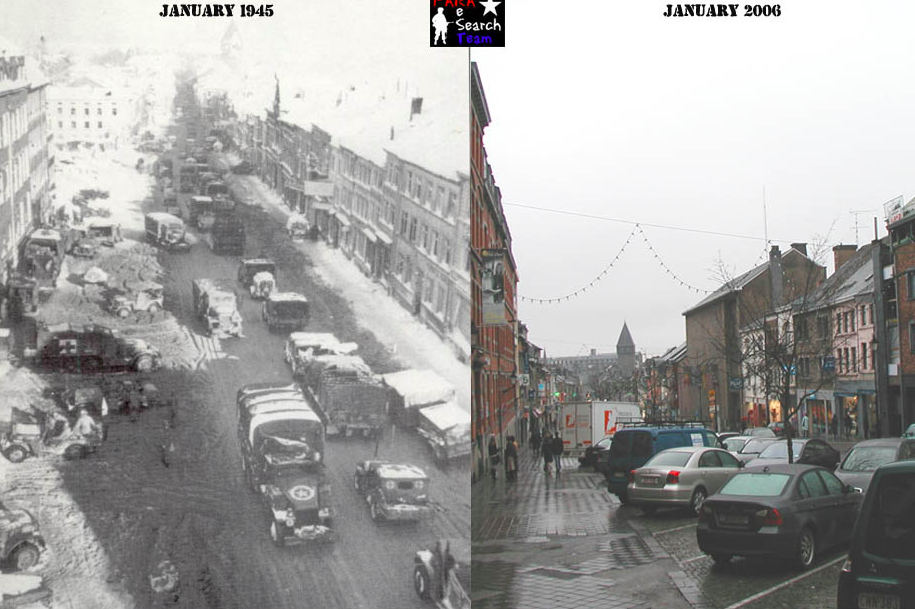
I taught European history for many years at Arroyo Grande High School and so wound up leading summer trips for students so they could see some of the places we’d studied. The 2010 trip focused on Western Europe in World War II and during one of the stops we found ourselves in Bastogne, Belgium.

Bastogne, of course, won fame in the winter of 1944-45 when the town and the woods around it were occupied by the American 101st Airborne. Although surrounded completely by the Wehrmacht, the German army, the airborne troops refused to surrender. They were downright rude about it. “Nuts!” the airborne artillery officer in charge, Anthony McAuliffe, told the German delegation that offered humane surrender terms.

What does that mean? The German delegation asked.

It means “go to hell,” they were told.

That’s the sanitized version. I imagine the reply was closer to something the Wehrmacht could do to itself were it not anatomically and militarily impossible.

Bastogne, then and now.

The 101st held on until they were relived–one of them, Art Youman, a member of the 506th Parachute Infantry’s famed Easy Company, was from Arroyo Grande. In holding on, during the coldest winter in Europe in thirty years, the paratroopers ruined the German timetable for their offensive, and the timetable was precious to the offensive’s success. The 101st’s stubbornness helped defeat the Germans, rich in steel but oil-poor, in what came to be called the Battle of the Bulge because they simply ran out of the fuel they needed to drive their panzers— their tanks and trucks and their mobile artillery.

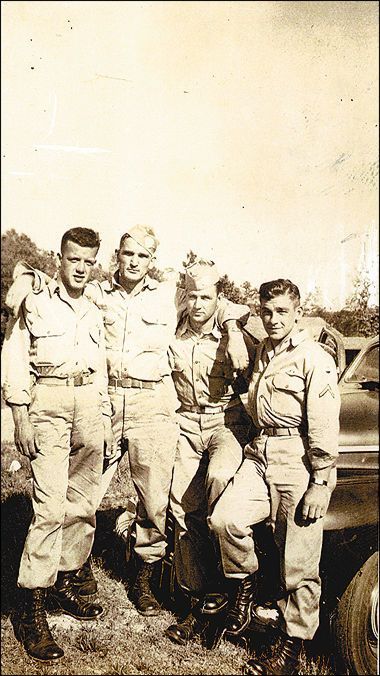
Art Youman, second from left, during jump training in South Carolina. Easy Company occupied Bastogne on his 23rd birthday; by then he’d been promoted to sergeant by Easy Company’s C.O., Richard Winters.
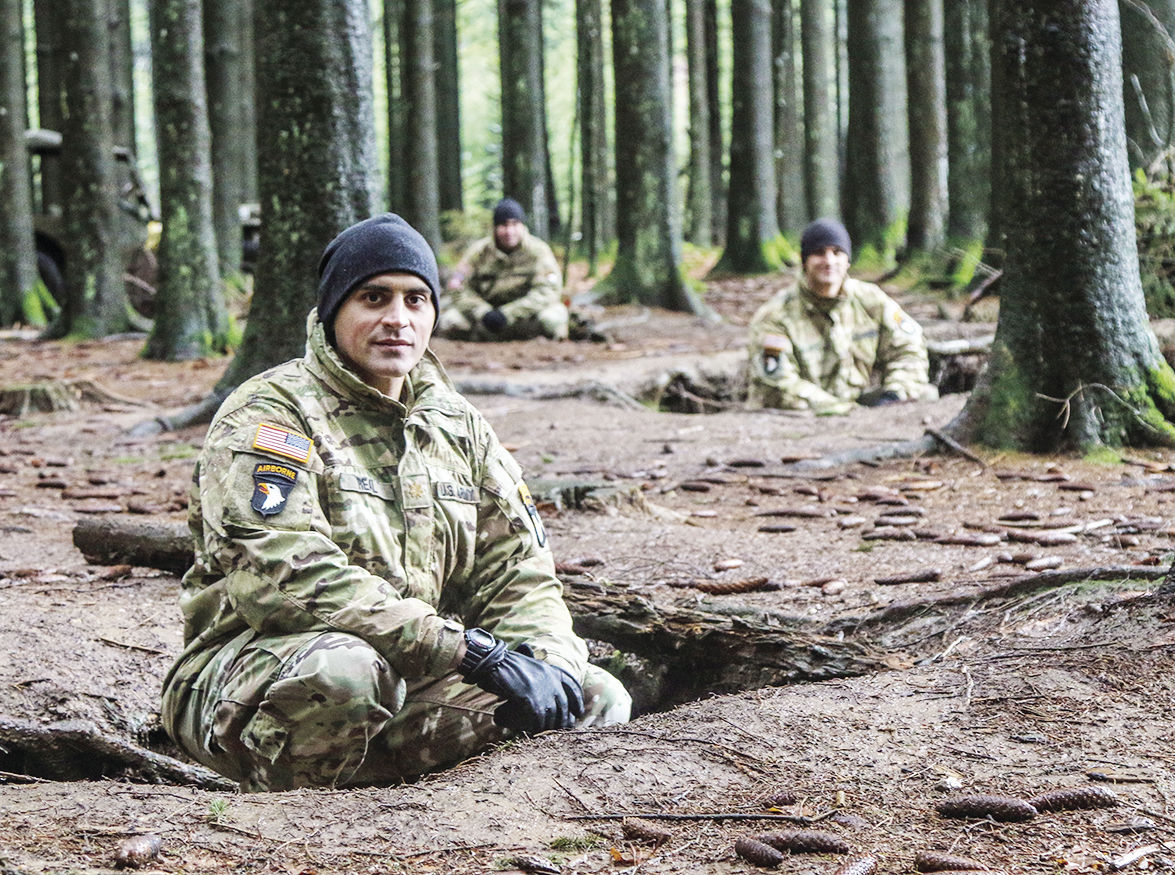
In 2019, 101st Airborne paratroopers posed in these foxholes, near Bastogne, that their comrades had dug in 1944-45.

None of that history mattered to the Bastogne lady giving our tour group the stinky eye in the creperie the day of our visit. All that Belgian-American amity built up during and since the war had dissipated in her eyes. Not only were we Americans–we laughed too loudly, chewed gum, were innocent of all languages other than a strange Southern California variant of Standard English, and we were (horrors!) a bunch of teenagers.

Despite the daggers the lady cast our way, I spotted one redeeming feature: in her lap was a small dog, secured by a chain leash. On my cell phone, I had a photograph of our Basset, Wilson, who passed away at thirteen earlier this year. “Wilson,” our neighbor said, “was a dog for the Ages.” Our neighbor was right.

Our best friend, Wilson.

This is why: I walked over to the lady and showed her the picture of Wilson. She grew so excited that she dropped her small dog.

“COLUMBO!” she shouted with delight. I could hear her dog’s nails askitter on the tile floor.

Her husband just then came out of the restroom. She gestured toward me—her little dog went with her, like laundry fluttering on a clothesline–and my cell phone. The husband looked.

And shouted “COLUMBO!” with delight.

We were all friends after that.

I have been convinced ever since of the singular ability that Basset hounds have to bring harmony to a disordered world. They should be the Official Dog of the United Nations.

Of course, the syndication of old Universal Studios detective shows played a part, as well. Despite your characteristically rumpled appearance, Lieutenant Columbo, I offer you a snappy 101st Airborne salute, sir.
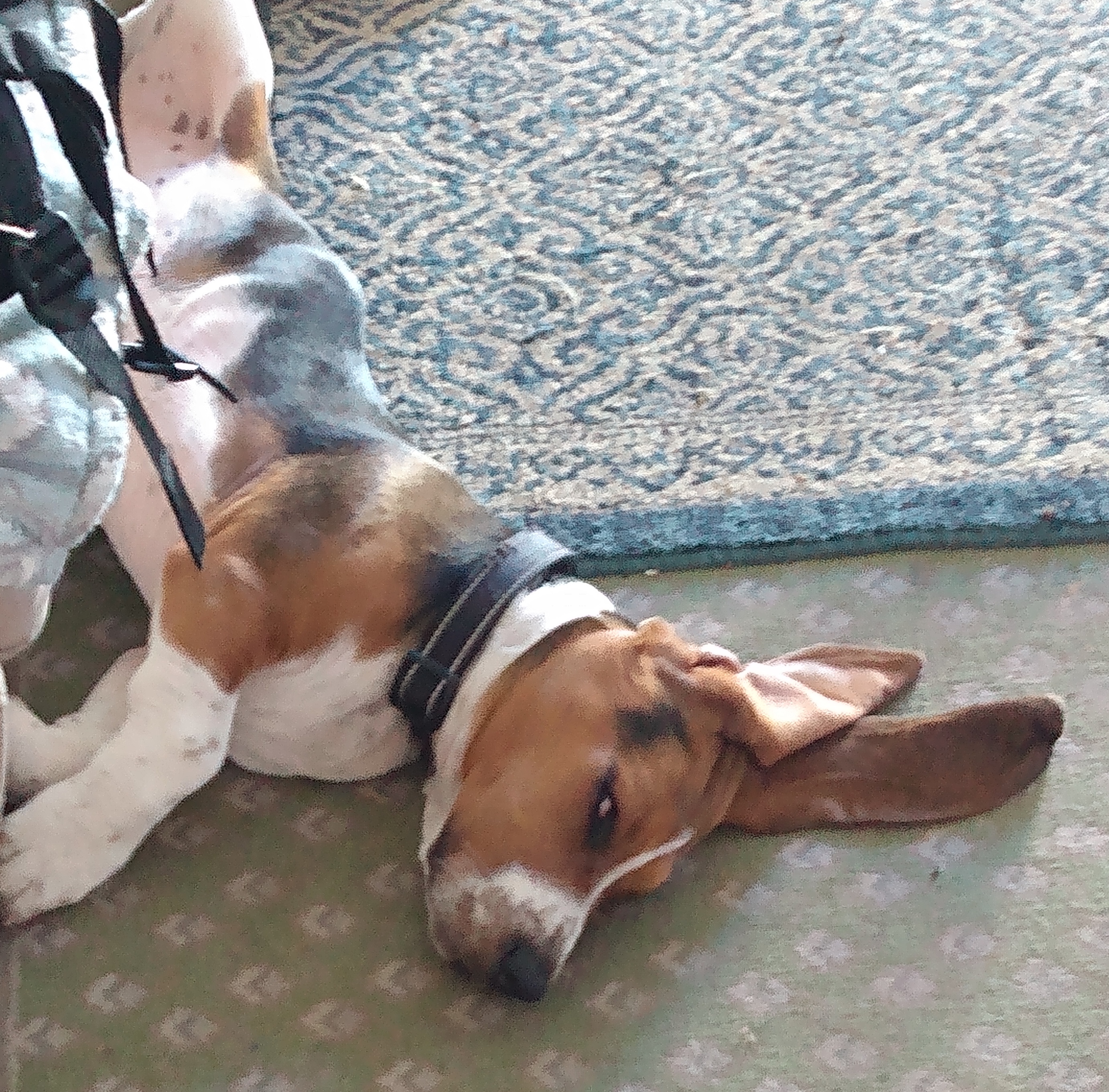
And I offer for your viewing enjoyment another Basset hound photo. That’s Walter. We adopted him in March and drove so far south to meet him—way, way past San Diego—that his vaccination papers were in Spanish.

Wilson, Walter. What was the name of Columbo’s dog? I had to look it up: It was “Dog.” He was a dog for the ages, too.

Our Basset puppy, Walter, has stolen our hearts.

A Place in County Clare

10 Thursday Jun 2021

Posted by ag1970 in Arroyo Grande, History, Personal memoirs, Teaching, Uncategorized

≈ 2 Comments


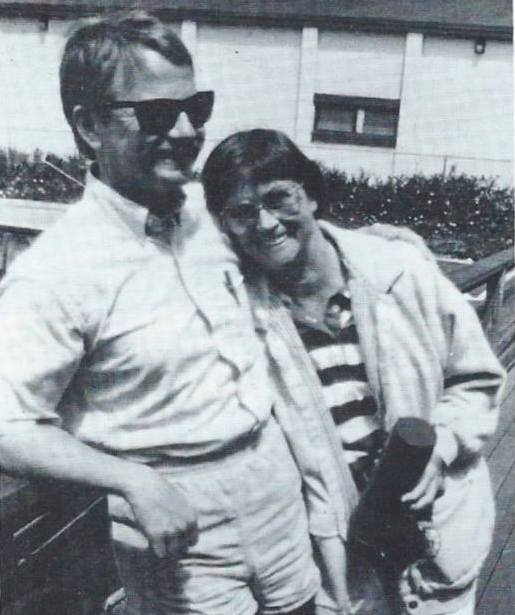
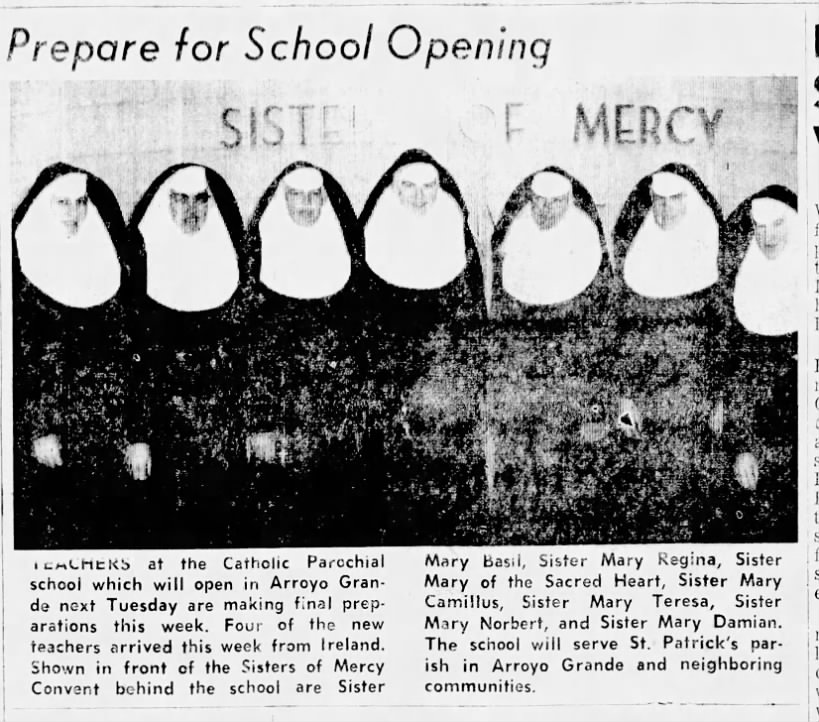
Our dear friend Sister Teresa O’Connell died in May at 90. She taught at St. Patrick’s in Arroyo Grande and Elizabeth and I taught with her at Mission in the 1980s and 1990s. Here’s the two of us back then:

As a member of the Sisters of Mercy, Teresa spent most of her life teaching young people. But when she returned to Ireland, she found a new calling in ministry to the elderly. Hers was such a rich life.

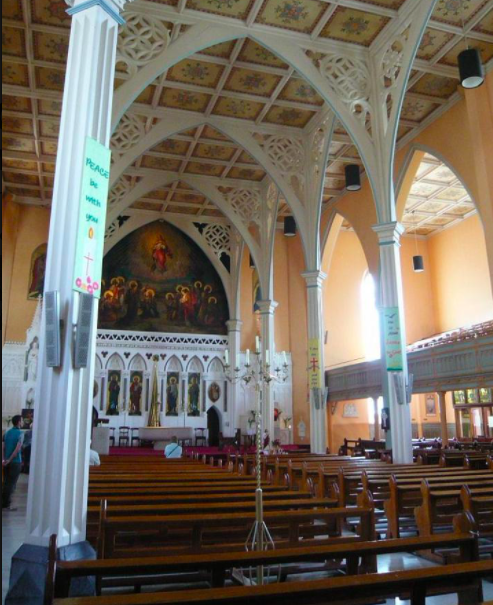
Elizabeth and I “attended” her funeral at the Ennis Cathedral–it was four a.m. our time–thanks to the internet. It was a six-priest funeral Mass with a couple of Monsignors included. Behind the altar, It was like the Irish Catholic equivalent of the 1927 New York Yankees.

It was the least they could do for her.


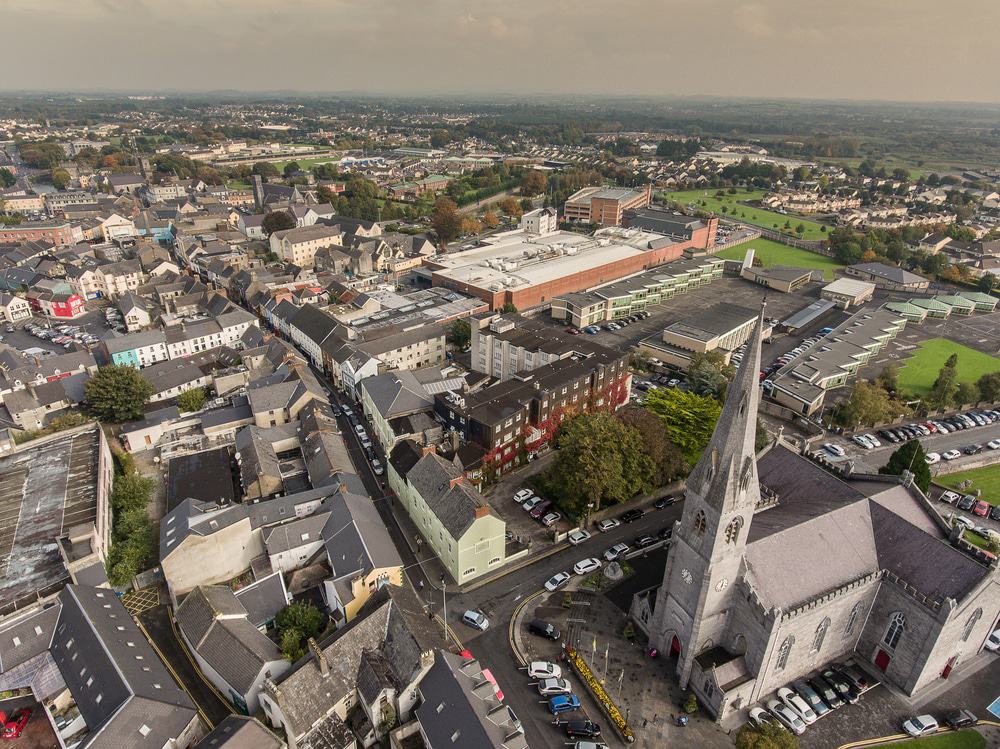
Here are two views of the church.

I made the mistake of starting to do some research on Ennis, because in thinking of Irish history as a road, every few miles you are confronted with a sad detour. The cathedral was built in 1828, which in itself is significant, because the Penal Laws enacted at the end of the 17th Century–that would’ve been when Great Britain, after the insolent Popery of King James II, was once again securely and relentlessly Protestant under William and Mary–forbade the building of new Catholic churches in Irish cities. The ban, then, lasted until the English were long past the Stuarts and running toward the end of their Hanoverians.


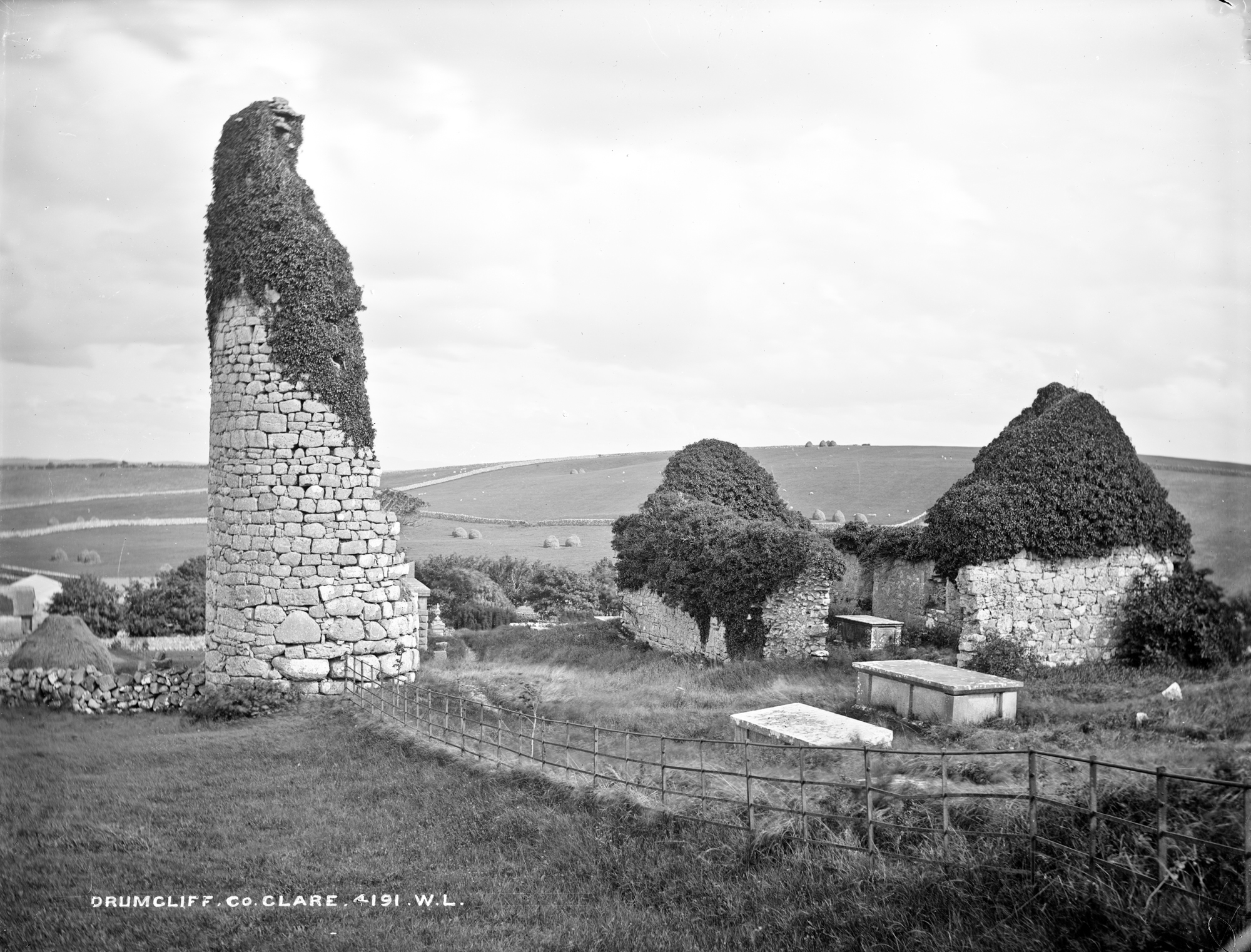
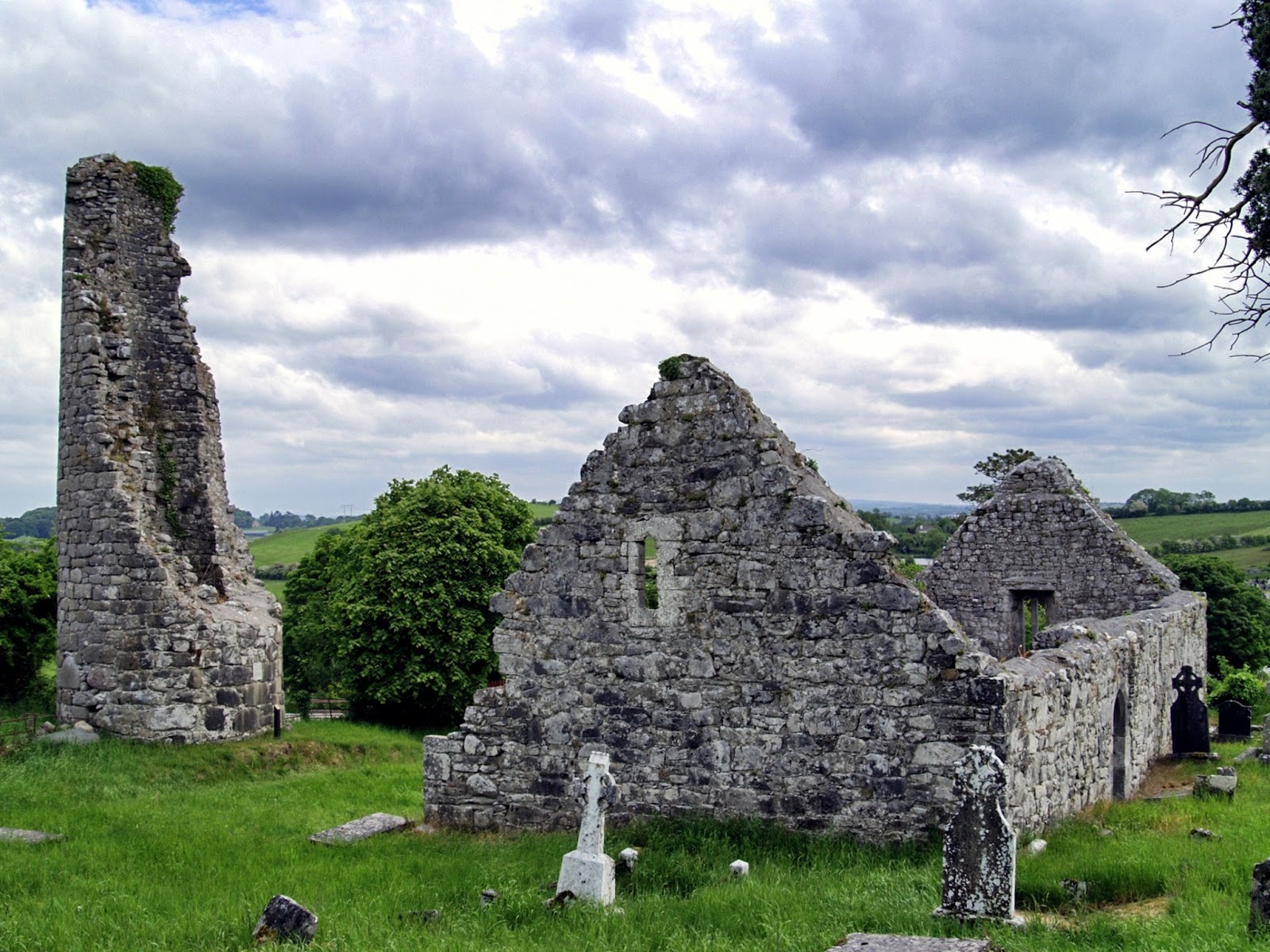
I looked up the cemetery where Sister is buried. It’s Drumcliff, Ennis, County Clare. It’s rich in Irish history, too.


This photo shows the tower and ruined abbey church at Drumcliff. The cemetery adjoins the ruins, on a steep hill that one guide says is windy but strangely serene. Another guide says this: “The existing church ruins are from the 15th century with bits of 10th and 12th century architecture incorporated into it, suggesting it was built on the site of at least one earlier church.”

The earlier church may have been founded by St. Conall. He lived in the 7th century.

When you grow up in a place whose oldest landmark dates to 1772, your history is an eyeblink next to Ireland’s.


The cemetery itself represents one of those sad detours in that history. From a County Clare genealogical website:

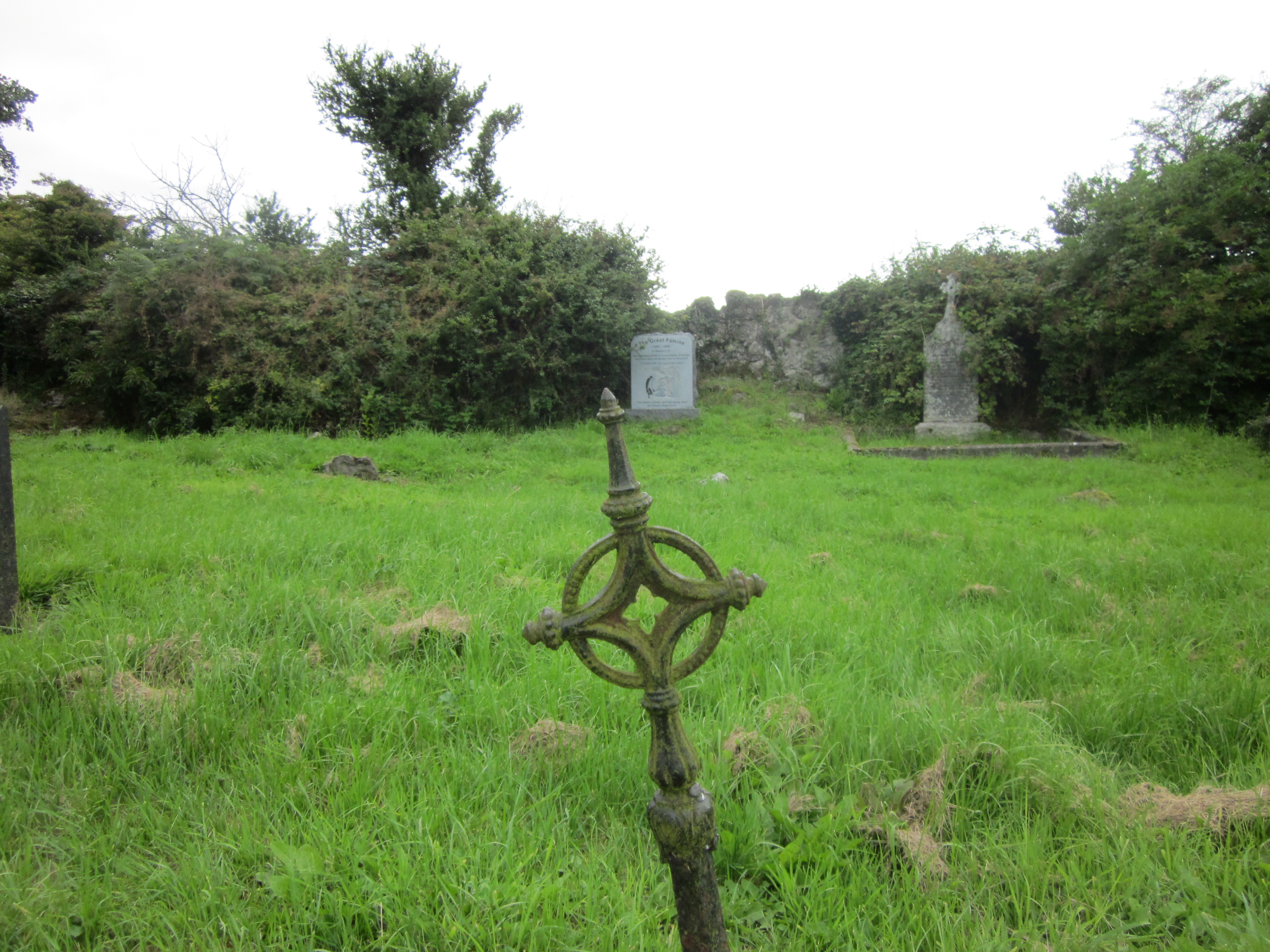
It is impossible even to guess how many persons are buried at Drumcliffe [sic]: so many graves were never marked at all, countless others have no inscriptions, and the multitudes who lie in the cholera grave, the Famine grave pit beside it and the pauper plot closer to the road, will never be identified by the names they bore in life.

Cholera was a terrible killer in the first half of the nineteenth century; it killed Londoners in their thousands, as well as the Irish, until Joseph Bazalgette designed and built a network of intercepting sewers that carried the Thames River’s sewage out to sea.

Ireland, of course, was far behind in engineering projects as grand as this one.

“The Famine grave pit” is mentioned in passing. Perhaps many of those people were on their way out of Ireland. We once saw a massive green in Galway, one of the Famine ports of exit, also in the west, beneath which thousands of destitute Famine victims are buried. They’d almost made it. It’s probable that the people buried in Drumcliff, like those in Galway, died, enfeebled by starvation, of opportunistic diseases like typhus.

At least the paupers are symbolically remembered. Many of them ended their lives in a nearby workhouse. Here is their monument:

Pauper’s Memorial, Drumcliff


The Famine Grave


It’s a windy but strangely serene place.


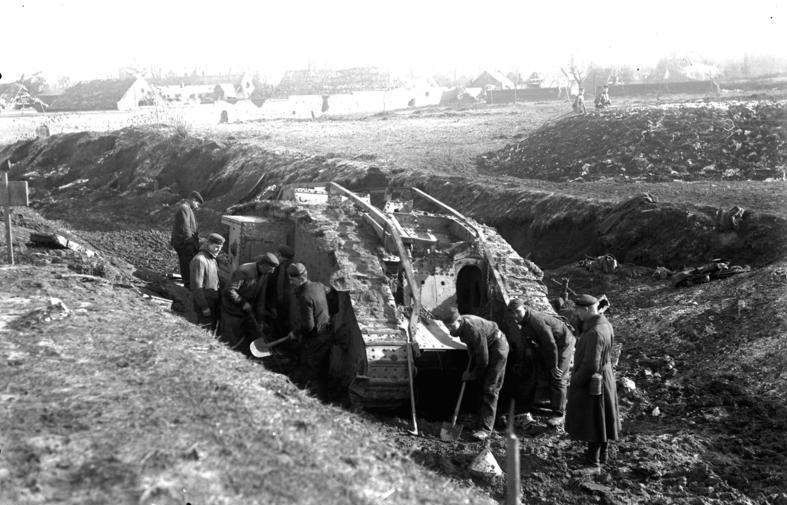
And then you reach the 20th century. There are Great War soldiers buried here: over 200,000 Irishmen fought for the British between 1914 and 1918. Drummer John McMahon served in the King’s Own’s Scottish Borderers, in a battalion that had survived Gallipoli; it’s possible that his death, in July 1917, came in Palestine. Thomas Moody served in the Irish Guards; his death, in November 1917, must’ve been at the Battle of Cambrai, which, like Bazalgette’s intercepting sewers, began as a landmark for modern technology. The British launched a massive attack spearheaded by Mark IV tanks, an innovation in warfare. By the second day of the attack, half the tanks had broken down, and that’s when the Germans responded. Moody probably died in their counterattack, the biggest assault on the British Expeditionary Forces since 1914. It was in that ealier assault–the the First Marne, in September 1914, the battle that stopped the Germans short of Paris, when Parisian taxicabs carried poilus to the front in relays–that claimed artilleryman Michael O’Brien, another soldier buried in Drumcliff.

German soldiers inspect a British tank wrecked at Cambrai.


Of course, the Great War was punctuated by the Easter Rising in Dublin. You can still the gouges British bullets left in the columns of the Neoclassic General Post Office, where the rebels held out for six days during Easter Week 1916. The Dubliners jeered the Irish Republican Army rebels as they were led away, after their surrender, by British forces.

The General Post Office, O’Connell Street, Dublin, after the Easter Rising. Nelson’s Column, to the right, was later blown up by the IRA.


Then the British began executing them, granting one, terribly wounded, the privilege of being shot while seated in a chair. That was a mistake. Now they were martyrs.

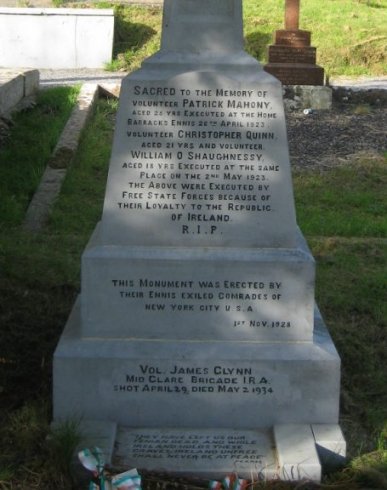
And that leads to one more place in the Drumcliff Cemetery: An IRA Memorial.


Irish rebels memorial

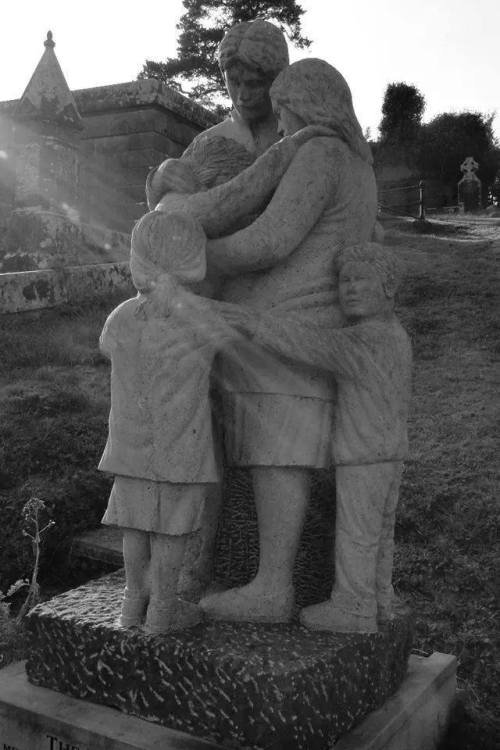
Maybe it’s typical that this memorial was made possible by expatriates, Irish living comfortably and happily distant in New York. What it commemorates might be too painful to remember for the people who live in Ennis today. The four Irish Republican Army men cited on this monument were killed in The Troubles, but not by the English. Three of the four were shot by firing squads made up of fellow Irishmen during the Civil War of 1922. Two were eighteen years old. They were Republicans executed by soldiers of the Irish Free State, the government that shot three times as many Irish revolutionaries in 1922 as the English had during the rising of 1919-1921.

One of the eighteen-year-olds wrote this on the eve of his execution:

Home Barracks, Ennis

Dearest Father,

My last letter to you; I know it is hard, but welcome be the will of God. I am to be executed in the morning, but I hope you will try and bear it. Tell Katie not to be fretting for me as it was all for Ireland; it is rough on my brothers and sisters–poor Jim, John, Joe, Paddy, Michael, Cissie, Mary Margaret–hope you will mind them and try to put them in good positions. Tell them to pray for me. Well father, I am taking it great, as better men than ever I was fell. You have a son that you can be proud of, as I think I have done my part for the land I love. Tell all the neighbours in the Turnpike to pray for me. Tell Nanna, Mary and Jimmy to pray for me, Joe, Sean, Mago, Julia, Mrs. Considine and family, also Joe McCormack, the Browne family, my uncle Jim and the Tipperary people which I knew. I hope you will mind yourself, and do not fret for me. With the help of God I will be happy with my mother in Heaven, and away from all the trouble of this world, so I think I will be happy...
…Dear father, I will now say goodbye – goodbye ‘till we meet in heaven.

I remain,
Your loving son,
Christ
ie

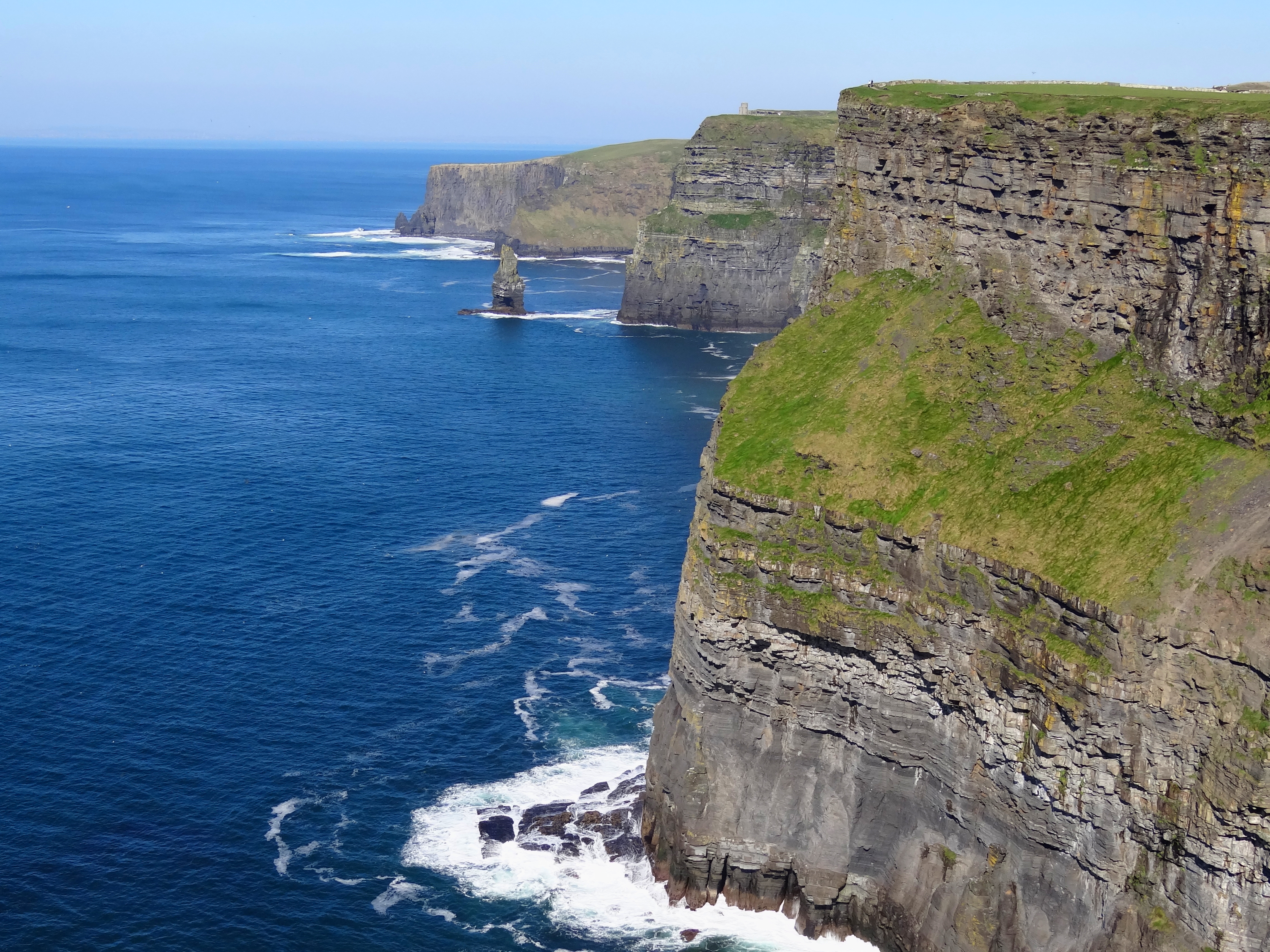
County Clare is famous for goodbyes. The Cliffs of Moher (above) might have been the last many Famine emigrants to America saw of Ireland. A windy and wild place, they are remindful of the title Leon Uris chose for a book he and his wife Jill wrote about Ireland: “A Terrible Beauty.”


Sister Teresa, even in her rest, cannot escape the long road of Irish history that has carried so many travelers—including my own family—on the journeys of their lives. Hers ended in Clare, a place, like the rest of Ireland, so marked by sadness. But sadness is not a dominant Irish trait—the last thing the Irish lost during the Famine, one chronicler noted, was their sense of humor—and it was service to others, not sadness, that dominated Teresa’s life.

I’ve been to Ireland and don’t know that I’ll ever get the chance to go again. If I do, God willing, there’s a place in the Drumcliff Cemetery that needs beautiful flowers and a pinch of California topsoil, perhaps from a field that adjoins St. Patrick’s Church, a parish five thousand miles away from County Clare.

September 1963: Off the airplane and into the classroom. Teresa is third from right.

The South County’s Civil War Veterans: Why Did They Move Here?

02 Wednesday Jun 2021

Posted by ag1970 in Arroyo Grande, Uncategorized

≈ Leave a comment

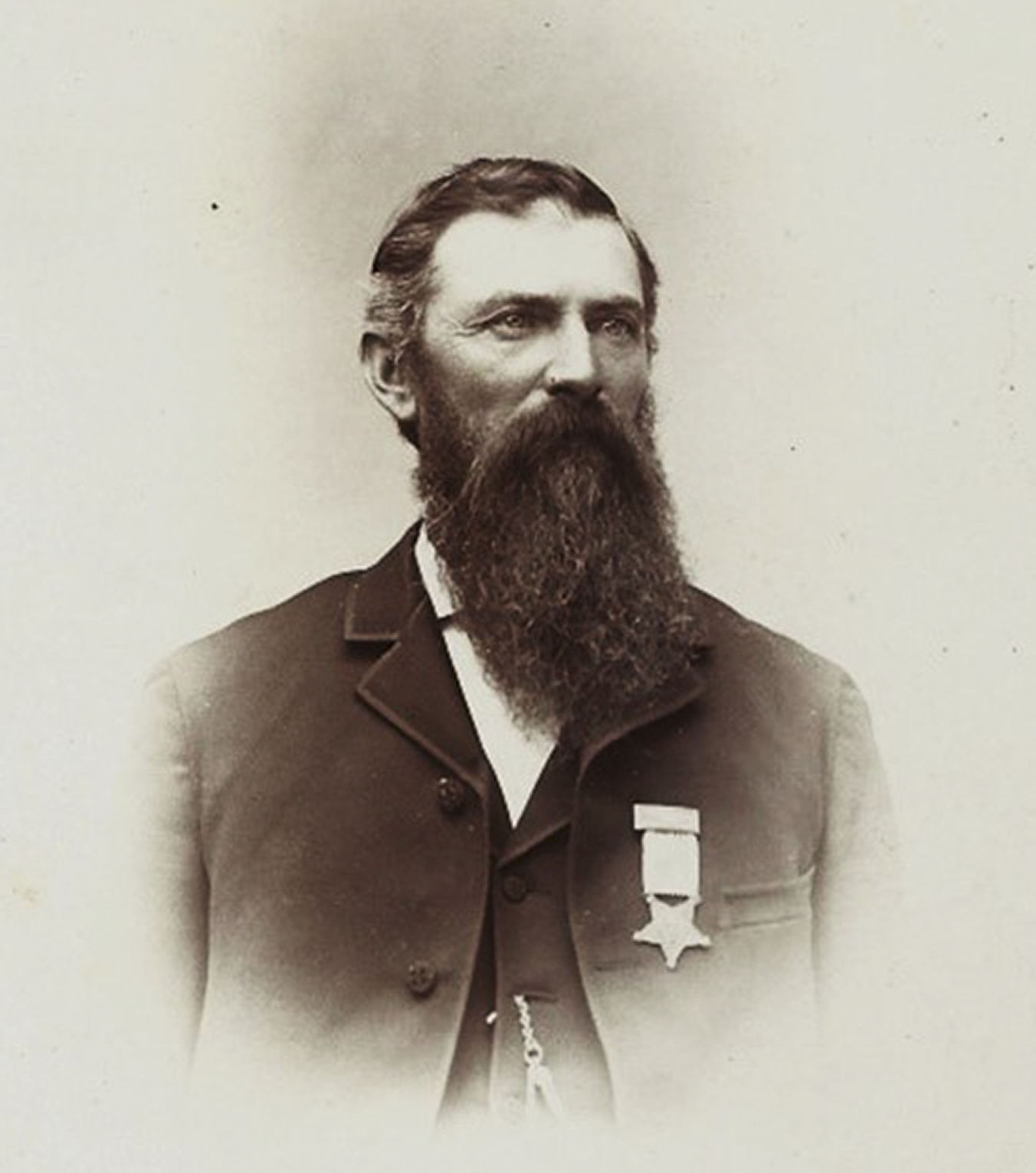
In the 1880s, Erastus Fouch farmed along was is today Lopez Drive. As a sixteen-year-old he’d fought in the Shenandoah Valley where he saw his brother killed in action. He later fought at Chancellorsville and Gettysburg. Here he wears his Grand Army of the Republic badge. Jack English photo.

Nearly sixty Civil War veterans are buried in the Arroyo Grande District Cemetery. This excerpt from the book Patriot Graves describes the forces that drove them here.


…A soldier who had endured the third day of Gettysburg and emerged unhurt, and who had then seen his own boys in their counterattack destroy Pickett’s Charge…had already passed the zenith of his life. Nothing like this would ever happen to him again, and what had happened to them brought them, ironically, great joy.

So, for a generation enmeshed in the ethical web spun tightly by mid-Victorian Protestantism—these were Christian soldiers who fought in armies, on both sides, marked by intense waves of wartime revivalism within their camps—the excitement of battle generated a profound moral contradiction. In This Republic of Suffering, a superb account of coming to terms with the scale of death the Civil War generated, Harvard president and historian Drew Gilpin Faust describes the experience of a stunned Confederate who, during a firefight, came to the aid of a shrieking comrade, only to find out that he was “executing a species of war dance,” exulting over the body of the Union soldier he’d just killed. In another battle in 1862, Union soldiers on the firing line called their shots, as if combat were billiards: “Watch me drop that fellow,” one said to his comrades; battle was, indeed, like a game.[1]

The killing didn’t end when the war did. Violent crime rose at three times the rate of population growth in the decades following the war, and perhaps as many as two-thirds of the nation’s convicted felons were veterans.[2] Soldiers understood, on some level, that combat had changed them irrevocably and some worried about it. Society, one Vermont soldier wrote his sister, “will not own the rude soldier when he comes back, but turn a cold shoulder to him, because he has become hardened by scenes of bloodshed and carnage.”[3] He was, in many respects, right: some of the soldiers who came home to Vermont, New Jersey or Iowa brought with them a measure of fear—they had become, in the Civil War novelist Michael Shaara’s term, “Killer Angels.”

Many Union soldiers had demonized themselves and by extension all of their comrades by celebrating their mustering out with epic alcohol binges and episodic violence throughout the demobilization summer of 1865.[4] A Chicago civilian’s insulting comment about William Sherman set off a saloon brawl that cascaded into a riot that police were helpless to put down. Only the fortuitous appearance of the legendarily hard-drinking Gen. Joseph Hooker, who had the credibility to intervene with combat veterans, brought the violence to an end.

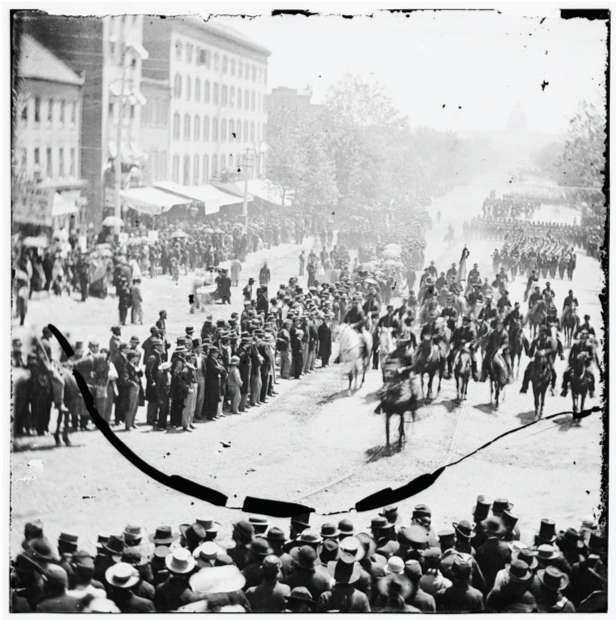
The Grand Review of the Armies at war’s end, Washington D.C., May 1865. Arroyo Grande settler Morris Denham marched with this unit, Francis Blair’s XVII Corps, Sherman’s army.

But for even the most sober of veterans that was precisely the problem with homecoming: it brought them little peace. Professor Jordan describes a sense of what, at its mildest, could be called disorientation. Home wasn’t home anymore. Even little farm towns had changed so much in four years that, for some veterans, they didn’t feel like home at all. Soldiers from the hard-fighting regiments of the Old Northwest, states like Iowa and Minnesota, couldn’t reconcile themselves to the cold winters they’d forgotten while fighting in Mississippi or Georgia. There was a more sinister change to which they couldn’t adjust: Union veterans resembled the little boys who’d survived the 1918 influenza epidemic and were finally let out to play, only to find there was no playmate on their city block left alive. The survivors of “Pals” Battalions who’d joined the Great War’s British Army together went home to neighborhoods empty of the young men with whom they’d grown up. Their pals were gone, swallowed up by the Western Front.

Gone too, in 1865, were whole towns of young men in New York or Vermont or Indiana, dead and buried on Southern farmland that had been poisoned by violence, land still studded with spent bullets. Other young men had vanished without a trace in dark, dense woodlots or fetid swamps.  Soldiers came home, then, ostensibly alive and whole and strong but with unseen dead spaces inside where their comrades had once lived. Missing them, or the trauma of seeing them killed, figured in the chronic depression with which so many veterans struggled. Now that the war was done, they still were caught in its aftermath like swimmers in an undertow, struggling to break surface, to find light and cool air, to breathe again.

They recognized, too, that what they had fought for—for the rededication of the democracy Lincoln had described at Gettysburg in November 1863—was fast slipping away. Union veterans remained intensely suspicious of and hostile toward the defeated South; Lincoln’s assassination had been one impetus for their rancor but their anger only intensified when they read the newspaper accounts of the postwar emergence of the old Slave Codes, now called Black Codes.  They read, too, of the defiance and the terrorism of the Ku Klux Klan, co-founded by a cavalryman, Nathan Bedford Forrest, who had bedeviled some of them in the Deep South. When Reconstruction ended in 1877, Jim Crow laws revived white supremacy in a way that rivaled the days of slavery. The Union veterans’ hostility was exacerbated because the other side refused to admit—significantly, on a moral level—that they’d lost the war. Typical, in 1894, were the dedicatory remarks that accompanied the unveiling of a Confederate memorial in Richmond, when newspapers noted that the clouds parted and the sun emerged when the speaker, the Rev. R.C. Cave, began an oration that included passages like this:

But brute force cannot settle questions of right and wrong. Thinking men do not judge the merits of a cause by the measure of its success; and I believe

The world shall yet decide

In truth’s clear, far-off light,

that the South was in the right; that her cause was just; that the men who took up arms in her defence were patriots who had even better reason for what they did than had the men who fought at Concord, Lexington, and Bunker Hill; and that her coercion, whatever good may have resulted or may hereafter result from it, was an outrage on liberty.[5]

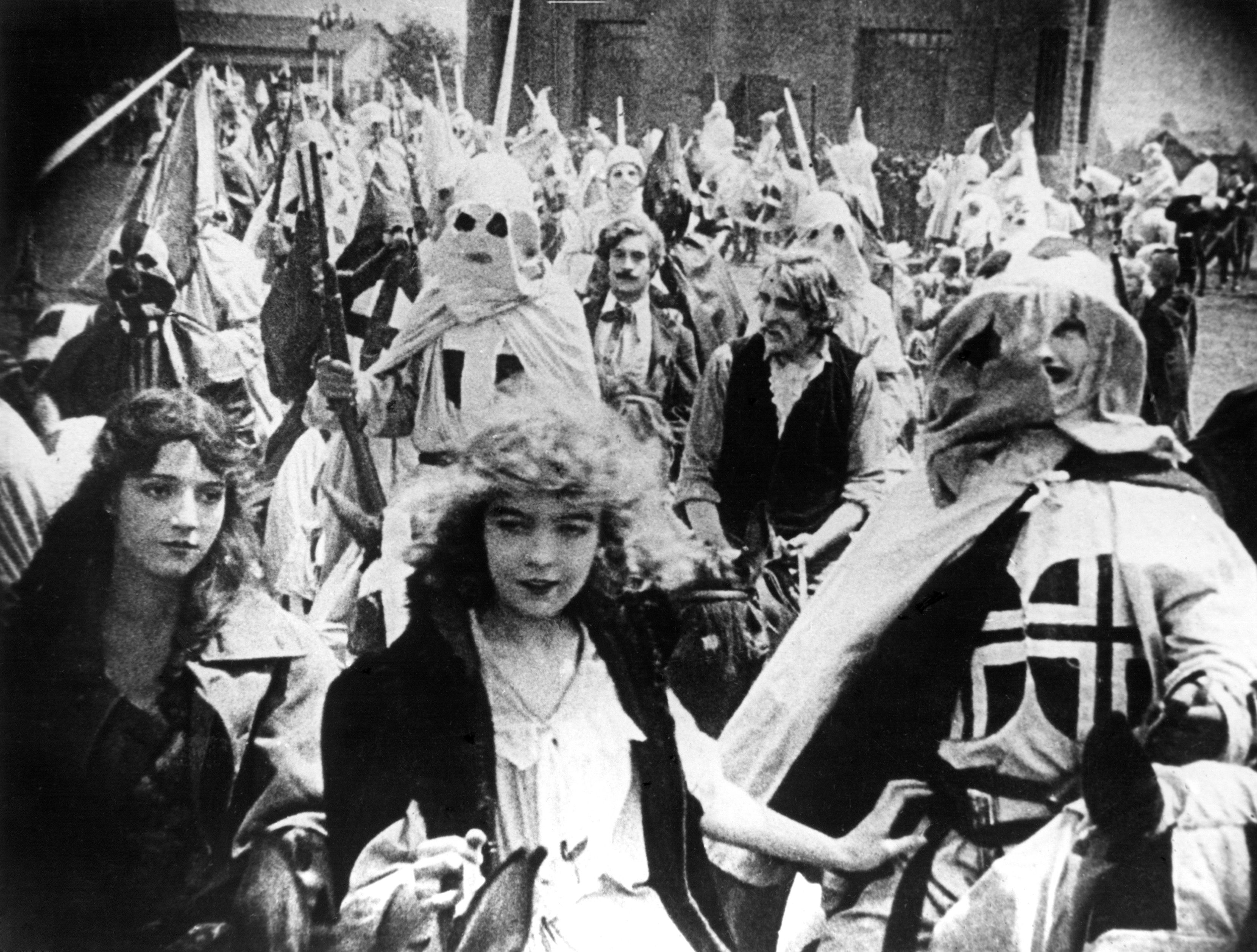
White supremacy triumphant, Birth of a Nation.

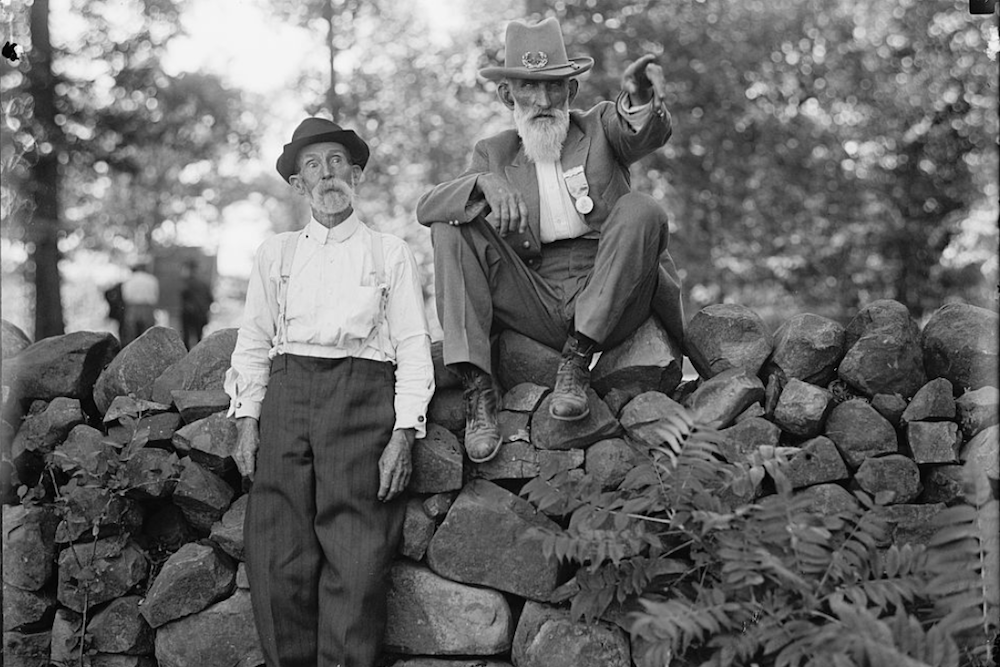
Similar remarks by Southern speakers invited to a Gettysburg reunion in 1913, Professor Jordan notes, rankled the same Union veterans who had protested another unveiling, in 1909, in the Capitol’s Statuary Hall: a sculpture of Robert E. Lee. No matter how chivalrous Lee had been (He never, for example, uttered the word “Yankees,” using instead, in his verbal orders to his subordinates, the term “those people.”), he was a killer, and he had harvested thousands of solders’ lives. The survivors of what they saw as Lee’s war would protest again at the rapturous reception, one that included the Southern-bred President Woodrow Wilson, awarded the 1915 D.W. Griffith film Birth of a Nation, which depicts Klansmen, too, as chivalric heroes who reassert Southern white supremacy over rapacious carpetbaggers and predatory African Americans. “It is like writing history with lightning,” the president said, “and my only regret is that it is all so terribly true.”[6] The most enduring image of the 1913 Gettysburg reunion is that of Confederate survivors of Pickett’s Charge reaching across the stone wall–fifty years before, it had been their objective–to shake the hands of Pennsylvania veterans. What goes unmentioned is the fistfight at the same event that sent seven aged Yankees and Confederates to the hospital.[7]

How the 1913 Gettysburg Reunion Came to Be ‘the Greatest Gathering of Conqueror and Conquered’ in History | Zocalo Public Square • Arizona State University • Smithsonian
Two Gettysburg veterans, seemingly reconciled at the 1913 Reunion.

Even as Southern whites reasserted their social and political primacy, American democracy in the North was no tribute to the sacrifice of Civil War veterans, either. The Radical Republican Congress and Andrew Johnson finished what should have been Lincoln’s second term in what resembled the political equivalent of a Western range war. Johnson escaped conviction on impeachment charges by one Senate vote. Grant’s relentlessness and drive had served him well in the struggle against Lee, but another aspect of his personal character—an almost childlike credulity—ate his presidency alive in a series of scandals perpetrated by subordinates who betrayed Grant as surely as Warren G. Harding would be betrayed by his “Ohio Gang” in the 1920s. 

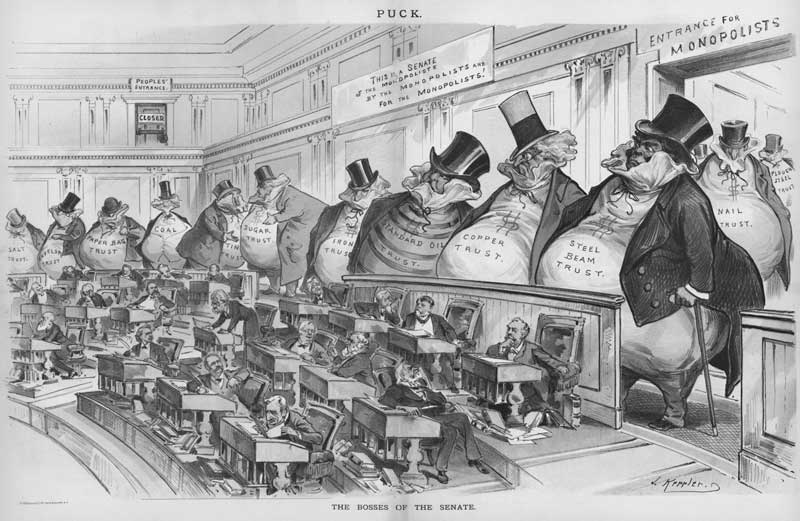
The corruption penetrated to state houses, where the lobbyist for the Santa Fe Railroad kept a slush fund in his office safe for the frequent lubrication of Kansas legislators about to vote on regulatory bills; the monopoly that railroads enjoyed in their American fiefdoms and the freight rates they demanded were so egregious that it cost a farmer more to ship a bushel of wheat from Topeka to Chicago, by rail, than it did to ship that bushel from Chicago to Liverpool, mostly by water. Machine politics dominated cities from New York to San Francisco, where Irish-American voters really did vote early and often, and deceased. In New York, the most famous political machine was Tammany Hall, and it was Tammany Hall’s Boss Tweed who disbursed the equivalent of $4 million to a Tammany-contracted plasterer for two days’ work on City Hall.
The 1889 cartoon “Bosses of the Senate” exemplifies the corruption of Gilded Age America.
In both their disillusionment and in their restlessness, the Civil War generation seems to resemble the generation that came of age during the First World War. After that war, they would become expatriates–Ernest Hemingway, F. Scott Fitzgerald, John Dos Passos among them—young men, many of them veterans, and young women, who no longer recognized or understood the America they’d known as children. They were among the members of Gertrude Stein’s “Lost Generation.”

…[Like}the young people of the 1920s, Civil War veterans were members of a generation on the move.  In postwar America, veterans, according to a 2010 study by Seoul University economist Chulhee Lee, were 54% more likely to move to a different state and 36% more likely to move to a different region than non-veterans.[8] Lee posits several reasons for this phenomenon: a central one is the idea that veterans had been exposed to the concept of a wider nation, one beyond their rural farms or row tenements, by campaigns in the South. Westerners, too, fought along the Atlantic seaboard, and some Easterners saw combat or garrison duty during the 1860s Indian Wars on the frontier.

Lee’s point is a key one: Americans had been so isolated and disparate before the war that an outbreak of measles that would make a New York regiment sick would kill soldiers in the Iowa regiment bivouacked alongside, soldiers that, before the war, were so geographically isolated that they lacked the immunity to that particular strain of measles–measles, in fact, killed 11,000 soldiers during the war.[9] The war had begun to break that isolation down, and the troop movements necessary to fighting it had opened young soldiers’ minds to the vastness of their nation and to the possibility of starting over somewhere else.

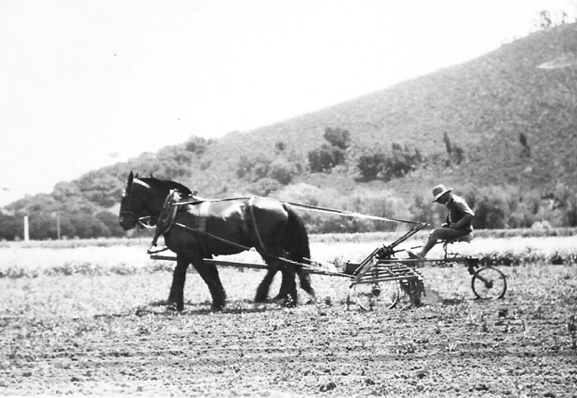
Among the area’s crops were flowers grown for seed. Here, a Waller Farms worker and his team are sowing a field. Photo courtesy Richard Waller

This pattern of increased mobility was a key factor in the lives of Arroyo Grande’s Union veterans. Over fifty would settle the Arroyo Grande Valley and nearby Nipomo. Enough census data exists to follow twenty-three of them, in the course of their lives. After the war, seven of them moved once from the state they’d served as soldiers; seven moved twice. Nine moved three times or more before they came to the Arroyo Grande area. So the men who came here had come as far as they could—like Jody’s grandfather in the Steinbeck novella The Red Pony, they had to stop because they’d arrived at the Pacific: their days of “Westering” were over.

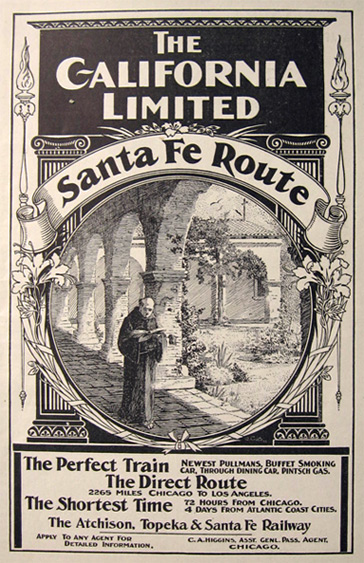
Santa Fe Ad, 1898. The fare from Chicago to Los Angeles was only $25 during the 1880s competition between the Santa Fe and Southern Pacific for California-bound passengers.


[1] Drew Gilpin Faust, This Republic of Suffering: Death and the American Civil War. Vintage Books: New York, 2008, pp. 37-38.

[2] Michael C.C. Adams, Living Hell: The Dark Side of the Civil War, Johns Hopkins University Press, Baltimore: 2014, p. 198.

[3] Edward Alexander, “Life of the Civil War Soldier in Battle: And Then We Kill,” Hallowed Ground Magazine, Winter 2013, http://www.civilwar.org/hallowed-ground-magazine/winter-2013/life-of-the-civil-war-soldier-battle.html?referrer=https://www.google.com/

[4] Jordan, pp. 46-47.

[5] R.C. Cave, “Dedicatory Remarks, Soldiers’ and Sailors’ Monument, May 30, 1894,” Southern Historical Society Papers, Volume 22. Reverend J. William Jones, Ed. http://www.perseus.tufts.edu/hopper/text?doc=Perseus%3Atext%3A2001.05.0280%3Achapter%3D1.27%3Asection%3Dc.1.27.198

[6] “D.W. Griffith’s Birth of a Nation,” The Rise and Fall of Jim Crow, PBS., http://www.pbs.org/wnet/jimcrow/stories_events_birth.html

[7] Jordan, p. 197.

[8] Chulhee Lee, “Military Service and Economic Mobility: Evidence from the American Civil War,” February 2010. http://www.sciencedirect.com/science/article/pii/S0014498312000046

[9] “Civil War Diseases,” http://www.civilwaracademy.com/civil-war-diseases.html

Elsie

24 Wednesday Mar 2021

Posted by ag1970 in Arroyo Grande, Personal memoirs, Uncategorized

≈ 1 Comment

Elsie Cecchetti. San Luis Obispo Tribune; photo by Vivian Krug

Elsie Cecchetti was our bus driver. In the same way that Louis Tedone was SLO’s baby doctor. Elsie was everybody’s bus driver.

Yes, I go back to the days of Branch School’s yellow pickup with bench seats and the tarp overhead, when we bounced happily over creek crossings.

We waited for her at the Harris Bridge.

I think she had mechanical problems one morning–and it was a cold one–when Mary Gularte took me inside from the bus stop for some sopa. That was a good morning.

Both Mary and Elsie called me “Jimmy.”

We tormented Elsie with “99 Bottles of Beer on the Wall” and then, in 1964, with “She Loves You,” ” I Want to Hold Your Hand” and she always headed us off in “The Name Game” song, before we got to “Chuck.”

And I always looked over the edge of the bus window as she drove confidently up Corralitos Canyon. There were some good drops there, but Elsie knew what she was doing. At the Canyon’s end, past the Dentons, she made a three-point turn that the California Department of Motor Vehicles should have filmed for posterity.

If there was a girl on whom I had a crush–and this was frequent–I looked a long time out the bus window after we’d dropped her off.

I once saw Elsie’s wedding photo, the day she married George, on the steps of Old St. Patrick’s on Branch Street. She was so beautiful that she took my breath away.

But she cleaned up after us at school.

She chewed us out when when we were jerks.

She laughed when we tried to be funny.

She cocked an eyebrow dubiously when we had excuses for being late.

But my most vivid memory is the day she cried. We were on our usual route with most of the stops ahead of us, near what is today Lopez Drive and Cecchetti Road, when she stopped the bus.

The old farmhouse, where she’d made a home and a family, was on fire. And it wasn’t just smoke. It was violent–big, ugly orange flames and billowing, acrid black smoke. Elsie threw the lever that opened the bus doors and stood at the bottom of the steps and she began to sob.

I don’t know–I was only about eight–that any of us, fifteen or so of us, had ever seen an adult in such pain.

And it wasn’t just an “adult.” It was Elsie.

I guess then we heard sirens from the CDF and they knocked the fire down, but it was too late. I don’t remember that part.

What I do remember is walking the rest of the way home in complete silence. We were shocked because we realized, just then, how much we loved Elsie and just how cruel life could be even toward the people we loved the most.

What we began to learn from her, in that terrible moment, was empathy.

Even a school-bus driver can guide you toward wisdom. I finally understand, now that she’s gone, that it was Elsie who always got me home again.

← Older posts
Newer posts →

Subscribe

  • Entries (RSS)
  • Comments (RSS)

Archives

  • June 2026
  • May 2026
  • April 2026
  • March 2026
  • February 2026
  • January 2026
  • December 2025
  • November 2025
  • October 2025
  • September 2025
  • August 2025
  • July 2025
  • June 2025
  • May 2025
  • April 2025
  • March 2025
  • February 2025
  • January 2025
  • December 2024
  • November 2024
  • October 2024
  • September 2024
  • August 2024
  • July 2024
  • June 2024
  • May 2024
  • April 2024
  • March 2024
  • February 2024
  • January 2024
  • December 2023
  • November 2023
  • October 2023
  • September 2023
  • August 2023
  • July 2023
  • June 2023
  • May 2023
  • April 2023
  • March 2023
  • February 2023
  • January 2023
  • December 2022
  • November 2022
  • October 2022
  • September 2022
  • August 2022
  • May 2022
  • April 2022
  • March 2022
  • February 2022
  • January 2022
  • December 2021
  • November 2021
  • October 2021
  • September 2021
  • August 2021
  • July 2021
  • June 2021
  • April 2021
  • March 2021
  • February 2021
  • January 2021
  • December 2020
  • November 2020
  • August 2020
  • July 2020
  • June 2020
  • May 2020
  • April 2020
  • January 2020
  • December 2019
  • November 2019
  • October 2019
  • September 2019
  • August 2019
  • May 2019
  • April 2019
  • March 2019
  • February 2019
  • January 2019
  • December 2018
  • November 2018
  • October 2018
  • September 2018
  • July 2018
  • June 2018
  • May 2018
  • April 2018
  • March 2018
  • February 2018
  • January 2018
  • December 2017
  • November 2017
  • October 2017
  • April 2017
  • March 2017
  • December 2016
  • November 2016
  • October 2016
  • September 2016
  • August 2016
  • July 2016
  • June 2016
  • April 2016
  • March 2016
  • February 2016
  • January 2016
  • December 2015
  • November 2015
  • October 2015
  • September 2015
  • August 2015
  • July 2015
  • June 2015
  • May 2015
  • April 2015
  • March 2015
  • February 2015
  • January 2015
  • December 2014
  • November 2014
  • September 2014
  • August 2014
  • July 2014

Categories

  • American History
  • Arroyo Grande
  • California history
  • Family history
  • Film and Popular Culture
  • History
  • News
  • Personal memoirs
  • Teaching
  • The Great Depression
  • trump
  • Uncategorized
  • World War II
  • Writing

Meta

  • Create account
  • Log in

Blog at WordPress.com.

  • Subscribe Subscribed
    • A Work in Progress
    • Join 69 other subscribers
    • Already have a WordPress.com account? Log in now.
    • A Work in Progress
    • Subscribe Subscribed
    • Sign up
    • Log in
    • Report this content
    • View site in Reader
    • Manage subscriptions
    • Collapse this bar

Loading Comments...